Printed Voices of the Salt Lake City LGBT Community in the Early 1990s

by BRIAN ROBLES

A newspaper’s success is heavily dependent on the character and strength of the people behind the scenes. This is especially true of the alternative press, including newspapers targeted for the Lesbian, Gay, Bisexual, and Transgender (LGBT) community. Without a large group of readers and subscribers, it would make printing and distributing a heavy cost not easily paid. Luckily, there are people who are willing to champion this cause. In recent years, Salt Lake City has become one of the most LGBT-friendly cities in the U.S., which contrasts with the city’s conservative image. (Breen) This is in part due to the LGBT community that pioneered for a voice.

Tracy Baim, an award-winning journalist in the gay community, wrote in her book, Gay Press, Gay Power: The Growth of LGBT Community Newspapers in America, that:

There is a reason a gay press was needed. When the media of the previous two centuries were not wholly ignoring everything about homosexuals and the growing gay-rights movement, they were doing far worse: moralizing, demonizing, criminalizing, medicalizing, “repairing,” proselytizing, polarizing, ostracizing and often just pitying those poor, sad, pathetic “avowed” homosexuals. (Baim, 15)

Gay media were able to supply the LGBT community with something that it desperately needed: gay news that was relevant to the community. Because the mainstream media tended to show the gay lifestyle in a negative light, it was important for readers to have somewhere to turn for reinforcement that it was OK to be gay. The gay press was able to provide role models and inspirational authors who were able to help readers find a positive self-image. A study on the effects of media on gay identity states that without these role models there “was a sense of being excluded from traditional society.” (Gomillion and Giuliano, 347) Without the gay press, the LGBT community of Salt Lake City would have found themselves as outsiders with no room for their alternative lifestyle.

The purpose of this project is to illustrate the crucial role that the writers, editors, and publishers of certain Salt Lake City publications played in creating a voice for the LGBT community in the early 1990s. Their staunch support and willingness to represent this minority demographic enabled the LGBT community to have its issues gain public awareness. Highlighted are the attempts by these editors and publishers to draw the lay public into action.

Excerpts from three publications that were published through the early 1990s in Salt Lake City will be presented and interpreted in this article. These publications were: The Bridge, Outfront Review, and The Pillar of the Gay Community. The editors and publishers of these papers reflected on specific LGBT issues at the beginning of each publication, which helped set the tone of that particular publication. Their blurbs, pieces, and publications provided a place for these community contributors to try to bring the LGBT voice of out complacency and to bring the community together as a collective chorus that would assure that their voices would be heard.

The Bridge

Starting in 1990, a monthly publication called The Bridge, and its copublishers Becky Moorman and Alice Hart, brought the call to action and urgency to the Salt Lake City LGBT community. The forceful tone found throughout the publications present LGBT issues that demand to be heard. The Publishers’ Notes varied from introductions of the month’s publication to celebrations of queer culture to short shout-outs to close friends. These Publishers’ Notes are how we see just how deeply invested Moorman and Hart were in their community. According to the note in the second issue of The Bridge, published in November 1990:

Besides being a service to the gay and lesbian communities of Utah, The Bridge is Utah’s watchdog to the arts (and art censors): literary and visual. And if you don’t believe they need guarding; you don’t get out much. America’s art, music, and culture are going to the congressional dogs, and the constitution right along with it.

From the beginning, Moorman and Hart showed a penchant for the political. This was a publication that had publishers who were not willing to let their community be voiceless any longer.

caption

Cover of The Bridge. This publication, and others discussed in this article, are available at the Special Collections Department, J. Willard Marriott Library, University of Utah.

The Bridge was a call to action for the LGBT community. The publishers were not merely interested in presenting alternative news; they wanted to shape their history and society. The editors and publishers of The Bridge believed that involvement was the way to bring change. But that is not to say that Moorman and Hart were solely interested in what affected the LGBT community. In the sixth issue, published in March 1991, Moorman and Hart wrote to their readers regarding pending legislation — The Hate Crimes Statistics Act and Anti-Abortion laws. The Hate Crimes Statistics Act, which was ultimately adopted in 1992, required the state to collect and publish the hate crimes committed in the state. Pro-life versus pro-choice was also a hot topic at the time with the Planned Parenthood v. Casey case discussing abortion. In this sixth issue, the editors were not afraid to show where they stood nor were they afraid to push their readers to action:

“Be sure to voice your support for the Hate Crimes Statistic Bill and to mention how disgusted you are with the new anti-abortion law. Remember to boycott Utah. Cancel your conferences. Encourage everyone you know out of state not to travel here, spend money or do business with Utah companies until the unconstitutional ban on choice is lifted. Gut and burn any cars you see with anti-choice bumper stickers. Or if you’re a republican pro-lifer, bomb an abortion clinic for Jesus. There’s no one in them right now; which makes it less fun, but infinitely safer.”

This use of language — asking the readers to participate in boycotts and the like — was to encourage readers to come out and start taking an active role in their community. While this call for boycotting and law breaking was strong, the idea itself proves to be a radical one and may have perhaps alienated some of the readers of these notes. The other issue with boycotting Salt Lake City as a whole is that it would hurt the LGBT community just as much as the general population. A powerfully emotional, and perhaps too zealous, call to action can prove to be more detrimental than helpful in this case.

As mentioned, not all of the Publishers’ Notes were written in this authoritative call to action, but it was the urge for readers to become one of their community, to shirk their fear of retaliation due to the way they chose to love, that made The Bridge such an important publication. The February 1992 issue featured one of the more powerful calls to raise the voice of the LGBT community:

Love & Hate — this is the month for it! Hate Radio! Hate Crimes! Hate legislation! Homosexuals are the fashionable to-hates. The last sanctioned discrimination. Legislators, churches hide behind silence and exclusion — tacitly financing violence. Stop the straight war on gay love. No one can afford to be a fence-sitter. Violence is everyone’s problem. We can only stop it by saying STOP in as loud a voice as we can. Ask everyone. TELL everyone. They don’t have a right to NOT have an opinion. Don’t be complacent. Don’t let anyone be complacent. They may not like you for it now. Equality is contagious. If you keep on person from being silent – other’s will speak up. Others will listen. Silence is death. There may be blood on your hands for every time you heard gays talked about, joked about, whatever and didn’t say STOP!

Here Moorman and Hart explain that it’s not only a right, but also an obligation to raise one’s voice and to participate. They take a stand against those who don’t walk their talk. Discrimination of any kind is kept in power by the silence of the people who may oppose it in their hearts but never lend their voices to the cause. As a member of a community, one has certain responsibilities. If readers chose to read this particular publication and be a part of the community, it was their responsibility to become an active member to help further the progress of the LGBT movement in Salt Lake City.
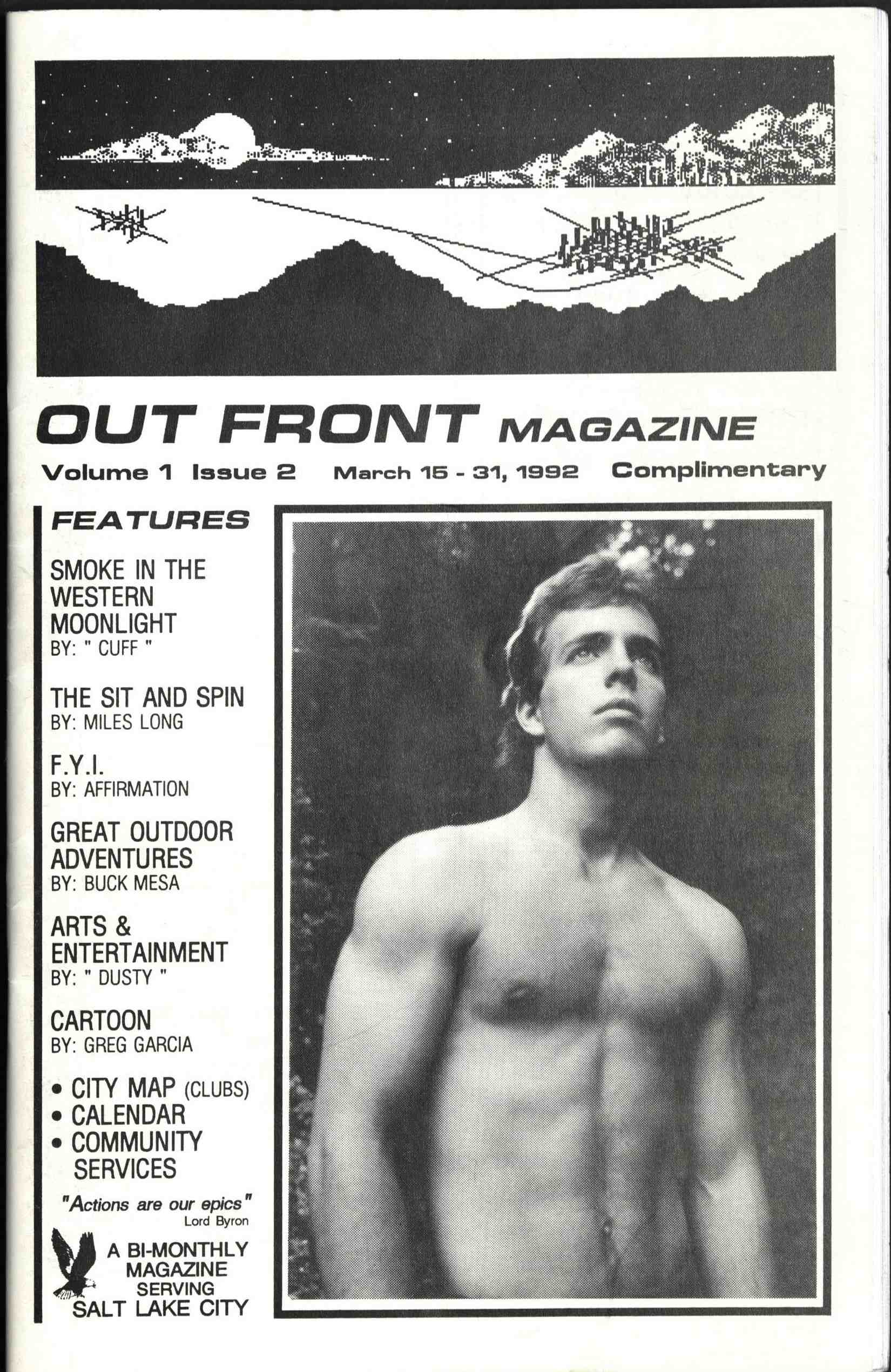
Image courtesy of J. Willard Marriott Library, University of Utah.

Image courtesy of the Special Collections Department, J. Willard Marriott Library, University of Utah.

Outfront Review

The second publication of focus is the bi-monthly publication Outfront Review, originally Out Front Magazine, whose editor provided a more unified vision to their readers. Throughout the years, Editor Randy Richardson used a voice that seemed more suggestive than authoritative in the call to arms for the LGBT community of Salt Lake. While reviewing the Editor’s Notes in these publications, it’s found that Richardson spoke more with an appeal to pathos in contrast to Moorman and Hart’s lean to logos.

Like The Bridge, Outfront Review called for the LGBT public to participate in politics in order to gain awareness and make political strides. Outfront Review presented this same line of thinking in November 1992 when Richardson wrote:

“When you VOTE, remember all those who have gone before us and died needlessly because we had no rights. Remember all of those who never had a chance because AIDS was a Gay disease. Do it in remembrance of all those who have fought hard all of these years to get us to where we are today … think of all of our children … what future will they have, what legacy shall we leave them?

“PLEASE VOTE. We know you are out there, and that you do really care!”

This piece shows that appeal to emotion in the mention of children and the dead but its plea is similar to that of The Bridge in that the editor still seeks participation from the community.

The second issue, published in November 1992 discussed the role of the community in politics. The Editor’s Note addressed the need for the community to come together rather than remain segregated into gays, lesbians, bisexuals, or transgender individuals ­— an issue that continues even today. Editor Richardson wrote: “Perhaps we need to look at forming a united gay and lesbian alliance … so that we can discuss things together, in an open forum … and then vote to obtain a majority opinion, speaking with one voice, representative of … and in … the best interest of our desires, goals and objectives as a community.”

The Pillar

Image courtesy of J. Willard Marriott Library, University of Utah.

Image courtesy of the Special Collections Department, J. Willard Marriott Library, University of Utah.

This brings us to The Pillar of the Gay Community (The Pillar for short), which began publishing in 1993 with a specific demographic in mind — gay men. As The Pillar grew in popularity, it became apparent that the niche it filled could be inclusive to all of the LGBT community. The paper started to expand its role in the LGBT community, which can be seen in the paper’s changing tagline. For example, it started as a publication for “For Utah Mehn,” [sic] then billed itself as being for the “Lesbian and Gay Community” before broadening its focus to the “the Gay, Lesbian, Bisexual and Transgendered Community” of Salt Lake. The Pillar was the longest lived of the three publications presented in this article and continued publication until 2007. Its longevity may be due to its mix of LGBT news, entertainment, and flat out in-your-face attitude. Here, in the paper’s debut issue published April 1993, the writers set the record straight on what they will contribute to their community — and what the community could expect in future issues:

Why another paper in an over-developed market such as Salt Lake City you might ask? Great Question! We at The Pillar feel that there is a “hole” that is not being filled in the Gay Media and we hop to plug it! With the demise of The Bridge, and the Outfront, a group of us desired to compliment The Womyn’s Community Newsletter by mirroring them in our Mehn’s community. We are not out to offend anyone but get use to seeing Faggot, Dyke, and Queer in print and some outrageous Gay consciousness raising at times. We are firm proponents of the Gay Human Rights and we make no apologies for being homosexually proactive.

As mentioned in the note above, The Bridge and Outfront Review had both closed their doors, leaving a gap for this publication to fill.

The Pillar seemed to combine the best aspects of both The Bridge and Outfront Review. In the premier issue, readers were introduced to what they could expect from The Pillar — an unapologetic, authoritative use of language, which is reminiscent of the pieces published in The Bridge. But then The Pillar also adopted that same desire for unity that The Bridge sought, as seen in the “From The Editor” piece by Kim Russo in the December 1995 issue:

Too many times and on too many occasions when we have had a conflict or could not come to an agreement as an organization, we tended to “eat our own.” Instead of resolving differences or understanding that we can disagree and still function as a group or organization, anger took its turn and we “ate our own.” Torie Osborne coined that phrase and I resolved never to forget it. She said that in gay and lesbian communities around the nation, when conflict occurred, members would turn against each other and tear the other one down. How right Torie is. Therefore, resolve to be fair and not too critical. You know of all communities that should stick together because they have personally experienced their own kind of pain, it is us. Indeed may we stand together through it all.

This piece echoes Richardson’s note from Outfront Review, showing us that there was, and is, still the need for the community to band together.

Conclusion

The Editor’s Notes and Publisher’s Notes are often missed or skipped over for the traditional news and entertainment articles. This is a problem as these notes and additions to periodicals reveal so much emotion in them and provide insight to why the LGBT publications existed in the first place. The stories found between the covers of the publications discussed here held many of the same qualities found throughout great journalistic articles, but these notes presented something similar to a dialogue, which helped make these documents relevant even after nearly two decades. It was like reading a letter from a dear friend. They provided summaries of what had happened, and hopes of what may come, and always pushed readers to be better in their community and their lives.

The efforts by the influential people of the time helped make the LGBT community as strong as it is today. There’s still work to be done and maybe today’s publications, like QSaltLake, will be what The Bridge, Outfront Review, and The Pillar were for the LGBT community in the early 1990s. There’s still a need for gay press to spur the people into action, to inform them of what rights they have (or don’t), and to unite the factions within the LGBT community.

Brian Robles is a senior at The University of Utah. He is majoring in mass communication.

Sources

Kim Russo, “From The Editor,” The Pillar of the Gay Community, December 1995, 6.

Kim Russo, “From The Editor,” The Pillar of the Gay Community, May 1994, 2.

“Premier Issue,” The Pillar of the Gay Community, April 1993, 1.

Randy Richardson, “Editor’s Note,” Outfront Review, November 15-30, 1992, 2.

Randy Richardson, “Editor’s Note,” Outfront Review, November 1-15, 1992, 3.

Randy Richardson, “Editor’s Note,” Outfront Review, July 15-31, 1992, 3.

Alice Hart and Becky Moorman, “Publishers’ Note,” The Bridge, February, 1992, 5.

Alice Hart and Becky Moorman, “Publishers’ Note,” The Bridge, March, 1991, 4.

Alice Hart and Becky Moorman, “Publishers’ Note,” The Bridge, November, 1990, 3.

Baim, Tracy and John D’Emilio. Gay Press, Gay Power: The Growth of LGBT Community Newspapers in America. CreateSpace Independent Publishing Platform, 2012.

Breen, Matthew. “Gayest Cities in America,” The Advocate, January 9, 2012.

Gomillion, Sarah C. and Traci A. Giuliano. “The Influence of Media Role Models on Gay, Lesbian, and Bisexual Identity.” Journal of Homosexuality 58, no. 3 (2011): 330-54.
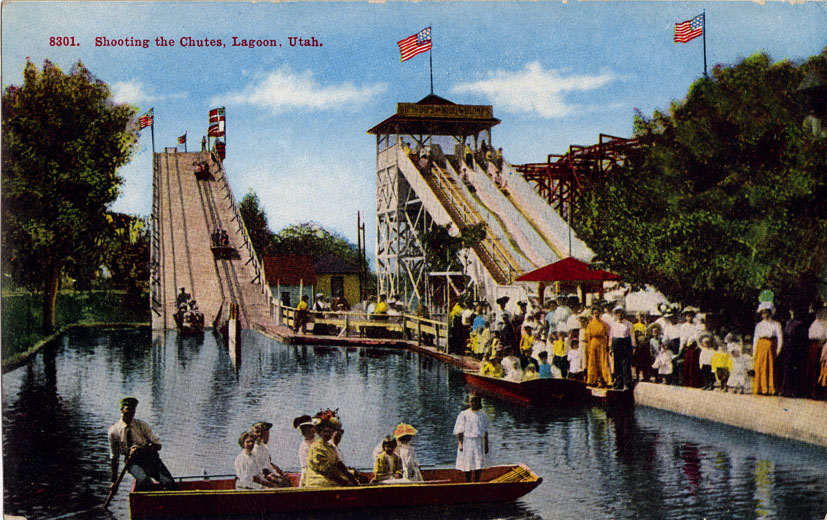


Lagoon, the Roller Coaster, and the Kilee King Investigation, 1989

by JOHANNA M. MELIK

In the late 1800s, Utah’s beloved amusement park, today known as Lagoon, was located in a different area along the shores of the Great Salt Lake, along with other “recreational resorts.” Not only was Lagoon’s location different back in the day, but its name was too. The resort was called “Lake Park,” and was open to the public on July 15, 1886. “It was one of the most attractive watering places in the West.” (127 Years) However, in 1893, the Great Salt Lake began to recede, leaving this once wonderful paradise surrounded by “a sticky, blue mud that was miserable to swimmers and guests.” (127 Years) This nasty inconvenience, among other reasons, basically forced Lake Park to switch locations and relocate to its current address in Farmington in 1896. The new home of this park was situated on the banks of a nine-acre lagoon, two and one-half miles inland from its original location, providing the park with its new name: Lagoon. (127 Years)

Department of Special Collections, J. Willard Marriott Library, University of Utah.

The thrill ride, Shoot-the-Chutes, was popular in 1896. Special Collections Department, J. Willard Marriott Library, University of Utah.

The same year of its relocation, Lagoon presented its first thrill ride, Shoot-the-Chutes, which is similar to today’s Log Flume ride. Later, in 1921, one of the most well known rides of this amusement park was finally introduced and “the roar of the Roller Coaster began.” (127 Years) “Almost 90 years old,” Arave writes, “the Lagoon Roller Coaster remains one of the most popular attractions at the park and is one of only a few wooden coasters between Denver and the West Coast.”

According to Lagoon’s press kit, a fire in 1953 destroyed the front of this coaster. It was rebuilt the following year, and sections of the Roller Coaster have been rebuilt each year since then. In that same press kit, Lagoon ensured the ride was, and would be, safe for the community. “The tracks are walked and thoroughly checked over each day before being put into use for the public.” (127 Years) As true as this may be, there have still been a few accidents, even fatal incidents, which occurred on this very ride. However, it seems that in all of those situations, Lagoon was not at fault. Arave writes that those deaths were caused by the “patron’s own negligence or recklessness.” In fact, the odds of being killed on one of these rides are about two chances in 43 million. (Arave) Rep. Blaze Wharton, D-Salt Lake, “compliments Lagoon’s safety record and doesn’t think, given information about the recent accident, that inspections could have prevented the deaths.” (Deseret News, June 25)

In the specific case of Kilee King, a 13-year-old girl of Bountiful who died on the infamous wooden Roller Coaster in 1989, investigation proved that no criminal negligence was involved. (Rosebrock, June 14) According to a June 29 story in the Deseret News, the Farmington police detective who investigated the incident found that the death of this teenage girl was a “fluke combination of her physique, actions and the laws of physics.” (Rosebrock, June 29) King was a slim, 5 feet 3 inches tall girl who only weighed 71 pounds. “In effect, it was a quirk of physics, combined with what the girl did and her height and weight,” said Detective Sgt. Jeff Jacobson after investigation of the incident. (Rosebrock, June 29)

Deseret News reporter Joel Campbell wrote on June 11 that Kilee King died at the park after falling from the front seat of the ride’s carts. “Witnesses said that the girl stood up from beneath a locked retraining bar, lost her balance and fell to a grassy area beneath the coaster.” According to that same article, the coaster had just gone over the curve of its second hill when she lost contact with the cart. The girl pushed herself up against the safety bar as the cart was at the peak of the hill, raised her arms above her head and lifted up off her seat as the cart took its ordinary “downward plunge.” The momentum from her forward and upward motion caused her to slip from under the bar, falling 35 feet to the ground. (Deseret News, July 29) The South Davis Fire Department officials said the girl was pronounced dead before any emergency medical personnel had arrived. (Deseret News, June 11)

The victim was the daughter of J. Wayne and Susan King. After the terrible incident, Susan filed a lawsuit against the amusement park, charging it with negligence. (Deseret News, July 29) According to Deseret News reports on July 29, 1989, Mrs. King stated that the design and operation of the park’s roller coaster was dangerous and that the lack of sufficient safety restraints is what had allowed her daughter to be thrown from the ride. Lagoon officials choose to not disclose much information about the lawsuits filed against the park, but according to Detective Jacobson’s findings, this was not the case. (Deseret News, July 29) According to Deseret News reporter Don Rosebrock, King had a season pass to Lagoon and had ridden the roller coaster multiple times prior to the deadly accident.

Department of Special Collections, J. Willard Marriott Library, University of Utah.

A postcard view of Lagoon. Special Collections Department, J. Willard Marriott Library, University of Utah.

Being a part of the LDS church, King’s passing was a topic of discussion during one of her church’s meetings. “We discussed the fact that her spirit had left her body, that she was still living…. We explained she will continue to live and they [young people whom she was friends with] should not be fearful and they would see her again,” stated Bishop Sherman Fuller, in an article written by Deseret News on June 12. “There was an air of peace.” Friends and neighbors remembered King as “vivacious, energetic and a natural leader.” She was thought of as someone whom everybody liked. (Deseret News, June 12) She was the type of person who did not care about what others had, “maybe they weren’t as popular or energetic. She tried to bring those people forward. She tried to involve them,” said Fuller in the article. (Deseret News, June 12) One of her “lifetime” friends, Katie Gardiner, was one of the people whom she “went out of her way to make feel accepted by a group of friends.” (Deseret News, June 12) Another one of King’s friends, Jeremy Christoffersen, said, “Next year in eighth grade I will think about her a lot and that she is gone. We spend a lot of time together. I used to go to Lagoon a lot with her. We went to a restaurant as a presidency. She was always laughing and smiling…. I still don’t understand what happened on the roller coaster.” (Deseret News, June 12)

The park itself remained opened after this accident, but the ride was shut down for inspection. (Rosebrock, June 14) However, “two studies, using research by doctors, scientists, astronauts and engineers, say amusement park rides are very safe.” (Deseret News, Jan. 21) J. Clark Robinson, a worker at Lagoon for 27 years who was president of the International Association of Amusement Parks and Attractions, said that the studies “have brought to light scientific proof that our rides are safe.” (Deseret News, Jan. 21)

People should not worry about accidents when visiting Lagoon, because cases such as Kilee King’s are very uncommon. Over the 127 years that Lagoon has been running and available to the public, there have been 16 deaths overall, including incidents not involving any of the rides themselves (such as heart attacks). Nearly half of those were caused by “the patron’s own negligence or recklessness.” (Arave) So it is, however, important to know how to keep yourself safe when riding these rides, in order to avoid a tragic accident. There are just some things that cannot be controlled by a safety restraint.

Johanna M. Melik is a junior at The University of Utah, majoring in mass communication.

Sources

Joel Campbell, “OFFICIALS PROBING DEATH OF GIRL, 13, WHO FELL FROM ROLLER COASTER,” Deseret News, June 11, 1989.

Joel Campbell, “KILEE WAS HAPPY AND CARING GIRL FRIENDS RECALL,” Deseret News, June 12, 1989.

Don Rosebrock and Joel Campbell, “BOUNTIFUL GIRL’S DEATH NOT THE 1st ON LAGOON’S WOODEN ROLLER COASTER,” Deseret News, June 13, 1989.

Don Rosebrock, “TEEN’S DEATH ON ROLLER COASTER AT LAGOON IS RULED ACCIDENTAL,” Deseret News, June 14, 1989.

Joel Campbell and Ray Eldard, “LEGISLATOR WANTS INSPECTIONS OF CARNIVAL, PARK RIDES,” Deseret News, June 25, 1989.

Don Rosebrock, “ROLLER COASTER DEATH CALLED A FLUKE A QUIRK OF PHYSICS, TEEN’S PHYSIQUE AND HER ACTIONS, DETECTIVE SAYS,” Deseret News, June 29, 1989.

“BOUNTIFUL MOTHER FILES LAWSUIT IN DEATH OF DAUGHTER AT LAGOON,” Deseret News, July 29, 1989.

Lynn Arave, “Lagoon questions data on injuries,” Deseret News, August 15, 2000.

Lee Davidson,“2 studies declare roller coaster safe,” Deseret News, January 21, 2003.

Arave, Lynn. “It’s About Fun: A History of Lagoon Amusement/Theme Park.” The Mystery Of Utah.

127 Years of Family Fun!” Lagoon Corp. Media Resources.


The Salt Lake Tribune’s Coverage of the Cancellation of ‘Brokeback Mountain’

by MIRANDA A. KNOWLES

Ang Lee’s 2005 film, Brokeback Mountain, portrayed  two cowboys, Jack Twist and Ennis Del Mar (performed by Jake Gyllenhaal and the late Heath Ledger), who showcased their “forbidden” love. The film created controversy all over the world — including in Utah.

According to ads in the Deseret Morning News and Salt Lake Tribune, Brokeback Mountain was scheduled to play at 12:45 p.m., Friday, January 6, 2006, at Megaplex 17 at Jordan Commons. But the previous night, the film was pulled from its schedule and replaced by another film after the owner of Megaplex 17, Larry H. Miller, learned that the film was about two gay cowboys. The film’s cancellation brought up public debate all over Utah. From January 6, 2006, to January 31, 2006, The Salt Lake Tribune’s coverage of the cancellation showed both sides of the controversy and the power of communication as it shapes public debate.

Findings

The Brokeback Mountain vs. Larry H. Miller controversy began during a KCPW-FM interview with Miller and Jonathan Brown. The interview on the Salt Lake City public radio station was done on Thursday, January 5, 2006, the day before the film was released in theaters, and aired the next day. An article by Sean P. Means and Sheena McFarland published in The Salt Lake Tribune on January 7 discussed the interview between Miller and Brown. According to the article, Brown said during the interview, “Miller was unaware of the storyline of Brokeback Mountain … until Brown described it to him Thursday.”

The Salt Lake Tribune’s Brandon Griggs also discussed Miller and Brown’s interview in his article, published January 11. The article said Miller’s initial response to booking the film was because the film had received seven Golden Globe nominations. Miller saw this as a sign of its “potentially broad appeal.” Toward the end of the radio interview Miller stated,“It is possible that the content of this [film] … is offensive enough to a large enough segment of the population that this is one that slipped by our screening process. Maybe I’ve been a little naive and not paid proper attention to it and let it slip through the cracks. If I have, then I made a mistake.”

Nothing in the interview made it sound like Miller would take matters to the extreme and completely cancel the film before it began playing. The interview made it sound like Miller would first see how audiences reacted to the film. If there was a negative response, then he would pull the film from showing. However, two hours after the interview, Miller canceled the show from playing.

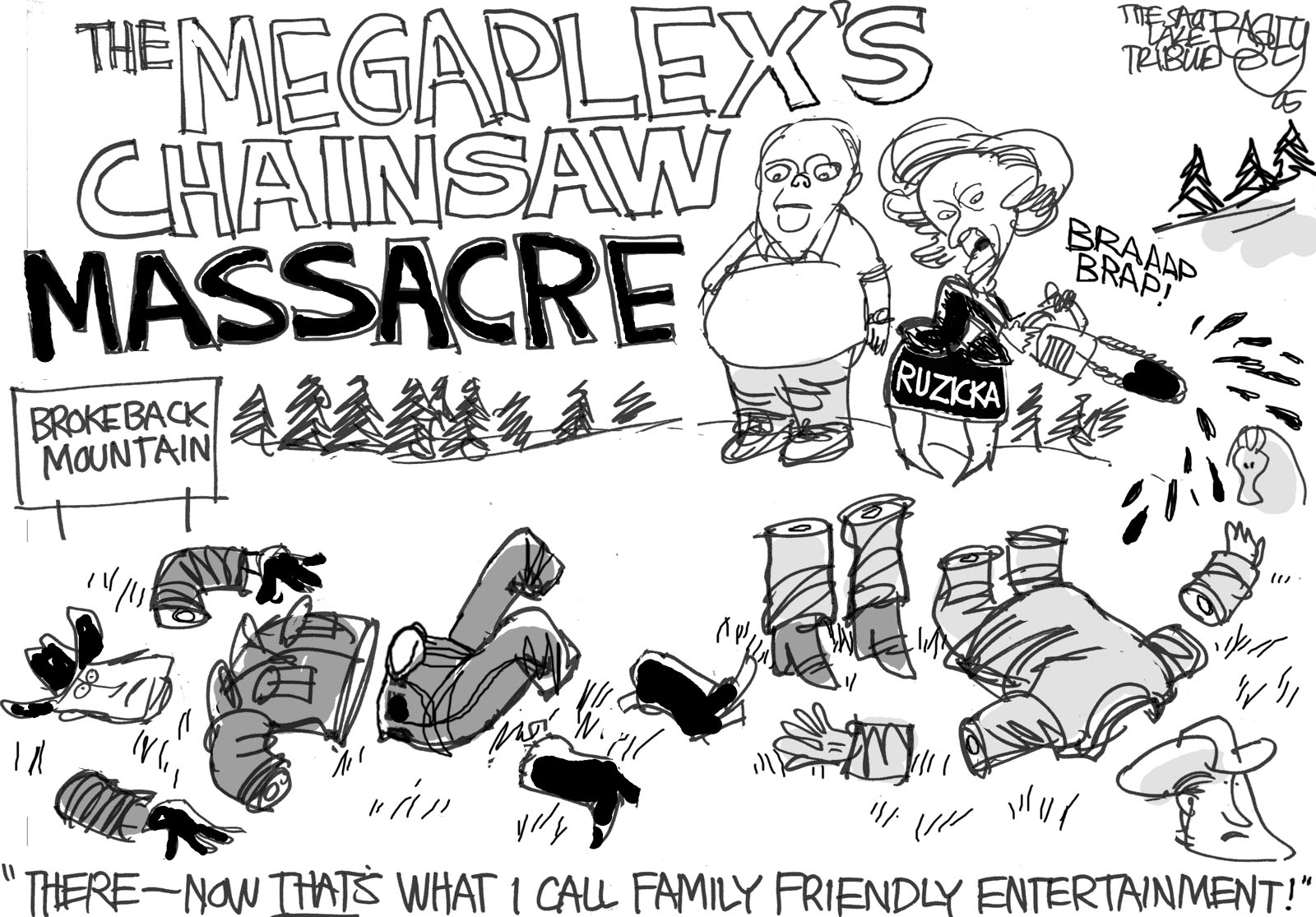
This cartoon, by the Salt Lake Tribune's Pat Bagley, appeared . Used with permission.

This cartoon, by the Salt Lake Tribune‘s Pat Bagley, appeared in the paper on January 10, 2006. Used with permission.

The Salt Lake Tribune’s website posted an update on the cancellation shortly after the decision to pull the movie from theaters appeared. The update, posted on January 6, stated, “The Megaplex 17 announced it was pulling the film late Thursday afternoon. The change-of-heart came too late to remove the title from the theater’s ads in today’s Salt Lake Tribune”

The update was the beginning of a media frenzy that included numerous editorials, columns, and letters to the editor. Of the articles published, most focused on Miller’s lack of response, how the film was doing in award season, the business aspect of the cancellation, the world’s reaction to the cancellation, and what the film was about — love. The issues at large, such as morals, civil liberties, and press bias were brought up through countless letters to the editors.

Means and McFarland were among the first journalists to report on the cancellation. In their article, published January 7 and titled, “‘Brokeback’ gets boot,” they discussed the details of the cancellation and what Focus Feature (the production company of the film) had to say about it. The article also interviewed Carol Adams about her reactions to the film’s cancellation. The local woman wanted to see the film and was saddened to learn that it had been canceled.

Articles also discussed  negative public relations, Miller’s continuous silence on the issue, and of course the world’s reaction. According to Lesley Mitchell’s article, published in The Salt Lake Tribune on January 12, “Miller’s silence has helped give the story international appeal.” Another article by Griggs, published January 15 and titled, “‘Brokeback Mountain’: Why all the fuss?,” discussed the huge reaction to the film and the cancellation. This article is the most blunt of any article published in The Salt Lake Tribune because Griggs stated the hard truth on why the film was pulled from the schedule: “Men having sex.” Griggs explained that the homosexual relationship was the reason why people were getting so upset. Griggs also addressed hypocritical morals when  he wrote, “How is a gay love story more morally offensive than other movies — such as ‘Hostel,’ a horror film that shows sadists fulfilling their depraved fantasies by paying to torture other people; or the stoner comedy ‘Grandma’s Boy,’ which features drug use in almost every scene — now playing at Miller’s theaters?” His questions and bluntness were met with countless letters on the matter by Utah’s citizens.

Similarly, Griggs’ article, “‘Brokeback’ squelch has spotlight on Utah again,” published January 11, discussed the world’s reaction and Heath Ledger’s. Ledger was quoted as saying, “It’s all just really unnecessary” and “Personally I don’t think the movie is [controversial], but I think maybe the Mormons in Utah do. I think it’s hilarious and very immature of a society.” Griggs also reported, “Articles about the snub have made international headlines. NBC’s Jay Leno and MSNBC’s Keith Olbermann joked about it on the air Monday night.” Steven Oberbeck’s article, “Miller’s move: shrewd or rash?,” published January 13, quoted Paul Mero of the Sutherland Institute, a conservative think-tank in Salt Lake City. Mero stated, “Considering the conservative nature of our population, I’m sure a lot of people think: We’ll, it’s [Millers’] business and he’s entitled to do with it what he wants.”

The cancellation was something to talk about, and Utah’s citizens made sure their voices were heard. The letters were short, blunt, and very opinionated. One Salt Lake Tribune reader, Karla G. McGuigan, said the decision was an “encroachment into American citizens’ rights to civil liberties.” However, another reader, Bret A. Stapley, responded with, “Larry H. Miller is a private business owner who decides what is best for his own business. This is not a case of ‘government censorship’ or a civil liberty violation.”

Robert Seifert also questioned Larry H. Miller’s morals in a letter titled, “Miller’s moral compass.” Seifert, like Brandon Griggs, brought  up the hypocrisy of playing Hostel and not Brokeback Mountain. Seifert stated, “To sum up, pulling ‘Brokeback Mountain’ tells young people that being gay is unacceptable, so not pulling the movie ‘Hostel’ (being shown in the same theater complex) sends the message that torturing and mutilating other human beings is all right.” Harry A. Rodes disagreed in his letter, titled, “Morally correct decision”: “I would like to call on moral-minded people in Utah to actively support Miller’s businesses, especially his movie theater, to show the state and the country that there are still some people who have not given in to societal pressure to accept that which is immoral. He should be praised, not condemned.”

Readers also began saying that The Salt Lake Tribune was biased toward the gay community. Morgan T. Beach wrote in a letter titled, “Tribune’s gay bias,” published January 17: “I wonder how  many favorable articles and commentaries you would devote toward a movie of the same caliber, romanticizing the polygamous lifestyle.” The same day another Salt Lake Tribune reader, JoAnn Nokes, sent in a letter titled, “Get on with Life.” Nokes wrote, “Decisions are made daily. So accept it and let’s get on with life.”

Though The Salt Lake Tribune did indeed publish positive reviews for the film, it was not the only newspaper in Utah to do so. According to a journal article published in August 2008 by Brenda Cooper and Edward C. Pease, Brokeback Mountain was rated positively by several Utah newspapers. The article stated, “Despite the Church of Jesus Christ of Latter-day Saints’ (LDS) position that homosexuality is a sin and that practicing homosexuals may be excommunicated, the church-owned daily newspaper, the Deseret Morning News, gave the film three and a half stars out of four, and The Daily Herald of Provo, Utah — home of the LDS-owned Brigham Young University — also reviewed Brokeback positively.”

Conclusion

Utah’s reaction to Larry H. Miller’s decision to pull Brokeback Mountain from his theatre was one of great debate. The divide between Utah’s views on heterosexuality, ethics, morals, and business standards was showcased through the great response of Utah’s citizens. In 2009, Cooper and Pease published another article on the topic of Brokeback Mountain. The article, published in Western Journal of Communication, discussed how newspapers framed the controversy over the film. Cooper and Pease’s study found that of the 188 Brokeback-Miller items published during January 6, 2006-February 2006, 55 percent opposed the cancellation of the film and 45 percent  defended the cancellation. The study also found that 153 letters were published statewide. Of the 153, 48 percent were pro-Miller, and 52 percent were anti-Miller. Of those 153 letters, 34 were published in The Salt Lake Tribune. My research, along with Cooper and Pease’s research, proves that Utah was greatly divided on the issue. People discussed the film’s cancellation and topics related to Miller’s decision, including morals, business practices, civil liberties, press bias, and the amount of attention devoted to the issue.

Miranda A. Knowles is a senior at The University of Utah. She is majoring in communication and minoring in sociology.

Sources

JoAnn Nokes, “Get on with life,” The Salt Lake Tribune, January 17, 2006, A8.

Morgan T. Beach, “Tribune’s gay bias,” The Salt Lake Tribune. January 17, 2006, A8.

Brandon Griggs, “Why all the fuss?,” The Salt Lake Tribune, January 15, 2006, D1.

Harry A. Rodas, “Morally correct decision,” The Salt Lake Tribune, January 15, 2006, AA2.

Robert Seifert, “Miller’s moral compass,” The Salt Lake Tribune, January 13, 2006, A12.

Steven Oberbeck, “Miller’s move: shrewd or rash?,” The Salt Lake Tribune, January 13, 2006, A1.

Brandon Griggs, “‘Brokeback’ squelch has spotlight on Utah again,” The Salt Lake Tribune, January 11, 2006, A1.

Bret A. Stapley, “Simple as That,” The Salt Lake Tribune, January 11, 2006.

Lesley Mitchell, “Media pros say silence on pulling gay movie gives the story legs,” The Salt Lake Tribune, January 11, 2006.

Karla G. McGuigan, “Denial of Civil liberties,” The Salt Lake Tribune, January 10, 2006.

Sean P. Means and Sheena McFarland, “‘Brokeback’ gets boot,” The Salt Lake Tribune, January 7, 2006, A1.

“Update: Miller’s theater pulls Brokeback mountain,” The Salt Lake Tribune, January 6, 2006.

Cooper, Brenda and Edward C. Pease. “Framing Brokeback Mountain: How the popular press corralled the “Gay Cowboy Movie.” Critical Studies in Media Communication 25, no. 3 (Aug. 2008): 249-273.

Cooper, Brenda and Edward C. Pease. “The Mormons Versus the ‘Armies of Satan’: Competing Frames of Morality in the Brokeback Mountain Controversy in Utah Newspapers.” Western Journal of Communication 73, no. 2 (April-June 2009): 134-156.

The Wenner Family on Fremont Island

by ANDREW BUTTERFIELD

The Wenner family lived on Fremont Island from 1886-1891, the only family to ever call Fremont Island home. Uriah James and Kate Wenner are forever sealed into the history of Fremont Island, the Great Salt Lake and the state of Utah.

The Great Salt Lake is one of the largest lakes in the Western United States. The lake is surrounded by many islands, one of which is Fremont Island. Fremont is the third largest island in the Great Salt Lake. Discovered on September 9, 1843, by John C. Fremont and his four companions, Fremont described the island as “simply a rocky hill on which there is neither water nor trees of any kind although the Fremontia vermicularis, which was in great abundance, might easily be mistaken for timber at a distance.” Fremont was said to be so dissatisfied with the discovery that he named the island “Disappointment island.” (Miller, 219)

After Fremont and his companions had left the Rocky Mountain territory, the next group of explorers named the Mud Hen crew began investigating the Great Salt Lake. According to David E. Miller, the Mud Hen crew, the first known Mormon pioneers led by Albert Carrington, named Fremont Island “Castle Island,” a name that was commonly used by Mormon explorers during this time period. (Miller, 220)

A very important contributor to the history of Fremont Island is Howard Stansbury, who developed the first geographical outline of the Great Salt Lake. Stansbury had a meeting with Brigham Young, the pioneer of Mormonism and the migration to Utah, to develop the survey outline of the Great Salt Lake. Of the meeting, Stansbury declared, “ The impression was that a survey was to be made of their country in the same manner that other public lands are surveyed, for the purpose of dividing it into townships and sections.” (Madsen, 152) Stansbury knew of Fremont’s discovery and “in honor of him who first set foot upon its shore,” Stansbury revived the territory’s true name, Fremont Island. (Miller, 220-21) Using the created surveys, he determined that the island would excel as a territory for sheep herding.

A water spring on Fremont Island. Used by permission, Utah State Historical Society, all rights reserved.

A water spring on Fremont Island. Used by permission, Utah State Historical Society, all rights reserved.

Fremont Island first served as a cattle territory organized and controlled by Henry Miller and his family in the late 1850s. The Miller family had established a fresh water spring on the southeastern tip of the island, the only true source of fresh water. The Miller family decided the island would be best for the sheep because of the lack of natural predators, restrictions in sheep migration, naturally rural land area, and the privacy the sheep would enjoy to keep them protected. (Eckman, and Miller, 161-62)

The story of the Wenners begins with their arrival in Salt Lake City in 1880. Uriah James Wenner launched a small law office, which transformed the family into some of Salt Lake City’s most successful and recognizable citizens. Eli A. Smith, a judge, was relieved of his duties due to a violation of the Edmunds Act of 1882. Salt Lake City Governor Eli H. Murray proclaimed in the September 9, 1882, Deseret News, “Know ye, that by virtue of the anthority in me vested, I, Eli H. Murray, Governor of said Territory, do hereby appoint” Wenner to fill the vacancy. The article reported that Murray had announced several new positions, one of which was probate judge of Salt Lake County. Uriah James Wenner had been tapped to serve on the bench. Wenner, a non-Mormon, accepted the position.

Shortly after his appointment, the community became skeptical toward the Wenner family due to their lack of interest in the dominant religion. Many opposed his rise to the title of Probate Judge of the county. According to the September 20, 1884, Desert News, “Mr. U.J. Wenner, was in dense obscurity, being almost totally unknown in Utah, until a few months ago Governor Murray gave him a bogus appointment to the office of Probate Judge of Salt Lake County, a position which is elective and within the gift of the people.”

Uriah Wenner’s time as judge was short-lived. In 1886, he was diagnosed with tuberculosis and it was recommended the family move to a remote location to better his health. In the years leading up to his diagnosis, Wenner had become friends with the Miller family. Wenner had visited the Millers on Fremont Island several times. (Eckman, and Miller, 163-65)

The family's residence on Fremont Island. Used by permission, Utah State Historical Society, all rights reserved.

The family’s residence on Fremont Island. Used by permission, Utah State Historical Society, all rights reserved.

The story of the Wenners’ first purchase of Fremont Island is a hazy one, one that has not been confirmed. After two years witnessing the tranquility and privacy of the island, Uriah James Wenner had gone to the Union Pacific Railroad Company, which owned Fremont Island, and bought a portion of the territory under the Desert Land Act of 1877. (Eckman, and Miller, 164) Wenner acquired the most significant piece of land on the island, where the only fresh water supply was located. This was made in an attempt to move the Miller family off the island. With their sheep and livestock no longer having a sufficient water supply, they would not be able to survive. (Eckman and Miller, 164-65) Upon receiving the news that they were being evacuated, the Miller family, infuriated and betrayed, wrote to Union Pacific stationed in Omaha. By the time the Millers had received a reply from Union Pacific, they had already moved off the island. The letter stated that the Wenner family had no right to the land nor a record of purchasing property on Fremont Island. Jacob Miller, who had succeeded his father Henry, wanted to take the Wenners to court. However, due to his practicing polygamy, Miller decided against taking real action. Polygamy had been recently found unlawful and against the practice of the Mormon faith. The Wenner family officially purchased a vast majority of Fremont Island and in 1886 called Fremont home. (Eckman, and Miller, 171-73)

Life for the Wenner family had changed drastically. Kate Wenner, née Noble, who had always enjoyed a life of luxury, was now a housewife. According to the November 21, 1891, Dalles (OR) Daily Chronicle, she “cheerfully gave up her luxurious home in this city and went with him.” The original journey to Fremont Island took three days. “It seemed fun at first, but with calms, head winds, squalls, and seasickness,–for hours that treacherous body was like ‘a tempest in a teapot.’” (Noble, 225) By being able to rely on a boat shipment that came once or twice a month, the Wenner family rarely returned to the mainland. Kate Wenner addressed the matter in her personal account of life on Fremont by stating, “On that unsteady trip I made up my mind I would not take my family back to the mainland very soon, and perhaps I would wait until the lake dried up.” (Noble, 225)

Island living seemed to come naturally to the Wenner family. Kate Wenner wrote, “In the afternoon a swim in the lake, after supper a walk over the hill where a glorious sunset held us, and then the moon lit up our little world and hope built happy days ahead.” (Noble, 225) The three Wenner children seemed to be the greatest supporters of the move to the island. Like any family throughout history, Uriah and Kate Wenner set rules and restrictions. Living in semi-isolation, the Wenner adults did not have many worries about their children’s safety. In fact, there was “only one ‘do not’ on the children’s lives and that was not to go in the lake unless we were with them. If the briny water is swallowed it brings on a terrible strangulation!” (Noble, 226)

The Wenner family had been able to explore and rediscover life. The family was able to appreciate the natural beauties of both the island and of living in peace and solitude. These were the main highlights of their time spent on Fremont. Living in solitude forced the family to try new things. In “A True Story” of island life, Kate Wenner described an episode where she milked a cow: “His (Uriah Wenner) greatest surprise on the Island was my bucket of milk, and I am sure it was the cow’s greatest surprise too.” (Noble, 231) When the Wenner family was missing an ingredient or supply, they would simply say it was not needed, that it was an attempt at something new. That seemed to be the reality of island living, only the true necessities mattered, it was an eternal happiness for the Wenner family.

Unfortunately, the joyous times did not last. As the years went by, Uriah Wenner had begun losing his battle with tuberculosis. He stopped working, he needed the assistance of a walking cane, and when he was bedridden he was forced to call upon his wife for all his needs. Wenner died peacefully in 1891, lying in his bed on his beloved home, his island Fremont. According to Kate Wenner’s story, her husband’s final words to her were, “I love you, love the children.” (Noble, 232) With those words he rested for the final time. In a stunned fear, she used the island’s only distress signal with the mainland. Kate set off multiple fires on the highest hill, but it took several days until she was able to see a fire lit on the mainland shore. This signal meant that help was on its way.

Uriah Wenner's gravesite on Fremont Island. Used by permission, Utah State Historical Society, all rights reserved.

Uriah Wenner’s gravesite on Fremont Island. Used by permission, Utah State Historical Society, all rights reserved.

Several newspapers published accounts of Uriah’s death in 1891. According to the September 30, 1891, issue of the Ogden Standard Examiner, “The husband had expressed a desire to be buried on the island and his faithful wife determined to heed his request.” The Wenners had become a family loved by many. In another issue of the Standard Examiner, published on October 4, 1891, the paper wrote, “Many residents of this City and valley have been their guests and were charmed by the grace and refinement of the Islanders.”

After Uriah’s death, Kate and her children moved from the island. Shortly after their move, Kate died. Her second husband along with her family honored the request that she should be buried on Fremont Island, next to Uriah James Wenner. To this day Uriah and Kate Wenner have their graves on Fremont Island. Although currently owned by a different family, only the Wenner family called Fremont Island home. (Miller, 234-36)

Andrew Butterfield is a senior at The University of Utah. He is majoring in mass communication and minoring in sociology.

 Sources

Everett L. Cooley, “Great Salt Lake — Fremont Island p.13,” Utah State Historical Society, Mountain West Digital Library.

Everett L. Cooley, “Wenner, Uriah J. — Residence P.2,” Utah State Historical Society, Mountain West Digital Library.

Shipler Commercial Photographers, “Wenner, U. J. — Grave P.1,” Utah State Historical Society, Mountain West Digital Library.

Kate Y. Noble, “A Great Adventure on Great Salt Lake: A True Story,” Utah Historical Quarterly 33, no. 3 (July 1965): 218-236.

Faithful After Death,” The Dalles (Oregon) Daily Chronicle, November 21, 1891, 4.

J.H.K., “U.J. Wenner,” Ogden (Utah) Standard Examiner, October 4, 1891, 6.

A Heroic Woman,” Ogden Standard Examiner, September 30, 1891, 1.

The Alleged Reception,” Deseret News, July 23, 1884, 8.

Proclamation of the Governor,” Deseret News, September 9, 1882, 5.

Arave, Lynn. “Fremont Island is no disappointment,” Deseret News, April 16, 2009.

Eckman, Anne M. and David H. Miller. “Seymour Miller’s Account of an Early Sheep Operation on Fremont Island,” Utah Historical Quarterly 56, no. 2 (Spring 1988): 163-165.

Madsen, Brigham D. “Exploring the Great Salt Lake: The Stansbury Expedition of 1849-50,” Utah Historical Quarterly 56, no. 2 (Spring 1988): 148-159.

Golden Age of Theatre at the University of Utah

by HASTY NAZARINIA

In the world of performing arts, making it to the big lights of Broadway is almost an impossible goal to obtain. So when the University of Utah began its Musical Theatre Program in 1976, the program boasted some of the most successful “triple threats” to have ever walked this campus, and many of those talented singers/actors/dancers became original cast members in prominent shows such as A Chorus Line, Cats and Les Miserables.

So why did such a successful program close down after producing such amazing talent?

Keith Engar, head of the Department of Theatre and executive director of Pioneer Theatre Company, started the Musical Theatre Program in May 1976. Given an assignment to put on a full-length musical, he turned to fellow colleague Rowland Butler to train singers into dancers. The production was No No Nanette, a musical set in 1925 Atlantic City. The production was dance-heavy and needed talented dancers. Rowland was given about four months to train the newcomers and shape them into a star cast. That was the beginning of one of the most successful musical theatre programs in the University’s history. [citation needed]

Students had little time to train for No No Nannette, but with rehearsals going on for eight hours a day, it was all starting to come together. In addition they had to learn music and acting for the production. No No Nannette premiered at the U in the fall of 1973 to rave reviews. Director Keith Engar, choregrapher Rowland Butler and musical director James Prigmore were praised. The Salt Lake Tribune stated it was a “happy extravaganza … with excellent choreographic style, PMT chorus never misses a beat.” (Funk)

A few years later a BFA in musical theatre was developed. The first in the Midwest, it was the baby to an already prestigious line of arts degrees such as an MFA in arts administration, directing, playwriting, children’s theatre and a Ph.D. program in playwriting. [citation needed]

The Theatre Department worked with the Department of Dance and the School of Music to provide expert training in each field and offered BFA and MFA degrees. Various majors were offered such as dance, theatre and vocal performance, all with the options of a musical theatre emphasis. The MTP was one of two of the largest graduate programs within the Department of Theatre, the other being Child Drama. [citation needed]

The program trained students from day until night with various jazz, tap, acting, voice, theory classes among others. Many of the students auditioned throughout and would leave the program with a contract with touring musical companies. Most of the students left the program before graduation and with the success of the students the program gained recognition. [citation needed]

A total of 15 University of Utah students were in the cast of the successful Broadway musical A Chorus Line. One student, Cynthia Fleming, was in the original Broadway cast and stayed with the show until its closing in 1990. In an interview with The Salt Lake Tribune she credited the University’s Musical Theatre program for advancing her professional training and preparing her for the role. (Blake)

The success of the musical theatre program only added to the already nationally recognized College of Fine Arts Institute of the Arts for its strong programs in theater, dance, music, art and architecture. (“Arts Receive”) The MFA program in Musical Theatre and Child Drama were the largest graduate programs within the Department of Theatre. The programs worked with Pioneer Memorial Theatre’s Young People Theatre program on community outreach projects combining young theatre students, University students and community actors.

It was in 1986 that the program began to fall apart. Charles Morey, the new artistic director for Pioneer Memorial Theatre Company, was hired to replace Engar. Due to low ticket sales, Morey moved the Youth Theatre Program off the main stage and added shows to cater to adult audience. Pioneer Theatre began to produce its own high-quality shows and was drifting away from the department. The theatre became a professional theatre known for its Broadway quality productions. (“About Pioneer”)

Years following, in 1988 department chair Marilyn Holt stepped down to devote more time to acting, directing and teaching. The department struggled to pick a replacement, but eventually hired Thomas Markus. What was then proposed was a drastic downsizing of the department majors and Markus wanted to cut seven graduate programs down to only MFAs in directing and design. With the support of various tenure-track/tenured faculty the decision was made to cut the programs, among them the BFA and MFA in Musical Theatre. This cut cost the department 150 majors and student had to find expert training elsewhere. [citation needed]

Subsequently as years passed the department lost other graduate programs until it dwindled down to undergraduate studies in acting, set design, stage management and theatre studies. A huge part of the University artistic expression was lost, the nationally recognized programs the department offered vanished. [citation needed]

But in the fall of 2010 the Department of Theatre began a new Musical Theatre Program with the help of David Schmidt. Schmidt was hired as the voice teacher for the department and was asked to help build a musical theatre program. Over a few years and with the help of other administration and faculty, the musical theatre program was developed. Looking at other successful programs around the country the department established a program that focuses on classical voice foundation, pedagogy, acting, jazz, modern and tap dancing. The program participates in the National Unified Auditions, a program that allows university programs to travel to major cities to audition students from around the country. The program takes about 20 students a year and is quickly expanding. [citation needed]

The new musical theatre program is approaching its third year and is slowly but surely continuing to grow. Currently the program is working with the dance department to provide expert training to the students and is expanding its vocal training. Working the program from the ground up with be tough, but it has all the potential to reach the success of the program that existed from 1976-1988. [citation needed]

Sources

Nancy Funk, “Yes, Yes! PMT’s ‘Nanette’ Proves Just Fun,” The Salt Lake Tribune, September 27, 1973.

Rowland Butler, personal interview, April 6, 2012.

Marlyn Holt, telephone interview, April 12, 2012.

Xan Johnson, email interview, April 24, 2012.

Daisy Blake, “She’s One, Singular Sensation,” The Salt Lake Tribune, May 9, 2011.

About Pioneer Theatre Company.” Pioneer Theatre Company.

“Arts Receive Donner Grant,” The Daily Utah Chronicle, June 3, 1976.

A History of the Sundance Film Festival

 by MELANIE HOLBROOK

The Sundance Film Festival has brought not only fame to Utah, but also a sense of culture and better knowledge of the film industry. Marked as one of the biggest independent film festivals the US has to offer, Sundance brings millions of people from around the world to Utah every January. The festival showcases upcoming productions written and directed by filmmakers throughout the world.

Originally called the Utah/US Film Festival, Sundance was founded by Sterling Van Wagenen and John Earle as an attempt to bring filmmakers to Utah. Van Wagenen, a Brigham Young University film school graduate, and Earle, a Utah State Film Commissioner, believed Utah was the place to bring a film festival. Their reasoning? The two partners wanted to bring something different to audiences that wasn’t the Hollywood flashy lights; they desired a bigger audience and films that weren’t usually shown. (Smith)

Like any successful organization, a board of directors was needed. Van Wagenen turned to his cousin’s husband and Utah resident Robert Redford. Redford held the title of the board’s inaugural chairman while Earle provided the funding through the Utah Film Commission. Funding was also provided through donations from wealthy acquaintances and industry sponsors.

In September 1978 the first festival premiered in Salt Lake City. As Redford had already established a name in the industry, his association with the festival led to big-name companies’ interest with the festival. Despite some shows that harvested huge crowds, the festival left the team $40,000 in debt. As debt is seen as negative, the team turned it positive as it influenced them to keep the festival running in order to make money. (Gaydos)

The entrepreneurs made plans for festivals to come but little could be done if their patterns of falling into debt didn’t change.

It wasn’t until planning for the Utah/US Film Festival, set for March 1980, that director and board of directors member Sydney Pollack spoke out with a what-would-be-monumental suggestion. Pollack suggested the team “ought to move the festival to Park City and set it in the wintertime.” He knew it would be “the only film festival in the world held in a ski resort during ski season, and Hollywood would beat down the door to attend.” (Craig)

With that the decision was made; the event would move to Park City and mark the start of a worldwide tradition.

Because of the move, the festival rescheduled its 1980 event for the third week of January 1981. Taking place during this time of year would become permanent. [citation needed]

The 1981 festival proved the word “setback” only applied to the date of its event. The third annual festival had its largest programs of independent films and greatest turnout. Not only came change in location but change in its name. The once Utah/US Film Festival would become known as United States Film and Video Festival. [citation needed]

Throughout the years the festival only progressed. The program established several different sections for various categories including documentary, short films, video art and movies made for television. Box-office numbers were up and the debt only continued to lessen; the men had stamped their place into the culture of film. “Each year Sundance became more crowded, more frantic, more Hollywood. Suddenly, everyone had cell phones glued to their ears.” (Biskind)

With the amount of success it seemed as if things were fine to stay where they were, until a meeting in 1985 called for change that would imprint permanency. In a meeting with members of the Sundance Institute and the festival’s board (made up of initial members Van Wagenen and Earle), discussion of new festival ownership was brought to the table. Festival program director Lory Smith came up with the idea of the Sundance Institute taking ownership. With clean convincing, it was turned over to the Institute. (de Valck)

The two entrepreneurs’ decision yielded to be wise yet again. The 1985 festival contained over 80 features that included an international film section. By the end of the 1980s the event was receiving great publicity through the press and growing in great demand. Films that would later be considered as classics were presented. Two hundred films such as Woody Allen’s Hannah and Her Sisters, Tim Hunter’s River’s Edge and Robin William’s Seize the Day were screened for audiences. (Smith)

The end of the 1980s not only brought groundbreaking films to the screen but also a new name for the festival- the Sundance Film Festival.

As society grew into the 1990s it also grew more interested in independent films. Because of this Sundance’s popularity grew as well. Films that were being screened continued to exceed the public’s expectations. Quentin Tarantino’s famous Reservoir Dogs was screened in 1992 while 1993 brought Robert Rodriguez’s award-winning El Mariachi. (Smith)

It seemed as if year after year brought new record attendances. By 1997 it was reported that Park City was making over $20 million a year, thanks to the event. (Craig)

Throughout the years the Sundance Film Festival has gone from a small-budget festival into a huge media extravaganza. The festival has transformed Utah into one of the major destinations for people to go to from around the world.

The 20th century brought independent films that would be talked about not so independently; films such as Super Size Me by Morgan Spurlock and Napoleon Dynamite would hit the screens. More big-name actors and actresses would appear in these Sundance films, such as Keira Knightley and award-winning Adrien Brody, because the festival had become so respected. (Turan)

Today Sundance is known not only for its movie screenings, but also for its parties, concerts and big names that make appearances. Sundance has become a culture that has helped make Park City thrive. Once small and on the verge of failing, the Sundance Film Festival has marked its name as one of the most important and demanding independent film festivals in the world.

Melanie Holbrook is a senior at The University of Utah majoring in mass communication-journalism and minoring in business.


Sources

Lory Smith, Party in a Box: The Story of the Sundance Film Festival (Salt Lake City, UT: Gibbs Smith, 1999).

Steven Gaydos, The Variety Guide to Film Festivals: The Ultimate Insider’s Guide to Film Festivals Around the World (New York: Berkley Books, 1998).

Benjamin Craig, “History of the Sundance Film Festival,” SundanceGuide.net.

Peter Biskind, Down and Dirty Pictures: Miramax, Sundance, and the Rise of Independent Film (New York: Simon & Schuster, 2004).

Marijke de Valck, Film Festivals: From European Geopolitics to Global Cinephilia (Amsterdam: Amsterdam University Press, 2007).

Kenneth Turan, Sundance to Sarajevo: Film Festivals and the World They Made (Berkeley, CA: University of California, 2003).

From New Orleans Jazz to Utah Jazz

by MIKE BARRUS

Utah Jazz guard Gordon Hayward shoots free throws during the game against the Denver Nuggets on Friday, March 23, 2012, at the EnergySolutions Arena. Photo by Mike Barrus.

It was the year 1998 and game six of the NBA finals between the Utah Jazz and the Chicago Bulls. The score was 87-86 for the Bulls. With five seconds left on the clock, the ball was quickly passed to John Stockton who then took a few steps and launched up a three-point shot at the buzzer. It seemed like minutes as the ball floated through the air until it hit the rim and bounced off. That was the closest that the Utah Jazz has ever come to winning an NBA championship. [citation needed]

The New Orleans Jazz was formed on March 7, 1974, and became the 18th team of the NBA. Hall of Famer “Pistol Pete” Maravich was the first player drafted to the team. New Orleans ended the 1974-75 season with a losing record of 23-59 and finished last in their division. Unfortunately, the Jazz never had a winning season while in New Orleans; they continued to struggle year after year. Sam Battisone, the founding owner of the Jazz, decided at the end of the 1978-79 season that the New Orleans Jazz would make the move to Salt Lake City, to become the Utah Jazz. Dave Blackwell stated that after trading several star players to earn a little extra cash and in return gaining older veteran players, the Jazz became a worse team. (“Utah Jazz”)

The Jazz fans in New Orleans were not very happy about the move of their team and a lot of them still feel that way today. KUTV News reported in 1979 that the mayor of New Orleans was not in support of the Jazz leaving New Orleans; he said he had no idea that the Jazz owners were unhappy enough to leave his city. The mayor mounted a campaign to try to keep the team, but that obviously did not have too great of an impact to keep the Jazz there.

An article from the New Orleans Times-Picayune published June 8, 2011, shows that even some of the players on the team were unhappy about the move. In the article, it quotes “Pistol” Pete Maravich when he said, “If, in fact, this team does anything, if I’m in a situation like Seattle and Washington for the championship, anything I do, I’ll do for the city of New Orleans. Whether the team’s in Salt Lake or not, I’ll do it personally for the city of New Orleans.”

A 1979 article in the Times-Picayune noted that the move was the second time that the city of New Orleans had lost a professional basketball team within ten years and the fans could not have been more devastated. There were many recent comments from fans in response to the Times-Picayune article, the majority of which were negative comments about the Jazz being in Utah. Some fans even went to the extremes to say that the Utah Jazz are cursed for not changing the name of the team and will be until they return the name to New Orleans. Perhaps there is some voodoo magic that cursed the Utah Jazz by coming so close to winning an NBA championship, but leaving them with just a taste.

As the New Orleans fans were devastated that the Jazz left, the Utah fans had mixed feelings about the Jazz coming to Salt Lake. A Deseret News article published October 16, 1979, expressed the disappointment of Jazz management in the lack of interest for the season opener. The Jazz managing partner, Larry Hatfield, estimated an attendance of 9,000 people. To his disappointment only a mere 7,721 people showed up to watch the game. Despite the disappointment of the Jazz management, the fans seemed to be more optimistic. KUTV News sent out a reporter around Salt Lake City who asked people if they were excited about the Jazz coming to Utah. All of those who were interviewed were thrilled about the move. Many people said that they would purchase tickets to the games and some fans already had season tickets.

Four years later, the Jazz finally had their first winning season, finishing at 45-37. According to an article by Doug Robinson with the Deseret News, there was a group of people who were interested in buying the franchise and moving it to Minnesota, which would make it the third home for the Jazz. Larry H Miller was a co-owner and wanted to avoid losing his team. However, he could gain $14 million if he sold the franchise. The article quoted Miller, who wrestled with the decision: “Thoughts were racing through my head like, what would I do with that much money? What does it mean to me? What would Salt Lake City be without the Jazz? How could I face the fans who would be upset by this?” It was then that he made the biggest decision in his life when he took a gamble and decided to buy the remaining 50 percent of the franchise to keep the Jazz in Utah. The gamble paid off and the Miller family still owns the team today. Had Larry H Miller not decided to purchase the franchise, who knows where the Jazz would be?

Now, 33 years later, the Jazz fans in Utah have been very pleased with their team after appearing in the NBA finals two years in a row. Fans are also proud of all of the great players who have made the Utah Jazz what they are today, including the legends John Stockton and Karl Malone. On the other end of the court, the fans from New Orleans still have bitter feelings towards the Jazz, even after all of these years. According to those in New Orleans, the team will be forever cursed so long as they keep the name “the Jazz.” Perhaps one day the Utah Jazz will overcome the voodoo curse and get rid of the bitter taste of only being second best.

Mike Barrus is a senior at The University of Utah. He is majoring in communication and minoring in Spanish.

Sources

Dave Blackwell, “Jazz hunt becomes Bucks only,” Deseret News, October 16, 1979.

1979: New Orleans basketball fans lose the Jazz to Utah,” New Orleans, LA, Times-Picayune, December 22, 2011.

KUTV News audio-visual collection A0303, Special Collections and Archives, J. Willard Marriott Library, The University of Utah.

Jimmy Smith, “Unhappy anniversary, the day the NBA voted to move the New Orleans Jazz to Utah,” Times-Picayune, June 8, 2011.

Justin Davies, personal interview, February 25, 2012.

Utah Jazz,” CBS Sports.com.

Fleming, Frank. “Utah Jazz (1979-Present).” The Sports E-Cyclopedia-The Ultimate Sports Resource. Web. 25 Feb. 2012. http://www.sportsecyclopedia.com/nba/utah/jazz.html

Doug Robinson, “Late Jazz Owner Larry Miller spurned huge payday to keep team in Utah,” Salt Lake City, UT, Deseret News, May 6, 2010.

Jazz Basketball Investors, Inc.FundingUniverse.com.

Dave Blackwell, “Lively Jazz seek Warriors repeat,” Deseret News, December 10, 1979.

Daniel Rascher and Heather Rascher, “NBA Expansion and Relocation,” Journal of Sport Management 18 (2004): 274-95.

Dave Blackwell, “Utah Jazz,” Utah History to Go, State of Utah.

The Good, The Bad, The 2002 Olympics

by LANDON FRETER

Introduction:

Hosting the Olympics is one of the most, if not the most, exciting things that can happen in any city on the entire planet. For around 14 days, one city turns into the headquarters of a worldwide celebration of friendly competition. Every two years, thousands of athletes from countries all over the world come together to compete for the gold and see who is the best athlete at a particular sport. The Olympics rotate between the Summer Games and the Winter Games. Each season of games occurs every four years, the two then offset with each other so that either the Winter Games or the Summer Games occur every two years. [citation needed]

The Olympic Games date to 776 BC, but some speculate these were not the first games. Instead, these were known to be the first games that began an era of the occurrence every four years. At the beginning there was only one event known as the Stadium. It consisted of a 200-yard dash, which at that time was the length of the stadium. As the years went on, more and more events were added up until 393 AD, when the Christian Byzantine Emperor Theodosius eliminated the games entirely. Then, on March 24, 896, the modern Summer Games were brought to life. (Nostos)

In the first versions of the Olympics, the Winter Games were not included. It wasn’t until 1948 that the Winter Olympics were instigated and even then, the Summer and Winter Games were held in the same year. Starting in 1992, the International Olympic Committee (IOC) decided to have the games alternate every two years. [citation needed]

In 1995, Sion, Switzerland, Quebec City, Canada, Ostersund, Sweden and Salt Lake City were selected to be candidates to host the 2002 winter games with Salt Lake City emerging the victor.  The Beehive State became the fourth state in the United States to be a host of the Winter Olympics.  Somewhere around 2,400 people from 77 different nations competed in 78 different events.  However, in 1998, a controversy was raised stating that the IOC, took bribes from the Salt Lake Organizing Committee to bring the Olympics to Salt Lake. (McDonald)

In February 1999, CNN U.S. reported that in the previous month, 14 IOC members had received cash or favors from the Salt Lake Bid committee, and 10 more had been accused. After these members got word that they were to be under heavy investigation, many resigned their positions, perhaps fearing that they would be discovered.  This caused the controversy to blow up into something more. Plans to enclose the $29-million speed skating oval were under way before the contract to host the Olympics was given out, which could be seen as an attempt in bribery. Also, one of the members of the IOC owned a ski area venue and had put $13.8 million into building a new hotel that members of the IOC could reside in during the games. (LaMotte)

The Olympic cauldron on the campus of The University of Utah. Photo by Landon Freter.

Not everything about the 2002 Winter Olympics was full of controversy. In fact, hosting the Olympic Games had a major impact on not just the city of  Salt Lake, but the entire state of Utah as a whole. It gave the chance for many people from around the world to see what the state is all about. Hosting the Olympics brought many different cultures together for some great friendly competitive action. They also brought in over 250,000 visitors to Utah, along with 2.1 billion viewers in 160 different countries and had a worldwide audience for 17 days straight. (Haws) “Even before the games started, the impact was very real. 35,000 jobs appeared in Utah from 1996-2003 thanks to the $1.3 billion dollar injection into the local economy.” (Haws) This count shows that indeed, while the Olympics were happening in 2002, Salt Lake City was one of the best places to be, whether it was the location of residence, or if one was traveling to see the festivities. (Billings)

Records were broken, history was made and it was all done on the state-of-the-art facilities that were built specifically for the arrival of the Olympics. The sites stretched all across northern Utah as millions of dollars were put into constructing these buildings to be the top quality for these athletes. Even after the Olympics, these monumental buildings,  such as the Ogden Ice Sheet and the Energy Solutions Arena (formerly known as the Delta Center) are still in use today. For a small fee, patrons may skate on the ice, shoot the luge, and even snowboard in the half pipe as all the famous athletes did in 2002. (McDonald)

Now that the 10th anniversary of the 2002 Winter Olympic Games has come and gone, The Salt Lake Tribune reports that there has been chatter between the government and large business regarding the feasibility of joining forces to begin a multimillion-dollar campaign to bring the Olympics back to Salt Lake City in 2022. (Gorell) There is a lot of worry that things might happen the way they did in 2002 with all the controversy. Many people agree that Salt Lake is better suited to host the Olympics now than it was in 2002. A few main arguments are the fact that there will be light-rail trains that will give patrons quick access to downtown to and from the airport as well as surrounding areas. Another reason is the new City Creek mall that recently opened up in downtown Salt Lake City, which is attracting thousands every day. All we can hope for is that this is enough to bring back the once-in-a-lifetime experience.

Conclusion:

Through all the highs and lows that came out of Salt Lake City hosting the 2002 Olympic games, nobody can deny that it will be an event to be remembered forever. From the disappointing scandals to the triumph atop the podiums, Salt Lake will be eternally engraved with the fact that it put on one of the most successful and stressful Winter Games in the history of the Olympics.

Landon Freter is a senior at the University of Utah. He is majoring in mass communication with an emphasis on journalism and plans to graduate in May 2012.

Sources

A.C. Billings and S. Eastman, “Framing Identities: Gender, Ethnic and National Parity in Network Announcing of the 2002 Winter Olympics,” Journal of Communication 53 (2003): 569-86.

Scott Haws, “Legacy of the Olympics lives on in Utah’s economy,” KSL, February 20, 2012.

CNN U.S., “New Salt Lake Olympic Leader Vows Clean Games,” February 11, 1999.

Nanette McDonald, Salt Lake City: Site of the 2002 Olympic Winter Game (Salt Lake City: Great Mountain West Supply, 1998).

Mike Gorrell, “Salt Lake City in the hunt for 2022 Olympics?” The Salt Lake Tribune, January 13,2012.

Nostos Helenic Information Society (UK), “Brief History of the Olympic Games.”

Salt Lake Theatre: “The Cathedral in the Desert”

by LESLIE WILLIAMSON PRICE

Even back in Nauvoo, Illinois, the Mormons had delighted in entertainment, drama, the performing arts, and expression. It is no wonder that they made building a theatre one of their top priorities when they settled into what we now know as the state of Utah. Brigham Young himself is said to have announced the project and worked tirelessly to bring about the Salt Lake Theatre. (Carter, 213)

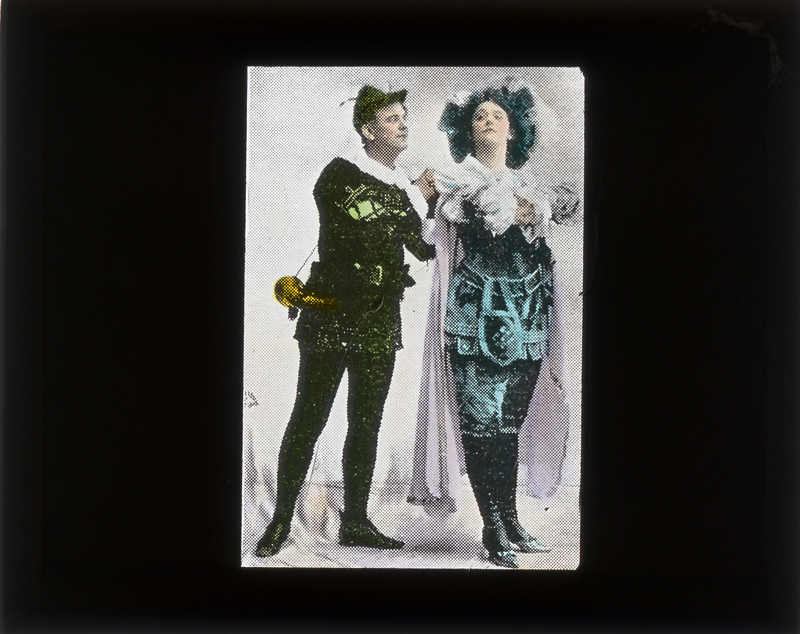
Interior of the Salt Lake Theatre. Image courtesy of the Special Collections Department, J. Willard Marriott Library, The University of Utah. All rights reserved.

The Salt Lake Theatre was built in 1861 and was located on State Street and First South in downtown Salt Lake City. From the time the project was announced, the city was full of excitement and anticipation for what awaited them when this theatre was completed. The theatre gained immense support from the community. In fact, it gained so much support that many said it was impossible to thank all of the contributors because almost every family in the Valley had played a role in its creation. The Mormons actually completed the theatre before completing the Salt Lake TempleBrigham Young believed that bringing theatre to Salt Lake was a way to bring culture and civilization to the Valley. (Walker, 84)

News of the Salt Lake Theatre spread rapidly upon its completion. Compared to other buildings of its day, it was modest in size. It was only 80 by 144 feet and could hold roughly 1,500 people at once. (Walker, 484) In the beginning, the theatre was tastefully decorated, with two Doric columns and chalky white plaster. It was quite inviting to patrons. However, its renovation in 1873 attempted to make the theatre look like an old European opera house.  In addition to updated décor, the renovation brought about more storage space, larger dressing rooms, and the addition of rehearsal space. New advanced stage equipment provided amazing acoustics and decorative art created an elegant environment. The renovation exposed a spacious, sophisticated theatre that rivaled many other theatres of its day. (Walker, 484)

The Salt Lake Theatre had a rich musical heritage. The performing group valued music and took pride in rehearsing and perfecting each note in performances. The theatre housed an orchestra, band, and choir, all of whom performed at various times while the theatre was opened. Music was present in each production and opera at the theatre. (Pyper, 260)

Production photo of Robin Hood. Image courtesy of the Special Collections Department, J. Willard Marriott Library, The University of Utah. All rights reserved.

As the Salt Lake Theatre was a professional theatre, its actors, musicians, and workers were all paid for their work. However, prior to 1866, the workers were paid with both money and livestock or a very small fee. Some positions were on a volunteer basis only. The 1866-67 season brought about changes in the way they were paid. The theatre had started to take up so much of the workers’ time, that they were unable to work other jobs. Because they were not receiving adequate compensation for working in the theatre, many became concerned about how they would make enough money to survive. Noticing these concerns, Brigham Young called a meeting in the Green Room of the theatre to find a solution. By the end of the meeting he knew the old way of payment was dead. He decided, instead, to pay the company members salaries. These salaries ranged anywhere from $15 to $50 depending on the job. The salaries were composed of one-third cash, one-third store credit, and one-third tithing office pay. Tithing office pay was anything that could have been offered to the LDS church as tithing. It could consist of produce, animals, store-bought goods, etc. These types of items would then help to make up some of their salary. This form of payment stuck and was the method of payment through the remainder of the company’s lifespan. (Henderson, 69)

Many plays were performed at the Salt Lake Theatre, from melodramas to Shakespeare’s works. However, the theatre was not limited to performing plays. Miscellaneous events took place at the theatre from time to time, such as meetings, speeches, children’s parties and balls. (Walker, 485)

The Salt Lake Theatre was a source of unity in the community. Although the Mormon Church always owned the theatre, it was a place where all different people could come together. It welcomed everyone, regardless of faith, class, social status, or political preference. In his dedication speech, Henry Miller stated that the Salt Lake Theatre was “the cathedral in the desert.” (Carter, 260) From that moment on, it was truly thought of as the theatre of the people. The theatre unified the entire community and promoted respect between all involved.

Exterior of the Salt Lake Theatre. Image courtesy of the Special Collections Department, J. Willard Marriott Library, The University of Utah. All rights reserved.

Financially, the Salt Lake Theater never did tremendously well. It never had a great financial team, and struggled to gain profit. The fire and destruction of a rival theatre caused the only financial increases for the Salt Lake theatre, though even then, it had shaky stability and hardly broke even. By 1910, things did not look well for the fate of the Salt Lake Theatre. Motion pictures were gaining popularity and drawing a crowd. Furthermore, the Great Depression was right around the corner and Utah’s economy was in trouble. In 1928, Heber Grant, the president of the Mormon Church at the time, decided that it was necessary to close the theatre. (Walker, 485) Though he had attended productions at the theatre as a child and felt sad about closing it, he felt that based on its financial standings, it was the best thing to do.

His decision spurred much controversy. Many Utahns were outraged and felt that closing the theatre violated pioneer heritage. In response, the Daughters of the Utah Pioneers stepped in to try to preserve the theatre. They suggested renovating the theatre again, moving it to a less expensive location, or turning it into a museum site. Despite their efforts, each of their proposed ideas were rejected and it was ultimately decided that the theatre would be demolished in 1928.

Leslie Williamson Price is a senior at The University of Utah who is majoring in speech communication. She earned an Associate of Science degree in Theater Arts at Snow College.

Sources

K.B. Carter, Museum Memories (Salt Lake City, UT: International Society, Daughters of Utah Pioneers, 2009).

H.R. Lamar, The Theater in Mormon Life and Culture (Logan: Utah State University Press, 1999).

Ronald W. Walker, “Salt Lake Theatre,” Utah History Encyclopedia, The University of Utah.

B.B. Malouf, Social Life and Recreation of the Utah Pioneers (Salt Lake City, UT: Daughters of Utah Pioneers, 1989).

I.M. Maughan, Pioneer Theatre in the Desert (Salt Lake City, UT: Deseret Book Co., 1961).

G.D. Pyper, The Romance of an Old Playhouse (Salt Lake City, UT: Deseret News Press, 1937).

G.D. Pyper, The Salt Lake Theatre: souvenir program, October 20, 1928 (Salt Lake City: UT: Seagull Press, 1928).

H.G. Whitney, The Drama in Utah; The Story of the Salt Lake Theatre (Salt Lake City: Deseret News, 1915).

Ann W. Engar, “Theater in Utah,” Utah History Encyclopedia, The University of Utah.

Terryl L. Givens, People of Paradox: A History of Mormon Culture (Oxford: Oxford University Press, 2007).

M.E. Henderson, A History of the Theatre in Salt Lake City from 1850 to 1870 (Evanston, IL: 1934).

KZN: The Birth of Radio in Utah (1922-1924)

by ANNA LOLA HATTON

“Hello, hello, hello!  This is KZN. KZN, the Deseret News, Salt Lake City calling. KZN calling! Greetings!”

These enthusiastic and welcoming words were the first to break radio silence in Utah on May 6, 1922. They might not have been the most awe-inspiring or motivating words to be uttered over the air, but H. Carter Wilson, an engineer contracted by the LDS Church-owned Deseret News, was rejoicing for having his self-built transmitter actually work. Nate Fullmer and Elias S. Woodruff, the business manager and general manager for Deseret News, took a chance on what could have been a fleeting medium of a new invention. (Ison)

Ison gives a brief history on how the station came about. Fullmer and Woodruff both saw the genius in having a station in Salt Lake City, but the Deseret News lacked the funding and Heber J. Grant, president of The Church of Jesus Christ of Latter-day Saints as well as the Deseret News, disapproved as well.

"Opening Night of KZN on the top of the Deseret News Building.” Photo courtesy of Special Collections, J. Willard Marriott Library, The University of Utah. Photograph Number p0111n01_01_02, May 8, 1922. Included on the back was a personal note from Nathan Fullmer to his mother.

These innovative men, Fullmer and Woodruff, never lost sight, though, and decided to build a transmitter from scratch with Wilson’s help. They selected a spot on top of the Deseret News tower and within a year had it working. They invited Grant as well as other Deseret News leaders to their initial broadcast. All invited were extremely surprised and unanimously agreed that this was the future of news. Their risk resulted in the formation of KZN radio station, which would help shape the future of broadcasting in Utah.

Nathan Fullmer wrote a personal note to his mother about the event and a photograph taken of it saying, “Yes – Mother this is none other than your darling boy… This is a flash light picture taken on the roof of the Deseret News Building… It being one of the most wonderful things of the age. Our station will send messages of all kinds thro the air with no wire connection of any kind, but only on the ether waves of the atmosphere, far from 1500 miles to 2500 miles. The Opening program was one of the greatest events of my life.”

Although researchers Larson and Avery point out that KZN was not the first radio station in Utah, it definitely has proven to be the most successful. KZN breathed new life into the state of Utah. The Davis County Clipper reported in May 1922 that Henry Bartholomew, age 70, was regaining health just by listening to the radio. “It is predicted he will continue to grow young if he listens to the radio being sent out daily by the Deseret News and other radio broadcasting stations.” KZN was providing the antidote for hundreds of Utah residents suffering from a lack of culture and boredom. The City of Parowan held a grand celebration outdoors for the Fourth of July in 1922, with food and fireworks, but the main event announced in the Parowan Times was the radio broadcast that would be played for the whole town to enjoy.

“William Jennings Bryant at the Radio Station.” Photo courtesy of Special Collections, J. Willard Marriott Library, The University of Utah. Photograph Number p0111n01_01_01, October 25, 1922.

All over the state of Utah, people were purchasing radios and tuning in on the dial. It brought a sense of community and unity that branched out farther and longer than anyone could have expected. It even attracted leading political figures of that era, such as William Jennings Bryan, who was photographed outside the station and spoke on the air October 25, 1922.

Now known as KSL, KZN has a 90-year-long history of providing entertainment, religious enrichment and culture. The Box Elder News in December 1924 reported how many Brigham City listeners were entertained by their local singers who had gone to Salt Lake City to perform over the airwaves.

Bigger cities across the nation already had popular stations, but at the time, the majority of the nation could not understand the value of radio broadcasting. It was a risky move and with the Deseret News lacking the funds to fully support this quest, it would be up to Woodruff and Fullmer to build their transmitter from scratch. They found engineer H. Carter Wilson, and in the summer of 1921 began building the station on top of the Deseret News Building in downtown Salt Lake City. Years later, Ison tells us, their efforts would carry the Mormon Tabernacle Choir to be heard all across the U.S. on NBC broadcasting Music and the Spoken Word. The Church of Jesus Christ of Latter-day Saints put it to use to deliver messages of faith and hope to their members spread throughout the state.

In the present time we get a daily bombardment of media from all over the world that we would probably find it hard to comprehend how excited and connected to each other these early radio listeners must have felt. “It is understood that the Salt Lake paper will send out speeches, music, weather reports, baseball scores and various bits of important news broadcasting these to the intermountain country. Radio receiving sets are being installed in this state at a rapid rate and such service will be of great value,” mentions The Eureka Reporter in May 1922.

We take these reports maybe three or four times a day now with radio, television, newspapers and the Internet. To the residents living in Utah in the roaring ’20s, this information meant the world. Not only could they connect to other cities in Utah, but also they could receive transmissions from other states on clear days.

The News-Advocate in July 1920 reported, “The radio outfit at C.H. Stevenson home is now working splendidly and past few clear nights have brought messages from all over the country. The Pacific coast, Denver, Kansas City and points at similar distances are easily heard and much music and other entertainment features have been enjoyed.” The Advocate would publish little tidbits of what the city folk would be doing, anything from visiting a relative to local political drama. It gives us a deep insight into how the KZN and Deseret News Media could really reach individual lives throughout Utah. The news that C.H. Stevenson could pick up stations from outside of the state was cause for printed mention in the paper.

The early 20th century was full of inventions, like radio, that bridged the gap of the United States and the world. Very soon after, and some at the same time of KZN, other stations were popping up all throughout Utah. The Kiwanis Club in Price, Utah, saw to it that that city council met to discuss the options of getting a radio station there. The News-Advocate also mentioned in September 1922 that the Club knew it would be a way to “divide its entertainments with Salt Lake.” This divide would allow an even more centralized audience and listenership and would provide Price with a voice of its own.

It is by studying our rich history of radio that we can grow to understand our predecessors a little better. Based on my research, there were not many negative reactions, if any, to radio being in Utah, which tells me that Utah embraced the advances in technology. The Deseret News also used it to establish a greater sense of community across the state as a whole. Radio today offers similar feelings in communities across the country. It is our duty to keep those stations alive that do all they can to uphold those values and support their own community. Many say that the radio industry is a dying breed, but the argument stands for good strong community radio. Utah has a long history of providing a voice for the people and that should be cherished and continued.

Anna Hatton is a senior at the University of Utah majoring in mass communication. She has worked as station manager of K-UTE student radio since 2011.

Sources

“Radio Radiating Youth Into Boys of Seventy,” The Davis County Clipper, May 12, 1922, 4.

“Salt Lake Paper Now Broadcasting Reports,” Eureka Reporter, May 12, 1922, 9.

“Will Be Real Celebration!” The Parowan Times, July 19, 1922,1.

“Just About Folks,” The News-Advocate, July 20, 1922, 2.

“Radio Address is Kiwanis Feature,” The News-Advocate, September 7, 1922, 4.

“Local Singers Broadcast at Salt Lake,” The Box Elder News, December 12, 1924, 4.

Yvette D. Ison, “Radio in Utah Began in May 1922 on Station KZN,” Utah History To Go, State of Utah.

Tim Larson and Robert K. Avery, “Utah Broadcasting History,” Utah History Encyclopedia, The University of Utah.