Bennion Plan: The State of the ASUU in 1960

By Meg Clasper

John Bennion

John Bennion was president of the ASUU in Fall 1960. Photos originally appeared in The Daily Utah Chronicle, University of Utah.

The student government at the University of Utah is a mixture of administrative and representative bodies that collaborate on issues and projects across campus. They are seen as a sturdy group of students who are relied on by the student body and other figures to make decisions for the student body. Seeing the student government disrupted is rare.

During the fall semester of 1960 the Daily Utah Chronicle recorded the life cycle of the Bennion Plan, which moved to streamline functions of the student government. From October 26 to December 8, the Chronicle published articles, updates, editorials and letters to the editor covering the status of the plan and the views of students involved.

On October 26, 1960, the Bennion Plan -— later named after its originator — started its first stages. John Bennion, president of the University of Utah ASUU (Associated Students of the University of Utah) announced his desire to abolish the position of class officers. The positions, he believed, lacked any responsibilities that made them meaningful to the student government. With ASUU second vice-president Steve Brockbank’s support, Bennion requested time for the student body to be made aware of the issue before any decision was made.

The announcement of Bennion’s proposal to the Alumni Association was deeply discussed between members of the student government. Then, on October 27, less than a day later, the ASUU Senate barred any discussion of the proposed issue until the next meeting on November 3.

No opposing side took a public voice until November 1. Paul Cracroft, the Alumni Association secretary, stated his opposition on the basis that abolishing the positions wasn’t the answer, they just needed to be made meaningful. Cracroft made a comment about class officers taking over the responsibilities of the senatorial body, but he didn’t create a formal solution.

Ron Magnuson

Ron Magnuson believed class officers were useless. Photo appeared in The Daily Utah Chronicle, University of Utah.

Even students weighed in on the issue. On November 1, the consensus was that class officers had no jobs. “The worth of class officers might be compared with having a new car each year but not driving it.” This was the opinion of Ron Magnuson, who continued to express how he agreed with the worthlessness of class officers. Another student, Jolene Ogden, questioned what the officers did. Some students expressed their support to keeping the position of class officers. Philip Hallstrom compared the abolishment resolution to having a totalitarian system.

On November 11, the current class officers were able to defend their roles in the student government system. Kathryn Cannon said officers were elected without any prior knowledge of their responsibilities. She offered up a solution to create an occasional meeting with the ASUU Executive Council.

The second stage of the Bennion Plan was created on November 30 in response to a solution made by the Alumni Association to increase the duties of the class officers — the first official solution. This solution was discussed at the time of the original proposal with John Bennion rebutting that creating responsibilities would take a University constitutional amendment or individual initiative. The Board of Regents was then handed the decision.
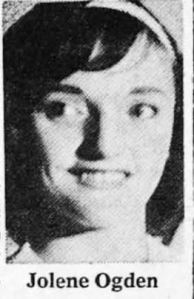
Jolene Ogden

Jolene Ogden was confused about the roles of class officers. Photo appeared in The Daily Utah Chronicle, University of Utah.

Bennion voiced on November 28 that he was opposed to the decision. He believed nothing should be done about the issue without student body opinion. In the end, three solutions were made by the ASUU Executive Council: 1) do away entirely with the class officers and have a senatorial delegation created with the Senior delegation organizing themselves as an Alumni Committee. 2) Elect a president of each class who would act as an administrator with four class senators or representatives. 3) Maintain the position of class officers but justify their existence by assigning them responsibilities. These solutions became the second stage of the Bennion Plan.

University President A. Ray Olpin, on November 30, promised Bennion and the Executive Council that the Board of Regents would not act upon the proposed solution “unless it has gone through proper student channels.” These channels referred to the student government and body.

The third stage of the Bennion Plan, electing three or more delegates per class as representatives to the National Student Association (NSA) delegation, was also proposed. The delegation would run on national and educational issues and report back to each other and an annual NSA National Congress. Olpin felt it was a big position for someone to represent the whole student body nationally, but was assured the representatives would act on their own accord while keeping student opinions in mind.

Bennion then urged students to weigh in on the issue and requested the ASUU Senate to send the Bennion Plan to a student referendum. He believed if the student body had a voice in the decision, they would be less likely to undermine it.

Dick Paul, ASUU senate president, wrote to the Daily Utah Chronicle on December 6, stating he believed that polling an uninformed student body would only lead to wrong decisions. He was also quoted as saying that polling the “relatively uninformed members of the student body” would be “highly impractical and inefficient.”

The uninformed members of the student body, as Paul referred to them, spoke up. In a Letter to the Editor, David Gillette, Martin Zachresen, Stephen West, and Bud Billeter questioned why these proposals and decisions were being made. The students, on December 7, wanted to know why class officers were going to be abolished on a lack of responsibility. They described their confusion on the decision to expand the NSA delegation when less than a month prior there was a debate on if the University of Utah was going to remain a member of the NSA.

In the end, on December 8, the Senate made the decision to pass the NSA proposal but kill the student referendum.

Presently, the ASUU assembly does not include an NSA delegation. The student government now consists of a Senate and Assembly filled with students from each college on campus. Compared to the current state of the ASUU, the decision over the NSA appears to lack what was needed to make it sustainable.

The Bennion Plan changed during its time and showed the true nature of some ASUU representatives. The debates and conversations that took place on this issue made the representatives appear less sturdy than they had before.

Meg Clasper is a junior studying journalism. She specializes in gaming journalism and pop culture.  

Primary Sources

Bennion, Brockbank Defend Stand on U Officer Proposal,” Daily Utah Chronicle, October 26, 1960, 2.

Senators Postpone Officers Debate,” Daily Utah Chronicle, October 27, 1960, 1.

Class Conscious?” Daily Utah Chronicle, November 1, 1960, 2.

Student Consensus: Class Officers Have no Jobs,” Daily Utah Chronicle, November 1, 1960, 3.

ASUU Execs Hear Class Officers Defend Roles,” Daily Utah Chronicle, November 11, 1960, 2.

Bennion Frowns on Alum Move,” Daily Utah Chronicle, November 28, 1960, 1.

Execs Meet with Olpin, Discuss Alum Resolution,” Daily Utah Chronicle, November 30, 1960, 1.

Bennion Urges Student Poll on NSA Proposition,” Daily Utah Chronicle, December 5, 1960, 1.

John vs. Dick,” Daily Utah Chronicle, December 6, 1960, 2.

Letters to the Editor: We Know,” Daily Utah Chronicle, December 6, 1960, 2.

Senate Approves Bill But Not Student Poll,” Daily Utah Chronicle, December 8, 1960, 1.

Secondary Sources

Gillette, David, et al. “Letters to the Editor,” Daily Utah Chronicle, December 7, 1960, 2.

A Poor Show…,” Daily Utah Chronicle, December 8, 1960, 2.


Activities of University of Utah Fraternities and Sororities in 1960-1961

By Lucy Choi

The Fraternity and Sorority community started at the University of Utah in the fall of 1909 when the first fraternity was chartered and established. The first sorority on campus was founded four years later, in 1913. According to the official University of Utah Greek site, today the University of Utah has 18 fraternities and sororities with over 1,600 students involved.

This article explores various activities that the fraternities and sororities of the University of Utah engaged in during 1960 and 1961.

According to the articles found in the Daily Utah Chronicle, the activities of the Greeks could be divided into three main categories: contributions to the local community, socialization between members, and sports.

Melon

Sigma Chi fraternity members Jim Moss and Brent Bateman prepare melons for the Melon Mess on October 10, 1960. The event was open to all students on campus. Originally published in the Daily Utah Chronicle.

To start with, the Daily Utah Chronicle reported in the November 30, 1960, issue that “Phi Sigma Kappa, Lambda Delta Sigma, Central and Wasatch Halls, and the Navy ROTC captured first place awards in the fall blood drive.” Seeing that several fraternities showed a high percentage of participation and that half of the awardees were Greek groups, the article implied that the students involved in fraternities and sororities were encouraged to participate in events that contributed to society. In addition, the University of Utah’s yearbook, Utonian, introduced a sorority that dedicated their musical talents to children by participating in a “Christmas project by the pledges, who made and decorated boxes, which were distributed to the Children’s Hospital.”

Furthermore, in terms of socialization, fraternities and sororities came up with a lot of creative and fun events for not only the Greek members but also the students on campus. The Daily Utah Chronicle’s issue published on May 3, 1961, wrote about the Songfest saying, “Nineteen Greek groups will present novelty and serious songs.” This allowed the Greek groups to “collaborate.” This was an event where the student body and the public were invited while the Greek students entertained them. From this event, the Greeks not only provided activities to get the students entertained but also a platform for the members and the students to socialize. By preparing this event, the Greek members developed strong bonds between members.

The fraternity Sigma Chi was known for holding the Melon Mess annually, according to the Daily Utah Chronicle in October 1961. Melon Mess was an event where hundreds of melons were shared with the whole student body. It also said that “each sorority pledge class is scheduled to present a skit on the Sigma Chi front porch to entertain the melon-eaters.” This event is also an example that shows the effort of fraternities and sororities in providing a platform for the students to mingle as well as to entertain themselves.

tennis

Dick Ruppel, left, and Fred Wheeler from Kappa Sigma fraternity won the Intramurals Tennis doubles in 1959 and 1960. Originally published in the Daily Utah Chronicle.

Moreover, the Greeks had a high participation rate in sports on campus. Kistler wrote, “For the fraternities, softball, basketball, fencing, tennis, ping-pong, archery, badminton, pool, golf, and touch football are available” and “for the sororities, archery, badminton, ping-pong, softball, basketball and tennis are available.” (Report of Fraternity Study Committee, p. 29) Impressively enough after going through competitive tournaments, several members from the fraternities and sororities boosted and came to a high standing. The Daily Utah Chronicle published on November 23, 1960, the article titled “Winners Named WRA Volleyball Tourney Play” saying “Kappa Kappa Gamma took their first place in this year’s WRA Volleyball Tournament” — a huge achievement. Even in the article “Kappa Sigs Stage Win” in the Daily Utah Chronicle issue of November 30, 1960, “two members of Kappa Sigma staged a repeat performance last week” to capture their win in the Intramurals tennis doubles, which they won two years in a row. This shows that many fraternities and sororities participated and competed with each other and a lot of them showed high performance.

This article discusses the engagement of University of Utah fraternities and sororities in different categories: volunteer work, socialization, and sports. Greek groups these days are holding activities such as boot camps and Greek Weeks to socialize and also are engaging in a variety of events. Because the early members of the fraternities and sororities had laid a firm foundation, current student members could inherit their spirit of passion for engagement and carry it on.

Lucy Choi graduated in December 2019 with a Bachelor of Arts degree in Communication at the University of Utah.

Primary Sources

Phi Sigma Kappa’s 100% Earns Blood Drive First,” Daily Utah Chronicle, November 30, 1960.

Kappa Sigs Stage Win,” Daily Utah Chronicle, November 30, 1960.

Fraternities, Sororities Collaborate in Songfest Thursday,” Daily Utah Chronicle, May 3, 1961.

Sigma Chi Melon Mess Open to Student Body, Daily Utah Chronicle, October 9, 1961.

Utonian, The University of Utah (Salt Lake City, Utah, 1960), p. 285.

Winners Named WRA Volleyball Tourney Play,” Daily Utah Chronicle, November 23, 1960.

Kistler, Samuel. “Results of Fraternity Study Committee, University of Utah.” Salt Lake City, Utah: The University of Utah, 1962.

The University of Utah Student Section at Football Games: An Evolution

MUSS_Page_2

The Mighty Utah Student Section (MUSS) is filled with energetic students just before kickoff. Used by permission, Daily Utah Chronicle.

By Gianna M. Cefalu

Rice Eccles Stadium, home of the University of Utah football team, has a designated student cheer section called the MUSS, which stands for Mighty Utah Student Section. The MUSS, established in 2003, is described and showcased during prospective student tours as an exciting benefit to students who choose to attend the University of Utah. The MUSS capacity is 6,000 energetic students at every game. This article will explore the scope of current student spirit at the University and the historical series of events that led to the current status of student fan support.

Lee Benson, a Utah student reporter, sensed the apathy of school spirit among classmates and brought attention to the gradual increase of student enthusiasm. A Deseret News article titled “All the Fuss is in the Muss” by Benson noted that an average of only 500 students attended football games in 2001. It was the spring of 2002 that Alumni Association member John Fackler came up with the Utah Football Fan Club in hopes of encouraging more students to attend games. The number of fans slowly improved to 800 with the promotion of a free T-shirt, a permanent seat, and a tailgate with food before every home game. (Benson)

It was the addition of Head Coach Urban Meyer in 2003 that changed the momentum and piqued student interest. After an undefeated season in 2004, registration for the MUSS rapidly increased to 5,000 students. (Benson)  Utah’s entry into the prestigious Pac-12 football conference in 2011 elevated the viewership and exposure for the Utah football program. Their schedule was centered on Pacific 10 teams with huge alumni followings, including University of Southern California, Stanford, Washington, and Oregon. This shift in the conference improved student interest in the football program. (Benson) Today, the MUSS is ranked 7th in the nation for best student section.

The history of school spirit provides important background as to how the MUSS has evolved. It all started in the 1950s where student interest at football games was almost nonexistent. On November 19, 1951, the Salt Lake Telegram reported that the school spirit was at an all-time low following a loss to Wyoming. The football club took a turn for the worse when the Redskins lost to Oregon State, Brigham Young University, and Wyoming. The Redskins were called a “stumbling, fumbling, and uncoordinated club.”

Despite their success in the 1951 season, ticket sales were down for football games. An article published in the Salt Lake Telegram on November 20, 1951, reported a record low of 9,038 people, which was the smallest crowd in six years. It surprised many to see the low attendance even though they were the Skyline Conference Champions.

Two years later, the student spirit hadn’t improved. On February 12, 1953, the Daily Utah Chronicle encouraged suggestions on how to improve school spirit. Pierre Dubois in his “Sportslight” article emphasized the importance of holding a pep rally before the game. Dubois mentions how words of encouragement from the athletic director and the presence of the U marching band can help students get excited for games. Tradition should also be improved in order to increase student interest, such as a Cougar cage trophy between the Utah vs. BYU rivalry.

A natural rivalry was born because of the close proximity between Utah and BYU. Over the years, the rivalry game between Utah and Brigham Young University has always been a big game, with millions of viewers watching the match up on TV. The Daily Utah Chronicle reported on November 24, 1953, that school spirit was encouraged, but not vandalism. Reports stated that University of Utah students allegedly painted the BYU campus white, which was portrayed as childish and a bad reputation for Utah.

football program_Page_1

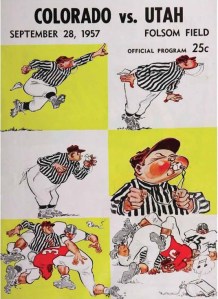
Program for the University of Utah football game vs. the University of Colorado. Image courtesy of Special Collections, J. Willard Marriott Library, The University of Utah.

“School spirit and student attendance at games is one of the most important elements of a successful football program,” said Head Coach Ray Nagel in a Daily Utah Chronicle article published May 21, 1958. Nagel also emphasizes that having an enthusiastic student body would contribute to a winning football team. Nagel was a firm believer in having the coaching staff being aligned with the student body. For example, the coaches should be a part of student rallies and assemblies in order to feel better connected with the team.

The same mentality of students supporting the athletes holds true for the goal of the MUSS in 2019. “Student sections are crucial for athletes to feel supported and for students to gain a sense of camaraderie among each other through attending games together,” wrote Casey Overfield in a Daily Utah Chronicle article published on September 5, 2019. The energy that the students exert during the games is important to the team’s success.

The student section is made up not only of those in the stands, but those on the sidelines and on the field. The program for the November 27, 1958, Utah State University vs. Utah game reported both the marching band and cheerleaders contributed to school spirit. The exciting music and marching routines intrigue the student crowd. This article suggests that the cheerleaders’ energy and the marching band has a direct effect on the enthusiasm of the students.

In conclusion, history shows the low student attendance in the 1950s has shifted throughout the years.  Students brought forth the cause and administrators saw the need to foster school spirit. The creation of the MUSS in 2003 propelled students to attend football games, with 6,000 students cheering on the Utes loud and proud. The success of the football program wouldn’t be possible without the enthusiasm of the MUSS. When Utah joined the Pac-12 in 2011, the Utes gained regional attention on the West Coast, and are now the Pac-12 South champions for the second straight year. Time will tell, but the increase in school spirit has proven to positively impact the University of Utah football program.

Gianna Cefalu is a junior at the University of Utah. She is majoring in communication, with an emphasis in journalism.

Primary Sources

Jack Schroeder, “Utah’s Skyline Champs Await Thanksgiving Battle,” Salt Lake Telegram, November 19, 1951, 22.

Jack Schroeder, “Jack Straws,” Salt Lake Telegram, November 20, 1951, 24.

Pierre Dubois, “Sportslight,” Daily Utah Chronicle, February 12, 1953, 4.

Rivalry: No Vandalism Just Spirit,” Daily Utah Chronicle, November 24, 1953, 2.

Program, Utah State University vs. Utah, November 27, 1958, Special Collections, J. Willard Marriott Library, The University of Utah.

Nagel Says School Spirit is Important,” Daily Utah Chronicle, May 21, 1958, 4.

Secondary Sources

Overfield, Casey. “Uniting Utes and Frightening Foes: The Legend of the Mighty Utah Student Section,” Daily Utah Chronicle, September 5, 2019.

Benson, Lee. “About Utah: All the Fuss is in the MUSS,” Deseret News, September 8, 2013.

Drew Pearson’s Journalistic Legacy

By Oakley Burt

Drew Pearson (1897-1969) was an American journalist from Evanston, Illinois. He is regarded as one of the most influential, but controversial news and radio journalists of his time with a career spanning close to fifty years.

Pearson’s career in journalism began while he attended Swarthmore College (1915-1919) and worked as an editor for the school newspaper, The Phoenix. After graduating from Swarthmore, Pearson took on new opportunities and ventured into the world. From 1919-1921 he served with the American Friends Service Committee directing post-war efforts in Kosovo. He returned to the US and taught geography at the University of Pennsylvania until 1922.

Pearson1

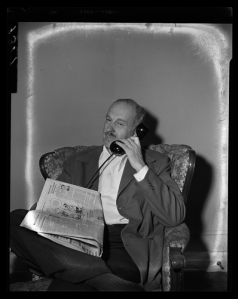
Journalist Drew Pearson taking a reading break to answer his phone. Shot by staff photographers at the Salt Lake Tribune in 1952. Used by permission, Utah State History.

Pearson traveled abroad again in 1923, to Eastern Europe, Asia, and Australia. According to one source, he wrote about his travels as a freelance journalist and secured a six-month lecture tour in Australia. As Pearson was traveling through the Mediterranean he was also commissioned for America’s “Around the World Syndicate” for a series of interviews titled, “Europe’s Twelve Greatest Men.” (Nimmo and Newsome, p. 267)

Upon returning to the United States he transitioned into a full-time career as a journalist. Pearson went on to work at the United States Daily from 1926-1933, and the Baltimore Sun from 1929-1932. While working at the Baltimore Sun in 1930, Pearson was sent to Cuba to cover the Cuban Revolution. According to Heintze, his reporting earned him an honorable mention for the Pugsley Award for the best journalistic reporting of 1930.

Pearson’s most notable and famed contribution to journalism was a book he co-authored titled, Washington Merry-Go-Round, and the daily column that followed. In 1931, he and Robert S. Allen anonymously published the book described as “a collection of gossip-ridden news items concerning key figures in public service.” (Heintze) The pair released another book the following year titled, More Merry-Go-Round, but were found to be the authors and were fired from their jobs. Pearson was subsequently hired as the head of the Baltimore Sun’s Washington division. From there he and Allen began the infamous “Washington Merry-Go-Round” daily column. Like the book, the column was dedicated to honest reporting, uncovering corruption, lies, affairs, etc. “From the thirties through the sixties, no one crossed the journo-politico line in search of real policy impact with greater fervor than Drew Pearson,” reported the New Yorker on September 28, 2015.

Pearson2

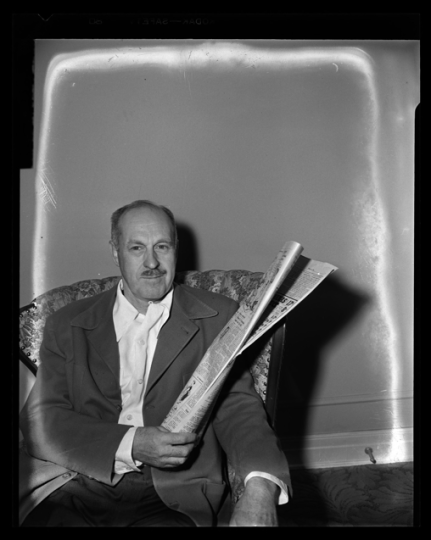
Drew Pearson holding his newspaper. Shot by staff photographers at the Salt Lake Tribune in 1952. Used by permission, Utah State History.

Pearson rarely shied away from reporting on controversial topics throughout his career. He reported on bribes taken by New Jersey Congressman, J. Parnell Thomas from the White House, and that Senator Robert F. Kennedy had authorized electronic surveillance of Martin Luther King Jr. (Hopkins, p. 552) Pearson often reported on the Kennedy family, President John F. Kennedy in particular. He aired his concerns with the Kennedy Administration and was one of the journalists reporting on President Kennedy’s alleged affairs. Pearson also reported on the Watergate scandal in 1972. Pearson’s beliefs and stances on issues were made well known in his reporting, he remained candid and controversial in his work.

Toward the end of his career, his status landed him numerous speaking engagements, including a guest speaking appearance at the University of Utah. On November 7, 1970, the Daily Utah Chronicle reported that Pearson would be a guest speaker in Kingsbury Hall at the University of Utah. Roger Traynor and Jan Preece were also selected as guests to highlight activities during that week. Traynor spoke on appellate judges while Preece, a famed metropolitan opera singer, would be performing works of Bach. The Daily Utah Chronicle reported on November 9, 1970, that Pearson’s lecture topic would be his famous syndicated column, “Washington Merry-Go-Round.” On November 14, after his lecture, the Chronicle reported that Pearson mainly spoke on the new Kennedy Administration — voicing his concerns surrounding the election and speculating that Nixon would run for president again.

For the remainder of his life and career, Pearson continued to publish the “Washington Merry-Go-Round” column and air his radio show of the same name. Upon his death, his longtime aide, the investigative journalist Jack Anderson, inherited the column. (Heintze)

Drew Pearson died on September 1, 1969. On September 2, the Washington Post reported on Pearson’s death, saying, “He was a crusader. He passionately believed that public office was a public trust, and with his brand of journalism, he went after the corrupt, incompetent and pompous.” The Washington Post reported on Pearson again on September 3, saying, “He was a moralist who was proud to be a muckraker in the strict dictionary sense — one who searches out and exposes publicly real or apparent misconduct of prominent individuals.” The Post continued, “Somewhere in these unlikely combinations lies the key to his extraordinary career as the most successful, in many ways the most effective, and certainly the most controversial journalist of his time.” The Washington Post accurately described Pearson’s impact on journalism.

Drew Pearson’s contributions to the journalism profession cannot be ignored or forgotten. He was an influential, controversial and important figure in American journalism. In more ways than one Pearson laid the foundation for current journalists to follow in his footsteps and conduct in-depth reporting. Especially in today’s political climate, it is crucial that American journalists never shy away from reporting on controversial topics and news as Pearson did not. Journalism is a profession that aims to keep the government and its public figures in check, a statement that was upheld by Pearson and should be regarded by modern-day journalists as well.

Oakley Burt is a junior at the University of Utah. She is a communication major with an emphasis in journalism and a minor in political science.

Primary Sources

Drew Pearson Speaks Friday in Kingsbury,Daily Utah Chronicle, November 7, 1960, 1.

Drew Pearson, Columnist, to Address Students,” Daily Utah Chronicle, November 9, 1960, 1.

Drew Pearson to Speak in Kingsbury,” Daily Utah Chronicle, November 10, 1960, 1.

Pearson Talks on Coming Kennedy Administration,” Daily Utah Chronicle, November 14, 1960, 2.

Jack Anderson, “Drew Pearson: A Great Reporter Dies: The Washington Merry-Go-Round,” Washington Post, September 2, 1969, 13.

“Drew Pearson,” Washington Post, September 3, 1969, 22.

Secondary Sources

Hopkins, W. Wat. “Pearson.” In Biographical Dictionary of American Journalism, edited by Joseph P. McKerns. Westport, Conn.: Greenwood Press, 1989.

Heintze, Jim. “Drew Pearson Biography.” University Library, American University, February 9, 2006.

Mallon, Thomas. “The Journalist Who Was His Own Inside Source,The New Yorker, September 21, 2015

Nimmo, Dan D. and Chevelle Newsome. Political Commentators in the United States in the 20th Century: A Bio-Critical Sourcebook. Westport, Conn.: Greenwood Press, 1997.

Drew Pearson,” Encyclopedia Britannica, December 9, 2019.


Fraternities and Discrimination at the University of Utah in 1962–1963

By Megan McKellar

In 1928, more than half of college fraternities incorporated an “exclusionist” clause in their constitution in order to deny membership to people of color, according to Charles LaPradd in College Male Fraternities in Controversy. (p. 60) One such clause was written into Phi Delta Theta’s constitution, which stated that “only male, white persons of full Aryan blood not less than sixteen years of age, shall be eligible.” (LaPradd, p. 61)

interfrat council1_Page_1

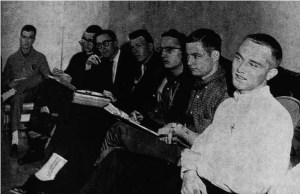
The Interfraternity Council at the University of Utah gathered for a meeting in January 1961. Photo credit: Daily Utah Chronicle.

However, following the end of World War II, a national movement to eliminate racial and religious discrimination had begun. Many war veterans returned home with little tolerance for discrimination, having “fought alongside Negro and Jew in a war precipitated by men with an Aryan philosophy.” (LaPradd, p. 61) Universities started to take steps toward abolishing discrimination practices.

The Associated Students of the University of Utah, or ASUU, formed a committee in the beginning of 1962 called the Human Relations Committee. The purpose of the committee was to investigate various sectors of student living for discrimination or unfair practices. The Daily Utah Chronicle reported in May 1962 that the committee found certain Greek organizations with “white clauses” (clauses that denied membership to non-whites) in their constitutions, and that even groups without such clauses still practiced discrimination. Additionally, an off-campus charter of Delta Gamma pledged a “Negro” and consequently had its charter suspended by the fraternity’s national office.

Students wrote letters to the Daily Utah Chronicle expressing their views on the discriminatory practices of the fraternities. Their opinions were varied. Student Doug Mottonen wrote one such letter in May 1962, describing the fraternities as “discriminating institutions.” He believed that each fraternity needed to be supplied with “a copy of the Bill of Rights, a Bible, a New Testament, and related documents.”

Three days later, a response to Mottonen was published in the Daily Utah Chronicle titled “Free Association” and signed by 12 male students. They called Mottonen’s perspective “narrow and bigoted” and asserted that the Constitution does not say that a person does not have the right to choose their friends. They claimed that they had no problem with riding or eating with a person of another race, but defended the notion that fraternities had the right to exclude whomever they see fit.

Mottonen wrote another letter the same month defending his initial assertions. He reasoned that “stipulating membership requirements on racial grounds implies inferiority. Such an organized practice is a breeding ground for egotism, prejudice and racial superiority attitudes. A discriminating act of a single sorority or fraternity may seem like a small thing. But if one were to multiply all the organized discrimination of our society in its totality, what emerges is a tremendous cost in human suffering.” The group of fraternity members did not submit a response.

interfrat council1_Page_2

University of Utah students prepare an application for the fraternity rush in April 1961. Photo credit: Daily Utah Chronicle.

On January 25, 1963, the Daily Utah Chronicle published the University of Utah’s Student Affairs Committee’s policy on discrimination in group organizations. The policy stated that the aims and goals of the organization needed to be aligned with the objectives of the University as a whole, and that membership requirements of the group were to further serve to reach the goals of both the group and the university. The policy emphasized unauthorized membership discrimination, stating that “the educational goals of the University are not best served by restricting organizational membership on the basis of religious belief or ethnic origin.”

This policy sparked another series of articles and letters to the editor. An editorial published in February 1963 in the Daily Utah Chronicle argued against the policy, reasoning that the policy was in direct conflict with the national policies of fraternities, thus jeopardizing the existence of the campus organizations. In a letter to the editor, three students argued that fraternities had the right to discriminate. They defended their stance by claiming that fraternities were not the only groups that practiced discrimination, and that “fraternities discriminate on more than just race and religion, although these are indeed important.”

As the University of Utah and its students grappled with discrimination within fraternities, there were those who worked to abolish discrimination, and those who defended and rationalized it. Although the community and society as a whole have since made great steps toward equality and fair treatment, social injustices still exist. In our society, there too will be those who work toward justice and those who find justifications for long-standing oppressive practices, practices that are harmful to a variety of marginalized groups. Today, the social issues that we face might involve people of color, or the LGBTQ+ community, or women’s rights. It is important to examine our own beliefs, and the practices of the organizations and societies to which we pertain, and to work toward justice and equality.

Megan McKellar is a junior at the University of Utah studying communication with an emphasis in journalism.

Primary Sources

Letters to the Editor,” The Daily Utah Chronicle, May 7, 1962, 2.

Letters to the Editor,” The Daily Utah Chronicle, May 10, 1962, 2.

Greek Discrimination ‘A Problem,’” The Daily Utah Chronicle, May 11, 1962, 1.

Letters to the Editor,” The Daily Utah Chronicle, May 16, 1962, 1.

Student Organizations Set Policy,” The Daily Utah Chronicle, January 25, 1963, 4.

A Threat to Greeks,” The Daily Utah Chronicle, February 5, 1963, 2.

Greeks Present Answer in Discrimination Issue,” The Daily Utah Chronicle, February 18, 1963, 2. https://newspapers.lib.utah.edu/details?id=640183

Secondary Source
LaPradd, Charles William. “College Male Fraternities in Controversy, 1950-1965: As Reported in American Magazines.” EdD diss., Florida State University, 1965.


Dr. Arthur Larson speaks to the University of Utah in 1960

By Briella Brice

IMG_6022

Portrait of Dr. Arthur Larson that was published in The Daily Utah Chronicle, October 26, 1960.

Dr. Arthur Larson was the director of the World Rule of Law at Duke University and special event coordinator for President Dwight Eisenhower. Larson was an assistant to the Eisenhower Administration starting in 1954 and shared a close relationship with the president. After attending the Pittsburgh Law School for only nine months, Larson played a substantial role in the way the Eisenhower Administration was perceived by citizens at the time. Larson provided support in areas where Eisenhower lacked communication skills and helped convey what the Republican party stood for at the time. David L. Stebenne stated in his book, The Modern Republican, that Larson served as the secretary of labor, director of the United States Information Agency, and chief presidential speechwriter between 1954 and 1958. (p. x) Many thought of Larson as a political celebrity, before his name was forgotten and much of this period of Republican fame was erased from America’s political history. (Stebenne, p. x)

After the release of Larson’s most popular book, A Republican Looks at his Party, he was labeled by the New York Times as “chief theoretician” of the Eisenhower-era Republicanism. (Stebenne, p. x) His book was published at a time when Republicanism in America was transitioning to a newer version that did not fit into the characteristics of existing political parties, specifically “Old Republicanism.” The goal of Larson’s writing was to show the connection between the Eisenhower Administration’s views and how they compared to 1950s America, a time of strong agreement throughout the country. (Stebenne, p. 157) Eisenhower stated that Larson captured all of his philosophical ideas the best he had seen for a book the size of A Republican Looks at his Party.

This was an important topic at the time because of substantial changes, confusion within our own country and others around the world, and lack of political knowledge. Businesses were becoming more aware of the positive aspects of government intervention and the government was experiencing extreme growth and change in regard to the economy. America had changed from a place of agriculture to industry, leading to more international responsibilities, and revising of policies put into place at a simpler time. (Stebenne, p. 159)

While serving under the Eisenhower Administration, Larson was heavily involved with social insurance policies and workers compensation. Inspired by British policy, he used a comparative approach to research the topic, examining contrasts and potential problems in America. Larson saw a relationship between good health and economic security and recognized that the current policy needed reevaluating.

“The best way to minimize the likelihood of such expenses, Larson suggested, was good preventive medicine.” (Stebenne, p. 104) This quote expresses Larson’s cautious and heedful personality that brought success into many aspects of his life. His research on this topic shows American pride that had been stirring throughout the country for the past twenty years, and the optimism Larson expressed toward America led him to further accomplishments.

Larson’s vigilant behavior toward economic security reveals the reason behind his passion of spreading knowledge about the positive aspects of America. Larson delivered a speech to the University of Utah in the Union Ballroom on Thursday October 27, 1960. The topic of his talk was “What Are We For,” regarding American life at the time including our accomplishments, ideals, and aspirations. Larson was passionate about the aspects of American life and the importance of government.

It was stated in the Daily Utah Chronicle that the United States equalized private enterprise and government intervention and we were constantly trying to find a balance between private freedom and public interest. According to Larson, we had to understand ourselves and know what we stood for in order to accurately portray an image to the rest of the world. For this reason, Larson emphasized the importance of foreign students attending his speech at the University. The University of Utah Students from Abroad Committee sent invitations to each international student, in hopes their attendance would help fulfill Larson’s goal of more foreigners understanding the way America operated. People were confused about the Republican party at the time and Larson’s speeches were important in making their new objectives clear. The following quote was stated in Larson’s speech given at the University and reported in The Daily Utah Chronicle on October 28, 1960:

One of the most crucial tasks our country is faced with is to convey to people all over the world the idea of what we stand for. We know we are against communism; but if we do not have a clear idea of what we are for the people of the world will have no way of identifying themselves with us. This identification might be presented as our chief objective.

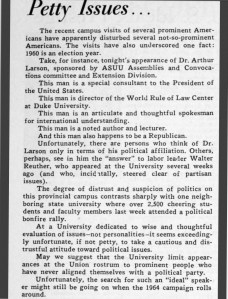
IMG_6018According to an article in the Chronicle titled “Petty Issues,” there was controversy regarding Larson’s visit to the University of Utah, as well as other prominent Americans. The year 1960 was an election year in the United States, which made some individuals suspicious about speakers brought in to speak to the University during this period. Larson was very well known for representing the Republican Party, and some saw this as a way to involve more students and faculty with that political group. The article published in the Chronicle suggested that the University limit the number of political speakers and reserve this spot for those who have never been affiliated with a political party.

Larson made his way back to Salt Lake City two years later to deliver a speech at Westminster College. According to an article published in The Salt Lake Times in 1962, the topic of his talk was “World Rule of Law,” a different theme from his speech delivered at the University of Utah. Among Larson’s many accomplishments, he taught at the Duke Law School for twenty-two years and made many contributions to the Duke Law Journal. Individuals from Duke who had the opportunity to work with Larson had strong positive opinions of him. As Norman Cousins stated in the Duke Law Journal, “It is impossible to pay too high a tribute to such a human being.” (p. 391)

Larson’s views regarding the World Rule of Law reflect his political views. Instead of trying to portray a positive image of America, his talk at Westminster was based on showing strong leadership in order to share a new approach to law and make it a reality across the globe. Both of Larson’s visits to Salt Lake City show his willingness to spread ideas and make his thoughts heard.

It is important to remember this time in history because of the position of the Republican Party at the time. Although there are gaps where crucial pieces of conservatism history could be missing, the information we have can assist individuals with similar goals. The controversy of why the university decided to host Arthur Larson is also important. While influencing listeners may not have been the overall goal, it opens our minds to the impact events have on the University of Utah community, even today.

Briella Brice is a junior at The University of Utah. She is majoring in communication with an emphasis in journalism and minoring in parks, recreation, and tourism with an emphasis in sustainable tourism and hospitality.

Primary Sources

Ike Consultant, Dr. Larson Slates Speech,” The Daily Utah Chronicle, October 26, 1960, 1.

Larson Outlines Purpose, Defines Government Role,” The Daily Utah Chronicle, October 28, 1960, 1.

Dr. Arthur Larson Schedules Talk at Westminster College,” Salt Lake Times, April 20, 1962, 2.

Larson To Discuss U.S. Ideals, Prestige,” The Daily Utah Chronicle, October 27, 1960, 1.

Petty Issues,” The Daily Utah Chronicle, October 27, 1960, 2.

Larson, Arthur. A Republican Looks at His Party. New York: Harper, 1956.

Secondary Sources

Cousins, Norman, et al. “A Tribute To Arthur Larson,” Duke Law Journal 385 (1980): 387-415.

Stebenne, David L. Modern Republican: Arthur Larson and the Eisenhower Years. Bloomington: Indiana University Press, 2006.


Ted Kennedy Comes to the University of Utah

By Rachel L. Beus

There are very few people in the United States who are unfamiliar with the Kennedy surname. Ted Kennedy was a member of a family known to us as a family with insurmountable political power that has been ravaged by both personal tragedy and public scandal. Ted Kennedy was born the youngest son of Rose Fitzgerald and John P. Kennedy on February 22, 1932. During his brother’s campaign Ted Kennedy gave a speech at the University to promote his candidacy for president of the United States, but this was just the beginning of his long and distinguished career in politics.

Ted Kennedy is famously known as the younger brother of President John F. Kennedy and Senator Robert Kennedy, both of whom were assassinated at the height of their political careers. Ted Kennedy’s life was rattled with much personal tragedy for him and his family. “It may be appropriate for Ted Kennedy’s life to be treated with sympathy by biographers and historians in that he was the kid brother living under the shadow of Joe Sr.’s favorite three sons, and only came to prominence in his own family after one brother was killed in World War II and the other two by assassination.” (Popejoy)

The website Biography discusses Ted Kennedy’s political contributions by saying, “Ted Kennedy campaigned for his brother, John F. Kennedy, in the 1960 presidential race. In 1962, shortly after his brother’s victory, Ted was elected to John’s former U.S. Senate seat. At the age of 30, he became a representative for the state of Massachusetts.” Popejoy writes, “It may be appropriate for Ted Kennedy’s life to be treated with sympathy by biographers and historians in that he was the kid brother living under the shadow of Joe Sr.’s favorite three sons, and only came to prominence in his own family after one brother was killed in World War II and the other two by assassination.”

On October 21, 1960, the Daily Utah Chronicle announced that Ted Kennedy would be coming to the University of Utah at noon to speak to students on behalf of his brother John F. Kennedy, since he was the director of the Democratic presidential campaign. This was just one stop on his nine-day tour of western state universities and colleges. The Daily Utah Chronicle reported that the brother of the Democratic presidential candidate, Ted Kennedy, spoke of university students encouraging enthusiasm and interest regarding politics in his speech at Orson Spencer Hall earlier that week.

In the “Letters to the Editor” section, the Daily Utah Chronicle was criticized for not giving more attention to Governor Clyde’s visit to the University of Utah, especially when there was extensive coverage regarding Ted Kennedy’s visit and speech. The paper was also criticized for this being a recurring theme, citing the lack of coverage regarding Senator Bennett also coming to the campus. The letter also disregarded any further excuses or justifications over the lack of coverage of public figures, claiming they were unfounded.

The August 19, 1960, issue of the Salt Lake Times reported, “Gov. Grant Sawyer of Nevada and Ted Kennedy, brother of the Democratic candidate for president, will be major speakers at the huge FDR Day rally.” That article later went on to call Ted Kennedy the campaign manager for his brother in 13 western states.

Ted Kennedy had an influential and far reaching career as a politician that lasted almost 47 years. In the 1960s the University of Utah got a small glimpse of the political prowess that was to come from him in the future. Popejoy notes, “The American public and the world tend to associate the Kennedy name with wealth, power, bold liberal legislative leadership, and often, unfortunately, unbecoming of men of their stature. Kennedy men boldly embraced life with gusto if not thoughtful restraint.” Ted Kennedy left a lasting impression on this country both with is legislative policies and eventful personal life.

Rachel Beus graduated from the University of Utah in December 2019 with a Bachelor of Arts degree in Communication and a minor in History. 

Primary Sources

Young Demos to Talk on Business,” Daily Utah Chronicle, October 20, 1960.

Ted Kennedy to Speak Before Campus Today,” Daily Utah Chronicle, October 21, 1960.

Ted Kennedy Lauds U Enthusiasm,” Daily Utah Chronicle, October 24, 1960.

Senator Moss Says U.S. ‘Must Align Nation on Freedom Side,’” Salt Lake Times, December 30, 1960.

Letters to the Editor,” Daily Utah Chronicle, October 31, 1960.

Kennedy, Sawyer to Speak at FDR Day Rally on Saturday,” Salt Lake Times, August 19, 1960.

Secondary Sources

Ted Kennedy, U.S. Senator 1932-2009.” Biography.com. July 23, 2019.

Popejoy, Michael. “Last Lion: The Rise and Fall of Ted Kennedy.” Public Integrity 12, no. 2 (Spring 2010): 188–90.


An Anthropological and Environmental Look at the Effects of the Glen Canyon Dam on the American Southwest

Aerial glen canyon

Negative of an aerial view of part of Glen Canyon in early days of Lake Powell. Possibly taken in November of 1964.
Used by permission, Special Collections, J. Willard Marriott Library, The University of Utah.

By Daniel Belding

The Glen Canyon region is one of the most popular destinations of the American Southwest. The area is perhaps most known for Lake Powell, yet many visitors do not know the story of how this site was formed. Lake Powell is a reservoir which was created when the backwater from the Glen Canyon Dam flooded Glen Canyon.

The United States Bureau of Reclamation (USBR) notes that upon Congress’ approval of the Colorado River Storage Project Act in early 1956, construction of the dam began and officially concluded in 1966. The Glen Canyon Dam is an engineering marvel that provides the states of Utah, Colorado, Arizona, New Mexico, Wyoming, Nevada, and California with a steady water supply. Aside from California, each of the aforementioned states also benefits from the dam’s hydroelectric power. In “Dam(n) How Times Have Changed…,” Peter Lavigne writes, “Dams have turned the arid deserts of the West into dazzling electrical cities, water-wanton agricultural plots, and high desert grazing ranges.” While the Glen Canyon Dam has turned a barren landscape into a livable region and provided clean energy the project faced scrutiny which has lasted to this day. Even the construction process itself proved to be tumultuous.

glen canyon construction

Photo shows construction work on the Glen Canyon Dam in 1963. Used by permission, Special Collections, J. Willard Marriott Library, The University of Utah.

One of the largest controversies surrounding Glen Canyon’s intentional flooding was the loss of archaeological sites within the canyon. However, the October 13, 1960, issue of The Daily Utah Chronicle highlights the efforts of anthropologist Dr. Jesse D. Jennings along with others to salvage and preserve these historic sites. Jennings also created a film that showcased the work required to complete the salvaging and discussed the necessity of the dam. The film was presented at the University of Utah to positive reviews. The Daily Utah Chronicle also reported in the February 23, 1960, issue that Glen Canyon was once home to over 300 Native American sites that dated back 800 years prior to the dam’s construction. Although some sites were lost, Jennings and his team of anthropologists were able to uncover numerous ancient records opening doors for further research on the tribes of the Southwest and why they vacated their former settlements.

While the work of Jennings and his colleagues was celebrated by many, it also highlights the frustrations of those who opposed the dam. The October 14, 1960, issue of The Daily Utah Chronicle explains that Jennings and his team were the first non-indigenous explorers of the majority of these sites. This was met with controversy as opposition of the dam saw this as an intrusion that was a direct effect of the region’s rapid development.

A quote from the article “Man’s Impact on the Colorado River in the Grand Canyon” featured in the July-August 1974, issue of American Scientist further highlights the Glen Canyon Dam’s adverse effects. The article states that the once remote Southwest now houses “some of the most extensive and persistent scars of large scale environmental modification.” (Dolan, Robert, et al., p. 392) As roads and residential developments continued to appear in the region, Lake Powell was filled with sediment and eroded materials that are important to the Colorado River’s stability. However, the dam blocked these resources from entering the lower portions of the river, resulting in a change in the Colorado River’s shape, flow and flood patterns as soon as the 1970s.

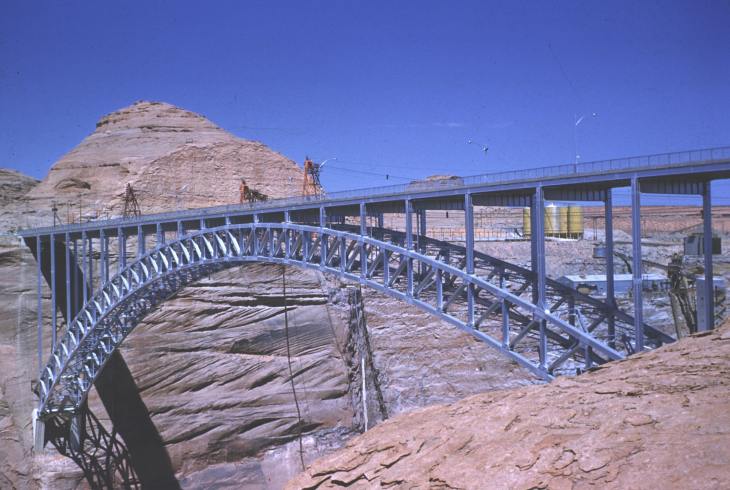
glen canyon bridge

Photo showing Glen Canyon Bridge. Photo by Greg Dimmitt or David Thompson during a South Cottonwood Ward river trip on the Colorado River around 1960 or 1961. Used by permission, Special Collections, J. Willard Marriott Library, The University of Utah.

The Glen Canyon Dam project was met with considerable outside protests, yet there were many issues with internal affairs as well. The Times Independent reported in the April 20, 1961, issue that Utah was one of the last affiliated states to actively support the filling and creation of Lake Powell. Once Utah politicians agreed on the project more trouble arose. Early into the construction process workers went on strike after wages were cut. The March 11, 1960, issue of the Salt Lake Times covered the workers’ strike, which forced Utah Senator Frank Moss to introduce a bill to the Treasury hoping to erase interest the project had accumulated during the period when no progress was made on the dam. The strike went on to delay completion of the dam by six months.

Glen Canyon Dam is an often unrecognized project which has helped shape the Southwest. The dam has been met with both praise and opposition. Millions have visited and enjoyed the Glen Canyon Dam and Lake Powell, while other groups still actively call for the dam’s decommissioning. The Glen Canyon Dam’s commissioning was a major factor in the development of the Southwest but this has certainly come at a price.

Daniel Belding is a senior at the University of Utah. He is majoring in communication.

Primary Sources

“Publication Outlines Utah’s Anthropological Sleuthing,” Daily Utah Chronicle, February 23, 1960, 3.

“Moss Asking Congress to Overlook Strike in Dam Interest Cost.” Salt Lake Times, March 11, 1960, 1.

“Glen Canyon To Be Topic For Lecture,” Daily Utah Chronicle, October 13, 1960, 2.

Richard Rosenbaum, “Salvage Movie with Talks Sparks Interest,” Daily Utah Chronicle, October 14, 1960, 2.

“Utah Backs Commission,” Times Independent, April 20, 1961, 2.

Secondary Sources

Dolan, Robert, et al. “Man’s Impact on the Colorado River in the Grand Canyon,” American Scientist 62, no. 4 (July-August 1974): 392–401.

Glen Canyon Unit,” United States Bureau of Reclamation.

Lavigne, Peter M. “Dam(n) How Times Have Changed…,” William & Mary Environmental Law and Policy Review 29, no. 2 (2005): 450-480.


Cartoonist Al Capp Gives Speech Offered Through the University of Utah’s Assemblies and Convocations Committee

By Taylor Barney

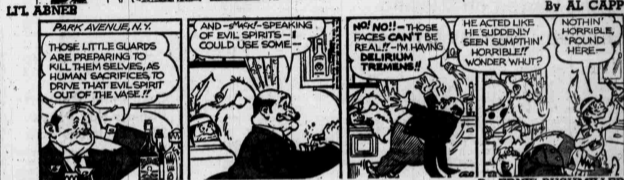
Alfred Gerald Caplin, better known by the abbreviated Al Capp, was a cartoonist from New Haven, Connecticut. Capp had gone to work for Ham Fisher, a cartoonist in Connecticut known for his popular comic strip, Joe Palooka. In 1933, while working on Joe Palooka, Capp introduced a hillbilly character into the comic’s cast of characters. This hillbilly character, a boxer from Kentucky named Big Leviticus, became a quick favorite of the comic reading public. So, when Capp quit working with Fisher, he decided to begin a new comic strip that took place in the South. Capp’s most famous comic strip, Li’l Abner, was established with this vision on August 13, 1934. (Studies in American Humor, 2001)

Li’l Abner became the biggest comic ever set in the South. At its height, the comic strip was read by “such great people as Britain’s Queen Elizabeth, and novelist John Steinbeck.” On top of the comic’s famous readers, it was being read by about “60 million readers in over 900 million American newspapers and 100 foreign papers in 28 countries.” (The Daily Utah Chronicle, 1960)


Screenshot 2019-12-04 at 11.43.23 AM

Provo Sunday Herald, October 2, 1960


Li’l Abner could locally be seen in the Provo Daily Herald, and had become a student favorite at the University of Utah. Al Capp was able to capture real-life happenings and make them into a satirical comic strip. In the October 6, 1960, issue of the Daily Utah Chronicle, a reporter gives a brief overview of just some of the topics that could be found in Li’l Abner, such as “sex, law enforcement, and the housing situation.” Al Capp was putting a humorous lens on top of things that were critical to the American life in 1960.

Screenshot 2019-12-04 at 11.42.44 AM

Al Capp addressed a large crowd at the University of Utah Union Ballroom. Daily Utah Chronicle, October 7, 1960.

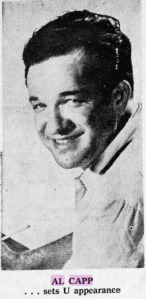
With Capp’s popularity among the University of Utah Students, he was a perfect fit to begin a set of speeches that were being offered by the University’s Assemblies and Convocations Committee. Capp’s speech was to take place on October 6, 1960, and was aptly titled “Al Capp Talks.” In an article titled “Capp and Cows” from the October 6 issue, a reporter observed, “To many, he is more than a satirist or a cartoonist; he is an institution.” Possibly the biggest indicator of just how popular Al Capp was among the students is shown in the September 22, 1960, issue of the Chronicle. In the issue there’s an article titled, “Top Speakers Set for Shows,” where the first speakers were announced for the Assemblies and Convocations Committees upcoming speaker series. Among the speakers were Dr. Martin Luther King Jr., then Senator Paul Douglas, and one of the most widely known American columnists at the time, Drew Pearson. In front of all of those names, and with a large photograph right in the middle of the article, is none other than Al Capp.

Screenshot 2019-12-04 at 11.46.07 AM

A portrait of Al Capp appeared in the Daily Utah Chronicle issue of September 22, 1960, with the article, “Al Capp Sets U Appearance.”

During his speech at the University of Utah, Capp touched on every one of his major topics while still finding a way to surprise the audience. In the Chronicle article, “Capp Treats Campus, Lampoons Television,” the reporter said that Capp had spoken on “everything from his suspicion of lawyers with three names to his opinion of abstract art.” Reading through the article gives a wider view of just what type of comedy and satire Capp was giving in his speeches, and it’s easy to see why college students of the time were infatuated with the man. The article brings up how Capp could also tone it down and become very serious. At one point Capp “drew a modern comparison between television programs and Fagin of Dickens’ ‘Oliver Twist.’” He delved into politics when he said about war, “Less emphasis should be placed upon which world political faction is better prepared to destroy the other and more upon the fact that this destruction could take place.” After a night of laughter and wisdom, a full Union Ballroom crowd was complimented when Al Capp said how much he had enjoyed Salt Lake City and the University of Utah. Capp left the crowd with this final thought, “The American Humorist is freer to print what he wants to today than he has ever been before.” (“Capp Treats Campus”)

In summary, Al Capp was a prominent figure in 1960. He gained popularity from his Li’l Abner comic strip, where readers found real-life issues that were brought forward with a satirical view. He then toured the country giving speeches at multiple universities, where the students enjoyed his anti-war, anti-establishment talking points. In the 1960s Capp was showing a rather progressive viewpoint through his speeches and cartoons, and students across the country were able to find someone who spoke in a way that resonated with them.

Taylor Barney is a senior at the University of Utah, where he is studying communication with an emphasis in journalism.

Primary Sources

Top Speakers Set For Shows,” Daily Utah Chronicle, September 22, 1960, 4.

Al Capp, “Li’l Abner,” Provo Sunday Herald, October 2, 1960, 19.

Al Capp, “Li’l Abner,” Provo Daily Herald, October 3, 1960, 13.

Capp’s Lecture Kicks Off ’60 Guest Speaker Series,” Daily Utah Chronicle, October 4, 1960, 1.

Capp Speech Set For Union Tonight at 8:15,” Daily Utah Chronicle, October 6, 1960, 1.

Capp and Cows…,” Daily Utah Chronicle, October 6, 1960, 2.

Capp Treats Campus, Lampoons Television,” Daily Utah Chronicle, October 7, 1960, 1.

Secondary Sources

Arnold, Edwin T. “Abner Unpinned: Al Capps “Lil Abner,” 1940-1955,” Appalachian Journal 24, no. 4 (Summer 1997): 420-436.

Inge, Thomas. “Al Capp’s South: Appalachian Humor in “Li’l Abner,” Studies in American Humor 3, no. 8 (2001): 4-20.


Guest Lecturers at the U: From Cartoonists to Civil Rights Leaders

By Rahul Barkley

The importance of racial diversity in higher education should not be understated. The lack of racial diversity on a college campus can lead to skewed prioritization and underrepresentation while an ethnically diverse campus that encourages cross-race socialization and frequent discussion of racial issues can result in self-confidence, positive interaction between students, and overall college satisfaction. (Gonzalez, 2012) With the topic of racial diversity, reflecting upon historical contexts can provide integral insight on issues of race within a collegiate setting.

In the Fall 1960 semester at the University of Utah, a lecture series sponsored by the ASUU Assemblies and Convocations committee and the Extension Division was entering its third season. The goal of this series was to give “students and faculty a chance to hear the views of some of the world’s great people on some timely and critical problems.” (1961 Utonian, p. 203) Several notable speakers were scheduled to speak throughout the 1960-61 school year. Looking back, it is notable to point out the various speakers that the University of Utah was able to get. From politicians to columnists to anthropologists, the student government undoubtedly succeeded in obtaining an eclectic roster of guest lecturers. What is more interesting, however, is how the University’s media covered the appearances of certain speakers. The University of Utah was a considerably less diverse institution in 1960 and with that, it is important to look at how the school’s media outlets might have prioritized certain speakers depending on their race.

MLK

Dr. Martin Luther King Jr. during his visit to Salt Lake City on January 31, 1960. Image courtesy of Special Collections, J. Willard Marriott Library, The University of Utah.

The Daily Utah Chronicle first covered the lecture series on October 3, 1960, by primarily giving attention to the speaker who was going to start off the lecture series, Al Capp. The article gave background information on Capp’s world-renowned work as a cartoon artist. The article concluded by listing some of the other lecturers who would come to speak later that year. One of the speakers who was mentioned was Dr. Martin Luther King Jr. The following day on October 4, 1960, The Chronicle followed up with a similarly structured article.

This is where the question of prioritization comes in. Is it right to rate the value of certain individuals’ contributions to society? From a 2019 lens, one would probably argue that King had a far greater and important impact on American culture than Al Capp did. Even for the time, King had already made some monumental strides in the Civil Rights Movement. Did America in 1960 not value the contributions of the civil-rights activist? The more likely answer is that the predominantly white University of Utah could not foresee how important King was as an individual.

Eventually, King was given his own article once it came close to the time of his appearance. The January 30, 1961, issue of The Chronicle described King with just reverence and respect when giving readers background information on the speaker who would soon visit their school. Another article was written in The Chronicle about King on the day of his lecture on January 31, 1961, this time offering specific details on what the topic of his lecture was going to be on. The article quoted the subject of his lecture as “The Future of Integration.” (Daily Utah Chronicle, 1961)

MLK and Williams

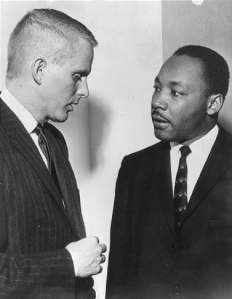
Dr. Martin Luther King Jr. speaking with political science professor J. D. Williams during King’s visit to the University of Utah. Image found through the Deseret News archives.

Should there have been more attention given to the appearance of Martin Luther King Jr. in those initial Chronicle articles? Or was it sufficient to give him his exposure during the time of his lecture? Given the aforementioned goal of the lecture series, more coverage should have been given to King’s appearance considering that the Civil Rights Movement was a central part of arguably the most “critical problem” that America had been facing at the time. This problem is further highlighted in the fact that King’s arrival in Salt Lake City for the event was delayed an hour due to a bomb threat. (House, 2012) Surely none of the other guest lecturers faced a detriment like that. And surely The Chronicle could not have foreseen such a thing happening to King, but it should have made clear after the fact of who would have been the most important speaker of that lecture series.

Rahul Barkley is a fourth-year student at the University of Utah. He is a double major in strategic communication and film and media arts.

Primary Sources

“Dogpatch Ambassador to Speak,” Daily Utah Chronicle, October 3, 1960, 1.

“Capp’s Lecture Kicks Off ’60 Guest Speaker Series,” Daily Utah Chronicle, October 4, 1960, 1.

Elaine Krans, “Martin Luther King Sets Campus Speech,” Daily Utah Chronicle, January 30, 1961, 1.

“Southern Leader Speaks of Race Problem Tonight,” Daily Utah Chronicle, January 31, 1961, 1.

The University of Utah, Utonian (Salt Lake City, Utah: 1961), 203.

Joe Bauman, “King’s visits to Utah are chronicled,” Deseret News, January 19, 2009.

Secondary Sources

House, Dawn. “Civil rights speaker questions Utah’s History with Martin Luther King Jr. Day,” The Salt Lake Tribune, January 6, 2012.

Clarke, Chris Gonzalez. “Rethinking Research on the Impact of Racial Diversity in Higher Education,” Review of Higher Education 36, no. 1 (December 2012).