Robert Redford: The Creation of the Sundance Institute and Film Festival

by L. WYLIE SHEPARD

Introduction: The Sundance Film Festival is deeply rooted in a quarter-century of history beginning with the Utah Film Festival. The Festival was introduced in 1978 by the Utah Film Commission in an effort to “promote tourism” in Salt Lake City. (Malserger, 38) The early years of the Utah Film Festival were fairly successful but equally rocky. Debt not only plagued the Festival, but also caused its continuation. In 1981, the Festival was relocated to the small ski town of Park City, Utah, and was moved from September to January with the intention of attracting a new, more elite crowd. (Smith, 50) The Festival became known as the Utah/United States Film Festival in the following years but continued to diminish. As the 1984 Festival approached, many believed it would see its last season. Meanwhile, in nearby Provo Canyon, Robert Redford had created a phenomenon in the world of filmmaking known as the Sundance Institute. It was a center to advance the world of independent filmmaking and his success would not go unnoticed by the struggling Utah Film Commission.

Findings: In the early 1960s, Robert Redford was a rising star in Hollywood, but the constant publicity and demands of success led him to the Utah Mountains in an attempt to escape from his current reality. In 1969, Redford purchased a vast section of Provo Canyon, including a small ski resort, as the “ideal locale for environmental conservation and artistic experimentation,” as well as his new home. (sundanceresort.com) Redford named the land Sundance, utilizing the success of his recent role in Butch Cassidy and the Sundance Kid, and he began to focus on his intentions to “marry the arts community to Sundance.” (Smith, 26)

In an article published by The Salt Lake Tribune on December 9, 1990, Redford explained his plan to create an institute, which would “concentrate on film making from the other end, beginning with the script.”

In November 1979, Redford began this process with a three-day planning conference for what would be deemed the Sundance Institute. The conference concluded that it “would emerge as a center, a resource, bringing together talented aspiring filmmakers with collaborating skilled professionals in an extraordinarily supportive environment, which would allow greater experimentation with scripts, direction, and performance.” (Smith, 37) In the following years, Redford worked with the National Endowment for the Arts to secure a budget for what would be known as the Sundance Institute’s June Laboratory.

The first Sundance Lab was held in 1981, in which a select group of 65 students were chosen to spend four weeks with the industry’s most prominent directors, actors, writers, and producers in order to take their abilities to the next level. Redford saw this as expert tutoring, in which workshops enabled filmmakers to take risks without penalties and potentially secure themselves as spot in what had now become the Utah/United States Film Festival. The immediate success of the Sundance Institute was not anticipated and it concerned Redford.

In a February 1985 interview with the Los Angeles Times, Redford stated, “It’s dangerous, I wanted filmmakers to have a place to struggle and make mistakes. I think a focus on our success won’t be fair to the filmmakers or the process.” The Institute soon gained recognition in Hollywood and the Utah/United States Film Festival quickly noticed that the Lab’s students were continually submitting winning films.

By 1984, many believed the Utah/United States Film Festival had run its course, but Redford’s passion and determination for the future of filmmaking had led those involved to believe that the Sundance Institute could save the Festival.

Robert Redford speaking at the Sundance Film Festival. Photo by Calvin Knight courtesy of the Sundance Institute.

“I was never big on festivals,’” Redford explained to the Los Angeles Times in February 1985. “And when I was originally approached the first year to do this one, I said I’d be interested only if it emphasized independent film.” Redford hoped to use this as an opportunity to change the negative perception of independent filmmakers in Hollywood, according to an article published in the South Florida Sun-Sentinel in January 1987.

After the Sundance Institute had agreed to take over the 1985 Festival, the decision was made to change its name to the Sundance Film Festival, which was believed to add a dimension to the Institute. In December 1990, Redford relayed his belief to The Salt Lake Tribune that “it completes the connection, we have development in June, exhibition in January. We’re the only organization that offers the independent filmmaker that symbiosis between development and exhibition.” In a subsequent interview with the Tribune in June 1992, Redford detailed that the “annual Sundance Film Festival in Park City is the public expression of what his Sundance Institute does privately the rest of the year. The Festival is the showcase; the rest of the year is labor.”

In Benjamin Craig’s novel, Sundance: A Festival Virgin’s Guide, he explains that “the Sundance Institute and the Utah Film Festival had a natural connection from the start,” which was easily visible after the Festival completed its first successful year. The first year of the Sundance Film Festival marked the seventh year of the Festival as a whole and “there was no question that everything had changed.” (Biskind, 13) More than 80 films were shown, including the introduction of the international category; the previous year’s attendance was doubled, and the ongoing debt had reached its lowest amount since the Festival’s creation.

Conclusion: According to a January 1988 interview in the Los Angeles Times, “[Robert Redford] and the Sundance Institute are largely responsible for nurturing the event from relative obscurity to its current status as one of the top Film Festivals in the world.” After Sundance took control of the Festival, “1,500 people from outside Utah bought ticket packages, compared to 80 two years ago, and we’ve had to put a ceiling on the number of outside vendors which is almost unheard of.” It is believed to be the “flagship of the American independent film resurgence of the 1990s.” (Craig, 49)

L. Wylie Shepard is from Park City, Utah. She is a senior at The University of Utah and is majoring in mass communication.

Sources

Our Story,” Sundance Resort.

Kristina Malberger, “Sundance Film Festival,” VIA: AAA’s Travel Companion (January-February 2007).

“Sundance Institute Rises and Shines,” USA TODAY, May 15, 1998.

“Sundance Institute’s June Lab Gives Filmmakers a Head Start,” The Salt Lake Tribune, June 14, 1992.

Terry Orme, “After a Decade: The Sundance Kid on the Sundance Institute,” The Salt Lake Tribune, December 9, 1990.

Deborah Caulfield, “Movies,” Los Angeles Times, January 19, 1988.

“Redford Enjoying Building Institute to Aid Artists,” The Ottawa Citizen, July 8, 1986.

Deborah Caulfield, “Will Success Spoil Sundance?” Los Angeles Times, February 4, 1985.

Deborah Caulfield, “Robert Redford Lends Status to Film Festival,” Los Angeles Times, January 21, 1985.

“The Sundance Institute’s First Festival,” Original information packet, Park City, Utah (January 18-27, 1985).

Peter Biskind, Down and Dirty Pictures (New York, New York: Simon & Schuster, 2004).

Michael Feeney Callan, Robert Redford: The Biography (New York, New York: Alfred A. Knopf, 2011).

Lory Smith, Party in a Box: The Story of the Sundance Film Festival (Layton, Utah: Gibbs Smith, 1999).


The Civilian Conservation Corps and the Building of Zion National Park

by AMY D. WILDE

Photo courtesy of the Special Collections Department, J. Willard Marriott Library, The University of Utah.

Zion National Park is one of the United States’ natural hidden treasures and would not be the utopia that it is today without the efforts put forth by the Civilian Conservation Corps. Also known as the CCC, this program was created to help sustain jobs and to give opportunity to the young unemployed men of the United States as well as to improve public lands during the Great Depression of the 1930s.

Signed as a national park in 1919, Zion is one of Utah’s best-kept secrets and the first national park of the state. Mukuntuweap Canyon, which was the original name for Zion Canyon, was the  “cool habitat that became the home for the first people of Utah … around 11,000 B.C.,” writes David Oswald in his book, A Journey Through Mukuntuweap: The History of Zion National Park. Located in the southeast corner of the state, Zion is a spectacular Park that can only be accessed by one double-lane state road, which is closed to public traffic in the summer months. Instead, visitors ride park-run busses that help keep the park almost emission free, clean and pristine. One thing that is more than likely forgotten by the visitors who come to the park is the history and how it came to be. Zion not only has a rich history of Native American culture but also an opulent history that involves the growth sustainability of the United States as a country.

President Franklin Delano Roosevelt established the CCC on March 31, 1933. The organization was created to fight against soil erosion and declining timber resources by utilizing unemployed young men from large urban areas across the country. It is said that “the speed with which the plan moved through proposal, authorization, implementation and operation was a miracle of cooperation among all branches and agencies of the federal government. It was a mobilization of men, material and transportation on a scale never before known in time of peace.” (CCC Legacy) After establishment the program boomed, and held great public support with hundreds of thousands of young workingmen enrolling every day.

Zion Canyon, Zion Lodge, circa 1930. Photo courtesy of the Special Collections Department, J. Willard Marriott Library, The University of Utah.

The Zion Camp was established in June 1933 and began to flourish not too long after. A newspaper ad from the Garfield County News on September 9, 1941, ran with a title, “Openings Announced in Zion CCC Camp.” An excerpt reads, “During this period of National Emergency there is a great demand for trained workers and the Civilian Conservation Corps performing its share of training young men for better jobs.” It gave insight into the demand for workers and the scarcity of position openings at the camps during their peak years. During the nine years that the CCC spent creating Zion, members “built and improved many of the Zion Canyon’s trails, created many of the parking areas, fought fires, eradicated invasive plants, helped build campgrounds, built park buildings, and reduced flooding of the Virgin River.” (NPS)

The booming year for the CCC camps was 1935 and by the end of the year, there were over 2,650 camps operating in all states. In total, $322,682 was spent expanding the Zion National Park through the CCC, according to Wayne K. Hinton in his 2011 Utah Historical Quarterly article. California had more than 150 camps, each housing over 6,000 people. CCC enrollees were performing more than 100 kinds of jobs and skills. Some of the specific accomplishments of the Corps included 3,470 fire towers erected; 97,000 miles of fire roads built; 4,235,000 man-days devoted to fighting fires; and more than three billion trees planted. (CCC Legacy)

For payment, the men were given somewhere to sleep, food to eat and clothing to wear, and made about $30 a month. Most of them kept $5 and the remaining $25 was sent home to their families. (Oswald) Topics regarding the “hearty Army meals and menus,” the clean hospitality that was given to the workers, as well as the hefty budget that was dedicated to running the camps can be seen in an article from the Kane County Standard on February 15, 1935. The reporter writes, “When the American boy of today goes into the woods he takes his appetite with him no less than his older brother took and appetite to war in other days.” Men gained an average of “9 ¾ pounds” after working in the camps for only three months, according to an article form the Iron County Record published on March 8, 1934. This information was noteworthy news because of the Great Depression in which the rest of the country was rationing food and supplies. Working for the CCC was not only beneficial to the country, but also for the workingmen who got the opportunity to enroll.

The men spent all week completing backbreaking jobs around the park, including building the 1.1-mile tunnel through a solid mountain. But they still had the energy to spend time taking hikes throughout the park on the weekends. One example of this is from the diary of Belden Lewis, a CCC enrollee who worked in the park from 1934-1935.

“I went on a long hike. First to West Rim, then on the way back Widdison and I went to Angels Landing and signed our name in the autograph book. The hike was at least 25 miles long round trip and we were tired.”

These places that Belden mentions are some of the most popular hikes in the Park and today are very frequently traveled trails, which were created by the CCC. “The main roads and trails of the canyon were built, including the trail to The Narrows by the men of the CCC.” (Larson) The men worked extremely hard on creating the beautiful park that we see today, but also had the amazing opportunities to explore the park themselves.

The CCC did wonders for Zion and almost the entire park holds the history of this hard time for the United States. When the Civilian Conservation Corps’ work in Zion was ended in 1942, many of the men were able to transition from structured CCC life to the structured life of a military man as they fought in World War II. The CCC was essential in the creation of Zion and without their work it is hard to say what would have became of the canyon, if anything.

Today, more than 2.5 million curious patrons visit Zion National Park annually, and many hope to catch a glimpse of the sun rising on the Towers of the Virgin. In the summer months, busy sightseers crowd the paths like sidewalks in New York City during rush hour, and walk upon trails created by the CCC. Zion National Park holds nothing less than the jaw-dropping landscapes and awe-inspiring cliff faces one would assume. There is nothing like it in the world and without experiencing this veiled sandstone treasure with your own eyes, you cannot say that you have seen the earth’s natural true beauty.

Amy D. Wilde is a senior at The University of Utah. She is majoring in mass communication and minoring in international studies.

Sources

“Openings Announced in Zion CCC,” Garfield County News, September 9, 1941, 1.

“Supt. Patraw Praises CCC,” Kane County Standard on February 15, 1935, 1.

“Men of CCC Camp in Good Condition,” Iron County Record, March 8, 1934. 1.

“CCC Camp Now Located at Zion Nat’l. Park,” Iron County Record, August 2, 1934. 1.

Wayne K. Hinton, “Getting Along. The Significance of Cooperation in the Development of Zion National Park,” Utah Historical Quarterly (2000): 313.

Karl A Larson, “Zion National Park—Park with Some Reminiscences Fifty Years Later,” Utah Historical Quarterly (1969): 408I.

David Oswald, A Journey Through Mukuntuweap: The History Of Zion National Park (Scotts Valley: CreateSpace, 2009).

J.L. Crawford, Zion National Park: Towers of Stone (Albion Publishing Group, 1988).

Zion National Park Museum, “The Diary of Belden Lewis,” 1934-1935.

National Park Service, “Civilian Conservation Corps,” http://1.usa.gov/HjZiGs

“CCC Brief History,” Civilian Conservation Corps Legacy, http://bit.ly/Hiaym9

Flood Watch 1983: Newspaper Coverage of the Flooding of Thistle and Salt Lake City

by JAMES STARBUCK

During the spring of 1983, Utah was awakening from one of the wettest winters on record. The previous year saw record precipitation and, in the latter part of 1982, summer rains continued through the fall. Rainfall eventually turned to winter snows and, in the process, saturated the ground beyond its capacity. What was left in the spring was an unusually large snowpack that was waiting to release its moisture down the mountain streams. In normal years the snowpack melts slowly due to air temperatures that gradually warm through late June. This particular season, however, saw a very rapid warm up that created an equally rapid snowmelt and high run-off that overwhelmed local streams, buried a town underwater, and turned streets into rivers.

Throughout this record water year, each new storm was adding to a narrative that would become the prominent news story from mid-April through mid-June 1983. This narrative was conveyed through the two local newspapers, The Salt Lake Tribune and the Deseret News, and each story seemed to be a precursor to the subsequent stories that followed.

What would follow was a flood that had a lasting impact on Utah’s capital city and northern Utah, in general. This flooding was the result of heavy precipitation that accumulated during the 1981-82 water year, which began in October 1981, and culminated in September 1982. According to Linda Sillitoe in her article, “Floods,” it was a “water year that had broken all records; then September 1982 climaxed with ten times more moisture than normal.” Within this last month of the water year, saturated ground turned to mudslides that closed Big and Little Cottonwood canyons and flooded creeks to the point that the state’s Governor, Scott Matheson, declared a state of emergency, although federal aid was denied. (Sillitoe) September’s floods paled in comparison to what the following spring had to offer.

By spring, March again saw record rain and snowfall on top of soil that had reached its limits of absorbing water, and this record moisture continued on through April 1983. The soil limitations became evident on April 15, when a mountainside in Spanish Fork Canyon began to move and forced authorities to close the canyon. This mudslide was threatening U.S. Highway 6 and two railroad tracks and could potentially disrupt transportation and interstate commerce. The Salt Lake Tribune reported on Saturday, April 16, 1983, that during the previous afternoon, “the highway was measured at rising about a foot an hour. It is now about 15 feet higher than the original roadbed.”

In contrast to the reporting in The Salt Lake Tribune, the Deseret News took the opportunity to report on the impact the slide would have on the last run of the Rio Grande Zephyr, “the nation’s last privately owned, inter-city passenger railroad,” that was scheduled to run on April 24. (Fackrell) Inclusion of this bit of information brought a somewhat personal, or humanistic, approach to the paper’s reporting.

As the slide began to dam off the Spanish Fork River, rising waters were threatening the nearby town of Thistle. On April 17, 1983, the Deseret News stated that crews were giving up on “trying to keep the road or the railway open through Spanish Fork Canyon and will now concentrate on keeping residents of Thistle and nearby areas from being flooded.” The Tribune reported that within Thistle, 72 families were evacuated “as water backed up behind millions of tons of heaving, sliding mud.” (Clark)

By Tuesday, April 19, 1983, this rising water was now being called Lake Thistle. The township of Thistle was doomed. Already, the 22 homes that occupied the area were inundated by the lake, now as deep as 50 feet, and The Salt Lake Tribune reported that the town “is up to its rooftops in gray water. Thistle may be no more.” The Deseret News again added a human touch by reporting that “some of the residents are staying with friends and relatives and others in trailers set up in the Canyon Ward church house.” (Ward, Martz)

Federal aid finally came to the residents of Thistle on April 30, 1983, as President Ronald Reagan approved Utah’s request for disaster status for the Spanish Fork slide.  The Salt Lake Tribune reported on May 1 that the “emergency declaration could provide family financial relief grants and temporary housing assistance.”

In areas surrounding Thistle, similar slides were beginning to form, such as in nearby Payson Canyon. The Salt Lake Tribune quoted Utah County Sheriff’s Lt. Gary Clayton as saying that the slide was “a loaded gun up there just waiting to go off.” (Raine) This was a common sentiment felt across all of northern Utah as other streams and rivers were beginning to feel the strains of the spring runoff.  On May 1, 1983, an article in The Salt Lake Tribune prophesied on the floods that would threaten Salt Lake City. The article noted that the National Weather Service expected heavy rains that would cause “flash flooding and standing water in intersections and underpasses throughout the Wasatch Front.” The article also noted that the snowpack, which was only beginning to melt, contained 33 percent more water than the previous year and would strain the streams already swollen with run-off and steady rain. (Clark)

It would be nearly a full month after the Spanish Fork slide that the areas located in Salt Lake County felt the brunt of the melting snowpack. Spring storms were still falling on northern Utah throughout May, and by mid-month it was evident that disaster would soon strike Salt Lake City. On May 17, the result of these storms was beginning to show as “the rain and snow filled Red Butte and Emigration Creeks to overflowing and in some areas the bubbling water flowed into curbs and gutters.” (Sorenson) It was the same story in the surrounding suburbs of Salt Lake City, and the nearby towns located in Davis and Utah counties, as the groundwater began to push above ground. Eventually, the rains were reduced to isolated storms, but in their wake the makings of a “worst-case scenario” was brewing.

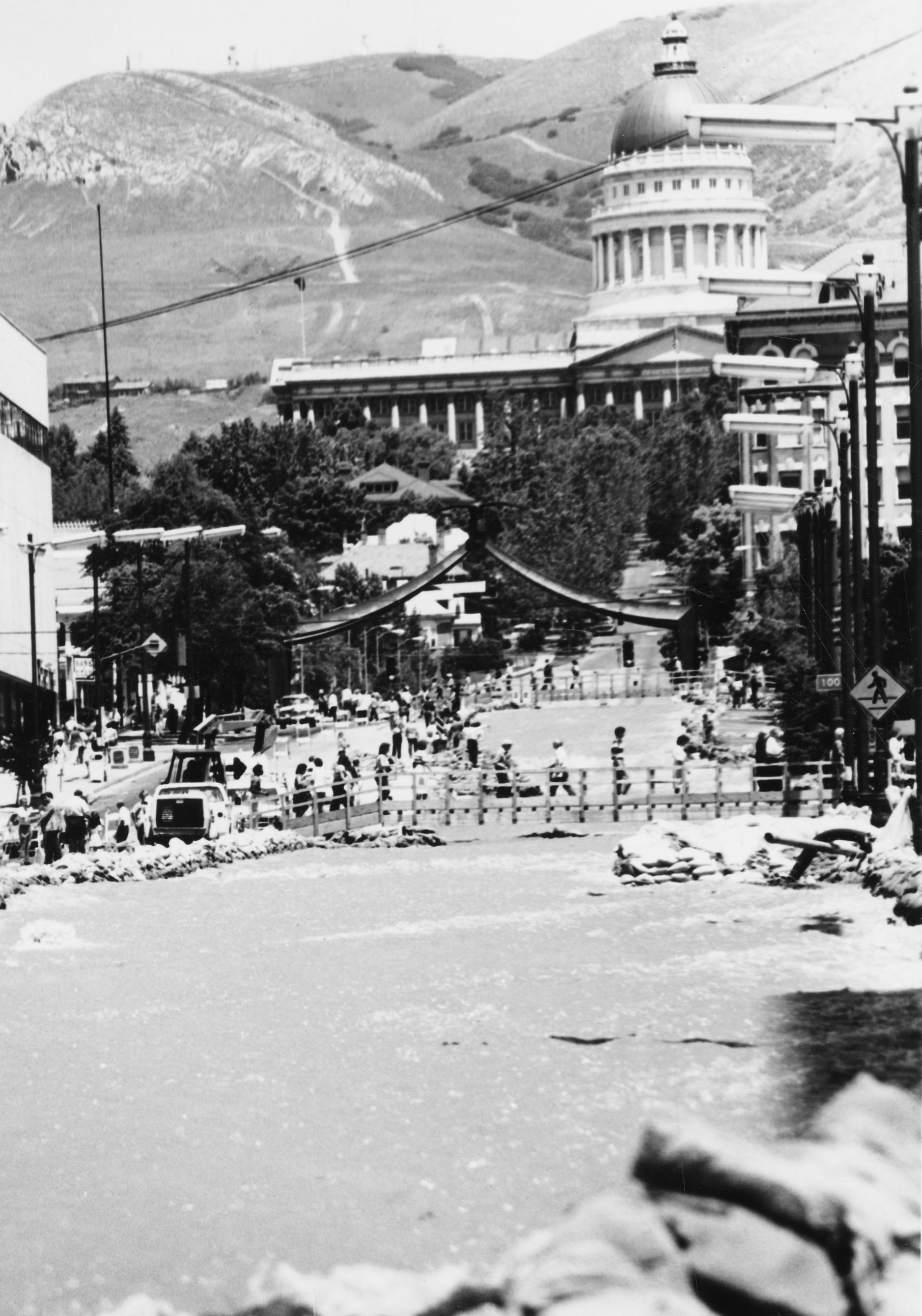
Sandbagging efforts created manmade rivers in Salt Lake City over Memorial Day weekend in 1983. Courtesy of Special Collections, J. Willard Marriott Library, The University of Utah.

By the end of May, the rains had given way to higher temperatures that soared into the 80s. (Sillitoe) As The Salt Lake Tribune put it, “The sins of Winter have been visited upon the Spring.” On May 26, crews began setting up dikes and stacking sandbags along the east-to-west thoroughfare of 1300 South to convert it into a river that would run from State Street westward to the Jordan River. Things then went from bad to worse during the Memorial Day weekend as temperatures rose into the 90s. (Sillitoe)

Water began flowing down the makeshift river on Friday, May 27, between dikes that were seven feet high. The waterway was also extended six blocks eastward to accommodate the overfilled reservoir in Liberty Park. The Deseret News noted that “traffic was snarled … as crews blocked major roads and turned them into rivers.” (Davidson) Around the Salt Lake Valley, the melting snowpack was overfilling the numerous creeks and streams and prompted Salt Lake’s mayor, Ted Wilson, to declare a state of emergency for the city. City and state officials also began pleading with the public to supply volunteers to help with the sandbagging efforts in and around Salt Lake.

The next day, May 28, in a downtown park known as Memory Grove, water surged over a pond and sent City Creek rushing down both Main Street and State Street. (Ure) It was this event that made the flooding front-page news in the Sunday paper as the water flow from the creek “set a record of 234 cubic feet per second; the old record was 156 feet per second.” ( Ling, Dowell, Pressley) Previously, the coverage of the flooding had been placed in the local sections of both papers, but this changed once the capital city was affected. That night, road crews and volunteers began the construction of a second river to divert City Creek southward down State Street.

To save the local businesses from water damage, volunteers worked on through the morning of Memorial Day rerouting the creek from Temple Square to 400 South in downtown Salt Lake City, turning the city into a modern Venice. Whether it was in the spirit of the holiday, or the fact that disaster had been averted, once the water began to flow an impromptu “street festival” broke out among the 4,000 or so volunteers who helped build the waterway. (Ward, Davidson)

City Creek flows down State Street as pedestrians cross makeshift bridges. Courtesy of Special Collections, J. Willard Marriott Library, The University of Utah.

This festive sentimentality was also evident as the Deseret News attempted to add a little tongue-and-cheek humor to the situation. In its Sunday edition, the paper laid out instructions on “how to turn a street into a canal,” and listed the four necessary ingredients: “thousands of tons of dirt, a multitude of volunteers, a few thousandths of an inch of plastic, and, of course, water.” (Warchol) Already, these rivers in the middle of the city were becoming something of a novelty.

In the few weeks to follow, wood bridges were constructed to allow for pedestrians and vehicles to cross the river and linked downtown with Interstate 15. Restaurants also capitalized on the novelty as office workers navigated around the waterways during their lunch hours. (Sillitoe) At times, an occasional fisherman could also be seen casting his lure into the brown waters from one of the bridges.

Eventually, the streets dried up and the numbers were tallied. On June 9, 1983, The Salt Lake Tribune relayed the figures calculated by the Utah Department of Transportation, which put the damage to roadways at around $63 million. The Great Salt Lake had also risen over 4.4 feet and was continuing to rise. This was five feet above what was called the “compromise level.” (Fehr)  In a controversial move, Gov. Norm Bangerter ordered giant pumps that were installed in 1987 to lift the water out of the lake and into the desert to evaporate, to the cost of $65 million. (Fidel)

Both The Salt Lake Tribune and the Deseret News built upon this story as it evolved with each storm throughout the spring of 1983. Although television news covered the events, it was the newspapers that really captured the narrative with each article. Television was better able to show the devastation through aerial views, but only once the events took place. The newspapers were able to begin their coverage much earlier. Not only did they report on the events as they happened, they also helped to predict what was to become.  Within each weather forecast throughout the spring, the papers gave predictions for air temperatures as well as the effects that the ongoing precipitation would have on future flooding.

The newspapers also helped the public to be informed on flood areas around the state. Although the events in Thistle and Salt Lake City were the prominent news stories, there were several other areas that were affected by the flooding as well. By the end of May, updates were regularly printed that gave accounts of flooding in specific areas. The narrative that came out of each article, fully told the story of how “the desert did more than bloom like a rose. It became waterlogged.” (Fehr)

James Starbuck is a junior at The University of Utah.  He is majoring in mass communication with an emphasis in new media and is minoring in arts and technology.

Sources

Jerrie S. Fackrell, “Crews give on canyon roads, tracks,” Deseret News, April 16,  1983, B1.

Ann Shields, “Shifting Mud Clogging Spanish Fork Canyon,” The Salt Lake Tribune, April 16, 1983, B1.

Doug Clark, “Mountain Collapse Stops River, Destroys Town,” The Salt Lake Tribune, April 18, 1983, B1.

George Raine, “Wall of Debris Holding Water Back,” The Salt Lake Tribune, April 18, 1983, A1.

John Ward and Maxine Martz, “Slide turns mountain town into a lake,” Deseret News, April 18, 1983, A1.

Douglas L. Parker, “Reagan Approves Disaster Status for Slide,” The Salt Lake Tribune, May 1, 1983, B1

Doug Clark, “Crews Monitor Streams Rains Threaten Floods,” The Salt Lake Tribune, May 1, 1983, B2.

George A. Sorenson, “Storm Provides Flood Control Crews With Preview of Coming Disasters,” The Salt Lake Tribune, May 17, 1983, B1.

Lee Davidson, “Crews Turn Streets Into Rivers,” Deseret News, May 27, 1983, B1.

“Warm Days Heat Up Utah Flood Battle,” The Salt Lake Tribune, May 27, 1983, B1.

Glen Warchol, “How to turn a street into a canal,” Deseret News, May 29, 1983, A6.

Jon Ure, “Flooding Erupts From Memory Grove,” The Salt Lake Tribune, May 29, 1983, A1.

Ben Ling, Thomas R. Dowell, and Roderick Pressley, “Sandbaggers Turn State Street Into Aqueduct,” The Salt Lake Tribune, May 30, 1983, A1.

John Ward and Lee Davidson, “Storms threaten to aggravate flood nightmare,” Deseret News, May 30, 1983, A1.

Will Fehr, ed., Spirit of Survival: Utah Floods 1983, Indianapolis, IN: News & Feature Press, 1983.

Steve Fidel, “Chiefs from ’83 remember Salt Lake Floods and their impacts on conditions now,” Deseret News, April 20, 2011, http://bit.ly/higJCe

Linda Sillitoe, “Floods,” Utah History to Go, http://1.usa.gov/9GmOKI

1942: Developing the Topaz Community As Noted in The Topaz Times

by JESSICA BOUDAH

On September 11, 1942, the Central Utah Relocation Center – later known as Topaz for most of the Second World War – opened. The U.S. War Relocation Authority (WRA) imprisoned roughly 9,000 Japanese-American residents from the San Francisco Bay Area. Topaz, one of ten WRA incarceration camps, housed virtually all Japanese-Americans from the Bay Area by the end of the year. (Bankson)

Japanese-Americans from the San Francisco area, who had been held at Tanforan Race Track while Topaz was under construction, were transported to Delta, Utah, by train. (Beckwith) Upon the internees’ arrival at Topaz, many barracks and schools were not complete at the camp. (Beckwith) Beckwith also mentioned in her article that once situated, some internees “finished building their own barracks and other structures at the site.”

The Topaz Times, which was published at the Central Utah Relocation Center, was first published at Tanforan Assembly Center and then continued in Topaz until the camp closed in October 1945. The first issue printed in Topaz was printed on September 17, 1942. The Times was designed to inform its public on local events, community involvement, employment, education and religion.

In issue No. 1, The Topaz Times stated, “You will find various agencies of the United States Government have been mindful both of your needs and those opportunities which you desire in the fields of religion, employment, education, health and recreation.” The same article also states that the authorities of the center expected its internees to put in their best efforts in the “common objective” of developing the Topaz community to the “greatest degree possible.”

Most issues of The Topaz Times ranged from four to six pages in length. The first ten issues of the Times were called pre-issues. These pre-issues were published from September 26 to October 24, 1942. Within the first month of the camp’s opening, there was a great deal of internal action and organization necessary. As illustrated in eight of the first ten issues of The Topaz Times, there was a large amount of change in the society’s organization. In pre-issues No. 1 through 7, the main topics discussed were residential housing, education facilities and employment for internees.

With approximately 8,500 Japanese-American internees, it was deemed necessary to have immediate action on the internal organization. (Ostlund) Framework for a community council, as stated in the WRA Manual, was debated in a community meeting that was called in late September. According to an article in the pre-issue  published September 26, 1942, blocks 3, 5, 6, and 14 were to elect councilmen the following Monday. The article reported, “The vision of establishing Topaz into a model city came another step nearer to its realization as the machinery for self-government was being rapidly set up this weekend through the cooperation of the residents and the project administration.”

Association between the new community and its need for organization was an important theme in the first three pre-issues of the paper. Pre-issue No. 1 also stated that the Community Council would consist of one representative from each residential block, and later stated the members of the community council would possess some jurisdiction in the Topaz community:

“The Community Council will be authorized to ‘establish such regular and special committees and commissions as may be necessary to carry out its duties and functions or to cooperate with the Project Director in promoting the general welfare of the residents,’ according to a statement approved by Project Director Charles Ernst.” (The Topaz Times, September 26, 1942, 1)

According to an article by Clarence Ostlund, some earlier issues that faced the Community Council were: enacting a charter or constitution under which community-business could be legally transacted, labor problems, welfare and health problems, housing problems and fuel, education and recreation, work clothing problems, medical problems due to “lack of doctors,” medical supplies, equipment and hospital facilities. (Ostlund, Section I)

The issue of The Topaz Times published October 3, discussed the first eight members inducted into the Community Council in early October 1942. The new members of the Topaz Community Council were: Vernon Ichisaka (Block #3), Albert Kosakura (Block #5), Ernest Iivena (Block #6), Kay Nishida (Block #7), Dr. Carl Hirota (Block #12), Sam Yagyu (Block #13), Shinji Yamemoto (Block #14), and Paul Fuiii (Block #15). The same issue also described how the new officers repeated the following oath:

I solemnly pledge, as a member of the Community Council of Topaz, State of Utah, to uphold the Constitution of the United States and the related laws thereof. I further pledge my ideals, devotions and energy to the common welfare of all residents of this community: and to insure that my efforts will not be contrary to the basic principles of human rights.

Outlined in the October issue of the Times were the basic roles of the Topaz Community Council, which included: members were obligated to act in a legislative capacity, act in a liaison capacity, and to act in an advisory capacity.

In its first eight pre-issues, The Topaz Times also covered education – an important issue for the United States Government and the Japanese-American internees. Author Charles Wollenberg writes in the book, Schools Behind Barbed Wire, that “during WWII the United States government undertook an unusual educational enterprise – teaching students who were imprisoned behind barbed wire … an understanding of the American ideals, institutions and practices.” (210) The WRA soon found itself capable and “responsible for the education of more than 25,000 Japanese-American children,” not just at Topaz, but at other relocation centers as well. (75)

Pre-issue No. 6, published on October 10, 1942, is the first issue where we see education reach the front page of the paper. The paper reported that Robert E. Gibson, the Assistant Director of Education, would be visiting the city to assist with the “evolution of the educational curriculum” at Topaz. The issue suggested that Gibson believed that the “prevailing educational system in the average American community need[ed] reconstruction and that the WRA projects [had] the opportunity to set an example for America” in the Topaz community.

In the next issue, published on October 14, the headline read, “Housing For Schools Discussed Before First Public Hearing.” Educational systems were underway. When internees first started moving into the Topaz community, school buildings were not yet completed. The issue of the Times stated that at the public hearing, the need for an elementary and high school was deemed necessary. The same issue also discussed idyllic segmentation of the camp, and which block would be designated to which school building. The issue reports a motion by a Community Council member, Marii Kyoroku of the housing committee, who displayed a series of graphs that showed a breakdown of building space for the high school and elementary school. As written in pre-issue No. 7, “all of Block 32 be allocated to the high school” with 28 schoolrooms … and “half of Block S and half of Block 41 to the elementary school.”

The Topaz Times is extremely important to our present-day understanding and knowledge of the Relocation Center at Topaz. Now, we as researchers have the ability to understand what life was like at Topaz in 1942 through the articles and topics discussed in The Topaz Times. The development of community involvement became more prevalent within the Topaz society, as seen in the progression of the first eight issues of The Topaz Times. By 1943 camp life at Topaz “settled down” as residents got in the habit of gardening, attending classes at schools or recreation halls and working, according to an article from the Topaz Museum Web site. The Topaz Times helped develop the community life within the camp. By promoting community involvement with elections for the Community Council, and developing space for both an elementary school and a high school, The Topaz Times reassured the internees that Topaz was a “model city” and it would be developed into the greatest city possible – as stated in the first issue of The Topaz Times: Jewel of the Desert.

Jessica Boudah is a senior at the University of Utah, planning to graduate at the end of fall semester 2010. She is a mass communication major in the strategic communication sequence. Jess is originally from Burlington, Vermont, a small, idyllic town, also home to the University of Vermont. Currently, Jess works for the Salt Lake City School District as a tutor at Highland High School. She plans to acquire her master’s degree in education after receiving her bachelor’s degree in communication from The University of Utah.

Sources

Bankson, Russell A. “Guide to the Records of the United States War Relocation Authority Central Utah Project 1941-1945.” University of Washington Library.

Jane Beckwith. “Topaz Relocation Center.” Utah History Encyclopedia.

Clarence Ostlund, ed. “War Relocation Authority Central Utah Project Topaz, Utah.” Online Archive of California. The Bancroft Library, University of California, Berkeley.

“Greetings,” The Topaz Times, September 17, 1942, 1.

“Blocks 3, 5, 6, 14 to Elect Councilmen Next Monday,” The Topaz Times, September 26, 1942, 1.

“The City,” The Topaz Times, September 26, 1942, 1.

“More on Elections,” The Topaz Times, September 26, 1942, 3.

“Induction of 7 Councilmen Slated for 7:30 Tonight,” The Topaz Times, September 30, 1942,1.

“More on Community Council,” The Topaz Times, September 30, 1942, 5.

“Eight Representatives Take Council Oath Wednesday,” The Topaz Times, October 3, 1942, 1.

“More on Induction,” The Topaz Times, October 3, 1942, 2.

“Education,” The Topaz Times, October 10, 1942, 1.

“Housing for Schools Discussed Before First Public Hearing,” The Topaz Times, October 14, 1942, 1.

“Education,” The Topaz Times, October 14, 1942, 2.

Charles Wollenberg. “Schools Behind Barbed Wire.” California Historical Quarterly 55 (1976): 210-217.


The Circleville Massacre: A Tragic Event in Utah History

by THEADORA DAVIDSON

In history classes, as we go through school, we are told that history repeats itself. It’s for this reason that we take careful account of the past. It’s why media have covered many of our historical events, such as the sinking of the Titanic, World War II, and the assassination of John F. Kennedy. The media cover events like these so that they may become public knowledge, because if history repeats itself, as we’ve been warned, we would at least know what’s to come.

Occasionally, however, there are events throughout history that have escaped the media’s attention. That may be because an event happened in a remote location and the media just never heard of it, or the event may have been horrible, and the people involved made an effort to disguise what had happened. One such event is the Circleville Massacre. On April 22, 1866, the settlers of Circleville, Utah, slaughtered sixteen men, women, and children while the three youngest children were left alive and later adopted by the townspeople. (Gottfredson)

The Black Hawk War was being fought all around Circleville and its neighboring towns. When the settlers of Circleville heard of Indian uprisings not far from their home, they received instructions to be cautious of the nearby encampment of Paiute Indians. Bishop William Allred of the Church of Jesus Christ of Latter-day Saints sent a message to the Indian encampment asking them to come to town and read the notice they had received. A handful of Indians went into town and it was decided that the encampment would give up their weapons, and live peacefully with the settlers for the duration of the war. When the militia went to escort the remaining Indians to town, one man tried to escape and was shot and killed.

This act spurred the militia to arrest the entire encampment and hold them as prisoners in town. The men were held in the town’s meetinghouse, and the women and children were placed in an empty cellar. The townspeople, needing advice on how to proceed, sent a message to Colonel W.H. Dame. A passage from the message reads, “As we did not like to take the responsibility of deciding the course to be taken with the Indians.” (Winkler 16-17) Colonel Dame received the letter, and General Snow, who was with him at the time, left strict instructions for the townspeople of Circleville “to see that those prisoners were treated kindly and such only retained in custody as were found hostile or affording aid to the enemy. (Winkler 17) Sadly, Circleville’s militia did not receive the message soon enough. The Indians had attempted to escape, causing the settlers to act in haste and kill the imprisoned Indians one by one.

Martha C. Knack, in the book, Boundaries Between: The Southern Paiutes, 1775-1995, writes that the Indian men were gunned down, while the women and children had their throats cut. (Knack 85) The few newspaper articles that were written on, or around, the time of this massacre give very little information on what truly happened. The given date of the incident also ranges from April 21 to April 23, 1866. There is a dispute over how many Indians were killed. While the Winkler article says that it is unknown for sure how many Indians were killed, the Gottfredson article says that sixteen men and women were killed while three children were allowed to live.

Because a lot of information is missing from the actual event, historians have had to piece together what happened through accounts given by family members of those children who lived, and from the few references found in journals and letters of those involved. The newspapers of the time didn’t publish all that had happened at Circleville. Many articles glossed over the incident even 100 years later. In the April 23, 1960, issue of The Deseret News, there was an article with the headline, “Paiute County Colonies Abandoned.” According to the article, “The Circleville settlers retaliated for this raid by wiping out an encampment of Paiutes near the town.”

An article in the Richfield Reaper gives a slightly better description. “A few days before the ‘minute men’ arrived, there were a number of Indians camped nearby who pretended to be friends of the settlers, but who were spies. They had killed one man [and] wounded another who had managed to escape. The people were so enraged at this that they made short work of the 9 renegades who committed the treacherous act.” (“The Relief of Circleville”)

The only accounts we have with information of this event comes from the letters written by the militia leaders, and the accounts given by those few children who survived because they were thought to be too young to remember what occurred. Newspaper articles at the time generally glossed over the event as if it wasn’t a tragic event. Although the townspeople of Circleville tried to cover up the incident initially, what had happened was leaked and became known by the surrounding areas and the press. Even though the incident was mentioned in the press, it did not get much attention. An example of this is in the May 10, 1866, edition of The Deseret News: “In a skirmish with the savages, near Circleville, in that region, several of them got killed, but no whites.”

“The next consideration,” a guard recalled, “was how to dispose of the squaws and papooses. Considering the exposed position we occupied and what had already been done it was considered necessary to dispatch everyone that could tell that tale. Three [of four] small children were saved and adopted by good families.” (Winkler 18) This quote recalls how the settlers felt about what they had done. When the church leaders had heard of this crime, they were disgusted; however, there was never any mention of charges being pressed against any of the settlers involved.

Theadora Davidson is a junior at The University of Utah. She is majoring in mass communication.

Sources

“A Brief Resume of the History of Circleville,” Piute County News, June 20, 1947.

Phillip B. Gottfredson, “The Circleville Utah Massacre.” Blackhawk Productions.

Martha C. Knack. Boundaries Between: The Southern Paiutes, 1775-1995. Lincoln: University of Nebraska Press, 2001.

LaVan Martineau. The Southern Paiutes: Legends, Lore, Language, and Lineage. Las Vegas: KC Publications, 1992.

“More About the Indians,” The Deseret News, May 10, 1866.

John Alton Peterson. Utah’s Black Hawk War. Salt Lake City: The University of Utah Press, 1998.

“Paiute County Colonies Abandoned in Fear of Marauders,” The Deseret News, April 23, 1960.

“The Relief of Circleville,” Richfield Reaper, July 10, 1909.

“The Sevier Region,” The Deseret News, June 9, 1891.

Albert Winkler. “The Circleville Massacre: a Brutal Incident in Utah’s Black Hawk War.” Utah Historical Quarterly (1987): 4-21.

Utah’s Spiral Jetty: Art and Nature Collide

by MADELINE VANDEVER

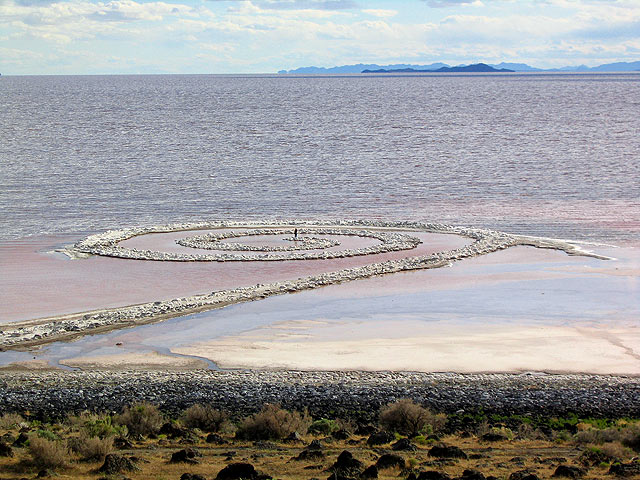
Photograph of the Spiral Jetty at Rozel Point by Soren Harward.

The Spiral Jetty is a man-made, sculpted work of art by artist Robert Smithson. It is located on the northeastern shore of the Great Salt Lake, near the Golden Spike National Historic Site. Smithson used black basalt rocks and earth from the area to create the Spiral Jetty in 1970. The Jetty is in the shape of a spiral coil that is 1,500 feet long and 15 feet wide, and it took six days to create. It reaches out counter-clockwise into the red waters of the area. The Spiral Jetty was acquired by Dia Art Foundation, based in New York, as a gift from Smithson’s estate in 1999. It has worked diligently to preserve the Spiral Jetty since the acquisition, according to the foundation’s Web site.

The Spiral Jetty is a highly regarded and well-respected work of art that tourists and art enthusiasts alike can enjoy and appreciate. In 1972, The New Yorker referred to it as Smithson’s “most ambitious [project] to date.” The Jetty is only visible when the water level of the Great Salt Lake is low enough, giving the Jetty an air of rarity and mystique among those who seek it. The Jetty was not visible for many years in the 1980s, resurfacing briefly in the 1990s only to disappear once again. Today, the Jetty is entirely visible.

Because the Spiral Jetty exists within a natural, outdoor setting, it has been the center of some controversy between environmentalists, art enthusiasts and oil drillers. An editorial published in The Free Lance-Star in 1981 referred to the Jetty as a “curling path of rock bulldozed into Utah’s Great Salt Lake,” addressing concerns over environmentally destructive works of art such as the Jetty. There has been some controversy regarding the Spiral Jetty and mining. The New York Times has published articles discussing how art enthusiasts believe the Jetty should be left alone, while mining and drilling proponents think that the land surrounding the Spiral Jetty should be fair game for Utah’s mining industry. In one article, John Harja, director of the Utah Governor‘s Public Lands Policy Coordination Office, said, “Like everywhere in the West, the lake is being discovered and people want to protect it and people want to use it.”

Photograph of the Spiral Jetty by Michael David Murphy.

The Jetty has also served as a great location for amateur, nature and art photographers due to its unique design and all-natural landscape. Of the included photographs, two were taken at Rozel Point, which is slightly northeast of the Jetty and a popular spot for photographers to capture the Jetty in its entirety. The aerial photograph was featured on a New Jersey public television (NJN) program titled, “State of the Arts” for their Forces of Nature segment, demonstrating that interest in the Jetty is not only at a local level, but a national one as well. Many pictures of the Jetty have been taken over the years, some while the Jetty was fully exposed, others while it was barely visible above the waters of the Great Salt Lake. According to the Dia Art Foundation’s Web site, no permits or special permissions are required to take photographs of the Jetty.

As for artist Robert Smithson, he did not live to see the Spiral Jetty gain momentum in the press, or attention from fans. He died on July 20, 1973, at age 35 in a plane crash in Texas. Following his death, The New York Times wrote, “When a culturally significant person dies, there may occur for the living a moment of illumination, not only of one career but of a whole nexus of events and meanings into which that career was woven.” Smithson and his Spiral Jetty have gained a number of fans posthumously, including a number of fellow modern artists.

Aerial view photograph of the Spiral Jetty courtesy of NJN Public Television.

The Spiral Jetty has been called one of Utah’s best kept secrets by some. Smithson revealed in an interview with Paul Cummings that he felt the Jetty possessed a “prehistoric motif,” making it a timeless work of art in the spirit of Earth’s histories. The visitor’s center at Golden Spike National Historic Site serves as an unofficial information center for the Spiral Jetty where fans and curious onlookers can go for directions and information. Writer Kirk Johnson from The New York Times discusses the controversy that exists between the state of Utah and the Dia Art Foundation over the land surrounding the Spiral Jetty. The Utah state government, which includes the aforementioned Governor’s Public Lands Policy Coordination Office, is interested in drilling oil near the site, while the Dia Art Foundation feels that oil rigs would harm the work’s aesthetic experience. As of today, the future of the Jetty is uncertain. The debate over drilling near the site is still ongoing, and the Jetty is not visible indefinitely. However, this unique piece of artwork has carved itself an important place in Utah’s artistic and geographic history.

Madeline Vandever is a mass communication major at The University of Utah. She plans to graduate in May 2011 and will then pursue a Master’s degree in elementary education.

Sources

Calvin Tomkins, “Onward and Upward with the Arts: Maybe A Quantum Leap,” The New Yorker, February 5, 1972, 42.

George Will, “Pistol-packing ‘artists’ may reflect mood of world,” The Free Lance-Star, August 1, 1981, 3.

Peter Schjeldahl, “Robert Smithson: He Made Fantasies as Real as Mountains,” The New York Times, August 12, 1973, 127.

“Robert Smithson, 35, A Sculptor, Is Dead,” The New York Times, July 24, 1973, 41.

Kirk Johnson, “Plans to Mix Oil Drilling and Art Clash in Utah,” The New York Times, March 27, 2008.

Secondary sources

Nancy Holt, ed. The Writings of Robert Smithson. New York: New York University Press, 1979.

Paul Cummings. “Interview with Robert Smithson For The Archives of American Art/Smithsonian Institution (1972).” Robert Smithson: The Collected Writings, ed. by Jack Flam. Berkeley: University of California Press, 1996.

Scofield Mine Disaster, May 1, 1900

by EMILY JOHNSON

On May 1, 1900, there was an explosion in the Winter Quarters Mine, Number 4 shaft. Winter Quarters mine is west of Scofield, which is located southeast of Provo. The Winter Quarters Mine was a coal mine.  According to A History of Carbon County: “The best possible explanation of the cause of the explosion was the coal dust had not been kept at a safe level. The state inspector’s report stated that one miner accidentally ignited a keg of black powder in the mine which ignited the coal dust.” (Watt, 148-149) Although the explosion involving the ignited coal dust happened in the Number 4 shaft, those who were in the Number 1 mine also were affected because the two mines were connected. Those who died in Number 1 were not killed immediately,  but rather were poisoned by the carbon monoxide and carbon dioxide. According to J.W. Dilley, author ofHistory of the Scofield Mine Disaster: “Dr. E.B. Isgreen lives in Scofield and has practiced for two years …. He said suffocation by gas may have caused the death of those examined. He noticed in treating some of the miners, who went into the mine later as rescuers, that there was a smell of poisonous odor. Some seemed to have struggled before death came, as the bodies showed great bodily violence.” (Dilley, 55) Because this was a small community comprised mostly of mining families, it had a huge impact on everyone. This also had a huge impact on Utah history in that this mine disaster had the most deaths compared to any other mine disaster in the state. It also was the worst in the country at that time. Many women not only lost husbands, but also sons. It was a devastating time for this community.

My great-grandfather, Emil Isgreen, was working as a doctor in Scofield at this time. He later wrote a journal of his memories from what happened and included many of his findings and personal experiences with the mine disaster. I will compare and contrast the things he wrote about the explosion and what was written in newspapers in the subsequent days.

Isgreen wrote of the devastating effect  that the explosion had on the mothers and wives of the miners. “I went to Edwards Boarding House just across from the railroad track in front of mine no. 1…. Tables and chairs were taken out and already more than 50 dead were lying in rows on the floor while all around them were wives, mothers [and] children crying furiously.” (Isgreen, 2) On May 2,1900, The Deseret News reported on the “Story of  terrible suffering of heart-broken wives, parents, brothers, sisters, and little children…. The lamentations of the bereaved were heard on all the streets and the moans of mothers and piteous cries of many orphans were heartrending in the extreme.”

Isgreen wrote about a young woman who had lost her husband in the mine. He told of walking by the railroad track and seeing a train coming.  “The young bride rushed out onto the middle of the track screaming ‘I want to die. Jimmie I am coming.’ I suddenly dropped my case [and] rushed out and grabbed her and pulled her off the track just in time for the train to cross. She was very angry at me saying ‘I want to die, I want to die.” (Isgreen, 3-4)

This was something that not only affected those who were right there in Scofield but also those who were throughout Utah and even all over the nation. On May 3, 1900, The Deseret News reported  that President Loubet of France had sent a message to President McKinley with his condolences regarding the mining disaster that happened in the Winter Quarters mine.

One thing that the residents of Salt Lake did to show their love and sympathy was to send flowers. On May 3, 1900, the Deseret Newsreported, “It was made known here this morning that a carload of flowers, presumably the gift of the people of Salt Lake, would arrive here tomorrow night. The simple announcement brought tears to many eyes, engulfed in their own sorrow. The stricken ones have scarcely thought of the sympathy that is felt for them all over Utah, and an act like this suddenly awakens in them the thought that their sorrow is shared by others.” Isgreen wrote about this experience in his journal: “An express car completely filled with flowers from Salt Lake, Ogden, Provo, Springville and Price was such an expression of sorrow and sympathy to the bereaved families.” (Isgreen, 6)

Four days after the disaster, The Deseret News reported on the front page the number of miners who had died from the tragedy. “Five brought out this morning and the other four all located, which makes a total of two hundred and fifty corpses.” (May 5, 1900)  In all of my research I have found that this number has been different in every article that I have read.  This number varies from 200 to 250 in contemporaneous newspaper accounts. On May 7, 1900, The Deseret News asked: “Will the number ever be learned? … Dr. Seymour B. Young counted two hundred and two — others who have been on the ground continuously insist upon the number of being dead near two hundred and fifty — News correspondents invariably make a higher count than does the company.” Even within the same newspaper the number is uncertain. Isgreen reported 202 men had died in the mine.

Most of what was being reported was news of the deaths and the sorrow of what was going on within the community. Articles published during the first week of the explosion talk about those who had died. Many articles name the men counted as dead and spoke of the widows and orphans left behind. Many of the people living in Scofield had just had their means of support taken from them. Support funds were set up for the widows and orphans. On May 15, 1900, the Salt Lake Mining Reviewreported, “Prompt aid and assistance on the part of the kind-hearted and generous people of the state robbed the situation of some of its terrors but it will take time to soothe and comfort the afflicted ones and to erase from their memory the horrible fate which overtook their loved ones.” TheDeseret News names many of the different organizations that were raising money for relief. Of those that were reported was a charity concert given at the Tabernacle, Richfield Commercial and Savings bank, Ladies of Provo, Evanston’s Odd Fellows, Arizona Lumber and Timber company and many more. (May 9, 1900) 

One thing that was not widely publicized in the newspapers was the cause of the explosion. However, a short article published in The Deseret News on May 4, 1900, reported that “State Mine Inspector Thomas Says There Was Neglect.” Gomer Thomas, the mine inspector, is quoted in the article as saying: “This accident was caused by neglect of the Pleasant Valley Coal Company. … There has been considerable carelessness. The dust in tunnel No. 4 and the various cross-entries and ‘rooms’ should have been sprinkled with water. Had that been done none could have arisen to be ignited.  … Consequently there should have been greater precaution taken ….” Isgreen wrote in his memoir what he felt was the cause of the deaths of the miners. He described how some had died of carbon dioxide poisoning and others had died of carbon monoxide poisoning. He wrote five lessons to be learned from this explosion. “1st — dry coal miners should be sprinkled. 2nd — moist air should be pumped in. 3rd — all men must be kept out of the mine when dynamite charges are set off. 4th — miner’s  headlights are to be safe. 5th — the purity of the air to be regularly tested.” (Isgreen, 10)     

In every instance of reporting from this explosion we can see that it was a devastating thing to happen to the community and the state. I found that for the most part the reporting from both my great-grandfather and fromThe Deseret News was the same. There were some small differences, but overall it was a true report of what was going on at that time. I was interested to see the personal way of writing; the newspaper listed names and told the stories of the people who had been killed. In today’s reporting we get the facts but many times leave our hearts out of reporting. I felt as I read the many articles that it had the potential to be a personal experience for everyone who was reading the articles. To me this has a great significance for communication history because it shows how history was reported and even more importantly how we have changed over the years.  To me this shows that our society has become detached and not as caring about the details. But also from their style of reporting, you can see that the problems were not necessarily addressed. And when the investigative reporting was addressed it was in a small article. This shows that it is good to have the stories in the articles but because the investigative reporting was not up to par at this time we might be missing some of the important details that could be beneficial to us in this day.

One struggle that I had with writing this paper was that many of the newspapers did not go back to 1900. Some newspapers went further back than 1900, but for some reason the year 1900 was missing from the archives. I felt that it made my research difficult in that I got almost all of my primary resource information from The Deseret News. This made it difficult to find variety in my research. One source that I was planning on relying on, The Salt Lake Tribune/ Salt Lake Telegram did not have the year 1900 for me to look up. I felt that the broad scope that I wanted to have became narrow and limited. 

Emily Johnson Keyes graduated in May 2010 with a bachelor of science in mass communication from The University of Utah.

Sources

Journal of Emil Isgreen, author’s collection.

“Death’s Awful Harvest At Winter Quarters,” The Deseret News, May 2, 1900, 1.

“Sympathy of France,” The Deseret News, May 3, 1900, 1.

“Terrible Mutilation,” The Deseret News, May 3, 1900, 1.

“State Mine Inspector Thomas Says There Was Neglect,” The Deseret News, May 4, 1900, 1.

“All the Miners’ Bodies Are Found,” The Deseret News, May 5, 1900, 1.

“Will The Number Ever Be Learned,” The Deseret News, May 7, 1900, 1.

“Efforts for the Fund,” The Deseret News, May 9, 1900, 1.

“The Mining Review,” Salt Lake Mining Review, May 15, 1900, 6.

Ronald G. Watt. A History of Carbon County. Salt Lake City: Utah State Historical Society, 1997.

J.W. Dilley, J.W. History of the Scofield Mine Disaster. Provo, Utah: Skelton, 1900.

The Scofield Mine Explosion

by JESSIE WARMOTH

On the morning of May 1, 1900, the most deadly explosion the United States had witnessed up until that point tore through the Winter Quarters Mine in Utah. The coal mine, owned by the Pleasant Valley Coal Company of Carbon County, was located just west of Scofield. Work at the mine provided the incomes for many of the families in the area. The explosion occurred when a significant amount of coal dust in the tunnels caught fire, resulting in the deaths of at least 200 men and young boys.

According to Floyd A. O’Neil, author of “Utah’s Twentieth Century History: Reprise and Nostrums,” published in the Utah Historical Quarterly in spring 2006, “It was one of the worst mining disasters in the history of the nation and the worst in Utah’s history.” (O’Neil, 6) Among the dead were 20 boys and 61 Finnish immigrants. O’Neil also noted that caskets holding the bodies of the deceased were gathered at the Scofield train station to be sent home to their families for burial. (O’Neil, 6)

Many of the deaths were not caused by the explosion itself, but by the carbon monoxide gas that was released in the blast. Some of the men trying to escape made their way through the Number Four mine, the quickest way out of the mines, but were suffocated before they could reach the opening. A similar incident took place seven years later, when a West Virginia coal mine exploded causing the deaths of 362 men and boys. According to an online article published by Boise State University, titled “Monongah Mining Disaster,” that explosion disrupted the ventilation system and also blocked several mine entrances, causing poisonous gas to accumulate and remain trapped within the tunnels.

According to an article published on the Utah History Encyclopedia Web site, families grieving the losses of their fathers, grandfathers, and sons each received $500 from the Pleasant Valley Coal Company as compensation, and were also supplied with the coffins and burial clothes for their dead. As an added contribution, the mining company forgave $8,000 of the debt incurred by the miners at the company store. (Powell)

The media coverage had a tremendous effect on the community’s response to the mine tragedy. The Deseret News, as well as other news sources, brought reports of the disaster into American homes and helped to create a strong sense of community in the area. Perhaps most important was the media’s ability to spread awareness. Newspapers at the time not only gave details about the incident, but also painted a vivid picture of the grief and destruction that the affected families faced.

The Deseret News, a Utah newspaper, tirelessly covered the events of the tragedy as they unfolded. Readers of the paper could find news about the funeral plans, fundraising efforts, and the struggling families of the dead miners. Reporters captured the suffering caused by the explosion by using both eloquent and stirring language to describe the scene.

In an article titled, “Agony of Bereaved,” published May 4, 1900, it was stated that, “Death’s winding sheet seems to envelop Scofield this morning. Every house, without exception, is a house of mourning and every household is preparing to receive its dead.” The article also added this description: “The awful scene of yesterday had passed away when the sun dawned this morning and the awful calm of despair had taken its place. The agonizing shrieks of the widows and the moans of the fatherless were no longer heard.”

The detail and imagery used in many of the newspaper articles, like the one mentioned, likely influenced the public to feel sympathy for the grieving widows and children. Donations and fundraisers continued for months after the disaster. An article published in the June 5, 1900, Deseret News stated, “Philanthropic ladies raise nearly one thousand dollars more,” referring to a ladies group that was still meeting to collect money for the mine victims’ families. Also influential in the public’s willingness to give were the petitions of the Utah governor of the time, Heber M. Wells, for support of the grieving community. According to an article in the Deseret News published May 8, 1900, Governor Wells quickly established a relief committee to aid the families of the deceased. He also made an eloquent appeal to Utahns, and later one to the whole American public, to be generous in their support for the poor Utah women and children.

Leaders in the Church of Jesus Christ of Latter-day Saints also encouraged support. An article, titled “Jordan Stake Conference,” published May 8, 1900, in the Deseret News recorded the speech of Apostle Brigham Young, in which he stated that those of the faith “should be liberal in their donations to the bereaved in order that the cries of the widows and orphans should not go unheeded.”

People everywhere wanted to know more about the disaster and to find out what was going to be done to help the community. In a May 8, 1900, article, “Agony of the Bereaved,” the Deseret News reported, “All along the line of travel the people are greatly agitated over the mine disaster; papers are in such demand that five times their price has been refused; they are read aloud to listening groups at the post offices.” The news of the tragedy was also far reaching. Within the days following the disaster, the news had reached the White House. According to the May 4, 1900, edition of the Deseret News, President McKinley sent a telegram to Governor Wells on May 3, expressing his sorrow over the tragedy.

News of the mine disaster also helped to make the public aware of the plight of the widows and orphans created by the explosion. Many of the families were left without a means of support. Perhaps even more problematic was the fact that a great many of the women had immigrated with their husbands and could not speak English. Thus they were left isolated in a foreign land without the support of relatives or close friends. According to a Deseret News article published May 8, 1900, a 21-year-old immigrant woman proclaimed upon watching the coffin of her husband being lowered into its grave, “What will become of me? I am alone. I have no relatives in America, nowhere to go. They cannot give them back to me and I only want to die.”

The Scofield Mine Disaster was one of the most damaging coal mining tragedies in the United States. On the surface, the incident was the cause of grief and major losses for the wives and children from Manti to Coalville. It cost families both their livelihoods and their only means of assimilation into a foreign society. However, the common grief caused by such a massive loss helped to create a stronger sense of community. Newspapers like the Deseret News vividly described the days that passed between the first news of the explosion, and the heart wrenching funeral services where the dead found their final resting places. Both Utahns and those living outside the state were touched by the stories of the women and children struggling to accept their losses. They were quick to offer their support and their sympathies. The newspaper offered a means for connectedness to exist among those affected and those interested in the story of the mine. The Deseret News provided a vantage point from which those affected could step back and see the bigger picture of what had happened. It also created a road map for outsiders to follow along and have an understanding of what was going on in the Scofield area in the aftermath of the explosion. Thus, the paper was critical in not only chronicling the event in history, but also in shaping the public view of what had taken place May 1, 1900.

Jessie Warmoth is a senior at the University of Utah. She is majoring in mass communication.

Sources

“Agony of Bereaved,” The Deseret News, May 4, 1900, 3.

“Arrival of the Dead – A Fortunate Misfortune,” The Deseret News, May 8, 1900, 8.

“Eleven Coalville Citizens Among the Victims – Escape,” The Deseret News, May 8, 1900, 7.

“God Help Her,” The Deseret News, May 8, 1900, 5.

“Jordan Stake Conference,” The Deseret News, May 8, 1900, 5.

“Last Rites at Ogden,” The Deseret News, May 8, 1900, 5.

“McKinley Extends His Sympathy,” The Deseret News, May 8, 1900, 5.

“Official Report on Mine Disaster,” The Deseret News, June 5, 1900, 7.

“Scofield Fund Increased,” The Deseret News, June 5, 1900, 5.

“Utah Now Appeals to the Nation,” The Deseret News, May 8, 1900, 6.

Yvette D. Ison. “The Scofield Mine Disaster in 1900 Was Utah’s Worst.” Utah’s History to Go. State of Utah, 1995.

Floyd A. O’Neil. “Utah’s Twentieth Century History: Reprise and Nostrum,” Utah Historical Quarterly (Spring 2006): 6.

Allan Kent Powell. “Scofield Mine Disaster.” Utah History Encyclopedia.

My Darling Clementine.” Monongah Mining Disaster. Boise State University.

Saltair: The Tragic Fire of 1925

by KIMBERLEE WARD

As soon as the Mormon pioneers settled the Salt Lake Valley in July 1847, they knew that the Great Salt Lake was something special. Three days after arriving in the valley, Brigham Young, the president of the Mormon church, and other church leaders traveled to the Great Salt Lake and enjoyed the buoyancy of the water. (McCormick & McCormick) From this time forward, residents and tourists have enjoyed the recreation found at the Great Salt Lake. Beach resorts began to emerge on its banks beginning in 1870. The one resort that was known as an American tourist destination was Saltair.

The owner of the new resort was the Saltair Beach Company and its largest stockholder was the Mormon Church. Church leaders wanted to build a resort that was family-oriented and intended that there be a wholesome atmosphere with the open supervision of church leaders. The Saltair Beach Company was established in 1891 and plans for the new resort started then. The beach resort of Saltair was built on the southeast side of the lake and was finished in 1893. The Mormon Church intended Saltair to be the “Coney Island of the West.” Saltair was advertised just as that before completion and for many years afterward. (McCormick & McCormick) A direct train route made the resort accessible to people all over the Salt Lake Valley. People visiting Saltair not only enjoyed the beach and the buoyancy of the Great Salt Lake, but also took pleasure in one of the first amusement parks west of New York.

After a record-breaking season in 1924, tragedy struck the beach resort Saltair. On April 22, 1925, as workmen readied Saltair for the upcoming season, a fire broke out in the Ali Baba Cave. The Salt Lake Tribune reported on April 23 that L.S. Peterson, an employee of the Saltair Beach Company, had smelled smoke and discovered “a wall of flame about four feet wide and running the length of the cave.” Peterson beat out the fire and was able to reduce the fire to embers before running for help. The Salt Lake Tribune quoted Peterson as saying, “I hadn’t been gone over two minutes and in that time [the fire] had started up again and spread before the wind.” The strong southerly winds helped expand the fire that eventually took over much of the beloved resort.

For several hours Saltair employees, workers, concessionaires, and volunteers from the Inland Crystal Salt Company struggled to save the pavilion. Firefighters from Salt Lake were called in and arrived at the resort in record time. (McCormick &McCormick) The Deseret News reported on April 22 that “fire station No. 3, located in Sugar House district responded to the call for the reason that it has the only pump that can be used for pumping salt water.” On April 23, the Salt Lake Telegram reported that two trucks of the Salt Lake County volunteer fire department from Murray had also arrived to fight the ongoing fire. The Telegram continued to say that “Claude Anderson, Superintendent at Garfield, arrived with six men and offered to dynamite the pier leading to the pavilion and hence stop the spread of the fire and was denied admittance.”

About 3:30 p.m., the winds shifted away from Saltair and it looked for a moment that the main pavilion could be saved. Just minutes later, the winds swerved back and the flames began to overtake the pavilion. The Salt Lake Tribune reported on April 23 that “tongues of the flame and smoke leaped fifty to one hundred feet [and] shot out and licked up the timbers and beams of the great structure as though they were cardboard.” The heat and smoke from the fire drove the firefighters away until the fire burned out of control. (McCormick & McCormick) The Telegram observed that “the smoke cleared slowly and left a gaunt-like pavilion, once the largest dance hall in the world, nothing but a network of wooden posts gnawed at by the tongues of fire.”

The fire continued into the evening and much of the famous beach resort was destroyed. On April 23 the Telegram noted the losses from the fire. The property lost included the Fun House, Dinty Moore’s, the Ali Baba Cave, the Hippodrome, the Old Scenic Railway, Dodgem, Ship Café, the dancing pavilion, a shooting gallery, the Automat, a photograph gallery, twelve hot dog stands, a bathing suit house, minor concessions, and stands and piers and houses. The Telegram estimated a total of $500,000 in damages with the total insurance coverage being $150,000.

Just one day after the tragic fire at Saltair, there was talk of rebuilding the beach resort. On April 23 The Salt Lake Tribune quoted part of the statement released by the president and manager of Saltair. It said that “[Saltair] was covered by all the insurance the company could obtain, but at this time that does not seem adequate to rebuild any such elaborate structure as has been destroyed. However, it is reasonably certain that a new Saltair will rise from the ashes of the old resort.” On the same day, the Deseret News reported that “Manager Stevens looks forward to 1925 being the banner season and expressed hope the resort would be restored in time to take care of hordes of tourists who will visit Salt Lake.”

After a visit to Saltair and an evaluation of the damages, the owners decided that the resort would open up for bathing at the end of May. On April 24 the Deseret News reported that “with every bathing house at Saltair beach intact … bathing in the lake will still be one of Salt Lake City’s finest attractions this summer.” Saltair’s President Ashby Snow issued orders for the wreckage to be cleared as soon as possible. At this time, plans regarding rebuilding of the pavilion and other structures were put on hold until after insurance adjustments had been made. However, the overall plan of the Saltair Beach Company was to rebuild the resort. The officers had decided to build on the same site and to reuse the same building plans for sentimental and historical purposes. (McCormick & McCormick)

On April 24, in both the Deseret News and the Davis County Clipper, there were articles regarding Ogden’s suggestion that the famous resort be moved closer to Ogden. The Deseret News reported that “Ogden’s Chamber of Commerce officers are suggesting to directors of the Saltair Beach Company a resort be built on the shores of the Salt Lake, somewhere in Davis County, instead of rebuilding Saltair.” The article continues to say that a letter was sent to Manager Stringham A. Stephens, pointing out the reasons why a move would be better for the Saltair Beach Company. The letter stated that “such a resort … would draw more people from Ogden, Logan, Brigham City and all northern Utah points, and would not be farther removed from Salt Lake than the present resort.”

The Davis County Clipper reported that the Ogden Chamber of Commerce had seriously considered the building of a resort on the lakeshore west of Ogden. The Chamber officers felt that if a resort were placed on the state highway, it would be “patronized by more tourists and would more adequately show the big things Utah has to display.” The Davis County Clipper reported in the letter sent to Manager Stephens that “if the new Saltair could be placed closer to Ogden such plans [for a new resort] would be abandoned and all would boost and support the new resort.” Ogden’s plan to move the beach resort Saltair closer to the highway never happened.

The Great Salt Lake has been an attraction to people from the beginning. People have traveled from near and far to experience swimming in the lake. They have enjoyed the many resorts that lined the shores of the Great Salt Lake, but none as much as the famed Saltair. The fire of 1925 was the beginning of Saltair’s decline. The community loved Saltair along with the many tourists who had visited the resort. For months and even years after the fire, there was talk of rebuilding the famous resort. No one wanted to see the end of Saltair. They wanted to hold onto what it once was.

Saltair did not open to the public when the owners and manager had anticipated. The resort reopened on July 1, two months after the fire. The summer of 1925 was the grand opening of Lagoon, which offered a larger scale amusement park to the community. (McCormick & McCormick) With the difficulties that the fire caused and the attraction of Lagoon, Saltair did not regain the patronage and splendor it once had. Toward the end of 1925, the new pavilion was built and the resort was expanded. However, Saltair never achieved the same success that it once had. A number of factors prevented Saltair’s overall success, including the advent of motion pictures and radio, automobiles and the Great Depression, which kept most people closer to home. In 1931, another fire overcame Saltair once again. The once famous amusement park and beach resort never regained the popularity and splendor that it once enjoyed during its first 30 years.

Kimberlee Ward is a senior at the University of Utah. She is majoring in mass communication and will graduate August 2010.

Sources

“Flames Leap in High Wind Over Buildings,” Deseret News, April 22, 1925, 1.

“New Building will be Upon Larger Scale,” Deseret News, April 23, 1925.

“Saltair to be Bathing Place This Summer,” Deseret News, April 24, 1925.

“Salt Lake’s Famous Place of Diversion Ravaged by Flames,” The Salt Lake Tribune, April 23, 1925, 1.

“Future of Saltair to Be Determined at Today’s Meeting of Directors,” The Salt Lake Tribune, April 24, 1925.

“No Decision on Saltair Made,” The Salt Lake Tribune, April 25, 1925.

“New Saltair on Old Site, Plan,” The Salt Lake Tribune, April 26, 1925.

“Great Dance Pavilion at Resort Afire,” The Salt Lake Telegram, April 22, 1925, 1.

“$500,000 Fire Wipes Out Main Portion of World-Famed Resort,” Salt Lake Telegram, April 24, 1925, 2.

“Ogden Suggest Davis as Center for Resort,” Davis County Clipper, April 24, 1925, 1.

Nancy McCormick and John McCormick. Saltair. Salt Lake City: University of Utah Press, 1985.