
By Jake Lewis
Jazz has long been recognized as one of America’s truly original art forms. Combining Western European classical music, African culture and improvisational technique, jazz assembled an entirely new musical language. The progressive genre also played a major role in ushering in the civil rights era decades before it began to gain traction on a nationwide level. As jazz gained popularity outside of the African-American community, Black musicians were beginning to receive recognition as legitimate composers, with many going on to perform at some the world’s most legendary venues such as the Cotton Club and Carnegie Hall.

Orchestra leader Duke Ellington plays the piano before an audience in New York City, 1943. Public Domain, Library of Congress, Prints and Photographs Collection.
One of the most iconic African-American musicians of the jazz era was Duke Ellington. He is widely considered one of the greatest jazz composers of all time. His work not only catapulted jazz into the mainstream, but also brought along with it an impassioned message of equality that helped fuel the civil rights movement. As we near the 60th anniversary of his visit to the University of Utah in 1961, it is important we look back on how far Black musicians have come and draw on the significance of the trail Ellington blazed for civil rights in America.
Born in Washington, D.C., into a burgeoning Black middle class at the turn of the 20th century, Ellington’s family tried to shield him from many of the hardships of segregation that plagued the nation’s capital. Duke developed a sense of racial pride and social justice, which he carried with him throughout his decades-long career.
Ellington first broke on to the scene at a previously White-only venue known as the Cotton Club in Harlem. Ellington and his all-Black band quickly gained notoriety as some of the best jazz musicians in New York. It wasn’t until his 1932 album, It Don’t Mean a Thing if It Ain’t Got That Swing, that Ellington began seeing worldwide praise. Despite all of his success, Duke and his band still faced roadblocks when it came to segregation, even after White band managers attempted to protect the band. Even in more progressive regions like the Northern and Western United States, Black musicians were victimized by unexpressed segregationist policies. While passing through on tour, Duke and his band were denied service at a cafe in a Salt Lake City hotel in 1940. (Scott and Brooks)

A portrait of the famed jazz musician Duke Ellington before his concert at Carnegie Hall in 1946. Public Domain, Library of Congress Prints and Photographs Collection.
This encounter in Utah did not stop Ellington from making a return to Utah, however. In 1961, Duke and his band came to the University of Utah October 4, 1961, for a performance at the Union Ballroom. The concert is first advertised in the September 22, 1961, issue of the Daily Utah Chronicle, with subsequent advertisements following on September 29, October 3, and October 4, 1961. Tickets cost just $1.75-$2 for students to attend the event.
Deseret News Music Editor Harold Lundstrom attended the event and recalled the concert in his October 5, 1961, column. Lundstrom remarked that Ellington’s work was incredibly influential for many artists throughout the jazz world. “The longer I sat listening to Duke Ellington Wednesday evening in the spacious Union Building ballroom on the University of Utah campus, the more I realized the fact that more ideas have been borrowed from him by jazz composers, arrangers, and band leaders than any other figure in jazz history.”
The concert included more than a dozen of Ellington’s most accomplished works, such as “Mood Indigo,” “Solitude,” “In a Sentimental Mood,” and even his own rendition of Tchaikovsky’s “Nutcracker Suite.” Throughout the concert, Lundstrom noticed a theme in Ellington’s melodies. Although split up by breaks in-between songs, Lundstrom believed that Duke’s compositions were constructed collectively, an uncommon trait in the improvisational world of jazz.
Despite recognizing the melodic themes carefully laid out in Ellington’s compositions, Lundstrom briefly mentioned, but failed to grasp Duke’s message of the tribulations of an African-American man in segregated America. “Best of all, in this day, sans the “angry young Negro” all of Duke’s music ends on a note of hope!”’ remarks Lundstrom in his October 5 review.
It is unfortunate that Duke Ellington’s visit to the University of Utah did not receive the fanfare it would have today. It is, however a reflection of its time. A segregated America was unable to acknowledge Duke’s brilliance that a modern audience would surely appreciate today. Duke’s struggles helped pave the way for modern African-American artists to thrive today. Without Ellington and the jazz movement’s push for desegregation, it hard to imagine where we would be today.
Jake Lewis is a senior at the University of Utah. He is majoring in communication with an emphasis in journalism.
Primary Sources
“Jazz Concert Set,” The Daily Utah Chronicle, September 22, 1961, 4.
“Duke Ellington Sets Jazz Concert Wednesday,” The Daily Utah Chronicle, September 29, 1961, 1.
“Jazz Duke Plays Peer Gynt in Royal Program for Utes,” The Daily Utah Chronicle, October 2, 1961, 1.
“Student Activities Add Spice to Campus,” The Daily Utah Chronicle, October 3, 1961, 3.
Harold Lundstrom, “The Duke and Improvisation,” The Deseret News, October 3, 1961, 15.
“Duke Ellington to Present Jazz Concert,” The Daily Utah Chronicle, October 4, 1961, 1.
Harold Lundstrom, “Sentimental Ellington Also Sophisticated,” The Deseret News, October 5, 1961, 48.
Secondary Sources
Scott, Michelle R. and Earl Brooks. “Duke Ellington’s melodies carried his message of social justice,” The Conversation, April 24, 2019.


 If you were to open up an issue of the Utah Chronicle during the early to mid-1940s, you might find an advertisement in large, looping scroll advertising the next big jazz band in town. There were two “hoppin’ places” in this time, The Empire Room and The Rainbow Randevu, which later become known as the Terrace Ballroom. So, what happened to these iconic spots that, for decades, played such a large part in the music and nightlife culture of Utah?
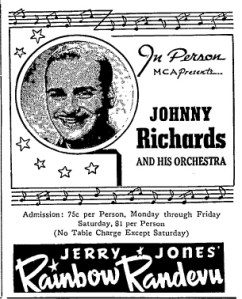 Joining the Empire Room at Hotel Utah, sandwiched between 400 and 500 South on historic Main Street, was the Coconut Grove. The Grove was advertised as the largest ballroom dance in the country. At the start of World War II, the name would be changed, yet again, to the Rainbow Ballroom and eventually became Jerry Jones’s Rainbow Randevu — or The Rainbow colloquially. It wasn’t until the 1960s that it was ultimately given the name Terrace Ballroom.
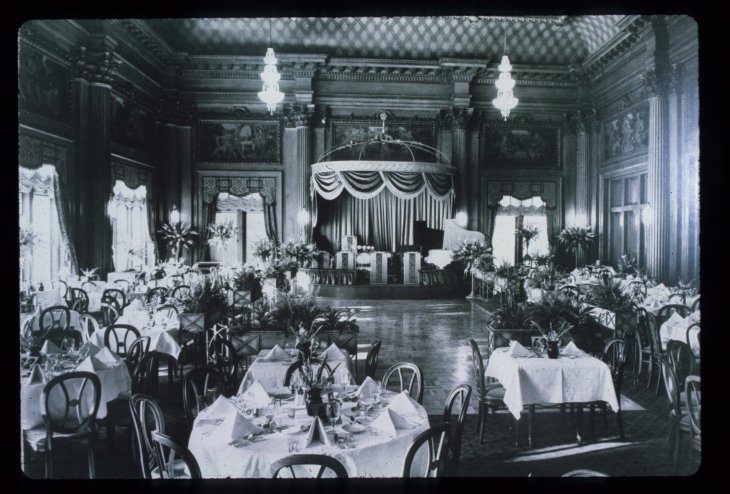 After 76 years of hosting visiting celebrities, politicians, parties and enjoying “minor celebrity status” in Utah, the LDS Church announced the closure of Hotel Utah in 1987 and it was converted into what we now know today as the Joseph Smith Memorial Building — an exceedingly elegant office building and visitors center. (Davidson) Coincidentally, this same year the Terrace Ballroom fell accident to a building fire during its demolition. The Provo, Utah, Daily Herald at the time called the demolition “an inelegant and unfair epitaph” for the beloved political and musical site that was enjoyed for over five decades. (“History Comes Tumbling Down”)
 An article in the Salt Lake Tribune describes the venue in its “heyday” saying, “Jerry Jones and his orchestra played big band sounds and hosted regular dance nights. For many in the 1940s and ’50s, it was the place to be on a Friday or Saturday night.” (Smart) This venue continued to shape Utah’s counterculture. In another interview with the Tribune, Steve Williams, jazz host for decades at KUER, said of the scene in the 1960s, “I had no idea how many hippies were in Utah. It blew my mind.” (Smart)
 In May 1948, The Salt Lake Telegram wrote that a large fire consumed the Rainbow Randevu, completely destroying the building other than the four outer walls. Officials suspected the cause of the fire to be a cigarette. Days before the fire, the Rainbow Randevu had held an inspection and received approval of its wiring, heating and other equipment in the building. Raff wrote that the fire began with three explosions at 3:45 a.m. Saturday, only two hours after the Friday night performance by the Ink Spots band that was attended by 1,132 dancers had ended. While the firefighters were battling to save the Rainbow, they realized there was no hope for the venue and worked to save the surrounding businesses on the block. Witnesses claimed the flames reached 200 feet in the air at the height of the fire, which left the building as “a mass of twisted steel and charred wood.” (Raff)
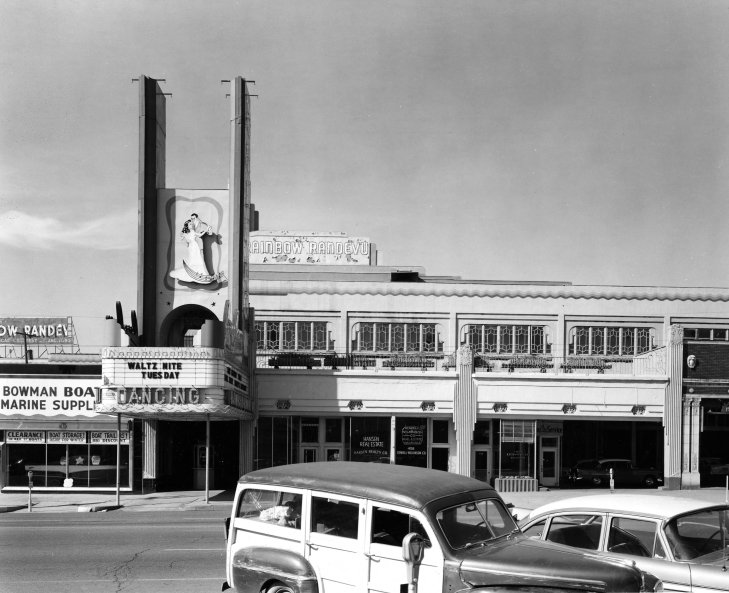 Built in 1922, the Covey-Ballard Motor Company stood between 400 and 500 South on Main Street in downtown Salt Lake City until 1931, when it was transformed into the Coconut Grove. According to Lagoon history, the ballroom was advertised as the largest in the United States. Sometime during the 1940s, the Coconut Grove was changed to the Rainbow Ballroom. Jerry Jones assumed ownership in 1946 and renamed it Rainbow Randevu. Its popularity continued as the community continued to fill the hall. In 1958 Lagoon bought and named it Danceland. A few years later, the company settled on its final name, The Terrace. Lagoon History shares that a final New Year’s Eve party was thrown in 1981 before The Terrace permanently closed. In August 1987 a fire demolished the building and “they paved paradise and put up a parking lot.” (Braden)
 In May 1948, The Salt Lake Telegram reported the fire that turned Rainbow Randevu “to a mass of twisted steel and charred wood” in the middle of the night. (Raff) Firemen searched, but only found a cigarette as the reason only four walls of the Rainbow were left standing. Covered by insurance, a seemingly positive Jerry Jones wanted to rebuild “as soon as possible.” The Rainbow would reopen to renewed popularity.
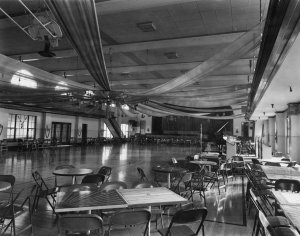 Already partially torn down, The Terrace couldn’t disappear without a bang. In August 1987, The Deseret News wrote how it took 30 minutes for a fire to demolish a building that was so beloved by a community forever.
 The venue, known as The Terrace at this time, helped lead Salt Lake City into the modern mindset of equality. Before that time, many businesses and hotels still supported segregation. (Salt Lake City Television) Pushing boundaries by allowing admittance by all helped hoist the hall into fond memories from a diverse culture. According to historian Ronald G. Coleman, “By the late 1940s, Robert Freed had succeeded in fully opening Lagoon to Blacks; and when his company acquired the Rainbow Gardens (Terrace), the same policy was adopted.”
 Utah Communication History Encyclopedia