
The Rainbow Randevu was one of the larger music revenues in northern Utah. The dance club previously located at 460 S. Main Street was a popular spot for larger band performers to visit from the 1930s to the 1960s. (Stewart, p. 221) Like many of the popular spots in historic Salt Lake City, the Rainbow Randevu played a large role in the music culture in northern Utah. The ballroom also gave generations of young people a fun place to gather, especially during times of hardship, such as World War II.

The September 10, 1937, ad that appeared in The Salt Lake Telegram.
The Rainbow Randevu, previously known as the Rainbow Ballroom, opened for dining and dancing the week of September 10, 1937, according to an advertisement in The Salt Lake Telegram published the same date. The Rainbow Randevu was a popular spot for University of Utah students who were looking to escape their school responsibilities for the weekend. Wilkins and Williams wrote in 1944 that students who were either leaving to fight in the war or had returned from the war would meet at the dance club to enjoy each other’s company.
The Salt Lake Telegram wrote in July 1943 that Louis Armstrong performed at the Rainbow Randevu with other swing performers. Jerry Jones, the manager of the Rainbow Randevu, would often perform with his own orchestra at the Rainbow, and over the years many big-name artists would come to perform at the club. (Raff)
 In May 1948, The Salt Lake Telegram wrote that a large fire consumed the Rainbow Randevu, completely destroying the building other than the four outer walls. Officials suspected the cause of the fire to be a cigarette. Days before the fire, the Rainbow Randevu had held an inspection and received approval of its wiring, heating and other equipment in the building. Raff wrote that the fire began with three explosions at 3:45 a.m. Saturday, only two hours after the Friday night performance by the Ink Spots band that was attended by 1,132 dancers had ended. While the firefighters were battling to save the Rainbow, they realized there was no hope for the venue and worked to save the surrounding businesses on the block. Witnesses claimed the flames reached 200 feet in the air at the height of the fire, which left the building as “a mass of twisted steel and charred wood.” (Raff)
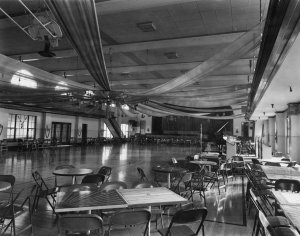
In October 1948, manager Jerry Jones chose a new site for the Rainbow Randevu. The Salt Lake Telegram reported that the Coconut Grove would be remodeled to become the new Rainbow site. The renovations included adding 250 booths, a new bandstand, two fountains, a TV room, and a new entrance. Jones said the building would have drapery installed in order to close off certain sections of the ballroom making renovations during the day possible while the venue was open in the evenings.
The music culture in Salt Lake City was fostered by the music venues such as the Rainbow Randevu. (Stewart, p. 221) This was a popular hub for University students and Salt Lakers alike to dance and listen to artists. The venue allowed artists from all over to meet at this cross-road town of the West and try out their music on the attendees of the club. Such cultural spots were the go-to place for many young people at the time and show the importance of having venues where the arts can be celebrated.
Kendra A. Madsen is a communication major at the University of Utah and will be graduating in May 2019.
Sources
Advertisement, Rainbow Randevu, Salt Lake Telegram, September 10, 1937, 12.
“Rainbow Randevu Adds New Musician,” Salt Lake Telegram, March 26, 1938, 7.
“Louis Armstrong to Appear at Randevu,” Salt Lake Telegram, July 14, 1943, 15.
Pat Wilkins and Norma Williams, “Full Weekend Keeps Utes Busy . . . Playing,” Utah Chronicle, October 26, 1944, 3.
Colin Raff, “Fire Razes Rainbow Randevu,” Salt Lake Telegram, May 22, 1948, 1.
“New Site Set for ‘Randevu,’” Salt Lake Telegram, October 5, 1948, 24.
Stewart, Polly. “Urban Pioneers: The Folk-Music Revival in Utah, 1959-1966,” Utah Historical Quarterly 74, no. 3 (2006): 220-230.
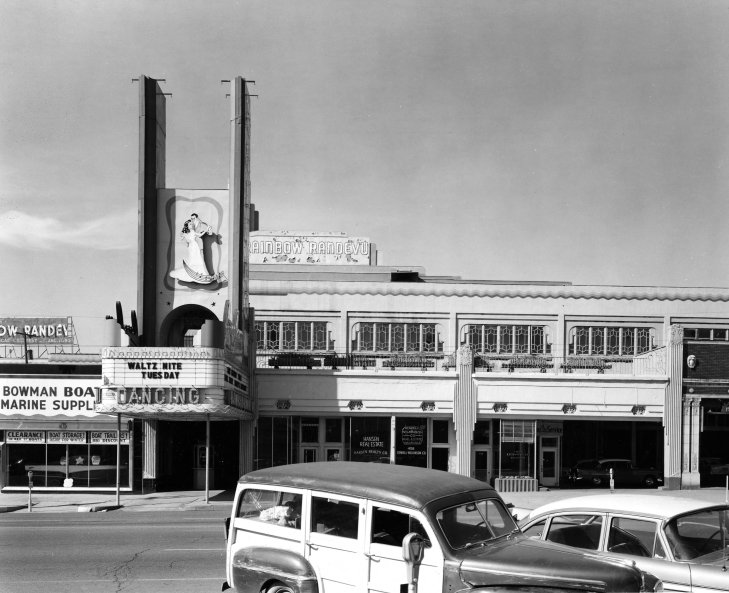 Built in 1922, the Covey-Ballard Motor Company stood between 400 and 500 South on Main Street in downtown Salt Lake City until 1931, when it was transformed into the Coconut Grove. According to Lagoon history, the ballroom was advertised as the largest in the United States. Sometime during the 1940s, the Coconut Grove was changed to the Rainbow Ballroom. Jerry Jones assumed ownership in 1946 and renamed it Rainbow Randevu. Its popularity continued as the community continued to fill the hall. In 1958 Lagoon bought and named it Danceland. A few years later, the company settled on its final name, The Terrace. Lagoon History shares that a final New Year’s Eve party was thrown in 1981 before The Terrace permanently closed. In August 1987 a fire demolished the building and “they paved paradise and put up a parking lot.” (Braden)
 In May 1948, The Salt Lake Telegram reported the fire that turned Rainbow Randevu “to a mass of twisted steel and charred wood” in the middle of the night. (Raff) Firemen searched, but only found a cigarette as the reason only four walls of the Rainbow were left standing. Covered by insurance, a seemingly positive Jerry Jones wanted to rebuild “as soon as possible.” The Rainbow would reopen to renewed popularity.
 Already partially torn down, The Terrace couldn’t disappear without a bang. In August 1987, The Deseret News wrote how it took 30 minutes for a fire to demolish a building that was so beloved by a community forever.


 The venue, known as The Terrace at this time, helped lead Salt Lake City into the modern mindset of equality. Before that time, many businesses and hotels still supported segregation. (Salt Lake City Television) Pushing boundaries by allowing admittance by all helped hoist the hall into fond memories from a diverse culture. According to historian Ronald G. Coleman, “By the late 1940s, Robert Freed had succeeded in fully opening Lagoon to Blacks; and when his company acquired the Rainbow Gardens (Terrace), the same policy was adopted.”
 In the February 3, 1944, issue of The Utah Chronicle, students were invited to attend a campus screening of the Academy Award-nominated documentary The War Department Report. The film was originally released to a small number of military personnel on December 7, 1943, by the U.S. Office of Strategic Services (OSS). It was directed by Oliver L. Lundquist; David Zablodowsky was credited as the writer, Carl Marzani as producer, Richard Lyford as editor. It was narrated by Walter Huston. (IMBD)
 The documentary’s project began after a report was made by Major General George V. Strong on “The Strength of the Axis Forces.” The documentary included obtained footage taken of allies by the Germans, Italians, and Japanese. One segment of the film included “startling shots of the Pearl Harbor raid, taken from [Jap] planes.” (“New War Film”)
 The War Department Report is still viewed today, primarily used in military training. The OSS is highly praised for the film’s exposure of the war. Katz writes, “Through their pioneering experiments in the visual display of information … in service of the War Crimes trials … they left a small but indelible mark on history.” The film is kept today in the Academy Film Archives.


 Utah Communication History Encyclopedia