History of the Utonian Yearbook 1940-1945

By Dillon Anderson

Dating back to the early 1800s, students of various college campuses have kept a record of their time on campus through yearbooks, making them a rich source of history. (Lear, p. 184) Such as it is, by annotating the details of the Utonian books, one can build a working index of their materials, which, in turn, can assist teachers and students in future research endeavors for years to come. In the same way that the Utah Chronicle finding aid has and will continue to contribute to our understanding of the past, my hope is that this index will do the same.

1940 edition: The 1940 edition of the Utonian was a crimson-colored book, featuring a woman in an elegant white dress dancing on the cover. The edition was 334 pages in length and contained many illustrations. Entire pages are dedicated to student and faculty administration, sports teams and campus organizations, and portraits for seniors, juniors, sophomores and freshman students are found throughout. In 1940, the Chronicle reported that the book cost $4 and that overall sales, to that point, had reached an all-time high.

Student Leadership: Herbert Price, President; Rose Bud Marshall, Vice President; Montana Torkelson, Secretary; Hemer Culp, 2nd Vice President; Grant Aadnesen, Senior President; Fred Price, Junior President; Richard Ensign, Sophomore President; Keith Montague, Freshman President.

1941 UtonianDedicated To: “President George Thomas, world citizen, American, Utahn …. son of the West. Forthright and intelligent is the cataclysmic world, he stands unflinchingly for the principles of democratic and spiritual freedom. Born in the land of blue skies and surging mountains we may look to him for the best in man. An inspired educator and leader, he has guided the University of Utah along the road of vanity and moderation. Social adjuster … gentleman … scholar … son of the West … our President Thomas.” 

1941 editionThe 1941 edition was a silver-colored book, featuring a woman and man (standing side-by-side) with the Block U embossed between them. The edition was 338 pages in length and, according to a 1941 Chronicle article, was at least two pages larger than any in the University’s history. According to that same article, the edition was expected to “possibly set records both for advertising space and for sales.”

Student Leadership: Hamer Calp, President; Connie Mortensen, Secretary; Scott Dye, Treasurer; Elisa Rogers, Vice President.

Dedicated To: “Lively reminiscence of classrooms and libraries … athletic fields and bleachers … the dance floor and theatres … the offices and editorial rooms—this year, 1941 Utonian.” 

1942 editionThe 1942 edition was a black-colored book, featuring a woman and man standing underneath a blue tree with words, lettered in blue and gold, reading above them: A Year of College Life At The University Of Utah. The edition was 352 pages in length and apportioned to feature portraits of seniors, juniors, sophomores and freshman. More than previous editions, much of the book was dedicated solely to the portraits. According to a 1942 Chronicle article, the advertising section of the book was compromised by the then-ongoing war.

Student Leadership: Wendell Paxton, President; Luella Sharp, Vice President; Betty Jo Snow; Frank Child, Treasurer.

Dedicated To: N/A

1943 editionThe 1943 edition wore a burnt orange cover with images of blue trees, as well as the words “Utonian” inside a red square. At the bottom of the cover, red script read, “Nineteen Hundred Forty-Three.” It is unclear how many pages were in this issue, but in terms of format, this edition was keen on highlighting the events and activities that took place on campus during that year. Interestingly, the Chronicle reported in 1943 that males were required to wear coats and neckties for their portraits. Failure to comply often resulted in a considerable time delay, according to the article.

Student Leadership: Val J. Sheffield, President; Virginia Weilenman, Vice President; Athelia Sears Tanner, Secretary; Robert B. Barker, Treasurer; Mary Anna Recore, Historian; Lynn Warburton, Second Vice President; Huck Adelt, Second Vice President; Marjorie Muir Hess, Historian.

Dedicated To: “The people in it are leaders. They are the men and women who plan and worry and sit up nights. They hold conferences and argue and their decisions are final. They are brainy and unselfish and they have foresight. They lead and 3,000 students follow. It’s a busy life they live … filled with disappointments and headaches sometimes, and sacrifices … But it’s a pleasant life, too … and worthwhile, for these people find … a life made rich.” 

1944 edition: The 1944 edition was a yellow-covered book, featuring the number “44” above royal blue letters that spelled, “Utonian: Nineteen Hundred Forty-Four.” Blue and red stars also decorated the cover. True to tradition, the edition was 356 pages in length, seemingly larger than any of the preceding yearbooks in the university’s history.

According to a 1944 Chronicle piece, the war brought on a shortage of materials, which led to the University cutting down on the use of film. As a result, the institution was only able to take one picture instead of two for student portraits, and because some students were unable to pay yearbook fees in advance of the deadline, said students were not pictured in that year’s edition. The book also features an entire section on the war, resplendent with photos of the Army and Red Cross.

Student Leadership: Ed Muir, senior proxy president; Margaret Cornwall, Vice President; Peggy Berryman, Secretary; Jay Skidmore, Treasurer; Bill Pingree, Treasurer.

1945 utonianDedicated To:  “We said goodbye so many times to so many friends. We stood side by side with the governor, the president and the deans as we paid tribute to the fellows off to war. 

1945 editionThe 1945 edition was a red-covered book, and for the first time in this six-year snapshot, acknowledged the school’s Indian heritage on its cover. There, a profile of an Indian warrior, imaged in gold, stood upright while the words “Utonian” and “1945” surrounded him. This edition also departed from convention in terms of measure, as the book spanned just 336 pages, down from 356 in 1944.

Student Leadership: Eugene Overfelt, President; Shirley Bangerter, Vice President; Richard Warner, 2nd Vice President; Darlene Anderson, Secretary; Helen Keeley, Historian; Hope Horsfall, Treasurer.

Dedicated To: “To the Senior Utes, the class of 44’, who have blazed to the end or their Utah Trail, we dedicate this Indian issue of the Utonian.”

Dillon Anderson is a student at the University of Utah. He is majoring in literary journalism.

Sources

“Utonian Sales,” Utah Chronicle, January 4, 1940, 2.

“Utonian May Come Out On May 26,” Utah Chronicle, May 15, 1941, 3.

“Utonian Names Final Picture Deadline,” Utah Chronicle, March 5, 1942, 3.

“Coats, Ties Necessary For Utonian Shots,” Utah Chronicle, January 21, 1943, 6.

“Utonian Makes Plea,” Utah Chronicle, January 13, 1944, 2.

The University of Utah and the Utes: A Photo Gallery,” Utah Division of State History.

Lear, Bernadette A. “Book History in ‘Scarlet Letters’: The Beginning and Growth of a College Yearbook during the Gilded Age,” Book History 9 (2006): 179–212.


Spirit of the Beehive: Coon Chicken Inn an Unfortunate Utah Original

By Devon Alexander Brown

Coon_Chicken_Inn_P_2

Coon Chicken Inn logo. Image courtesy of Special Collections, J. Willard Marriott Library, The University of Utah.

When Brigham Young and a vanguard company of Latter-day Saints entered the Salt Lake Valley in 1847 they knew they’d finally found their home in the Rockies. (Griffiths) And as their community in the desert quietly blossomed they declared it Deseret, a term for honeybee lifted from the Book of Mormon, and adopted the beehive as their state emblem. This simple emblem not only referenced their Christian roots, but it also symbolized a unified commitment to industriousness that has remained a hallmark of Utah’s culture. (Malouf)

In modern times that industrious spirit has led to a boom in the beehive state’s tech and creative sectors, but in 1925 it drove Maxon Lester Graham and his wife Adelaide Burt to create a fast-food restaurant legacy built on a foundation of racist imagery with a name to match: Coon Chicken Inn.

Utah, like much of America, has a complicated history with race. Much of the population is affiliated with the Church of Jesus Christ of Latter-day Saints, which has always allowed Blacks into its ranks although they’ve held a lower status. A demonstration of this fact is that three Black members of the church were present in the vanguard company of 1847, but they were used as servants The most controversial aspect of this attitude is that Black members — as well as suspected Black members according to a racial “one drop” policy — were denied priesthood privileges essential to the faith until the 1970s. (Reeve) Yet these complications reach far beyond faith. An attitude of separation trickled into Utah’s secular psyche as well, with Blacks receiving second-class treatment inside and outside of the church. While the creation of Coon Chicken Inn is perhaps the most blatant example of this attitude, it is not an isolated example.

To grasp the severity of the logo’s use, one must understand the racist history behind the “coon” caricature. The term came into prominence during 19th-century minstrel shows through a character named Zip Coon. As a part of his act, Zip Coon would act uppity with a braggart’s swagger while employing malapropisms in a nod to his lack of education. This would elicit laughter and intrigue while also reinforcing White supremacy and animosity toward Blacks. The slur itself became popular in the late 1800s after Black entertainer Ernest Hogan released a song called, “All Coons Look Alike to Me.” Subsequent derogatory imitation “coon songs” were released shortly after and remained popular until the 1920s. Eventually the “coon” caricature became a nostalgic device for certain northerners and southerners to rekindle revisionist memories of life in the American South. (Strausbaugh)

coon ad

Advertisement for Coon Chicken Inn. Utah Chronicle, February 1, 1940, p. 4.

The first Coon Chicken Inn opened in 1925 after the Grahams bought and renovated a small building in the Sugar House neighborhood of Salt Lake City. Their take on southern fried chicken was a hit and by 1930 they opened two additional sites (in Washington and Oregon). To stir up additional business they incorporated the smiling blackface logo as they believed it would entice young families. The logo, an abrasive caricature with exaggerated lips, would reflect the owners’ racial disconnection, especially in Seattle and Portland where more Blacks were present.

Black residents did not accept the imagery, however, and Joseph Staton, a Black resident of Seattle, was arrested, booked, and fined $3 for cutting the caricature out of a Coon Chicken Inn spare tire cover. (The Seattle Times) Also, Clarence R. Anderson, a Black attorney, launched a two-year lawsuit against the inn with the NAACP, although Graham dodged the lawsuit by painting the Black porter’s face blue. (Northwest Enterprise) Nonetheless, the logo would later appear on paper products, plates, and menus that are now considered collectible. Eventually, 12-foot constructions of the logo would beckon patrons at the restaurants’ front doors.

Coon_Chicken_Inn_P_4

Coon Chicken Inn locations. Image courtesy of Special Collections, J. Willard Marriott Library, The University of Utah.

Protests by angry Black citizens of Seattle and Portland would ultimately yield few changes to the franchise, but the locations finally closed in 1949. (Seattle Post Intelligencer) However, in December 1949, Graham opened G.I. Joe’s New Country Store in the same Seattle location and continued using the coon logo in advertisements that reached Salt Lake City. (Lake City Citizen) The Salt Lake City location remained open until 1957.

Undoubtedly, Coon Chicken Inn is an ugly reminder of the past, but an unnamed grandson of the Grahams has since written an essay about the restaurant’s legacy for the Jim Crow Museum of Racist Memorabilia. (McFarland) “I preface this essay by saying that I do not condone the ‘Jim Crow’ attitudes of the past. I and ALL of my siblings believe in full equality for all races, creeds, and skin colors. My grandparents were entrepreneurs engaging in what were normal business practices,” he penned in the essay. “They left behind artifacts, popularly called ‘Black Memorabilia,’ that serve as reminders that this particular part of history must never, and will never, be repeated.” (The History of Coon Chicken Inn)

Utahns of Salt Lake City must ensure this sentiment rings true.

Devon Alexander Brown is a senior at The University of Utah and is majoring in journalism. He is pursuing a career in writing and photojournalism and is primarily interested in art and culture. Devon is also interested in documentary films and the tiny house movement.

Sources

Sadie McIver, “Files Protest Against ‘Coon Chicken’ Advertisement,” Northwest Enterprise, July 16, 1931, 8.

Candace Black, “Chicken Inn Dodges Suit with Blue Paint,“ Northwest Enterprise, March 17, 1932, 6.

“Big Crowd — Little Profit,” Seattle Post Intelligencer, March 8, 1937.

“C. of C. Helps to End Dispute,“ The Seattle Times, March 18, 1937.

Advertisement for Coon Chicken Inn, Utah Chronicle, February 1, 1940, 4.

“Joe’s Country Store,” Lake City Citizen, December 8, 1949.

The History of Coon Chicken Inn.” Jim Crow Museum of Racist Memorabilia, Ferris State University.

Strausbaugh, John. Black Like You: Blackface, Whiteface, Insult & Imitation in American Popular Culture. New York: Penguin, 2006.

Reeve, W. Paul. Religion of a Different Color: Race and the Mormon Struggle for Whiteness. New York: Oxford University Press, 2015.

McFarland, Sheena. “Whatever happened to … the chicken restaurant with the racially charged name?” The Salt Lake Tribune, January 13, 2015.

Malouf, Mary Brown. “Behind the Beehive,” Salt Lake Magazine, May 2, 2016.

Griffiths, Casey Paul, et al. “The myth about Brigham Young’s ‘this is the place’ quote,” LDS Living, July 25, 2017.

Carl Ravazza and His Orchestra, Rainbow Randevu, 1939-1941

By Adelina R. Whitten

Jazz music was booming in the 1930s and 1940s in the United States. Jazz in the West, specifically, “played a crucial role in producing and shaping jazz during the 1920s and 1930s, decades critical in the formation of the swing style,” writes Stowe in Jazz in the West. (p. 53) Big bands of the swing era took an inherent role in the West’s embodiment of the popular culture, crossing national boundaries. The audience of Western jazz followed and listened to most of the same bands popular with the rest of the public. (Stowe, p. 53) These bands followed touring patterns laid out by earlier popular culture forms, including the theatric vaudeville. (Stowe, p. 55)

Western jazz differed from jazz in other parts of the country. The racial attitudes of those in the West were one of these differences. According to Stowe, “The northern Midwest was relatively free of racial discrimination, while the Southwest exhibited virulent racism.” (Stowe, p. 61) African American and White swing-era bands were both surprisingly popular with White listeners. (Stowe, p. 63) The venues touring bands played “varied widely in the West, as elsewhere, and depended largely on the fame and drawing power of the group.” (Stowe, pp. 66-67) Municipal ballrooms, dance palaces, dime-a-dance halls, restaurants, and nightclubs were popular establishments, although urban ballrooms were the most desirable places to play. (Stowe, p. 67)

Carl Ravazza Advertisement-2

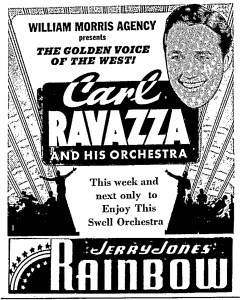
Carl Ravazza and his ochestra played at Jerry Jones’ Rainbow Randevu in Salt Lake City. Utah Chronicle, April 9, 1941, page 5.

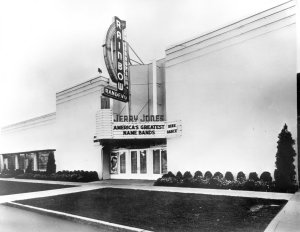
Carl Ravazza, a White violinist and vocalist from California, and his orchestra played several times in Utah, a state situated in the Western United States’ jazz scene. The San Francisco Examiner reported on July 29, 1968, that Carl Ravazza was popular among college students in the 1930s. This remained true during the 1940s. The Utah Chronicle, the University of Utah newspaper, advertised Ravazza at Jerry Jones’ Rainbow Randevu on September 22, 1938; January 19, 1939; April 9, 1941; and April 18, 1941. The Rainbow Randevu was a ballroom in Salt Lake City that often held swing and jazz groups. Ravazza and his orchestra played at the Rainbow Randevu consecutively in 1938, 1939, 1940, and 1941.

Newspapers in Salt Lake City frequently informed Utahns of Ravazza visits. On September 15, 1938, the Salt Lake Telegram reported that “the romantic voice of the west” was to begin a two-week engagement at the Rainbow Randevu, where there would be dancing every night. The Salt Lake Telegram reported Jerry Jones saying that other popular traveling bands would follow suit if the engagement was successful. It must have been, since Ravazza’s group returned at least four additional times in the next three years. In January 1939, April 1940, and March 1941, the Salt Lake Telegram reported return engagements by Ravazza’s group.

Rainbow Randevu Front Utah State Historical Society

Carl Ravazza and his orchestra, among other name bands, played at Jerry Jones’ Rainbow Randevu at 41 E. 500 South. The building was destroyed by a fire in 1948. Used by permission, Utah State Historical
Society.

Ravazza was popular in Utah, but also countrywide. The Utah Chronicle reported on April 18, 1940, that his famous theme song “Vienni Su” was credited with shooting him “into nationwide recognition.” This might be why the Salt Lake Telegram reported on April 29, 1940, that Ravazza was to stay in Salt Lake City and perform an additional three days. The newspaper noted that Ravazza had played the week before “to record crowds, which demanded a return engagement of the popular maestro.”

Jazz music was booming in the 1930s and 1940s in both the East and West. In the West, swing bands traveled from state to state on tour. Carl Ravazza and his orchestra toured the Western United States regularly, especially Salt Lake City where he visited at least four times. Advertisements in the Utah Chronicle showed jazz bands visited Utah quite frequently. These engagements were part of the Salt Lake City scene, where people from all walks of life would enjoy music and dancing. The social events provided an opportunity for Utahns to come together and participate in the entertainment of the time.

Adelina Whitten graduated from the University of Utah in December 2018 with a Bachelor of Arts degree in communication and a minor in sociology.

Sources:

“Ravazza Group To Open Here,” Salt Lake Telegram, September 15, 1938, 9.

Advertisement for Carl Ravazza and his orchestra at Jerry Jones’ Rainbow Randevu, Utah Chronicle, September 22, 1938, 3.

Advertisement for five entertainment groups at Jerry Jones’ Rainbow Randevu, Utah Chronicle, January 19, 1939, 3.

“Carl Ravazza Band Held Over Here,” Salt Lake Telegram, January 20, 1939, 20.

“Salt Lakers to Hear Ravazza Orchestra,” Utah Chronicle, April 18, 1940, 3.

“Randevu Books Ravazza Band,” Salt Lake Telegram, April 19, 1940, 24.

“Randevu Awaits Ravazza Return,” Salt Lake Telegram, April 29, 1940, 14.

“Ravazza Set For Randevu,” Salt Lake Telegram, March 17, 1941, 9.

Advertisement for Carl Ravazza and his orchestra at the Rainbow Randevu, Utah Chronicle, April 9, 1941, 5.

“Carl Ravazza Dies In Nevada at 58,” San Francisco Examiner, July 29, 1968, 41.

Stowe, David. “Jazz in the West: Cultural Frontier and Region During the Swing Era,” Western Historical Quarterly 23, no. 1 (February 1992): 53-73.

The Linguaphone Group: Pioneers of Language Learning Technology

By Diego Romo

There are currently many ways to learn another language. Software like Rosetta Stone is neither a new nor astonishing technology to most of us, and apps like Duolingo and Babbel are making language learning even more accessible to all. It could be said that it is the easiest time to learn a new language because of all of the technologies available to us. But that was not always the case.

Before the availability of language learning technologies, people who were not able to learn through immersive experiences relied on traditional learning methods such as classroom instruction and literature to guide their education. But, Thomas Edison’s invention of sound recording and Alexander Graham Bell’s revolutionary creation, the phonograph, changed everything. And during the turn of the 20th century, a smart Russian immigrant capitalized on those technologies and developed the method that modern technologies still use.

Linguaphone

Advertisement for the Linguaphone, with coupon for GIs, featured in an April 1949 edition of Popular Mechanics.

In 1901, Jacques Roston immigrated to London and founded The Linguaphone Group. Roston, a translator and language teacher, believed in “the primacy of the spoken word.” (“Our Heritage,” 2018) He theorized that the best method to teach students a new language—if they were not able to immerse themselves into the culture in which it is spoken—was to utilize the new sound technologies to record native speakers and play that back to students alongside the Rees Pictorial Language books. (“Our Heritage,” 2018)

By 1920, sound recording technology had time to mature and was refined. The traditional wax cylinder became the phonograph record—more commonly referred to as the vinyl record. This innovation in the technology made it so more and more people around the world had access to phonographs and records, and again Roston saw an opportunity. He pursued an aggressive print ad campaign in many countries and by the end of the decade, the Linguaphone Group’s programs were taught in 92 countries. Lessons were available in French, German, Italian, Spanish, English, Afrikaans, Esperanto and many other languages. (“Our Heritage,” 2018) Ads for the Linguaphone can be found in many local Utah newspapers including The Utah Chronicle, Salt Lake Tribune, Provo Daily Herald and Ogden Standard-Examiner.

On a national level, Roston and the Linguaphone Group pursued major ad campaigns in magazines like Popular Science and Popular Mechanics. The ads featured in the various newspapers and magazines were all very similar, with slight variations in the illustrations and language. Some, like the ads featured in Popular Science and Popular Mechanics, included coupon cutouts that gave any active or retired GI the opportunity to receive a free Linguaphone set for their service. Interestingly, the ad featured in The Utah Chronicle from the same time period did not include the coupon for GIs, even though there were many active service members who called the fieldhouse on campus home.

The ads encouraged readers to try out the revolutionary language learning product that provided an easy way to learn, right in the comfort of one’s home, a very innovative concept at the time. One Salt Lake Tribune ad from 1943 said, “Save time, work and money. With a Linguaphone set at your side you can study anywhere anytime at your ease, alone or in a group.” It was available to purchase from the Deseret Book Store. Another ad from a 1949 edition of Popular Mechanics details the educational value of the product. “Educators hail Linguaphone as a notable advance in simplifying the mastery of languages. That is why so many Linguaphone Sets are used in schools, colleges, universities, as an aid to fluent speaking.”

byu

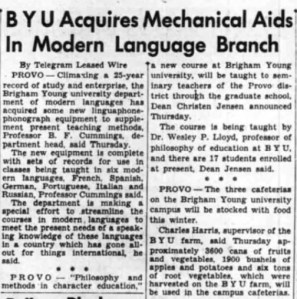
Article from a November 1943 edition of the Salt Lake Telegramdetailing the use of the Linguaphone by the BYU language department.

According to a 1943 Salt Lake Telegram article, the language department from BYU had “acquired some new linguaphone-phonograph equipment to supplement present teaching methods,” and the product aided in the instruction of French, Spanish, German, Portuguese, Italian and Russian at the school. An Orem-Geneva Times article from the same time period mentions that students from Lincoln High School in Orem purchased a Linguaphone set to be used in their newly created foreign languages club. Classified ads can also be found in many newspapers, like one in The Salt Lake Tribune from 1944, where the seller is offering a Linguaphone set in exchange for a “good portable typewriter.”

Roston’s methods of teaching languages with the assistance of sound technologies was groundbreaking at the time and helped many across the world, including government officials, diplomats and even dignitaries, learn new languages. (“Our Heritage,” 2018) Roston theorized that by using the sound of native language speakers, alongside images and text that illustrate the corresponding word, people were better suited to learn a language. “With the aid of these pictures you learn to associate the appearance of things with the appropriate word sounds. This is the truly natural way of learning a language, a way you first, as a child, learned your own mother tongue,” Roston said in a 1927 ad in The Linguist.

As the method proved to be very effective, it continued to grow in popularity. Author H. G. Wells prophesized at the advent of the phonograph that it would be used to teach language in the future, and was pleased when the Linguaphone Group fulfilled that prophecy. He wrote to Roston “expressing his admiration for Linguaphone’s work.” (“Our Heritage,” 2018) Even the top linguists of the day were praising Roston for his innovations in the teaching of language to the masses of the world.

Eventually, the use of Linguaphone’s teaching methods became so common that the product entered popular culture. According to Wilfried Decoo, it was included in the 1964 film My Fair Lady. A scene shows Professor Henry Higgins using the method to teach Eliza Doolittle proper English. (Decoo, p. 9) Interestingly, a 1967 ad found in the Ogden Standard Examiner alludes to the growth and popularity that the product had undergone in the previous decades stating, “Thousands of students, travelers, teachers and businessmen have already mastered other languages [in] this natural way.” And, by the mid-1940s, the peak of the company’s reach, 40,000 students were using the linguaphone to learn a new language on a monthly basis. Even the US military used the program to teach its soldiers languages during World War II.

The Linguaphone Group advertised extensively in national magazines like Popular Science and Popular Mechanics through the 1940s, and ads for the product can be found locally in The Utah Chronicle, Salt Lake Tribune, Ogden Standard-Examiner and Provo Daily Herald issues of the same time period. The company continued its tradition of technological adaptation throughout the next few decades; the phonograph record became the cassette tape, which became the CD, which finally evolved into the modern MP3. The Linguaphone Group still operates today and is still teaching lessons in 15 different languages.

Diego Romo is a senior at the University of Utah. He is studying communication with an emphasis in journalism, and a minor in political science.

Primary Sources

Advertisement for the Linguaphone, Ogden Standard-Examiner, October 22, 1967, 94.

Advertisement for the Linguaphone, Provo Daily Herald, March 26, 1951, 5.

Advertisement for the Linguaphone, Orem-Geneva Times, February 8, 1951, 4.

Advertisement for the Linguaphone, Popular Mechanics, April 1949, 78.

Advertisement for the Linguaphone, Popular Mechanics, February 1949, 40.

Advertisement for the Linguaphone, Popular Science, November 1948, 52.

Advertisement for the Linguaphone, Popular Science, October 1948, 38.

Advertisement for the Linguaphone, Popular Science, January 1948, 52.

Advertisement for the Linguaphone, The Utah Chronicle, November 09, 1944, 09.

Advertisement for the Linguaphone, Salt Lake Tribune, January 23, 1944, 28.

Advertisement for the Linguaphone, Salt Lake Telegram, November 04, 1943, 13.

Advertisement for the Linguaphone, Salt Lake Tribune, July 11, 1943, 46.

Secondary Sources

Our Heritage,” The Linguaphone Group.

Decoo, Wilfried. “On the mortality of language learning methods,” James L. Barker Lecture, Brigham Young University, November 8, 2001.

Utah’s First Female Editor: Louisa Green Richards and The Woman’s Exponent

by BAYLEE STEPHENSON

LuLu_Greene_Richards

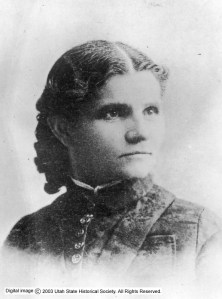
Louisa Greene Richards was the first female editor in Utah. She served as the first editor of the Woman’s Exponent. Digital Collections, Utah State Historical Society.

The Woman’s Exponent carved a path for women, equality and woman suffrage in Utah through the assistance of two incredible editors. Emmeline B. Wells is probably the most notable editor to have worked for the publication, but had it not been for her predecessor, Louisa Greene Richards, the newspaper would not have existed. Richards, known fondly as Lula or Lulu, was born in 1849 as the eighth of thirteen children to Evan Greene and Susan Kent in Kanesville, Iowa. (Bennion, 2) Greene and Kent were first cousins by their mothers, who were the sisters of the president of The Church of Jesus Christ of Latter-day Saints, Brigham Young. Richards relocated to Salt Lake City, Utah, with her family in 1852 when Brigham Young and the Mormon pioneers left Iowa. It was in Utah that she found her passion for writing. (Bennion, 2)

Richards had always enjoyed writing and had a knack for poetry. It is believed that her first poem was written when she was fourteen, with her first step into journalism happening at the age of twenty when she began editing the Smithfield Sunday School Gazette. That same year she made the decision to attend the University of Deseret, presently known as The University of Utah. (Bennion, 3) By late 1871 she had finished school and was in Salt Lake City inquiring about a teaching position. While there, she received a letter requesting that she return home due to a family illness. She didn’t have the funds for the journey and decided that she would stay up all night and write poetry in the hopes that she might be able to sell it to a publisher in exchange for the fare she needed to get to Smithfield. The next day she went to the Salt Lake Daily Herald to meet with the editor, Edward L. Sloan, to sell her poetry for the $7.50 she required. She was successful in her endeavor. (Romney, 262)

Richards made the journey back home to be with her family, which is where she received a letter from Sloan asking her if she would be interested in editing a paper for Mormon women that he would print on the Herald’s presses. (Bennion, 3) She had her reservations regarding the idea and wrote to Eliza R. Snow, the president of the Relief Society, the women’s organization within the church, to ask her if she could discuss the prospect of the newspaper with the president of the church, Brigham Young. Richards believed that if Young approved of the paper then she should pursue the opportunity of running the new publication. Young gave Richards a calling to serve a mission, which is a personal assignment to be done for the church for a designated time frame, as the editor of the paper. (Bennion, 3)

On April 9, 1872, Sloan sent a copy of the Daily Herald to every member of the Relief Society with an advertisement promoting the Woman’s Exponent and its first issue. It read, “…a proposed woman’s journal … will be found in the Herald this morning. A more extended notice of it is crowded out until to-morrow by a press of other matter.” The ad was in two spots on the third page, one announcing the new paper and another expanding on what the publication would be writing about and who its target audience would be. That ad elaborated on the Exponent’s mission to write to the women of the Relief Society and the goals it had set. The advertisement announced Richards would be the acting editor of the bi-monthly paper, which would release its first issue on May 1, 1872. Subscription costs were based on delivery frequency, ranging from $1.00 to $18.00.

Richards married shortly after she became the editor of the paper and during her time she had two daughters, both of whom died. She helped build and mold the publication into the successful female-centric paper remembered under the leadership of Emmeline Wells. Wells took over in 1877 when Richards stepped down to pursue being a wife and mother full time. (Bennion, 9) While her personal life changed, and grew during her tenure as editor, she never neglected the paper and prioritized its success. The paper focused on what mattered to women as well as what was going on within the news.

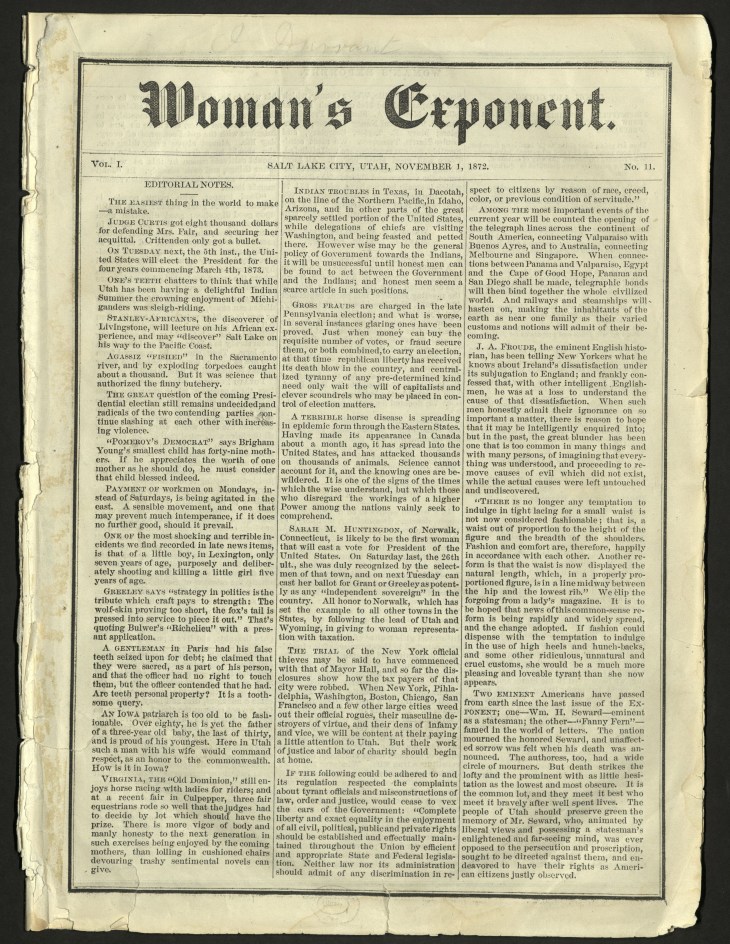
WomansExponent-Volume1-Number11-1872

The November 1, 1872, issue of the Woman’s Exponent featured the news that a Connecticut woman might be the first female to cast a ballot for the president of the United States. Special Collections, J. Willard Marriott Library, The University of Utah.

Richards was unable to meet the release date of May 1, 1872, so the first issue of the paper published on June 1. It featured articles and information that Richards thought to be the most interesting and important to women at the time. The paper didn’t simply focus on matters of the home, or what could be considered the traditional normative role women typically took within society due to the religious influence. On page 4, an article titled “Our Position” delved into Richards’s intentions for the paper, which stated that the purpose was not to advocate for woman suffrage, “for it is enjoyed by women of this Territory.” Women in Utah had received the right to vote per a decision by the territorial legislature in 1870, years prior to the 19th amendment. This right was revoked by Congress in 1887, but was ultimately restored in 1895 upon it being written into the state constitution. (White)

The Exponent aimed to speak for many of the women within the state, knowing that there would be dissenting opinions. Richards knew that there was still much to be done for women’s rights, but she strived to reach the majority in the hope that the topics discussed and covered were those that were significant to the women of Salt Lake City. On page 5 of the first issue, an article titled “Woman’s Rights and Wrongs” examined the equality that women lacked in relation to their male counterparts. This article explained the hardships women faced in doing the same amount of work as a man and receiving only a portion of the pay, as well as addressing the issue that women have the right to do any job their desire regardless of gender should they be able to adequately perform. Whether Richards intended for the publication to speak on behalf of women, equality, and at times for woman suffrage, it did and it became a key player in advocating for women in Utah.

The first issue of the Exponent set the stage for what would come from Richards, and later her successor, Emmeline Wells. The front page of the publication began with an article titled “News and Views.” This article commanded the entire front page of the paper and disclosed the news and opinions of Utah, as well as what was happening nationwide. Topics discussed in this article included religion, politics, suffrage, and race. Richards didn’t shy away from discussing what she believed in and what she thought the women of Utah wanted to be reading. The bold approach she took in writing and editing the paper helped catalyze the publication into the success that it experienced during its 42-year lifespan. On page two of the first issue, there is an article written by Eliza R. Snow on “The Female Relief Society,” which became a regular column in the Exponent penned by Snow. It gave readers a summary of the happenings of the church at the time. Richards felt that providing women with insight into the church was important as most of her readers were members of the religion. She also felt that having this section written by the president of the relief society was important for the women consuming the material.

The articles seemed to mildly contradict in that the written purpose was not to advocate for equality, but the articles themselves did articulate the support and advancement of equal rights for women. Emmeline B. Wells, who was known for her work within the woman suffrage movement, became Richards’s successor when Richards chose to withdraw as editor. Under the new leadership of Wells, the publication began taking a stronger stance on equality and woman suffrage.

On August 1, 1872, the Exponent published an article titled, “Why Women Should Vote.” This article touched on the fact that while some women cared nothing for politics and would most likely not vote, women should still be able to participate in voting and the voting process. The article stated that it was an important part of our society and should not exclude half of the nation’s population, as women had well-informed opinions and deserved to have a voice within democracy and politics. This article was extremely well received because women in Utah already possessed the right to vote and it led to further articles regarding woman suffrage and equal rights.

For example, on October 1, 1872, there was an article titled “Lady Lawyers” that recognized the remarkable accomplishment of two women who were admitted and sworn into the bar to become attorneys-at-law in the state of Utah. And while it wasn’t their intention or desire to practice law, they understood the large impact this would have for women across the nation. The article acknowledged that just a few years prior to this event, women were often ridiculed for their pursuits. The article also addressed the right of a woman “to earn her living in any honorable career for which she has capacity.” Utah was a remarkably advanced state within the union at the time and encouraged women to pursue their aspirations and career goals.

The first few months of the Exponent under Richards’s leadership laid the foundation for this progressive paper. Just five years after she signed on to the project, she decided to remove herself as acting editor. On July 15, 1877, the final issue of the Woman’s Exponent crediting Richards was published. That issue continued to advocate for equal rights, provide updates on the LDS church, and share poetry. The issue also shows significance in that it sold ad space on the last page, which generated revenue and income for the publication. Throughout all the stories and articles published in this issue, there is no acknowledgement of Richards’s departure. In a following issue of the paper, dated August 1, 1877, Richards penned an article titled “Valedictory,” in which she bid the paper farewell and discussed her reasons for departing the Exponent. She made it clear in her message that she would not be losing contact with her readers, but would be communicating with them as a contributing writer for the Exponent. She noted that she was in good health, but her “head and eyes need recruiting.” She also wrote that she believed her time would be best spent dedicated to domestic duties. Richards was content to relinquish all claim to the Exponent, because she knew she would be leaving it in good hands. She ended her farewell by asking her “sisters old and young” to subscribe and write to the Exponent to make it “more interesting and successful in performing its mission.”

After retiring as the editor of the Woman’s Exponent, Richards turned to being a wife and mother full time, but she never stopped writing. Her poetry is what launched her into her career with the Exponent; her poetry is how she continued to express herself throughout her life. Richards published a few of her poems during her five-year run with the paper and afterward found herself publishing a book, Branches That Run Over the Wall. Richards spent her life dedicating her time to her family and her writing. Never forgetting who she was or what she believed in, and was never afraid to speak her mind in the effort of being an independent woman at a time when that wasn’t always fully embraced. Louisa Lula Greene Richards was the first female editor in Utah and became a respected public figure and advocate for women all over the state.

The Woman’s Exponent provided women with an outlet and a resource that wasn’t a common commodity at the time. The publication had a female editor, the first in the state and breached topics that were both helpful, informative, and at times controversial. Looking back at the many issues of the paper, it is obvious that these women were dealing with issues that are still prevalent today. We are still fighting for gender equality in many regards, we are still fighting to give women an independent voice and we are still fighting to break into male dominated industries. Utah was a unique place, where women held positions without it being perceived as a woman trying to take over a man’s role. These women were praised for their work and made strides in the fight for equality for women everywhere. The paper was so successful that it even spurred the conception of Exponent II, a quarterly publication launched to give feminist Mormon women a voice. (Sheldon) Women across Utah, especially within the Mormon community, have been deeply impacted by the Exponent and the work of Richards and Wells. Their efforts have resonated with women across generations for over 100 years and even led to the development of other publications. This progressive paper was created by women for women.

Baylee Stephenson graduated in May 2017 from The University of Utah with a degree in communication. She moved to New York City after graduating to pursue a career in product development and now resides in the city full-time.

Sources

Louisa L. Richards, Branches That Run Over the Wall: A Book of Mormon Poem and Other Writings. Salt Lake City, Utah: The Magazine Printing Company, 1904.

“Valedictory,” Woman’s Exponent, August 1, 1877, 36.

Woman’s Exponent, June 15, 1877, 25-32.

“Lady Lawyers,” Woman’s Exponent, October 1, 1872, 68.

“Why Women Should Vote,” Woman’s Exponent, August 1, 1872, 36.

“News and Views,” Woman’s Exponent, June 1, 1872, 1.

“Our Position,” Woman’s Exponent, June 1, 1872, 4.

Eliza R. Snow, “The Female Relief Society,” Woman’s Exponent, June 1, 1872, 2.

“Woman’s Rights and Wrongs,” Woman’s Exponent, June 1, 1872, 5.

“Woman’s Exponent,” Salt Lake Daily Herald, April 9, 1872, 3.

Bennion, Sherilyn Cox. “Lula Greene Richards: Utah’s First Woman Editor.” BYU Studies 21, no. 2 (1981): 1-14.

Romney, Thomas C. “Louisa Lula Greene Richards.” The Instructor (September 1950): 262-263.

Sheldon, Carrel Hilton. “Launching Exponent II.” Exponent II. http://bit.ly/2otlTLP

White, Jean Bickmore. “Women’s Suffrage in Utah,” Utah History to Go. http://bit.ly/2kWl4rr


Florabel Muir, First Woman Reporter for the Salt Lake Tribune and Pioneer for Women in Journalism

by MADISAN HINKHOUSE

Florabel Muir was a pioneer for women in journalism, from being the first female reporter for The Salt Lake Tribune after getting her start at a lesser known Salt Lake paper called the Salt Lake Herald, to being the first woman to witness and report on an execution. In this analysis of the life and career of Muir, I will explore these implications and other aspects of her career in the world of journalism.

1950_BookMuir, born in 1900, grew up in Rock Springs, Wyoming. She credited her upbringing for her ability to handle the “rough and tumble” side of journalism, meaning blood, fights and murder. Muir described Rock Springs as a mining town where rugged people had a better chance of survival, and most arguments were settled with fists. She was the youngest of eleven children. She wrote in her autobiography, Headline Happy, “Being a nonconformist from an early age, I developed a great strength of will to keep myself from being swamped by dos and don’ts from the rest of the family.” (Muir, 3)

The non-conformity began when Muir attended college at the University of Washington, where, following in the footsteps of her sisters, she studied to be a teacher. She went to work for the student newspaper to make extra money. This is where she was “bitten by the bug.” Muir writes about the time she spent as a teacher in rural Wyoming, but teaching was not what she wanted to do. (Muir, 3-4)

She made her way to Salt Lake City in search of a reporting job. Muir posed as an experienced reporter in an attempt to land a job. The language she learned while at the student publication helped her sound more experienced than she was. Even with this language and prior experience Muir worked odd jobs for nearly three months before getting a reporting job with the Salt Lake Herald. (Muir, 2-5)

Her career in professional news began in 1926 as a police reporter, according to an obituary published in Boxoffice in 1970. In her autobiography, Muir reflected on the hardships she faced being a woman in an industry dominated by males. She recalled when she got her start with the Herald: Women were not looked upon as proper instruments with which to get out the gutsier parts of the newspaper.” (Muir, 3) In this time, the 1920s and 1930s, editors allowed women to cover societal events and club pages. According to Muir, those beats bored the “bejesus” out of her. This boredom inspired her determination to cover murders, robberies and malfeasance with the boys. (Muir, 3; Boxoffice)

Although The Salt Lake Tribune was her first choice, it had never had a female reporter and the editor, Forest Lowry, had no intention of hiring one. Eventually Francis Matson, editor of the Salt Lake Herald, gave Muir a job covering the City and County Building. (Muir, 3-5)

In regard to landing the job, Muir wrote: “Matson was motivated primarily by a sly urge to dish out a cowering insult to a veteran Tribune reporter, Tom Higgs, with whom he had been feuding, by sending a girl to cover the beat against him.” (Muir, 4) This is only the beginning of the obstacles Muir faced in the journalism world solely based on her gender.

Muir worked hard to make a name for herself in Salt Lake City covering murders and scandals. She wrote in her autobiography about a time when she ruined the only good shoes she had by tramping through blood and gore to get information on a murder for a story. She wrote about sneaking around policemen to prevent being arrested for breaking and entering. “I do not intend to convey the impression here that walking around in blood is standard practice among newspaper reporters, but it does seem in retrospect that I have had more than my share of it,” Muir wrote in her memoir. (6)

She eventually landed a job with The Salt Lake Tribune as the newspaper’s first female general assignment reporter. While at the Tribune, Muir made it clear to her editor that she was not going to cover society or club news, which was the standard for women journalists. A history of the newspaper describes Muir’s career following her time with the Tribune as “violence studded.” She covered gang wars, murder and sensational trials. (Malmquist, 419-420)

Muir’s breakthrough for women reporters came when she was the first woman to cover the legal death of a man whose story she originally covered when he murdered his lover. During her time in Salt Lake City, Utah law stated only men could witness executions, leaving women out of a possible story during an already turbulent time for women in news, as discussed above. In order to cover the execution, Muir went to Utah’s attorney general and was ruled a reporter, not a woman, according to a 1944 article in Time. (Muir, 28-29)

Muir was successful in her push to cover the execution, but was provided a male back-up reporter, just in case she became ill while witnessing a man die. As it turned out, her backup is the one who fell ill watching a man die in front of a firing squad. (Malmquist, 419-420)

She writes a detailed and insightful chapter in Headline Happy about covering the execution. She remembered her editor telling her she had handled the story better than expected, considering she was not the reporter who became sick. She observed, “I graduated into the big time that day. I could handle a story like a man. That was very important to me.” (Muir, 32)

Through her career, Muir moved on to work for the New York Daily News, where she wrote a daily column, according to a 1932 story in Variety magazine. Muir wrote columns that were syndicated to Chicago and Los Angeles, giving her a wide readership and well-known name among journalists. (“Florabel Muir succeeds”) She spent time in her career covering Hollywood-esque beats while also heading out on multiple special assignments according to another article in Variety. (“Charterer as a Scenarist”)

In her autobiography, Muir relates a colorful story of a time when she was shot in the “derriere” while following an infamous New York gambler for a story. It happened in July 1949 when she followed Mickey Cohen to various night spots around Hollywood. She wrote that she was waiting for someone to kill him in hopes that she would be there when it happened. She succeeded, but not without scars. When the shooting began, a bullet hit an object and then Muir, but she got the “newsbreak” that several other reporters missed because they gave up and left before the shooting started. (Muir, 1-2)

Muir found herself in trouble later in her career, once for buying and reselling liquor licenses and once for spitting in the face of another reporter, according to Variety. The story, published October 14, 1953, detailed how the former got her fired from a beat at the L.A. Mirror, and that she didn’t resign, as other news outlets reported.

At the end of her career, Muir was widely respected by fellow writers and journalists. One Variety reporter observed in 1938, “Many of Miss Muir’s kidding phrases were fine bits of reporting and evidenced a showmanship slant of the principals.” From my research, I conclude that Muir enjoyed the peak of her career between 1926 and 1938.

A 1950 review of her autobiography published in Variety praised Muir and cited her “delicious sense of humor and double barreled talent for superb writing craftsmanship.” The book accounted the adventures of her exciting career in journalism.

Muir died of a heart attack at the age of 80. In the New York Times obituary she was quoted as saying, “I was having a talk with my croaker the other day. He says ‘Florabel, your ticker ain’t worth a pot in hell—you take it easy, so I guess I will.’”

While researching and reading her autobiography, I grew to admire Muir’s love of journalism of being a reporter. She claimed to be suffering from an occupational disease called “Headline Happy,” which she described as a “wonderful, stimulating form of looniness in the like of which is found only in the newspaper game.” She wrote that colleagues found her expeditions to get stories crazy. She claimed they were right: she was crazy about journalism. (Muir, 1)

Madisan Hinkhouse is an alumna of The University of Utah with a fiery passion for journalism and the First Amendment. She enjoys fly fishing, skiing and spending more time outdoors than indoors.

Sources

“Florabel Muir resigns,” Variety, February 16, 1932, 3.

“Charterer as a Scenarist,” Variety, June 21, 1932, 53.

“Florabel Muir, Take a Bow,” Variety, December 28, 1938, 45.

“The Press: Florabel,” Time, November 13, 1944, 70.

Florabel Muir, Headline Happy (New York, New York: Henry Holt and Company, Inc., 1950).

“‘Headline Happy’ Is Just That,” Variety, October 25, 1950, 61.

“Miscellany: Florabel Bounced By L.A. Mirror,” Variety, October 14, 1953, 2.

“Florabel Muir succeeds Hedda,” Variety, February 9, 1966, 4.

“Florabel Muir, 80, of The Daily News,” The New York Times, April 28, 1970, 41.

“Florabel Muir, 80, Dies following heart attack,” Boxoffice, May 4, 1970, 4.

Malmquist, O. N. The First 100 Years: A History of The Salt Lake Tribune, 1871-1971. Salt Lake City, Utah: Utah State Historical Society, 1971.


Creating and Building the Pride of Utah Marching Band, 1940s-1960s

by MACKENZIE McDERMOTT

On October 10, 1940, the Utah Chronicle reported the exciting news that the University of Utah band would present its new “costumes” to the student body “with some display of marching” at the upcoming Homecoming game. The article also noted that the new leader, Joseph C. Clive, promised “new and greater activity for the year.” But it wasn’t until 1948, according to Jay L. Slaughter, that the Pride of Utah Marching Band “reorganized.” That meant that the group, which had been established as a military band to perform military drills during halftime at football games, transformed into a 120-piece “marching unit using fast cadence [tempo, or speed of music] and fully uniformed.” (Slaughter, 8) The band stopped running military drills and started putting on shows that would be performed during halftime; they also started working on music to play at other school events. When the band was reorganized, the organization lobbied to expand the program. The band never competed in formal marching competitions, but was constantly being compared, in quality, to other bands across the nation.

The year that the band made the transition, it began to pick up speed with a guest conductor, Ronald D. Gregory. The Salt Lake Telegram reported on July 12, 1948, that he had been hired to lead the band. Gregory, a graduate of Ohio State University, conducted the band in a six-week course. One of his main goals, as reported by the Salt Lake Telegram on July 12, 1948, and the Utah Chronicle on July 14, was to prepare for a football game in Los Angeles that would be held on September 17. Gregory received $5,000 to purchase new instruments and uniforms for the band. The Utah Chronicle shared some of the ways the University of Utah marching band planned to impress the Southern California Trojans with “showy marching formations and such unusual designs as a moving covered wagon with rolling wheels.” Despite the band being bigger than it ever had been, with 120 people, the Sugar House Bulletin reported in August that the band was still looking for and auditioning people to join.

HomecomingUniversityofUtah

A band marches in a parade associated with The University of Utah’s homecoming celebration. Courtesy of Special Collections, J. Willard Marriott Library, The University of Utah.

In 1952, the marching band’s success was still being attributed to Gregory. The Daily Utah Chronicle reported that “much of the credit for a superior band should be given to Ronald Gregory.” According to the article, he was the first in the West to march the band group as fast as 180 beats per minute, and was one of the first to have a themed show for halftime. Marching Utes, members of the marching band in 1952, were also mentioned in the article for forming a block U on the field to create a “brilliant show.” At that time, all 120 members of the band would practice every day for an hour, along with extra rehearsals before games, for one and a half credit hours.

In Slaughter’s The Marching Band, he includes a survey that he based some of his findings on. One of the questions was designed to find out if band directors across the nation preferred men or women for the position of drum major, who are the student leaders of the band. The survey showed that most directors did indeed prefer men to women in this leadership position, although in 1958, the Salt Lake Times advertised for majorette tryouts at the U. The major and majorette auditions in 1958 were open to both men and women, putting the U ahead of many other bands across the nation that required men for the role. Auditions for the position were for university students, as well as high school seniors, who were eligible and willing to try for the position. Drum majors at this time would often twirl batons to infuse the audience with excitement.

After Gregory’s leadership, the Pride of Utah was able to gain high marks all across the nation under the direction of Forrest D. Stoll, who took over in the 1950s. By then, the Ute marching band was being ranked alongside some of the best marching bands in the country. According to a story published in the Chronicle on October 30, 1959, the band was comparable to those at institutions including UCLA and Michigan State University. The campus newspaper acknowledged Stoll’s “fine directorship” and commended his “capable assistant,” Loel Hepworth. “These two men work very hard to maintain the high standards of the Utah band,” noted the reporter. The consistently high standards held by Stoll and Hepworth pushed the band toward greatness. The Chronicle also mentioned the drum major, Lamar Williams, and the baton twirler, Karen Berger, who were strong examples of hard work for the band, as well as the entire university. The band at the time could not have been made possible without the hard work of each of these individuals.

The marching band at the University of Utah owes much of its success to a six-week guest conductor and all of the highly dedicated students who choose to give up their time to play a part in something greater than themselves. Today, the marching band has reached over 150 students under the direction of Dr. Brian Sproul. These students take two hours out of their day, Monday through Friday, and give extra time on days of football games. On game days, the band goes from tailgaters, an event where fans park cars and trailers and often indulge in barbeque before the game; to the Ute walk, where the fight song is played repeatedly as the team enters the stadium; to a performance on the field before the game (pregame); to the actual game and halftime. The University of Utah Pride of Utah Marching Band still performs in home games and across the nation for away games. But the group doesn’t just play at sporting events. The band can also be heard playing in ceremonies at the University of Utah, and welcoming incoming freshmen with the University’s fight song. The band continues to strive for excellence to live up to their name, Pride of Utah.

Mackenzie McDermott is a freshman at the University of Utah, majoring in journalism McDermott has participated in concert bands for seven years in Las Vegas, Nevada. Throughout her time at Cadwallader Middle School and Las Vegas Academy of the Arts, a performing arts high school, she played the flute. She marched for the Pride of Utah Marching Band, and played piccolo, in Fall 2016. She performed in a University of Utah concert ensemble, on flute, in Spring 2017.

Sources

Bob Foreman, “Ute marching band ranks high,” Utah Daily Chronicle, October 30, 1959.

“U. of U. to Conduct Majorette Tryouts,” Salt Lake Times, May 9, 1958.

“The Last March,” Utah Daily Chronicle, December 1, 1952.

“U. Names Band Leader For 6-Week Course,” Salt Lake Telegram, July 12, 1948.

“U band gets guest conductor, $5000,” Utah Chronicle, July 14, 1948.

“Positions Open In Largest Band In U of U History,” Sugar House Bulletin, August 6, 1948.

“Man of the hour! Gregory talk of Uteville after band revamping,” Utah Chronicle, October 7, 1948.

“University Band Elects Chiefs For New Season,” Utah Chronicle, October 10, 1940.

The University of Utah Marching Band: 1965 handbook. Salt Lake City, Utah, 1965.

Slaughter, Jay Leon. The Marching Band. Department of Music, University of Utah, 1950.


Creation of the WAACs and their Arrival to Utah, 1943

by NICOLE COWDELL

In September 1939, German armies invaded Poland and the world was forever changed. The resulting war involved a dozen countries, took upwards of 60 million lives and altered the worldly perceptions for generations to come. However, this story is not strictly about the war. Instead, this story focuses on a unique group of individuals who answered the call when their country needed them. This story is about strength, courage and independence. This story is about breaking barriers and smashing stereotypes. This story is about the formation of the United States Women’s Auxiliary Army Corps. The WAAC was created by President Franklin D. Roosevelt in 1942. The first units started training in July and by 1943 units were sent out across the nation. In May 1943, one of those units arrived in Utah.

On May 18, 1943, the Transcript Bulletin reported that a WAAC unit comprised of 92 women arrived at the Dugway Proving Grounds in Tooele, Utah. One of the first units to be sent out, their arrival marks an important point in history. The article goes on to say that “although situated almost in the middle of the desert, the morale of the detachment is said to be unusually high.” The women there were replacing soldiers in positions such as “chemical work, laboratory aides, chauffeurs, truck drivers and other work connected with the operation of the post.”

Of particular note, was the fact that the unit was entirely self-sufficient. On that same day, the Transcript Bulletin also reported the unit was doing “their own cooking, laundry and the many details to maintain the camp.”

The Dugway Proving Grounds was a unique assignment for the women, as it was tasked with a very specific goal by the U.S. War Department. The grounds were set up in order to test and experiment with chemical warfare methods due to the growing usage of such weapons in the World War II battlefields. Needing a spacious, unpopulated area, the War Department looked to Western Utah as the ideal location. There, “tests with toxic agents, flame throwers and chemical spray systems were performed.” (Ison, 1)

FullSizeRender2

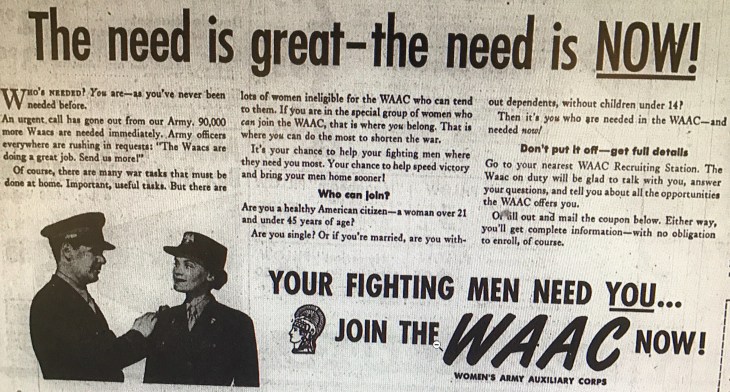
Advertisements, including this one published in the May 15, 1943, issue of The Salt Lake Tribune, urged women to support military men by joining the WAAC.

The WAACs’ arrival was seemingly perfectly timed, for earlier that same week the Governor of Utah, Herbert B. Maw, declared the week of May 10 to 15 as WAAC Week. According to the Salt Lake Tribune, the week was to be recognized statewide for “the first anniversary of the women’s auxiliary army corps…for the purpose of taking over many of the army’s noncombat jobs.” (May 10, 1943, p.16) In his address to the public, the Salt Lake Tribune reported that Governor Maw said the WAAC “has rendered important services to the army by performing more than 100 different types of work formerly done by soldiers needed on the fighting fronts.”

On May 12, 1943, the Salt Lake Tribune reported recruiting would “be the principal feature of the week.” Though the WAAC had already recruited over 60,000 members, the goal was set to quickly add another 110,000 recruits and send them off to training.

Since the primary focus would be recruitment, that week the Salt Lake Tribune featured a variety of ads for the Women’s Auxiliary Army Corps. One featured on page 10 on May 15, 1943, declared largely that the women in the WAAC were “the luckiest girls alive – and we know it! The need is great – the need is NOW!,” it said, sparking patriotism and desperately trying to appeal to the American women who could help fill the wartime void. It seemed great pride was placed upon the women as they bravely entered into unknown territory to dutifully help their country during wartime.

FullSizeRender3

Ads such as this one, published in the May 15, 1943, edition of The Salt Lake Tribune, emphasized duty and patriotism and encouraged women to seek more information about the program.

The women who enlisted also received much praise from their communities. In fact, updates of women who signed up were frequently printed in the papers. Since Tooele was home to one of the units serving at Dugway, it should come as no shock that they were particularly proud of their women. On March 23, 1943, the Transcript Bulletin announced that “Miss Eva C. Brough … left Tooele Saturday for Salt Lake headquarters prior to her departure for Fort Des Moines, Iowa.” The announcement made the front page and was printed above the announcement of two marines leaving for training soon. This is just one of many examples of communities rallying behind men and women supporting the nation’s war efforts.

The community, both local and farther away in Salt Lake City, welcomed the Dugway Proving Grounds unit and continued to encourage more enlistments. The WAAC even received praise from the nation’s president. Printed on page 12 of the Salt Lake Tribune on May 16, 1943, President Roosevelt said, “I congratulate the WAACs and express the gratitude of our nation for a task well commenced.”

The Women’s Auxiliary Army Corps became simply the Women’s Army Corps in July 1943 but the units’ story doesn’t end there. Women continued to dutifully, though separately, serve in the military until 1978 when the WAC was finally fully absorbed into the United States Army. Even then though, the battle for equality and recognition still continued. Though the creation, implementation and ultimate success of the Women’s Army Corps worked to break down gender stereotypes, women were still not seen as fully fit for combative military positions. Even once absorbed in the army, they were withheld from holding combat positons for years to come. Not until December 2015, close to 74 years after the creation of the WAAC, would women finally be allowed to occupy combat roles in all areas of the United States military.

On December 3, 2015, the New York Times published an article which stated “the Pentagon would open all combat jobs to women.” The newspaper also called this decision a “historic transformation,” a “groundbreaking decision” and “the latest in a long march of inclusive steps by the military.” As the fight continues around the nation, and the globe, for women’s equality the WAC and its legacy are a heart-filled reminder of all those who came before us and the accomplishments they strived to achieve.

Nicole Cowdell is a senior at the University of Utah. She is majoring in communication with an emphasis in journalism.

Sources

“Maw Signals Start of WAAC Week: Governor Cites Opportunities Waiting Recruits,” The Salt Lake Tribune, May 10, 1943, 16.

“Conference Opens Drive to Hike WAAC Total,” The Salt Lake Tribune, May 12, 1943, 14.

Advertisement for WAAC Enlistment, The Salt Lake Tribune, May 16, 1943, 10.

“The WAAC…Its First Birthday Just Passed…On They March,” The Salt Lake Tribune, May 16, 1943, 11.

“WAACS Gain Praise of U.S. President,” The Salt Lake Tribune, May 16, 1943, 12.

“92 WAACS Arrive at Dugway: Morale High as Ladies Adjust to Desert Life,” The Transcript Bulletin, May 18, 1943, 1.

“All Combat Roles Now Open to Women, Defense Secretary Says,” The New York Times, December 3, 2015, 1.

Ison, Yvette. “Chemical Weapons Testing Created Controversy at Dugway.” The History Blazer (July 1995): 41-42.

Williams, Vera. WACs: Women’s Army Corps. Osceola, Wisconsin: Motorbooks International, 1997.

Salt Lake Comic Con

by GEORGE W. KOUNALIS

In August 2013, The Salt Lake Tribune reported that Salt Lake Comic Con was projected to break inaugural convention attendance records with a low-end estimate of 40,000 attendees. That September, 72,000 comic fans showed up to the premier convention, according to Salt Lake Comic Con’s own statistics. These numbers speak volumes to the fandom phenomena taking place across the United States as well as in Utah. According to Jeffrey A. Brown, author of Comic Book Fandom and Cultural Capital, “Cons often appeal to a much wider range of fandom than just the comic book enthusiast.” (Brown, 17) The Geek Phenomenon is one that is becoming mainstream in American culture, with Utah being cited as the “nerdiest state in the country,” according to a 2014 piece in Time. Dan Farr and Bryan Brandenburg, the two forces behind organizing Salt Lake Comic Con and its current directors, have created Utah’s biggest convention in the state’s history.

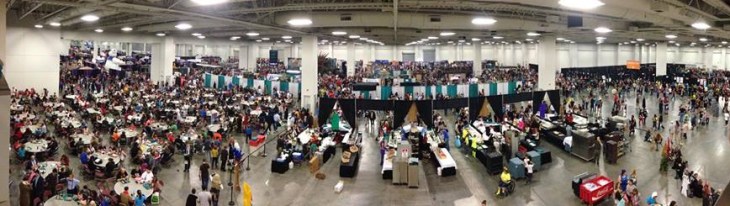
Photo1

The vendor floor of the Salt Lake Comic Con, September 2013. Photo by George W. Kounalis.

Salt Lake Comic Con’s inaugural event had many guests of honor, including actors Adam West, William Shatner, and Henry Winkler, and comic-book writer Stan Lee. The initial event also boasted many vendors and artists from a wide range of fandoms. To the uninitiated, fandoms are the driving force of a comic con. The term is used to describe the groups of people who are fans of certain TV shows or other geek groups. The diverse amount of vendors, artists, and guests attracted thousands of Utah’s “geekiest” to the Salt Palace Convention Center in Salt Lake City.

Photo2

A panoramic view of the Salt Lake Comic Con vendor floor, September 2014. Photo by George W. Kounalis.

The event lasted from September 5-7, 2013. According to the Deseret News, “Fans reported waiting in line for as much as four hours Saturday just to get into the front door to catch the last of the three-day convention.” Ticket sales on that Saturday topped 50,000, with the event being declared as sold out and the Salt Lake County fire marshal limiting the number of people allowed in the Salt Palace. This means, according to The Salt Lake Tribune, that Salt Lake Comic Con’s inaugural event was bigger than the popular Outdoor Retailer show. (McFall) On August 30, 2013, The Salt Lake Tribune quoted one of the convention’s cofounders, Bryan Brandenburg, as saying, “Not only will we increase local participation by 50 to 100 percent, but based on analytics, we are going to be another San Diego Comic-Con.”

Salt Lake Comic Con’s next event, FanXperience 2014, hosted 100,000 people, making it the new biggest convention in Utah. According to Salt Lake Comic Con’s own website, event attendance has continued to grow with each additional convention.

The Salt Lake Tribune, in a story published on September 3, 2014, cited Salt Lake Comic Con’s statistics to illustrate the event’s popularity: “Attendees at FanX came into Salt Lake City from all but two U.S. states.” This suggests that the impact of Salt Lake Comic Con is reaching beyond Salt Lake County. The reporter also noted: “While only 15 percent of the registered guests at last year’s Comic Con were from outside of Salt Lake County, Farr says that number is showing a steady uptick.” Comic Con has been growing since its inaugural convention and is beginning to show an impact on businesses in downtown Salt Lake City.

Photo3

A group of cosplayers have fun at the September 2014 Salt Lake Comic Con. Photo by George W. Kounalis.

Salt Lake Comic Con’s initial convention included many panels on a wide variety of topics, including “How to Get on a Reality TV Show,” and featured numerous film/TV workshops and a Cosplay Contest. “Cosplay” is a term that is the fusion of costume and play. In
“geekdom,” the term is used to describe costuming as a character from a piece of visual media. The convention’s ability to give people access to these sorts of events is one of the many reasons that Salt Lake Comic Con has grown exponentially over the years. Attendees also have opportunities to get autographs and photos (for a fee of $20 or more) and greet the stars who are present.

Photo4

From left: Tom Kenny, Jeff Zannini, Jess Harnell, Grey DeLisle, and Bill Farmer participate in the Twisted Toonz Panel at Salt Lake Comic Con FanX, 2016. Photo courtesy of Dan Adams.

Prior to Salt Lake Comic Con’s 2014 event, San Diego Comic-Con notified Salt Lake Comic Con that it was suing for trademark infringement and false designation of origin. The Deseret News reported on August 8, 2014, that Dan Farr and Bryan Brandenburg denied dropping the Salt Lake Comic Con name and said, “We feel very strong that we’re not doing anything that everyone else isn’t doing.” The Deseret News also reported that “Salt Lake Comic Con is among dozens of conventions across the country and the world that brand their events as comic cons. San Diego Comic-Con holds the trademark on ‘Comic-Con’ with a hyphen, but abandoned its 1995 bid for the rights to ‘Comic Con,’ with a space.” In May 2016, according to Salt Lake Comic Con’s website, both San Diego Comic-Con and Salt Lake Comic Con requested an extension for the lawsuit. Dan Farr and Dan Farr Productions are arguing that they obtained a trademark for Salt Lake Comic Con and that many other events use the term comic con in their name.

In February 2017, The Salt Lake Tribune reported that Emerald Expositions, the company that owns the Outdoor Retailer show, would no longer hold its massive, twice-yearly shows in Salt Lake City. In response, Bryan Brandenburg wrote an open letter on LinkedIn regarding the situation and how Salt Lake Comic Con can fill in the shoes of the Outdoor Retailer Expo. In his letter he cites how the state’s tax credits for filmmaking in Utah has created the perfect environment for Salt Lake Comic Con to grow. Brandenberg writes, “We believe we can build something that will have much more impact if we are able to line up the type of support that Outdoor Retailers had here. Salt Lake Comic Con is only three years old and we’ve already helped generated tens of millions of dollars in economic impact to the area.” Requesting the support from the state of Utah could fill in the shoes of the Outdoor Retailer Expo and allow Salt Lake Comic Con to become the number 3 comic convention in the United States behind San Diego Comic-Con and New York Comic Con.

Salt Lake Comic Con is currently the largest convention in the state of Utah and has set a new precedent for Geek culture in the state. Even though the con is only about 3.5 years old, the impact of it is being seen across the state. With the Outdoor Retailer Expo making the decision to leave in February 2017, Salt Lake Comic Con has been put in a position to fill in those shoes and has the potential to become bigger.

I interviewed Dan Farr at the most recent event on March 17, 2017, regarding the Outdoor Retailer Expo leaving Utah and he had the following to say, “We would like to be something like South by Southwest, which is a fan festival for music. If we can turn it [Salt Lake Comic Con] into something like that here, we can have hundreds of millions brought into the state.”  This convention matters because it is one of the biggest events in the state and will continue to be so. The impact of events such as Comic Con bring new people into geekdom and allow the community to be put on the map for other geek events. It also allows Utah to expand connections with the entertainment industry.

George W. Kounalis is a junior at The University of Utah. He is majoring in journalism with a minor in music technology.

Sources

George Kounalis, interview with Dan Farr, recorded March 17, 2017, http://bit.ly/2nwDYGy.

Salt Lake Comic Con, “San Diego Comic-Con International vs. Salt Lake Comic Con,” accessed March 14, 2017, http://bit.ly/2mSLQkG

Bryan Brandenburg, “Salt Lake Comic Con Can Fill the Void of Outdoor Retailers Exit,” LinkedIn, February 24, 2017.

Salt Lake Comic Con, accessed February 23, 2017, http://bit.ly/2m4Jv8L

Michael McFall, “Comic Con delivers fans, but does it deliver dollars?” The Salt Lake Tribune, September 3, 2014.

McKenzie Romero, “San Diego Comic-Con strikes back: Lawsuit filed against growing S.L. convention,” The Deseret News, August 8, 2014.

Nolan Feeney, “This is the nerdiest state in America,” Time, April 26, 2014.

Matthew Piper, “Salt Lake Comic Con organizers have San Diego in their sights,” The Salt Lake Tribune, September 11, 2013.

Program, Salt Lake Comic Con 2013, September 5-7, 2013.

Matthew Piper, “Salt Lake City is poised to challenge first-year comic con records,” The Salt Lake Tribune, August 30, 2013.

Alberty, Erin. “Outdoor Retailer is leaving Utah over public lands issues, a move Herbert calls ‘offensive.'” The Salt Lake Tribune, February 17, 2017, http://bit.ly/2m1xxJx.

Brown, Jeffrey. “Comic Book Fandom and Cultural Capital,” The Journal of Popular Culture 30, no. 4 (March 1997): 13-31.

Wright, Bradford. Comic Book Nation: The Transformation of Youth Culture in America. Baltimore, MD: John Hopkins University Press, 2003.

Doug Fabrizio, Host of KUER’s ‘RadioWest’

by HANNA TATRO

Doug Fabrizio was born in 1964 in Bountiful, Utah. He studied at the University of Utah and began working and reporting for the KUER broadcasting station in 1987. KUER is a public radio station and is a member of National Public Radio (NPR). Its mission is simple: the station is “committed to building a community of world citizens through story and art, discussion and debate, sound and creativity.” (“About KUER”) The station is broadcast from the University of Utah and listeners around Utah tune in.

Fabrizio began working at the station when he was a junior in high school. By 1993, he had assumed the position of news director of KUER. (Sheehan) Then, in 2001, Fabrizio began hosting a radio segment, RadioWest. The show is “a radio conversation where people tell stories that explore the way the world works. (“About RadioWest“) In an interview with CityWeekly, Fabrizio expressed his views of the shows’ particular content, “Art and culture are an important part of the program. I actually don’t believe in segregating news – keeping the hard stuff from the softer stories (in fact I hate describing arts coverage or features as ‘soft’) or the local ones from the national ones. No matter where it comes from, most of us don’t see music or literature or great film as any less important to our lives than knowing about the critical events and issues of the day.” (Sheehan) Fabrizio has had the chance to interview many influential people throughout the years, from Madeleine Albright, the first woman in the United States to become secretary of state, to the Dalai Lama.

Doug Fabrizio, host of RadioWest, has worked at KUER since 19xx.

Doug Fabrizio became host and executive producer of KUER’s RadioWest in 2001. Photo courtesy of KUER.

Fabrizio’s work has been recognized by many organizations, including the Public Radio News Directors Association, Society of Professional Journalists, the Utah Broadcasters Association, and the Academy of Television Arts & Sciences.

RadioWest has steadily progressed throughout the years and Fabrizio’s style has evolved using storytelling mixed with honest interview question and answers. Fabrizio has profiled a number of topics, Utahns, and intellectuals, including the documentary, Ab Jenkins and the Boys of Bonneville, Everett Ruess, University of Utah President Chase Peterson, Congressman Ron Paul, David Foster Wallace, Nobel Peace Laureate Mohamed ElBaradei, and Robert Redford. These profiles incorporate Fabrizio’s storytelling approach.

“The Boys of Bonneville” segment aired on August 24, 2011. The segment featured the story of Ab Jenkins, who sped across the Bonneville Salt Flats and set record speeds. Fabrizio interviewed the director and others about the new documentary. Fabrizio introduced the piece with a simple introduction, setting the scene of the Salt Flats, a landmark not as well known by Utah residents as one would think. Fabrizio had four separate guests on the program; he kept the atmosphere relaxed.

Fabrizio focused on Everett Ruess, a young man who disappeared in the Utah desert, for a segment that aired on July 13, 2011. The tone was more serious as Fabrizio interviewed David Roberts, a writer who had thought he had found the body of Ruess. Fabrizio carried the piece by asking the tough questions first, and using basic interview skills. The piece doesn’t provide answers for where Ruess lies, but Fabrizio explores Ruess’s story and invites Roberts to discuss his chronicle of Ruess’ adventures.

University of Utah President Chase Peterson sat down with Fabrizio on May 7, 2012, to discuss his new book, The Guardian Poplar. The segment was carried by Fabrizio’s tone. He had respect for Peterson, which was evidenced by his very candid introduction. Fabrizio listed Peterson’s accomplishments and then let him do the talking. Peterson was humble and quiet and shared stories that appeared in his book. Fabrizio’s technique gave Peterson the stage and allowed the story to speak for itself. Peterson had been diagnosed with cancer and believed he only had a few years to live. But, he outlived his death sentence and Fabrizio’s presence put him at ease to share his struggles and joys.

Musician La Monte Young, who was born in Idaho and worked on a family farm on Utah Lake, has influenced some of the great artists. In a show that aired November 29, 2013, Fabrizio interviewed Professor Jeremy Grimshaw from Brigham Young University, who wrote a biography about the musical protégé. Fabrizio was knowledgeable about the guest and artist, but he asked open-ended questions that led to further discussion and allowed Grimshaw to discuss the complex character and Young’s musical compositions. Fabrizio’s technique allowed for a more in-depth approach that yielded untouched information.

Congressmen Ron Paul spoke at Utah Valley University in October 2012 and conducted a question and answer afterward with the students. Fabrizio’s segment took listeners inside the discussion and allowed people to share in the conversation. Fabrizio began with his simple introduction approach and allowed the congressmen to greet the viewers. Then Fabrizio facilitated the Q and A session.

David Foster Wallace was an acclaimed writer who committed suicide. D.T. Max, a New Yorker staff writer, wrote a biography of Wallace and joined Fabrizio’s show by phone to tell the story. The piece began with an introduction of Wallace and Max, which gave the audience an immediate feel for both parties.

Mohamed ElBaradei, a Nobel Peace Laureate, came to Utah in September 2012 to talk about his international atomic energy plans. He also joined Fabrizio for a RadioWest interview. The piece had a serious tone in keeping with a newsworthy international discussion.

Biographer Michael Feeney Callan chronicled the life of Robert Redford in his book, Robert Redford: The Biography. Callan spent fifteen years speaking to Redford and discovering his ways before finishing his book. Fabrizio introduced the September 2011 program with a story of Redford’s search for art and wanderings and then allowed Callan to discuss his book and findings about the infamous founder of Sundance Film Festival.

The early 1900s began the trend of the national radio craze throughout America. It all started with young teens from Utah, much like Fabrizio. In 1909 these kids began the first Radio Club in Salt Lake City. They transmitted and broadcast segments over the airwaves. (Larson and Avery) Fabrizio has continued to carry on the young Utah tradition and has transformed his broadcast to feature several storytelling techniques. He uses the airwaves to tell the stories, which carry communication to Utah and the rest of the nation.

Fabrizio’s broadcasts since 2009 can be found online. Archiving is an ongoing project.

Hanna Tatro graduated from The University of Utah in May 2014 with a Bachelor of Science degree in journalism.

Sources

Biographical sketch, Doug FabrizioRadioWest.

Doug Fabrizio, “Boys of Bonneville.” RadioWest.

Doug Fabrizio, “Finding Everett Ruess,” RadioWest.

Doug Fabrizio, “The Guardian Poplar,” RadioWest.

Doug Fabrizio, “The Music and Mysticism of La Monte Young,” RadioWest.

Doug Fabrizio, “Congressman Ron Paul,” RadioWest.

Doug Fabrizio, “The Life of David Foster Wallace,” RadioWest.

Doug Fabrizio, “Nobel Peace Laureate Mohamed Elbaradei,” RadioWest.

Doug Fabrizio, “Robert Redford: The Biography,” RadioWest.

Tim Larson and Robert K. Avery, “Utah Broadcasting History,” in Utah History Encyclopedia (Salt Lake City: University of Utah, 2009).

About KUER,” KUER.org.

Gavin Sheehan, “Doug Fabrizio,” City Weekly, July 10, 2009.