Piston-Engined Rocket Ships on Wheels: Bonneville Salt Flats

by NICHOLAS W. HAGEMAN

In 1833, Joseph R. Walker, an explorer, was interested in the region of the Great Salt Lake. During his journey, he traveled through the northern perimeters of the Salt Flats in Utah, while working for Captain Benjamin L.E. Bonneville. (Hallaran, 2011) Little did Walker know, he was traveling across more than 45 square miles of Salt Flats, which is roughly 30,000 acres. Since that exploration, the name of the area has come to be known as the “Bonneville Salt Flats.” Many years later, other explorers wanted to use the Bonneville Salt Flats as a shortcut to the Pacific Coast. However, this was deemed to be an inefficient way of traveling due to the mountainous terrain, which cuts across the flats. (Hallaran, 2011)

In 1910, Ab Jenkins discovered the Bonneville Salt Flats for his own. The Salt Lake Tribune reported on August 21, 2011, that Jenkins found the Salt Flats when he was riding his motorcycle to Reno to see Jack Johnson fight Jim Jeffries in the “Fight of the Century.” According to Hallaran, Jenkins returned to the flats in 1925 where he decided to race his Studebaker truck across the Salt Flats, walloping a special excursion train by more than ten minutes in the race. Jenkins decided to race this train because of the long, flat and desolate surface the Salt Flats provided. It was here in 1925 when Jenkins realized that this remote area had true potential for being a place to achieve land speed records. After Jenkins’ race, he said, “That was my first time on the salt with an automobile, and right then and there I realized the tremendous possibilities of those beds for speeding.” (Embry and Shook, 1997) It was from this day on that the Bonneville Salt Flats have been classified as a world renowned raceway, known for its high speeds and potential for setting land speed records.
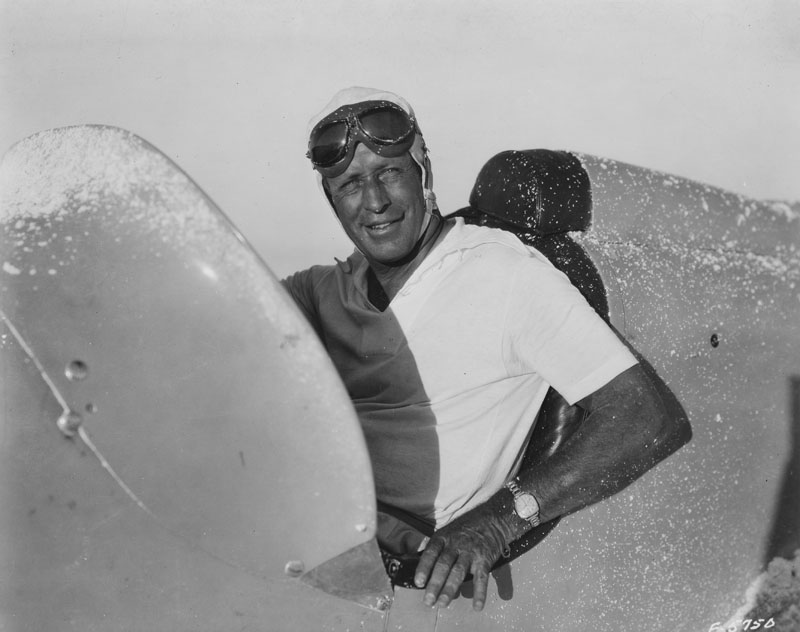
Ab Jenkins sitting inside his racing vehicle, the "Mormon Meteor," on the Bonneville Salt Flats Raceway, late 1930s. Photo courtesy of the Special Collections Archive at the J. Willard Marriott Library, The University of Utah.

Jenkins was born in Spanish Fork, Utah, and was raised in Salt Lake City. He was a man of many different trades. Not only was he known for his development of racing on the Salt Flats and making this a place to set land speed records, but according to The Salt Lake Tribune “The Meteor Rides Again,” he was also known as a race-car driver, safety advocate, and the mayor of Salt Lake City for a time during World War II. In 1932, Jenkins took his 12-cylinder “Pierce-Arrow” automobile to the Bonneville Salt Flats, where he began the sport of land speed racing.

Between the years of 1932 and 1956, Jenkins achieved many new, world land speed records at the Bonneville Salt Flats. According to an article published in The Deseret News on October 15, 1946, Jenkins was considered to be “the holder of more automobile racing records than any other racing driver in the world.”

Setting these world records caught the attention of many exceptional racers worldwide, bringing them to Utah to get a taste of the Bonneville Salt Flats. Jenkins’ popularity grew ever so rapidly once he had exposed these land speed records to the mainstream public. Furthermore, in 1950, Jenkins wiped out twenty-six world records on the Bonneville Salt Flats in his “Mormon Meteor.” He named his racecar the Mormon Meteor to show respect to his Mormon faith and heritage.
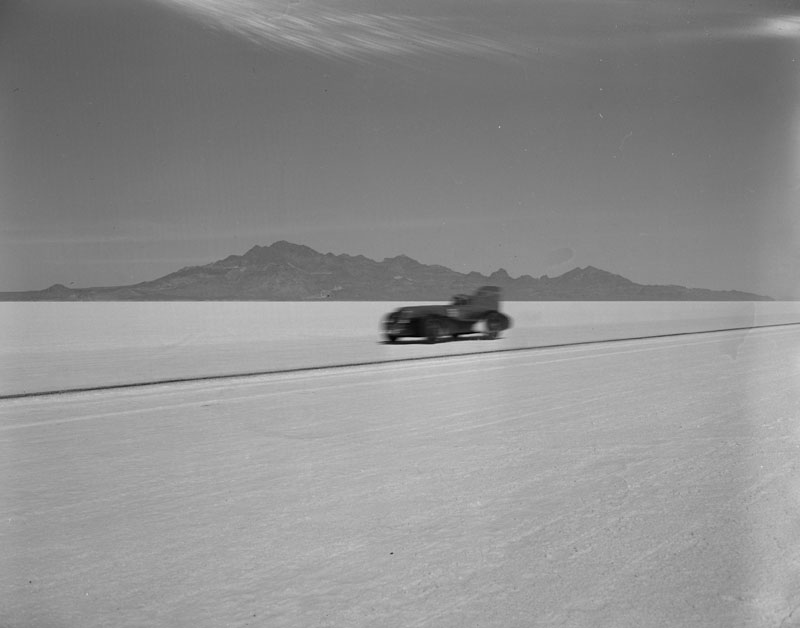
Ab Jenkins racing his "Mormon Meteor" across the Bonneville Salt Flats, circa 1936-1939. Photo courtesy of the Special Collections Archive at the J. Willard Marriott Library, University of Utah.

In an article published by The Deseret News in 1950, the paper refers to the Bonneville raceway as “glassy-smooth” and “record fast” as well as very dry, which was great for setting land speed marks. As reported in an article published in The Deseret News on July 15, 1951, the 68-year old set out to race his Mormon Meteor at speeds of more than 200 mph. This is especially astounding given his age and how he had already “racked up more than 10,000 records and has never had an accident on the flats, a course that ranks as the world’s fastest and safest.”

Although Jenkins had thousands of records under his belt, he did have problems with his racecar early on. In an article published by The Deseret News in 1936, the author explains how Jenkins lost two of his records due to a mechanical error when a casting leak led a universal joint to burn out, paralyzing his car and wiping him out of that day’s record-setting runs. Even though circumstances such as mechanical malfunctions can occur, it was — and still is — very important that these racecar drivers had a crew of mechanics with them as well as parts so they could fix any problems at hand. Above all, Ab Jenkins was the catalyst to the sport of land speed racing at the Bonneville Salt Flats and he had turned this sport into a popular worldwide event that takes place annually September 8-12, right here in Utah.
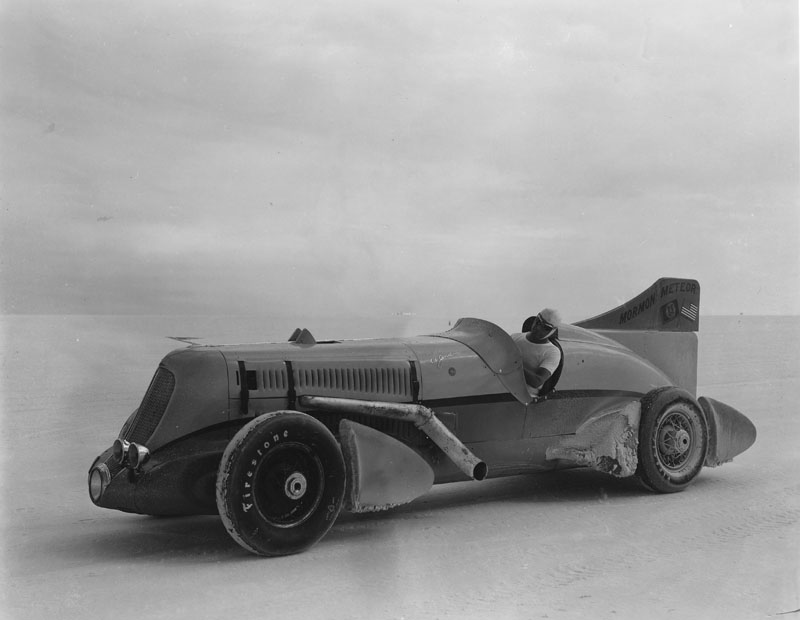
Ab Jenkins sitting inside his "Mormon Meteor" on the Bonneville Salt Flats, late 1930s. Photo courtesy of the Special Collections Archive at the J. Willard Marriott Library, University of Utah.

To get an idea of the types of automobiles Ab Jenkins and other racers were using (and still are used to this day), it is important that we know these racers used everything from 12-cylinder gas engines to straight jet engines. For example, in 1932 (Jenkins’ first race on the Salt Flats) he pushed his 12-cylinder Pierce-Arrow to the limits by driving it on the flats for 24 hours straight, only to stop for refueling. His average speed in this race was 112.916 mph. (The Salt Lake Tribune, 2011) The A.A.A., however, did not record this land speed record. Being the goal oriented and driven man that Ab Jenkins was, he decided to go after his own record again in 1933.

Furthermore, he influenced “top British racers Sir Malcolm Campbell, Capt. E.T. Eyston and John Cobb to visit the Salt Flats for the first time, setting records and launching the site’s global reputation.” (The Salt Lake Tribune, 2011). Just a couple years later in 1935, Jenkins came out with his “Mormon Meteor II,” which was a 12-cylinder Curtis airplane engine that had a little over 400 horsepower. In this vehicle he set a 24-hour land endurance average speed record of 135 mph, covering over 3,523 miles. (Owens, Supercars.net) Jumping ahead to 1970, Gary Gabolich’s rocket car, “Blue Flame,” set a speed of 622.4 mph (The Salt Lake Tribune, 2011). When these men are out racing their cars, it is the A.A.A. that is clocking their official times on the racetrack (or Salt Flats). In a September 1936 article published by The Deseret News, the author wrote that Jenkins was to pay $2,500 to the A.A.A. timers for their assistance in clocking the official runs down the Salt Flats. Back then, $2,500 was a lot of money, but thanks to Jenkins’ accomplishments and popularity in the state of Utah, the Optimist Club (a philanthropic organization) gathered this money for Jenkins and paid the A.A.A timers for his runs.

After many years of passion and joy for the sport of land speed racing, Ab Jenkins is still a legend and still holds the 48-hour endurance record to present day. According to Barracuda Magazine, “Ab Jenkins held and broke more records than any other person in the history of sports.” Jenkins’ attitude and outlook on life and the sport of racing was rare. “Jenkins was a breed of consummate sportsman-gentleman whose polite and honorable conduct today seems as rare and quaint as the open-cockpit Pierce-Arrow that he first raced at Bonneville.” (Barracuda Magazine) Additionally, in an article published by The Salt Lake Tribune in July 1935, John Cobb (a top British racer) applauded the sportsmanship of America and spoke very highly of Ab Jenkins, whom he called the “Iron man of America.”
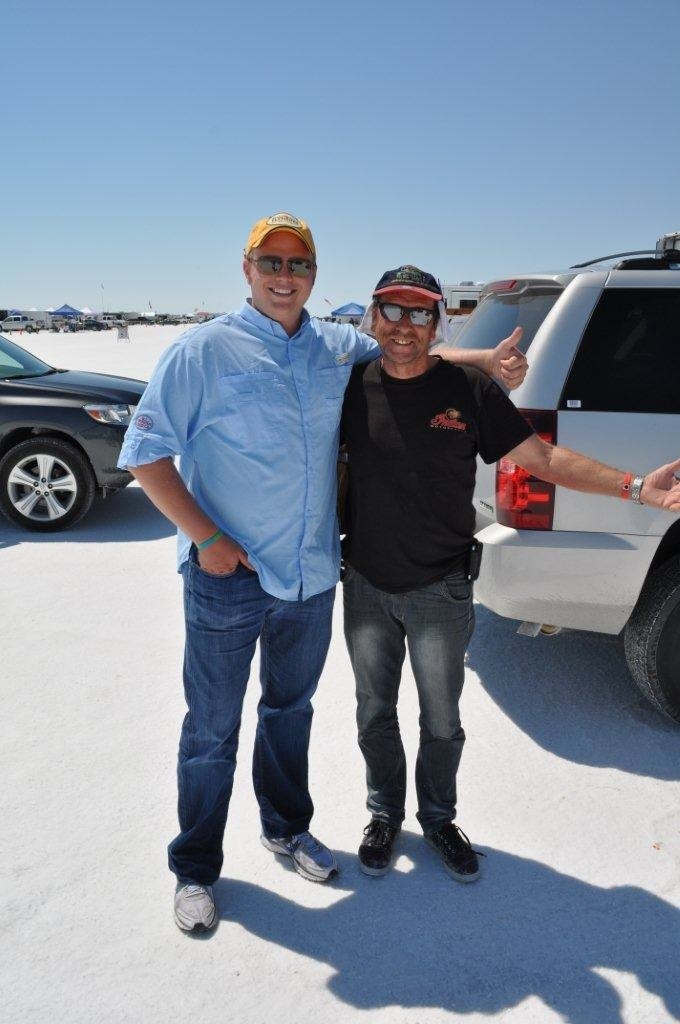
Nicholas W. Hageman, left, at the Bonneville Salt Flats, September 2011.

Thanks to Ab Jenkins, the Bonneville Salt Flats are used for more than just land speed racing, however. Filmmakers and television producers use the Salt Flats in movies and TV shows because of the beautiful scenery it can evoke. Examples of a couple of films that have been shot at the Salt Flats are Independence Day, The World’s Fastest Indian, and even The Pirates of the Caribbean. Additionally, the surrounding areas of the Bonneville Salt Flats are featured in the movie Con Air. (The Salt Lake Tribune, 2011) The scenery is so wide open and remote, filmmakers and directors can virtually make the Salt Flats look like any place in the world they want to. Overall, the Bonneville Salt Flats have many uses and are popular worldwide by a variety of different enthusiasts, thus making it a significant landmark for entertainment and historical purposes here in the state of Utah.

Nicholas Hageman is a senior at the University of Utah. He is studying speech communication and will graduate in August 2012 with a B.S. in speech communication. Nicholas is an avid golfer, fisherman, hunter and car enthusiast. He transferred to the University of Utah in the fall of 2011 from the University of Arizona, where he studied Agribusiness Economics & Management.

Sources 

Tom Wharton, “Wendover: More Than Gambling,” The Salt Lake Tribune, December 6, 2011, C1.

Sean Means, “The Meteor Rides Again,” The Salt Lake Tribune, August 21, 2011, D2.

“Jenkins Awaits Friday Salt Flat Run,” The Deseret News, July 15, 1951, C5.

“Salt Flats Dry, Fast For Races,” Deseret News, September 2, 1950, 11.

“Ab Jenkins To Go After Own Records,” Deseret News, October 15, 1946, 10.

“Five Bouts Feature Ab Jenkins Benefit Card,” Deseret News, September 25, 1936, 15.

“Jenkins Will Start Again Monday,” Deseret News, September 17, 1936, 7.

George Chambers, “Cobb To Return To Utah Salt Flats,” The Salt Lake Tribune, July 18, 1935, 12.

Richard Owen, “1935 Duesenberg SJ Mormon Meteor Speedster,” Supercars.net

Janna Bushman and James Davis, “Crafting a Sense of Place: Media’s Use of the Bonneville Salt Flats,” Journal of Cultural Geography 17, no. 1 (1997).

George Lepp, Bonneville Salt Flats: Speed Limit 1,000 mph (Osceola, WI: Motorbooks International, 1988).

Ab Jenkins and Wendell J. Ashton, The Salt of The Earth (Salt Lake: The Deseret News Press, 1939).

Real-Man Revisited: Ab Jenkins Son of the Salt,” Barracuda Magazine (no. 11).

Jessie Embry and Ron Shook, “Utah’s ‘Ugly Duckling’ Salt Flats,” Utah History to Go, State of Utah.

Kevin B. Hallaran, “Bonneville Salt Flats,” Utah History to Go, State of Utah.

Topaz Internment Camp and how Japanese Citizens were Portrayed to the Public

by CLINTON CURTIS

In 1942 Millard County was very different from the way it is viewed today, because it was home to the Central Utah Relocation Center, commonly known as “Topaz.” Many residents of Japanese ancestry were relocated and isolated at Topaz as a safety precaution to the United States entry into World War II. A total sum of “120,000 Japanese Americans were placed in concentration camps, 70,000 of these internees were United States citizens by birth.” (Sundquist, 532) These residents of Japanese ancestry were rounded up by the United States Army and forced to leave their homes, occupations, and lives. They were told to pack one suitcase per person and be on their way. This Executive Order had been passed by President Franklin D. Roosevelt, along with the support from the Justice Department and the War Department. Ten different Relocation Centers were erected in California, Utah, Idaho, Wyoming, Arizona, Colorado, and Arkansas during the spring and summer of 1942. (Sundquist, 532)

Just a couple days after the attack on Pearl Harbor, Japanese Americans were forced into internment camps. One of these camps was right here in Millard County, Utah. Through all of this mayhem the news media were able to collect information and print what they found in their articles. Much of this information was very valuable to many Americans; knowing that the Japanese Americans were contained in internment camps helped them think that they were safe. The print media printed articles surrounding the entry into the internment camps, movement of internees amongst the internment camps, and the selective service for the Nisei who were currently held in the internment camps. The articles that I focused on were articles written and published by the Topaz Times, the camp newspaper that covered many important moments through WWII.

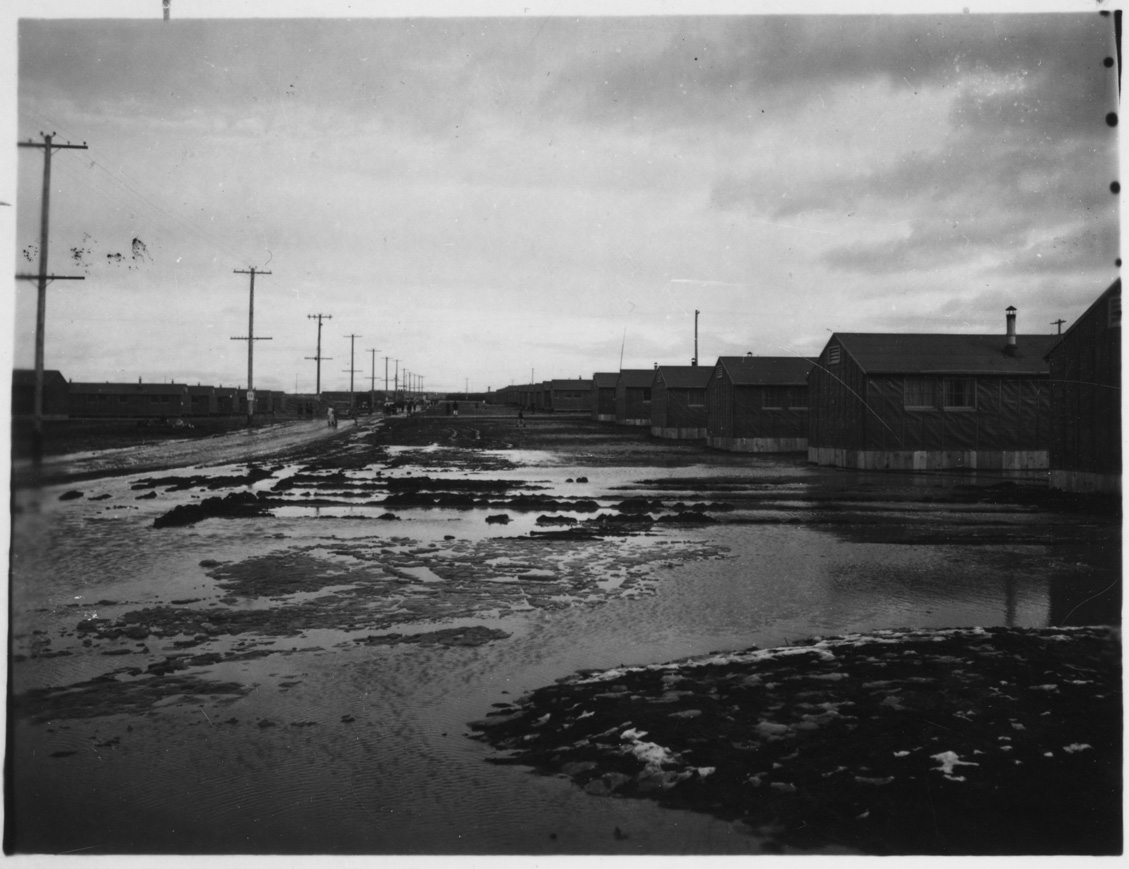
Photograph taken inside the Central Utah Relocation Center, commonly known as Topaz. Photo courtesy of Special Collections, J. Willard Marriott Library, The University of Utah.

An article titled “The Nisei and the Selective Service” discusses the options that the Japanese Americans had concluding their placement in the internment camps. The Japanese American citizens who chose to work in war plants had to acquire a “War Plant Clearance,” although these permits were not given out to them frequently. The few who had been granted a permit had very strict rules to their release from the internment camp. The citizens were not allowed to return back to their homes, and they were not allowed in the Atlantic, Gulf, or West Coast. With this permit that they had been granted they were simply allowed to work in the war plant. The Japanese American men who decided to join the Armed Forces had very strict rules as well. “Other than a very small group of Japanese American troops who were allowed to serve with the Americans, a majority of the Japanese American troops were not allowed to serve with the other Americans and were enlisted to the 442nd battalion.” (Sundquist, 533)

Another article titled “Court Convicts Nisei on Draft Charge” helps give a picture of what happened to many of the Japanese American men who had signed up for the Armed Forces, but decided not to show up. George Jiro Sugihara, who was only 19 at the time and felt that he owed nothing to the United States Armed Forces, was charged guilty under the Selective Service Act for not showing up for his induction into the Armed Forces. This was only one article, but this article explains the consequences to the decisions that many Japanese Americans made, whether they decided to join the Armed Forces or stay in the internment camps.

While the Japanese Americans were staying at the internment camps their mail was supervised. An article by the Topaz Times titled, “Instructions Released on Internee Mail,” explained the process that the internees along with the internment camps took before sending their mail. All of the internees had to send their mail to New York with the title “Prisoner of war mail—free” at the upper right-hand corner. This new rule was established to censor what the Japanese Americans were allowed to say to either others in internment camps or others outside of the internment camps.

I was able to find two articles published by the Topaz Times that discussed stories by families who were reunited in internment camps. One of the articles was titled “5 Internees Here From New Mexico”; the other article was titled “9 Internees Join Families.” In both, the Santa Fe internment camp sent family members to the Topaz internment camp, so the families could be reunited. These two articles give you a background idea that the American internment camps did have sympathy. The internment camp directors made an effort to make sure that families had the opportunity to be reunited.

External view of Topaz. Photo courtesy of Special Collections, J. Willard Marriott Library, The University of Utah.

During the year of 1945 when World War II ended, the Japanese Americans were allowed to leave the internment camp. Although this was a very joyous time for many of the internees, there were articles published about the dangers that the Japanese Americans faced upon returning home. A Topaz Times article titled “Shots Fired on Returnee’s Home” gave the readers an insight to the prejudice individuals were subjected to once they were released from the internment camp. Late one night at the Fresno, California, home of Setsugo Sakamoto, two shots were fired at his house. Mr. Sakamoto had just returned from the internment camp a month prior to this event with his family. This article shows that even though the Japanese Americans were released and freed from the internment camp, they still faced many dangerous hardships upon their arrival back to their homes.

The last article that I found very interesting was titled “A Letter.” This article explains that the government had started to compile the information about the Japanese American internees. This compilation would serve as a “permanent reference file of America’s history.”

These articles were a great representation depicting the news coverage during wartime. It is very important to see how the news coverage has varied from the past to present day. As communication majors the past affects our present and future. To see how the news was covered in the past can help you either adopt or revise the past and create a new style of news reporting for the future. I have been very surprised to read about the Topaz internment camp. Even though this was during a time when everyone was very suspicious, the internment camps still tried to make it easier on their internees. For instance, they would transport their internees in order for them to reunite with their families.

Clinton Curtis is graduating in August 2012 with a Bachelor of Science degree in communication and a minor in psychology. This information is very important to myself and to my family history. My grandfather was placed into an internment camp in Idaho and shortly after he was drafted into the war. My grandfather was specifically drafted into WWII under the 442nd Regimental Combat Team.

Sources

“5 Internees Here from New Mexico,” Topaz Times, November 2, 1943.

“9 Internees Join Families,” Topaz Times, July, 13, 1943.

“A Letter,” Topaz Times, July 17, 1943.

“Court Convicts Nisei on Draft Charge,” Topaz Times, November 26, 1945.

“Editorial,” Topaz Times, August 15, 1942.

“Instructions Released on Internee Mail,” Topaz Times, February 12, 1943.

“The Nisei and the Selective Service,” Topaz Times, April 1, 1944.

“Shots Fired on Returnee’s Home,” Topaz Times, May 15, 1945.

“Photograph 1 inside Topaz internment camp”. Marriot Library Special Collections.

“Photograph 2 taken outside of Topaz internment camp”. Marriot Library Special Collections.

Robert Shaffer, “Opposition To Internment: Defending Japanese American Rights During World War II” Historian 61, no. 3 (1999): 597.

Dolores Flamiano, “Japanese American Internment In Popular Magazines,” Journalism History 36, no. 1 (2010): 23-35.

Eric J. Sundquist, “The Japanese-American Internment,” American Scholar (1999): 529-47.

Iosepa: The Polynesian Colony of Utah

Iosepa, Utah, residents celebrating Pioneer Day, August 28, 1914. Used by permission, Utah State Historical Society, all rights reserved.

by PENI TAGOAI

History—The LDS Church sent missionaries to the South Pacific as early as 1844, three years prior to the pioneers settling the Salt Lake Valley. When the first LDS missionaries arrived in Hawaii and other Polynesian islands, they were unsuccessful. None of the native Hawaiians and Polynesians were interested in their message. As the missionaries were able to learn the language and culture of the people they served among, they began to see more Polynesians interested in their message and eventually many of them joined the LDS Church. The Hawaiians, Samoans, and other Polynesians who were converted to the LDS Church desired to join the saints in Utah in the settling of the Salt Lake Valley. Unfortunately, due to the laws of the Hawaiian government, they were not able to leave the islands until the laws relaxed in or around 1875. (Panek)

By 1889 there were about 75 Polynesians in the Salt Lake Valley. With the majority being Hawaiian, they settled in Warm Springs, Utah (Beck’s Hot Springs). Language barriers and culture differences made it difficult for these Polynesians to adapt to life in Utah. As a result, this led to difficulty in finding employment, which then led to a difficulty in providing for their families. (Panek)  Also challenging for these Polynesians was the fact that rumors had spread about the islanders having leprosy. The Salt Lake Herald reported on June 20, 1896, that “although rumors prevail to the effect that one had appeared ere they were settled on the lands composing the small settlement.”

On May 16, 1889, the First Presidency of the LDS Church put a together a committee to find a permanent home for these Polynesians. This group included three men: Harvey H. Cluff, William W. Cluff, and Fred A. Mitchell. They presented the plan to the Polynesians in Warm Springs to find them a home. The Polynesians selected three men of their own to join this committee: J. W. Kaulainamoku, George Kamakaniau, and Napela (First Hawaiian convert and first Hawaiian to visit Utah). (Atkin) This plan was welcomed warmly and with excitement to have a place they could call their home.

The land unanimously voted on as the home for these Polynesians is located at Skull Valley in Tooele County. Tropical landscapes filled with beaches and greenery were traded for desert farm land. George Fredric Stratton of the Salt Lake Herald described a trip into Skull Valley in 1915 from Salt Lake City: “Forty miles to an early breakfast at Granstville [Tooele County], then another forty miles across the desert took them into Iosepa.”

The land in Skull Valley was owned by John T. Rich. Chosen over three other locations from Utah, Cache, and Weber counties, it provided the best farming land that could potentially provide financial means and accommodate growth. Their new home was named Iosepa after the boy missionary, Joseph F. Smith. He was called to serve a mission to the Hawaiian Islands when he was 15 years of age. The colony was named in his honor using the Hawaiian translation of Joseph. (Atkin)

Life in Iosepa—The Polynesians, numbering about 50 people, moved into their new home August 28, 1889. Work immediately started on the layout plans of the town. In an interview with the Daily Enquirer November 5, 1889, Harvey H. Cluff pointed out that the newly established colony was part of an incorporated company named the Iosepa Agricultural and Stock Company (IASC). Cluff pointed out that the colony would have the opportunity to work for IASC and in turn have a more comfortable home. He added that a public square had been laid out, four center streets designated, a day school had been planned, and homes were being built for the community’s increasing numbers.

In time Iosepa expanded and the LDS Church purchased 800 additional acres. This increased the land that was being cultivated from 200 acres to 400 acres. The ability to provide sufficient water played a major role in this expansion. On November 9, 1908, the Deseret Evening News reported that the irrigation canal that was under construction was now complete. The newspaper describe the irrigation engineering as “remarkable, of passing through the mountains with the canal by which the waters of the different streams were intercepted and brought together.”

Due to financial pressures, the LDS Church and Iosepa were tempted to rent out part of their farmland to Samuel Woolley of Grantsville who would hire the Polynesians to work the land in return. (Panek) In 1904, colony president Thomas A. Waddoups spoke about the signs of self-sufficiency. The Deseret Evening News reported on the productive harvest of the year: 1,000 tons of hay, 250 beeves [beef], several hundred stock of cattle, 5,200 bushels of wheat and barley, 800 bushels of potatoes, 50 tons of squash, 600 bushels of corn. Similar to other colonies, there are financial difficulties at first and it can take time to become self-sufficient. The Iosepa colony of the LDS Church was no exception.

Life in Iosepa was affected by the economic circumstances because of the need to survive. The need to educate the people of Iosepa was also made a priority within the first year of its existence.The Daily Enquirer interviewed Harvey H. Cluff, who was  then president of the Iosepa colony, on November 1, 1889. He said,  “A day school will be set in operation as soon as the people are properly located for the winter, when such class instruction to the more advanced male and female population as will conduce to the improvement of the people socially, religiously, morally, and in cleanliness, will be given from time to time.”

On September 3, 1910, 21 years after that initial interview with Harvey H. Cluff, the Deseret Evening News reported that the school in Iosepa had been very successful. “All these years a good free school has been maintained…. The native Hawaiians make rapid progress from 6 years up to 16 and 17 years, outstripping the white children.”

They also had to make sure their culture and identity remained intact.  Social activities were planned around LDS Church activities because the colony was under the direction of the LDS Church. Every year the same important dates took place:

  • Hawaiian Pioneer day, August 28
  • New Years Day
  • Christmas Day
  • Polynesian day, celebrated every time LDS Church officials visited—about four times a year. (Atkin)

Festivities included a pig roast, traditional Polynesian food, and traditional Polynesian music and dance from each island represented in Iosepa. The Deseret Evening News reported on September 2, 1905, about one of the annual celebrations commemorating the Polynesian’s first arrival into Skull Valley: “7 o’clock this morning two dressed pigs weighing over 100 pounds each, were placed whole in a pit, where a fire, hours old, had heated stones in the bottom to an intense heat…. At 8 o’clock a dance commenced in the amusement hall of the colony, and the fun was furious until 12 o’clock midnight.” By cooking in the methods of their homeland, they preserved their culture and educated their youth about their native cultures.

In 1915, the LDS Church announced the building of the Laie, Hawaii Temple on the island of O’ahu. This announcement ushered in the closing of the Iosepa colony along with the offer from the LDS Church to pay the settlers’ fares back to Hawaii. (Atkin) By 1916, several of the Polynesian residents of Iosepa returned home. The Maui News reported on November 3, 1916, that 17 of the Iosepa pioneers arriving on the ship, Sierra, as “going old and gray-haired” moving into yet another “Mormon colony” this time in their homeland located at “Laie, windward O’ahu.” By 1917, Iosepa was almost entirely abandoned save a few residents (Atkin), breaking up one of the oddest pairings of the 20th century: the tropically-grown people of Polynesia and the desolate farmlands of Utah.

Peni Tagoai is a senior at the University of Utah, graduating in August 2012. His major is in speech communication with a minor in international studies. He grew up on the North Shore of O’ahu.

Sources

“Iosepa, The Kanaka Colony in Tooele County,” Daily Enquirer, November 1, 1889.

“Leprosy in the Kanaka Settlement,” Salt Lake Herald, June 20, 1896.

“Conference at Iosepa,” Deseret Evening News, November 26, 1904.

“Iosepa, Hawaiian Celebration,” Deseret Evening News, September 2, 1905.

“Big Event for Iosepa Colony,” Deseret Evening News, November 9, 1908.

“Hawaiian Village of Iosepa Celebrates Twenty-first Birthday,” Deseret Evening News, September 3, 1910.

George Frederic Stratton, “From Salt Lake to South Sea Islands,” Salt Lake Herald, September 5, 1915.

“On The Other Islands,” The Maui News, November 3, 1916, 5.

Tracey E. Panek, “Life at Iosepa, Utah’s Polynesian Colony,” in Proclamation to the People: Nineteeneth-century Mormon and the Pacific Basin Frontier, ed. Laurie F. Maffly-Kipp and Reid L. Neilson (Salt Lake City: The University of Utah Press, 2008), 170-81.

Dennis H. Atkin, History of Iosepa, The Utah Polynesian Colony (Provo: Brigham Young University, 1958).

Oscar Wilde in the Land of Deseret

by SARA A. DAVIS

The citizens of Salt Lake City anxiously awaited the visit of the Sunflower Apostle, Oscar Wilde, the greatest “aesthete” in the world. As wild as his name, the “singularly deep young man” from London who was known for his poetry and eccentric style, would begin his American lecture tour at the beginning of 1882. (Warner, 2) The Aesthetic Movement was a mainly European art movement that emphasized aesthetics more than political and social themes for most forms of art in the day. Generally elaborate and ahead of his time, Oscar Wilde was known throughout the world as one of the greatest to ever speak on the subject. All over the country people were being shown Gilbert and Sullivan’s latest live opera, Patience, to ready themselves to meet the unusual Wilde, as well as acquaint themselves with the entire Aesthetic Movement. (Mason) The Salt Lake Theatre was no exception, showing the famous opera over one hundred times and selling out on many of those nights. (Mason, Warner)

His visit was well publicized, especially covered in the three big papers in Northern Utah at the time, as well as some of the less extensive local journals scattered in the smaller neighboring cities. There is no question that people were curious about the man who dressed in knee breeches and preached of the virtues of lilies and sunflowers. He had only recently come to fame, not as much for his curious unprincipled poetry, but more so for his depiction as the character Bunthorne in the aforementioned opera. (Warner, 2) Many did not believe that he would be as nonsensical in manner as Gilbert had portrayed him. For most Utahns, who were able to attend his lecture, however, he turned out to be every bit as ridiculous as his depiction.

His tour in the United States started out in the bustling New York City. The people of New York loved Oscar Wilde and he loved them. “His voice is pleasing and well-modulated and he speaks very distinctly,” one enthusiastic New Yorker reported. (Quoted in Warner, 6) It is thought that Wilde was able to leave a positive perception of himself in the East because he had not yet vanquished his vigor for the tour, or perhaps the more liberal views found on the East Coast during that time were more conducive to his unique message. But whatever the reason, Wilde was not nearly as well received at his lectures in the West as he was in the East, especially in Mormon Salt Lake City.

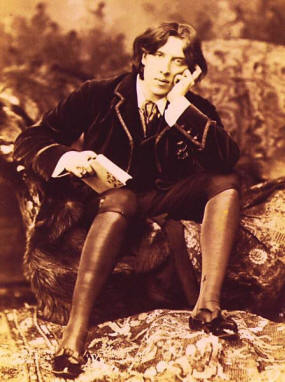
Oscar Wilde as a student. This image is in the public domain.

It was on April 10, 1882, that Wilde arrived in a bustling Salt Lake. He was set to lecture that night and move to his next location the following morning. The local newspapers had advertised well in advance for this celebrated day. On April 6 both the Salt Lake Daily Herald and Deseret Evening News, as it was called at the time, reported that the topic of “The Oscah’s!” lecture was to be “the Practical Application of Aesthetic Theory to Everyday Home Life and Art Ornamentation,” a fascinating subject to the Salt Lake Mormons who had triumphantly created a city out of the barren desert valley in the shadows of the Wasatch Mountains.

When Oscar Wilde arrived on the morning train he was “observed of all observers.” (Deseret News, April 10, 1882) He was not dressed in his eccentric bottle green knickers, much to the disappointment of those gathered. Around noon he went to his hotel, the Walker house. He granted the small crowd of the agog only a glimpse, disappearing through the ladies entrance. He took his midday meal in his room with only his servant for company. Next on the agenda was a visit to the president of the Church of Jesus Christ of Latter-day Saints, John Taylor, at his home in downtown Salt Lake City. The two of them took a tour of the city, “Oscar seeing as much as possible and being seen as little as possible.” (Warner, 14) The Sunflower Apostle did not take to the Mormon prophet or to the buildings found in the city at large. He commented in a letter to his friend, Mrs. Bernard Beere, that the Tabernacle was the shape of a soup kettle and had decorations suitable for a jail. (Wilde)

As the evening arrived the crowd gathered excitedly in the grand Salt Lake Theatre. It is reported that as the famous Oscar Wilde finally stepped out onto the stage, “he seemed disconcerted by the young men seated on the front row” who were all wearing enormous sunflowers on their lapels. He was now dressed in his infamous getup, much to the delight of the audience. He plunged into his pre-written speech but did not deliver as the audience expected. His speech was halting and nervous, done with a large amount of astonishment as well as some politeness. The lecture lasted just under an hour and was recognized at the end with a short awkward applause. (Warner, 16)

Each of the three large newspapers in Salt Lake City at the time were quick to weigh in on the strange looking man who muttered his speech all in one breath. The Deseret Evening News reported on April 10, 1882, that Wilde’s ideas were unoriginal and absurd. The Salt Lake Daily Herald stated in an article that appeared the morning of April 11, 1882, that “there was no attempt at enthusiasm, and the only impression one could obtain of the lecturer himself from the lecture was that he was an enthusiast without enthusiasm.”

Editorials concerning Wilde continued to pop up in the papers as reports of the impression Oscar Wilde had of the Mormons began to reach the media. The Deseret Evening News reported on July 7, 1882, in an article titled “How They looked to Oscar” that Oscar Wilde was “one of the greatest humbugs ever thrust upon the American public. Talk about the gullibility of the British public!” This review came after a report from a New York City journalist that “The gentle Wilde had put it thus: ‘The most unintellectual audience I had was in Salt Lake. The Mormons are the most unintellectual people I have met in America.’ ” (Deseret Evening News, April 10, 1882) Though Wilde may have been a poor lecturer, he was no fool. A reporter for the Salt Lake Daily Herald was granted an interview with Oscar Wilde and reported in an editorial on April 12, 1882, that Wilde had modestly admitted that he had never studied elocution and had not become famous based on his ability to speak in public.

The only positive review to be found in all the Salt Lake news outlets was an article published in the Salt Lake Tribune on April 13, titled “Oscar Wilde: The Young English Gentlemen and John Taylor’s Mormon Critics.” The paper’s editor said glowingly “It is for the people and through the people that he would re-awaken the love of art…. Who else could fill up such an enjoyable hour?” In her paper written in 1987 on the subject of Oscar Wilde’s visit, Helen Louise Warner suggested that the traditionally non-Mormon publication may have written such a review as a means to oppose the Mormon residents in Salt Lake City, which she suggested they did whenever possible.

“Fortunately … he has come and gone unmolested,” the Herald reported on April 11, 1882. Warner concluded that “in spite of all the advertising and publicity for Oscar Wilde’s visit to Salt Lake City, he did not make a great or lasting impression.” Though the people of Salt Lake did not particularly like the “singularly deep young man” from across the ocean, they did have the opportunity to see one of the most prominent celebrities of the late 19th century, and certainly the most celebrated aesthete to ever “lie upon the daisies.” (Mason, 2; Warner)

Sara Davis is a junior at The University of Utah. She is majoring in illustration with a minor in arts and technology.

Sources

“Oscar Wilde,” Deseret Evening News, April 6, 1882.

“Oscar Wilde,” Salt Lake Daily Herald, April 6, 1882.

Deseret Evening News, April 10, 1882.

“Oscar Wilde: He Came, He Lectured, and He Is About to Depart,” Salt Lake Daily Herald, April 11, 1882.

“Oscar Wilde: A Pleasant Chat with the Aesthete; His Impression of America and Her People and Poets; The Courtesy of His Audiences,” Salt Lake Daily Herald, April 11, 1882.

“Oscar Wilde: The Young English Gentlemen and John Taylor’s Mormon Critics,” Salt Lake Tribune, April 13, 1882.

Oscar Wilde, Impressions of America, ed. with an introduction by Stuart Mason (Sunderland: Keystone Press, 1906).

“How They Looked to Oscar,” Deseret Evening News, July 7, 1882.

Stuart Mason, Oscar Wilde and the Aesthetic Movement (New York: Haskell House, 1972).

Helen Louise Warner, “Oscar Wilde’s Visit to Salt Lake City,” (Honors thesis, The University of Utah, 1987).

KDYL Brings Local, Independent Television to Utah

by JASON BUSHNELL

Introduction

When KDYL began broadcasting in Salt Lake City in 1922, it was just the thirteenth radio station in the United States. It became the radio station for the already prominent Salt Lake Telegram newspaper in Salt Lake City. However, by 1927 the station was failing financially and falling behind the already established KZN radio station (owned and operated by the Church of Jesus Christ of Latter-day Saints and the Deseret News) and looking for new support. Sydney S. Fox, an outside investor, entrepreneur and stepfather of then-KDYL president Fred Provol, purchased the failing station for $4,000. Fox saw potential in radio to be an “entertainment medium,” and saw KDYL as a great way to test this potential. (Boyles, iv)

Fox immediately established a new and innovative way to build revenue for KDYL. He knew it would have to come through advertisement. In fact, much of his own success in broadcasting (radio and television) was based upon his ability to sell advertisement in new, inventive ways. (Boyles, 27) Over the next ten years, Sydney S. Fox continued to improve and build up revenue and the popularity of KDYL.

Fox’s focus shifted from radio to television in 1939 after he attended the World’s Fair in both New York City and San Francisco. This is where he saw television demonstrated for the first time. Fox’s drive and enthusiasm quickly turned to developing a local television station in Salt Lake City under the KDYL name. He felt that the possibilities of this new form of medium were unlimited and all of his time went to making it a reality in Salt Lake City.

Fox knew that it would be a sensation, but he failed to see how much of an impact it would have on the local Salt Lake City community. He began to demonstrate local television at state fairs and at public demonstration days at local department stores in downtown Salt Lake City. The turnout was outstanding. Following several applications to the FCC, he was granted an experimental license in 1941. However, the timing was not meant to be. Shortly after obtaining a license, the onset of World War II halted any further progress. That was until 1946, when RCA began production of television transmitters once again.

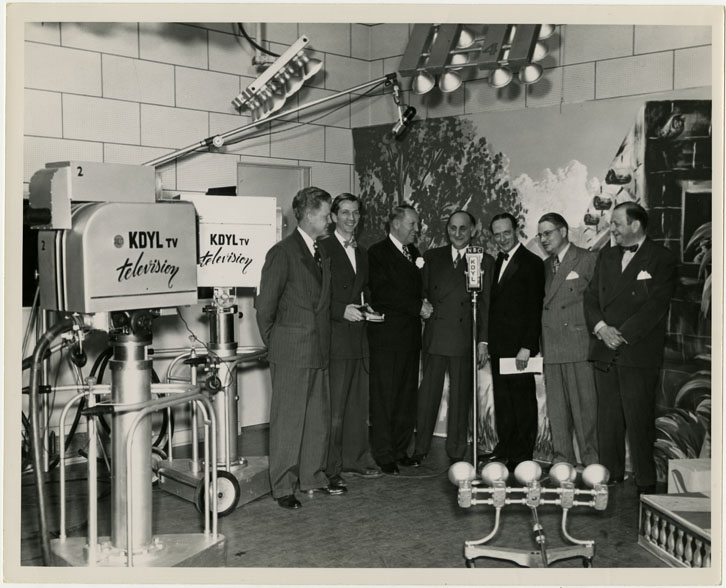
Inside the television studio of KDYL-TV. Photo courtesy of the Special Collections Department, J. Willard Marriott Library, The University of Utah.

KDYL, with a recently purchased transmitter, began to build a transmitter on the top of the Walker Bank and Trust Building in downtown Salt Lake City. A full television studio was also built at the Regent Street Playhouse on 68 Regent Street. (Boyles, 39) Then, with the approval of a television broadcasting application in 1946 by the FCC, KDYL began transmitting by November as KDYL/W6XIS. (Boyles, 40) These transmissions soon turned into regular programmed media in April 1948, and thus launched the first independently owned television station in the United States. KDYL, going by the call sign of W6XIS, continued to provide independent programming for the Salt Lake City community until early 1953, when KDYL was sold to TIME Inc. for just over $2 million.

Findings

Radio, having been around for some time by the 1920s, was viewed as a source of information and news. And even though rumors of television being the main medium for such information and news were growing daily, people still had their doubts. As early as 1910, the idea of sending pictures over wires had been well discussed but yet looked upon as impossible. A 1910 article in the Deseret News emphasizes these doubts:

“Something more tangible than television has been devised by a French inventor … [who] is making an apparatus to which a series of photographs can be telegraphed one after the other instantaneously, and reformed so as to give a cinematograph reproduction of an event.” (“Seeing By Wire”)

Yet by 1938, full-page articles were being printed within newspapers featuring the progress of the television.

The Kane County Standard printed such an article titled “Television, Science’s Youngster, Starts Wearing Long Trousers.” In this article, Joseph W. LaBine focuses on progress of the invention and notes that the “bugs” had been eliminated. “Actually, RCA’s engineers have already ironed out most of the ‘bugs’ in transmission.” It may have been articles such as that one that focused on the television that influenced Sydney S. Fox, president of KDYL in Salt Lake City, to pursue the concept of television.

But the most influential impact came from Fox’s visits to the World’s Fair in New York City and San Francisco. There he witnessed RCA’s demonstrations of television that launched the beginning of television’s rise to the top of broadcasting mediums. Fox was reportedly “so enthusiastic and saw such possibilities for the new medium, that they immediately ordered a ‘jeep’ television outfit consisting of equipment capable of demonstrating but not telecasting, television.” (“KDYL-TV Laid Plans for Video”)

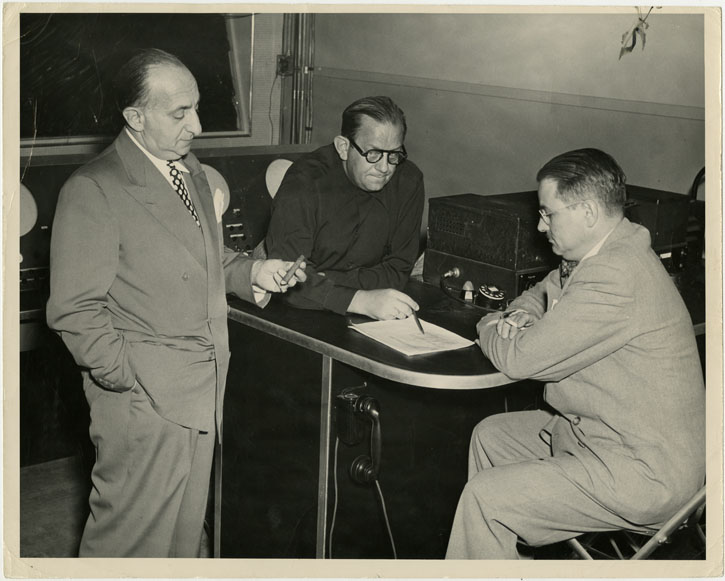
Sydney S. Fox with two of KDYL-TV's engineers, including head engineer John Boldwin (far right), inside main control room at KDYL. Photo courtesy of the Special Collections Department, J. Willard Marriott Library, The University of Utah.

KDYL immediately began to show the power of this “new medium” with demonstrations in local Paris Co. department stores as early as fall 1939 and at the State Fair in 1940. Over 45,000 people filled demonstrations in department stores in the space of just three days to witness the demonstration of television, and the television was also designated the key attraction at the State Fair. The Salt Lake Telegram quotes Fox saying that “he knew there was enough interest in television in Salt Lake City to justify going ahead with plans for commercial television here.” (“KDYL-TV Laid Plans for Video”)

Fox’s plans for television were put on hold in 1941 with the onslaught of World War II. “Because of America’s all out war effort, [the War Production Board] would not permit the manufacture or sale of television broadcasting equipment by regular manufacturers.(Boyles, 39) But this did not stop the enthusiasm of Fox. KDYL continued to invest time into developing the already existing technology and in 1943, following a trip to New York, Fox explained that television production factories were preparing transmitters for postwar delivery. (“SL Radio Executive Says Industry Eyes Television”)

In September 1944, KDYL filed an application for the building of a commercial use television station on an experimental basis. (“S.L. Firm Asks to Build Television Station”) By December 1944, the FCC granted KDYL a permit for the construction of an experimental television station, which would become the first studio between Kansas City and the West Coast. Fox was quoted as saying, “KDYL is proud to be a pioneer in this great field.” (“S.L. Firm Granted Television Permit”)

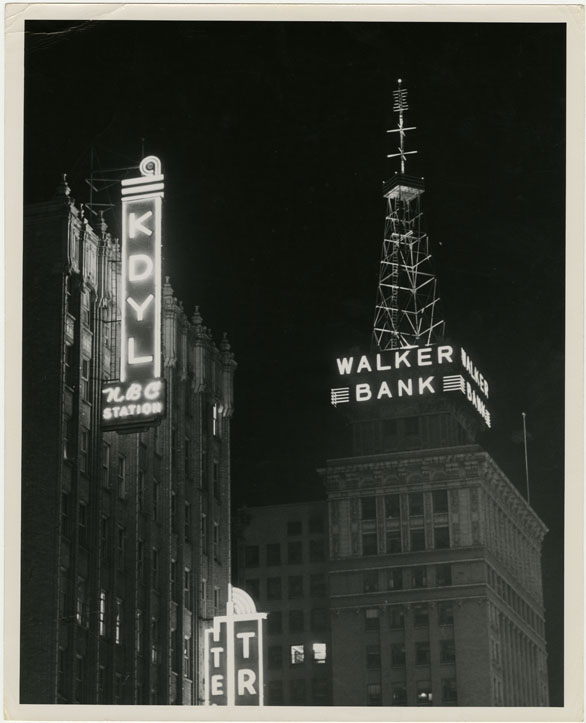
KDYL's downtown building next to the Walker Bank building in Salt Lake City. The KDYL-TV transmitter was located on top of the Walker Bank Building. Photo courtesy of the Special Collections Department, J. Willard Marriott Library, The University of Utah.

Between 1944 and 1948, KDYL was actively pursuing the reality of broadcasting local television programs to the Salt Lake City community. KDYL built a television transmission tower on top of the Walker Bank and Trust Building in downtown Salt Lake City, and finished building a television studio in the Regent Street Playhouse on 68 Regent Street. (Boyles, 39) The Regent playhouse worked perfectly for the site of a television studio since the playhouse was given up during the war. In 1946, KDYL began experimental transitions but did not officially sign on the air until April 1948 under the call sign W6XIS. The Salt Lake Telegram explained the significance of KDYL-TV:

“An event of historic significance in the field of entertainment and the dissemination of information occurred in Salt Lake City this week. It was the inauguration of the first regularly scheduled television program in the intermountain region…. Salt Lake City thus becomes the 13th city in the nation to have regularly scheduled television.” (“Salt Lake 13th to Have Television”)

The inaugural program was graced with the presence of the Utah governor, the Salt Lake mayor, and Frank Streator, president of the Chamber of Commerce. (“Salt Lake 13th to Have Television”) Along with KDYL-TV being the first station west of Kansas City, it also set another milestone by being the first independently owned television station in the nation. KDYL became a pioneer for what television would become and mean as a local informational source in the United States.

KDYL-TV followed a five-night-a-week schedule, but due to public demand KDYL-TV changed to seven nights a week by October 1948. In its early years KDYL-TV had many firsts and milestones. It was the first to broadcast golf and downhill skiing, and by 1952 KDYL-TV was broadcasting from 9:30 in the morning until midnight seven days a week, which made it one of the largest scheduled local television stations in the nation. (Boyles, 47)

A group of men, including Sydney S. Fox (center) addressing a TV audience on a live broadcast from KDYL-TV studios. Photo courtesy of the Special Collections Department, J. Willard Marriott Library, The University of Utah.

Television continued to boom and expand within the Salt Lake Valley as well. By May 1948, KSL, a competing radio station, had helped build an entertainment television studio in a ZCMI department store located in downtown Salt Lake City. The studio was scheduled to broadcast a one-hour show daily from 1:30 to 2:30 pm. (“Department Store Sees Television”) This became an added attraction for shoppers at ZCMI and led to KSL filing an application for construction of its own local television station by July 1948 with construction beginning in early 1949. (“Get Television Permit”)

KDYL-TV continued to set the pace for local television. “In late July the station’s mobile unit was delivered, which made possible the telecasting of events away from the studio.” (“KDYL-TV Laid Plans for Video”) This also brought sporting events to viewers at home. The Salt Lake community would soon be able to watch a wide range of sporting events from their own front room. This became a true pioneering television station, which played a major part in the Salt Lake community.

KDYL-TV continued to broadcast as an independent company through Intermountain Broadcasting Company, headed by Sydney S. Fox, until July 24, 1953, when KDYL-TV was purchased by TIME Inc. for just over $2 million. Fox retired as president of Intermountain Broadcasting and as president of KDYL. He would be succeeded by Roy E. Larsen, president of TIME, Inc. This was not necessarily a terrible move for KDYL-TV, as Larsen stated: “We know the KDYL stations will profit by TIME’s journalism and television success formula. We at KDYL hope to make our station ‘The Voice of the New Golden West.'” (“Sale of KDY-TV”)

Conclusion

Sydney S. Fox and his team at KDYL helped pioneer and develop early television station standards that directly impacted the Salt Lake community and the rest of the nation by being the first at many aspects of broadcasting, including: first independent television station, first to air golf and downhill skiing, first to challenge the nation’s use of locally scheduled broadcasts by providing local broadcasts seven days a week from 9:30 a.m. until midnight. The station also pioneered ways of gaining advertisement space on local television. Sydney S. Fox continued to work within television after leaving KDYL and pressed the concept of entertainment with the idea of producing movie-like television shows. Sydney S. Fox truly helped drive local television into the news, information and entertainment source that it has become, and his desire for the public to witness television still lives today as KDYL continues to air local programming under call number KTVX in Salt Lake City.

Jason Bushnell is a senior studying mass communication at The University of Utah. He is set to graduate following the Fall 2012 semester. He will be continuing a career within television broadcasting.

Sources

“Seeing By Wire,” The Deseret News, April 12, 1910.

Joseph W. LaBine, “Television, Science’s Youngsters, Starts Wearing Long Trousers,” Kane County Standard, January 7, 1938.

“Salt Lake Concerns To Show Television,” Davis County Clipper, September 15, 1939.

“Television Set To Be Exhibited,” Salt Lake Telegram, September 10, 1940.

“S.L. Radio Executive Says Industry Eyes Television,” Salt Lake Telegram, October 12, 1943.

“KUTA Files Application For Television Station,” Salt Lake Telegram, June 3, 1944.

“S.L. Firm Asks to Build Television Station,” Salt Lake Telegram, September 23, 1944.

“S.L. Firm Granted Television Permit,” Salt Lake Telegram, December 30, 1944.

“Salt Lake City 13th To Have Television,” Salt Lake Telegram, April 21, 1948.

“Department Store Sees Television,” Salt Lake Telegram, May 28, 1948.

“S.L. Station Expands Television Schedule,” Salt Lake Telegram, July 7, 1948.

“Get Television Permit,” Salt Lake Telegram, July 30,1948.

“KDYL-TV Laid Plans For Video in ’39,” Salt Lake Telegram, May 31, 1951.

“Sale Of DKY-TV OF Salt Lake City To Time, Inc. Stated,” Davis County Clipper, July 24, 1953.

Patrick Wm. Boyles, Sydney Fox and KDYL, 1927-1952: A Utah Broadcasting History (M.S. thesis, University of Utah, 1953).


Robert Redford: The Creation of the Sundance Institute and Film Festival

by L. WYLIE SHEPARD

Introduction: The Sundance Film Festival is deeply rooted in a quarter-century of history beginning with the Utah Film Festival. The Festival was introduced in 1978 by the Utah Film Commission in an effort to “promote tourism” in Salt Lake City. (Malserger, 38) The early years of the Utah Film Festival were fairly successful but equally rocky. Debt not only plagued the Festival, but also caused its continuation. In 1981, the Festival was relocated to the small ski town of Park City, Utah, and was moved from September to January with the intention of attracting a new, more elite crowd. (Smith, 50) The Festival became known as the Utah/United States Film Festival in the following years but continued to diminish. As the 1984 Festival approached, many believed it would see its last season. Meanwhile, in nearby Provo Canyon, Robert Redford had created a phenomenon in the world of filmmaking known as the Sundance Institute. It was a center to advance the world of independent filmmaking and his success would not go unnoticed by the struggling Utah Film Commission.

Findings: In the early 1960s, Robert Redford was a rising star in Hollywood, but the constant publicity and demands of success led him to the Utah Mountains in an attempt to escape from his current reality. In 1969, Redford purchased a vast section of Provo Canyon, including a small ski resort, as the “ideal locale for environmental conservation and artistic experimentation,” as well as his new home. (sundanceresort.com) Redford named the land Sundance, utilizing the success of his recent role in Butch Cassidy and the Sundance Kid, and he began to focus on his intentions to “marry the arts community to Sundance.” (Smith, 26)

In an article published by The Salt Lake Tribune on December 9, 1990, Redford explained his plan to create an institute, which would “concentrate on film making from the other end, beginning with the script.”

In November 1979, Redford began this process with a three-day planning conference for what would be deemed the Sundance Institute. The conference concluded that it “would emerge as a center, a resource, bringing together talented aspiring filmmakers with collaborating skilled professionals in an extraordinarily supportive environment, which would allow greater experimentation with scripts, direction, and performance.” (Smith, 37) In the following years, Redford worked with the National Endowment for the Arts to secure a budget for what would be known as the Sundance Institute’s June Laboratory.

The first Sundance Lab was held in 1981, in which a select group of 65 students were chosen to spend four weeks with the industry’s most prominent directors, actors, writers, and producers in order to take their abilities to the next level. Redford saw this as expert tutoring, in which workshops enabled filmmakers to take risks without penalties and potentially secure themselves as spot in what had now become the Utah/United States Film Festival. The immediate success of the Sundance Institute was not anticipated and it concerned Redford.

In a February 1985 interview with the Los Angeles Times, Redford stated, “It’s dangerous, I wanted filmmakers to have a place to struggle and make mistakes. I think a focus on our success won’t be fair to the filmmakers or the process.” The Institute soon gained recognition in Hollywood and the Utah/United States Film Festival quickly noticed that the Lab’s students were continually submitting winning films.

By 1984, many believed the Utah/United States Film Festival had run its course, but Redford’s passion and determination for the future of filmmaking had led those involved to believe that the Sundance Institute could save the Festival.

Robert Redford speaking at the Sundance Film Festival. Photo by Calvin Knight courtesy of the Sundance Institute.

“I was never big on festivals,’” Redford explained to the Los Angeles Times in February 1985. “And when I was originally approached the first year to do this one, I said I’d be interested only if it emphasized independent film.” Redford hoped to use this as an opportunity to change the negative perception of independent filmmakers in Hollywood, according to an article published in the South Florida Sun-Sentinel in January 1987.

After the Sundance Institute had agreed to take over the 1985 Festival, the decision was made to change its name to the Sundance Film Festival, which was believed to add a dimension to the Institute. In December 1990, Redford relayed his belief to The Salt Lake Tribune that “it completes the connection, we have development in June, exhibition in January. We’re the only organization that offers the independent filmmaker that symbiosis between development and exhibition.” In a subsequent interview with the Tribune in June 1992, Redford detailed that the “annual Sundance Film Festival in Park City is the public expression of what his Sundance Institute does privately the rest of the year. The Festival is the showcase; the rest of the year is labor.”

In Benjamin Craig’s novel, Sundance: A Festival Virgin’s Guide, he explains that “the Sundance Institute and the Utah Film Festival had a natural connection from the start,” which was easily visible after the Festival completed its first successful year. The first year of the Sundance Film Festival marked the seventh year of the Festival as a whole and “there was no question that everything had changed.” (Biskind, 13) More than 80 films were shown, including the introduction of the international category; the previous year’s attendance was doubled, and the ongoing debt had reached its lowest amount since the Festival’s creation.

Conclusion: According to a January 1988 interview in the Los Angeles Times, “[Robert Redford] and the Sundance Institute are largely responsible for nurturing the event from relative obscurity to its current status as one of the top Film Festivals in the world.” After Sundance took control of the Festival, “1,500 people from outside Utah bought ticket packages, compared to 80 two years ago, and we’ve had to put a ceiling on the number of outside vendors which is almost unheard of.” It is believed to be the “flagship of the American independent film resurgence of the 1990s.” (Craig, 49)

L. Wylie Shepard is from Park City, Utah. She is a senior at The University of Utah and is majoring in mass communication.

Sources

Our Story,” Sundance Resort.

Kristina Malberger, “Sundance Film Festival,” VIA: AAA’s Travel Companion (January-February 2007).

“Sundance Institute Rises and Shines,” USA TODAY, May 15, 1998.

“Sundance Institute’s June Lab Gives Filmmakers a Head Start,” The Salt Lake Tribune, June 14, 1992.

Terry Orme, “After a Decade: The Sundance Kid on the Sundance Institute,” The Salt Lake Tribune, December 9, 1990.

Deborah Caulfield, “Movies,” Los Angeles Times, January 19, 1988.

“Redford Enjoying Building Institute to Aid Artists,” The Ottawa Citizen, July 8, 1986.

Deborah Caulfield, “Will Success Spoil Sundance?” Los Angeles Times, February 4, 1985.

Deborah Caulfield, “Robert Redford Lends Status to Film Festival,” Los Angeles Times, January 21, 1985.

“The Sundance Institute’s First Festival,” Original information packet, Park City, Utah (January 18-27, 1985).

Peter Biskind, Down and Dirty Pictures (New York, New York: Simon & Schuster, 2004).

Michael Feeney Callan, Robert Redford: The Biography (New York, New York: Alfred A. Knopf, 2011).

Lory Smith, Party in a Box: The Story of the Sundance Film Festival (Layton, Utah: Gibbs Smith, 1999).


Helen Foster Snow – A Utah Pioneer

by LAUNA GARDNER

Born in Cedar City, Utah, on September 21, 1907, Helen Foster Snow was a journalist who traveled to China in the 1930s to report on the emerging revolution in China. Snow produced an abundance of writings from China during this time, which was full of severe turmoil. She recorded everything she could on the Communist Movement in China, her perspective of Chinese experiences during World War II, and the ultimate victory of the Revolution. Snow’s writings also showed her exemplary ability as a journalist of politics and war. (Long)

Helen Foster Snow was 23 years old in 1931 when she set sail from a Seattle port for the Far East aboard an American Mail Line vessel called the President Lincoln. Originally, Snow travelled to Shanghai to start a new position as secretary to the managing director of the China Finance Company in the American Consulate. According to Snow, traveling to China was a dream come true: “I have read about the Orient and dreamed about the Orient for three years and now I am really sailing for the Orient; it’s too good to be true.” (“Miss Helen Foster”)

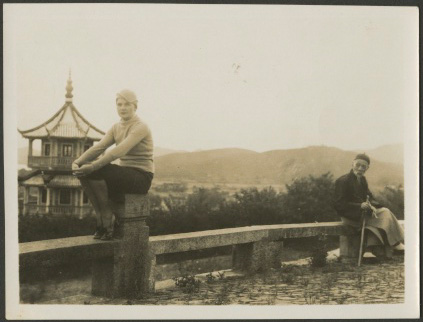
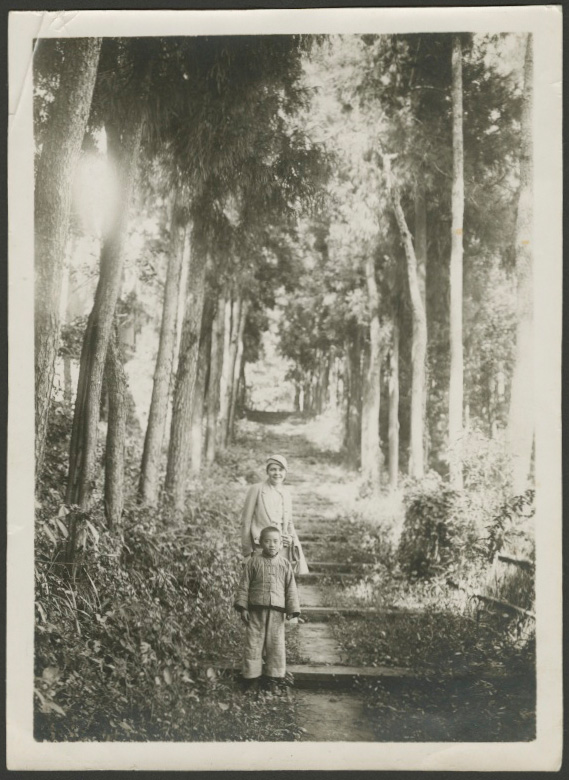
Personal Photo, Helen Foster Snow Collection, L. Tom Perry Special Collections Library, Harold B. Lee Library, Brigham Young University, Provo, Utah.

During Snow’s stay in China, she married, and later divorced, Edgar Snow of Missouri in 1932. The Snows both taught journalism at Yenching University in Beiping, the former name of Beijing. There, Helen Snow met a number of patriotic students in her classes, many of whom were associated with the Communist underground. Helen Snow, known to her friends as “Peg,” urged communication among her students as to what was happening in China, which prompted her excitement on current events during that time. Such events also made Snow sympathize with the people in China during such perilous times. In addition, Snow and her husband supported the December 1935 Chinese student movement, which helped spur resistance to the danger of the Japanese conquest in China. (Long)

As a journalist, Snow wrote multiple articles for newspapers back in America, all sent by mail in a journal-like fashion. For The Salt Lake Tribune in the early 1930s, Snow recounted the fear she and her colleagues felt during such tense times in her article “Tenseness Prevailing in Shanghai Recounted by Former Salt Lake Girl.” According to Snow, Shanghai was dangerous—a place where people had to be alert and prepared for any situation with war on the horizon:

“Every minute we are expecting the Japanese fleet to steam into the peaceful Whangpoo River. Several transports of marines come in now and then, but you could hear a pin drop as far as actual war is concerned. However, when a pin drops there probably won’t be much left of China but 400,000,000 lost souls looking for a concession. If you only knew how tragic and strange it is to be here now!”

Snow also wrote about how the undeclared war between the Nipponese and the Chinese affected business in the area. In her article for The Seattle Star titled “Shanghai Busy City Until War Stifles Its Commerce” published on March 23, 1932, Snow described how the market once boomed in the new place she called home. Low silver values helped pave the way for the development of local industries, and high gold exchange triggered foreign capital to hurry over to Shanghai at a time where it could be invested at an excellent rate of 5-to-1. However, once Japanese troops made it to Shanghai, a deadly message came alive in the form of machine guns and rifles. As Snow described it: “While we in Shanghai were congratulating ourselves smugly upon an unprecedented activity in industry and while the rest of the world twiddled its thumbs in enforced idleness, down swooped calamity.”

Personal Photo, Helen Foster Snow Collection, L. Tom Perry Special Collections Library, Harold B. Lee Library, Brigham Young University, Provo, Utah.

Among Snow’s writings were her private journal-like entries, most of which were printed onto paper by typewriter (Snow had stated that she was “practically illiterate with a pen”). One entry, in which she refers to her memoirs as “mem-wars,” discusses her day-to-day experiences in China. Interestingly, after only a few weeks stationed in China, Snow became accustomed to the war going on in her neighborhood of “gunfire raging within a few blocks” and described the fear she felt and how she got around the violence—she didn’t let the violence stand in the way of her having a good time. Describing one of her days of fun during her stay in China, Snow wrote: “Sunday, I got up at my customary twelve o’clock meridian for ‘tiffin,’ watched a cricket game for two hours, then went home to dress for a tea dance at five o’clock at the French Club. Then I had dinner and went to the ‘Canidrome’ that’s a famous dancing place where they have greyhound racing.” (Personal Writing)

Snow also had the honor of putting together an American Independence Day in China. According to an article in The China Press from July 3, 1932, Snow was in charge of many festivities, some of which included a flag raising ceremony and a baseball game.

Personal Photo, Helen Foster Snow Collection, L. Tom Perry Special Collections Library, Harold B. Lee Library, Brigham Young University, Provo, Utah.

Although war surrounded her, Snow found a certain beauty about China, and she felt as if she were living in a fantasy. One of her writings, which she labeled “Americasian Eurasian,” notes that she was “thrilled” to be in China. According to Snow: “I occasionally stopped short in my busy days at first just to remember that I was actually in China. I couldn’t quite believe I was in China, it seemed like a dream, not to be taken seriously somehow, like being in costume at a masquerade party.”

In another entry titled “The Inimitable Chinese,” Snow beautifully describes how she saw China’s people: “Alice in Wonderland could not be more amused and astonished than I in this Land behind the looking glass. What wonderful strange people are these inimitable children of China!”

In 1937, Snow set out to visit Yan’an, located in northwest China. Here, Snow visited a Communist stronghold. She used the information she garnered to write her book, Inside Red China, later published in 1939. The book was largely compiled of Snow’s writings that describe up-close and personal accounts of destruction and sympathy. With her husband, Snow also helped establish the Chinese Industrial Cooperatives (industrial worker’s cooperatives) Gung Ho (work together). (Snow)

By December 1940, Snow was ready to come home. She returned to America where she spent the remainder of her life in Connecticut. Snow died on January 11, 1997. In 2011, The Salt Lake Tribune reported that five performing arts students from Southern Utah University had the opportunity to go to China to perform their play on Snow, The Dream of Helen. A statue of Snow also stands at Cedar City’s Heritage Center.

Helen Foster Snow continues to be a significant figure in American and Chinese history because she was a native of Utah who made a copious number of contributions to China during the 1930s. She was respected as a friend of China and as a savior by students and colleagues during her time spent overseas. Snow’s journalistic ability and reports on the war also gave people in America a personal account of global affairs; as a woman in the 1930s, such recognitions are major. For many people, Snow will always be one of the most influential cultural pioneers in Utah’s history.

Launa Gardner is a senior at the University of Utah. She is majoring in mass communication and will graduate in August 2012.


Sources

Helen Foster Snow. Inside Red China. New York: Doubleday, Doran & Company, Inc., 1939.

“Shanghai Busy City Until War Stifles Its Commerce,” Seattle Star, March 23, 1932.

“Americans To Celebrate Glorious Fourth Here Tomorrow In Grand Style,” China Press, July 3, 1932.

“Americasian Eurasian,” Helen Foster Snow Collection, Tom Perry Special Collections, Harold B. Lee Library, Brigham Young University, Provo, Utah.

“Miss Helen Foster,” Helen Foster Snow Collection, Tom Perry Special Collections, Harold B. Lee Library, Brigham Young University, Provo, Utah.

Personal Writing, Helen Foster Snow Collection, Tom Perry Special Collections, Harold B. Lee Library, Brigham Young University, Provo, Utah.

“Tenseness Prevailing in Shanghai Recounted By Former Salt Lake Girl,” Helen Foster Snow Collection, Tom Perry Special Collections, Harold B. Lee Library, Brigham Young University, Provo, Utah.

“The Inimitable Chinese.” Helen Foster Snow Collection, Tom Perry Special Collections, Harold B. Lee Library, Brigham Young University, Provo, Utah.
Kelly Ann Long. Helen Foster Snow: An American Woman In Revolutionary China. Boulder: University Press of Colorado, 2006.

“Remembering a 1930s-era Cultural Pioneer,” The Salt Lake Tribune, July 24, 2011, D2.

1942: Developing the Topaz Community As Noted in The Topaz Times

by JESSICA BOUDAH

On September 11, 1942, the Central Utah Relocation Center – later known as Topaz for most of the Second World War – opened. The U.S. War Relocation Authority (WRA) imprisoned roughly 9,000 Japanese-American residents from the San Francisco Bay Area. Topaz, one of ten WRA incarceration camps, housed virtually all Japanese-Americans from the Bay Area by the end of the year. (Bankson)

Japanese-Americans from the San Francisco area, who had been held at Tanforan Race Track while Topaz was under construction, were transported to Delta, Utah, by train. (Beckwith) Upon the internees’ arrival at Topaz, many barracks and schools were not complete at the camp. (Beckwith) Beckwith also mentioned in her article that once situated, some internees “finished building their own barracks and other structures at the site.”

The Topaz Times, which was published at the Central Utah Relocation Center, was first published at Tanforan Assembly Center and then continued in Topaz until the camp closed in October 1945. The first issue printed in Topaz was printed on September 17, 1942. The Times was designed to inform its public on local events, community involvement, employment, education and religion.

In issue No. 1, The Topaz Times stated, “You will find various agencies of the United States Government have been mindful both of your needs and those opportunities which you desire in the fields of religion, employment, education, health and recreation.” The same article also states that the authorities of the center expected its internees to put in their best efforts in the “common objective” of developing the Topaz community to the “greatest degree possible.”

Most issues of The Topaz Times ranged from four to six pages in length. The first ten issues of the Times were called pre-issues. These pre-issues were published from September 26 to October 24, 1942. Within the first month of the camp’s opening, there was a great deal of internal action and organization necessary. As illustrated in eight of the first ten issues of The Topaz Times, there was a large amount of change in the society’s organization. In pre-issues No. 1 through 7, the main topics discussed were residential housing, education facilities and employment for internees.

With approximately 8,500 Japanese-American internees, it was deemed necessary to have immediate action on the internal organization. (Ostlund) Framework for a community council, as stated in the WRA Manual, was debated in a community meeting that was called in late September. According to an article in the pre-issue  published September 26, 1942, blocks 3, 5, 6, and 14 were to elect councilmen the following Monday. The article reported, “The vision of establishing Topaz into a model city came another step nearer to its realization as the machinery for self-government was being rapidly set up this weekend through the cooperation of the residents and the project administration.”

Association between the new community and its need for organization was an important theme in the first three pre-issues of the paper. Pre-issue No. 1 also stated that the Community Council would consist of one representative from each residential block, and later stated the members of the community council would possess some jurisdiction in the Topaz community:

“The Community Council will be authorized to ‘establish such regular and special committees and commissions as may be necessary to carry out its duties and functions or to cooperate with the Project Director in promoting the general welfare of the residents,’ according to a statement approved by Project Director Charles Ernst.” (The Topaz Times, September 26, 1942, 1)

According to an article by Clarence Ostlund, some earlier issues that faced the Community Council were: enacting a charter or constitution under which community-business could be legally transacted, labor problems, welfare and health problems, housing problems and fuel, education and recreation, work clothing problems, medical problems due to “lack of doctors,” medical supplies, equipment and hospital facilities. (Ostlund, Section I)

The issue of The Topaz Times published October 3, discussed the first eight members inducted into the Community Council in early October 1942. The new members of the Topaz Community Council were: Vernon Ichisaka (Block #3), Albert Kosakura (Block #5), Ernest Iivena (Block #6), Kay Nishida (Block #7), Dr. Carl Hirota (Block #12), Sam Yagyu (Block #13), Shinji Yamemoto (Block #14), and Paul Fuiii (Block #15). The same issue also described how the new officers repeated the following oath:

I solemnly pledge, as a member of the Community Council of Topaz, State of Utah, to uphold the Constitution of the United States and the related laws thereof. I further pledge my ideals, devotions and energy to the common welfare of all residents of this community: and to insure that my efforts will not be contrary to the basic principles of human rights.

Outlined in the October issue of the Times were the basic roles of the Topaz Community Council, which included: members were obligated to act in a legislative capacity, act in a liaison capacity, and to act in an advisory capacity.

In its first eight pre-issues, The Topaz Times also covered education – an important issue for the United States Government and the Japanese-American internees. Author Charles Wollenberg writes in the book, Schools Behind Barbed Wire, that “during WWII the United States government undertook an unusual educational enterprise – teaching students who were imprisoned behind barbed wire … an understanding of the American ideals, institutions and practices.” (210) The WRA soon found itself capable and “responsible for the education of more than 25,000 Japanese-American children,” not just at Topaz, but at other relocation centers as well. (75)

Pre-issue No. 6, published on October 10, 1942, is the first issue where we see education reach the front page of the paper. The paper reported that Robert E. Gibson, the Assistant Director of Education, would be visiting the city to assist with the “evolution of the educational curriculum” at Topaz. The issue suggested that Gibson believed that the “prevailing educational system in the average American community need[ed] reconstruction and that the WRA projects [had] the opportunity to set an example for America” in the Topaz community.

In the next issue, published on October 14, the headline read, “Housing For Schools Discussed Before First Public Hearing.” Educational systems were underway. When internees first started moving into the Topaz community, school buildings were not yet completed. The issue of the Times stated that at the public hearing, the need for an elementary and high school was deemed necessary. The same issue also discussed idyllic segmentation of the camp, and which block would be designated to which school building. The issue reports a motion by a Community Council member, Marii Kyoroku of the housing committee, who displayed a series of graphs that showed a breakdown of building space for the high school and elementary school. As written in pre-issue No. 7, “all of Block 32 be allocated to the high school” with 28 schoolrooms … and “half of Block S and half of Block 41 to the elementary school.”

The Topaz Times is extremely important to our present-day understanding and knowledge of the Relocation Center at Topaz. Now, we as researchers have the ability to understand what life was like at Topaz in 1942 through the articles and topics discussed in The Topaz Times. The development of community involvement became more prevalent within the Topaz society, as seen in the progression of the first eight issues of The Topaz Times. By 1943 camp life at Topaz “settled down” as residents got in the habit of gardening, attending classes at schools or recreation halls and working, according to an article from the Topaz Museum Web site. The Topaz Times helped develop the community life within the camp. By promoting community involvement with elections for the Community Council, and developing space for both an elementary school and a high school, The Topaz Times reassured the internees that Topaz was a “model city” and it would be developed into the greatest city possible – as stated in the first issue of The Topaz Times: Jewel of the Desert.

Jessica Boudah is a senior at the University of Utah, planning to graduate at the end of fall semester 2010. She is a mass communication major in the strategic communication sequence. Jess is originally from Burlington, Vermont, a small, idyllic town, also home to the University of Vermont. Currently, Jess works for the Salt Lake City School District as a tutor at Highland High School. She plans to acquire her master’s degree in education after receiving her bachelor’s degree in communication from The University of Utah.

Sources

Bankson, Russell A. “Guide to the Records of the United States War Relocation Authority Central Utah Project 1941-1945.” University of Washington Library.

Jane Beckwith. “Topaz Relocation Center.” Utah History Encyclopedia.

Clarence Ostlund, ed. “War Relocation Authority Central Utah Project Topaz, Utah.” Online Archive of California. The Bancroft Library, University of California, Berkeley.

“Greetings,” The Topaz Times, September 17, 1942, 1.

“Blocks 3, 5, 6, 14 to Elect Councilmen Next Monday,” The Topaz Times, September 26, 1942, 1.

“The City,” The Topaz Times, September 26, 1942, 1.

“More on Elections,” The Topaz Times, September 26, 1942, 3.

“Induction of 7 Councilmen Slated for 7:30 Tonight,” The Topaz Times, September 30, 1942,1.

“More on Community Council,” The Topaz Times, September 30, 1942, 5.

“Eight Representatives Take Council Oath Wednesday,” The Topaz Times, October 3, 1942, 1.

“More on Induction,” The Topaz Times, October 3, 1942, 2.

“Education,” The Topaz Times, October 10, 1942, 1.

“Housing for Schools Discussed Before First Public Hearing,” The Topaz Times, October 14, 1942, 1.

“Education,” The Topaz Times, October 14, 1942, 2.

Charles Wollenberg. “Schools Behind Barbed Wire.” California Historical Quarterly 55 (1976): 210-217.


Fortunato Anselmo

by LAURA NIELSON NEWBOLD

From 1890 to the 1920s, Utah became home to thousands of Italian immigrants. This second wave of Italian immigrants exerted by far the most influence on the development of Utah, and the development of Italian culture in Utah. Unlike the first wave of Italian immigrants, in the late 19th century, this second wave included immigrants from all parts of Italy, most notably Calabria and Sicily and the northern regions of Trentino and Piedmont. As a result of this increase of Italian Americans, a Little Italy soon developed and spread across the western part of Salt Lake City near the Rio Grande railroad station. Due to the influence of a devout Catholic following, a parish began holding meetings at St. Patrick church in downtown Salt Lake City. (Notarianni) It was this enviroment in which Fortunato Anselmo, one of Utah’s most famous Italian Americans, raised his family and thrived.

"Italian fighter Primo Carnera (left), visits Italian Vice Consul Fortunato Anselmo at 164 S. 900 East, Salt Lake City, May 1930."

Born October 1, 1883, in Grimaldi, Italy, Fortunato Anselmo immigrated to Pueblo, Colorado, in the early 1900s. There he met and married Anna Pagano, and the couple had three daughters, Gilda, Annette, and Emma. In 1911, Anselmo and his family moved to Salt Lake City and started F. Anselmo & Co., an imported wholesale Italian food store. With the store’s success, he opened another in Carbon County, where many Italian immigrants had settled to work on the nearby railroads and mines. With so much interaction with fellow Italian immigrants, Anselmo started La Gazzetta Italiana in 1912, to give a voice to the concerns and interests of his fellow immigrants. He quickly established himself as a representative of Italian Utahns, particularly those in the Salt Lake Valley. (Notarianni)

In 1915, he was appointed vice consul of Italy of Salt Lake City and the official adviser to Utah and Wyoming Italians. As such, he presided over all the official documents that required the approval of the Italian government, such as requests for visas, passports, and other papers and documents. He also served as a representative of the Bank of Naples, a prestigious institution and one of Italy’s oldest banks. This position allowed him to help local Italians send money orders to friends and relatives in Italy as well as provide the proper paperwork for traveling immigrants. (Notarianni)

Beyond these responsibilities, Anselmo also participated in many of the local political and social issues of the community. One endeavor he is well known for was his lobbying of the Utah State Legislature to have Columbus Day proclaimed a legal state holiday. While his efforts ultimately failed, Columbus Day did eventually become a holiday in 1919. (Notarianni; Chiariglione)

In addition to being a businessman and diplomat, Anselmo was well known for his magnanimity. Despite not being a member of the Church of Jesus Christ of Latter -day Saints, his generosity was spread to some of the most prominent Mormons at the time. In 1943, J. Reuben Clark Jr., a member of the Church’s First Presidency and namesake of Brigham Young University’s Law School, wrote Anselmo a letter thanking him for the cheese he sent him. Clark wrote, “As I am sure you like cheese (you can hardly like it better than I do), and as you know as well as I how hard good cheese is to get just now, I feel very certain that you will understand me when I say I am most thankful to  you for your thoughtfulness in sending to me that large portion of Gorgonzola cheese.” (Clark)

Similarly, the entire First Presidency of the Church wrote Anselmo in 1946 to thank him for the olive oil he gave them. They noted, “We are all beneficiaries of you gracious kindness in the matter of a supply of pure Italian olive oil. It has been so long since we were able to secure any of this oil that it is a real luxury. Please accpet our thanks for this splendid gift and accept also our sincere wishes for your welfare.” (Smith, Clark, and McKay)

One of his sadder diplomatic duties took him to the site of a mining accident. In 1924, Castle Gate suffered a mine explosion in which 172 men were killed, twenty-two of them Italian immigrants. As one of the most well known Italian Utahns at the time, Anselmo traveled to Castle Gate to offer his services and condolences to the devastated town. (“Castle Gate Relief Fund”)

At other points in his career, Anselmo rubbed shoulders with celebrities and dignitaries from around the world. In 1922, Anselmo and his wife entertained Vittorio Rolandi-Ricci, the Italian ambassador to the United States. Governor Mabey, the Utah governor at the time, was so impressed with Anselmo’s hosting abilities that he wrote him a letter saying, “I would indeed be remiss in my duty if I did not convey to you my cordial appreciation for the splendid reception accorded your esteemed countryman, Ambassador Ricci. In every respect the ceremonies and entertainment were commendable, and the committee in charge is to be heartily congratulated.” In 1930, the Anselmo family was treated to a visit by Italian heavyweight boxing champion Primo Carnera, who is depicted in the photograph. Probably the most distinguished guest Anselmo had the opportunity to greet was Cardinal Eugenio Pacelli, who would eventually become Pope Pius XII. (Notarianni; Mabey)

Anselmo’s favor with the Italian government and their diplomats actually began early on in his career as vice consul. On Feburary 3, 1920, after only five years of being vice consul, he was made a Knight of the Crown of Italy and Officer of the Order of the Crown of Italy. These awards, much like being knighted in England, are only given to those believed to have offered great service to the Italian government. Most who are awarded with such an honor are military men or important political figures. The fact that Anselmo was awarded with both honors speaks volumes of about how valued he was as a diplomat. (Notarianni; “Italian Consul Honored By King”)

Despite these honors, Benito Mussolini forced Anselmo to resign from his position as vice consul in 1923 after Anselmo completed the naturalization process and became a United States citizen. However, he was ordered to maintain the position until a successor could be appointed.  Nobody else was ever appointed, and in 1941, the US government ordered the office to close entirely. (Notarianni; Monson)

In addition to forcing him out of his position as vice consul, becoming a naturalized citizen incited distrust in terms of Anselmo’s allegiance to America. Some even went as far as to claim he was un-American and began a movement to denaturalize Anselmo. These rumors and defamations caused many to speak out on behalf of Anselmo and his family. One notable writer, Secretary Gus P. Backman of the Salt Lake City Chamber of Commerce, wrote a letter to Burton W. Musser. Backman writes:

I have been personally acquainted with Mr. Anselmo for fifteen to eighteen years …. During the entire time I have know Mr. Anselmo, he has always conducted himself in a most outstanding manner, has also been rated by me, as well as by the people of the community in general, as a forthright, honorable business man. His business ethics have always been above reproach and any question as to his Americanism and loyalty to American ideals has never to my knowledge been raised …. This letter is written due to the fact that I understand some one has started a movement to denaturalize Mr. Anselmo which, in my opinion, would be outrageous …. (Backman)

Fortunately for Anselmo, the movement to denaturalize him failed. In 1950, the office of vice consul was reopened, and the position was returned to Anselmo. He served in that position until he died on July 15, 1965. (Notarianni) Zopito Valentino, an Italian American author, has since eulogized Anselmo with the following:

For how long have the Italians of Utah known Anselmo? For how long have they looked to him for help, protection and advice? Who ever saw his door closed? Who ever found his heart indifferent? He is always ready to extend the glad hand, to help and protect, to offer his counsel and to give liberally. A more generous heart does not exist and a better soul is not to be found. (Valentino)

Today, visitors can learn about Anselmo Fortunato and his family by visiting his home, located at 164 S. 900 East in Salt Lake City. His house has been preserved as a historical monument by the Utah State Historical Society. Visitors may also visit the Utah State Historical Society for more information about Anselmo and other notable Utahns.

Laura Nielson Newbold is a communication major at The University of Utah. She will be graduated this year with a Bachelor of Arts in speech communication and plans to attend the University of Utah S.J. Quinney Law School in the fall. Her husband, Sean Newbold, translated all of the Italian documents into English.

Sources

Fortunato Anselmo Papers, Folders 1-15, Box 1, 1917-1963, Utah State Historical Society.

Governor Charles R. Mabey to Fortunato Anselmo, May 19, 1922, Fortunato Anselmo Papers, Mss B 103, Utah State Historical Society.

Secretary Gus P. Backman to Burton W. Musser, March 19, 1943, Fortunato Anselmo Papers, Mss B 103, Utah State Historical Society.

Secretary of State E. E. Monson to Fortunato Anselmo, July 12, 1941, Fortunato Anselmo Papers, Mss B 103, Utah State Historical Society.

Salt Lake Tribune article, “Italian Consul Honored By King,” February 3, 1920, Fortunato Anselmo Papers, Mss B 103, Utah State Historical Society.

J. Reuben Clark Jr. to Fortunato Anselmo, March 30, 1943, Fortunato Anselmo Papers, Mss B 103, Utah State Historical Society.

George Albert Smith, J. Reuben Clark, and David O. McKay to Fortunato Anselmo, November 29,1946, Fortunato Anselmo Papers, Mss B 103, Utah State Historical Society.

Prop H. Chiariglione to Fortunato Anselmo, January 6, 1917, Fortunato Anselmo Papers, Mss B 103, Utah State Historical Society.

Philip F. Notarianni, “Italianità in Utah: The Immigrant Experience,” in Helen Z. Papanikolas, ed., The Peoples of Utah. Salt Lake City: Utah Historical Society, 1976.

Zopito Valentino, Italian Activities of the Intermountain Region (1965-1975)

Castle Gate Relief Fund Committee.” Division of Archives and Records Service, Department of Administration Services.

Ordini Cavallereschi del Regno d’Italia, Corpo della Nobiltà Italiana.

Statutes of the Order of Merit of Savoy

Summer of ’68: Janis Joplin, Jimi Hendrix & Beach Boys Concerts at Lagoon Amusement Park

by ANNA SULLIVAN

After Lagoon Amusement Park opened its Patio Gardens concert venue in 1954, the Gardens hosted many famous acts there until the venue changed to a roller rink in the late 1970s. Some of the acts that visited Patio Gardens included such luminaries as Johnny Cash, Ella Fitzgerald, The Doors, Ray Charles and the Monkees. In the summer of 1968, three of the most popular names of the time decided to make a stop at Lagoon: Janis Joplin with Big Brother & the Holding Company, Jimi Hendrix, and The Beach Boys.

"Jimi Hendrix Picking Peace, 1968." Photo by Brian C. Record. Collection of Brian C. Record.

Between 1886, when Lagoon opened as “Lake Park” and 1968, the park went through numerous changes, reflecting the change of the culture surrounding the park. When it first opened, Lake Park featured an “open-air dancing pavilion with delicately carved latticework and archways,” and true to its name, the park sat along the banks of the Great Salt Lake. (Lagoon Press Kit, 5) Some of the other activities available to guests there were swimming, boating, roller skating, dancing and bowling. After seven years of the success at Lake Park, the Great Salt Lake began to dry, receding and forcing the now murky lake to be closed to visitors.

As the park transitioned to its current location, it began to gravitate more toward rides as attractions, and finally in 1954, Patio Gardens was erected to become a premier concert venue for Utah and its residents. As the summer of 1968 approached and Big Brother & the Holding Company, Jimi Hendrix, and the Beach Boys prepared to make a tour stop in Farmington, Lagoon also opened its Opera House, where musicals would be performed for the next few years for the Utah summer theater. (Lagoon Press Kit, 6) The year 1968 was an important year for Lagoon, when it would contribute greatly to Utah’s history by bringing so many live performances to Farmington, primarily advertising in The Salt Lake Tribune.

Janis Joplin. Photo by Brian C. Record. Collection of Brian C. Record.

Janis Joplin, performing with Big Brother & the Holding Company, was the first of the three bands to come to Lagoon on July 20, 1968. In the days leading up to the concert, The Salt Lake Tribune ran daily advertisements for Lagoon, paying special attention to concerts that were coming to the music venues there, the Opera House and Patio Gardens. The first advertisement ran on July 18, 1968, in four panels, one of which loudly proclaimed “Big Brother & the Holding Co.,” and in smaller words below, “with Janis Joplin.” (Advertisement, B6). It is interesting to note that while Joplin’s name ran fairly small in all advertisements, in the single article devoted to the concert leading up to the show, Big Brother & the Holding Company was downplayed, while the focus was on Joplin.

The article states: “Two big-name rock groups will entertain Saturday at 7:30 and 10:30 p.m. in the Patio Gardens of Lagoon. Appearing will be Big Brother & the Holding Company with Janis Joplin and Blue Cheer. Miss Joplin, 25, of Port Arthur, Tex., has emerged as one of the new stars of the rock music world. She has been working with the group for a year and a half.” (The Salt Lake Tribune, A13) The article’s claim that Joplin was a “new star” at the time of the concert is also notable, as she had been performing with Big Brother & the Holding Company for almost two years at the time of the concert. She had performed with the band in such venues as the Hollywood Bowl in Los Angeles, the Avalon Room and perhaps most famously, the Monterey Pop Festival earlier in 1968. (Dalton, 131)

"Jimi Hendrix Guitar Backing, 1968." Photo by Brian C. Record. Collection of Brian C. Record.

The Salt Lake Tribune’s label of Joplin as a new artist speaks to Salt Lake City, and the Tribune more specifically as a conservative center then, just as it is now. While Joplin may have been more accepted in California, where many of her early concerts occurred, she was just starting to catch on in Utah. That Janis Joplin with Big Brother & the Holding Company played at Lagoon, rather than a larger venue like the Great Saltair, shows that the band may not have been as popular in this conservative community.

Jimi Hendrix & the Experience came to Patio Gardens at Lagoon on August 30, 1968, a little more than a month after Joplin graced the stage. Like Joplin, Jimi Hendrix had advertisements in The Salt Lake Tribune leading up to his performance, which billed the concert as the “Jimi Hendrix Experience Dance Concert.” (Advertisement, B7) These advertisements were published for the two days before the concert as well as the day of the concert. And like Joplin’s performance, Hendrix was granted a short blurb two days before his concert. Neither advance story featured a photograph accompanying the preview.

"Jimi Hendrix pulling out all the strings, 1968." Photo by Brian C. Record. Collection of Brian C. Record.

Hendrix’s preview, however, was a bit longer, delving deeper into his musical history:

While working in Greenwich Village, Hendrix came to the attention of Chase Chandler, one of the Animals. Chandler persuaded him to go to England, where the Jimi Hendrix Experience originated. Jimi Hendrix writes all his own material including songs three albums: ‘Are You Experienced?’ ‘Axis: Bold as Love,’ and ‘Electric Ladyland,’ a newly recorded record set. (The Salt Lake Tribune, B11)

Despite the fact that Janis Joplin was also a songwriter who penned her own songs, The Salt Lake Tribune did not find that to be pertinent information for her, but it was for Hendrix. The two also had the similarity that their fame had risen at the Monterey Pop Festival; but it seems that in Utah, Hendrix may have been more revered.

Unlike Hendrix and the Jimi Hendrix Experience and Janis Joplin with Big Brother & the Holding Company, the Beach Boys did not have a preview article leading up to the show. They had performed previously at the Patio Gardens, though; according to Lagoon, the band performed in 1963, 1964, 1965, and 1966. (The Beach Boys also performed in 1969 and 1970 following the 1968 concert.) What’s most surprising about the lack of recognition The Salt Lake Tribune gave the Beach Boys is that the band wrote a song about Salt Lake City in 1965, after visiting Lagoon and Salt Lake City.

Salt Lake City

Down in Utah
The guys and I dig a city called Salt Lake
It’s got the grooviest kids
That’s why we never get tired of Salt Lake
And the way the kids talk so cool
Is an out of sight thing
And the number one radio station
Makes the town really swing yeah
Salt Lake City we’ll be coming soon

There’s a park near the city, yeah
All the kids dig the Lagoon now
It’s full of all kinds of girls
And rides and we’ll be flyin’ there soon now
And girl for girl
They’ve got the cutest of the Western states
They got the sun in the summer
And winter time the skiing is great yeah
Salt Lake City we’ll be coming soon. (Wilson)

As evidenced by the Beach Boys lyrics, they clearly appreciated Salt Lake City, and Lagoon in particular. Though The Salt Lake Tribune did publish advertisements for their show, those were paid for by Lagoon; there was no write-up before their show previewing the Beach Boys for those who might go see them, nor a review following the concert.

There were no concert reviews in The Salt Lake Tribune following the Big Brother & the Holding Company with Janis Joplin concert at Patio Gardens either, nor was there a review for The Jimi Hendrix Experience. Despite the fact that other than advertisements in the newspaper, there was very little promotion for any of these bands, that did not impact their popularity negatively. All three artists went on to greater success, and save for the Beach Boys, neither Janis Joplin nor Jimi Hendrix returned to the Patio Gardens. Two years later, Joplin and Hendrix both died of drug overdoses, but their legacies lived on and Lagoon and Utah residents and visitors were a part of all of their careers. (Gent, 1)

The Patio Gardens was converted to a roller rink in 1978, and is now the Game Time Arcade. (Lagoon Press Kit, 6) Because no posters were made for the concerts, there is little evidence of them outside some photographs, and newspaper articles and advertisements. Customers who bought tickets to Lagoon on the days of the concerts were only given regular Lagoon tickets, not tickets with the bands’ names on them. Despite this lack of publicity, Patio Gardens was an important part of both Lagoon and Utah’s history.

Anna Sullivan will be a senior at The University of Utah in Fall 2010, majoring in journalism with a minor in creative writing.

Sources

“Death of Janis Joplin Attributed to Accidental Heroin Overdose,” The New York Times, October 6, 1970, 50.

“Jimi Hendrix to Perform,” The Salt Lake Tribune, August 28, 1968, B11.

“Holding Co., Blue Cheer Set Lagoon Performance,” The Salt Lake Tribune, July 19, 1968, A13.

Lagoon Advertisement: Jimi Hendrix & the Beach Boys, The Salt Lake Tribune, August 30, 1968, C6.

Lagoon Advertisement: Jimi Hendrix, The Salt Lake Tribune, August 29, 1968, B7.

Lagoon Advertisement: Big Brother & the Holding Company, The Salt Lake Tribune, July 18, 1968, B6.

Lagoon Advertisement: Big Brother & the Holding Company, The Salt Lake Tribune, July 19, 1968, A12.

Lagoon Advertisement: Big Brother & the Holding Company, The Salt Lake Tribune, July 20, 1968, A11.

Lagoon Advertisement: Beach Boys, The Salt Lake Tribune, September 5, 1968, A17.

Lagoon Advertisement: Beach Boys, The Salt Lake Tribune, September 6, 1968, D7.

Lagoon Advertisement: Beach Boys, The Salt Lake Tribune, September 7, 1968, A8.

“Open Verdict Given in Hendrix’s Death,” The New York Times, September 29, 1970, 59.

Brian C. Record. Jimi Hendrix Picking Peace, 1968. Collection of Brian C. Record.

Brian C. Record. Jimi Hendrix Tripping at Lagoon¸1968. Collection of Brian C. Record.

Brian C. Record. Jimi Hendrix Guitar Backing, 1968. Collection of Brian C. Record.

Brian C. Record.  Mitch Mitchel in Jimi Hendrix Experience, 1968. Collection of Brian C. Record.

Brian C. Record. Jimi Hendrix Pulling Out All The Strings. 1968. Collection of Brian C. Record.

Brian C. Record. Janis Joplin, Patio Gardens at Lagoon. 1968. Collection of Brian C. Record.

Brian Wilson and Mike Love. “Salt Lake City,” Summer Days (and Summer Nights!!) Capitol Records, 1965.

David Dalton. Janis. New York: Simon and Schuster, 1971.

Korral L.K. Broschinsky. Novelty Versus Nostalgia. Unpublished Master’s Thesis. University of Utah, June 9, 1997.

Images:

Record, Brian C. Jimi Hendrix Picking Peace, 1968. Collection of Brian C. Record.

Record, Brian C. Jimi Hendrix Tripping at Lagoon¸1968. Collection of Brian C. Record.

Record, Brian C. Jimi Hendrix Guitar Backing, 1968. Collection of Brian C. Record.

Record, Brian C.  Mitch Mitchel in Jimi Hendrix Experience, 1968. Collection of Brian C.

Record.

Record, Brian C. Jimi Hendrix Pulling Out All The Strings. 1968. Collection of Brian C. Record.

Record, Brian C. Janis Joplin, Patio Gardens at Lagoon. 1968. Collection of Brian C. Record.