Utah’s Spiral Jetty: Art and Nature Collide

by MADELINE VANDEVER

Photograph of the Spiral Jetty at Rozel Point by Soren Harward.

The Spiral Jetty is a man-made, sculpted work of art by artist Robert Smithson. It is located on the northeastern shore of the Great Salt Lake, near the Golden Spike National Historic Site. Smithson used black basalt rocks and earth from the area to create the Spiral Jetty in 1970. The Jetty is in the shape of a spiral coil that is 1,500 feet long and 15 feet wide, and it took six days to create. It reaches out counter-clockwise into the red waters of the area. The Spiral Jetty was acquired by Dia Art Foundation, based in New York, as a gift from Smithson’s estate in 1999. It has worked diligently to preserve the Spiral Jetty since the acquisition, according to the foundation’s Web site.

The Spiral Jetty is a highly regarded and well-respected work of art that tourists and art enthusiasts alike can enjoy and appreciate. In 1972, The New Yorker referred to it as Smithson’s “most ambitious [project] to date.” The Jetty is only visible when the water level of the Great Salt Lake is low enough, giving the Jetty an air of rarity and mystique among those who seek it. The Jetty was not visible for many years in the 1980s, resurfacing briefly in the 1990s only to disappear once again. Today, the Jetty is entirely visible.

Because the Spiral Jetty exists within a natural, outdoor setting, it has been the center of some controversy between environmentalists, art enthusiasts and oil drillers. An editorial published in The Free Lance-Star in 1981 referred to the Jetty as a “curling path of rock bulldozed into Utah’s Great Salt Lake,” addressing concerns over environmentally destructive works of art such as the Jetty. There has been some controversy regarding the Spiral Jetty and mining. The New York Times has published articles discussing how art enthusiasts believe the Jetty should be left alone, while mining and drilling proponents think that the land surrounding the Spiral Jetty should be fair game for Utah’s mining industry. In one article, John Harja, director of the Utah Governor‘s Public Lands Policy Coordination Office, said, “Like everywhere in the West, the lake is being discovered and people want to protect it and people want to use it.”
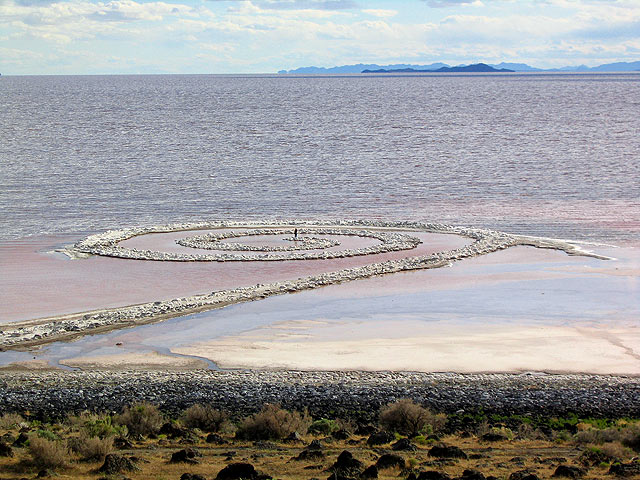
Photograph of the Spiral Jetty by Michael David Murphy.

The Jetty has also served as a great location for amateur, nature and art photographers due to its unique design and all-natural landscape. Of the included photographs, two were taken at Rozel Point, which is slightly northeast of the Jetty and a popular spot for photographers to capture the Jetty in its entirety. The aerial photograph was featured on a New Jersey public television (NJN) program titled, “State of the Arts” for their Forces of Nature segment, demonstrating that interest in the Jetty is not only at a local level, but a national one as well. Many pictures of the Jetty have been taken over the years, some while the Jetty was fully exposed, others while it was barely visible above the waters of the Great Salt Lake. According to the Dia Art Foundation’s Web site, no permits or special permissions are required to take photographs of the Jetty.

As for artist Robert Smithson, he did not live to see the Spiral Jetty gain momentum in the press, or attention from fans. He died on July 20, 1973, at age 35 in a plane crash in Texas. Following his death, The New York Times wrote, “When a culturally significant person dies, there may occur for the living a moment of illumination, not only of one career but of a whole nexus of events and meanings into which that career was woven.” Smithson and his Spiral Jetty have gained a number of fans posthumously, including a number of fellow modern artists.

Aerial view photograph of the Spiral Jetty courtesy of NJN Public Television.

The Spiral Jetty has been called one of Utah’s best kept secrets by some. Smithson revealed in an interview with Paul Cummings that he felt the Jetty possessed a “prehistoric motif,” making it a timeless work of art in the spirit of Earth’s histories. The visitor’s center at Golden Spike National Historic Site serves as an unofficial information center for the Spiral Jetty where fans and curious onlookers can go for directions and information. Writer Kirk Johnson from The New York Times discusses the controversy that exists between the state of Utah and the Dia Art Foundation over the land surrounding the Spiral Jetty. The Utah state government, which includes the aforementioned Governor’s Public Lands Policy Coordination Office, is interested in drilling oil near the site, while the Dia Art Foundation feels that oil rigs would harm the work’s aesthetic experience. As of today, the future of the Jetty is uncertain. The debate over drilling near the site is still ongoing, and the Jetty is not visible indefinitely. However, this unique piece of artwork has carved itself an important place in Utah’s artistic and geographic history.

Madeline Vandever is a mass communication major at The University of Utah. She plans to graduate in May 2011 and will then pursue a Master’s degree in elementary education.

Sources

Calvin Tomkins, “Onward and Upward with the Arts: Maybe A Quantum Leap,” The New Yorker, February 5, 1972, 42.

George Will, “Pistol-packing ‘artists’ may reflect mood of world,” The Free Lance-Star, August 1, 1981, 3.

Peter Schjeldahl, “Robert Smithson: He Made Fantasies as Real as Mountains,” The New York Times, August 12, 1973, 127.

“Robert Smithson, 35, A Sculptor, Is Dead,” The New York Times, July 24, 1973, 41.

Kirk Johnson, “Plans to Mix Oil Drilling and Art Clash in Utah,” The New York Times, March 27, 2008.

Secondary sources

Nancy Holt, ed. The Writings of Robert Smithson. New York: New York University Press, 1979.

Paul Cummings. “Interview with Robert Smithson For The Archives of American Art/Smithsonian Institution (1972).” Robert Smithson: The Collected Writings, ed. by Jack Flam. Berkeley: University of California Press, 1996.

Community Park to Derks to Franklin Covey to Spring Mobile: A 94-plus-year History of Salt Lake’s Diamond

by BRETT CURTIS

A little known fact is that professional baseball has been an important part of Salt Lake City culture for nearly a century. Since the birth of the Salt Lake City ball club, in March of 1915, the team has undergone many name changes and venue adaptations. The club was initially known as the Salt Lake Bees and retained the name for many years. Next, the team was known as the Trappers (the team’s name changed many times at this point and was called the Angels, the Gulls, and the Giants). This series of name changes began in 1950 and went on for forty years. I first knew the team as the Buzz in 1993, after which the name was changed to the Stingers for a short twoseason time period and it has come around full circle to be called the Salt Lake Bees anew.

The team name is not the only thing that has changed. In the history of the franchise, stadiums also have come and gone, and changed names multiple times. Demolition of the ballpark has happened by means natural or of man power; construction and stadium name changes have been a common reoccurrence in its lifespan. In this article, I will discuss the evolution of team and stadium names and construction of the current stadium. Independent of the team and stadium name changes this extraordinary part of Utah’s history has undergone, one fact has remained unspoiled. The park’s northwestern cornerstone has sat and will continue to sit at 1300 South and West Temple, and hundreds of thousands of fans will visit annually to enjoy an exhibition of America’s favorite pastime.

When first constructed in 1915, the stadium was given the name Community Park; it retained this title and facade for a little over two decades, until it burned to the ground on the night of September 24, 1946, as throngs of spectators gathered to observe the consuming inferno. All this happened just four evenings after the team finished the Pioneer League Playoffs. Construction of Derks Field began in early Februrary of 1947 and was completed just in time for the Bees home opener on the 23rd of May in that same year. (Deseret News, May 30, 1947)

Aerial view of Derks Field three years after its construction. Photo courtesy of the Utah State Historical Society.

The team was forced to commence its season with twenty-two consecutive away games because the project was in the final stages of completion. The park was named after John C. Derks, the “dean of baseball,” a longtime Salt Lake Tribune writer, a sports editor, and baseball advocate who died just two years prior to the field’s opening. The stadium commemorated Derks until its demolition in 1992.

During that year, fans arrived to discover a deteriorating edifice where 1,500 of 10,000 total seats were sectioned off and condemned to public use. The concrete was unsafe and unsound for spectators and the decision to close a portion of the park was made due to a lack of structural integrity on the third baseline section between home plate and into the left field bleachers. At this point, demolition of the existing park and a rebuilt stadium it its place was in the best interest of stakeholders, including Salt Lake City Mayor Deede Cordini, who came into office and jumped at the opportunity to go out with the old and in with the new in the form of a stadium that would attract a larger fan base and provide sports fans with peace of mind and needed safety. (Deseret News, April 19, 1992)

The task of building the new park was given to Adams & Smith, Inc. The project called for 952 tons of steel and took two years to complete — a lengthy period when considering the design’s simplicity. The park, named Franklin Covey Field, opened in 1994 with a spectator capacity of 15,500 people. Three years later, the park was renamed Franklin Quest Field due to the merger of Franklin Quest (day planners and time management company) and Covey (time management seminars). When it opened, one source observed: “Franklin Covey Field was one of the first of the new, double-decked AAA stadiums, and it’s a beauty.” (Jarvis)

Spring Mobile Ballpark as it looks today. Photo courtesy of City Weekly.

The name of the diamond changed again in April 2009 when it became known as Spring Mobile (this is the park’s name to present date). This ballpark has been and will continue to be of great importance to Utah’s rich recreational history. The franchise is second only to the Jazz in numbers of fan spectators over its lifetime. It is important in communication because the general public knows very little about the park’s history. This article was written as a tool to educate a mass number of those who have long appreciated The Bees without knowledge of the evolution of the team or stadium’s interesting history. The relevance of this brief history is to both Utah citizens and baseball fans round the globe.

Brett Curtis is a senior at The University of Utah. He is majoring in organizational communication and minoring in Brazilian studies. He is a Realtor at RAN Life Real Estate and is a native Utahn with a “fever pitch” for the game of baseball.

Sources

Eric Pastore , Wendy Pastore, and Fred Sagebaum. “Derks Field.” Baseball Reference.com.

“Smoking and Voting,” The Deseret News, March 2, 1964.

“At Cavalcade,” The Deseret News, July 3, 1965.

“Old Timers Tilt Set Saturday,” The Deseret News, July 30, 1967.

Lex Hemphill, “History of Neglect Has Plagued Derks,” The Deseret News, April 19, 1992.

Dee Chipman, “Derks Roof? One Problem …,” The Deseret News, March 5, 1963.

“Ready for Cubs, Bosox Derks Field Takes on Polish,” The Deseret News, April 4, 1965.

Hal Schindler, “Utah Grows Up With the New Century,” The Salt Lake Tribune, January 28, 1996.

Interview with Craig Wirth, University of Utah Adjunct Professor, April 7, 2010.

Interview with Dave Curtis, a Bees fan who attended games in the 1950s and 1960s, April 7, 2010.

Gary Jarvis. “Franklin Covey Field.” Minorleagueballparks.com.

Sir Arthur Conan Doyle’s Lecture in the Salt Lake Tabernacle on May 11, 1923

by VALERIE JOHNSON

Sir Arthur Conan Doyle, best known for creating Sherlock Holmes, became a fervent Spiritualist during the latter part of his life. He strove to prove the existence of spirits through psychic photography and exposed fraudulent psychics. According to an interview he gave to the Deseret Evening News on May 11, 1923, he became interested in spiritualism about 35 years before, or around 1888, when A Study in Scarlet, the first Sherlock Holmes novel, was published. After his son and his brother died in World War I, Conan Doyle turned his attention towards Spiritualism, the Daily Utah Chronicle reported on May 9, 1923. This was his second academic tour of the United States and his first time visiting Utah and members of The Church of Jesus Christ of Latter-day Saints, both of which had been featured prominently in A Study in Scarlet, the latter unflatteringly so. With some arrangements from the extension division of the University of Utah, Conan Doyle headed to Salt Lake City.

Sir Arthur Conan Doyle arrived in Salt Lake City on May 11, 1923, around 12:50 p.m. He was accompanied by his wife, Lady Jean Elizabeth Conan Doyle, his three children, Denis, 14, Malcolm, 12, and Miss Jean, 10, his business manager Wallace Erskine, and the children’s governess, Miss French. Conan Doyle was immediately impressed with the Salt Lake Valley that he was seeing for the first time. According to a May 11, 1923, Deseret Evening News article, he described the valley as “very lovely and so well cultivated and neatly done. It is quite inspiring.” The same article neglected to mention that not only did he have one more son who died in World War I, but he also had two other daughters, one of whom was traveling with him. The Salt Lake Tribune and The Salt Lake Telegram both mention that Conan Doyle was traveling with his three children, but the Deseret Evening News either forgot about his daughter, or chose to omit her altogether. It’s possible that they didn’t feel the need to mention her because she was a girl.

Sir Arthur Conan Doyle was scheduled to lecture in the Tabernacle at 8:15 in the evening. Tickets were priced from $0.50 to $2.00, and all 5,000 seats were sold out, according to the May 12, 1923, Salt Lake Telegram article. His topic, “Recent Psychic Evidence,” sparked great interest. A May 11 Salt Lake Tribune article attributed the unprecedented popularity of Conan Doyle’s lecture to the fact that he could answer the question of what might lie beyond the grave. The other reason was that he was the creator of the great detective Sherlock Holmes. The Salt Lake Tribune expected the crowd to consist of “pastors of many churches, attorneys, doctors, men of science, students of literature, bankers, merchants, mechanics, salesmen, railroad men, from executive down to the clerical force; women, from social leaders down to house servants – representatives of every type and station.” All came to see the exciting psychic photographs or to meet the author of the famous Sherlock Holmes stories.

The most popular feature of Conan Doyle’s visit were his photographs proving the existence of spirits. The Salt Lake Telegram published several stories on Conan Doyle’s work in Spiritualism in the weeks before his arrival. One of these pictures was described in detail in The Salt Lake Tribune on May 9, 1923. It described the scene of a crowd around a soldier’s tomb, with the presence of spirit faces amongst the living. It was to this photograph that women reacted so emotionally. On the same day, The Salt Lake Telegram described a photograph of a paraffin glove created by a spirit during a séance. Conan Doyle explained that only a spirit could have made the glove of wax because the thin layers were unbroken.

In order to show these photographs, a special screen was erected in the Tabernacle. On May 9, 1923, the Deseret Evening News asked for “an expert slide operator and a machine with an adjustable carrier since the slides which Sir Conan will use are of English manufacture and a little different in style from the American make.” According to an article in The Salt Lake Telegram on May 11, Russell E. Enger was put in charge of the visuals so that everyone could see the slides. Levi Edgar Young was chosen to introduce Conan Doyle’s lecture. He was also the toastmaster at a luncheon given at the Alta club, where Conan Doyle and his wife were guests of honor.

A May 13, 1923, article in The Salt Lake Telegram detailed the luncheon given by F. W. Reynolds, director of the extension division of the University of Utah. It was through his arrangements that Conan Doyle was able to lecture at the Tabernacle. During his stay, Conan Doyle was able to visit a pioneer museum and compared the items to those he had seen in South Africa after the Boer War.

The Deseret Evening News seemed hesitant to print anything about Conan Doyle’s psychic endeavors. The paper focused on what Conan Doyle had to say about Salt Lake City and on the literary achievements of his 12-year-old son, but had little to say about Conan Doyle’s photographs. On May 12, 1923, a summary of his lecture gave the overall impression that spiritualism was an optimistic religion that promoted tolerance. It hardly mentioned the photographs that were supposed to be the main feature. Like Sherlock Holmes, Conan Doyle kept his lecture free of “the uncanny” and explained the difference between the tricks used by swindlers and real psychic phenomena.

The Salt Lake Tribune took a different stance to covering Conan Doyle’s lecture. On May 12, 1923, it described the process for photographing spirits, how the spirits were able to become visible for brief periods, and what kind of life one should expect beyond the grave. It took as clear and calculated a tone as Conan Doyle was likely to have taken with his lecture. The Salt Lake Tribune took Conan Doyle’s methods seriously, but with a grain of salt and didn’t take his theories to be fact.

The Salt Lake Telegram was possibly the most “spellbound” of the papers to summarize Conan Doyle’s lecture on May 12, 1923. It was impressed by Conan Doyle’s conversations with his dead brother and mother, and explained how his view of Spiritualism depended on the Bible and Christianity. It is the only paper to put some doubt in his lecture: “It was when he grew argumentative that his logic at times appeared to be far from invulnerable.” It also brought up an argument against Conan Doyle’s claim that life is mostly unhappy, reminding readers about the joy of childhood.

Most of the credibility of Sir Arthur Conan Doyle’s claims comes from Sherlock Holmes. Even though Conan Doyle was trying to shift his readers’ attention from his popular Sherlock Holmes novels to his more serious, historical works, the great detective still comes back into play. The public believed that someone who could create as analytical and clever a character as Sherlock Holmes must himself be a man of science and understanding. In The Salt Lake Tribune May 11, 1923, article, Conan Doyle’s sincerity and integrity was placed next to the mention of Sherlock Holmes. On the same day, The Salt Lake Telegram ran a story on Conan Doyle with a sub-head of, “Man Known to World as Sherlock Holmes Will Exhibit Photos Showing Evidence of Ectoplasm.” The mystery of what lay beyond the grave was akin to one of Holmes’ cases, and would be solved just as easily. Were it not for Sherlock Holmes, Conan Doyle wouldn’t have nearly as much credibility, and the articles about his “spirit” photographs or the sighting of spirits around a soldier’s tomb would not have been run in The Salt Lake Tribune on May 7 and 9 respectively.

Valerie Johnson is a junior at the University of Utah. She is majoring in mass communication and minoring in creative writing. She has also been a Sherlock Holmes fanatic for six years and is an aspiring Sherlock Holmes expert.

Sources

Primary Sources:

“Sir Conan Doyle is Accompanied by Family,” Deseret Evening News, May 9, 1923, sec. 1, 5.

“Doyle Delighted With First Visit to Western U.S.,” Deseret Evening News, May 11, 1923, sec. 2, 1.

“Most of Mankind Deserves Reward Says Sir Conan,” Deseret Evening News, May 12, 1923, sec. 2, 8.

“A. Conan Doyle to Lecture on Psychic Proofs,” Daily Utah Chronicle, May 9, 1923, 1.

“Doyle Will Exhibit ‘Sprit’ Photographs,” The Salt Lake Tribune, May 7, 1923, 7.

“Doyle Will Arrive in City Friday Noon,” The Salt Lake Tribune, May 8, 1923, 11.

“Doyle Film Pictures Dead Around Tomb,” The Salt Lake Tribune, May 9, 1923, 7.

“Doyle Awakens Much Interest,” The Salt Lake Tribune, May 11, 1923, 11.

“Spirit Proofs are Advanced,” The Salt Lake Tribune, May 12, 1923, 18.

“Recent Psychic Evidence” (advert for Conan Doyle’s Lecture), The Salt Lake Telegram, May 7, 1923, 10.

“Conan Doyle Comes Friday,” The Salt Lake Telegram, May 9, 1923, 5.

“Sir Arthur Conan Doyle Salt Lake Visitor: Noted Author Will Tell of Spirit Research,” The Salt Lake Telegram, May 11, 1923, 2.

“5000 Attend Conan Doyle Spirit Lecture,” The Salt Lake Telegram, May 12, 1923, 3.

“Conan Doyle is Entertained at Luncheon Here,” The Salt Lake Telegram, May 13, 1923, 3.

Secondary Source:

Michael W. Homer, “‘Recent Psychic Evidence’: The Visit of Sir Arthur Conan Doyle to Utah in 1923,” The Journal of The Arthur Conan Doyle Society 6 (1995): 160-168.

Saltair: The Tragic Fire of 1925

by KIMBERLEE WARD

As soon as the Mormon pioneers settled the Salt Lake Valley in July 1847, they knew that the Great Salt Lake was something special. Three days after arriving in the valley, Brigham Young, the president of the Mormon church, and other church leaders traveled to the Great Salt Lake and enjoyed the buoyancy of the water. (McCormick & McCormick) From this time forward, residents and tourists have enjoyed the recreation found at the Great Salt Lake. Beach resorts began to emerge on its banks beginning in 1870. The one resort that was known as an American tourist destination was Saltair.

The owner of the new resort was the Saltair Beach Company and its largest stockholder was the Mormon Church. Church leaders wanted to build a resort that was family-oriented and intended that there be a wholesome atmosphere with the open supervision of church leaders. The Saltair Beach Company was established in 1891 and plans for the new resort started then. The beach resort of Saltair was built on the southeast side of the lake and was finished in 1893. The Mormon Church intended Saltair to be the “Coney Island of the West.” Saltair was advertised just as that before completion and for many years afterward. (McCormick & McCormick) A direct train route made the resort accessible to people all over the Salt Lake Valley. People visiting Saltair not only enjoyed the beach and the buoyancy of the Great Salt Lake, but also took pleasure in one of the first amusement parks west of New York.

After a record-breaking season in 1924, tragedy struck the beach resort Saltair. On April 22, 1925, as workmen readied Saltair for the upcoming season, a fire broke out in the Ali Baba Cave. The Salt Lake Tribune reported on April 23 that L.S. Peterson, an employee of the Saltair Beach Company, had smelled smoke and discovered “a wall of flame about four feet wide and running the length of the cave.” Peterson beat out the fire and was able to reduce the fire to embers before running for help. The Salt Lake Tribune quoted Peterson as saying, “I hadn’t been gone over two minutes and in that time [the fire] had started up again and spread before the wind.” The strong southerly winds helped expand the fire that eventually took over much of the beloved resort.

For several hours Saltair employees, workers, concessionaires, and volunteers from the Inland Crystal Salt Company struggled to save the pavilion. Firefighters from Salt Lake were called in and arrived at the resort in record time. (McCormick &McCormick) The Deseret News reported on April 22 that “fire station No. 3, located in Sugar House district responded to the call for the reason that it has the only pump that can be used for pumping salt water.” On April 23, the Salt Lake Telegram reported that two trucks of the Salt Lake County volunteer fire department from Murray had also arrived to fight the ongoing fire. The Telegram continued to say that “Claude Anderson, Superintendent at Garfield, arrived with six men and offered to dynamite the pier leading to the pavilion and hence stop the spread of the fire and was denied admittance.”

About 3:30 p.m., the winds shifted away from Saltair and it looked for a moment that the main pavilion could be saved. Just minutes later, the winds swerved back and the flames began to overtake the pavilion. The Salt Lake Tribune reported on April 23 that “tongues of the flame and smoke leaped fifty to one hundred feet [and] shot out and licked up the timbers and beams of the great structure as though they were cardboard.” The heat and smoke from the fire drove the firefighters away until the fire burned out of control. (McCormick & McCormick) The Telegram observed that “the smoke cleared slowly and left a gaunt-like pavilion, once the largest dance hall in the world, nothing but a network of wooden posts gnawed at by the tongues of fire.”

The fire continued into the evening and much of the famous beach resort was destroyed. On April 23 the Telegram noted the losses from the fire. The property lost included the Fun House, Dinty Moore’s, the Ali Baba Cave, the Hippodrome, the Old Scenic Railway, Dodgem, Ship Café, the dancing pavilion, a shooting gallery, the Automat, a photograph gallery, twelve hot dog stands, a bathing suit house, minor concessions, and stands and piers and houses. The Telegram estimated a total of $500,000 in damages with the total insurance coverage being $150,000.

Just one day after the tragic fire at Saltair, there was talk of rebuilding the beach resort. On April 23 The Salt Lake Tribune quoted part of the statement released by the president and manager of Saltair. It said that “[Saltair] was covered by all the insurance the company could obtain, but at this time that does not seem adequate to rebuild any such elaborate structure as has been destroyed. However, it is reasonably certain that a new Saltair will rise from the ashes of the old resort.” On the same day, the Deseret News reported that “Manager Stevens looks forward to 1925 being the banner season and expressed hope the resort would be restored in time to take care of hordes of tourists who will visit Salt Lake.”

After a visit to Saltair and an evaluation of the damages, the owners decided that the resort would open up for bathing at the end of May. On April 24 the Deseret News reported that “with every bathing house at Saltair beach intact … bathing in the lake will still be one of Salt Lake City’s finest attractions this summer.” Saltair’s President Ashby Snow issued orders for the wreckage to be cleared as soon as possible. At this time, plans regarding rebuilding of the pavilion and other structures were put on hold until after insurance adjustments had been made. However, the overall plan of the Saltair Beach Company was to rebuild the resort. The officers had decided to build on the same site and to reuse the same building plans for sentimental and historical purposes. (McCormick & McCormick)

On April 24, in both the Deseret News and the Davis County Clipper, there were articles regarding Ogden’s suggestion that the famous resort be moved closer to Ogden. The Deseret News reported that “Ogden’s Chamber of Commerce officers are suggesting to directors of the Saltair Beach Company a resort be built on the shores of the Salt Lake, somewhere in Davis County, instead of rebuilding Saltair.” The article continues to say that a letter was sent to Manager Stringham A. Stephens, pointing out the reasons why a move would be better for the Saltair Beach Company. The letter stated that “such a resort … would draw more people from Ogden, Logan, Brigham City and all northern Utah points, and would not be farther removed from Salt Lake than the present resort.”

The Davis County Clipper reported that the Ogden Chamber of Commerce had seriously considered the building of a resort on the lakeshore west of Ogden. The Chamber officers felt that if a resort were placed on the state highway, it would be “patronized by more tourists and would more adequately show the big things Utah has to display.” The Davis County Clipper reported in the letter sent to Manager Stephens that “if the new Saltair could be placed closer to Ogden such plans [for a new resort] would be abandoned and all would boost and support the new resort.” Ogden’s plan to move the beach resort Saltair closer to the highway never happened.

The Great Salt Lake has been an attraction to people from the beginning. People have traveled from near and far to experience swimming in the lake. They have enjoyed the many resorts that lined the shores of the Great Salt Lake, but none as much as the famed Saltair. The fire of 1925 was the beginning of Saltair’s decline. The community loved Saltair along with the many tourists who had visited the resort. For months and even years after the fire, there was talk of rebuilding the famous resort. No one wanted to see the end of Saltair. They wanted to hold onto what it once was.

Saltair did not open to the public when the owners and manager had anticipated. The resort reopened on July 1, two months after the fire. The summer of 1925 was the grand opening of Lagoon, which offered a larger scale amusement park to the community. (McCormick & McCormick) With the difficulties that the fire caused and the attraction of Lagoon, Saltair did not regain the patronage and splendor it once had. Toward the end of 1925, the new pavilion was built and the resort was expanded. However, Saltair never achieved the same success that it once had. A number of factors prevented Saltair’s overall success, including the advent of motion pictures and radio, automobiles and the Great Depression, which kept most people closer to home. In 1931, another fire overcame Saltair once again. The once famous amusement park and beach resort never regained the popularity and splendor that it once enjoyed during its first 30 years.

Kimberlee Ward is a senior at the University of Utah. She is majoring in mass communication and will graduate August 2010.

Sources

“Flames Leap in High Wind Over Buildings,” Deseret News, April 22, 1925, 1.

“New Building will be Upon Larger Scale,” Deseret News, April 23, 1925.

“Saltair to be Bathing Place This Summer,” Deseret News, April 24, 1925.

“Salt Lake’s Famous Place of Diversion Ravaged by Flames,” The Salt Lake Tribune, April 23, 1925, 1.

“Future of Saltair to Be Determined at Today’s Meeting of Directors,” The Salt Lake Tribune, April 24, 1925.

“No Decision on Saltair Made,” The Salt Lake Tribune, April 25, 1925.

“New Saltair on Old Site, Plan,” The Salt Lake Tribune, April 26, 1925.

“Great Dance Pavilion at Resort Afire,” The Salt Lake Telegram, April 22, 1925, 1.

“$500,000 Fire Wipes Out Main Portion of World-Famed Resort,” Salt Lake Telegram, April 24, 1925, 2.

“Ogden Suggest Davis as Center for Resort,” Davis County Clipper, April 24, 1925, 1.

Nancy McCormick and John McCormick. Saltair. Salt Lake City: University of Utah Press, 1985.

Topaz: Internment Through Young Eyes

by TIFFANY M.T. LIEU

Photos courtesy of J. Willard Marriott Library Special Collections

After the Japanese attacked Pearl Harbor on December 7, 1941, over 127,000 Japanese Americans were placed into government internment camps, due to a military exclusion order issued by President Franklin D. Roosevelt. Arrington wrote that the Executive Order 9066 was seen as a “military necessity” to remove all of the Japanese Americans, primarily from the coastal areas (California, Oregon, Washington and Alaska), to eliminate any danger during enemy attacks or raids along the coast. Arrington noted that Lieutenant General John L. DeWitt’s reasoning was that the bond between the Japanese (through culture, religion custom, race, etc.) were unparalleled; “A Jap is a Jap … it makes no difference whether he’s an American citizen or not; he is still Japanese.” (Arrington, 14) As a result, claims of communication between the coastal Japanese Americans and Japan grew largely in suspicion, though none of the claims were ever proven by reliable sources or evidence. (Arrington, 13)

The relocation of the Japanese Americans began as a voluntary process and nearly five thousand Japanese Americans obliged and moved without force. (Arrington, 15) However, as the speculation and fear grew larger that the Japanese Americans were a dangerous threat, the need for relocation spread among various states, including Utah, making the relocation mandatory on March 27, 1942. (Arrington, 16)

A total of 10 concentration camps were constructed after the relocation mandate was issued. The Central Utah Relocation Center was housed in Delta, Utah, also known as the “Jewel of the Desert.” The camp was located where Lake Bonneville once was in Millard County. The area was known as Sevier Desert on dated maps or as “Pahvant (abundance of water)” by the Paiute Indians; the camp’s name, Topaz, derived from the Topaz Mountains located near the center. (Arrington, 21) Arrington described Topaz as windy, which stirred up “a seldom interrupted whirl of dust. Another [detraction was] the non-absorbent soil, which, after a rain [storm], is a gummy muck, ideal as breeding ground for mosquitoes.” (Arrington, 22)

The Topaz Internment camp was constructed to comprise over 19,800 acres and “consisted of forty-two checker board blocks, of which thirty-four were living quarters or residential blocks.” (Arrington, 23) The blocks were built to accommodate 250 to 300 people and “had twelve single-story resident barracks buildings, a central mess or dining hall, recreation hall, a combination washroom-toilet/laundry building, outdoor clotheslines, and an office for the block manager,” wrote Arrington. (23) Among the many Japanese Americas transferred to Central Utah Relocation Center, and the nine other camps across the nation, many if not most of the internees were teenagers and children.

P1584 Willis Carl. BX 1, FLD #3. "Teens outside high school."

For many young people, the experience in the internment camps differed in perspective and experience than that of their parents or older Japanese Americans at the time. While camp life cast a cloud of uncertainty and worry for the future of older, parental figures, Japanese teens and children saw it differently. In fact, more often than not, many of them found ways to make the best of their situation. Many were able to meet and make new friends, attend school activities and be involved in sports. “Within the confines of the assembly centers, the Japanese Americans tried to create a community. They organized schools, camp newspapers, sports programs, and talent shows.” (Tunnell, Chilcoat, 11) Other than the fact that the teens were confined to the internment camps, their lives are very similar to the lives of many teenagers today.

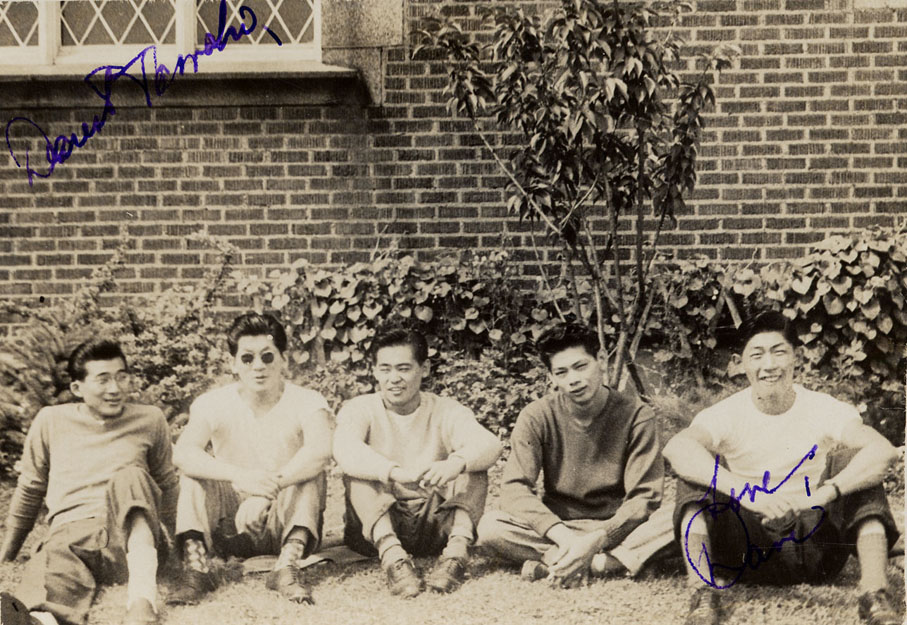
P1584 Willis Carl. BX 1, FLD #4. "Five young men." David Hisato is on the far right.

In the letters written between teenage lovers David Hisato and Tamaki Yamate, the two hardly spoke of any extreme sufferings or turmoil from being in Topaz or, in Hisato’s case, working at the Roy Labor Camp near Ogden.

Hisato sometimes spoke of the lack of work in his letters, where he only worked six to nine hours a day and earnings were tough and the harsh weather often made his hands dry. At the other extreme, he wrote about working continuously for over 13 hours a day. (Letter, September 9, 1944)

But a majority of the letters Hisato wrote to Yamate described the events of his day and his unconditional affection for her. “As for girls, no worry sweet because I got my heart on and it’s you only darling. You know I have your picture right above my bed so before I go to sleep I can look at it. Some of the boys see your picture and think I’m pretty lucky.” (Letter, September 12, 1944)

Yamate wrote similar letters to Hisato. She described the upcoming parties and dances at the high school in Topaz.

Yamate also continually expressed her love for Hisato. In one letter she writes, “The days I spend with you, are the happiest days I have spent in my whole life. I know I’ll never know that happiness with anyone else.” (Letter, March 26, 1945)

PO 800 George Murarami Topaz, FLD #6. "7 young men."

Hisato and Yamate also wrote to their friends throughout the nation and received many letters in return. A close mutual friend, “Minzo” Askiyoski, wrote them both and his letters were similar to the letters exchanged between Hisato and Yamate. There was minimal discussion of specifics of camp life, but he emphasized social and personal events.

In one letter he asks Hisato to send him some good basketball shoes if he saw any. They also exchanged holiday cards and gifts through the mail. (Hisato & Yamate Collection)

P1584 Willis Carl. BX 1, FLD #4. "5 young kids."

However, students in an English class at Tule Lake Internment Center felt that camp life was harmful to young minds. “Since I’ve been to camp, I no longer feel that I am a part of the world,” Yukio Kumata wrote. “I feel like a dangerous enemy spy being held in prison. I take no interest in world events concerning America as I did at home. For a loyal American to be placed in a stuffy camp, I feel I am no part of America. I am inclined to feel bitter and sarcastic about the whole fair. But as I recall my faithful Caucasian friends at home, I realize that America is and will be for the rest of my life, home for me.” (Kumata Papers)

PO 800 George Murarami Topaz, FLD #6. "Three Varsity football players."

Many teenagers found camp life dull and repetitive, but seldom complained about living conditions. Another English student from Tule Lake Internment, Heidi Morioka, described camp as being unbearably hot some days and with the lack of trees on site, there was no place to cool off under. (Morioka Papers) Nearly all the teens were happy that the camp gave them the opportunity to meet other Japanese teens/children their age.

P1584 Willis Carl. BX 1, FLD #2. "Young girls doing homework."

But beyond making the best of their situation, there was much fear and worry in the lives of these young people. Although life at camp was relatively easy, the future was uncertain and fearful to some young people as well. “We all wonder what the future will be like,” wrote Rosie Ishibashi. “It has been said, ‘let us look to the future, rather than to the present.’ Yes, we all wonder what the future will be.” (Ishibashi)

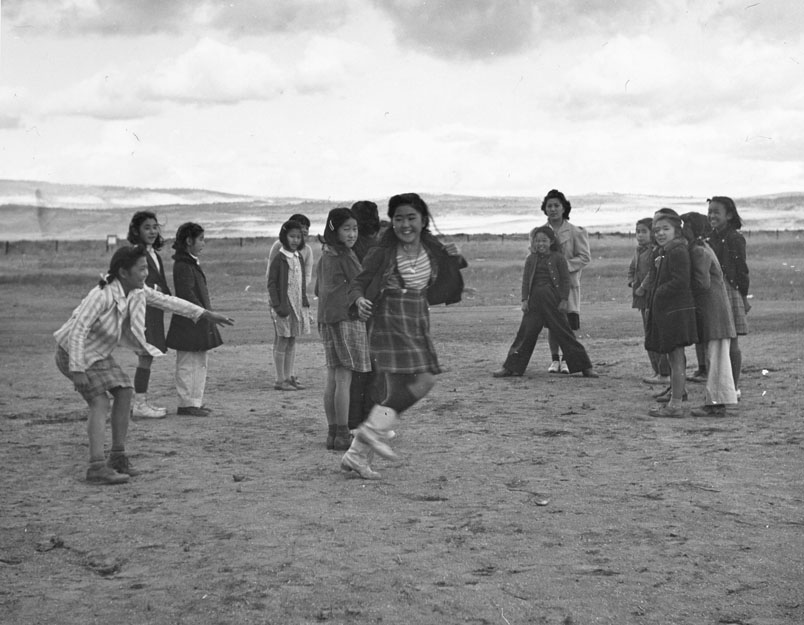
PO 144 Japanese Relocation, WRA. BX 1, FLD 3. #41. "5th grade girls playing 'too deep.'"

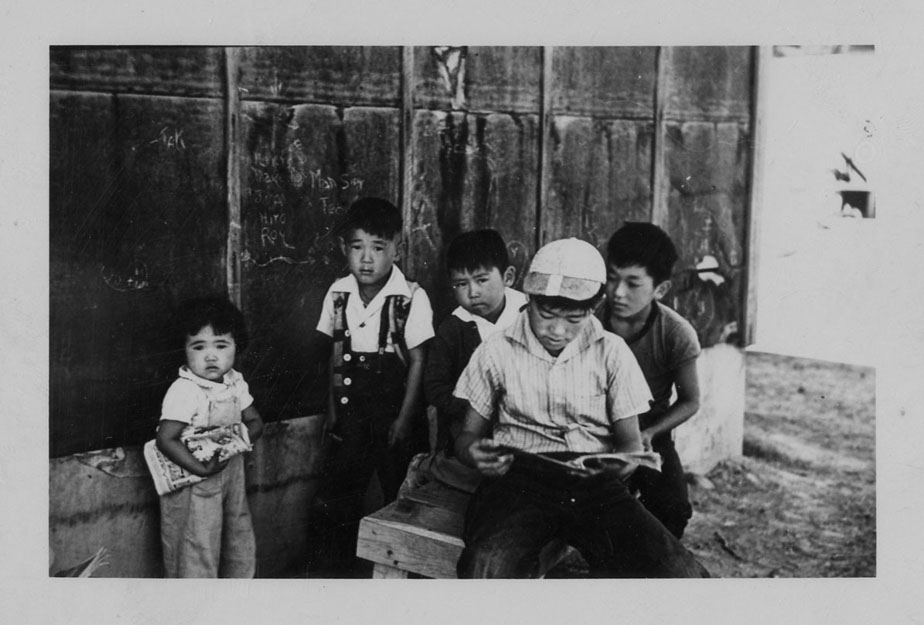
The Japanese relocation was a defining time in American history. For several years, many Japanese Americans lived in barracks behind fences, unable to go out on their own without being supervised. But as the youth internees have displayed, many Japanese Americans complied with the U.S. government and did their best to assimilate and adapt to camps to keep their lives as normal as possible. The Japanese Americans were faithful U.S. citizens and were punished for something they did not do or want.

PO 144 Japanese Relocation, WRA. BX 1, FLD 3. "5th grade boys."

The relocation of Japanese Americans will always be significant in U.S. history. The gender, race, ethnicity, religion and color of a person’s skin do not determine their amount of loyalty or disloyalty to their country. After the recent September 11th incident, many Muslim Americans were threatened and scrutinized for an attack made by a terrorist in a Muslim country. Some Americans feared the Muslim Americans, weighing in the same accusations the Japanese Americans were accused of (sharing information and helping Japan) because “that’s who they originally are.” It’s important that these stereotypes are broken and that we as a nation do not segregate individuals based on the way they look or where they come from.

Tiffany Lieu, born and raised in Utah, began her college career at the University of Utah in August 2006. She is experienced in both print and broadcast journalism and has worked for the Daily Utah Chronicle, KTVX ABC 4 News, News 8 Texas, Lessons Magazine and KUTV CBS 2 News. Lieu loves being able to share her love of writing and communicating by helping others tell their stories. Lieu studied mass communication, with a focus in journalism and graduated with a bachelors of science in May 2010.

Sources

David Hisato and Tamaki Yamate, Hisato and Yamate Papers – Letters, MS 680, Boxes 1-5, 8, Special Collections, J. Willard Marriott Library, The University of Utah.

Rosie Ishibashi, Japanese Relocation Papers, MS 144, Box 4, Special Collections, J. Willard Marriott Library, The University of Utah.

Yukio Kumata, Japanese Relocation Papers, MS 144, Box 4, Special Collections, J. Willard Marriott Library, The University of Utah.

Heidi Morioka, Japanese Relocation Papers, MS 144, Box 4, Special Collections, J. Willard Marriott Library, The University of Utah.

Leonard J. Arrington. The Price of Prejudice: The Japanese-American Relocation Center in Utah during World War II. Logan: Utah State University, 1962.

Michael O. Tunnell and George W. Chilcoat. The Children of Topaz: The Story of a Japanese-American Internment Camp. New York: Holiday House, 1996.