The Salt Lake Tribune’s Coverage of the Cancellation of ‘Brokeback Mountain’

by MIRANDA A. KNOWLES

Ang Lee’s 2005 film, Brokeback Mountain, portrayed  two cowboys, Jack Twist and Ennis Del Mar (performed by Jake Gyllenhaal and the late Heath Ledger), who showcased their “forbidden” love. The film created controversy all over the world — including in Utah.

According to ads in the Deseret Morning News and Salt Lake Tribune, Brokeback Mountain was scheduled to play at 12:45 p.m., Friday, January 6, 2006, at Megaplex 17 at Jordan Commons. But the previous night, the film was pulled from its schedule and replaced by another film after the owner of Megaplex 17, Larry H. Miller, learned that the film was about two gay cowboys. The film’s cancellation brought up public debate all over Utah. From January 6, 2006, to January 31, 2006, The Salt Lake Tribune’s coverage of the cancellation showed both sides of the controversy and the power of communication as it shapes public debate.

Findings

The Brokeback Mountain vs. Larry H. Miller controversy began during a KCPW-FM interview with Miller and Jonathan Brown. The interview on the Salt Lake City public radio station was done on Thursday, January 5, 2006, the day before the film was released in theaters, and aired the next day. An article by Sean P. Means and Sheena McFarland published in The Salt Lake Tribune on January 7 discussed the interview between Miller and Brown. According to the article, Brown said during the interview, “Miller was unaware of the storyline of Brokeback Mountain … until Brown described it to him Thursday.”

The Salt Lake Tribune’s Brandon Griggs also discussed Miller and Brown’s interview in his article, published January 11. The article said Miller’s initial response to booking the film was because the film had received seven Golden Globe nominations. Miller saw this as a sign of its “potentially broad appeal.” Toward the end of the radio interview Miller stated,“It is possible that the content of this [film] … is offensive enough to a large enough segment of the population that this is one that slipped by our screening process. Maybe I’ve been a little naive and not paid proper attention to it and let it slip through the cracks. If I have, then I made a mistake.”

Nothing in the interview made it sound like Miller would take matters to the extreme and completely cancel the film before it began playing. The interview made it sound like Miller would first see how audiences reacted to the film. If there was a negative response, then he would pull the film from showing. However, two hours after the interview, Miller canceled the show from playing.
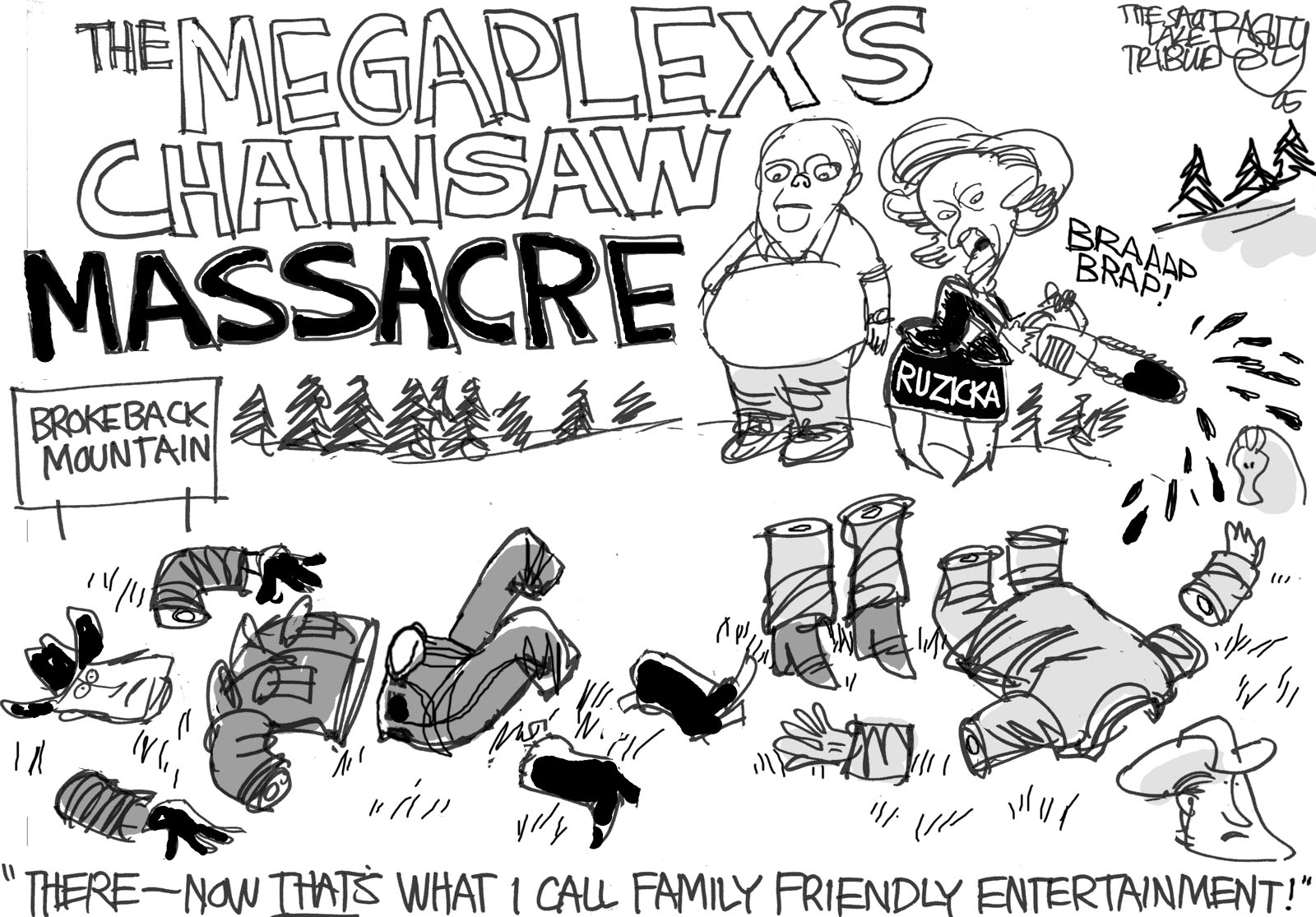
This cartoon, by the Salt Lake Tribune's Pat Bagley, appeared . Used with permission.

This cartoon, by the Salt Lake Tribune‘s Pat Bagley, appeared in the paper on January 10, 2006. Used with permission.

The Salt Lake Tribune’s website posted an update on the cancellation shortly after the decision to pull the movie from theaters appeared. The update, posted on January 6, stated, “The Megaplex 17 announced it was pulling the film late Thursday afternoon. The change-of-heart came too late to remove the title from the theater’s ads in today’s Salt Lake Tribune”

The update was the beginning of a media frenzy that included numerous editorials, columns, and letters to the editor. Of the articles published, most focused on Miller’s lack of response, how the film was doing in award season, the business aspect of the cancellation, the world’s reaction to the cancellation, and what the film was about — love. The issues at large, such as morals, civil liberties, and press bias were brought up through countless letters to the editors.

Means and McFarland were among the first journalists to report on the cancellation. In their article, published January 7 and titled, “‘Brokeback’ gets boot,” they discussed the details of the cancellation and what Focus Feature (the production company of the film) had to say about it. The article also interviewed Carol Adams about her reactions to the film’s cancellation. The local woman wanted to see the film and was saddened to learn that it had been canceled.

Articles also discussed  negative public relations, Miller’s continuous silence on the issue, and of course the world’s reaction. According to Lesley Mitchell’s article, published in The Salt Lake Tribune on January 12, “Miller’s silence has helped give the story international appeal.” Another article by Griggs, published January 15 and titled, “‘Brokeback Mountain’: Why all the fuss?,” discussed the huge reaction to the film and the cancellation. This article is the most blunt of any article published in The Salt Lake Tribune because Griggs stated the hard truth on why the film was pulled from the schedule: “Men having sex.” Griggs explained that the homosexual relationship was the reason why people were getting so upset. Griggs also addressed hypocritical morals when  he wrote, “How is a gay love story more morally offensive than other movies — such as ‘Hostel,’ a horror film that shows sadists fulfilling their depraved fantasies by paying to torture other people; or the stoner comedy ‘Grandma’s Boy,’ which features drug use in almost every scene — now playing at Miller’s theaters?” His questions and bluntness were met with countless letters on the matter by Utah’s citizens.

Similarly, Griggs’ article, “‘Brokeback’ squelch has spotlight on Utah again,” published January 11, discussed the world’s reaction and Heath Ledger’s. Ledger was quoted as saying, “It’s all just really unnecessary” and “Personally I don’t think the movie is [controversial], but I think maybe the Mormons in Utah do. I think it’s hilarious and very immature of a society.” Griggs also reported, “Articles about the snub have made international headlines. NBC’s Jay Leno and MSNBC’s Keith Olbermann joked about it on the air Monday night.” Steven Oberbeck’s article, “Miller’s move: shrewd or rash?,” published January 13, quoted Paul Mero of the Sutherland Institute, a conservative think-tank in Salt Lake City. Mero stated, “Considering the conservative nature of our population, I’m sure a lot of people think: We’ll, it’s [Millers’] business and he’s entitled to do with it what he wants.”

The cancellation was something to talk about, and Utah’s citizens made sure their voices were heard. The letters were short, blunt, and very opinionated. One Salt Lake Tribune reader, Karla G. McGuigan, said the decision was an “encroachment into American citizens’ rights to civil liberties.” However, another reader, Bret A. Stapley, responded with, “Larry H. Miller is a private business owner who decides what is best for his own business. This is not a case of ‘government censorship’ or a civil liberty violation.”

Robert Seifert also questioned Larry H. Miller’s morals in a letter titled, “Miller’s moral compass.” Seifert, like Brandon Griggs, brought  up the hypocrisy of playing Hostel and not Brokeback Mountain. Seifert stated, “To sum up, pulling ‘Brokeback Mountain’ tells young people that being gay is unacceptable, so not pulling the movie ‘Hostel’ (being shown in the same theater complex) sends the message that torturing and mutilating other human beings is all right.” Harry A. Rodes disagreed in his letter, titled, “Morally correct decision”: “I would like to call on moral-minded people in Utah to actively support Miller’s businesses, especially his movie theater, to show the state and the country that there are still some people who have not given in to societal pressure to accept that which is immoral. He should be praised, not condemned.”

Readers also began saying that The Salt Lake Tribune was biased toward the gay community. Morgan T. Beach wrote in a letter titled, “Tribune’s gay bias,” published January 17: “I wonder how  many favorable articles and commentaries you would devote toward a movie of the same caliber, romanticizing the polygamous lifestyle.” The same day another Salt Lake Tribune reader, JoAnn Nokes, sent in a letter titled, “Get on with Life.” Nokes wrote, “Decisions are made daily. So accept it and let’s get on with life.”

Though The Salt Lake Tribune did indeed publish positive reviews for the film, it was not the only newspaper in Utah to do so. According to a journal article published in August 2008 by Brenda Cooper and Edward C. Pease, Brokeback Mountain was rated positively by several Utah newspapers. The article stated, “Despite the Church of Jesus Christ of Latter-day Saints’ (LDS) position that homosexuality is a sin and that practicing homosexuals may be excommunicated, the church-owned daily newspaper, the Deseret Morning News, gave the film three and a half stars out of four, and The Daily Herald of Provo, Utah — home of the LDS-owned Brigham Young University — also reviewed Brokeback positively.”

Conclusion

Utah’s reaction to Larry H. Miller’s decision to pull Brokeback Mountain from his theatre was one of great debate. The divide between Utah’s views on heterosexuality, ethics, morals, and business standards was showcased through the great response of Utah’s citizens. In 2009, Cooper and Pease published another article on the topic of Brokeback Mountain. The article, published in Western Journal of Communication, discussed how newspapers framed the controversy over the film. Cooper and Pease’s study found that of the 188 Brokeback-Miller items published during January 6, 2006-February 2006, 55 percent opposed the cancellation of the film and 45 percent  defended the cancellation. The study also found that 153 letters were published statewide. Of the 153, 48 percent were pro-Miller, and 52 percent were anti-Miller. Of those 153 letters, 34 were published in The Salt Lake Tribune. My research, along with Cooper and Pease’s research, proves that Utah was greatly divided on the issue. People discussed the film’s cancellation and topics related to Miller’s decision, including morals, business practices, civil liberties, press bias, and the amount of attention devoted to the issue.

Miranda A. Knowles is a senior at The University of Utah. She is majoring in communication and minoring in sociology.

Sources

JoAnn Nokes, “Get on with life,” The Salt Lake Tribune, January 17, 2006, A8.

Morgan T. Beach, “Tribune’s gay bias,” The Salt Lake Tribune. January 17, 2006, A8.

Brandon Griggs, “Why all the fuss?,” The Salt Lake Tribune, January 15, 2006, D1.

Harry A. Rodas, “Morally correct decision,” The Salt Lake Tribune, January 15, 2006, AA2.

Robert Seifert, “Miller’s moral compass,” The Salt Lake Tribune, January 13, 2006, A12.

Steven Oberbeck, “Miller’s move: shrewd or rash?,” The Salt Lake Tribune, January 13, 2006, A1.

Brandon Griggs, “‘Brokeback’ squelch has spotlight on Utah again,” The Salt Lake Tribune, January 11, 2006, A1.

Bret A. Stapley, “Simple as That,” The Salt Lake Tribune, January 11, 2006.

Lesley Mitchell, “Media pros say silence on pulling gay movie gives the story legs,” The Salt Lake Tribune, January 11, 2006.

Karla G. McGuigan, “Denial of Civil liberties,” The Salt Lake Tribune, January 10, 2006.

Sean P. Means and Sheena McFarland, “‘Brokeback’ gets boot,” The Salt Lake Tribune, January 7, 2006, A1.

“Update: Miller’s theater pulls Brokeback mountain,” The Salt Lake Tribune, January 6, 2006.

Cooper, Brenda and Edward C. Pease. “Framing Brokeback Mountain: How the popular press corralled the “Gay Cowboy Movie.” Critical Studies in Media Communication 25, no. 3 (Aug. 2008): 249-273.

Cooper, Brenda and Edward C. Pease. “The Mormons Versus the ‘Armies of Satan’: Competing Frames of Morality in the Brokeback Mountain Controversy in Utah Newspapers.” Western Journal of Communication 73, no. 2 (April-June 2009): 134-156.

Salt Lake City and the Economy, One Year after the Stock Market Crash

by JOEY KINGSTON

Salt Lake City has a rich economic history that dates from the time it was settled in July 1847. That history is discussed in detail in the July 25, 1914, issue of The Salt Lake Tribune. When Latter-day Saints settlers arrived from the East, they quickly found that the Salt Lake Valley had a large reserve of copper just west of the Wasatch Front.

Salt Lake Tribune article published in November 1919 observed that mines quickly sprang up in the Salt Lake Valley and became an asset to Utah’s economy.

A view of Main Street, in downtown Salt Lake City, where most businesses were located. The image was made shortly before the onset of the Great Depression.

A view of Main Street, in downtown Salt Lake City, where most businesses were located. The image was made shortly before the onset of the Great Depression. Special Collections Department, J. Willard Marriott Library, University of Utah.

Today the economy of the Salt Lake Valley is still strong, but has changed drastically from the mining town it once was. Looking at downtown Salt Lake City today, one sees high-rise business buildings and large universities. Now one of the largest industries in the Salt Lake Valley is the banking industry, with the Chase tower and Wells Fargo tower located downtown. The economy is strong and the unemployment rate is low. But Salt Lake wasn’t always one of the economically strongest cities in America. There was a time, in fact, when it had one of the highest unemployment rates in the US, and poverty was at an all-time high. It all began in 1929, when the stock market crashed at the end of October.

Before the stock market crash, most people were either employed by the mining companies just west of Salt Lake or worked in factories in Salt Lake. But what was the city like a year after the market crash? We know that the effects of the stock market crash weren’t really felt in the first couple of months. Many commented on the stock volatility, but many were optimistic at first. Then after several months, the full effects of the crash were realized. We will take a look at what Salt Lake City economy was like a full year after the 1929 stock market crash on Wall Street.

One of the many mines that were located just west of Salt Lake City. They were the driving force of the economy in the 1920s, but saw difficult times in the '30s. Special Collections Department, J. Willard Marriott Library, University of Utah.

One of the many mines that were located just west of Salt Lake City. They were the driving force of the economy in the 1920s, but saw difficult times in the 1930s. Special Collections Department, J. Willard Marriott Library, University of Utah.

By the end of 1930, the stock market crash had reached all parts of the United States. Utah and the Salt Lake Valley had been hit especially hard. Their main source of employment had come to a halt; the coal industry and agricultural industry had decreased dramatically during that year. The Salt Lake Telegram reported on March 20, 1930, that the poor economy, plus several fatal mine explosions, caused the coal companies to lay off a large portion of their workers. Making matters worse, the agricultural industry In the Salt Lake Valley had decreased by almost half, causing even more local lay offs.

So how bad was it a year after the great depression hit? Some newspapers were optimistic regarding the stock market, claiming that stocks were on a rise and that jobs were being created every day. (Walzer) The reality was quite different, though. An article published in the Salt Lake Telegram exactly one year after the crash tells the story of a man who killed himself and his two sons by jumping off a building. This man had lost his wife the year before, and shortly afterward he lost his job as a tailor and never found a new job. Out of desperation, he committed suicide. While this was not representative of every situation in the Salt Lake Valley, it is a good reflection of the disparity many of the residence were in.

In addition, the coal industry was struggling and the banking industry slowed. (Thomas) In the first year alone, more than 25 banks failed. One particular failure that was a hard hit on the economy in Utah was the Ogden First National Bank. It was one of the largest banks in Utah at the time, reported the Salt Lake Telegram. (August 31, 1934)

The Walker Bank building, built in 1912 and located in the heart of downtown. The bank struggled during the 1930s due to the Great Depression. Special Collections Department, J. Willard Marriott Library.

The Walker Bank building, built in 1912 and located in the heart of downtown. The bank struggled during the 1930s due to the Great Depression. Special Collections Department, J. Willard Marriott Library, University of Utah.

At the year mark the Depression was in full effect in Salt Lake City and the whole valley. Unemployment was at an all-time high, reaching over 10 percent, according to Dean May. That statistic was one of the highest in the country, and was still rising. This was one of the lowest points in Salt Lake City’s history. Although unemployment was at an all-time high, there were several reports of local stimuli as well as government-assisted stimuli that were put in place. On October 30, 1930, the Davis County Clipper reported construction of a new office building. Its purpose was to offer office space at a cheaper rate than that of a similar building in Salt Lake City and thus stimulate small business in Salt Lake City and encourage the employment of more people. This is not the only case of artificial stimuli being implemented in the Salt Lake Valley. In December 1930, the Clipper reported that the federal government was getting involved. The proposed project was a new waterway system to be put in Salt Lake City to supply clean water to residents. This stimulus project was supposed to employ up to a thousand new government employees.

Alexander writes that by the one-year anniversary of the stock market crash, things were steadily worsening. The first year there was an additional 5.1 percent of unemployed. That doesn’t sound too bad, but the jump from the first year and the second year was 21.9 percent unemployment rate. The government knew it needed to get involved. Unfortunately, the federal government was spread thin at this point, so most of the burden fell on county government and private relief. At the time one of the largest groups in Salt Lake City was people of the LDS faith. Dean May wrote that in Salt Lake City at the time, about half the residents were members of the Church of Jesus Christ of Latter-day Saints. Most of the aid came from the church’s relief programs. Over 70 percent of the families receiving welfare from the LDS relief programs were not of that faith.

Salt Lake City was one of the hardest-hit cities in America. The stock market crash affected not just individual families but also whole communities. The first year was a hard year and it only got harder thereafter. Dozens of banks shut down, farms went out of business, and the mining industry suffered. The unemployment rate was growing and people were in the pit of despair. Welfare programs were just coming to the rescue, but help was hard to find. The year after the great Wall Street crash was a tough time for people in the Salt Lake Valley — and the worst was yet to come as the Great Depression took hold.

Joey Kingston is a junior at the University of Utah majoring in marketing with a minor in media communications. He expects to graduate in spring 2015.

Sources

“Cement firm sues Ogden state bank,” The Salt Lake Telegram, August 31, 1934, 5.

Edward Pickard, “Inland water way projects being pushed thorough to give jobs to unemployed,” Davis County Clipper, December 5, 1930, 3.

“New office building announced,” Davis County Clipper, October 31, 1930, 6.

Elmer Walzer, “Stock values climb fast as trading ends,” Salt Lake Telegram, October 30, 1930, 6.

“Man kills self after two attempts fail,” The Salt Lake Telegram, October 30, 1930, 5.

“Mine inspector blames lack of supervision in fatal mine explosion,” The Salt Lake Telegram, March 20, 1930, 8.

“Banker defends mining industry,” The Salt Lake Tribune, November 14, 1919, 2.

“Pioneer day celebration is big success,” The Salt Lake Tribune, July 25, 1914, 4.

Alexander, Thomas. Utah, The Right Place. Salt Lake City: University of Utah, 2003.

May, Dean. Utah: A People’s History. Salt Lake City: University of Utah, 1987.


Snow Canyon Project and the 1977 Drought

by CHELLE D. BRIDGE

The people who resided in the desert state known as Utah had an arid hit in the year of 1977. The Color Country Spectrum reported on February 27, 1977, that Gov. Scott Matteson had encouraged residents to prepare for the drought and urged the state to act as a team. Matheson asked Utah cities to help find a solution for the water shortage, particularly during the dry summer months.

Although the entire state experienced a water shortage that year, southern Utah — and the city of St. George — was particularly affected by the drought.

The city’s residents had saved water because of the shortage. The Water and Power Board enacted strict rules regarding water usage. Even so, the dryness still came.

St. George’s main water source was from natural springs and wells, but with the dry weather, the sunny city worried whether there would be enough water to last through summer. People feared that irrigation and agriculture would be hit the hardest. The Color Country Spectrum reported on February 24 that with the growth of the city and community it gave a great reason to also have the water usage shortened. The water development was worked on and was combined with the sewer project.

Fred Rendell, author of Making the Desert Bloom, wrote that “The Water and Power board were on a constant alert which made them ration the water.” (Rendell, 225) With the water disappearing, it had left residents with fear of water depletion. The almost waterless city had to find a solution to the shortage.

In fact, because of the dry weather, many residents had lost their jobs. But, the drought gave residents a new task. The Color Country Spectrum reported on March 4 that locals were asked to help in any way that they could. Ideas included limiting water usage, restricting the use of sprinklers, using water only for essential needs, and finding better sources of water. The residents would determine how much water they would have been able to use. This had made the residents look harder for water sources. The best idea was to go to local ponds, reservoirs, and lakes.

According to a story published in the Color Country Spectrum on February 24, ”The first place to drill for water was from a golf course in the sunny city. This would give hope to the residents and would save them about 88 million gallons of water a year.”

The paper reported on February 20  that “the main source was found by using pipes, from a natural spring.”

The project had begun by using aquifers. Rendell wrote in his book, “In the canyon water had been discovered. The Water, Power Company had put aquifers in the Navaho and Kayenta rock formations.” (Rendell, 445) This was an anticipated answer to come for the drought problems. Rendell also wrote that a University of Utah professor, Harry Goode, “was assured by the geology that the water could be found.” An employee with the U.S. Geological Survey also was optimistic that water would be located “beneath the floor of the canyon.”

Drilling ensued and five wells ultimately were constructed to feed “two giant underground storage tanks.” The Color Country Spectrum reported on March 4 that putting the tank in Snow Canyon Park created a water supply for residents of St. George.

Conclusion

Constant reminders to save and use water wisely were difficult for residents of St. George. However, the city pulled through, in part due to hard work and a team effort. This feeling of coming together helped to create an atmosphere of achievement and a sense that their city in southern Utah would remain.

Chelle Bridge is a senior at the University of Utah majoring in mass communication

 Sources

“Snow Canyon Arch … was source of life for Ivins,” St. George, Utah, Color Country Spectrum, February 20, 1977, 1.

“Drought program to aid West, Midwest,” Color Country Spectrum, February 23, 1977, 1.

“Washington copes with growing pains,” Color Country Spectrum, February 24, 1977, 1.

“Utah Faces Worst Drought,” Color Country Spectrum, February 27, 1977, 2.

“Southern Utah Prepares for water shortage,” Color Country Spectrum, February 27, 1977, 1.

“Weather Prompts Scare,” Color Country Spectrum, March 4, 1977, 1.

“Water Supply Deteriorates,” Color Country Spectrum, March 8, 1977, 3.

Bill Cooper,“Drought Affects Wildlife,” Color Country Spectrum, April 3, 1977, 2.

“Changing Water Rate System Encouraged,” Color Country Spectrum, April 10, 1977, 1.

About Snow Canyon State Park,” Utah State Parks and Recreation.

Rendell, Fred. “Drought Turns Eyes Toward Snow Canyon,” in Making the Desert Bloom, republished by the City of St. George.


George Q. Cannon, Tireless Mormon

by CHET CANNON

Apostle, revered statesman, federal prisoner, missionary, newspaper editor: George Q. Cannon was a man with a mission. And although Cannon was never president of the Church of Jesus Christ of Latter-day Saints, it is said that aside from Joseph Smith and Brigham Young, no one surpassed him as a “leader, shaper and defender of nineteenth-century Mormonism.” (Bitton, ix) From a humble beginning, the path to achieve even minimal amounts of success, let alone greatness in life, looked bleak. Having been presented with poverty-stricken conditions as a child, dropping out of school at the age of 13, and being orphaned at a young age, Cannon had a fire within him to turn the tables. (Evans, 85) Taking into account the less-than-favorable situation in which Cannon grew up, he would defy logic, while establishing a name for himself and helping Utah achieve the greatness that it now enjoys. Cannon would not sit idly.

George Q. Cannon was born in Liverpool, England, on January 11, 1827. Without a great deal of promise in his homeland, Cannon was fortunate to have been born with an intrepid spirit. From a very young age, George demonstrated a great deal of tenacity. At the age of 13, against the wishes of his parents, he left school to work in the shipyard, insisting that, “learning was not a matter of going to school; it was the result of an inner hunger.” (Evans, 86) This stubborn but compelling pride stuck with him throughout his life, choosing twice to be sentenced to prison, rather than compromise his convictions.

Cannon was baptized in 1840. For two years he worked, offering where he could. His money, combined with the efforts of his mother Ann, who had set up a private savings account, paid for passage on the ship, Sidney, destined for the New Orleans Harbor. After arriving stateside, the Cannon family would endure five months of harsh winter before eventually meeting up with the early Latter-day Saints in Nauvoo, Illinois. (Grant Cannon, 339)

At age 16, under the tutelage of his uncle, John Taylor, Cannon began to develop a voice and understanding of the media, spending much of his time focused on disabusing public thought relative to the Mormon faith. (Bitton, 44) It was in these critical teenage years that Cannon would hone his skills as a public and powerful defendant in the fight for Mormonism. Bitter hatred stirred and came to a head on June 27, 1844, when Joseph and Hyrum Smith were murdered in cold blood. Also present and subsequently wounded was Cannon’s uncle. In 1845, due to the now widespread, increasing hostility amongst Mormon enemies, early Latter-day Saints succumbed to the demands to leave Nauvoo and headed for the Rocky Mountains.

The Latter-day Saints arrived in the Salt Lake Valley in 1847. Two years later, Cannon was asked by Brigham Young to serve a “gold mission” in California to help with the dire straights in which the people were positioned. Cannon, many years later, would say, “there was no place that I would not rather have gone to at this point than California. I heartily despised the work of digging gold. I thought it very poor business for men to be running over the country for gold.” (Bitton, 61) Nevertheless, he went, as he always met his callings with a degree of humility and willingness.

It was in the fall of 1850 that Cannon was released from his California assignment and upon returning to Salt Lake, was met with another calling. Cannon was called to serve a mission in the Sandwich Islands (now the Hawaiian Islands) and would arrive on December 12, 1850. This was no simple task. Due in part to illness and an inability to communicate effectively, many early Missionaries to the islands packed up and went home. Cannon, also faced with these difficulties, made it a goal to immerse himself with the Native speakers to become a “master” of the foreign tongue. Cannon, indeed, mastered the language. So well did he speak, that he would eventually translate The Book of Mormon into the Hawaiian language; hard to believe for someone who had dropped out of school when he was 13. (Bitton, 2-9)

Within two weeks of his return to the Salt Lake Valley on November 28, 1854, Cannon was married to his first wife. Expecting to be called back to serve among the Hawaiian people, Cannon was instead sent to California in 1855 for reasons twofold: publishing The Book of Mormon in Hawaiian and publishing a newspaper, the Western Standard, a weekly newspaper whose purpose, along with current news stories, was to provide “correct information about the Church” in the wake of widespread falsehoods. (Bitton) Operating under the slogan, “To Correct Mis-Represention We Provide Self Presentation,” Cannon fought hard at his new position to debunk the plaguing rumors. (Western Standard)

Meanwhile in Salt Lake, as government intervention was heading west due to the practice of Polygamy, Brigham Young ordered Cannon to sell the press and “return to Zion.” (Grant Cannon, 342) So in 1858, Cannon returned to Salt Lake City and after working for just a few months as a “wood rustler,” he was called as an adjutant general of the militia during the Utah War. While fulfilling this duty and given his extensive knowledge of the press, Cannon was given the assignment as a printer for the Deseret News. However, this had to be done in exile in Fillmore, a “safe location.” (Bitton, 90)

Several months passed. Government intensity eased, so Cannon headed back to Salt Lake, only to be met 60 miles outside of the city by a messenger from Brigham Young, informing him that he should head up the Eastern States Mission. (Grant Cannon, 344) And just like that, he was off again.

At the age of 33, while serving in the eastern states, Cannon was called to the office of Apostle. It wasn’t long before he was then called back to his native land, England, where he would head the British mission efforts and take charge of the Church’s newspaper there, The Millennial Star. One of the tasks afforded him was arranging ships to assist converts on their first leg of the trek to the states. Charles Dickens, present at one of the departures, made note of Cannon in The Uncommercial Traveler, describing him as “a compactly-made handsome man in black, rather short, with rich brown hair and beard, and clear bright eyes. From his speech, I should set him down as American. Probably, a man who had ‘knocked about the world’ pretty much. A man with a frank open manner, and unshrinking look; withal a man of great quickness.” (Grant Cannon, 344)

In 1862, Cannon was elected to the United States Senate. Cannon, now around 37 years of age, left England for Washington, D.C., fighting incessantly for statehood. Congress, however, was overwhelmed with the rebellious secession of southern states to offer much thought in granting rights to what would become Utah, so Cannon returned to England to finish his mission. Upon returning to Salt Lake, he would take charge of the Deseret News. As editor, he took the paper from a semi-weekly publication to a daily newspaper. (Grant Cannon, 345)

Cannon maintained this idea of “no rest till the work is done” throughout his life.  He became increasingly active with overseeing the LDS Church, as well as politically active. In 1872, he was elected to Congress as a vote-less Territorial Delegate, a position “he likened to that of a Eunuch in a brothel.” (Grant Cannon, 347)

On April 8, 1873, he was called to the church’s First Presidency. He was eventually driven underground as a fugitive, along with other church officials involved in the practice of polygamy. In 1888, he turned himself in and was sentenced to 175 days in the state penitentiary.

Orson F. Whitney, an Apostle for the LDS Church, said about Cannon, “No man in Utah, after the passing of President Brigham Young, wielded with all classes so great an influence as President George Q. Cannon, and that influence was felt up to the very close of his life.” He was said to have, in many ways, carried the church.  (Street, 706)

Some might say Cannon was a man with a mission, but in fact, he was a man with many missions. One can’t speak about Utah’s early beginnings without mentioning Cannon. He is synonymous with Utah. Apostle, revered statesman, federal prisoner, missionary, and newspaper editor: George Q. Cannon’s life was a life well lived.

Chet Cannon is a senior at The University of Utah. He is majoring in mass communication and is the great-great-great grandson of George Q. Cannon

 
Sources

George Q. Cannon, San Francisco, California, Western Standard.

Arthur I. Street, “The Mormon Richelieu,” Ainslee’s Magazine, January 1900, 699-706.

Davis Bitton, George Q. Cannon: A Biography (Salt Lake City, UT: Deseret Book Co., 1999).

“George Q. Cannon,” David J. Buerger papers, Special Collections, J. Willard Marriott Library, The University of Utah.

Grant Cannon, Prophet, Pioneer, Politician, Prisoner. 1957. MS. University of Utah.

Charles Dickens, The Uncommercial Traveler ; No Thoroughfare. New York: P.F. Collier, [18-. Print.

Beatrice Cannon Evans and Janath Russell Cannon, Cannon Family Historical Treasury, 2d ed. (Salt Lake City, UT: George Cannon Family Association, 1995).

From Street Cars to Shooting Spree: a History of Utah’s Trolley Square

by KYLE K. LEETE

It was a typical Monday night in Salt Lake City, Utah, until gunshots echoed off the one hundred-year-old floors at Trolley Square Shopping Center. Six people were killed including the rampaging shooter, and four were injured; nothing would be the same for people everywhere. This tragedy would become part of the history of Trolley Square, Utah, and the nation.

The Salt Lake Tribune article, “Trolley Square: A Brief History,” gives a summary of Trolley Square: “It is in a historic area of Salt Lake City that Brigham Young in 1847 designated as the 10th Ward when he was gridding the city into neighborhoods.” The area also served as territorial fairgrounds until 1908 when Union Pacific Railroad executive E.H. Harriman made it the base for his new trolley car system. Harriman would invest $3.5 million (roughly $88 million in 2012 dollars) to build the complex including a carbarn building to house the trolley cars, a repair shop, and a paint shop.

The Utah Light and Railway Company was formed and author Jack Goodman noted, The company grew from a merged trio of streetcar companies whose rails once laced the city. One of those antecedent companies had used horsecars at its birth.” (Goodman, 146) The Salt Lake Tribune reported on February 17, 2007: “At one time, more than 144 trolleys operated from mission-style car barns erected at the site.” The new company and street cars went all over Salt Lake and beyond with 146 miles of track. They served the public until they were shut down in 1945.

After the decommissioning of the streetcars, the buildings were used for various purposes. According to “Trolley Square: A Brief History,” “Trolley persisted as a decaying garage for Utah Transit Authority buses and Utah Power maintenance vehicles and the historic block was littered with junk vehicles, old tires and trash contained within barbed wire.” The site became decrepit and was close to being torn down until developer Wallace A. Wright, Jr., was inspired to completely renovate the buildings into a shopping mall with boutique stores. Utah Stories Magazine describes the work:

“The renovations included removing the yellow paint to restore the original brick exterior, adding a second floor to the main building to utilize its height, and decorating the mall with scavenged parts from various locations. These parts included the doors from the Gardo House, balustrades from the ZCMI building, an old elevator from East High School, and a stained-glass dome from the Long Beach First Methodist Church. Perhaps the most unusual second-hand part was a conveyer trestle from an oxide mill east of Tooele, which became the skywalk spanning 600 South. The total cost of renovations was $10 -12 million.” (Razavi)

The renovations transformed a dirty car barn in an old lot to a beautiful shopping destination.

News outlet KSL noted that the 97-foot-tall, 50,000-gallon water tower was changed into a landmark and is now used to indicate the local weather forecast. Goodman noted that Trolley Square Mall had one of Utah’s first skybridges that spanned 600 South to get pedestrians safely from the parking lot, across the busy street, and to the complex. (Goodman, 146) In 1973, after the renovation, Trolley Square was added to the register of historical sites by the state of Utah. It was later added to the National Register of Historic Places in 1996. Four years ago, in 2008, the mall celebrated its centennial anniversary. The Square quickly became and remains one of the state’s most popular attractions, offering unique shopping, dining and entertainment in a charming, historic atmosphere. KSL reported, “Trolley Square welcomes over 3 million customers each year. Approximately 30% are tourists, making Trolley Square the second most visited tourist site in the city.” With two major malls/shopping districts being constructed since that article was written, that number has surely decreased, but Trolley Square is still a special shopping destination with stores found nowhere else.

Various stores changed throughout the years and specialty shops moved in. Every day was business as usual for Trolley Square Mall, which was why no one expected Sulejman Talovic, an 18-year-old Bosnian refugee, to walk in and open fire with a shotgun and a .38-caliber revolver. On February 12, 2007, at roughly 6:45 p.m., “Talovic parked his car in the west parking lot and walked into the mall, encountering two people, whom he shot. He then walked further into the mall and shot a woman,” Salt Lake Police Chief Chris Burbank told The Salt Lake Tribune in the article “Killer identified as 18-year-old Sulejman Talovic.”

This was the first part of this horrible crime. Talovic, it was discovered, killed a father and wounded a son in the parking lot and then ten steps into the mall shot at a man, a young woman and an unarmed security guard. As he roamed the mall, he then killed a young woman, according to the official Salt Lake City Police Department report. The shooter continued through the mall firing his guns and reloading constantly. People ran and hid in fear hearing shots, breaking glass and screams. In “Trolley Square: Emotionless killer gunned down victims randomly,” The Salt Lake Tribune reported, “The gunman made his way down the hallway, where he opened fire once again, this time into a gift shop with several people inside. Gunshots shattered the storefront glass, striking and killing at least three people.” Patrons of the mall fled in fear as the gunshots continued to roar throughout the building.

After the massacre in the gift shop Talovic came across an off-duty police officer and his wife. The Deseret News reported on February 18, 2007, that his wife “called 911 and explained to dispatchers that her husband was a police officer, giving them a description of what he was wearing.” Once the police officer was engaged, the standoff began. The officer ordered Talovic to drop his weapon, but he refused. Multiple shots were fired between the police officer and the shooter.

During this time, the Salt Lake Police were in action with officers en route and one already at Trolley Square. The solo officer entered the building, witnessed the standoff and came to the aid of the off-duty police officer. The shooter took cover in a nearby store while the officers hid behind posts. Occasional shots were exchanged between the officers and the gunman. Orders were given and ignored by Talovic.

Finally SWAT (Special Weapons and Tactics) officers entered from behind the shooter and witnessed him shoot at the other policemen. They opened fire and ended Talovic’s killing spree. Pat Reavy of the Deseret News reported on February 18, 2007, that “it was just seven minutes from the time the first person was shot in the west terrace parking lot to the time the gunman was killed, the district attorney’s office said.” In that brief seven minutes, six people, including a 15-year-old teenager, were dead, and four people were hospitalized with serious injuries.

The Deseret News article, “Mall Massacre,” reported, “Police officers in full SWAT gear went through the mall, discovering more and more frightened people huddling in back rooms, dressing rooms, closets, bathrooms and anywhere else they could hide. One group of people locked themselves in a freezer to stay safe.”

Forensic teams closed off the entire four-block area and started piecing the puzzle together. Police investigators did not have leads as to what Sulejman Talovic’s motives were. The Deseret News reported, “Detectives as of Friday had found no evidence that violent video games may have influenced Talovic. In fact, Talovic did not even own a computer or a video-game system…. Investigators also had not ‘found anything that has religious or political motivation’ or shown that Talovic’s ethnicity was a factor.” (Reavy) His family was deeply saddened by his actions and could not understand why he committed the crime. KSL reported on March 3, 2007, “The family of Sulejman Talovic buried him in his native Bosnia” that same day.

The community was shocked and outraged, but joined together and held candlelight vigils, placed flowers, and raised funds for the victims. Members of the community stood united and mourned together. The victims were honored by the government, by flying flags at half-staff and opening the Senate’s floor session by remembering the victims, as reported on by the Deseret News February 16, 2007. Mall owners eventually opened their doors and people gradually began to shop and dine again at Trolley Square. Attendance and business increased as citizens showed their support.

Recently the incident has been studied extensively and is now being used as an example of police procedure. The Salt Lake Tribune reported on March 20, 2012, “The way Salt Lake City officers and one off-duty Ogden officer responded as Sulejman Talovic shot shoppers and patrons has been considered such a good example of intercepting what police call an ‘active shooter’ that it’s been taught across the country.”

Stores have changed, consumer business has fluctuated and Trolley Square was even sold to new owners, but things are looking up. The new owners are investing more money and have since remodeled and built a massive new parking garage. A large anchor store has also moved in and a popular local bookstore has relocated to Trolley Square. The dark day will always remain in the history of Salt Lake but the future looks brighter for the residents and business owners in the area. Trolley Square will continue as a fixture in Salt Lake City.

Kyle K. Leete is a junior at The University of Utah studying mass communication with a new media emphasis.

Sources

Nate Carlisle, “Police around the nation learn from Trolley Square shootings,” The Salt Lake Tribune, March 20, 2012, 1.

Zacharia Razavi, “Trolley Square—A Salt Lake City Icon,” Utah Stories Magazine, November 6, 2008.

Pat Reavy, “Police, DA give further details in Trolley shooting,” The Deseret News, February 18, 2007, 2.

Pat Reavy, Linda Thomson and Joe Bauman, “More details emerging on Trolley Square gunman and victims: State officials, business owners, clergy extend sympathies, offer help,” The Deseret News, February 16, 2007, 5.

Ben Winslow, Pat Reavy and Wendy Leonard, “Mall massacre: Gunman at Trolley Square kills 5, wounds others before he’s slain,” The Deseret News, February 16, 2007, 3.

“Killer identified as 18-year-old Sulejman Talovic,” The Salt Lake Tribune, February 13, 2007, 1.

“Trolley Square: A Brief History,” The Salt Lake Tribune, February 13, 2007, 1.

John Goodman, As You Pass By: Architectural Musings on Salt Lake City: a Collection of Columns and Sketches from the Salt Lake Tribune (Salt Lake City: University of Utah Press, 1995).

KSL 5 Eyewitness Weather Tower at Trolley Square,” KSL News.

Trolley Shooter Laid to Rest Today,” KSL News, March 3, 2007.

Trolley Square Shooting Incident Investigative Summary,” Salt Lake City Police Department.

KDYL Brings Local, Independent Television to Utah

by JASON BUSHNELL

Introduction

When KDYL began broadcasting in Salt Lake City in 1922, it was just the thirteenth radio station in the United States. It became the radio station for the already prominent Salt Lake Telegram newspaper in Salt Lake City. However, by 1927 the station was failing financially and falling behind the already established KZN radio station (owned and operated by the Church of Jesus Christ of Latter-day Saints and the Deseret News) and looking for new support. Sydney S. Fox, an outside investor, entrepreneur and stepfather of then-KDYL president Fred Provol, purchased the failing station for $4,000. Fox saw potential in radio to be an “entertainment medium,” and saw KDYL as a great way to test this potential. (Boyles, iv)

Fox immediately established a new and innovative way to build revenue for KDYL. He knew it would have to come through advertisement. In fact, much of his own success in broadcasting (radio and television) was based upon his ability to sell advertisement in new, inventive ways. (Boyles, 27) Over the next ten years, Sydney S. Fox continued to improve and build up revenue and the popularity of KDYL.

Fox’s focus shifted from radio to television in 1939 after he attended the World’s Fair in both New York City and San Francisco. This is where he saw television demonstrated for the first time. Fox’s drive and enthusiasm quickly turned to developing a local television station in Salt Lake City under the KDYL name. He felt that the possibilities of this new form of medium were unlimited and all of his time went to making it a reality in Salt Lake City.

Fox knew that it would be a sensation, but he failed to see how much of an impact it would have on the local Salt Lake City community. He began to demonstrate local television at state fairs and at public demonstration days at local department stores in downtown Salt Lake City. The turnout was outstanding. Following several applications to the FCC, he was granted an experimental license in 1941. However, the timing was not meant to be. Shortly after obtaining a license, the onset of World War II halted any further progress. That was until 1946, when RCA began production of television transmitters once again.

Inside the television studio of KDYL-TV. Photo courtesy of the Special Collections Department, J. Willard Marriott Library, The University of Utah.

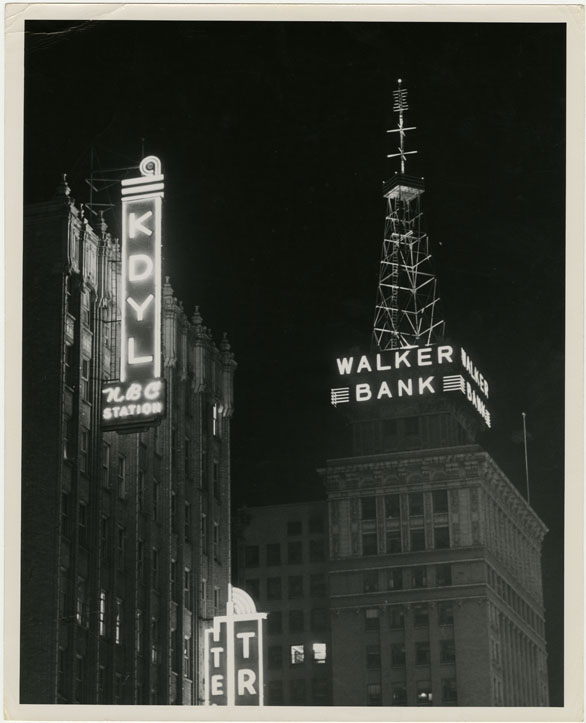
KDYL, with a recently purchased transmitter, began to build a transmitter on the top of the Walker Bank and Trust Building in downtown Salt Lake City. A full television studio was also built at the Regent Street Playhouse on 68 Regent Street. (Boyles, 39) Then, with the approval of a television broadcasting application in 1946 by the FCC, KDYL began transmitting by November as KDYL/W6XIS. (Boyles, 40) These transmissions soon turned into regular programmed media in April 1948, and thus launched the first independently owned television station in the United States. KDYL, going by the call sign of W6XIS, continued to provide independent programming for the Salt Lake City community until early 1953, when KDYL was sold to TIME Inc. for just over $2 million.

Findings

Radio, having been around for some time by the 1920s, was viewed as a source of information and news. And even though rumors of television being the main medium for such information and news were growing daily, people still had their doubts. As early as 1910, the idea of sending pictures over wires had been well discussed but yet looked upon as impossible. A 1910 article in the Deseret News emphasizes these doubts:

“Something more tangible than television has been devised by a French inventor … [who] is making an apparatus to which a series of photographs can be telegraphed one after the other instantaneously, and reformed so as to give a cinematograph reproduction of an event.” (“Seeing By Wire”)

Yet by 1938, full-page articles were being printed within newspapers featuring the progress of the television.

The Kane County Standard printed such an article titled “Television, Science’s Youngster, Starts Wearing Long Trousers.” In this article, Joseph W. LaBine focuses on progress of the invention and notes that the “bugs” had been eliminated. “Actually, RCA’s engineers have already ironed out most of the ‘bugs’ in transmission.” It may have been articles such as that one that focused on the television that influenced Sydney S. Fox, president of KDYL in Salt Lake City, to pursue the concept of television.

But the most influential impact came from Fox’s visits to the World’s Fair in New York City and San Francisco. There he witnessed RCA’s demonstrations of television that launched the beginning of television’s rise to the top of broadcasting mediums. Fox was reportedly “so enthusiastic and saw such possibilities for the new medium, that they immediately ordered a ‘jeep’ television outfit consisting of equipment capable of demonstrating but not telecasting, television.” (“KDYL-TV Laid Plans for Video”)

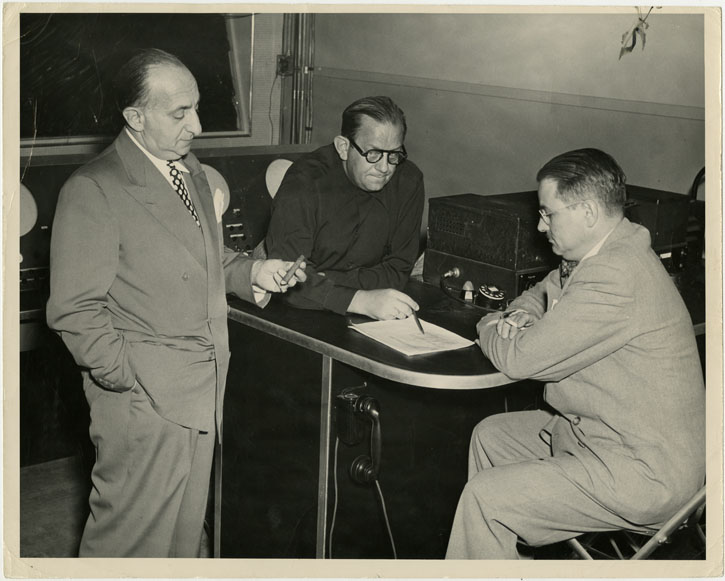
Sydney S. Fox with two of KDYL-TV's engineers, including head engineer John Boldwin (far right), inside main control room at KDYL. Photo courtesy of the Special Collections Department, J. Willard Marriott Library, The University of Utah.

KDYL immediately began to show the power of this “new medium” with demonstrations in local Paris Co. department stores as early as fall 1939 and at the State Fair in 1940. Over 45,000 people filled demonstrations in department stores in the space of just three days to witness the demonstration of television, and the television was also designated the key attraction at the State Fair. The Salt Lake Telegram quotes Fox saying that “he knew there was enough interest in television in Salt Lake City to justify going ahead with plans for commercial television here.” (“KDYL-TV Laid Plans for Video”)

Fox’s plans for television were put on hold in 1941 with the onslaught of World War II. “Because of America’s all out war effort, [the War Production Board] would not permit the manufacture or sale of television broadcasting equipment by regular manufacturers.(Boyles, 39) But this did not stop the enthusiasm of Fox. KDYL continued to invest time into developing the already existing technology and in 1943, following a trip to New York, Fox explained that television production factories were preparing transmitters for postwar delivery. (“SL Radio Executive Says Industry Eyes Television”)

In September 1944, KDYL filed an application for the building of a commercial use television station on an experimental basis. (“S.L. Firm Asks to Build Television Station”) By December 1944, the FCC granted KDYL a permit for the construction of an experimental television station, which would become the first studio between Kansas City and the West Coast. Fox was quoted as saying, “KDYL is proud to be a pioneer in this great field.” (“S.L. Firm Granted Television Permit”)

KDYL's downtown building next to the Walker Bank building in Salt Lake City. The KDYL-TV transmitter was located on top of the Walker Bank Building. Photo courtesy of the Special Collections Department, J. Willard Marriott Library, The University of Utah.

Between 1944 and 1948, KDYL was actively pursuing the reality of broadcasting local television programs to the Salt Lake City community. KDYL built a television transmission tower on top of the Walker Bank and Trust Building in downtown Salt Lake City, and finished building a television studio in the Regent Street Playhouse on 68 Regent Street. (Boyles, 39) The Regent playhouse worked perfectly for the site of a television studio since the playhouse was given up during the war. In 1946, KDYL began experimental transitions but did not officially sign on the air until April 1948 under the call sign W6XIS. The Salt Lake Telegram explained the significance of KDYL-TV:

“An event of historic significance in the field of entertainment and the dissemination of information occurred in Salt Lake City this week. It was the inauguration of the first regularly scheduled television program in the intermountain region…. Salt Lake City thus becomes the 13th city in the nation to have regularly scheduled television.” (“Salt Lake 13th to Have Television”)

The inaugural program was graced with the presence of the Utah governor, the Salt Lake mayor, and Frank Streator, president of the Chamber of Commerce. (“Salt Lake 13th to Have Television”) Along with KDYL-TV being the first station west of Kansas City, it also set another milestone by being the first independently owned television station in the nation. KDYL became a pioneer for what television would become and mean as a local informational source in the United States.

KDYL-TV followed a five-night-a-week schedule, but due to public demand KDYL-TV changed to seven nights a week by October 1948. In its early years KDYL-TV had many firsts and milestones. It was the first to broadcast golf and downhill skiing, and by 1952 KDYL-TV was broadcasting from 9:30 in the morning until midnight seven days a week, which made it one of the largest scheduled local television stations in the nation. (Boyles, 47)

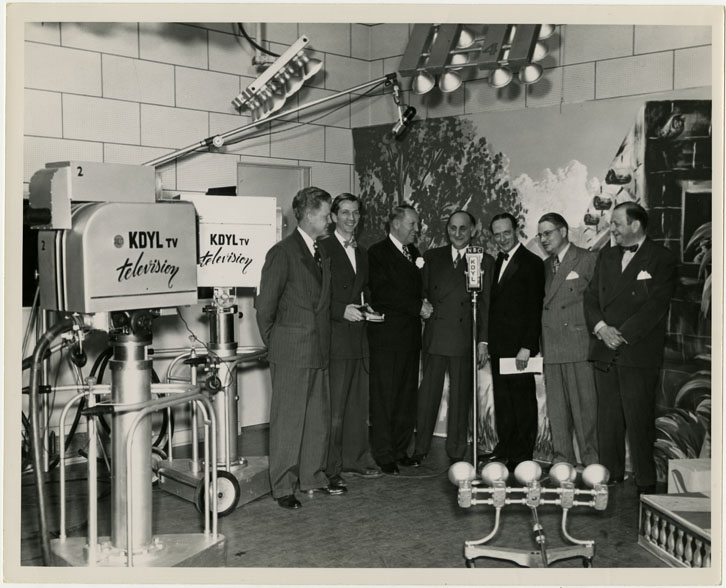
A group of men, including Sydney S. Fox (center) addressing a TV audience on a live broadcast from KDYL-TV studios. Photo courtesy of the Special Collections Department, J. Willard Marriott Library, The University of Utah.

Television continued to boom and expand within the Salt Lake Valley as well. By May 1948, KSL, a competing radio station, had helped build an entertainment television studio in a ZCMI department store located in downtown Salt Lake City. The studio was scheduled to broadcast a one-hour show daily from 1:30 to 2:30 pm. (“Department Store Sees Television”) This became an added attraction for shoppers at ZCMI and led to KSL filing an application for construction of its own local television station by July 1948 with construction beginning in early 1949. (“Get Television Permit”)

KDYL-TV continued to set the pace for local television. “In late July the station’s mobile unit was delivered, which made possible the telecasting of events away from the studio.” (“KDYL-TV Laid Plans for Video”) This also brought sporting events to viewers at home. The Salt Lake community would soon be able to watch a wide range of sporting events from their own front room. This became a true pioneering television station, which played a major part in the Salt Lake community.

KDYL-TV continued to broadcast as an independent company through Intermountain Broadcasting Company, headed by Sydney S. Fox, until July 24, 1953, when KDYL-TV was purchased by TIME Inc. for just over $2 million. Fox retired as president of Intermountain Broadcasting and as president of KDYL. He would be succeeded by Roy E. Larsen, president of TIME, Inc. This was not necessarily a terrible move for KDYL-TV, as Larsen stated: “We know the KDYL stations will profit by TIME’s journalism and television success formula. We at KDYL hope to make our station ‘The Voice of the New Golden West.'” (“Sale of KDY-TV”)

Conclusion

Sydney S. Fox and his team at KDYL helped pioneer and develop early television station standards that directly impacted the Salt Lake community and the rest of the nation by being the first at many aspects of broadcasting, including: first independent television station, first to air golf and downhill skiing, first to challenge the nation’s use of locally scheduled broadcasts by providing local broadcasts seven days a week from 9:30 a.m. until midnight. The station also pioneered ways of gaining advertisement space on local television. Sydney S. Fox continued to work within television after leaving KDYL and pressed the concept of entertainment with the idea of producing movie-like television shows. Sydney S. Fox truly helped drive local television into the news, information and entertainment source that it has become, and his desire for the public to witness television still lives today as KDYL continues to air local programming under call number KTVX in Salt Lake City.

Jason Bushnell is a senior studying mass communication at The University of Utah. He is set to graduate following the Fall 2012 semester. He will be continuing a career within television broadcasting.

Sources

“Seeing By Wire,” The Deseret News, April 12, 1910.

Joseph W. LaBine, “Television, Science’s Youngsters, Starts Wearing Long Trousers,” Kane County Standard, January 7, 1938.

“Salt Lake Concerns To Show Television,” Davis County Clipper, September 15, 1939.

“Television Set To Be Exhibited,” Salt Lake Telegram, September 10, 1940.

“S.L. Radio Executive Says Industry Eyes Television,” Salt Lake Telegram, October 12, 1943.

“KUTA Files Application For Television Station,” Salt Lake Telegram, June 3, 1944.

“S.L. Firm Asks to Build Television Station,” Salt Lake Telegram, September 23, 1944.

“S.L. Firm Granted Television Permit,” Salt Lake Telegram, December 30, 1944.

“Salt Lake City 13th To Have Television,” Salt Lake Telegram, April 21, 1948.

“Department Store Sees Television,” Salt Lake Telegram, May 28, 1948.

“S.L. Station Expands Television Schedule,” Salt Lake Telegram, July 7, 1948.

“Get Television Permit,” Salt Lake Telegram, July 30,1948.

“KDYL-TV Laid Plans For Video in ’39,” Salt Lake Telegram, May 31, 1951.

“Sale Of DKY-TV OF Salt Lake City To Time, Inc. Stated,” Davis County Clipper, July 24, 1953.

Patrick Wm. Boyles, Sydney Fox and KDYL, 1927-1952: A Utah Broadcasting History (M.S. thesis, University of Utah, 1953).


Robert Redford: The Creation of the Sundance Institute and Film Festival

by L. WYLIE SHEPARD

Introduction: The Sundance Film Festival is deeply rooted in a quarter-century of history beginning with the Utah Film Festival. The Festival was introduced in 1978 by the Utah Film Commission in an effort to “promote tourism” in Salt Lake City. (Malserger, 38) The early years of the Utah Film Festival were fairly successful but equally rocky. Debt not only plagued the Festival, but also caused its continuation. In 1981, the Festival was relocated to the small ski town of Park City, Utah, and was moved from September to January with the intention of attracting a new, more elite crowd. (Smith, 50) The Festival became known as the Utah/United States Film Festival in the following years but continued to diminish. As the 1984 Festival approached, many believed it would see its last season. Meanwhile, in nearby Provo Canyon, Robert Redford had created a phenomenon in the world of filmmaking known as the Sundance Institute. It was a center to advance the world of independent filmmaking and his success would not go unnoticed by the struggling Utah Film Commission.

Findings: In the early 1960s, Robert Redford was a rising star in Hollywood, but the constant publicity and demands of success led him to the Utah Mountains in an attempt to escape from his current reality. In 1969, Redford purchased a vast section of Provo Canyon, including a small ski resort, as the “ideal locale for environmental conservation and artistic experimentation,” as well as his new home. (sundanceresort.com) Redford named the land Sundance, utilizing the success of his recent role in Butch Cassidy and the Sundance Kid, and he began to focus on his intentions to “marry the arts community to Sundance.” (Smith, 26)

In an article published by The Salt Lake Tribune on December 9, 1990, Redford explained his plan to create an institute, which would “concentrate on film making from the other end, beginning with the script.”

In November 1979, Redford began this process with a three-day planning conference for what would be deemed the Sundance Institute. The conference concluded that it “would emerge as a center, a resource, bringing together talented aspiring filmmakers with collaborating skilled professionals in an extraordinarily supportive environment, which would allow greater experimentation with scripts, direction, and performance.” (Smith, 37) In the following years, Redford worked with the National Endowment for the Arts to secure a budget for what would be known as the Sundance Institute’s June Laboratory.

The first Sundance Lab was held in 1981, in which a select group of 65 students were chosen to spend four weeks with the industry’s most prominent directors, actors, writers, and producers in order to take their abilities to the next level. Redford saw this as expert tutoring, in which workshops enabled filmmakers to take risks without penalties and potentially secure themselves as spot in what had now become the Utah/United States Film Festival. The immediate success of the Sundance Institute was not anticipated and it concerned Redford.

In a February 1985 interview with the Los Angeles Times, Redford stated, “It’s dangerous, I wanted filmmakers to have a place to struggle and make mistakes. I think a focus on our success won’t be fair to the filmmakers or the process.” The Institute soon gained recognition in Hollywood and the Utah/United States Film Festival quickly noticed that the Lab’s students were continually submitting winning films.

By 1984, many believed the Utah/United States Film Festival had run its course, but Redford’s passion and determination for the future of filmmaking had led those involved to believe that the Sundance Institute could save the Festival.

Robert Redford speaking at the Sundance Film Festival. Photo by Calvin Knight courtesy of the Sundance Institute.

“I was never big on festivals,’” Redford explained to the Los Angeles Times in February 1985. “And when I was originally approached the first year to do this one, I said I’d be interested only if it emphasized independent film.” Redford hoped to use this as an opportunity to change the negative perception of independent filmmakers in Hollywood, according to an article published in the South Florida Sun-Sentinel in January 1987.

After the Sundance Institute had agreed to take over the 1985 Festival, the decision was made to change its name to the Sundance Film Festival, which was believed to add a dimension to the Institute. In December 1990, Redford relayed his belief to The Salt Lake Tribune that “it completes the connection, we have development in June, exhibition in January. We’re the only organization that offers the independent filmmaker that symbiosis between development and exhibition.” In a subsequent interview with the Tribune in June 1992, Redford detailed that the “annual Sundance Film Festival in Park City is the public expression of what his Sundance Institute does privately the rest of the year. The Festival is the showcase; the rest of the year is labor.”

In Benjamin Craig’s novel, Sundance: A Festival Virgin’s Guide, he explains that “the Sundance Institute and the Utah Film Festival had a natural connection from the start,” which was easily visible after the Festival completed its first successful year. The first year of the Sundance Film Festival marked the seventh year of the Festival as a whole and “there was no question that everything had changed.” (Biskind, 13) More than 80 films were shown, including the introduction of the international category; the previous year’s attendance was doubled, and the ongoing debt had reached its lowest amount since the Festival’s creation.

Conclusion: According to a January 1988 interview in the Los Angeles Times, “[Robert Redford] and the Sundance Institute are largely responsible for nurturing the event from relative obscurity to its current status as one of the top Film Festivals in the world.” After Sundance took control of the Festival, “1,500 people from outside Utah bought ticket packages, compared to 80 two years ago, and we’ve had to put a ceiling on the number of outside vendors which is almost unheard of.” It is believed to be the “flagship of the American independent film resurgence of the 1990s.” (Craig, 49)

L. Wylie Shepard is from Park City, Utah. She is a senior at The University of Utah and is majoring in mass communication.

Sources

Our Story,” Sundance Resort.

Kristina Malberger, “Sundance Film Festival,” VIA: AAA’s Travel Companion (January-February 2007).

“Sundance Institute Rises and Shines,” USA TODAY, May 15, 1998.

“Sundance Institute’s June Lab Gives Filmmakers a Head Start,” The Salt Lake Tribune, June 14, 1992.

Terry Orme, “After a Decade: The Sundance Kid on the Sundance Institute,” The Salt Lake Tribune, December 9, 1990.

Deborah Caulfield, “Movies,” Los Angeles Times, January 19, 1988.

“Redford Enjoying Building Institute to Aid Artists,” The Ottawa Citizen, July 8, 1986.

Deborah Caulfield, “Will Success Spoil Sundance?” Los Angeles Times, February 4, 1985.

Deborah Caulfield, “Robert Redford Lends Status to Film Festival,” Los Angeles Times, January 21, 1985.

“The Sundance Institute’s First Festival,” Original information packet, Park City, Utah (January 18-27, 1985).

Peter Biskind, Down and Dirty Pictures (New York, New York: Simon & Schuster, 2004).

Michael Feeney Callan, Robert Redford: The Biography (New York, New York: Alfred A. Knopf, 2011).

Lory Smith, Party in a Box: The Story of the Sundance Film Festival (Layton, Utah: Gibbs Smith, 1999).


Denver and Rio Grande Depot Brought Economic Prosperity to Utah

by KELSIE HAYMOND

In May 1869, the final spike was driven into the ties at Promontory Point, Utah, to complete the nation’s first transcontinental railroad. (Richards, 137) By 1906, railroad tracks crisscrossed the state. Trains were coming and going through many of Utah’s towns, hauling freight, mail, and passengers. As the capital, Salt Lake City had heavy train traffic, but the small, dilapidated depots were inadequate to handle the demand.

The grand exterior of the Denver and Rio Grande Depot. 3rd South became one of the busiest streets in the city because of the trolley traffic and the numerous businesses and restaurants that lined the paved lane. Digital Image © 2008 Utah State Historical Society. All Rights Reserved.

The Denver and Rio Grande railroad (D&RG) proposed to build a modern depot in downtown Salt Lake. On the 100th birthday (August 20, 2010) of the completion of the D&RG depot, Brandon Johnson, from the National Endowment for the Humanities in Washington, D.C., explained in his keynote address that the depot had initially been opposed by local neighborhoods. Because there would soon be a new Union Pacific Depot several blocks away, they feared the increased congestion and noise. In the end, however, the City Council sided with vocal business leaders and the area was greatly benefited economically by the addition of the D&RG depot. (Arave, 2010) The magnificent Rio Grande Depot, as it is now known, stands as a tribute to a past age in which trains were the arteries of industry and travel across America.

The interior of the depot while it was still under construction. Digital Image © 2008 Utah State Historical Society. All Rights Reserved.

The December 15, 1906, Deseret Evening News headlined with the long awaited announcement that George J. Gould, the “Young Colossus of the Railway World” and executive of D&RG, had plans to build a brand new train depot in the heart of Salt Lake City. The article exclaimed that Salt Lake was to be the “great mountain division point in George Gould’s ‘Atlantic to Pacific’ system.” While some residents had been skeptical of the necessity of a second depot, businessmen understood the implications of having two train depots to compete for business. The article articulated the benefits of two depots by explaining that, “It is all indicative of how the kings of finance and industry view the future of Salt Lake.” Clearly if men of great financial means were willing to pour money into large business projects, they had faith in the economic future of the city.

On page two of the same newspaper, another article detailed some early plans for the size and style of the building. The author described plans for the new passenger depot as “modern” and “up to date” and since Gould “builds for the future,” it would be one of the finest structures west of the Missouri River. This same article in the Deseret Evening News on December 15, 1906, announced the chosen site for the new depot as 3rd South, between 4th and 5th West. An update on the construction of the new depot was given in a January 3, 1909, article in The Salt Lake Tribune that encouraged Salt Lake residents not to worry about financial issues slowing its completion. The author explained that the D&RG executive E. H. Harriman was “watching Salt Lake grow, and while he is watching he is working for that end with all the might of his great financial standing.” Again, the people of Salt Lake had high hopes that their city and state had been targeted by financial titans as a place worth investing in.

A common theme among the articles regarding the depot was that Salt Lake was soon to be a burgeoning city.  “Salt Lake City will become the commercial metropolis of the west,” claimed an article on page 23 of the August 20, 1910, edition of the Deseret Evening News.

Utah industries eagerly awaited the increased routes in and out of the city. An article published in the Salt Lake Herald-Republican on August 14, 1910, described the new depot as a “Golden hopper to feed the city through extensive channels of trade and varied industries which stretch octopus-like east and west.” The D&RG depot would connect Salt Lake with new trade markets along the 20,000 miles of rail lines stretching from San Francisco in the West to Pittsburgh in the East, according to an article on page 22 of the August 20, 1910, Deseret Evening News.

That article included many ads for the newly built-up business district surrounding the depot. Acorn Printing Co., the Salt Lake Stamp Co., and the Bicycle Supply Co. were among a few that listed the great deals they would have in honor of the opening of the new depot, which was officially August 20, 1910.  The May 15, 1910, edition of The Salt Lake Herald-Republican described how 3rd South was turning into one of the busiest streets in the city. In fact, a brand new hotel, the “Mardorf Hotel,” would soon be under construction to accommodate the swell of visitors the D&RG depot was expected to bring.

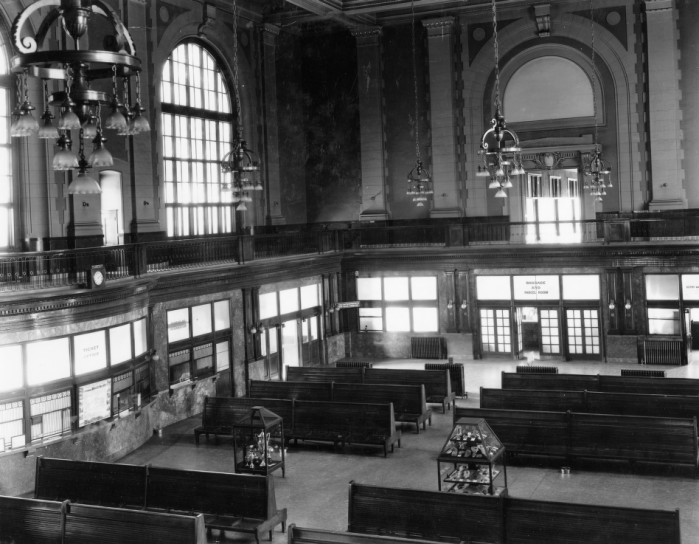
The modern interior with chandeliers, elegant woodwork, and green opalescent arched windows. Digital Image © 2008 Utah State Historical Society. All Rights Reserved.

With only days left until the first trains would pull into the depot, an August 14, 1910, article in The Salt Lake Tribune listed some facts about the new building. As promised back in 1906, Gould never did anything halfway and the estimated cost of the construction was over $750,000 (more than $18 million in today’s dollars). Other businesses had also been building up their infrastructure to take advantage of expanded opportunities. The Utah Light & Railway Co. had built a new streetcar line to the depot to facilitate travelers coming and going, announced The Salt Lake Herald-Republican in July 1910.

On the morning of August 20, 1910, the first passenger train rolled into the Denver and Rio Grande Depot in Salt Lake City. The structure was a magnificent edifice built by the famed Chicago architect Henry J. Schlacks, according to the August 14, 1910, edition of The Salt Lake Tribune. The article also detailed the beauty of the exterior of the building as consisting of white Colorado Yule Marble at the base that was contrasted wonderfully by red New Jersey rain-washed brick that made up the walls. Goodwin’s Weekly described the interior of the building as corresponding “in beauty to the exterior,” in its article published on the long awaited opening day. The spacious building’s main hall was illuminated by “three immense arched windows on each side through green opalescent glass,” which gracefully complemented the brownish-red and gray color scheme. The Tribune’s August 14 article also gave a long list of the depot’s amenities, including: baggage/parcel rooms, a men’s smoking room, a women’s retiring room, a restaurant, and telegraph and telephone offices. Covered platforms lined the tracks behind to the depot to protect travelers from the elements of snow, rain, and sun. It was the most modern and completely equipped union passenger depot of its size in the country. Travelers to the city would now be greeted with a grand sight that lent credence to the city’s ever burgeoning economy.

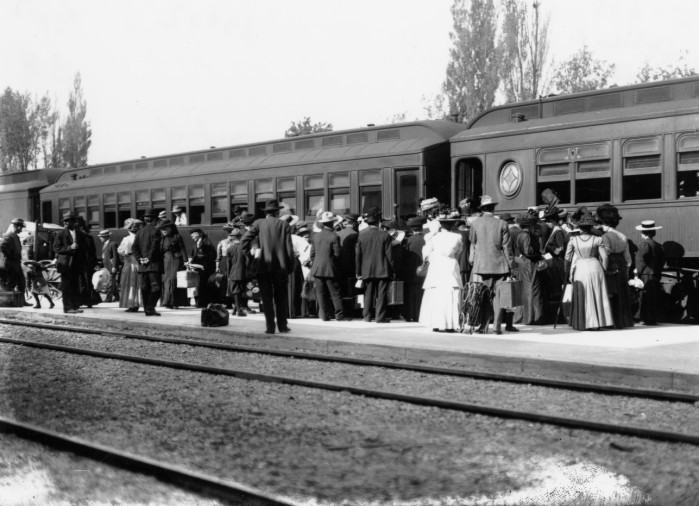
Passengers line up to board the first train on the opening day of the Denver and Rio Grande Depot. Digital Image © 2008 Utah State Historical Society. All Rights Reserved.

George J. Gould’s foresight to build a magnificent and costly depot in the heart of downtown Salt Lake City helped to mold the economic destiny of a state and its people. The architecturally elegant Denver and Rio Grande Depot brought not only pride to city residents, but also brought prosperity to Utah in numerous ways. New shops, restaurants, and hotels benefitted from the increased number of travelers to the city. The expanded rail lines opened new trade markets for Utah’s entrepreneurs.

To this day, over 100 years since the official opening of the depot, residents of Utah look upon the Rio Grande Depot as a monument to the perseverance and ingenuity of a generation past. While the Depot no longer acts as a hub to an artery of trade, industry, and travel, it stands as a tribute to the capitalist nature of America that took Salt Lake from a desert valley in 1847 to a thriving, prosperous city that played host to the world for the 2002 Olympic Winter Games. And though long past its prime in terms of age, the Denver and Rio Grande Depot has not been retired into the abyss of vacancy; it now houses the Utah State Historical Society, which helps to preserve our past so that we can have a more prosperous future.

Kelsie Haymond graduated in May 2012 in Mass Communication from the University of Utah.

Sources

“Gould Now Spans American Continent,” Deseret Evening News, August 20, 1910, 23.

“The New Denver & Rio Grande-Western Pacific Union Depot Opens its doors Today,” Deseret Evening News, August 20, 1910, 22.

“Mining and Financial,” Goodwin’s Weekly, August 20, 1910, 3-4.

“A New Epoch For Salt Lake,” The Salt Lake Herald-Republican, August 14, 1910, Section Three, 1.

“Epoch in Utah’s History Is the Opening of Western Pacific and New Gould Terminal in Salt Lake,” The Salt Lake Tribune, August 14, 1910, 3.

“Gould Limited to be a Fine Train,” The Salt Lake Herald-Republican, July 20, 1910, 5.

“Third South To Be A Busy Street,” The Salt Lake Herald-Republican, May 15, 1910, Section Two, 1.

“Prosperity on Denver & Rio Grande,” The Salt Lake Tribune, January 3, 1909, 77.

“Superb Terminal Station For the Gould Railroads,” Deseret Evening News, Art Section, December 15, 1906, 2.

“Dawn of the Era of Salt Lake City’s Greatness,” Deseret Evening News, Art Section, December, 15, 1906, 1.

Lynn Arave, “Salt Lake City’s Rio Grande Depot Finally Dedicated on 100th Birthday,” Deseret News, September 10, 2010. http://bit.ly/ap5SIU

Bradley W. Richards, “Charles R. Savage, the other Promontory photographer,” Utah Historical Quarterly 60, no. 2 (Spring 1992): 137-157. http://bit.ly/IP2N3C

The Salt Lake City Chamber of Commerce, 1880-1890s

by EMMA FULLERTON

While Salt Lake City was developing, businessmen had a difficult time getting Eastern investors interested in the state. A group of these men wanted to build a reputation for Utah and help it become an attractive investment. The Church of Jesus Christ of Latter-day Saints was interested in an independent economic system. As the settlement began to grow, non-Mormons began to settle in the valley and start their own companies. There was competition between the Mormons and non-Mormon business owners, or “gentiles,” as they were called, which resulted in a boycott against them.

During this time, mining and smelting were becoming popular and attracting other non-Mormon companies to develop in Utah. Groups started to form because of the success. One of these clubs, The Board of Trade, started as early as 1879 with Thomas R. Jones as president and William S. McCornik as treasurer. They worked to change the public image and show that there were healthy benefits of living in Utah. The LDS church started to feel the political pressure from their boycott of non-Mormon businesses.

Salt Lake City’s population continued to increase as the mining industry was evolving. In 1882, the president of the LDS church, John Taylor, had no choice but to abandon the boycott. (Woodward and Campbell) Mormon and non-Mormon businessmen “voiced concern that the city’s negative public image was hindering eastern investment in Utah’s resources.” (Hafen, 361)  McCornick, Patrick Lanahan, owner of The Salt Lake Tribune, and Mormon apostle Heber J. Grant joined together to form the Salt Lake City Chamber of Commerce in an effort to bring the community together for “business promotion purposes.” (Woodward and Campell, 18) With their motto, “No politics or religion in the Chamber,” they hoped to “revive trade, establish home industries, and attract capital and population to the territory. (Woodward and Campbell, 18)

Salt Lake Tribune reporter and historian O.N Malmquist wrote, “I think the Salt Lake Chamber of Commerce was the first formal organization in Salt Lake in the territory of Utah, in which Mormons and gentiles got together and actively collaborated in common causes. And in that sense it was certainly one of the major instruments of the evolution from the ‘irrepressible conflict’ to the situation we have today.” (Woodward and Campbell, 19)

In the early years of the Chamber of Commerce, the chamber set aside $4,000 of its $10,000 budget in an effort to change the public image of Utah through advertising and marketing. One of the first efforts was The Exposition Palace Car. On June 6, 1888, a rail car left Salt Lake City with the words on both sides, “Utah Exposition Palace Car; The Resources of Salt Lake City, the Gem City of the Rocky Mountains; Free exhibit sent under the auspices of the Salt Lake Chamber of Commerce.” (Woodard and Campbell, 19) It traveled 9,000 miles around the United States. A 96-page booklet written by the secretary, M.J. Forhan, called, “Salt Lake City; A sketch of Utah’s Wonderful Resources,” was distributed at stops around the country. This helped attract people and contributed to the economic development of the state. Shortly after the campaign, H.L.A Culmer wrote The Journal of Commerce, which spoke of the three-month trek to the East with the car. The end results of the campaign were fourteen tons of printed matter at a cost of $3,339.25 ($78,719.69 in 2009 dollars), which brought in thousands of new residents and got the Chamber recognition. (Inflation Calculator)

The Chamber was passionate about increasing the Utah population. It hired the Western Investment Company of Chicago to distribute 30,000 promotional pamphlets to over 200 cities in the East. (Woodward and Campbell) Also, as stated in the Journal of Commerce, the chamber placed ads in “100 of the country’s leading daily publications.”

Today, the Salt Lake Chamber represents 4,600 businesses statewide and “one in every three jobs in the Utah economy,” as stated on the Web site.  Also, it is Utah’s “largest business association and Utah’s Business Leader.” The Chamber recently celebrated its 100-year anniversary and released a history book called Common Ground, 100 years of the Salt Lake Chamber, by Don Woodard and Joel Campbell. The Chamber’s mission statement, as quoted on its site, is, “As Utah’s Business Leader, we stand as the voice of business, we support our member success, and we champion community prosperity.” The organization works with businesses such as American Express, Wells Fargo, Zion’s National Bank, Delta Air Lines, Questar  and many other firms.

Woodard and Campbell write, “Almost without exception, every major event and accomplishment in Salt Lake for the last 100 years has felt the influence of the Chamber. Whether it was the development of freeway routes, location of hospitals, distribution of welfare, building of the airport, securing the Utah Jazz, promotion of winter sports, or creating a business-friendly environment, it has been the Salt Lake Chamber leading the charge.” (Woodward and Campbell, 11)

Emma Fullerton is a communication major with an emphasis in public relations at the University of Utah.

Sources

Thomas K. Hafen, “City of Saints, City of Sinners: The Development of Salt Lake City As A Tourist Attraction 1869-1900,” The Western Historical Quarterly (Autumn 1997).

“Secretary’s Report,” Salt Lake Journal of Commerce (January 1891): 6.

The Inflation Calculator.

H.C.A. Culmer, “On the Utah Exposition Car,” Salt Lake Journal of Commerce (August 1888).

Don Woodward and Joel Campbell. Common Ground, 100 years of the Salt Lake Chamber. Alabama: Community Communications, 2003.

The Completion of the Transcontinental Railroad in Promontory, Utah

by KEITH THOMAS

The transcontinental railroad was completed May 10, 1869, in Promontory, Utah, when the Union Pacific Railroad of the East met the Central Pacific Railroad of the West. Many people said that building a single railroad that spanned the United States was impossible, but it was essential to expedite travel, communication, and business. It also helped to cement California’s allegiance to the United States during the Civil War, and win the fight for land with the Native Americans; it was easily one of the greatest of the United States’ achievements during the nineteenth century. (Utley, 45)

In 1850, the U.S. House of Representatives’ Committee on Roads and Canals stated the basic motives for building a railroad to the Pacific Ocean, saying that it would “cement the commercial, social, and political relations of the East and the West,” and would be a “highway over which will pass the commerce of Europe and Asia.” (Utley, 1) At the time, trade from China and Japan to the East Coast of the United States was only possible by ship, but building a railroad to the Pacific meant great trade and business opportunities. The railroad would also help win land from the Native Americans, through quick and easy transport of military supplies, soldiers, and citizens to occupy the West. The new possibilities for more efficient transport of mail and journalists would make communications faster. And the railroad would strengthen political bonds with California, ensuring that the new state would not secede from the Union as the Civil War began. (Utley, 1)

In 1862, Congress passed The Railroad Act of 1862. Under the act, the Union Pacific Railroad was authorized to build a railroad westward until it met with the Central Pacific, which was authorized to build eastward from California. (Kraus, 49) The construction of the railroad was not actually begun until 1865, after the Civil War ended, making more resources available to the project, and the Railroad Act of 1864 was signed, making the government the main endorser of the railroad. (Kraus, 100-107)

On May 10, 1869, the two railroad companies finally came together in Promontory, Utah. Leland Stanford, president of Central Pacific Railroad, and Dr. Thomas Durant, vice-president of the Union Pacific Railroad, pounded in the last two stakes to complete the railroad. (New York Times, May 12, 1869) Telegraph stations all across the country were waiting for the signal that the railroad was complete, and with the single word “done,” the country was informed that the task was completed. (Utley, 45)

A silver sledgehammer and golden spikes were used to complete the project, and on the final spike there was a silver plate with the inscription, “The last tie laid on the completion of the Pacific Railroad, May 10, 1869.” (Derby, 352) After a ceremony and celebration, the golden spikes were taken out and replaced with regular spikes, driven by a standard hammer. (Deseret News, May 18, 1869) At the time, this was considered to be one of the greatest industrial feats ever achieved.

The completion of the railroad meant progress in a lot of areas. According to E.H. Derby, an early traveler of the transcontinental railroad, riding the railroad was a pleasant and comfortable experience for passengers, and a great way to travel across the country in a quick and efficient manner. (Derby, 15; Pine 13-19) Political bonds with California were strengthened as well, leaving trade with Asia to be the only expectation that fell short, which ironically, was the main reason for building the railroad in the first place. The completion of the Suez Canal, however, made the railroad unnecessary for trade. (Utley, 57)

Now, the site where the two railroads met in 1869 is the Golden Spike National Historic Site, and although the section of track at Promontory, Utah, is no longer in commercial use, visitors can see reenactments of the trains coming together on a daily basis, through the use of replicas of the Union Pacific’s No. 119 and the Central Pacific’s Jupiter locomotives.

Keith Thomas is a communication major at The University of Utah. He is planning to graduate with his bachelor’s degree after he completes fall semester 2010, after which he is planning to join the Navy and sail the open seas.

Sources

E.H. Derby. The Overland Route to the Pacific. Boston: Lee & Shepard, 1869.

George W. Pine. Beyond the West. New York: T.J. Griffiths, 1870.

Union Pacific Railroad and Connections 1870. Map.

Robert G. Athearn. Union Pacific Country. Chicago: Rand McNally, 1971.

Andrew J. Russell. East and West Shaking Hands at Laying of Last Rail. 1869. Photograph. National Park Service.

“The Pacific Railroad,” The New York Times, May 12, 1869.

“The Proceedings at Promontory Summit,” The Deseret News, May 19, 1869.

Union Pacific Railroad 1867. Map. N.F. Mraz.

Union Pacific Railroad Collection. Promontory, Utah. 1969. Photograph.

George Kraus. High Road to Promontory. California: American West Publishing, 1969.

Robert M. Utley. Golden Spike. Washington, D.C.: US Government Printing Office, 1969.