
Salt Lake City has always been the hub for live entertainment and nightlife for the state of Utah and surrounding states. With the state’s flagship university, young population, and abundance of downtown venues, it’s no wonder that entertainment acts gravitate to Salt Lake City. According to The Salt Lake Tribune‘s 2015 article “Whatever happened to … The Terrace Ballroom?,” the venue has been known by many names: Coconut Grove, Rainbow Ballroom, Rainbow Randevu, Danceland, and finally the Terrace Ballroom. The downtown venue located on 500 South and Main Street represented an entertainment icon for generations. The building, a quarter of a million dollar project originally built by the Covey-Ballard Motor Company in 1922, was later transformed in 1931 into the “largest ballroom in the country” spanning across half a city block. Known by its original name Coconut Grove, the venue was the prominent dance and entertainment hall during the years of the Great Depression.

Ads such as this one appeared frequently in the Utah Chronicle.
The concert venue was known for hosting a large number of top-tier performers. In 1941, Jimmie Lunceford, the famed saxophone player and bandleader, blessed Salt Lake City with his performance at the great hall. The venue was known as Rainbow Randevu at the time of his performance. According to a Salt Lake Tribune article from 1941, “Jimmie Lunceford and his orchestra will make an appearance for three nights only at Jerry Jones’ Rainbow Randevu Thursday Friday and Saturday. Collectively and individually this organization is a versatile and dynamic musical group.”
The hall has seen significant changes throughout its time in Salt Lake City, from a multitude of name changes, to renovations, and even damaging fires. Billboard reported on November 20, 1948, “Jerry Jones, owner of Rainbow Randevu, Salt Lake City dancery, which was destroyed by a $175,000 fire May 22, this week took a 10-year lease, involving more than $250,000, on Coconut Grove Ballroom in the same city. Jones intends to spend $100,000 in remodeling the room.”
The venue hosted a number of famed acts throughout its time, but it was no stranger to local artists as well. The News-Examiner, the prominent news source of Montpelier, Idaho, reported on October 24, 1957, that “Wayne Hoff, a former Montpelier resident, is appearing with the famed Jones Boys’ quartet at the Rainbow Randevu in Salt Lake City Friday and Saturday. Hoff produced, wrote and directed both radio and television shows before going to Los Angeles in 1952 to sing with bands there prior to joining the Jones Boys, recognized as one of the nation’s top vocal groups. He is the son of Mr. and Mrs. Herman Hoff.”
 The venue, known as The Terrace at this time, helped lead Salt Lake City into the modern mindset of equality. Before that time, many businesses and hotels still supported segregation. (Salt Lake City Television) Pushing boundaries by allowing admittance by all helped hoist the hall into fond memories from a diverse culture. According to historian Ronald G. Coleman, “By the late 1940s, Robert Freed had succeeded in fully opening Lagoon to Blacks; and when his company acquired the Rainbow Gardens (Terrace), the same policy was adopted.”
The venue failed to remain in its golden era forever. After its closing in the 1980s, the abandoned building sat unoccupied for some time before the decision to demolish it came from the city. According to a 1987 Deseret News article, “Even in the death throes, Salt Lake’s Terrace Ballroom put on a good show on Wednesday afternoon. The memory-rich building on Main Street between Fourth and Fifth South was already half demolished. And at 5:30 p.m., fire added another element to its demise. The fire sent clouds of smoke through the downtown area and caused firefighters considerable concern as it danced inside the rubble. Although fire officials are happy to have one less fire hazard to worry about, the passing of the Terrace is not without a bit of melancholy.”
It is important to see the history of one’s community and the impact it may have had on the culture in that community. Although The Terrace isn’t around today, it was a historical icon and showcased the abundance of nightlife in Salt Lake City. The venue remains in Salt Lake City as a parking lot, but its rich history is retained through headlines in the newspapers and memories of attendees.
Cristian Garcia graduated from the University of Utah with a BS in Communication in Fall 2018.
Sources
“Local Items,” News-Examiner, October 24, 1957, 12.
“Salt Lake Dancery to Jones on Lease,” Billboard, November 20, 1948, 41.
Advertisement for Rainbow Randevu, Utah Chronicle, October 29, 1942, 5.
Advertisement for Rainbow Randevu, Utah Chronicle, November 5, 1942, 3.
“Lunceford Band Will Play at Local Club,” Salt Lake Tribune, May 14, 1941, 8.
Pierce, Scott D. and Twila Van Leer. “Flames Become Last Dancers at the Terrace,” Deseret News, August 6, 1987, B1.
“Covey-Ballard Motor Company Erecting $250,000 Building on Fifth South,” Deseret News, June 24, 1922, 3.
Ronald G. Coleman, “Blacks in Utah History,” Utah History to Go.
Braden [no last name,] “The Terrace,” Lagoon History Project.
Christopher, Smart. “Whatever Happened to … The Terrace Ballroom?” Salt Lake Tribune, March 12, 2015.
Salt Lake City Television, “Salt Lake City History Minute – Segregation,” YouTube, February 16, 2016.


 In the February 3, 1944, issue of The Utah Chronicle, students were invited to attend a campus screening of the Academy Award-nominated documentary The War Department Report. The film was originally released to a small number of military personnel on December 7, 1943, by the U.S. Office of Strategic Services (OSS). It was directed by Oliver L. Lundquist; David Zablodowsky was credited as the writer, Carl Marzani as producer, Richard Lyford as editor. It was narrated by Walter Huston. (IMBD)
 The documentary’s project began after a report was made by Major General George V. Strong on “The Strength of the Axis Forces.” The documentary included obtained footage taken of allies by the Germans, Italians, and Japanese. One segment of the film included “startling shots of the Pearl Harbor raid, taken from [Jap] planes.” (“New War Film”)
 The War Department Report is still viewed today, primarily used in military training. The OSS is highly praised for the film’s exposure of the war. Katz writes, “Through their pioneering experiments in the visual display of information … in service of the War Crimes trials … they left a small but indelible mark on history.” The film is kept today in the Academy Film Archives.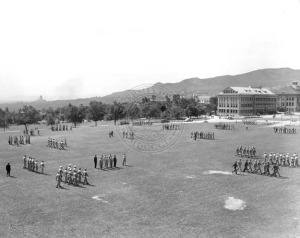
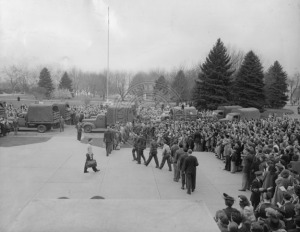

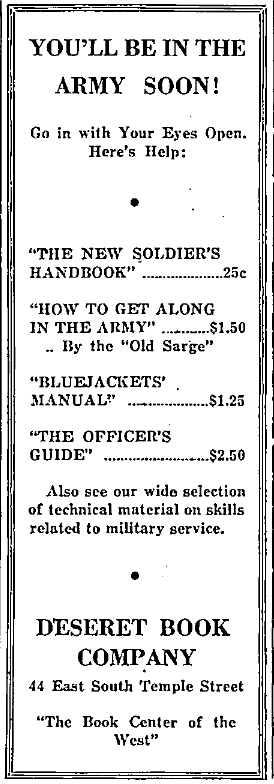 Deseret Book was started in Salt Lake City and has become a local staple for Utahns. It has kept up with current trends in order to provide its customers with relevant products and books. The Utah Chronicle published an ad for the Deseret Book Company on March 10, 1943, that advertised books to help prepare soldiers for their service in World War II. On March 24, 1943, the Utah Chronicle featured another ad for Deseret Book Company that was advertising “The new soldier’s handbook” and “How to get along in the army.”




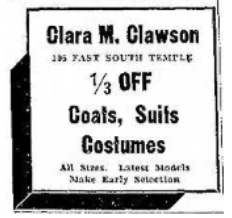 The Clara M. Clawson Shop was a clothing store for women located at 57 S. Main Street in Salt Lake City. Mrs. Clawson’s advertisements are found all throughout magazines and newspapers during the late 1930s, the 1940s and into the 1950s. The store was the passion project of Clara and was managed by her husband Seldon Clawson after it began to be recognized as a high-end clothing shop in Salt Lake City.
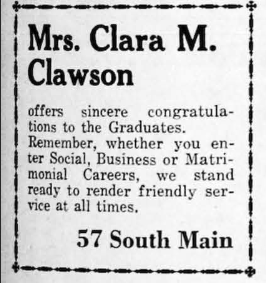 In a congratulatory ad published in the May 28, 1942, issue of the Utah Chronicle, the text states that “Mrs. Clara M. Clawson offers sincere congratulations to the graduates.” The couple tried to demonstrate they were there to help the graduates who needed them rather than trying to sell them anything. The ad gains more strength because everything around it is listing products that should be purchased, such as suit coats and new materials for schoolwork. This friendly congratulatory message is different from the surrounding ads and draws the reader of the newspaper into wondering who these people are and why their ads look so different.
 The Clawsons clearly made a consistent effort to make themselves known in the community as a friendly place. Published advertisements show that the couple was dedicated to the store that featured high-end clothing with a friendly, welcoming feel. Many of the ads are tailored to reach out to specific people during certain times. For example, an advertisement published in The Salt Lake Tribune around Mother’s Day in 1950 states that patrons should bring their mother into the store to pick out what she wants for her holiday gift. This is another subtle ad that invites a specific group into the store to meet those friendly individuals who are trying to curry favor with the community.
 The Clawsons took out a number of advertisements around the 1930s to 1950s, each working to build their image as a “Mom and Pop” store dedicated to their community and creating a friendly presence. Many of the advertisements were written in a way to make their readers feel like they were welcome there, which could be a reason why the Clara Clawson Shop was open for more than 65 years even during times of war and economic downturn.
 Utah Communication History Encyclopedia