History of the Utonian Yearbook 1940-1945

By Dillon Anderson

Dating back to the early 1800s, students of various college campuses have kept a record of their time on campus through yearbooks, making them a rich source of history. (Lear, p. 184) Such as it is, by annotating the details of the Utonian books, one can build a working index of their materials, which, in turn, can assist teachers and students in future research endeavors for years to come. In the same way that the Utah Chronicle finding aid has and will continue to contribute to our understanding of the past, my hope is that this index will do the same.

1940 edition: The 1940 edition of the Utonian was a crimson-colored book, featuring a woman in an elegant white dress dancing on the cover. The edition was 334 pages in length and contained many illustrations. Entire pages are dedicated to student and faculty administration, sports teams and campus organizations, and portraits for seniors, juniors, sophomores and freshman students are found throughout. In 1940, the Chronicle reported that the book cost $4 and that overall sales, to that point, had reached an all-time high.

Student Leadership: Herbert Price, President; Rose Bud Marshall, Vice President; Montana Torkelson, Secretary; Hemer Culp, 2nd Vice President; Grant Aadnesen, Senior President; Fred Price, Junior President; Richard Ensign, Sophomore President; Keith Montague, Freshman President.

1941 UtonianDedicated To: “President George Thomas, world citizen, American, Utahn …. son of the West. Forthright and intelligent is the cataclysmic world, he stands unflinchingly for the principles of democratic and spiritual freedom. Born in the land of blue skies and surging mountains we may look to him for the best in man. An inspired educator and leader, he has guided the University of Utah along the road of vanity and moderation. Social adjuster … gentleman … scholar … son of the West … our President Thomas.” 

1941 editionThe 1941 edition was a silver-colored book, featuring a woman and man (standing side-by-side) with the Block U embossed between them. The edition was 338 pages in length and, according to a 1941 Chronicle article, was at least two pages larger than any in the University’s history. According to that same article, the edition was expected to “possibly set records both for advertising space and for sales.”

Student Leadership: Hamer Calp, President; Connie Mortensen, Secretary; Scott Dye, Treasurer; Elisa Rogers, Vice President.

Dedicated To: “Lively reminiscence of classrooms and libraries … athletic fields and bleachers … the dance floor and theatres … the offices and editorial rooms—this year, 1941 Utonian.” 

1942 editionThe 1942 edition was a black-colored book, featuring a woman and man standing underneath a blue tree with words, lettered in blue and gold, reading above them: A Year of College Life At The University Of Utah. The edition was 352 pages in length and apportioned to feature portraits of seniors, juniors, sophomores and freshman. More than previous editions, much of the book was dedicated solely to the portraits. According to a 1942 Chronicle article, the advertising section of the book was compromised by the then-ongoing war.

Student Leadership: Wendell Paxton, President; Luella Sharp, Vice President; Betty Jo Snow; Frank Child, Treasurer.

Dedicated To: N/A

1943 editionThe 1943 edition wore a burnt orange cover with images of blue trees, as well as the words “Utonian” inside a red square. At the bottom of the cover, red script read, “Nineteen Hundred Forty-Three.” It is unclear how many pages were in this issue, but in terms of format, this edition was keen on highlighting the events and activities that took place on campus during that year. Interestingly, the Chronicle reported in 1943 that males were required to wear coats and neckties for their portraits. Failure to comply often resulted in a considerable time delay, according to the article.

Student Leadership: Val J. Sheffield, President; Virginia Weilenman, Vice President; Athelia Sears Tanner, Secretary; Robert B. Barker, Treasurer; Mary Anna Recore, Historian; Lynn Warburton, Second Vice President; Huck Adelt, Second Vice President; Marjorie Muir Hess, Historian.

Dedicated To: “The people in it are leaders. They are the men and women who plan and worry and sit up nights. They hold conferences and argue and their decisions are final. They are brainy and unselfish and they have foresight. They lead and 3,000 students follow. It’s a busy life they live … filled with disappointments and headaches sometimes, and sacrifices … But it’s a pleasant life, too … and worthwhile, for these people find … a life made rich.” 

1944 edition: The 1944 edition was a yellow-covered book, featuring the number “44” above royal blue letters that spelled, “Utonian: Nineteen Hundred Forty-Four.” Blue and red stars also decorated the cover. True to tradition, the edition was 356 pages in length, seemingly larger than any of the preceding yearbooks in the university’s history.

According to a 1944 Chronicle piece, the war brought on a shortage of materials, which led to the University cutting down on the use of film. As a result, the institution was only able to take one picture instead of two for student portraits, and because some students were unable to pay yearbook fees in advance of the deadline, said students were not pictured in that year’s edition. The book also features an entire section on the war, resplendent with photos of the Army and Red Cross.

Student Leadership: Ed Muir, senior proxy president; Margaret Cornwall, Vice President; Peggy Berryman, Secretary; Jay Skidmore, Treasurer; Bill Pingree, Treasurer.

1945 utonianDedicated To:  “We said goodbye so many times to so many friends. We stood side by side with the governor, the president and the deans as we paid tribute to the fellows off to war. 

1945 editionThe 1945 edition was a red-covered book, and for the first time in this six-year snapshot, acknowledged the school’s Indian heritage on its cover. There, a profile of an Indian warrior, imaged in gold, stood upright while the words “Utonian” and “1945” surrounded him. This edition also departed from convention in terms of measure, as the book spanned just 336 pages, down from 356 in 1944.

Student Leadership: Eugene Overfelt, President; Shirley Bangerter, Vice President; Richard Warner, 2nd Vice President; Darlene Anderson, Secretary; Helen Keeley, Historian; Hope Horsfall, Treasurer.

Dedicated To: “To the Senior Utes, the class of 44’, who have blazed to the end or their Utah Trail, we dedicate this Indian issue of the Utonian.”

Dillon Anderson is a student at the University of Utah. He is majoring in literary journalism.

Sources

“Utonian Sales,” Utah Chronicle, January 4, 1940, 2.

“Utonian May Come Out On May 26,” Utah Chronicle, May 15, 1941, 3.

“Utonian Names Final Picture Deadline,” Utah Chronicle, March 5, 1942, 3.

“Coats, Ties Necessary For Utonian Shots,” Utah Chronicle, January 21, 1943, 6.

“Utonian Makes Plea,” Utah Chronicle, January 13, 1944, 2.

The University of Utah and the Utes: A Photo Gallery,” Utah Division of State History.

Lear, Bernadette A. “Book History in ‘Scarlet Letters’: The Beginning and Growth of a College Yearbook during the Gilded Age,” Book History 9 (2006): 179–212.


The Cadet Nurse Corps at the University of Utah

By Tyson Aldridge

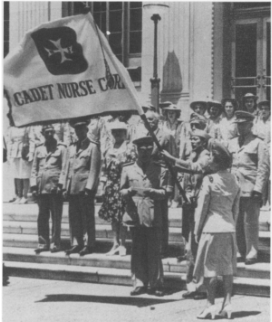
The Cadet Nurse Corps was established across the country between the years 1943 and 1948 to help with the demand for nurses during the war. According to authors Willever and Parascandola, “124,065 nurses were graduated from the Cadet Nurse Corps, making the Corps one of the largest and most fruitful Federal nursing programs in history.” (Parascandola and Willever, p. 455)

Screen Shot 2018-11-19 at 9.02.15 AM

Image from Public Health Reports.

The need for nurses was at an all-time high after the United States entered World War II and as a result, nursing leaders were trying to find solutions to supply enough nurses for the war. The need for nurses increased as the war went on, but other higher paying jobs were taking women away from the nursing profession. Consequently, the Public Health Service created in June 1943 the Cadet Nurse Corps to focus on improvement of nursing education and recruitment of more nursing students. If admitted, a student would receive scholarships that covered tuition and fees, as well as a monthly stipend. The expectation for the nurses was to graduate in 30 months, as opposed to the usual 36 months, and perform nursing services for the duration of the war. The schooling was broken into sections. The first nine months the nurses were known as “probies.” “Junior cadets” were in the middle of their schooling and attended classes as well as applying their learning in the field at actual hospitals. During the final training period, the students were known as “senior cadets” and would be placed where nurses were needed.

Screen Shot 2018-11-19 at 8.59.56 AM

Image from Public Health Reports.

Like many other universities across the country, the University of Utah was part of this program. In the very first semester of the program, 150 women registered. To help boost morale and get the nurses excited for the upcoming program, a representative from the national nursing council came to the University of Utah and spoke to the freshman students at Kingsbury Hall. The representative, Mildred E. Newton, spoke about the urgent need for 65,000 nurses and the chance to serve the country they loved.

From the very beginning, the University of Utah was extremely supportive of the Cadet Nurse Program and the students in it. In the Utah Chronicle on September 23, 1943, Mrs. Hazelle Baird Maequin, an assistant professor of nursing education at the University of Utah, said, “The 15 nurses in the cadet corps are going to make up an important part of the wartime life on the campus this year.” The nurses were not kept from students; the university wanted them to be recognized and supported. This was shown when Carlson Hall, a dining room and living area on campus, was renovated to accommodate the nurses in the program. The hall normally would fit around 76 people, but after a few renovations and converting the hall to cafeteria style, 154 people could fit in the hall. Most of those 154 were nurses in the program, and all of the nurses lived at Carlson Hall.

A lot of the nurses as they went through schooling at Utah would receive hands-on training at nearby LDS Hospital, and most of the time when they were there, their living arrangements would change as well. Once a nurse completed her 30 or 36 months of training, she would receive a certificate of nursing and would be placed at either LDS hospital or one of the nearby local hospitals as a civilian nurse, or she would be placed in one of the branches in the military to serve as a nurse there.

Overall, the Cadet Nurse Corps program at the University of Utah was a great success. The university made the nurses’ time in school comfortable and enjoyable by providing places to live and places to study and eat. The University of Utah also made sure that the Cadet nurses were included in student activities on campus, and made sure that other students were aware of the program and its importance. This program helped improve nursing education, as well as prompting federal aid for graduate school studies for nurses. The effect is still felt today around local and national hospitals and nursing now is a respected profession. Modern-day nursing definitely got a kickstart because of this program.

Tyson Aldridge is a senior at the University of Utah. He is majoring in journalism communication.

Sources

“Campus Trains Cadet Nurses,” Utah Chronicle, September 23, 1943.

Helen Chamberlin, “Registration Swells Despite War,” Utah Chronicle, September 23, 1943.

“Nursing Official Outlines Program,” Utah Chronicle, October 21, 1943.

Walter A. Shead, “Continuation of Nurses Training to Provide for Thousands of Qualified Hospital Assistants,” Pleasant Grove Review, September 21, 1945.

War Affects Carlson Hall,” Utah Chronicle, September 23, 1943.

Kathleen Emerson Britton, “U.S. Cadet Nurse Corps,” Rochester Regional Health.

Parascandola, John and HeatherWillever. “The Cadet Nurse Corps, 1943-48,” Public Health Reports 109 no. 3 (May-June 1994): 455-457.

Utah Sugar Beets: A Struggling Industry

By Andres-Alcantar Castro

During World War II, President LeRoy E. Cowles encouraged University of Utah students to help struggling sugar beet farmers. Ads were placed in the Utah Chronicle to increase participation. The Chronicle reported that only 24 students had participated. Utah farmers continued looking for workers in the coming years but the industry fought to keep crops plentiful despite the shortage.

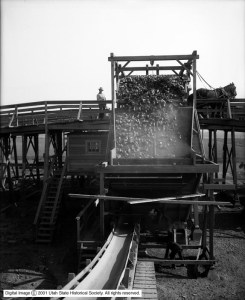
Sugar beets supplied half of the nation’s sugar by then. The U.S. military relied on sugar and foodstuffs for energy. In 45 years, Americans went from consuming 45 to 109 pounds of sugar per capita, making the U.S. the world’s largest sugar consumer. The sugar beet became a viable option because it grew where sugar cane couldn’t. Sugar beets, however, yielded a maximum of 15 percent sugar and thus required research to yield more. (Weeks, p. 370)

Beets_at_Loading_Station_copy_

Beets at loading station. 
Used by permission, Utah State Historical Society.

As early as June 1942, the North Cache News printed an article emphasizing the struggles that farmers faced in finding labor to thin their sugar beets. The locals suggested that farmers use children to help in the fields. While farmers were first reluctant, the crisis changed their minds. White-collar workers from Bingham City also helped the farmers of Cache Valley. The article points out that the labor shortage wasn’t only because of men turned soldiers, but also men working in the industries conducive to the war.

The Rich County Reaper reported on January 2, 1942, that 1.5 million workers would be needed by 1943 to produce sugar and other products. In addition, 12.7 million tons of sugar would be needed in 1943. This amount was twice as much as that needed in World War I.

University students might’ve thought the work was not worth doing because they were paid $1 per ton harvested. This amount translates to only $15 today, adjusted for inflation. The university, however, claimed it was patriotic to work in the beet fields and even offered transportation to and from the university to encourage students to do so. A Chronicle article published in the October 15, 1942, issue reported, “Even though it is difficult for students who are busy with defense jobs and activities …, they may, in a few spare hours after classes, do a job which to them might seem minute and unimportant, but which in reality will greatly aid in our war program.”

Layton_Sugar_Factory_Wagon_Dumping_Beets_into_Hopper

Layton Sugar Factory, wagon dumping beets into hopper.
Used by permission, Utah State Historical Society.

During this time, the Japanese relocation program had begun. The Topaz internment camp housed many of the displaced Japanese-Americans. On October 14, 1942, the Topaz Times printed a job announcement for topping sugar beets for $16 monthly pay. This work was attractive to Japanese men because they had little freedom. Fifty-six other Japanese men left for Cache County, while some went as far as Preston, Idaho, to work. Even Topaz only had 250 of the 400 workers needed there. Also, Mexican miners had started immigrating to Utah since the 1930s but by the 1940s about 60 families settled in Garland, Utah, to work in the sugar beet fields. Mexican immigrants were able to take advantage of the pay from the sugar beet industry and work toward building a community. (Solórzano, p. 18)

The new labor force helped the beet farmers harvest crops but they still required advancements in technology to reach their goals. Luckily, groups like the American Society of Sugar Beet Technologists were researching new ways to increase yields and were optimistic for the future of the industry. The Salt Lake Telegram reported on January 5, 1942, that a new method, tested in 326 beet fields, controlled irrigation and produced a higher sugar content within beets. Naphthalene acid amide was also a chemical being tested that could eliminate the leaf hopper, a type of fly that attacked the leaves on beet plants. The acid was reported to cause plant growth in some cases but damage in other cases.

The sugar beet industry suffered from a wide labor shortage, particularly because of the war. The university students’ reluctance to help was only part of a bigger problem. Farmers had to rely on immigrants and community members for their farms to survive. Small sugar yields helped win the war but more research needed to be done to make it successful.

Originally from the Columbia River Gorge area of Oregon, Andres Alcantar-Castro is a senior at the University of Utah. He will graduate in 2019 with a Bachelor of Arts degree in communication with an emphasis in journalism.

Sources

“Working in Beet Fields Is Patriotic and Fun,” Utah Chronicle, October 15, 1942, 5.

“Chairman Issues New Appeal for Student Labor,” Utah Chronicle, October 15, 1942, 1.

“Questions,” Topaz Times, October 14, 1942, 2-3.

“Farmers Accept Boys and Girls in Beet Fields” North Cache News, June 19, 1942, 4.

“Sugar Experts See Big Future for Industry” Salt Lake Telegram, January 5, 1942, 13.

“U. S. Farmers with Less Labor, Supplies, Machinery, Must Double the Production Shown in World War I,” Rich County Reaper, January 2, 1942, 3.

Solórzano, Armando. “The Making of Latino Families in Utah,” Beehive History 25 (August 31, 2009): 18.

Weeks, Michael. “Sugar State: Industry, Science, and the Nation in Colorado’s Sugar Beet Fields,” Western Historical Quarterly 48, no. 4 (October 2017): 367–391.

Spirit of the Beehive: Coon Chicken Inn an Unfortunate Utah Original

By Devon Alexander Brown

Coon_Chicken_Inn_P_2

Coon Chicken Inn logo. Image courtesy of Special Collections, J. Willard Marriott Library, The University of Utah.

When Brigham Young and a vanguard company of Latter-day Saints entered the Salt Lake Valley in 1847 they knew they’d finally found their home in the Rockies. (Griffiths) And as their community in the desert quietly blossomed they declared it Deseret, a term for honeybee lifted from the Book of Mormon, and adopted the beehive as their state emblem. This simple emblem not only referenced their Christian roots, but it also symbolized a unified commitment to industriousness that has remained a hallmark of Utah’s culture. (Malouf)

In modern times that industrious spirit has led to a boom in the beehive state’s tech and creative sectors, but in 1925 it drove Maxon Lester Graham and his wife Adelaide Burt to create a fast-food restaurant legacy built on a foundation of racist imagery with a name to match: Coon Chicken Inn.

Utah, like much of America, has a complicated history with race. Much of the population is affiliated with the Church of Jesus Christ of Latter-day Saints, which has always allowed Blacks into its ranks although they’ve held a lower status. A demonstration of this fact is that three Black members of the church were present in the vanguard company of 1847, but they were used as servants The most controversial aspect of this attitude is that Black members — as well as suspected Black members according to a racial “one drop” policy — were denied priesthood privileges essential to the faith until the 1970s. (Reeve) Yet these complications reach far beyond faith. An attitude of separation trickled into Utah’s secular psyche as well, with Blacks receiving second-class treatment inside and outside of the church. While the creation of Coon Chicken Inn is perhaps the most blatant example of this attitude, it is not an isolated example.

To grasp the severity of the logo’s use, one must understand the racist history behind the “coon” caricature. The term came into prominence during 19th-century minstrel shows through a character named Zip Coon. As a part of his act, Zip Coon would act uppity with a braggart’s swagger while employing malapropisms in a nod to his lack of education. This would elicit laughter and intrigue while also reinforcing White supremacy and animosity toward Blacks. The slur itself became popular in the late 1800s after Black entertainer Ernest Hogan released a song called, “All Coons Look Alike to Me.” Subsequent derogatory imitation “coon songs” were released shortly after and remained popular until the 1920s. Eventually the “coon” caricature became a nostalgic device for certain northerners and southerners to rekindle revisionist memories of life in the American South. (Strausbaugh)

coon ad

Advertisement for Coon Chicken Inn. Utah Chronicle, February 1, 1940, p. 4.

The first Coon Chicken Inn opened in 1925 after the Grahams bought and renovated a small building in the Sugar House neighborhood of Salt Lake City. Their take on southern fried chicken was a hit and by 1930 they opened two additional sites (in Washington and Oregon). To stir up additional business they incorporated the smiling blackface logo as they believed it would entice young families. The logo, an abrasive caricature with exaggerated lips, would reflect the owners’ racial disconnection, especially in Seattle and Portland where more Blacks were present.

Black residents did not accept the imagery, however, and Joseph Staton, a Black resident of Seattle, was arrested, booked, and fined $3 for cutting the caricature out of a Coon Chicken Inn spare tire cover. (The Seattle Times) Also, Clarence R. Anderson, a Black attorney, launched a two-year lawsuit against the inn with the NAACP, although Graham dodged the lawsuit by painting the Black porter’s face blue. (Northwest Enterprise) Nonetheless, the logo would later appear on paper products, plates, and menus that are now considered collectible. Eventually, 12-foot constructions of the logo would beckon patrons at the restaurants’ front doors.

Coon_Chicken_Inn_P_4

Coon Chicken Inn locations. Image courtesy of Special Collections, J. Willard Marriott Library, The University of Utah.

Protests by angry Black citizens of Seattle and Portland would ultimately yield few changes to the franchise, but the locations finally closed in 1949. (Seattle Post Intelligencer) However, in December 1949, Graham opened G.I. Joe’s New Country Store in the same Seattle location and continued using the coon logo in advertisements that reached Salt Lake City. (Lake City Citizen) The Salt Lake City location remained open until 1957.

Undoubtedly, Coon Chicken Inn is an ugly reminder of the past, but an unnamed grandson of the Grahams has since written an essay about the restaurant’s legacy for the Jim Crow Museum of Racist Memorabilia. (McFarland) “I preface this essay by saying that I do not condone the ‘Jim Crow’ attitudes of the past. I and ALL of my siblings believe in full equality for all races, creeds, and skin colors. My grandparents were entrepreneurs engaging in what were normal business practices,” he penned in the essay. “They left behind artifacts, popularly called ‘Black Memorabilia,’ that serve as reminders that this particular part of history must never, and will never, be repeated.” (The History of Coon Chicken Inn)

Utahns of Salt Lake City must ensure this sentiment rings true.

Devon Alexander Brown is a senior at The University of Utah and is majoring in journalism. He is pursuing a career in writing and photojournalism and is primarily interested in art and culture. Devon is also interested in documentary films and the tiny house movement.

Sources

Sadie McIver, “Files Protest Against ‘Coon Chicken’ Advertisement,” Northwest Enterprise, July 16, 1931, 8.

Candace Black, “Chicken Inn Dodges Suit with Blue Paint,“ Northwest Enterprise, March 17, 1932, 6.

“Big Crowd — Little Profit,” Seattle Post Intelligencer, March 8, 1937.

“C. of C. Helps to End Dispute,“ The Seattle Times, March 18, 1937.

Advertisement for Coon Chicken Inn, Utah Chronicle, February 1, 1940, 4.

“Joe’s Country Store,” Lake City Citizen, December 8, 1949.

The History of Coon Chicken Inn.” Jim Crow Museum of Racist Memorabilia, Ferris State University.

Strausbaugh, John. Black Like You: Blackface, Whiteface, Insult & Imitation in American Popular Culture. New York: Penguin, 2006.

Reeve, W. Paul. Religion of a Different Color: Race and the Mormon Struggle for Whiteness. New York: Oxford University Press, 2015.

McFarland, Sheena. “Whatever happened to … the chicken restaurant with the racially charged name?” The Salt Lake Tribune, January 13, 2015.

Malouf, Mary Brown. “Behind the Beehive,” Salt Lake Magazine, May 2, 2016.

Griffiths, Casey Paul, et al. “The myth about Brigham Young’s ‘this is the place’ quote,” LDS Living, July 25, 2017.

Carl Ravazza and His Orchestra, Rainbow Randevu, 1939-1941

By Adelina R. Whitten

Jazz music was booming in the 1930s and 1940s in the United States. Jazz in the West, specifically, “played a crucial role in producing and shaping jazz during the 1920s and 1930s, decades critical in the formation of the swing style,” writes Stowe in Jazz in the West. (p. 53) Big bands of the swing era took an inherent role in the West’s embodiment of the popular culture, crossing national boundaries. The audience of Western jazz followed and listened to most of the same bands popular with the rest of the public. (Stowe, p. 53) These bands followed touring patterns laid out by earlier popular culture forms, including the theatric vaudeville. (Stowe, p. 55)

Western jazz differed from jazz in other parts of the country. The racial attitudes of those in the West were one of these differences. According to Stowe, “The northern Midwest was relatively free of racial discrimination, while the Southwest exhibited virulent racism.” (Stowe, p. 61) African American and White swing-era bands were both surprisingly popular with White listeners. (Stowe, p. 63) The venues touring bands played “varied widely in the West, as elsewhere, and depended largely on the fame and drawing power of the group.” (Stowe, pp. 66-67) Municipal ballrooms, dance palaces, dime-a-dance halls, restaurants, and nightclubs were popular establishments, although urban ballrooms were the most desirable places to play. (Stowe, p. 67)

Carl Ravazza Advertisement-2

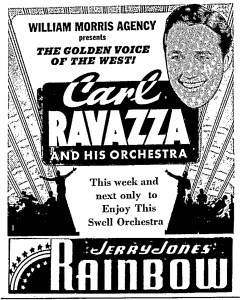
Carl Ravazza and his ochestra played at Jerry Jones’ Rainbow Randevu in Salt Lake City. Utah Chronicle, April 9, 1941, page 5.

Carl Ravazza, a White violinist and vocalist from California, and his orchestra played several times in Utah, a state situated in the Western United States’ jazz scene. The San Francisco Examiner reported on July 29, 1968, that Carl Ravazza was popular among college students in the 1930s. This remained true during the 1940s. The Utah Chronicle, the University of Utah newspaper, advertised Ravazza at Jerry Jones’ Rainbow Randevu on September 22, 1938; January 19, 1939; April 9, 1941; and April 18, 1941. The Rainbow Randevu was a ballroom in Salt Lake City that often held swing and jazz groups. Ravazza and his orchestra played at the Rainbow Randevu consecutively in 1938, 1939, 1940, and 1941.

Newspapers in Salt Lake City frequently informed Utahns of Ravazza visits. On September 15, 1938, the Salt Lake Telegram reported that “the romantic voice of the west” was to begin a two-week engagement at the Rainbow Randevu, where there would be dancing every night. The Salt Lake Telegram reported Jerry Jones saying that other popular traveling bands would follow suit if the engagement was successful. It must have been, since Ravazza’s group returned at least four additional times in the next three years. In January 1939, April 1940, and March 1941, the Salt Lake Telegram reported return engagements by Ravazza’s group.

Rainbow Randevu Front Utah State Historical Society

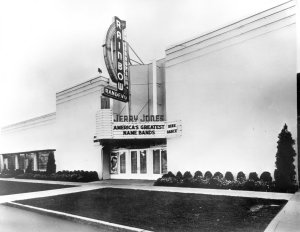
Carl Ravazza and his orchestra, among other name bands, played at Jerry Jones’ Rainbow Randevu at 41 E. 500 South. The building was destroyed by a fire in 1948. Used by permission, Utah State Historical
Society.

Ravazza was popular in Utah, but also countrywide. The Utah Chronicle reported on April 18, 1940, that his famous theme song “Vienni Su” was credited with shooting him “into nationwide recognition.” This might be why the Salt Lake Telegram reported on April 29, 1940, that Ravazza was to stay in Salt Lake City and perform an additional three days. The newspaper noted that Ravazza had played the week before “to record crowds, which demanded a return engagement of the popular maestro.”

Jazz music was booming in the 1930s and 1940s in both the East and West. In the West, swing bands traveled from state to state on tour. Carl Ravazza and his orchestra toured the Western United States regularly, especially Salt Lake City where he visited at least four times. Advertisements in the Utah Chronicle showed jazz bands visited Utah quite frequently. These engagements were part of the Salt Lake City scene, where people from all walks of life would enjoy music and dancing. The social events provided an opportunity for Utahns to come together and participate in the entertainment of the time.

Adelina Whitten graduated from the University of Utah in December 2018 with a Bachelor of Arts degree in communication and a minor in sociology.

Sources:

“Ravazza Group To Open Here,” Salt Lake Telegram, September 15, 1938, 9.

Advertisement for Carl Ravazza and his orchestra at Jerry Jones’ Rainbow Randevu, Utah Chronicle, September 22, 1938, 3.

Advertisement for five entertainment groups at Jerry Jones’ Rainbow Randevu, Utah Chronicle, January 19, 1939, 3.

“Carl Ravazza Band Held Over Here,” Salt Lake Telegram, January 20, 1939, 20.

“Salt Lakers to Hear Ravazza Orchestra,” Utah Chronicle, April 18, 1940, 3.

“Randevu Books Ravazza Band,” Salt Lake Telegram, April 19, 1940, 24.

“Randevu Awaits Ravazza Return,” Salt Lake Telegram, April 29, 1940, 14.

“Ravazza Set For Randevu,” Salt Lake Telegram, March 17, 1941, 9.

Advertisement for Carl Ravazza and his orchestra at the Rainbow Randevu, Utah Chronicle, April 9, 1941, 5.

“Carl Ravazza Dies In Nevada at 58,” San Francisco Examiner, July 29, 1968, 41.

Stowe, David. “Jazz in the West: Cultural Frontier and Region During the Swing Era,” Western Historical Quarterly 23, no. 1 (February 1992): 53-73.

H. V. Kaltenborn Discusses World War II at the University of Utah’s Master Minds Event

By Anthony Scoma

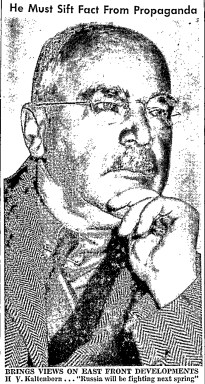
The October 9, 1941, issue of the The Utah Chronicle reported that H. V. Kaltenborn, the “fearless correspondent, editor, and radio newscaster,” would be speaking at the University of Utah’s first “Master Minds and Artists series” at the Salt Lake Tabernacle, after demand exceeded the capacity of the on-campus Kingsbury Hall. The event was sponsored by the university extension division, which brought Kaltenborn to deliver “his analytic accounts of war reports” based on his experiences as a broadcast journalist covering the war between Germany and Great Britain and his time spent living in Germany, where he had developed a “hate for Hitler and the Nazi regime which can only come from personal observation.”

Salt_Lake_Telegram_1941_10_15

Photo accompanying Bob Hale’s article, “Russ Good until Spring, Kaltenborn Believes,” that was published in The Salt Lake Telegram, October 15, 1941.

According to journalism historian Louis Liebovich, Hans Von Kaltenborn was an extremely popular and important radio broadcaster throughout the 1940s and was the “most listened to foreign affairs commentator of the time.” Kaltenborn’s radio broadcast was regularly listened to by anywhere from 10 to 17 percent of American homes during the years 1942 through 1947, meaning that his program “reached a larger portion of the American public across the country than any other single news opinion source with the exception of Time magazine.” His influence greatly shaped American discourse by stimulating newspaper editorials, effectively attacking high-ranking government officials, and shaping public opinion of government policy (Liebovich, p. 47).

Kaltenborn’s popularity was certainly evident in the tone of the coverage before and after the event by The Utah Chronicle and the Salt Lake Telegram. The October 15, 1941, issue of the Telegram called Kaltenborn the “No. 1 news commentator” and from the moment he landed at Salt Lake airport the paper reported on his observations of the war in Europe and specifically “the Russian fight against the invading Germans.” The Salt Lake Telegram’s subsequent October 16 issue reported that these topics were also addressed during Kaltenborn’s speech when he said that Hitler’s invasion of Russia was going so poorly that even Hitler admitted he had made an error.

Kaltenborn’s assessment of the war was also combined with a strong endorsement of the U.S. providing support to the Allied forces and called for a more involved foreign policy. According to the October 16 issue of the Salt Lake Telegram, during Kaltenborn’s 90-minute address to the audience of 5,000 people, he said that “[t]he weight of the United States will decide the turn of events in the European war” and that if China, with the support of the United States, could take the offensive with Japan “it might change the world situation.”

The Utah Chronicle’s coverage of Kaltenborn’s speech in its October 16, 1941, issue highlighted his dislike of Hitler, the Nazi regime, and its desire for conquest. The article also brought up Kaltenborn’s concerns in the “Far East” where Kaltenborn said, “Japan feels her destiny is to rule.” The article finished its coverage by describing Kaltenborn’s warning about labor unions and profit motives interfering with the defense industry and his conclusion that “Russia will never be conquered.”

Utah_Daily_Chronicle_1941_10_23

Hays Gorey’s story, “Noted News Lecturer Shows Weakness in War Problem Analysis.” (The Utah Chronicle, October 24, 1941, 1)

Kaltenborn’s speech and perspective was not without criticism, however, and in The Utah Chronicle’s October 23, 1941, issue, Hays Gorey argued that Kaltenborn “continued a policy common to Master Minds and Artists series speakers of being more concerned with propagandistic entertainment than with logical presentation and interpretation of facts.” While Gorey’s opinion column admitted Kaltenborn’s speech was “a success,” Gorey charged him with creating “a war-frenzy” and making claims without substantiating them with a “firm foundation of reasoning.” Of these claims, Gorey specifically questioned Kaltenborn’s analysis of the defensive capabilities of the English Channel, his certainty that Hitler was “inherently sinister and power-mad,” the lack of similar criticism of Josef Stalin, and the address being “full of generalities […] with a few statements that bordered on the ridiculous here and there.”

Less than two months after Kaltenborn’s speech in Salt Lake City, millions of Americans across the country tuned in on December 7, 1941, to hear his analysis of the attack at Pearl Harbor, which heralded the United States’ entrance into WWII (National Broadcasting Company, Inc.). The timing of Kaltenborn’s speech, his outspoken position on the war, and the media coverage before and after the event provide a great insight into the contemporary arguments for and against entering the war and can help to better understand the political landscape of Utah concerning the war prior to Pearl Harbor.

Anthony Scoma is a senior at the University of Utah majoring in communication and political science and is set to graduate in May 2019. He is interested in radio journalism and is the podcast producer for K-UTE Radio.

Sources:

“H. V. Kaltenborn Opens Master Minds Series,” The Utah Chronicle, October 9, 1941, 1.

Bob Hale, “Russ Good Until Spring, Kaltenborn Believes,” Salt Lake Telegram, October 15, 1941, 15.

“Hitler on His Way Out, Says Kaltenborn” Salt Lake Telegram, October 16, 1941, 11.

Wallace Bennett, “Famous News Analyst Sees Need for Unity,” The Utah Chronicle, October 16, 1941, 1.

Hays Gorey, “Noted News Lecturer Shows Weakness in War Problem Analysis,” The Utah Chronicle, October 23, 1941, 4.

National Broadcasting Company, Inc.“H.V. Kaltenborn’s Analysis Of The Japanese Attack On Pearl Harbor,” December 7, 1941.

Liebovich, Louis. H.V. Kaltenborn and the Origins of the Cold War: A Study of Personal Expression in Radio Journalism History, no. 14 (Summer/Autumn 1987): 46–53.


Auerbach’s: The Department Store That Advertised Customer Service and Quality Products

By Diana Rubio

In May 1943, The Utah Chronicle featured ads from Auerbach’s Department Store, a family-owned business that gained name recognition in the Western United States. (Auerbach, end page)

In 1864, Jewish brothers Frederick H. Auerbach and Samuel H. Auerbach gave rise to what would become a 113-year legacy of quality products and services. (Rudd, 234) Auerbach’s was initially named “The People’s Store: Auerbach & Brothers” and began welcoming customers in downtown Salt Lake City after the Auerbach brothers came to an agreement with former LDS leader Brigham Young. (Williams)

The difference in culture the Auerbach’s introduced to the business landscape in Utah connected non-Mormons and Mormons. When the store first opened on Main Street, the south end, where Auerbach’s was located, became a hub for non-Mormon shoppers, whereas the north end was known for catering to Mormon shoppers. (Stone, Introduction)

p0790n7_12_08

Interior of Auerbach’s department store in Salt Lake City. Image courtesy of Special Collections, J. Willard Marriott Library, University of Utah.

Auerbach’s began as a small shop, but as time progressed the business gained popularity due to its merchandise and customer service that touched its customers. (Auerbach, end page) These two characteristics were not only experienced in the store, but also promoted in advertisements. It is due to Auerbach’s advertising efforts and positioning that the family business distinguished itself from other retailers. (Auerbach’s, Folder 5, 7)

“You can count on the fingers of one hand the stores in Utah that have had a continuous life of eighty years,” said Herbert S. Auerbach, one of the successors of the company. (Auerbach, end page)

When the company observed its eightieth anniversary, the celebration was a testament to the company’s integrity, customers service, and its progress, despite the changes in the political atmosphere. (Auerbach, end page) Auerbach’s advertisements positioned the store as a retailer that carried high-quality goods and provided retail prices for consumers with various budgets. (Auerbach’s, Folder 5)

p0790n7_12_04

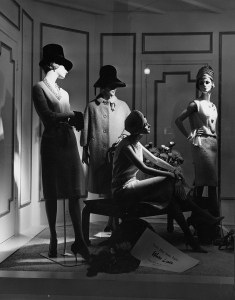
Auerbach’s store display in Salt Lake City. Image courtesy of Special Collections, J. Willard Marriott Library, University of Utah.

The first advertisement spanned two inches and appeared in the issues of the Daily Telegraph and described the merchandise as “Staple and fancy.” The advertisements promoted the following merchandise: dry goods, shoes, groceries, notions, clothing, and home accessories. An example of how merchandise was initially promoted advertised blankets imported from California as “the finest quality … offered at little over original cost.” (Auerbach’s, Folder 5)

In an ad published by Goodwin’s Weekly, the ad expressed that Auerbach’s had gained confidence and courage from experiencing success over the years. Such accomplishments had encouraged the company to import 100,000 handkerchiefs for the holidays that were packaged with care. In addition to providing details about “the world’s greatest production of handkerchiefs,” the ad was a cordial invitation for customers to experience these handkerchiefs for themselves. At the bottom, the ad read, “We invite you to make yourself at home among these new handkerchiefs of ours.” (Auerbach’s, Folder 7)

While Auerbach’s advertisements focused on the quality of products, other advertisements highlighted customer service, such as an ad that featured a sketch of the Auerbach store in Salt Lake City. The ad promised to deliver products within five days. If not, customers could return the items in store. Another ad with the sketch of a woman wearing a hat guaranteed a free purchase once customers had made fifty-seven purchases. Exceptions to this offer included: groceries, meats, phonographs, candy, and patterns. (Auerbach’s, Folder 5)

The Auerbach’s company recognized it had built a reputable name over the years and believed the store had become an inspiration to Utah history. (Auerbach’s, Folder 7) Although Auerbach’s reached its end in 1977, it was a Salt Lake City landmark for over 100 years. (Williams) The company’s focus on service and merchandise are marketing tactics still used today by marketers who position companies to increase revenue and eventually build strong brands.

Diana Rubio is a senior at the University of Utah. She is majoring in communication with a focus in strategic communication.

Sources

Auerbach, Herbert S. Auerbach Co.: 80 years of service, 1864-1944. Salt Lake City, UT, 1944.

Advertisement, Auerbach’s Man’s Shop Advertisement, The Utah Chronicle, May 20, 1943, 6.

Rudd, Hynda. “Auerbach’s: One of the West’s Oldest Department Stores.” Western States Jewish History 11, no.3: 234-38.

Stone, Eileen Hallet. Auerbach’s: The Store that Performed What It Promises. Charleston, SC: The History Press, 2018.

Various advertisements, Herbert S. Auerbach papers, Box 10, Folder 5, Special Collections and Archives, University of Utah, J. Willard Marriott Library, Salt Lake City, Utah.

Various Advertisements, Herbert S. Auerbach papers, Box 16, Folder 7, Special Collections and Archives, University of Utah, J. Willard Marriott Library, Salt Lake City, Utah.

Williams, Carter. “Auerbach’s to ZCMI: 4 historic Utah businesses that no longer exist,” ksl.com, November 16, 2017,