University Duty of Care for Student Deaths in Athletics

By Gloria M. Hammond

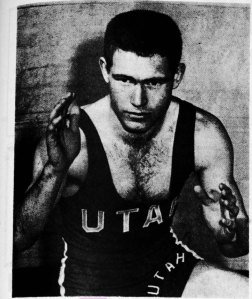
Doug Bingham 1960-1

Doug Bingham is pictured next to an article encouraging the attendance of a University wrestling match. The photo was published in February 1960, one year prior to his death. Courtesy of The Daily Utah Chronicle and J. Willard Marriott Library, The University of Utah.

Participating in athletics can sometimes be risky business. Sports-related injuries are common on college campuses, and athlete fatalities are not unheard of either. This risk of harm poses an important question: Do universities possess a duty of care to their student athletes in the event of a sports-related injury or death?

Michelle D. McGirt, a sports law scholar, offers some insight into potential answers to this question by analyzing the relationship between universities and student athletes through the framework of U.S. common law. McGirt offers her analysis using the legal decisions of cases involving student athlete injury or death within the United States. The application of legal discourse involving this issue provides a clearer understanding as to why there ought to be a special duty of care offered to student athletes that exceeds that of a typical student.

McGirt argues that universities do, in fact, have an imposed duty of care to their student athletes. (McGirt, p. 12) This duty is based on a mutual dependence between the athlete and the university. Student athletes rely on the university to receive an education and hone their physical abilities, while the university receives economic benefits as well as increased student enthusiasm and involvement in campus sporting events. While the student athlete is not an employee of the university, McGirt argues that it is important to distinguish them from private students due to the nature of the relationship universities have with campus sports. (McGirt, p. 10)

Based on legal precedent, McGirt argues that universities are rarely liable for the injury or death of a student athlete. However, the courts have recognized and stated that there is a special duty of care that universities have toward student athletes, and those involved in campus sports should hold a special standing in comparison to the private student body. Although universities may not suffer legal recourse for a sports-related death, examples of how these institutions handle and memorialize athlete fatalities can be observed through historical findings.

Findings

An article published in the Arizona Republic reported in February 1961 that University of Utah student Doug Bingham had died after suffering an apparent heart attack during a wrestling match in Wyoming. The article highlights Bingham’s prior good health and academic standing, as well as his widow and three young children.
Chronicle article 1961-1

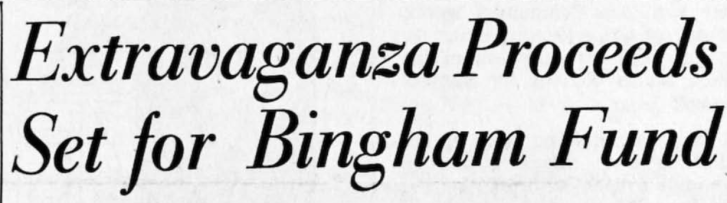
Front page headline from The Daily Utah Chronicle, March 1961. University fundraisers aim to pay tribute to student athletes who are injured or deceased. Courtesy of The Daily Utah Chronicle and J. Willard Marriott Library, The University of Utah.

A tribute for Doug Bingham was published in the Daily Utah Chronicle in February 1961. The Chronicle is a paper for the University of Utah community that is highly circulated on campus. The tribute highlights Bingham’s accomplishments and hopes that his untimely death will “carry a moral and a thought into every university student in America.” This particular quote emphasizes the reach of Bingham’s death, and the moral obligations that all students ought to have toward their peers. A follow-up article titled “Traditions” was published in the Daily Utah Chronicle in February 1961 to further explain the incident and urge students to “do their part to help right a tragic incident.”

A sense of duty to Bingham’s memory and surviving family was sparked when Floyd Dyches, with the University of Utah campus police, wrote a letter to the editor of the Daily Utah Chronicle in March 1961. Dyches urged the student body to “make a Doug Bingham fund” in order to compensate his family for the loss of their husband and father. Jackie Black, chairman of the Union Talent Extravaganza, announced in an article published in the Daily Utah Chronicle in March 1961 that all proceeds from the yearly school talent show would be donated to the Bingham fund. The University of Utah senior class also made a donation toward the Bingham fund, which was published in the Daily Utah Chronicle in May 1961.

Conclusion

The 1961 death of Doug Bingham, a University of Utah student athlete, was recognized as a campus tragedy. Bingham’s death also sparked discourse on how the university ought to respond to the loss of a valued student-athlete. The campus honored the memory and paid tribute to Bingham’s special relationship with the University of Utah by urging students to donate funds to aid the affected family. These tributes and fundraisers also served to solidify Bingham’s dedication and engrave his special standing within the public memory of the University of Utah campus. In present day, there is a growing concern with the well-being of student athletes. Universities can reflect upon the past, to instances like the death of Doug Bingham, to better address injury or death with compassion and a sense of duty to those affected.

Gloria Hammond is a senior at the University of Utah. She is majoring in communication with an emphasis in journalism.

Primary Sources

Heart Attack Kills Utah U. Wrestler,” Arizona Republic, February 27, 1961, 41.

Glowing Tribute,Daily Utah Chronicle, February 28, 1961, 2.

Traditions..,” Daily Utah Chronicle, March 3, 1961, 2.

Floyd Dyches, “Letter to the Editor,” Daily Utah Chronicle, March 6, 1961, 2.

Extravaganza Proceeds Set for Bingham Fund,” Daily Utah Chronicle, March 7, 1961, 1.

Senior Class Gift Divided to Benefit University, Campus,” Daily Utah  Chronicle, May 25, 1961, 1.

Secondary Source

McGirt, Michelle. “Do Universities Have a Special Duty of Care to Protect Student-Athletes from Injury?” Sports & Entertainment Law Journal 6, no. 1 (1999): 1-14.
Doug Bingham’s Untimely Death Could Have Shined a Light on Collegiate Sports and the Risk Involved

By Arielle Gulley

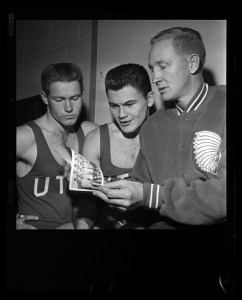
U_of_U_Wrestlers_Bingham_Doug_Hankin_Frank_Hess_Marv_Shot_2Collegiate sports are oftentimes regarded as rewarding experiences that can bring communities together and even ignite professional careers for some athletes. Being on a team surrounded by your peers can be a great time in your life. Unfortunately, the risk that comes with college athletics is a big one, and even more unfortunate, it often goes unrecognized. That was exactly the case in 1961 when the University of Utah’s wrestling team traveled to Powell, Wyoming, for a meet against the University of Wyoming.

Doug Bingham, a 21-year-old senior at the University of Utah and co-captain of the wrestling team, died during the match due to a heart-related incident while on the mat. This was 1961, and cardiopulmonary resuscitation (CPR) had just been introduced but was still an unfamiliar practice to many. The Daily Utah Chronicle reported in February 1961 that when Bingham went limp during the match he was given “artificial respiration on the mat, and later a physician opened his chest and massaged his heart.” His teammates watched and even gave blood in attempts of saving his life. Bingham’s heartbeat returned and he was rushed to Memorial Hospital where his heart lost and then regained a beat once more, only to stop later that night one final time. The student, husband, and father of three was pronounced dead.

Page_256_Matmen_win_IntermountainWhen Bingham died so unexpectedly, the school was unaware of the protocol in such a situation. It was a shock that someone so young and healthy could be there one minute, and gone the next. Bingham’s coach Marvin Hess referred to Bingham as someone “in fine health, perfect condition,” as the Arizona Republic reported on February 27, 1961.

Short articles were written of the event and placed in the sports section. Letters to the editor of the Daily Utah Chronicle published in late February and early March 1961 described Bingham as someone who was “highly thought of by all his friends and associates,” and who seemed to “go the extra distance.” A fund was also started at the University of Utah and eventually garnered hundreds of dollars to go toward his surviving family.

After a couple of weeks and time to digest the untimely passing of a young man seemingly in his prime, the school and news outlets found that they had performed their due diligence and found new stories to report on, no longer publishing stories on Doug Bingham or even mentioning the potential risk that collegiate athletics imposed on students. The question of how a young and seemingly healthy college student died from a heart complication was never addressed. Bingham’s circumstance never inspired a new policy where student athletes would be examined prior to competition on the competency of their bodies or their ability to withstand strain. The mental effect of the event on other college athletes and peers at the time was never brought into question. It wasn’t until February 2008, 47 years after the incident, that the athlete on the mat with Bingham at the time of his death shared his own insight on the harrowing situation with Wyoming’s Casper Star-Tribune.

Dave Edington, an awarded wrestler with the University of Wyoming in 1961, recalled wrestling Bingham and the confusion he felt when his opponent went limp and wouldn’t get up during the match. After the death of someone he did not know, Edington was unsure how to feel or if he should feel anything at all. The gravity of the situation affected his collegiate career for the worse. “I never could get it going again,” Edington said about wrestling with the university. “I never was the same.”

As a nation, it is instances such as these that have occurred far too often and taught us that we must shine a light on the untimely deaths and potential risks involved when it comes to college sports. The United States prioritizes sports and athleticism, though in instances such as these it comes at a cost. Someone’s health is overlooked for the chance at winning a trophy. Athletes must be recognized, their peers counseled and taught to properly grieve, and preventative measures taken to reduce future risk.

This wrestling match in 1961 that resulted in a death of a student was given mediocre media attention at best. If better addressed or reported on, this event in our history could have changed policies in collegiate sports and possibly saved or improved the lives of athletes in similar situations. The media’s job is to highlight and distinguish stories in order to bring about much needed change. In this instance, the media failed.

Arielle Gulley is a senior at the University of Utah. She is studying communication with an emphasis in journalism.

Primary Sources

U Athlete Dies in Wyoming,” Daily Utah Chronicle, February 27, 1961, 4.

Glowing Tribute…,” Daily Utah Chronicle, February 28, 1961, 2.

Drizzle by H20,” Daily Utah Chronicle, February 28, 1961, 4.

Traditions,” Daily Utah Chronicle, March 3, 1961, 2.

2 Barbershop Quartettes [sic] to Top ‘Extravaganza,’” Daily Utah Chronicle, March 6, 1961, 1.

Feel Bad?” Daily Utah Chronicle, March 6, 1961, 2.

Heart Attack Kills Utah U. Wrestler,” Arizona Republic, February 27, 1961, 41.

David Buck, “Wrestling brought ups and downs for the first four-time champ,” Star-Tribune, February 21, 2008.

“Wrestler dies as Surgery Fails,” San Francisco Chronicle, February 27, 1961, 41.

Secondary Sources

Harmon, Kimberly G., Irfan M. Asif, David A. Klossner, and Jonathan Drezner. “Incidence of Sudden Cardiac Death in National Collegiate Athletic Association Athletes.” Circulation 123, no. 15 (2011): 1594-600.

Chandra, Navin, Rachel Bastiaenen, Michael Papadakis, and Sanjay Sharma. “Sudden Cardiac Death in Young Athletes.” Journal of the American College of Cardiology 61, no. 10 (2013): 1027-040.

“Hyperthermia and Dehydration-Related Deaths Associated with Intentional Rapid Weight Loss in Three Collegiate Wrestlers — North Carolina, Wisconsin, and Michigan, November-December 1997.” Morbidity and Mortality Weekly Report 47 (6): 105-108.

Harmon, et al. “Pathogenesis of Sudden Cardiac Death in National Collegiate Athletic Association Athletes.” Circulation: Arrhythmia and Electrophysiology 7, no. 2 (2014): 198-204.

Van Camp, Steven P., Colin M. Bloor, Frederick O. Mueller, Robert C. Cantu, and Harold G. Olson. “Nontraumatic Sports Death in High School and College Athletes.” Medicine & Science in Sports & Exercise 27, no. 5 (1995): 641-47.


Delta Delta Delta and Sigma Alpha Epsilon, the forgotten houses from Greek Row at he University of Utah

By Chloe Greep

Greek life at the University of Utah has been a prominent part of the university since it began in the fall of 1909. Today 11 fraternities, seven sororities and over 1,600 students are members of Greek life at the university. Many of the articles in The Daily Utah Chronicle from 1941 were events and ongoings within the Greek life community. There are articles written on Greek life from parties, dances and even lists of who was newly engaged or married within the community.

Delta

Delta Delta Delta in the University of Utah Utonian yearbook in 1936. Courtesy of Special Collections, J. Willard Marriott Library, The University of Utah.

In these articles there are frequent mentions of the sorority Delta Delta Delta, better known as Tri-Delt, and the fraternity Sigma Alpha Epsilon. These two houses no longer exist on the university campus and in some ways the history of these houses has been lost and forgotten.

Delta Delta Delta was established at the University of Utah in 1932 with the address 1431 E. 100 South, which is now home to the fraternity Pi Kappa Alpha. The chapter’s purpose was “assisting its members in every possible way,” according to the chapter’s website. The chapter focused on raising money for the St. Jude Children’s Hospital Research.

The University of Utah founded the Sigma Alpha Epsilon Fraternity, better known as SAE, in 1949 and in 1967 it was the largest fraternity on campus, according to the Utonian, the university’s college yearbook. From the articles in The Daily Utah Chronicle, the Sigma Alpha Epsilon chapter was very involved on campus, hosting many parties and partaking in other campus-wide events.

The downfall of the Delta Delta Delta Chapter began in 2006. From year 2000 to 2006 the amount of students who were becoming involved in the Greek system at the University of  Utah declined from 970 to 625, a 36% decrease in involvement, according to an article in 2006 in The Salt Lake Tribune.

The Delta Delta Delta chapter was told in the early spring of 2006, that if it didn’t increase membership by 25 people the organization would pull its charter on April 30 of that year. Unfortunately, the chapter was unable to reach those numbers, according to an article written in the Deseret News, ending the legacy of the Delta Delta Delta sorority on the University of Utah Campus.

Sigma

Sigma Alpha Epsilon in the 1967 Utonian. Courtesy of Special Collections, J. Willard Marriott Library, The University of Utah.

There is not much information on the Sigma Alpha Epsilon chapter’s downfall. There is a lot of information on the fraternity’s reputation nationwide. According to the Sigma Alpha Epsilon’s Wikipedia page, between 2006 and 2013 nine deaths were linked to drinking, drugs and hazing within the fraternity. Along with that the site also says that during the 2010s, 18 chapters were suspended, closed or banned. After doing extensive research it seems like the fraternity just disappeared off the school’s campus in 1996.

It is strange how there were several articles written about the decline of the Delta Delta Delta sorority at the University of Utah, but nothing on the reasoning behind the downfall of the Sigma Alpha Epsilon Fraternity. The downfall of the fraternity remains a mystery to all except those who were members of the fraternity at that time. The fraternity Sigma Alpha Epsilon nationally has a bad reputation and history of hazing throughout the United States, and I wonder if that is the reasoning behind the chapter’s shut down in 1996.

Chloe Greep is a junior a the University of Utah. She is studying communication with an emphasis in journalism.

Primary Sources

Delta Delta Delta says goodbye to Greek Row,” The Daily Utah Chronicle, May 17, 2006.

Tri Delta, Salt Lake City Alumnae Chapter.

Erin Stewart, “Another U. Greek House May Close,” Deseret News, January 29, 2006.

Sigma Alpha Epsilon,” Wikipedia, November 28, 2019.

Secondary Source

Sykes, Shinika A. “Are U.’s Greeks Past Their Peak?” The Salt Lake Tribune, February 21, 2006.

The Legacy of Dr. Khosrow Mostofi: An Uphill Battle in Establishing the University of Utah Middle East Center

By Christian Gomez

Violence and war have become a normal part of life in the Middle East. Typically portrayed in a negative light, the Middle East is often scrutinized by people throughout the world for its differences in religious and political views. This has contributed to a general lack of understanding of the cultures, practices, and languages that exist in the Middle East.

The University of Utah has championed Middle Eastern studies for many years in hopes of providing opportunities to better understand the Middle East. From learning new languages to gaining an appreciation for other cultures, Middle Eastern studies at the University of Utah have provided opportunities for new perspectives and a deeper understanding of the Middle East. But, it wasn’t always this way. It took the efforts of prominent figures to establish this curriculum—people like Dr. Khosrow Mostofi.

Mostofi_Photo_1_Final-1

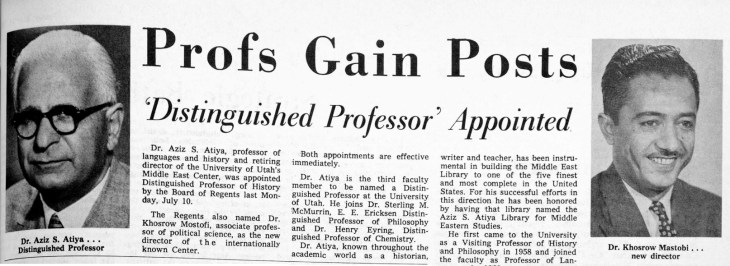
The Daily Utah Chronicle focuses on the accomplishments and retirement of former director and founder of the Middle East Center, Dr. Aziz S. Atiya. It also introduces Dr. Khosrow Mostofi as the new director. Photo from the July 1967 issue. Used by permission, The Daily Utah Chronicle.

Mostofi’s unique story began 7,000 miles away in Tehran, Iran, where he was born in 1921. He attended the University of Tehran, where he received his B.A. in English literature. His language skills were in high demand, and he taught English for the Ministry of Education at several institutions in Iran. (Bean, p. 306; Mostofi interview, p. 3)

In 1949, Mostofi immigrated to the United States. By this time, World War II had ended. But prior to leaving Tehran, he had met a U.S. officer from the Persian Gulf command. Mostofi and the officer stayed in touch after the war, and he told the officer of his plans to attend Columbia University. The officer informed him of the “cultural shock” that he would experience in New York City. Having been a student at the University of Utah, the officer suggested that Mostofi attend school in Salt Lake City—a place he had never even heard of. (Mostofi interview, pp. 3-4)

Mostofi quickly immersed himself into his graduate studies. He received a Ph.D. in Political Science four years later. Bothered by the lack of diversity in the curriculum, Mostofi proposed that three courses on the Middle East be implemented—an idea originally met with skepticism by administrators. Eventually, courses were added, and the University of Utah qualified for its first grant for the Middle East Center. (Mostofi interview, pp. 4-5)

After a two-year teaching stint at Portland State College, Mostofi returned to the University of Utah in 1960 when he was named the assistant director of the center—working alongside then-director and founder of the Middle East Center, Aziz Atiya. There were no formal degree programs and the only staff was Mostofi, Atiya, and one secretary. (Mostofi interview, pp. 6, 19)

Mostofi_Photo_2 Final-2

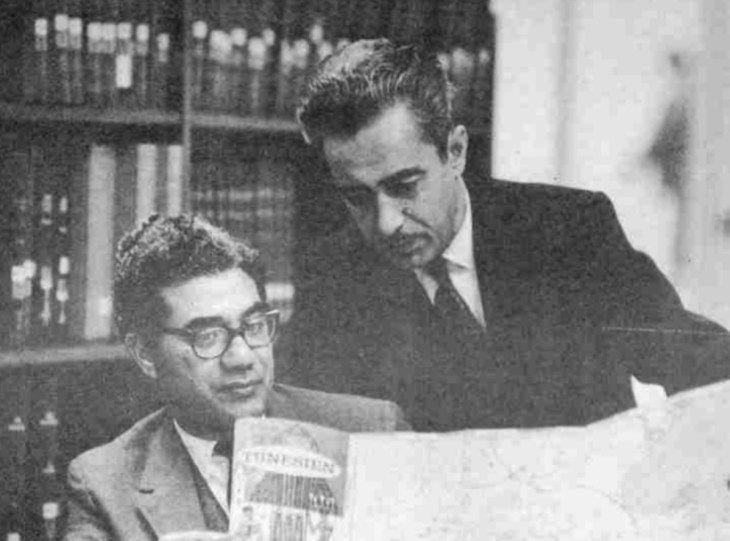
Dr. Sami A. Hanna, left, associate professor of languages, and Dr. Khosrow Mostofi, director of the Middle East Center, discuss their plans for the new cultural exchange program in Tunis, Tunisia. Photo from a February 1971 issue of The Daily Utah Chronicle. Used by permission.

While the addition of the Middle East Center was a step in the right direction, it wasn’t embraced by everyone. In an interview with Everett L. Cooley, Mostofi spoke about the “outright hostility in some circles” that the program was met with on campus. Some faculty felt that funding should be spent elsewhere, and not on a new, unproven program.

In 1966, Mostofi resigned his position to pursue full time teaching and research. His resignation was brief, as Atiya fell ill, and Mostofi took over. The Daily Utah Chronicle highlighted this change in its July 1967 issue, which commemorated Atiya and introduced Mostofi as the new director. (Mostofi interview, p. 18)

Mostofi introduced reforms for the center, citing a lack of performance. He reached an agreement with the U.S. Office of Education that allowed the center to host professors from Turkey, Iran, Lebanon, Egypt, Iraq, and Israel for three-month intervals. Mostofi improved curriculum by forming strong relations with Iran—as evidenced in the August 1966 issue of The Daily Utah Chronicle. The center’s funding increased, and graduate and undergraduate programs were approved. Seven graduate degree programs emerged for Middle East Studies: Arabic, Hebrew, Persian, Turkish, Anthropology, History and Political Science. (Mostofi interview, pp. 18-20)

After receiving little support from the federal government, Mostofi secured grants from major organizations—changing the entire outlook on the Middle East Center. He also formed relationships with the public-school system, as well as the local community, beginning a “grass roots support” for the center. This was illustrated in the February 1971 issue of The Daily Utah Chronicle, when Mostofi organized a cultural exchange program for U.S. students in Tunisia. (Mostofi interview, pp. 24, 27)

In his interview with Everett L. Cooley, Mostofi made it clear what his mission had been throughout this entire process: “Changing attitudes and outlooks.” Mostofi did this by instilling the Middle East’s proud and expansive history in higher education’s curriculum. It was about shifting the misperceptions associated with the Middle East, and bringing to awareness the richness of its culture.

Mostofi etched his mark on students at the University of Utah. The April 1964 issue of The Daily Utah Chronicle drew attention to Mostofi’s efforts in bringing thousands of Persian books to the library. His prominent role in the development of the Middle East Center left a lasting impact, and it most likely wouldn’t exist today if it wasn’t for his contributions.

Mostofi_Photo_3_Final-1

The Daily Utah Chronicle highlights Dr. Khosrow Mostofi’s efforts in bringing in over 3,000 volumes of Persian books for the Intercultural Library. Photo from the August 1966 issue. Used by permission, The Daily Utah Chronicle.

Mostofi retired from the Department of Political Science in 1987, but remained a Middle East Center consultant until 1991. He was honored with the Distinguished Service Award and acknowledged as “an internationally recognized scholar of Iranian culture, history, and politics,” according to the August 1992 issue of The Daily Utah Chronicle.

Today, the Middle East Center stands strong—empowering students to enact change and become global citizens. It offers graduate and undergraduate programs that provide students with dynamic skills in language and cultural comprehension in the Middle East. For students today, the center serves as a stepping stone for potential careers in public affairs, public service, business, and several other fields. Opportunities now exist for students to participate in conferences, workshops, and outreach activities to further their understanding of the Middle East, and shed the stereotypes that are still prevalent in today’s society.

Christian Gomez is a junior at the University of Utah. He is studying strategic communication with a minor in writing in rhetoric.

Primary Sources

Former Middle East Center director dies,” Daily Utah Chronicle, August 12, 1992, 3.

Intercultural Center Gains 3,000 Volumes,” Daily Utah Chronicle, August 16, 1966, 3.

Iran Embassy Honors Prof For Writings,” Daily Utah Chronicle, April 10, 1964, 4.

Mid East program okayed,” Daily Utah Chronicle, February 25, 1971, 5.

Profs Gain Posts,” Daily Utah Chronicle, July 14, 1967, 1.

Transcript, interview with Khosrow Mostofi, conducted September 17, 1985, by Everett L. Cooley, Everett L. Colley Oral History Collection, J Willard Marriott Library Special Collections, The University of Utah.

Secondary Source

Bean, Lee L. “Khosrow Mostofi.” Middle East Studies Association Bulletin 26, no. 2 (1992): 306-07.


Cheating Among University of Utah Fraternities and Sororities from 1961-1962

By Ashley Espinoza

When a student is admitted into any university, they are required take an oath refraining them from cheating. This does not mean that students haven’t found ways to get through classes by bending the rules a little. Finding new ways to cheat the system is nothing new. Academic predecessors have been doing this since before many current college students were born.

U of U Fraternity-1

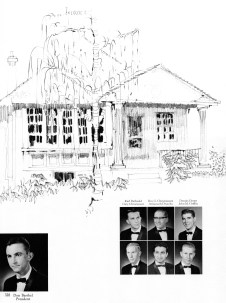
Photo of Don Barthel and fellow fraternity brothers from the 1961 University of Utah yearbook, the Utonian. Used with permission from Special Collections, J. Willard Marriott Library, The University of Utah.

Before there was innovative technology and Scantrons to ensure students weren’t cheating, there was just a simple pen and paper. This lack of monitoring offered students the opportunity for students to cheat. One student decided to share his perspective on the topic with a simple letter meant for the Letter to the Editor section of the University of Utah newspaper. In the February 6, 1961, issue of the Daily Utah Chronicle, Don F. Skipworth discussed the ongoing cheating he had witnessed throughout his first semester. He found that these individuals didn’t particularly care about the policy because they were not getting caught. He suggested in order to stop the phenomenon teachers and students should implement “a new and improved method to catch these traitors to the cause of learning.”

In the following “Letter to the Editor” section of the February 7, 1961, issue, student Maynard L. Pollock also wrote a letter to the editor titled “Cheater’s Delight” expressing his concerns on cheating, even going as far as to point the finger at fraternities and sororities for their use of files containing past tests. He suggested that the school implement an honor code to encourage students and faculty to tell an adviser if they saw a student cheating.

In an attempt to set the record straight in the following “Letter to the Editor” section of the February 8, 1961, issue, students Donald N. Bryan, William Maxey, Larry Jensen, Karl Bethsold, Don Barthel and S. M. Polinsky, who were involved in Greek life on campus, came to the defense of the use of test files. They claimed that the files were only used as a means of studying and it was not the fault of the student if the professor chose to administer the same test again. The group ended their letter by telling Maynard L. Pollock to “direct his remarks to individuals and not to groups who are trying to help their members become better student.”

Interfraternity Council-1

Photo of Interfraternity Council shown in the 1961 University of Utah yearbook, the Utonian. Used with permission from Special Collections, J. Willard Marriott Library, The University of Utah.

In an attempt to shift the blame, University student John Ronald Jones sent a letter to the “Letter to the the Editor” section of the February 8, 1961, issue to rebut the previous statements. The writer claimed that the grading system was set up in a way that made it competitive among students, resulting in them cheating to get ahead. He ended by suggesting that the University of Utah create its own form of a test file but make it accessible to all students, not just those in the Greek system.

To refute the statements made in the February 8 issue of the Chronicle, Maynard L. Pollock wrote a letter for the February 15, 1961, issue. He tried to invalidate the statements made by those in the Greek system by claiming that if students only depended on these test files, they are not technically retaining anything from class, therefore defeating the purpose of them being a “study guide.”

Almost a year later, on January 19, 1962, another letter entitled “Cheat — Whose Fault?” was published in the “Letters to the Editor” section of the Chronicle. The author Dianna Davis told her firsthand experience with living at the dorms and listening to students brag about cheating. She suggested that the University administer harder entrance exams and more stimulating courses in order to filter out all the unfit students.

Cheating was much easier over 50 years ago, but professors today have found more ways of catching cheating using technology. In the article “Technology Keeps Up With Cheating,” Chronicle reporter Andreas Rivera discussed how teachers use programs like Turnitin to catch when a student has plagiarized an essay. Rather than looking at test files, students have websites like SparkNotes that help them study and retain the information. Looking back at these letters and seeing how students are going through their schooling really puts into perspective how different, yet somewhat similar, our lives are compared to theirs. Cheating is definitely something that has not gone away over the past 50 years but seeing why they did it and how lets us know how to not repeat history.

Ashley Espinoza is a senior at the University of Utah. She is studying communication with an emphasis in communication studies.

Primary Sources

Dianna Davis, “Letters to the Editor: Cheat — Whose Fault?Daily Utah Chronicle, January 19, 1962, 2.

Don F. Skipworth, “Letters to the Editor: Cheating,” Daily Utah Chronicle, February 6, 1961, 2.

Donald N. Bryan et al., “Letters to the Editor: Helpful Files,” Daily Utah Chronicle, February 8, 1961, 2.

John Ronald Jones, “Letters to the Editor: A Solution,” Daily Utah Chronicle, February 9, 1961, 2.

Maynard L. Pollock, “Letters to the Editor: Cheater’s Delight,” Daily Utah Chronicle, February 7, 1961, 2.

Maynard L. Pollock, “Letters to the Editor: Files Open?” Daily Utah Chronicle, February 15, 1961, 2.

Secondary Sources

Rivera, Andres. “Technology Keeps Up with Cheating,” Center for Teaching and Learning Excellence, The University of Utah.

The Long History Behind the Natural History Museum of Utah

By Heather Ernst

In 1961, “in the basement of the decaying, eroded Biology Building, a collection of Utah fauna [was] cached away wherever room may [have been] found.” The Daily Utah Chronicle further noted that the cramped rooms were known at the time as Utah’s Museum of Natural History. Many university staff and students were pushing then for the construction of a new museum. But it wasn’t until the legislature made House Bill 93, which called for the construction of a Utah State Museum of Natural History, that the building plans were finalized. Now, almost 60 years later, the collection of Utah artifacts that were overflowing in a couple small classrooms in 1961 are housed in an even newer, state of the art building opened in 2011. So how did we get here? What is the history behind our beautiful Natural History Museum of Utah?

We’ll start our historical journey in 1961, when an editorial published on January 30 in the Daily Utah Chronicle called for the construction of a Utah natural history museum. The article referred to the new building as “a must.” Shortly after the article was written, real plans came into effect toward the new Utah State Museum of Natural History. In fact, on September 29, 1965, a Daily Utah Chronicle editor, Paul S. Taylor, reported the new museum was to be housed in the George Thomas Library on the University of Utah campus. The museum had a director, Dr. Jesse D. Jennings, a professor of anthropology, and it was to combine the existing Anthropology and Geology Museums. In a Daily Utah Chronicle article published on February 23, 1968, Jennings stressed the educational importance of the museum, calling it “an integral part of the educational program of the University, for the benefit and enjoyment of the people of Utah.” The people did not have to wait long as the museum officially opened its doors in the fall of 1969.

George_Thomas_Library

The George Thomas Library on the University of Utah campus was the home of the Natural History Museum of Utah from 1969 to 2011. The museum was later moved to The Rio Tinto Center in 2011. Used by permission, Special Collections, J. Willard Marriott Library, The University of Utah.

Once the museum was opened in the former George Thomas Library on campus, its allure spread across the Salt Lake Valley. “The museum and its displays will be of great interest to students in a wide variety of disciplines on the campus and will be a significant addition to the state’s cultural resources,” said Jennings in the Daily Utah Chronicle on February 7, 1969. The museum was home to anthropological, biological, and geological materials in a program of exhibits, educations and research. The artifacts were brought from the Desert Museum as well as from the Charles Nettleton Strevell Museum. The new Utah useum was set to house 150 exhibits at the time of its opening, including life-size dinosaur skeletons and dioramas of various areas of Utah. The major group displays were made up of the Wasatch Front, Jurassic Dinosaurs, and Utah Mule Deer. Many of the displays in the museum were funded by private donations plus federal grants. However, University students also had a role in the funding of the museum.

An article from the Daily Utah Chronicle describes how the museum asked the Associated Students of the University of Utah (ASUU) for financial help in developing and maintaining the new museum. The students were asked for $1.50 per student to come from regular fees, and in return, the museum would give them a year’s admission to the museum. The regular admission fee was a single dollar for adults and fifty cents for children under 15; much cheaper than today’s $12-15 admission fees.

By the fall of 1972, the Utah Museum of Natural History had become even more widely known and even received accreditation from the American Association of Museums. On September 27, 1972, the Daily Utah Chronicle reported “of the 6,000 museums in the United States and Canada, only 139 have received accreditation from the American Association of Museums,” making the honor that much more profound. The museum accreditation signifies that a museum has met the standards established by the museum profession and the Accreditation Committee. The museum was praised highly, having been referred to as an exemplary institution for design and technique.

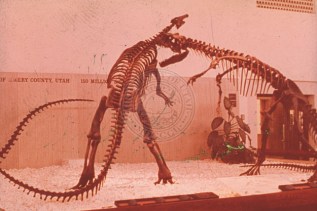
Three_of_the_first_mounted_dinosaurs_from_the_C_LDQ_were_displayed_in_1968_at_the_opening_of_the_new_Utah_Museum_of_Natural_History_They_are_an_Allosaurus_attacking_a_Camptosaurus_while_a_second_Allosaurus_looks_on_

Three of the first mounted dinosaurs were displayed in 1968 at the opening of the new Utah Museum of Natural History. The dinosaurs were an Allosaurus attacking a Camptosaurus, while a second Allosaurus looks on. Used by permission, Special Collections, J. Willard Marriott Library, The University of Utah.

Over the last 60 years, the museum has continued to flourish, grow in popularity and receive plenty of accreditations, including the one from the American Association of Museums. The collections have grown over time through research, acquisition and contributions to add up to more than 1.6 million objects. The museum grew so much. however, that it had to relocate once again into an even larger building in 2011. According to director Sarah B. George in a New York Times interview, the museum had inadequate quarters for research and collection. A new building was needed as soon as possible and a mix of public and private funds pushed the ambitious planning for the new Rio Tinto Center, the home of the Natural History Museum of Utah.

The new museum building, the Rio Tinto Center, was designed by Todd Schliemann. He drew his inspiration for the building from the Utah deserts. Schliemann explained his inspiration saying, “We talked to people about how they felt about their place [in Utah], and it became evident that architecture would have to reflect this place.” (Maffly) The building, which opened on November 18, 2011, is located on 17 acres in the foothills of the Wasatch Mountain Range and cost $102 million to construct. The building has a powerful impact under the shadow of the Wasatch Mountains and is surrounded by biking and hiking trails. The museum is home in the dominion it surveys, the natural world. The building’s exterior directly relates to the natural world surrounding it, covered in copper to resemble the sedimentary layers of Utah’s red rock geology. The roof of the museum features two 10,000 gallon cisterns to store rain water. Gardens of native grasses along the edges of the building help to moderate temperatures. Similarly, the new museum has installed solar voltaic panels on the roof to harvest energy from the sun and put it toward the building’s electrical needs. The best part of the new building was that more than a fourth of the materials came from recycled sources and most of the construction waste was recycled. “The new building represents the rich and natural history of Utah,” said Patti Carpenter, the museum’s public relations director, in a 2011 interview with the Deseret News.

The rich and natural history of Utah has been available for years. However, the construction of the “new” museum in 1969 made that history much more accessible. The Rio Tinto Center increases accessibility to artifacts and Utah natural history while adding a variety of educational and research opportunities that couldn’t be found in the past. The Natural History Museum of Utah has a rich history on its own, but the new building has brought new exhibit galleries, engaging programs for the public and research facilities. The museum has become invaluable to the University of Utah, Utahns as well as tourists. The museum is still a work in progress, with new educational programs and interactive exhibits added regularly, but the progress made over the past 60 years simply cannot be ignored.

Heather Ernst is a senior at The University of Utah. She is majoring in mass communication with an emphasis in journalism and minoring in creative writing.

Primary Sources

New Museum: It’s a Must,” Daily Utah Chronicle, January 30, 1961, 2.

Paul S. Taylor, “Museum of Natural History Planned For New Library,” Daily Utah Chronicle, September 29, 1965, 4.

Suzanne Boynton, “Old Library To Be Museum,” Daily Utah Chronicle, February 23, 1968, 6.

Geoff Towns, “Natural History Museum to house 150 exhibits,” Daily Utah Chronicle, October 8, 1968, 5.

Utah museum represents funds from U students,” Daily Utah Chronicle, February 2, 1969, 12.

Campus houses two accredited museums,” Daily Utah Chronicle, September 27, 1972, 2.

Michael Ann McKinlay, “Museum makeover: Natural History Museum of Utah Rio Tinto Center will open Nov. 18,” Deseret News, November 13, 2011.

Brian Maffly, “Natural History Museum of Utah: Rio Tinto Center designed with a sense of place,” The Salt Lake Tribune, November 14, 2011.

Edward Rothstein, “History Carved Out of the Hills,” The New York Times, March 23, 2012.

Secondary Sources

Accredited,” Davis County Clipper, September 1, 1972, 28.

Hague, Donald V. “Museums in Utah,” Utah History Encyclopedia.

Natural History Museum of Utah announces opening,” Utah Business, November 1, 2011, 16.

Venerated Civil Rights Leader Martin Luther King Jr. Speaks at The University of Utah

By Liam Elkington

Dr. Martin Luther King Jr. is one of the most documented figures in the history of the Civil Rights Movement. His active support of anti-segregation policies in the South, his status as a community minister and his ability to speak from his experience as a Black man in America cemented him as one of the most revered and significant men not only of his time, but in all of American history. His outspoken advocacy for civil rights earned King many invitations to speak of colleges and universities, one of them being the University of Utah.

MLKCH

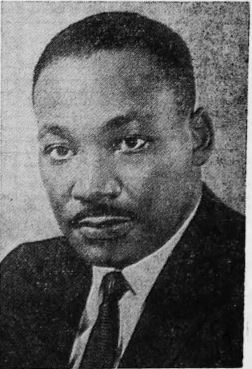
A portrait of Dr. King published in the Daily Utah Chronicle that was used to promote his visit.

Martin Luther King Jr. was born to a middle-class family in Georgia in 1929. His father, Martin Luther King Sr., was a Baptist minister, and his mother Alberta was a schoolteacher. He attended Morehouse College and Cozer Theological Seminary, later conducting his doctoral studies at The School of Theology at Boston University. In 1955, while working as a pastor in Montgomery, Alabama, he became a leader in the Montgomery Bus Boycott. His role in that nonviolent protest is thought to have propelled him into national awareness, as discussions surrounding the Civil Rights Movement coming out of Alabama grew in frequency and became the concern of not only African Americans living in the South, but Whites too. (Lincoln, 1970)

In 1961, King was invited to speak at the University of Utah, where he was to deliver his speech titled “The Future of Integration.” Leading up to the event, which was to be held in the Union Ballroom on January 31 at 8:15 p.m., The Daily Utah Chronicle gave context to readers regarding King and his accomplishments. On January 26, 1961, the Chronicle reported in the article, “Revered King, Set for Ute Talk, Becomes ‘Reluctant Race Leader,’” information about when and where King would be speaking, noting that the event was organized by ASUU Assemblies and Convocations committee. The article referred to King using an outdated term, calling him a “negro leader.”

Other Chronicle articles also preceded the arrival of Martin Luther King Jr., further advertising the event and further stating his accomplishments as a scholar and author. On January 30, 1961, Elaine Krans wrote in “Martin Luther King Sets Campus Speech” that King achieved fame after “his preaching of non-violence succeeded in ending the segregation on the public buses of Montgomery, Alabama.” On January 31, “Southern Leader Speaks on Race Problem Tonight” highlighted again how King used peaceful methods for social progress.

MLKJDW

Dr. King meets with Dr. J. D. Williams, who spoke at the event before King’s arrival.

However, the event did not go entirely to plan. King was delayed and so arrived at the University of Utah about two hours later than expected. While this may have caused some stress for the event organizers, they were vocal in their appreciation for the patience of the crowd gathered to hear King speak. In their letter to the editor published on February 6, 1961, Gail Plummer and Dave Gillette of the Assemblies committee thanked the student body for the “tremendous support.” They recounted how when they received the news that King would be late arriving, Dr. J. D. Williams stepped in to provide context and background for King’s remarks, filling time until his arrival. Plummer and Gillette were astounded at the attentiveness and enthusiasm of the crowd, citing the event as a success despite the delay. One student, Kay Winston, wrote in the April 4 Chronicle how the event demonstrated the maturity of the student body, praising the ability of the Assemblies and Convocations committee. Winston also advocated for bringing more controversial speakers on campus “so [students] may decide for themselves what they would like to believe, instead of being led down a road of one type of influential speaker.”

Following King’s visit, the Chronicle published an article on February 2, 1961, that summarized his primary points. “Negro Leader Looks at Integration” reported King’s belief that “integration will be accomplished, and stressed that it cannot be accomplished without sacrifice on the part of the Negro.”

The University of Utah continues to invite scholars and public figures of varying viewpoints to speak to its students. The sentiment of Kay Winston remains true, that being exposed to a variety of opinions allows those studying different worldviews to inform their own beliefs. This can be seen how the University of Utah continues to promote discussion surrounding important societal topics and allowing a variety of viewpoints to be shared, wherever they may come from. In 2017, notable conservative figure Ben Shapiro spoke at the University of Utah campus, creating much discord and some annoyance among the student body. While this may not have been the goal of Shapiro’s visit, it demonstrated that the university is still dedicated to providing a platform for speech that encourages students to think critically. Martin Luther King’s positions about social integration of a marginalized community surely were also seen as controversial, but still provided an opportunity for the students of 1961 to gain insight into a prominent movement. King’s vision of race integration may yet to completely come to pass, and the need for students to think and interact with important ideas has never diminished, therefore it continues to be a vital function of colleges and universities to provide an environment where students can interact with important ideas from a variety of sources and speakers.

Liam Elkington is a senior at The University of Utah, studying communication with an emphasis in journalism. He hopes to use his education to aid in the recording and reporting of truth.

Primary Sources

“Reverend King, Set for Talk, becomes ‘Reluctant Race Leader,’” Daily Utah Chronicle, January 26, 1961, 2.

Elaine Krans, ”Martin Luther King Sets Campus Speech,” Daily Utah Chronicle, January 30, 1961, 1.

“Southern Leader Speaks of Race Problem Tonight,” Daily Utah Chronicle, January 31, 1961, 1.

“Negro Leader Looks at Integration,” Daily Utah Chronicle, February 2, 1961, 1.

Gail Plummer and Dave Gillette, “Letters to the Editor: Thanks,” Daily Utah Chronicle, February 6, 1961, 2.

“Secretary Hopefuls Tell Duties, Responsibilities of ASUU Office,” Daily Utah Chronicle, April 4, 1961, 2.

Secondary Sources

Lincoln, C. E. Martin Luther King, Jr.; A Profile. New York: Hill and Wang, 1970.

Spotlighted Artist Richard “Dick” Bibler 

IMG_1999

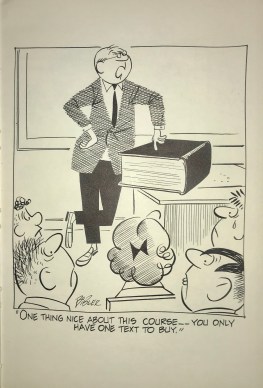
Professor Snarf telling students about the one book they will need to purchase for the course. Cartoon by Richard Bibler from More Little Man on Campus. Published 1957 by Bibler Features. Use in the public domain.

By Roberto Elguera

If you ever picked up a newspaper as a kid, the first thing you probably flipped to was the cartoons. Popular types of cartoons in newspapers include political, illustrative, gag, comic strip, and animated cartoons. The themes and jokes displayed in these cartoons are determined by the artist, with each artist showing their own style of humor and illustration. One artist who has a unique style is Richard “Dick” Bibler.

Bibler’s jump-start as an editorial cartoonist began as a freshman at the University of Kansas. Part of the class of 1946, Bibler could be found in the infamous quarters of Oread Hall. Oread Hall originally served as an army barracks but got transformed as an affordable housing unit for students. Oread Hall was known for its tight quarters and lack of air conditioning. Residents called it a “tinderbox.” (McCool) Maybe not the grandest of living spaces, but it was perhaps the perfect environment for Bibler to rub shoulders with his fellow classmates. This first-hand experience explains Bibler’s attention to detail to student life in his illustrations.

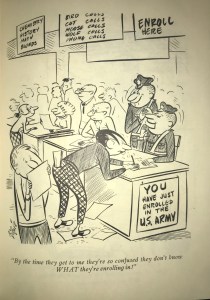
Bibler’s cartoons focused on themes familiar among college students. Published in over a hundred campus newspapers, Bibler’s “Little Man on Campus” (LMOC), quickly became a popular cartoon at universities by 1951. His cartoons follow the young and reckless “Worthal” and seemingly evil “Professor Snarf.” Bibler told The Word newspaper on November 3, 1967, that the University of Utah was among the first universities asking to publish his work on the campus newspaper, the Daily Utah Chronicle.

Although Bibler’s LMOC is no longer published in the present-day campus newspaper, his work is still relatable to today’s college students. Students and graduates alike flipping through the LMOC cartoons can relate to the character “Worthal” for his nervousness before tests, his silly pranks, and his perseverance as he goes through college. Readers can also relate to and identify their own “Professor Snarf”: the scary professor whose class seems impossible to pass, and the student’s favorite teacher to prank. As Bibler said in an interview with Morris Arden (Little Man, What Now?) about the character “Professor Snarf,” “every college has a ‘Snarf’ and if you don’t believe me, ask some of my students.”

IMG_1998

Worthal enlisting in the army. Cartoon by Richard Bibler. Use in the public domain.

Colleges and universities like North Carolina State College, Boise Junior College, Boston University, and the University of Miami have all shared their admiration for the series. The previous editor of the University of Miami Hurricane newspaper, John Garcia, said, “LMOC has contributed something different to the university and college campuses. He has been well received by the students…. Little Man has become a legend.” (Little Man, What Now?) With Richard Bibler’s death in 2013, it is important that we keep his art and humor alive today. The cartoons serve as a memento of the past as well as the present of the college social experience. For all the endless laughs and smiles we celebrate Richard “Dick” Bibler.

Roberto Elguera is a senior at the University of Utah, majoring in communication with an emphasis in journalism.

Primary Sources

Introducing: The Little Man on Campus,” The Word, November 3, 1967, 3.

Little Man On Campus,” Daily Utah Chronicle, January 16, 1961, 2.

Little Man on Campus,” Daily Utah Chronicle, January 18, 1961, 2.

Little Man on Campus,Daily Utah Chronicle, January 19, 1961, 2.

Richard Bibler, Little Man on Campus – Fourth Book of Cartoons, 1947.

Richard Bibler, Little Man on Campus (Stanford: Stanford University Press, 1952).

Richard Bibler, Little Man, What Now? (Elkhart, Kansas: Bibler Features, 1959).

Secondary Source

McCool, John H. “Independents’ Hall,” the University of Kansas.


Marcel Marceau: World’s Greatest Pantomimist

By Hannah Cook

IMG_0396-1

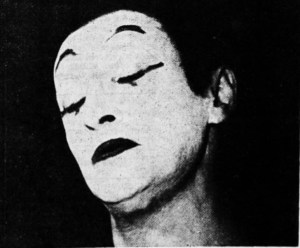
Tbe world-famed pantomimist Marcel Marceau as pictured in advance of his appearance at the University of
Utah. Daily Utah Chronicle, March 14, 1958.

Marcel Marceau was born in 1923 in a village near Strasbourg, France. Marceau stated that he was fascinated by the art of mime for “as long as he can remember.” During his early childhood he was found imitating people he saw in his daily life. He idolized and was inspired by great silent screen actors such as Charlie Chaplin and Buster Keaton. He was self-taught until 1946 when he enrolled under the great master of mime, Etienne Decroux, in Sarah Bernhardt’s Theatre in Paris. Marceau’s aim was to always make his audience see, feel and hear the invisible, but he also wanted to reach out to children and to draw them into theaters. Marceau said he wanted to do this to help educate them in “the universality of culture.” After practicing mime for years, Marceau eventually created a school to teach others the art of pantomime. Though at first his main goal was to teach mime, his school became much more than that. The Marcel Marceau Paris International School of Mimodrama taught many subjects other than pantomime, such as classical and modern dance, juggling, fencing, acrobatics and jazz. Marceau eventually stated that, “What matters is that the visual theater is alive.”

IMG_0395-1

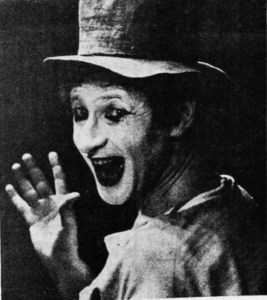
This photo accompanied a Daily Utah Chronicle story published March 28, 1958, about Marcel Marceau’s performance at the University of Utah.

In his days of practice, Marceau brought forth a small revival in the art of pantomime, an art that many would consider to be a lost art that seemed to be irrelevant. Marceau was a master interpreter of one of the oldest, least practiced of performing arts — the art of gesture. Lewis Funke of the New York Times wrote that Marceau “needs not a word to convey anything in the range of human experience.” Many compliments are spread of Marceau and his perfected practice of pantomime through his time of performing, as well as many years after. Walter Kerr, drama critic of the New York Herald Tribune, wrote that “Marcel Marceau is the sort of theatrical gift that one really deserves. To ask for such perfection would be presumptuous; you can only stare at it, believe it and be thankful. The fellow is, in case I forgot to say it, superb.” The great mime came to America after success at his home theater, Ambigu Theatre, in Paris with his entire Compagnie de Mime. He also had international success in Europe, Latin America, India, and Israel.

Though it may seem like a lost art, pantomime is still very much alive around the globe today — even in small towns in Utah. Gregg Goldston is a popular mime from Utah. After watching a performance by Marcel Marceau, Goldston said he walked out with his mouth open. He said he “was really fascinated.” A lot of hard work and practice goes into the art of pantomime. Though many of Marceau’s acts included comedy, especially his most popular act of “Bip,” Goldston said “mime is movement not just clowning, mime is derived from acting, and mime is a lot more expressive than dance and takes extreme concentration.”

Other pantomimists, such as Joe Pitti, worked with Marceau and were inspired by him. Pitti said in a 1990 interview with the Davis County Clipper that mime was his first love, and that “mime gave me the spark to communicate.” He was part of the Davis County School District’s Artist-in-Residence program and worked with children to teach them the art of mime and “to get them to laugh at themselves.”

Though the art of pantomime may seem to be irrelevant in today’s world, it is a topic that should still be recognized for its importance in history. This art form is still being taught and recognized globally in forms such as pantomime schools, as well as schools hosting performers of the arts. Marcel Marceau performed for the University of Utah on multiple occasions, in part due to his importance in the history of pantomime and his love for the art. Schools, such as the University of Utah, being able to bring well-known guests to perform for the student body and public creates a way to enlighten a student’s experience at the university with an internationally renowned art form.

Hannah Cook is a senior at the University of Utah. She is studying communication with an emphasis in strategic communication.

Primary Sources

Perfection Presented Monday,” Daily Utah Chronicle, March 28, 1958, 2.

Pantomimist Marceau Will Appear in Kingsbury Hall,” Daily Utah Chronicle, January 11, 1961, 3

Lost Art…,” Daily Utah Chronicle, January 12, 1961, 2.

Utes Spotlight Marceau Tonight,” Daily Utah Chronicle, January 13, 1961, 1.

Mime Artist Performs at Learning Center,” Park Record, March 23, 1978, 28.

Judy Jensen, “Mimes the Word,” Davis County Clipper, April 4, 1990, 3.

Secondary Source

Riding, Alan. “OFFSTAGE WITH: Marcel Marceau; Sounding a Legacy of Silence,” New York Times, December 2, 1993, 1.


Downwinders

Bombing_of_America_The

This map shows the hot spots of affected areas from nuclear fallout caused by the bomb tests at the Nevada Test Site. Used by permission, Special Collections, J. Willard Marriott Library, The University of Utah.

By Maddie Colosimo

In the 1950s and 1960s, the Atomic Energy Commission (AEC) ordered the United States government to conduct nuclear tests in the western states. This resulted in numerous people living around this area getting exposed to nuclear fallout and contracting some form of cancer. These people were later referred to as the Downwinders. At the same time of these tests, the University of Utah received a $3 million grant from the AEC to put toward nuclear research. This article will give a brief history of the AEC, examine the university’s role in the tests, and discuss the legacy of the Downwinders today.

As World War II ended, the United States Government created the Atomic Energy Commission to control nuclear development under President Harry Truman. Aside from aiding in national defense, Congress wanted the AEC to “promote world peace, improve public welfare, and strengthen free competition in private enterprise.” The Atomic Energy Act was then signed by Truman on August 1, 1946. (Buck, p. 1)

On January 6, 1961, the Daily Utah Chronicle wrote a story about the AEC giving Utah universities grant money for nuclear research. This grant was from the Atomic Energy Commission. They awarded the University of Utah, Utah State, and Brigham Young University a total of $4 million over a 10-year period for research in atomic studies. The University of Utah received the largest chunk at $3,552,528.

On February 3, 1961, an article in the Daily Utah Chronicle announced the addition of a new medical center on campus. This housed a research facility from the Atomic Energy Commission which included dog kennels for beagles as their nuclear test subjects. A reporter wrote a story in the same issue of the Chronicle, predicting the 1960s to be a decade of science with the grant from the AEC as well as Time magazine naming 15 prominent scientists its “Men of the Year.”

The Atomic Energy Commission’s generous grant to the University of Utah supported many research projects on campus that led to many amazing advancements in modern science. Unfortunately, the Atomic Energy Commission left a negative impact in the state of Utah with the fallout of their nuclear testing.

The University of Utah’s Marriott Library recently conducted interviews with many of the surviving Downwinders. Justin Sorenson interviewed a man named Joseph Ward Spendlove. Spendlove was born in Delta, Utah, in 1942 and lived there until 1958. Many members of his community began to get cancer around that time which eventually took the life of his mother. Today he is living with prostate cancer while taking care of his brother, who has a degenerative nerve disease. Doctors are unsure if it is related to the nuclear testing. To this day, Spendlove still attends his high school class reunions where the topic of conversation is almost always centered around who has most recently died of cancer.

Ilene Hacker is another living Downwinder. She was raised in St. George, Utah, through the 1960s. Hacker’s father died from pancreatic cancer when he was just 48 years old. She and 13 of her close friends from high school were diagnosed with Hashimoto’s disease. Despite living in the crossfire of nuclear toxicity and being well traveled, Hacker still feels that she is living in the greatest place on earth. With that, she also feels a total distrust of the government.

The nuclear tests done in the western US have had a tremendous impact on the people who inhabit the region. By the firsthand accounts of modern Downwinders, we see this is an issue that persists even today. Ilene Hacker’s distrust in the government is not unwarranted and even members of Congress agree. The fact that so many people died because of nearby nuclear testing provoked a bill in the 1990s by Utah Senator Orrin Hatch to give compensation to these victims. There has been a recent movement to expand the compensation to victims throughout all of Utah, as well as neighboring states like Idaho and Montana and even Guam. For all of those heavily affected, compensation would range from $50,000-$150,000 — which, as the leader of this movement Preston Truman explains — would not even cover the cost of one chemotherapy treatment.

Maddie Colosimo is a senior at the University of Utah and is majoring in communication with an emphasis in strategic communication and minoring in art history.

Primary Sources

AEC Grants For Utah’s Universities Applied in Research,” Daily Utah Chronicle, January 6, 1961, 1.

Important— But…” Daily Utah Chronicle, January 6, 1961, 1.

Law, Business, Medicine Are Building Projects,” Daily Utah Chronicle, February 3, 1961, 9.

Dr. Libby Talks Tonight in Spencer Hall,” Daily Utah Chronicle, March 2, 1961, 1.

Ute Briefs: Atomic Energy,” Daily Utah Chronicle, December 12, 1961, 4.

Atomic Exhibit Due In Salt Lake,” Daily Utah Chronicle, September 2, 1960, 4.

Spendlove, Joseph Ward, et. al. “Interview with Joseph Ward Spendlove, Downwinders of Utah Archive.” Transcript of an oral history conducted on June 25, 2019, by Justin Sorensen and Anthony Sams, Everett L. Cooley Oral History Project, Special Collections, J. Willard Marriott Library, The University of Utah.

Hacker, Ilene, et. al. “Interview with Ilene Hacker, Downwinders of Utah Archive.” Transcript of an oral history conducted on June 12, 2017, by Justin Sorensen. Everett L. Cooley Oral History Project, Special Collections, J. Willard Marriott Library, The University of Utah.

Secondary Sources

Buck, Alice. “The Atomic Energy Commission.” Washington, D.C.: US Department of Energy, 1983

Davidson, Lee. “Utahns who say family members died from cancer because of radioactive fallout would be eligible for $150K under new bill,” Salt Lake Tribune, July 6, 2018.

JCordes, “Scientific Discoveries of the 1960s.”

Utah Department of Environmental Quality, “Impact of Aboveground Nuclear Tests on Southern Utah,” September 11, 2019.