The Good, The Bad, The 2002 Olympics

by LANDON FRETER

Introduction:

Hosting the Olympics is one of the most, if not the most, exciting things that can happen in any city on the entire planet. For around 14 days, one city turns into the headquarters of a worldwide celebration of friendly competition. Every two years, thousands of athletes from countries all over the world come together to compete for the gold and see who is the best athlete at a particular sport. The Olympics rotate between the Summer Games and the Winter Games. Each season of games occurs every four years, the two then offset with each other so that either the Winter Games or the Summer Games occur every two years. [citation needed]

The Olympic Games date to 776 BC, but some speculate these were not the first games. Instead, these were known to be the first games that began an era of the occurrence every four years. At the beginning there was only one event known as the Stadium. It consisted of a 200-yard dash, which at that time was the length of the stadium. As the years went on, more and more events were added up until 393 AD, when the Christian Byzantine Emperor Theodosius eliminated the games entirely. Then, on March 24, 896, the modern Summer Games were brought to life. (Nostos)

In the first versions of the Olympics, the Winter Games were not included. It wasn’t until 1948 that the Winter Olympics were instigated and even then, the Summer and Winter Games were held in the same year. Starting in 1992, the International Olympic Committee (IOC) decided to have the games alternate every two years. [citation needed]

In 1995, Sion, Switzerland, Quebec City, Canada, Ostersund, Sweden and Salt Lake City were selected to be candidates to host the 2002 winter games with Salt Lake City emerging the victor.  The Beehive State became the fourth state in the United States to be a host of the Winter Olympics.  Somewhere around 2,400 people from 77 different nations competed in 78 different events.  However, in 1998, a controversy was raised stating that the IOC, took bribes from the Salt Lake Organizing Committee to bring the Olympics to Salt Lake. (McDonald)

In February 1999, CNN U.S. reported that in the previous month, 14 IOC members had received cash or favors from the Salt Lake Bid committee, and 10 more had been accused. After these members got word that they were to be under heavy investigation, many resigned their positions, perhaps fearing that they would be discovered.  This caused the controversy to blow up into something more. Plans to enclose the $29-million speed skating oval were under way before the contract to host the Olympics was given out, which could be seen as an attempt in bribery. Also, one of the members of the IOC owned a ski area venue and had put $13.8 million into building a new hotel that members of the IOC could reside in during the games. (LaMotte)

The Olympic cauldron on the campus of The University of Utah. Photo by Landon Freter.

Not everything about the 2002 Winter Olympics was full of controversy. In fact, hosting the Olympic Games had a major impact on not just the city of  Salt Lake, but the entire state of Utah as a whole. It gave the chance for many people from around the world to see what the state is all about. Hosting the Olympics brought many different cultures together for some great friendly competitive action. They also brought in over 250,000 visitors to Utah, along with 2.1 billion viewers in 160 different countries and had a worldwide audience for 17 days straight. (Haws) “Even before the games started, the impact was very real. 35,000 jobs appeared in Utah from 1996-2003 thanks to the $1.3 billion dollar injection into the local economy.” (Haws) This count shows that indeed, while the Olympics were happening in 2002, Salt Lake City was one of the best places to be, whether it was the location of residence, or if one was traveling to see the festivities. (Billings)

Records were broken, history was made and it was all done on the state-of-the-art facilities that were built specifically for the arrival of the Olympics. The sites stretched all across northern Utah as millions of dollars were put into constructing these buildings to be the top quality for these athletes. Even after the Olympics, these monumental buildings,  such as the Ogden Ice Sheet and the Energy Solutions Arena (formerly known as the Delta Center) are still in use today. For a small fee, patrons may skate on the ice, shoot the luge, and even snowboard in the half pipe as all the famous athletes did in 2002. (McDonald)

Now that the 10th anniversary of the 2002 Winter Olympic Games has come and gone, The Salt Lake Tribune reports that there has been chatter between the government and large business regarding the feasibility of joining forces to begin a multimillion-dollar campaign to bring the Olympics back to Salt Lake City in 2022. (Gorell) There is a lot of worry that things might happen the way they did in 2002 with all the controversy. Many people agree that Salt Lake is better suited to host the Olympics now than it was in 2002. A few main arguments are the fact that there will be light-rail trains that will give patrons quick access to downtown to and from the airport as well as surrounding areas. Another reason is the new City Creek mall that recently opened up in downtown Salt Lake City, which is attracting thousands every day. All we can hope for is that this is enough to bring back the once-in-a-lifetime experience.

Conclusion:

Through all the highs and lows that came out of Salt Lake City hosting the 2002 Olympic games, nobody can deny that it will be an event to be remembered forever. From the disappointing scandals to the triumph atop the podiums, Salt Lake will be eternally engraved with the fact that it put on one of the most successful and stressful Winter Games in the history of the Olympics.

Landon Freter is a senior at the University of Utah. He is majoring in mass communication with an emphasis on journalism and plans to graduate in May 2012.

Sources

A.C. Billings and S. Eastman, “Framing Identities: Gender, Ethnic and National Parity in Network Announcing of the 2002 Winter Olympics,” Journal of Communication 53 (2003): 569-86.

Scott Haws, “Legacy of the Olympics lives on in Utah’s economy,” KSL, February 20, 2012.

CNN U.S., “New Salt Lake Olympic Leader Vows Clean Games,” February 11, 1999.

Nanette McDonald, Salt Lake City: Site of the 2002 Olympic Winter Game (Salt Lake City: Great Mountain West Supply, 1998).

Mike Gorrell, “Salt Lake City in the hunt for 2022 Olympics?” The Salt Lake Tribune, January 13,2012.

Nostos Helenic Information Society (UK), “Brief History of the Olympic Games.”

Derks Field and the Salt Lake Trappers

by HANNA VAN WAGONER

From 1985 to 1992, the Salt Lake Trappers were an independent Pioneer League minor league baseball team based in Salt Lake City, Utah. The Trappers played in the Single A, Short Season league. The highest and most prestigious classification of minor league baseball is Triple A. It is the classification just below major league level. All Triple A teams have ties to major league clubs, and soon-to-be major league stars as well as aging former major leaguers are among the players. In comparison, the Trappers were an independent rookie league team, unaffiliated with any major league franchise. That meant that the Trappers had no access to any professional players who were signed with any major or minor league team. Other Single A teams had high draft picks and access to players from Triple A, Double A and even the major league team. Short season A began it season around Fathers Day and finished on Labor Day weekend. [citation needed]

The home field for the Trappers was at Derks Field, located at the present-day site of Spring Mobile Ballpark. The Derks Field stadium held 10,000 spectators and opened in 1946. It was named after Salt Lake Tribune sports editor John C. Derks. When first constructed in 1915, the stadium was given the name Community Park; it retained this title and its distinctive facade fora little over twodecades, until it burned to the ground on the night of September 24, 1946, as throngs of spectators gathered to observe the consuming inferno. All this happened just four evenings after the local team finished the Pioneer League Playoffs. [citation needed]

Baseball was hugely popular and there was no thought of missing a season. Construction of the new ballpark, Derks Field, began in early February 1947 andwas completed just in time for the Salt Lake Bees’ home opener on May 23rd. (Deseret News, May 30, 1947) Forty years later it would be the scene of one of the greatest feats in professional baseball.

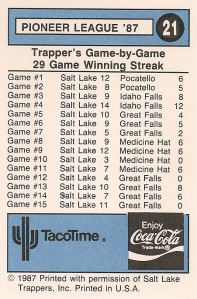
Despite its overwhelming handicap in acquiring and signing players, this Trappers team was best known for winning 29 consecutive games in 1987, marking an all-time professional baseball win streak record. Unexpected and unprecedented, when the Trappers celebrated by beating the Pocatello Giants 13-3 they accomplished an amazing feat matched by no other team in the 117-year history of organized professional baseball: 29 consecutive victories. Not only was this a history making moment but the history had been made by  a team of overlooked athletes that no other team in baseball wanted. They were individually undrafted and unsigned by any major or minor league team. [citation needed]

Sports Illustrated reporter John Garrity wrote, “The previous record had been shared by two teams on the fence line of baseball memory; the 1902 Corsicana Oilers of the Texas League and the 1921 Baltimore Orioles of the International League. The major league record of 26 straight belongs to John McGraw’s 1916 New York Giants.”

This Trappers team was even recognized by The New York Times in July 27, 1987, which reported that the major league record for consecutive victories was 26, achieved by the New York Giants in 1916. That record was finally beaten by the Salt Lake Trappers; with 29 straight wins the Trappers were finally known to the baseball world. After the win, Cooperstown, New York, where the Baseball Hall of Fame is located was expecting something to add into the Hall’s collection to mark this record-breaking moment from the Salt Lake Trappers. The Trappers contributed a ball signed by the team. But the signatures on the baseball framed in the Hall of Fame do not begin to explain the wide range of personalities this team created into one winning phenomenon. [citation needed]

These players were only making around $500 a month; however, they were a team that easily drew an audience to their mixture of grit, glamour and fame. The actor/comedian Bill Murray was a part owner. His appearance at Derks was always a crowd-pleasing event. He might coach first base for half an inning or take over announcing duties. The shortstop, Jimmy Ferguson, was a part-time model, known as the team’s spark plug. The Trappers’ manager, Jim Gilligan quipped, “He’s only hitting .400, but what the heck, as long as he’s playing a good shortstop.” Their first baseman was a self-appointed celebrity who said, “Remember the college guy who hit a home run that didn’t count because he touched a teammate before he crossed the plate and it got several lines in Sports Illustrated? … That was me.”

It was a David versus Goliath drama, played out over a few weeks in the Summer of 1987 in a remote mountain valley. But it became the story of a baseball season that ended in Cooperstown. That would have made John C. Derks happy.

Hanna Van Wagoner is a mass communication major at The University of Utah. She plans to graduate in May 2013 and attend law school in the fall of 2013.

Sources

John Garrity, “Streak City: With 28 straight victories Salt Lake’s Trappers made baseball history,” Sports Illustrated, August 3, 1987.

Mark Van Wagoner, “Salt Lake Trappers’ championship still celebrated,” Deseret News, September 13, 2011.

United Press International, “Salt Lake Trappers Win Pioneer League Pennant,” Los Angeles Times, September 4, 1987.

Salt Lake City Trappers,” Bullpen, Baseball-reference.com.

Larry Gerlach, “Streaking into History: The 1987 Salt Lake Trappers,” Nine: A Journal of Baseball History and             Culture 13 (Fall 2004): 10-27.

“Derks Field Leaves Fond Memories,” Deseret News, April 21, 1993.

“Trappers Stopped at 29,” The New York Times, July 28, 1987.

Piston-Engined Rocket Ships on Wheels: Bonneville Salt Flats

by NICHOLAS W. HAGEMAN

In 1833, Joseph R. Walker, an explorer, was interested in the region of the Great Salt Lake. During his journey, he traveled through the northern perimeters of the Salt Flats in Utah, while working for Captain Benjamin L.E. Bonneville. (Hallaran, 2011) Little did Walker know, he was traveling across more than 45 square miles of Salt Flats, which is roughly 30,000 acres. Since that exploration, the name of the area has come to be known as the “Bonneville Salt Flats.” Many years later, other explorers wanted to use the Bonneville Salt Flats as a shortcut to the Pacific Coast. However, this was deemed to be an inefficient way of traveling due to the mountainous terrain, which cuts across the flats. (Hallaran, 2011)

In 1910, Ab Jenkins discovered the Bonneville Salt Flats for his own. The Salt Lake Tribune reported on August 21, 2011, that Jenkins found the Salt Flats when he was riding his motorcycle to Reno to see Jack Johnson fight Jim Jeffries in the “Fight of the Century.” According to Hallaran, Jenkins returned to the flats in 1925 where he decided to race his Studebaker truck across the Salt Flats, walloping a special excursion train by more than ten minutes in the race. Jenkins decided to race this train because of the long, flat and desolate surface the Salt Flats provided. It was here in 1925 when Jenkins realized that this remote area had true potential for being a place to achieve land speed records. After Jenkins’ race, he said, “That was my first time on the salt with an automobile, and right then and there I realized the tremendous possibilities of those beds for speeding.” (Embry and Shook, 1997) It was from this day on that the Bonneville Salt Flats have been classified as a world renowned raceway, known for its high speeds and potential for setting land speed records.

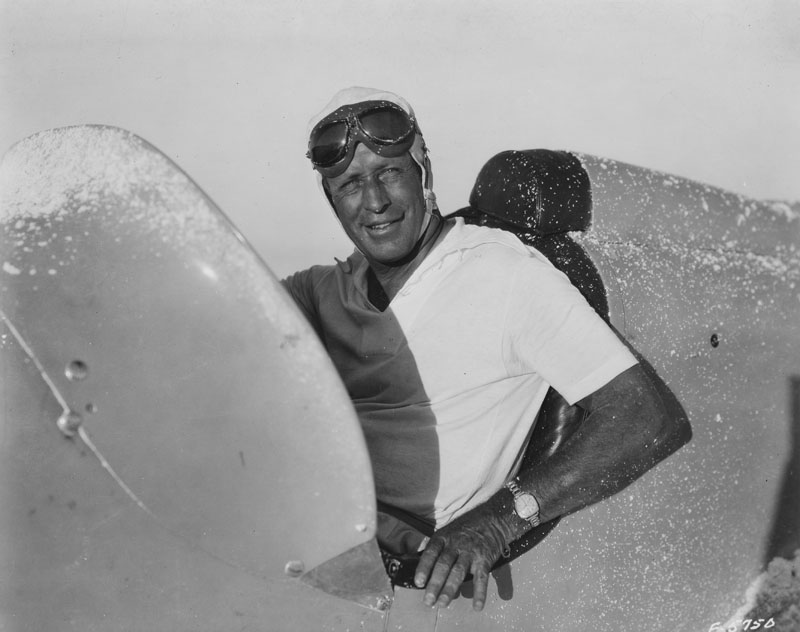
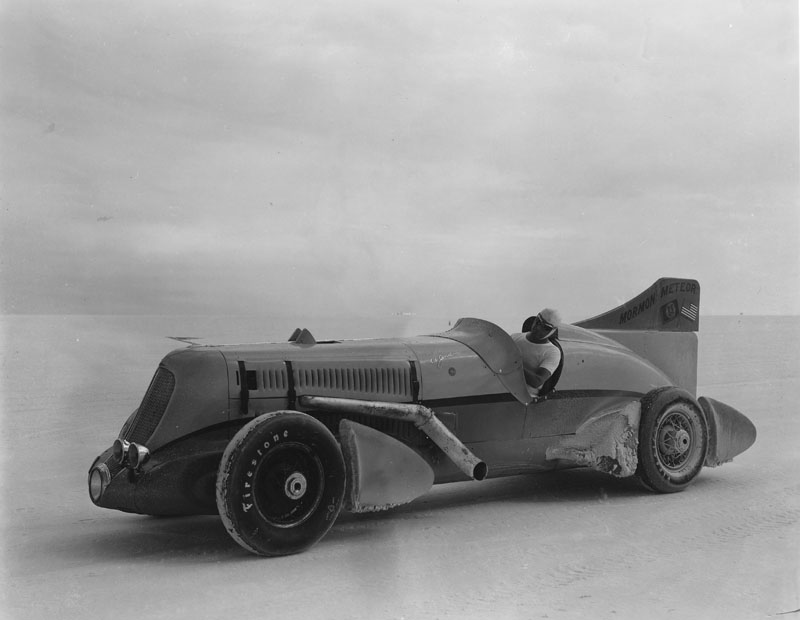
Ab Jenkins sitting inside his racing vehicle, the "Mormon Meteor," on the Bonneville Salt Flats Raceway, late 1930s. Photo courtesy of the Special Collections Archive at the J. Willard Marriott Library, The University of Utah.

Jenkins was born in Spanish Fork, Utah, and was raised in Salt Lake City. He was a man of many different trades. Not only was he known for his development of racing on the Salt Flats and making this a place to set land speed records, but according to The Salt Lake Tribune “The Meteor Rides Again,” he was also known as a race-car driver, safety advocate, and the mayor of Salt Lake City for a time during World War II. In 1932, Jenkins took his 12-cylinder “Pierce-Arrow” automobile to the Bonneville Salt Flats, where he began the sport of land speed racing.

Between the years of 1932 and 1956, Jenkins achieved many new, world land speed records at the Bonneville Salt Flats. According to an article published in The Deseret News on October 15, 1946, Jenkins was considered to be “the holder of more automobile racing records than any other racing driver in the world.”

Setting these world records caught the attention of many exceptional racers worldwide, bringing them to Utah to get a taste of the Bonneville Salt Flats. Jenkins’ popularity grew ever so rapidly once he had exposed these land speed records to the mainstream public. Furthermore, in 1950, Jenkins wiped out twenty-six world records on the Bonneville Salt Flats in his “Mormon Meteor.” He named his racecar the Mormon Meteor to show respect to his Mormon faith and heritage.

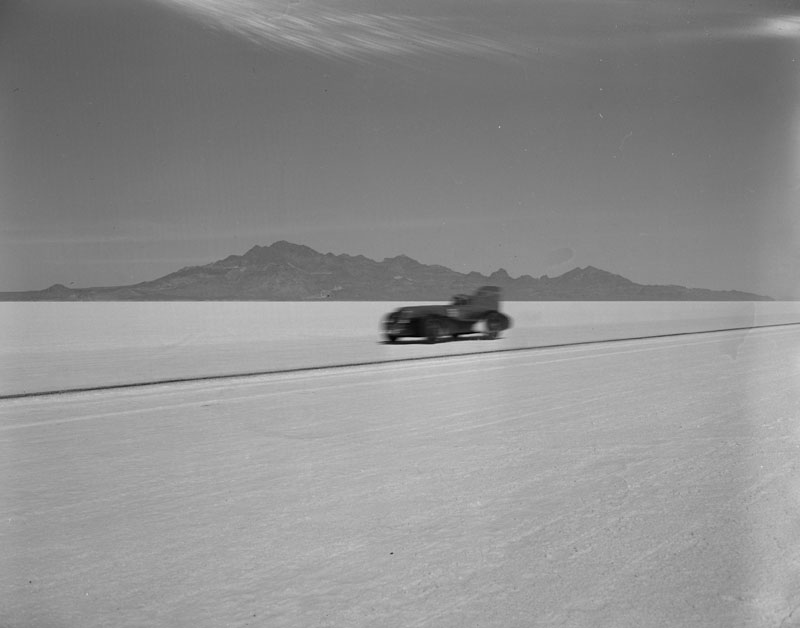
Ab Jenkins racing his "Mormon Meteor" across the Bonneville Salt Flats, circa 1936-1939. Photo courtesy of the Special Collections Archive at the J. Willard Marriott Library, University of Utah.

In an article published by The Deseret News in 1950, the paper refers to the Bonneville raceway as “glassy-smooth” and “record fast” as well as very dry, which was great for setting land speed marks. As reported in an article published in The Deseret News on July 15, 1951, the 68-year old set out to race his Mormon Meteor at speeds of more than 200 mph. This is especially astounding given his age and how he had already “racked up more than 10,000 records and has never had an accident on the flats, a course that ranks as the world’s fastest and safest.”

Although Jenkins had thousands of records under his belt, he did have problems with his racecar early on. In an article published by The Deseret News in 1936, the author explains how Jenkins lost two of his records due to a mechanical error when a casting leak led a universal joint to burn out, paralyzing his car and wiping him out of that day’s record-setting runs. Even though circumstances such as mechanical malfunctions can occur, it was — and still is — very important that these racecar drivers had a crew of mechanics with them as well as parts so they could fix any problems at hand. Above all, Ab Jenkins was the catalyst to the sport of land speed racing at the Bonneville Salt Flats and he had turned this sport into a popular worldwide event that takes place annually September 8-12, right here in Utah.

Ab Jenkins sitting inside his "Mormon Meteor" on the Bonneville Salt Flats, late 1930s. Photo courtesy of the Special Collections Archive at the J. Willard Marriott Library, University of Utah.

To get an idea of the types of automobiles Ab Jenkins and other racers were using (and still are used to this day), it is important that we know these racers used everything from 12-cylinder gas engines to straight jet engines. For example, in 1932 (Jenkins’ first race on the Salt Flats) he pushed his 12-cylinder Pierce-Arrow to the limits by driving it on the flats for 24 hours straight, only to stop for refueling. His average speed in this race was 112.916 mph. (The Salt Lake Tribune, 2011) The A.A.A., however, did not record this land speed record. Being the goal oriented and driven man that Ab Jenkins was, he decided to go after his own record again in 1933.

Furthermore, he influenced “top British racers Sir Malcolm Campbell, Capt. E.T. Eyston and John Cobb to visit the Salt Flats for the first time, setting records and launching the site’s global reputation.” (The Salt Lake Tribune, 2011). Just a couple years later in 1935, Jenkins came out with his “Mormon Meteor II,” which was a 12-cylinder Curtis airplane engine that had a little over 400 horsepower. In this vehicle he set a 24-hour land endurance average speed record of 135 mph, covering over 3,523 miles. (Owens, Supercars.net) Jumping ahead to 1970, Gary Gabolich’s rocket car, “Blue Flame,” set a speed of 622.4 mph (The Salt Lake Tribune, 2011). When these men are out racing their cars, it is the A.A.A. that is clocking their official times on the racetrack (or Salt Flats). In a September 1936 article published by The Deseret News, the author wrote that Jenkins was to pay $2,500 to the A.A.A. timers for their assistance in clocking the official runs down the Salt Flats. Back then, $2,500 was a lot of money, but thanks to Jenkins’ accomplishments and popularity in the state of Utah, the Optimist Club (a philanthropic organization) gathered this money for Jenkins and paid the A.A.A timers for his runs.

After many years of passion and joy for the sport of land speed racing, Ab Jenkins is still a legend and still holds the 48-hour endurance record to present day. According to Barracuda Magazine, “Ab Jenkins held and broke more records than any other person in the history of sports.” Jenkins’ attitude and outlook on life and the sport of racing was rare. “Jenkins was a breed of consummate sportsman-gentleman whose polite and honorable conduct today seems as rare and quaint as the open-cockpit Pierce-Arrow that he first raced at Bonneville.” (Barracuda Magazine) Additionally, in an article published by The Salt Lake Tribune in July 1935, John Cobb (a top British racer) applauded the sportsmanship of America and spoke very highly of Ab Jenkins, whom he called the “Iron man of America.”

Nicholas W. Hageman, left, at the Bonneville Salt Flats, September 2011.

Thanks to Ab Jenkins, the Bonneville Salt Flats are used for more than just land speed racing, however. Filmmakers and television producers use the Salt Flats in movies and TV shows because of the beautiful scenery it can evoke. Examples of a couple of films that have been shot at the Salt Flats are Independence Day, The World’s Fastest Indian, and even The Pirates of the Caribbean. Additionally, the surrounding areas of the Bonneville Salt Flats are featured in the movie Con Air. (The Salt Lake Tribune, 2011) The scenery is so wide open and remote, filmmakers and directors can virtually make the Salt Flats look like any place in the world they want to. Overall, the Bonneville Salt Flats have many uses and are popular worldwide by a variety of different enthusiasts, thus making it a significant landmark for entertainment and historical purposes here in the state of Utah.

Nicholas Hageman is a senior at the University of Utah. He is studying speech communication and will graduate in August 2012 with a B.S. in speech communication. Nicholas is an avid golfer, fisherman, hunter and car enthusiast. He transferred to the University of Utah in the fall of 2011 from the University of Arizona, where he studied Agribusiness Economics & Management.

Sources 

Tom Wharton, “Wendover: More Than Gambling,” The Salt Lake Tribune, December 6, 2011, C1.

Sean Means, “The Meteor Rides Again,” The Salt Lake Tribune, August 21, 2011, D2.

“Jenkins Awaits Friday Salt Flat Run,” The Deseret News, July 15, 1951, C5.

“Salt Flats Dry, Fast For Races,” Deseret News, September 2, 1950, 11.

“Ab Jenkins To Go After Own Records,” Deseret News, October 15, 1946, 10.

“Five Bouts Feature Ab Jenkins Benefit Card,” Deseret News, September 25, 1936, 15.

“Jenkins Will Start Again Monday,” Deseret News, September 17, 1936, 7.

George Chambers, “Cobb To Return To Utah Salt Flats,” The Salt Lake Tribune, July 18, 1935, 12.

Richard Owen, “1935 Duesenberg SJ Mormon Meteor Speedster,” Supercars.net

Janna Bushman and James Davis, “Crafting a Sense of Place: Media’s Use of the Bonneville Salt Flats,” Journal of Cultural Geography 17, no. 1 (1997).

George Lepp, Bonneville Salt Flats: Speed Limit 1,000 mph (Osceola, WI: Motorbooks International, 1988).

Ab Jenkins and Wendell J. Ashton, The Salt of The Earth (Salt Lake: The Deseret News Press, 1939).

Real-Man Revisited: Ab Jenkins Son of the Salt,” Barracuda Magazine (no. 11).

Jessie Embry and Ron Shook, “Utah’s ‘Ugly Duckling’ Salt Flats,” Utah History to Go, State of Utah.

Kevin B. Hallaran, “Bonneville Salt Flats,” Utah History to Go, State of Utah.

The Civilian Conservation Corps and the Building of Zion National Park

by AMY D. WILDE

Photo courtesy of the Special Collections Department, J. Willard Marriott Library, The University of Utah.

Zion National Park is one of the United States’ natural hidden treasures and would not be the utopia that it is today without the efforts put forth by the Civilian Conservation Corps. Also known as the CCC, this program was created to help sustain jobs and to give opportunity to the young unemployed men of the United States as well as to improve public lands during the Great Depression of the 1930s.

Signed as a national park in 1919, Zion is one of Utah’s best-kept secrets and the first national park of the state. Mukuntuweap Canyon, which was the original name for Zion Canyon, was the  “cool habitat that became the home for the first people of Utah … around 11,000 B.C.,” writes David Oswald in his book, A Journey Through Mukuntuweap: The History of Zion National Park. Located in the southeast corner of the state, Zion is a spectacular Park that can only be accessed by one double-lane state road, which is closed to public traffic in the summer months. Instead, visitors ride park-run busses that help keep the park almost emission free, clean and pristine. One thing that is more than likely forgotten by the visitors who come to the park is the history and how it came to be. Zion not only has a rich history of Native American culture but also an opulent history that involves the growth sustainability of the United States as a country.

President Franklin Delano Roosevelt established the CCC on March 31, 1933. The organization was created to fight against soil erosion and declining timber resources by utilizing unemployed young men from large urban areas across the country. It is said that “the speed with which the plan moved through proposal, authorization, implementation and operation was a miracle of cooperation among all branches and agencies of the federal government. It was a mobilization of men, material and transportation on a scale never before known in time of peace.” (CCC Legacy) After establishment the program boomed, and held great public support with hundreds of thousands of young workingmen enrolling every day.

Zion Canyon, Zion Lodge, circa 1930. Photo courtesy of the Special Collections Department, J. Willard Marriott Library, The University of Utah.

The Zion Camp was established in June 1933 and began to flourish not too long after. A newspaper ad from the Garfield County News on September 9, 1941, ran with a title, “Openings Announced in Zion CCC Camp.” An excerpt reads, “During this period of National Emergency there is a great demand for trained workers and the Civilian Conservation Corps performing its share of training young men for better jobs.” It gave insight into the demand for workers and the scarcity of position openings at the camps during their peak years. During the nine years that the CCC spent creating Zion, members “built and improved many of the Zion Canyon’s trails, created many of the parking areas, fought fires, eradicated invasive plants, helped build campgrounds, built park buildings, and reduced flooding of the Virgin River.” (NPS)

The booming year for the CCC camps was 1935 and by the end of the year, there were over 2,650 camps operating in all states. In total, $322,682 was spent expanding the Zion National Park through the CCC, according to Wayne K. Hinton in his 2011 Utah Historical Quarterly article. California had more than 150 camps, each housing over 6,000 people. CCC enrollees were performing more than 100 kinds of jobs and skills. Some of the specific accomplishments of the Corps included 3,470 fire towers erected; 97,000 miles of fire roads built; 4,235,000 man-days devoted to fighting fires; and more than three billion trees planted. (CCC Legacy)

For payment, the men were given somewhere to sleep, food to eat and clothing to wear, and made about $30 a month. Most of them kept $5 and the remaining $25 was sent home to their families. (Oswald) Topics regarding the “hearty Army meals and menus,” the clean hospitality that was given to the workers, as well as the hefty budget that was dedicated to running the camps can be seen in an article from the Kane County Standard on February 15, 1935. The reporter writes, “When the American boy of today goes into the woods he takes his appetite with him no less than his older brother took and appetite to war in other days.” Men gained an average of “9 ¾ pounds” after working in the camps for only three months, according to an article form the Iron County Record published on March 8, 1934. This information was noteworthy news because of the Great Depression in which the rest of the country was rationing food and supplies. Working for the CCC was not only beneficial to the country, but also for the workingmen who got the opportunity to enroll.

The men spent all week completing backbreaking jobs around the park, including building the 1.1-mile tunnel through a solid mountain. But they still had the energy to spend time taking hikes throughout the park on the weekends. One example of this is from the diary of Belden Lewis, a CCC enrollee who worked in the park from 1934-1935.

“I went on a long hike. First to West Rim, then on the way back Widdison and I went to Angels Landing and signed our name in the autograph book. The hike was at least 25 miles long round trip and we were tired.”

These places that Belden mentions are some of the most popular hikes in the Park and today are very frequently traveled trails, which were created by the CCC. “The main roads and trails of the canyon were built, including the trail to The Narrows by the men of the CCC.” (Larson) The men worked extremely hard on creating the beautiful park that we see today, but also had the amazing opportunities to explore the park themselves.

The CCC did wonders for Zion and almost the entire park holds the history of this hard time for the United States. When the Civilian Conservation Corps’ work in Zion was ended in 1942, many of the men were able to transition from structured CCC life to the structured life of a military man as they fought in World War II. The CCC was essential in the creation of Zion and without their work it is hard to say what would have became of the canyon, if anything.

Today, more than 2.5 million curious patrons visit Zion National Park annually, and many hope to catch a glimpse of the sun rising on the Towers of the Virgin. In the summer months, busy sightseers crowd the paths like sidewalks in New York City during rush hour, and walk upon trails created by the CCC. Zion National Park holds nothing less than the jaw-dropping landscapes and awe-inspiring cliff faces one would assume. There is nothing like it in the world and without experiencing this veiled sandstone treasure with your own eyes, you cannot say that you have seen the earth’s natural true beauty.

Amy D. Wilde is a senior at The University of Utah. She is majoring in mass communication and minoring in international studies.

Sources

“Openings Announced in Zion CCC,” Garfield County News, September 9, 1941, 1.

“Supt. Patraw Praises CCC,” Kane County Standard on February 15, 1935, 1.

“Men of CCC Camp in Good Condition,” Iron County Record, March 8, 1934. 1.

“CCC Camp Now Located at Zion Nat’l. Park,” Iron County Record, August 2, 1934. 1.

Wayne K. Hinton, “Getting Along. The Significance of Cooperation in the Development of Zion National Park,” Utah Historical Quarterly (2000): 313.

Karl A Larson, “Zion National Park—Park with Some Reminiscences Fifty Years Later,” Utah Historical Quarterly (1969): 408I.

David Oswald, A Journey Through Mukuntuweap: The History Of Zion National Park (Scotts Valley: CreateSpace, 2009).

J.L. Crawford, Zion National Park: Towers of Stone (Albion Publishing Group, 1988).

Zion National Park Museum, “The Diary of Belden Lewis,” 1934-1935.

National Park Service, “Civilian Conservation Corps,” http://1.usa.gov/HjZiGs

“CCC Brief History,” Civilian Conservation Corps Legacy, http://bit.ly/Hiaym9

Deseret News Marathon History

by CARA HASEBI

In 1847, the Mormon pioneers who had been traveling across the country trudged their way into the great Salt Lake Valley for the first time. Their first vision of the valley involved pulling handcarts down Big Mountain, up Little Mountain, down the other side of Little Mountain, through Emigration Canyon, until finally on the last turn they could see the vast desert valley that would be their home. More than 100 years later, folks from all over the country desire to trek through those same mountains over the same blessed ground in memory of the pioneer courage. Or, they simply love to run.

The first Deseret News Marathon was inaugurated in 1970. The course has become known as being “too difficult,” and Haraldsen notes it was the first such organized race west of the Continental Divide. It was originally named the Pioneer marathon, though the Deseret News was the marathon’s largest sponsor from its beginning. The name was eventually changed to reflect the sponsor but it is still held on Pioneer Day (July 24th) every year.

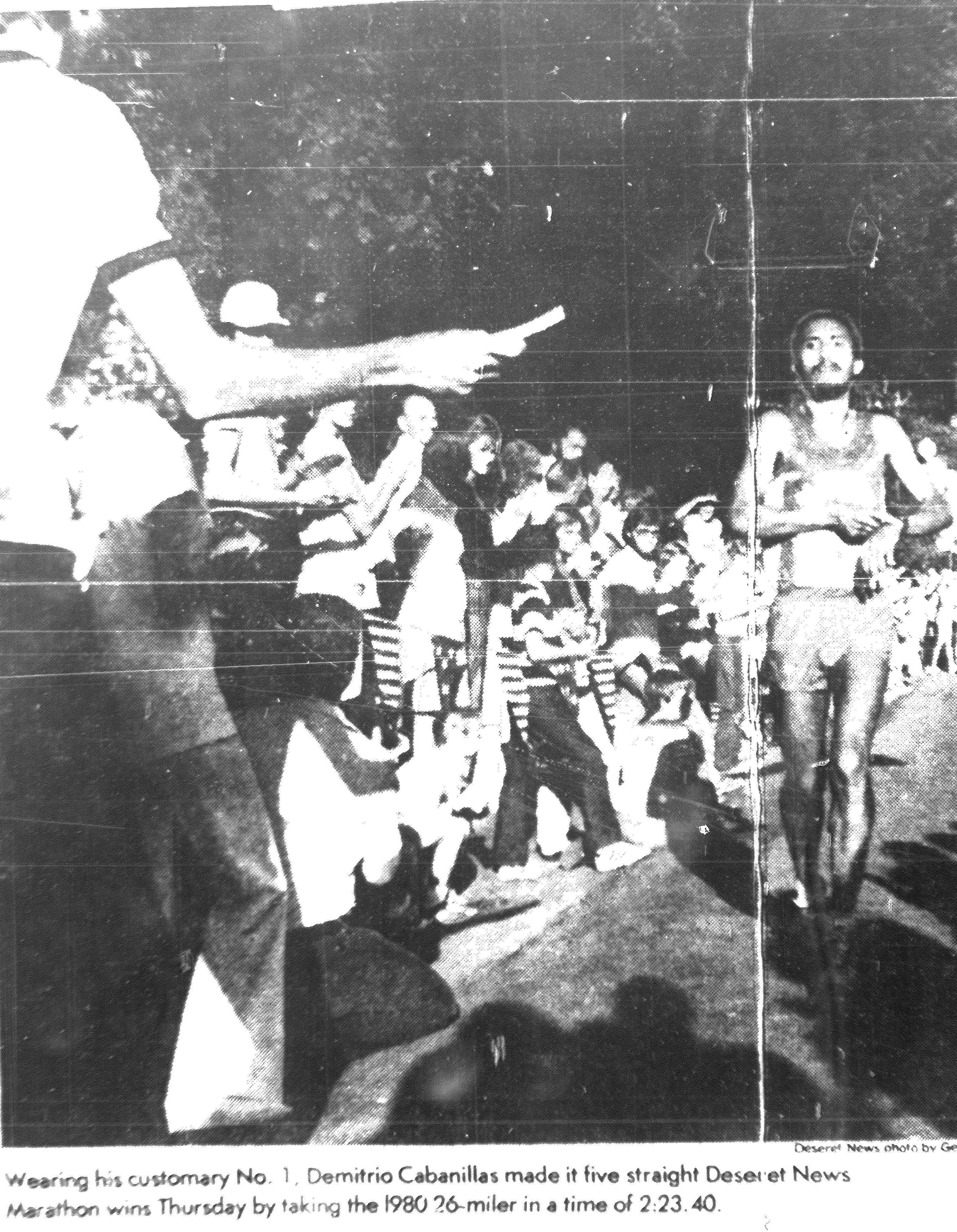
Demitrio Cabanillas won five straight Deseret News Marathons. In 1980, he competed against the largest field in the marathon's history and crossed the tape first with a time of 2:23:40. Published in the Deseret News, July 24, 1970.

According to a Deseret News article published July 24, 1970, the marathon started out small, with only 73 entrants, all of whom were men. The race gained in popularity and by 1980, more than 1,500 runners entered the race, according to a post-race article in the Deseret News. The popularity of running in Utah and specifically the Deseret News Marathon may be attributed to a national and religious fitness movement.

In 1980, the same year as the record number of Deseret News Marathon race participants, President Jimmy Carter spoke at the first ever Conference on Physical Fitness. Of the 15 priority areas created for national health, Physical Fitness was named as one of them. President Carter was a runner himself; he mentioned at the conference that he often jogged around the White House grounds with his wife. He also mentioned at the conference that the number of Americans who exercised had doubled between 1970 and 1980.

The number of race participants in the Deseret News marathon in that time had increased by a factor of 20. In a November 6, 1978, New York Times article, a spokesperson for the American Medical Association is quoted as saying, “there is unquestionably a greater awareness of the body and preventative medicine than 10 years ago.”

Utah was not absent during the rising national interest in fitness. The leaders of the Mormon Church, headquartered in Salt Lake City, found importance in physical fitness as well. Physical health is a key component in the Church of Jesus Christ of Latter-day Saints (Mormons). An article by an LDS member and marathoner appeared in the official church magazine, the Ensign, in February 1981, detailing directions on how to begin jogging and work up to marathoning. Church members were not the only ones who contributed to the fitness dialog. In February 1979, a church official wrote an article in the Ensign. He  noted that every member should practice sound principles of nutrition, physical fitness, and weight control. The article specifically mentioned running marathons as a way to have better physical health. Additionally, Thomas S. Monson, an apostle of the church, spoke officially for the LDS church in a semi-annual conference in April 1982. “The Church of Jesus Christ of Latter-day Saints affirms the continued support of Scouting and will seek to provide leadership which will help boys keep close to their families and close to the Church as they develop the qualities of citizenship and character and fitness which Scouting represents.” (Monson) He mentioned in the same article that scouting is a great way to stay physically fit, and running is an option for boys seeking to pass scouting requirements.

Despite support at the national and local level, participation in the Deseret News Marathon declined gradually until in 2003 organizers made the decision to no longer hold the marathon. Haraldsen writes that the directors announced in March 2003 they would no longer continue holding the marathon each year. With the decline of runners registering for the race there wasn’t enough reason to continue it. There are two primary reasons the race does not attract runners. The course is difficult with its many rolling hills, and the race is not considered “fast.” Also, on July 24th Salt Lake City can hit extremely high temperatures. Doug Robinson of the Deseret News explains it this way: “From its inception, the Deseret News Marathon has been largely the domain of grass-roots runners…. World-class marathoners, able to run only two or three marathons a year anyway, tend to look for fast marathon courses and fast times to promote their careers, and they’re unlikely to get either on a mountainous course at altitude in the heat of July.” Despite the decrease in the number of participants, the Deseret News Marathon received a message from the running community in Utah that it wants the Deseret News Marathon to continue. (Haraldsen, July 2003) Race directors listened to veteran runners’ pleas and decided to carry on with the race.

The growth of the Deseret News Marathon along with national and church health promotion is not purely coincidental. The rise and fall of national and religious physical fitness trends are displayed historically through organized marathon races. Although there are more options when it comes to marathons and the Deseret News course is more difficult to navigate, the Deseret News marathon is now in its 42nd year running — literally.

Cara Hasebi is an avid marathoner, having run the Deseret News Marathon several times.  She will be a senior at The University of Utah in Fall 2012, majoring in Mass Communication with a minor in Nutrition.


Tom Brown, “Price Runner Wins ‘News’ 47 Marathon,” Deseret News, July 24, 1970, B5.

Pamela G. Hollie,“Spas Thrive on Diet, Fitness Craze; Profits Mount For Owners,” New York Times, November 6, 1978, 82.

Marvin K. Gardner, “Staying Prepared,” Ensign (February 1979): 24

Jimmy Carter: National Conference on Physical Fitness and Sports for All Remarks at the Opening Session of the Conference,” February 1, 1980, accessible at The American Presidency Project, ed. Gerhard Peters and John T. Woolley.

Lee Benson, “Cabanillas makes it 5 in a Row,” Deseret News, July, 24, 1980, D1.

Scott S. Zimmerman, “Running Away from it All,” Ensign (February 1981).

Thomas S. Monson, “Run, Boy, Run!,” Ensign (October  1982).

Doug Robinson, “DNews Marathon: A Tale of Endurance,” Deseret News, July, 23 1994.

Tom Haraldsen, “July 24 marathon tradition coming to an end,” Deseret News, March 25, 2003.

Tom Haraldsen, “Marathon may get new life,” Deseret News, July 16, 2003.


The Salt Lake Bees, 1915

by CAMERON STEVENS

The Salt Lake Bees, a Pacific Coast League (PCL) baseball team, came into existence in 1915. In 1915, the Sacramento Sacts franchise had relocated to San Francisco due to poor ticket sales. The franchise stayed in San Francisco only one season before moving to Salt Lake City in search of better revenue opportunities. According to Snelling, once in Salt Lake City, the franchise had unprecedented financial gains and a highly successful, rollercoaster 1915 season.

The PCL has functioned as a minor league, or farm system, for developing Major League talent since its inception in 1903. Several minor leagues existed in the United States at the time, but the PCL offered higher quality baseball, salaries, and amenities than any other farm system at the time.  The PCL produced such excellent baseball that it was widely considered a third major league, according to Utah Historical Quarterly, in addition to the American League and National League, which would eventually join to form Major League Baseball.

In 1912, the Sacramento Sacts were failing at the gates, and in 1913 the team finished the regular season with a losing record and relocated to San Francisco in search of greener pastures. The official Web site of Minor League Baseball reports that after only one season as the San Francisco Mission Wolves, the franchise again moved in search of greater revenue, this time to Salt Lake City. As the only PCL franchise outside of California, the Bees became a baseball outpost. This both heightened the presence of the league throughout the western United States and raised operating costs for the league due to the increased amount of travel to meet home and away games. Despite these initial risks, Snelling notes that new franchise owner Bill “Hardpan” Lane deemed the move prudent and believed a success was inevitable.

The Bees season began on the road with a March 8 loss to the Chicago White Sox, followed the next day with a 5-3 victory over the same club.  The San Jose crowd (the White Sox were on an extended road tour to keep costs down, and thus played “home” games in California) was one of the largest recorded for a minor league game at the time, and the game was tied in the top of the sixth 3-3. On March 9, 1915, The Deseret News reported that Hannah, a little known utility infielder, came to the plate with the bases loaded and hit a low line drive that scored one run and provided a lead that would never be relinquished. It should be noted that because of the scarcity of full rosters and use of abbreviated box scores, players are often recorded only as last names.

On March 31, 1915, the Salt Lake Bees took the home field for the first time against the Vernon Tigers, a PCL team based near Los Angeles. Until this point, Salt Lake fans only knew of the Bees from sports page box scores and open practices.

Bonneville Park in Ogden, Utah, was filled beyond capacity with 10,000 newly minted Bees fans. As if preordained, the Bees pounded the perennial PCL powerhouse 9-3, as observed by The Deseret News on April 2, 1915. This game was the beginning of one of the most exhilarating seasons in minor league history, and an unquestionable financial success, explains Snelling.

A month and a half into the season, the Bees were playing above-average baseball. Because of the cost of traveling to the West Coast, the Bees went on extended road trips and played throughout California. The Bees played a game against the San Francisco Seals that would set the tone for the rest of the season. Despite also being a newly transplanted team, the Seals were locked in an early inning struggle with the Bees in which the Seals capitalized on their few scoring opportunities and Salt Lake repeatedly left men on base. The Seals pitcher, recorded simply as Meloan in the April 28, 1915 issue of The Deseret News, decided the game. The left-handed Meloan set a standard of dominating southpaws that Snelling’s statistics show haunted the Bees until season’s end.

At the season’s halfway point, the Bees were ten games above .500, but several crushing defeats turned the tide and threatened the season-ending standings of the PCL’s most remote franchise.

On June 22, Salt Lake lost in the last second to the Oakland Oaks 7 to 11.  Surprisingly, only the final score was reported in The Deseret News, on June 23, 1915. The full box score wasn’t even printed.

The following day, the Bees used four pitchers against the Oaks in a rematch (although common in modern era baseball, using more than two pitchers was a rarity in professional baseball in the early 1900s). Despite their best efforts and managerial creativeness, The Deseret News, June 23, 1915, reports that the Oaks shelled the Bees for 11 runs. The Bees managed three two-run spurts but nothing else over nine innings.

The ability to seemingly score at will became a hallmark of the 1915 Bees, but this ability only presented itself in patches with maddeningly irregular results. The Bees had shown that they could blow out any team in the PCL, yet had a terrible habit of losing crucial games. Snelling writes that despite these shortcomings, the Bees stood five games over .500 at the beginning of July.

As the season wore on, the Bees affirmed themselves as a PCL championship contender and every game became increasingly important. On July 10, 1915, the Bees played a critical doubleheader against the Vernon Tigers. Despite defeating the Tigers by three runs the day before, Salt Lake lost both games 4-6. When the season series had ended, Salt Lake had won only two of the seven games the two teams played in 1915, as explained in The Deseret News, on July 10, 1915.

On July 24, 1915 the Bees played against the Portland Beavers, a middling PCL team. Despite the dominance the Bees had shown throughout the season over the Beavers, Snelling observes that the game was important for the Bees record and season-ending standings.

The Bees’ right-handed pitcher Williams allowed only nine hits in a complete game. Despite Williams’ performance, The Deseret News reported on July 26, 1915, that his own fielders, namely Lou Barbour, undid his efforts.

Barbour was the Bees’ regular third baseman, a great hitter but an inconsistent fielder.  Three of the Bees’ six errors came from third base alone, one of which ricocheted off Barbour’s glove, and two balls he actually kicked away from himself while trying to field the ball.  These mistakes, combined with eight men left on base, show the comically bad side of a great baseball team.

The Los Angeles Seraphs came to Salt Lake for a July 29 meeting to place the finishing touches on the season. Salt Lake was one game out of first place, and had to win in order to maintain a chance at the PCL championship. Snelling’s game score card shows that the Bees entered the ninth inning two runs in the lead, and promptly fell apart at the seams. The Seraphs scored three times, twice on Salt Lake errors. After a close play at first base allowed the winning run to stay on base, the Bees’ fate was sealed. At game’s end, both teams had generated thirteen hits, according to The Deseret News August 1, 1915.

The  Bees finished the 1915 season with a record of 108-89 in second place in the PCL, as noted by Snelling.

On November 1, 1915, The Deseret News reported that the Bees paid out a 5 percent dividend to investors in Bees owner Bill Lane’s long shot and the franchise was officially valued at over $50,000. The franchise values provided by Snelling show that a newly transplanted team, in a remote location such as Salt Lake, would never be expected to experience this kind of success.

The Bees concluded their initial season under owner Bill “Hardpan” Lane and manager Cliff Blankenship, holding second place in the Pacific Coast League, one of the most dominant leagues in minor league baseball.

Cameron Stevens is a public relations student at the University of Utah.  He enjoys long walks on the beach, imported beers, and Café Rio fire grilled steak burritos, black beans, hot sauce.  Hold the guac, por favor.  Oh, and a large Fresca.

Sources

John Sillito, “‘Our Tone’: Tony Lazzeri’s Baseball Career in Salt Lake City, 1922-1925.” Utah Historical Quarterly 72 no. 4 (Fall 2004): 343-357.

The Deseret News, March 9, 1915.

The Deseret News, April 2, 1915.

The Deseret News, April 28, 1915.

The Deseret News, June 23, 1915.

The Deseret News, July 10, 1915.

The Deseret News, July 24, 1915.

The Deseret News, July 26, 1915.

The Deseret News, August 1, 1915.

The Deseret News, November 1, 1915.

Dennis Snelling. The Pacific Coast League: A Statistical History, 1903-1957. Jefferson, N.C.: McFarland & Co., 1995.

Ron McBride, University of Utah Football Coach

by KEVIN HUSSEY

Vickie McBride said about her husband: “Ron had only two girlfriends in his life, and he married them both.” (Jacobsen-Wells) Ron McBride got married at an early age to Joann Hefte. They eventually divorced; she said it was because he still was too into football and interested in hanging out with his friends. He later would marry Vickie, who is still his wife today.

Football was always a huge part of McBride’s life. He was captain of the San Jose State football team, and went on to play semi-professional ball with the San Jose Apaches. McBride would make his way up through the ranks, from coaching a high school team in San Jose to being one of the most renowned coaches of all time.

His greatest days were coaching the University of Utah Utes. “Since he became head coach in 1990, McBride has won 83 games, second most in school history.” (UtahUtes.com) That is an astounding number for a college coach. McBride always had a way of putting things simply, as he does here, “They kept getting better as it went on, and the other team kept getting worse.” (McBride)

He had great success with these Ute football players, and that came from his intense coaching style. He stressed to his players that they must take pride in their work and work for what they wanted to achieve. Coach Mac, as they called him, took pride in the rivalry games that occurred once a year. Coach Kyle Whittingham said, “Coach Mac got that thing turned around to where it was a true rivalry again.” (Kragthorpe) The rivalry became as intense as it had ever been before because of Coach Mac and his Utah Utes. “He’s responsible the resurgence of this program.” (Alden) He was commenting in the newspapers and letting people know that this was the year that the Utes would pull off the victory.  This of course caused uproar and chaos within Salt Lake City and Provo and created many years of epic rivalry games. “Utah had managed only two victories over BYU in the twenty years prior to Mac’s attack.” (Jacobsen-Wells)

In 1993, Coach McBride surprisingly led the Utes to an upset over the favored BYU Cougars, 34-31. “The state was stunned.” (Jacobsen-Wells) What made McBride such a star at the University of Utah was the fact that he started out three and one against the dreaded Cougars from down south. That is what mattered most to these die-hard Ute fans.

In 2002 Ron McBride was in the end of his career as Utah coach and he knew it. “There’s dark, and then there’s dark. And then there’s Ron McBride’s mood.” (Miller and Rosetta) This completely described Ron McBride’s career and how he felt toward his Utes. He would even take them to Price every August just to keep them away from distractions. Unless perfection was met, McBride was an unhappy fellow. “In just eight years, Coach Mac became the second-winningest coach in Utah’s 104-year football history and the only coach ever to take Utah to more than one bowl game.” (Jacobsen-Wells) Coach McBride was also very superstitious, especially when it came to rivalry games. Coach McBride talked after a game: “After the BYU game, I knew something was going to happen. There was an article in the Sunday paper that was pretty harsh.” (Dienhart)

McBride knew that his tenure at Utah was going to come to a screeching halt unless he won some sort of championship or kicked BYU’s butt; he did neither. Although he did not win a championship at Utah, he still led a potent football team that grew to the powerhouse it is today. Ron McBride was part of the roots of this football team, and he brought them to greatness. Dick Tomey, coach of the Arizona Wildcats, said about Coach McBride: “McBride is willing to sacrifice anything — time, effort, even his own blood — to earn a victory.” (Miller and Rosetta) He had won a few rivalry games during his tenure at Utah, but it surely wasn’t enough without a championship. Even though McBride had been at the University of Utah for thirteen years, he was still going to be shown the door because he hadn’t won a championship, and he lost to BYU a few too many times. Coach McBride said, “The people in Salt Lake were good to me, and the University treated me well. (Dienhart) He loved this city and how the rivalry made this community and his team come together. He said he deserved more respect at the end of his career because of all that he had done for this team, but in the end, “That’s just the way it is.” (McBride)

Some people didn’t feel like McBride fulfilled his potential. “He may be a decent recruiter, and able to motivate and inspire his players, but in the final analysis, he doesn’t have the resolve or gumption to push the players to the very limit of their endurance. He’d rather be their buddy.” (Neeleman) It is very hard for a coach to have full respect from his players if the player sees the coach as a friend. The coach is supposed to strike some fear in the players because he is considered their boss. If McBride were able to terrorize his players a little bit like Rick Majerus did, as well as mix in being a personable coach, then he would have had the chance to be one of the greatest coaches of all time to go along with his already stellar resume.

Some important stats to his resume: “McBride posted an overall record of 88-63 (.582).” (Wikipedia) He also took his Utes to six bowl games, previously three bowl games in the past 97 years. He beat powerhouse teams such as USC, Arizona, and Fresno State in three out of the six bowl games. “His best season came in 1994 when the Utes won a then-record 10 games and attained the highest post-season ranking, at the time, in school history climbing to No. 8 in the USA Today/ESPN poll and No. 10 in the AP poll.” (Wikipedia) Coach McBride started to look like a genius to Salt Lake City folk, and became a local town hero for turning the Utes into a national contender.

McBride had many nicknames in Utah: “Mac became known as ‘Captain Voodoo,’ the man who, with the sweep of his magical cape, had been known to ward off evil spirits and win games.” (Jacobsen-Wells) This was implying how superstitious that Coach McBride was. He believed in good-luck charms, and who can argue that they didn’t work, just look at his win/loss record? “Mac’s belief: It can’t hurt to have help.” (Jacobsen-Wells) He is absolutely right, why not have karma on your side? That is one of the reasons why the Utes would stay in the same hotel the night before home games, and McBride would stay in the same room every time, and if his team won the previous time then he would wear the same clothes as the previous time.

So why is Ron McBride such a great part of our Utah history? He was the base of our greatness for all Ute football fans. He brought pride back to our community and made people proud to say they were a Ute. People were able to talk trash again to the Cougar community, and flash their red in gloating greatness. He struck confidence into many players, that would go onto have successful careers in the NFL, as well as the workplace. He jump-started a program that continues to grow in talent every year. Ron McBride will always have a place in Utes fans hearts, and will be remembered for a long time.

Kevin Hussey is a senior at The University of Utah majoring in communication with a minor in business. He has played for the Utah baseball team from 2008-2010.  Kevin plans on working in the sports communication business, dealing with advertising.

Sources

Phil Miller and Dick Rosetta. BYU vs. Utah — The Unholy War. Salt Lake City: Gibbs Smith Publisher, 1997.

Tom Dienhart, “…To Get Canned?” July 12, 2004.

“Utah Football,” UtahUtes.com.

J. Neeleman. “Ron McBride’s Fatal Flaw and where the Utah Program May Have Gone Wrong in the Early 1980s.”

Kurt Kragthorpe, “BYU Vs. Utah: Mac’s Legacy Played out in LaVell’s House,” The Salt Lake Tribune, November 28, 2009.

Ron McBride. “Ron McBride Quotes.” ThinkExist.com.

“Ron McBride.” Wikipedia. <http://en.wikipedia.org/wiki/Ron_McBride&gt;.

“Ron McBride.” Daylife. <DayLife.com>.

Doug Alden, “Former Coach Returns to Face Utes,” USA Today, September 26, 2008.

JoAnn Jacobsen-Wells. Mac Attack: The Story of University of Utah Football Coach Ron McBride. Springville, Utah: Slickrock Books, 1998.

Deseret News Follows Developing Ski Industry, 1970-1973

by DAKOTA HAWKS

The Rocky Mountains have given Utah a resource for recreation and have become a selling point for tourists from all over the globe. Skiing has a long history in Utah and started gaining national and global recognition around the start of the 1970s. Resorts started to spring up in the mountainous areas in the northern and southern ends of the state, joining the veteran resorts such as Alta, Brighton, Park City, Snowbird, and Brian Head farther south. The Deseret News made an effort to attract both local and non-resident skiers to come get a piece of the action.

Prior to the Utah ski industry boom “ tourism expenditures increased over 30 percent in the Rocky Mountain Region in 1960-65,” which was a good indication that there was a bright future for a ski industry in Utah. (Rugh, 447) The impending revenue that was on the horizon forced Utah’s government to look into expanding ski resort accommodations and facilities in order to handle an expanding cliental.

Skiing presented a new industry for the local government to develop and visibility in local newspapers played a major role in the development. An article in The Western Historical Quarterly describes how state branding helped in “Utah’s transformation from a rural backwater to a world player in the tourism enterprise.” (Rugh, 446) The coverage of the booming ski industry in The Deseret News during the early 1970s displays boosterism tactics that attempted to help bring people up to the Rocky Mountains to experience the expanding facilities offered by the numerous resorts.

The Deseret News has delivered the news in Utah since 1850, following Utah through many changes and advancements. (Lythgoe) The growth of the ski industry in Utah and the revenue it brought in through tourism was a topic covered in the countless pages of grey paper. Looking at articles in The Deseret News during the beginning of the 1970s gives insight into how the paper attempted to bring people from outside the state and local skiers to Utah resorts as they expanded to new heights.

In 1970 the ski industry in Utah was reaching new revenue heights in the millions and the local economy was cashing in. The number of visits to ski resorts doubled between 1966 and 1971, from 442,000 to an estimated 862,000. (Wikstrom, 219) An article published in The Deseret News on March 24, 1970, noted that “new [ski] facilities are much needed” as the number of skier increased. This article voiced the need for the expansion of resorts and developments in new areas.

There was a long skiing heritage in Utah, dating back to the first resorts established in mining territories like Brighton and Park City in the late 1930s and early 1940s. Despite the skiing history the amount of non-local recognition was small and the mountains were utilized mostly by locals through the 1960s. The Deseret News reported on December 11, 1970, that actor Robert Redford had felt the power of the Rocky Mountains. The article describes a written feature including photos by Robert Redford about skiing in Utah and the treasures it offered, noting that the “vast Wasatch range have remained undiscovered by the majority of skiers.” The feature, “Robert Redford on Skiing in Utah,” displayed color pictures of the locations offered in Utah with descriptions of each area. This article gave Utah a well-known voice that advocated venturing to the ski resorts in the state.

The Deseret News on December 17, 1970, reported that the Intermountain Ski Instructor Association honored a local ski legend, Sverre Engen, for his work as a teacher of the sport and an early filmmaker of Utah skiing. He was an advocate of bringing people to Utah for the skiing locations and was praised in the article by stating that the “Wasatch wonderlands have never bad a better booster.” This article shows that movie stars and local skiing legends were both promotional selling points utilized by The Deseret News.

The Rock Hill Herald reported on March 12, 1971, about Snowbird’s new accessibility through a tram system that was the “ first tram in Utah and one of the largest in North America.” The article described the difficult accessibility of the mountain when it stated that it had been “popular with ski buffs affluent enough to use a helicopter as a chairlift.” The article also described the huge lodge projects that were being erected in Little Cottonwood Canyon stating, “Snowbird’s building program will accommodate 5000 people,” which showed the promise of further expansion in the ski industry.

An article published by The Deseret News on November 27, 1971, noted that “for visitors skiing is believing.” The article quoted then American Airlines president George Spater claiming that when “ a skier comes back from Utah and tells his friends about great skiing, they listen.” This was one of the first relationships between airlines and ski resorts. Spater continues saying that “ the proposed merger with Western Airlines would strengthen American’s ability to attract more people to Utah.” Gaining the support of airline companies in marketing and advertising gave Utah’s ski industry an new ally that could prove to be valuable in bringing people to the state in order to utilize the local ski resorts.

The Deseret News published an article on April 5, 1972, noting that skiing was perceived as the “least impressive recreation in Utah.”  The comparison against other neighboring states put Utah below neighboring states on the list of recreational tourism location. The message in the feature suggested that a new image and promotional efforts were necessary for expansion in Utah’s ski industry. The Deseret News reported on November 2, 1972, that “getting up the mountain is a snap” and recreation in Utah is a great ski location. The article noted resorts like Alta, Park City, and Park West along with the more southern region, and reported that “Robert Redford dug the area so much he put a ski resort there.” The Deseret News played a part in 1972 in attempting to change the state’s image in order to draw new skiers to Utah slopes.

An article published by The Deseret News on February 5, 1973, reported on the ski industry’s business growth. The article quotes Al Geibel, owner of the Rustler Lodge at Alta, who stated, “business is good—very, very good.” Geibel goes further and claims that “almost 100 percent of new business has been from out of state,” which helped pay for the new lodges that were under construction at the time. The article shows how different articles in The Deseret News were attempting to provide a positive image for the ski industry and Utah in general.

The increasing business occurring in the Utah ski industry was reported by The Deseret News on November 23, 1973, noting that “Utah’s ski industry showed a net profit of $18,000,000, in 1972.” This rise in profits and Utah Ski Association’s nationwide recognition showed that the industry was on the right track. The article also noted that non-resident skiing visitors “ increased 40 percent.” The article also hopes that resorts don’t “turn their collective backs on the all-important local skier.” This article shows the upswing in the ski industry and its contribution to Utah’s economy while keeping focused on local ski enthusiasts.

Looking at the move toward a successful ski industry, The Deseret News reported on September 15, 1973, that Utah’s ski industry “has been discovered” and will continue to prosper. The ski conditions of the Rocky Mountains were noted as “another factor in Utah’s ski success.” The article also shows how the airlines profited, stating that their revenue had grown “as much as 300 percent in skier traffic this past winter,” showing the symbiotic relationship between the industry. The feeling of the article is that Utah skiing had finally arrived and had a bright future.

My research on The Deseret News coverage on the ski industry was focused on the progression of the industry. Although the media aren’t always the driving factor behind industries, the ski industry was impacted by the newspaper’s coverage directed toward local and non-residential skiers. The Utah ski industry utilized the resources at hand and created an industry that continues to flourish. The Deseret News’ coverage of this development played a part in gaining support for the expansion of the industry on a local and non-residential level. The cooperation of the airlines and publicity drawn from Redford’s feature and local skiing legend Sverre Engen helped boost Utah’s ski industry to a new level.
Without the media coverage on the emerging ski scene, it may have never reached the high marks that we see it at today. The Deseret News has remained a staple of communication for Utah, because it has covered issues like “The Greatest Snow on Earth.”

Dakota Hawks will graduate from the University of Utah in August 2010 with a degree in mass communication. He is a snow fanatic.

Sources
Arnold Irvine, “Leisure Manufacturing Big In Utah,” The Deseret News, March 24, 1970, A17.

Hack Miller, “Ski Feature Boosts Utah,” The Deseret News, December 11, 1970, B9.

Hack Miller, “Skiers Honor Sverre,” The Deseret News, December 17,1970, D1.

Bill Hill, “Snowbird Rises on Wasatch Slopes,” The Rock Hill Ledger, March 12, 1971, 15.

Arnold Irvine, “Visitors: Skiing is Believing,” The Deseret News, November 27, 1971, 27.

Arnold Irvine, “Vacation in Utah? Poll Says ‘Unlikely,’” The Deseret News, April 5, 1972, 8b.

“Utah Has Desert Image,” The Deseret News, November 2, 1972, 6f.

Robert Buckhorn, “’Utah’s Really Arrived,’” The Deseret News, Febuary 5, 1973, 10B.

Rolf Koecher, “Utah’s ski snow a hot item these days,” The Deseret News, September 15, 1973, 1B.

Dave Kadleck, “Yes, Virginia, Utah’s skiing is on the move,” The Deseret News, November 23, 1973, 2C.

Susan Rugh, “Branding Utah: Industrial Tourism in the Postwar American West,” The Westerm Historical Quarterly (2006): 445-472.

Dennis Lythgoe, “Deseret News,” Utah History Encyclopedia.

Wikstrom Economic & Planning Associates, Inc., RRC Associates. “Utah’s Ski Industry.”

Community Park to Derks to Franklin Covey to Spring Mobile: A 94-plus-year History of Salt Lake’s Diamond

by BRETT CURTIS

A little known fact is that professional baseball has been an important part of Salt Lake City culture for nearly a century. Since the birth of the Salt Lake City ball club, in March of 1915, the team has undergone many name changes and venue adaptations. The club was initially known as the Salt Lake Bees and retained the name for many years. Next, the team was known as the Trappers (the team’s name changed many times at this point and was called the Angels, the Gulls, and the Giants). This series of name changes began in 1950 and went on for forty years. I first knew the team as the Buzz in 1993, after which the name was changed to the Stingers for a short twoseason time period and it has come around full circle to be called the Salt Lake Bees anew.

The team name is not the only thing that has changed. In the history of the franchise, stadiums also have come and gone, and changed names multiple times. Demolition of the ballpark has happened by means natural or of man power; construction and stadium name changes have been a common reoccurrence in its lifespan. In this article, I will discuss the evolution of team and stadium names and construction of the current stadium. Independent of the team and stadium name changes this extraordinary part of Utah’s history has undergone, one fact has remained unspoiled. The park’s northwestern cornerstone has sat and will continue to sit at 1300 South and West Temple, and hundreds of thousands of fans will visit annually to enjoy an exhibition of America’s favorite pastime.

When first constructed in 1915, the stadium was given the name Community Park; it retained this title and facade for a little over two decades, until it burned to the ground on the night of September 24, 1946, as throngs of spectators gathered to observe the consuming inferno. All this happened just four evenings after the team finished the Pioneer League Playoffs. Construction of Derks Field began in early Februrary of 1947 and was completed just in time for the Bees home opener on the 23rd of May in that same year. (Deseret News, May 30, 1947)

Aerial view of Derks Field three years after its construction. Photo courtesy of the Utah State Historical Society.

The team was forced to commence its season with twenty-two consecutive away games because the project was in the final stages of completion. The park was named after John C. Derks, the “dean of baseball,” a longtime Salt Lake Tribune writer, a sports editor, and baseball advocate who died just two years prior to the field’s opening. The stadium commemorated Derks until its demolition in 1992.

During that year, fans arrived to discover a deteriorating edifice where 1,500 of 10,000 total seats were sectioned off and condemned to public use. The concrete was unsafe and unsound for spectators and the decision to close a portion of the park was made due to a lack of structural integrity on the third baseline section between home plate and into the left field bleachers. At this point, demolition of the existing park and a rebuilt stadium it its place was in the best interest of stakeholders, including Salt Lake City Mayor Deede Cordini, who came into office and jumped at the opportunity to go out with the old and in with the new in the form of a stadium that would attract a larger fan base and provide sports fans with peace of mind and needed safety. (Deseret News, April 19, 1992)

The task of building the new park was given to Adams & Smith, Inc. The project called for 952 tons of steel and took two years to complete — a lengthy period when considering the design’s simplicity. The park, named Franklin Covey Field, opened in 1994 with a spectator capacity of 15,500 people. Three years later, the park was renamed Franklin Quest Field due to the merger of Franklin Quest (day planners and time management company) and Covey (time management seminars). When it opened, one source observed: “Franklin Covey Field was one of the first of the new, double-decked AAA stadiums, and it’s a beauty.” (Jarvis)

Spring Mobile Ballpark as it looks today. Photo courtesy of City Weekly.

The name of the diamond changed again in April 2009 when it became known as Spring Mobile (this is the park’s name to present date). This ballpark has been and will continue to be of great importance to Utah’s rich recreational history. The franchise is second only to the Jazz in numbers of fan spectators over its lifetime. It is important in communication because the general public knows very little about the park’s history. This article was written as a tool to educate a mass number of those who have long appreciated The Bees without knowledge of the evolution of the team or stadium’s interesting history. The relevance of this brief history is to both Utah citizens and baseball fans round the globe.

Brett Curtis is a senior at The University of Utah. He is majoring in organizational communication and minoring in Brazilian studies. He is a Realtor at RAN Life Real Estate and is a native Utahn with a “fever pitch” for the game of baseball.

Sources

Eric Pastore , Wendy Pastore, and Fred Sagebaum. “Derks Field.” Baseball Reference.com.

“Smoking and Voting,” The Deseret News, March 2, 1964.

“At Cavalcade,” The Deseret News, July 3, 1965.

“Old Timers Tilt Set Saturday,” The Deseret News, July 30, 1967.

Lex Hemphill, “History of Neglect Has Plagued Derks,” The Deseret News, April 19, 1992.

Dee Chipman, “Derks Roof? One Problem …,” The Deseret News, March 5, 1963.

“Ready for Cubs, Bosox Derks Field Takes on Polish,” The Deseret News, April 4, 1965.

Hal Schindler, “Utah Grows Up With the New Century,” The Salt Lake Tribune, January 28, 1996.

Interview with Craig Wirth, University of Utah Adjunct Professor, April 7, 2010.

Interview with Dave Curtis, a Bees fan who attended games in the 1950s and 1960s, April 7, 2010.

Gary Jarvis. “Franklin Covey Field.” Minorleagueballparks.com.

Utah vs BYU: Year One

by SHANE ROBERTS

“… to the thousands of Utahns who loathe Cougars and to their counterparts who can’t stand the Utes, it wouldn’t matter. The BYU-Utah game will always be the most important line on the schedule, the most anticipated afternoon of the fall. As long as they meet in late November with their fate and their faith on the line. Utah’s Unholy War will continue to rage.” (Miller & Rosetta, 251)

The Holy War is what the name of the game is called. The annual Utah/BYU game has become a Thanksgiving-time tradition in the state of Utah. In fall 2009 the two teams met for the 91st time on the football field. In recent years the rivalry has reached unseen success. Utah has crashed the exclusive Bowl Championship Series twice since the 2004 season. Brigham Young University has had four consecutive 10-plus-win seasons, a mark never seen in BYU football history. And within the last decade, the media coverage of this event has reached new heights. In 2004, for example, the annual game was highlighted when the very popular ESPN program College Gameday visited the University of Utah campus during the week of the game. The local media as well virtually shut out any other stories just for this week, just for this game. The Salt Lake Tribune and the Deseret News have it on the front page all week, and the student papers run rampant with excitement.

There was a time, however, when football in this state was just a blip on the radar. The rivalry started in 1896, back when BYU was know as Brigham Young Academy (BYA). There was only a single clipping in The Salt Lake Tribune, and the Deseret News was basically a local and national newspaper with little else in it, including sports. The Daily Utah Chronicle was very big on Utah football, however, primarily because it appeared to be a popular on-campus source of entertainment.

The very first Utah/BYU game was played on April 6, 1896, on the University of Utah campus. The only piece I found in either of the two big local newspapers (the Tribune and the Deseret News) was a clipping in the Tribune under the headline, “Provo BYA vs U of U: Interesting Game of Football Promised for Tomorrow.” (“Provo BYA vs U of U,” 1896) This particular story talked not only about the game time (4:15 in the afternoon it stated), but it also reported that BYA would bring to Salt Lake about 200 people. Compare that to today’s typical 50,000 to 60,000 fans in attendance at the rivalry games. The short articles goes on to speak about the rosters of both squads.

Two days later, after the game had happened, the Tribune ran a follow-up on the game headlined,  “University 12: BYA 4.” It touched on the attendance, which was around 800 people, and also included a brief description of the game itself. But it appeared the main story was the fight that happened at the game. The Tribune reported, “During the progress of the game some Salt Lake roughs, who had stolen into the grounds, started a fight with some Provo boys and in a minute over forty were being handled pretty roughly on all sides. One of the professors called the police patrol and great excitement followed on its arrival and its chase around the square after the rowdies that were captured. When the fray was over six or seven boys had bruises and bleeding faces, but no damage was done and the game went on, the University boys winning 12 to 4.” (“University 12: BYA 4,” 1896) It seems that this rivalry started the way that many fans would expect, with sleeves rolled up.

Some of the best, most detailed coverage of the rivalry can be found in The Daily Utah Chronicle. A story by I.C. Haslett, “Twelve to Four,” discussed why the first game in the rivalry happened in the spring. “After the games during the holidays, our team disbanded, and football was laid on the shelf until next fall; but the Provo boys were so very anxious to have a game that we could do no less than accommodate them.” (Haslett, 353) This article does a much better play-by-play description about that game than I would have imagined. It would rival many current publications when it comes to game analysis. Haslett touches on the fight, “Such an affair is disgraceful and gives the University a bad name, but so long as we rely on egg shell promises of the men in charge at police headquarters, occurrences of this kind will be frequent.” (Haslett, 355)

Aftershocks were felt for weeks after the first game. In a letter to the editor in the April 21 issue of the Chronicle there was a letter from one of the members of the football team saying that the U students did not carry themselves well and that they should “take a lesson in ethics and gentility.” (The Daily Utah Chronicle, 371-373) He also went on to say, “The Provo team deserves to be commended and congratulated for their excellent conduct during the game.” In the same section, the writer of the initial column, I.C. Haslett, wrote in and clarified a miscommunication that the University team played BYU “as a matter of accommodation.” He also added that his statement in the previous article about the game and the fight was only his opinion and not an official explanation. And following his letter, another writer stated that the buildings on campus needed to be used appropriately because of the lack of space and that “football and other athletic sports are not in the curriculum and the buildings must be used for legitimate use.” (The Daily Utah Chronicle, 371-373)

It is not until October that there is any correspondence from the Chronicle regarding the next game. It comes up in an article titled, “The U of U Foot-ball Team.” The piece was basically a preseason article and it touched briefly on the next BYU game that was scheduled for November 14 and it “promises[d] to be a very close contest.” (“The U of U Football Team,” 1896)

The next piece came in the November 3 issue of the Chronicle, and it was essentially an advertisement for the game in the “Home Happenings” section of the paper. It went on to say, “Do not forget the great foot-ball game to be played on the University campus Nov. 14. Provo (BYA) vs U of U. It will be a close contest and well worth seeing” (“Home Happenings,” 52) If you compare that to modern newspapers, usually they have a stand-alone area for the big game information. This information was mixed in with other student-life information. A week later a sales pitch to the game comes up. “The expense of bringing the Provo men here and their expenses while here will amount to considerable, so all students are earnestly asked to attend. The admission will be twenty-five cents … and you will not be sorry for your little investment, as the game will surely be one of the very best in the State this season.” (The Daily Utah Chronicle, 69) This appears to be the first attempt to cash in on the rivalry by the University. Early on it appears the priority in sports is the same as it is today: money.

In the same issue there is a very interesting article headlined, “Girls, Attention!” This article really dives into the idea of school spirit. This appears to almost be a subliminal spirit contest between Utah and BYU. G.M. Cheril writes, “The Provo girls not only turned out, but made a lively display of their college colors, and cheered their heroes on towards victory.” (Cheril, 75) The writer added: “Girls, we can’t afford to let the Provo maids outdo us in any respect.” This very passionate cry to fellow students (women primarily) to rally the team, what one can say is like a very early call for something like The MUSS (The Mighty Utah Student Section).

The article about the second game appeared on November 17. The article was titled, “Victory! The Senior Eleven Wins in its First Contest. After a Hard Fought Battle the BYA is Defeated. Score, 6-0.” This article started out much more descriptive about the events prior to the game. It showed much more pageantry, which is very common in modern college football. It speaks about the crowds showing up to the game, the flags being waved, and the college yells being shouted. And it seems that the article calls upon the women to show up to the game. “We are here forcibly reminded that U of U, co-eds were few and far between.” (“Victory!” 86) And then it goes into a very lengthy summary of the game activities. There also was a very impressive recap on the game that spans multiple pages. And, of course, at the end of the article there is a financial summary: “The Athletic Association made about seventy-five dollars from the game.” (“Victory!” 89) Again, money is becoming more of a central figure in collegiate athletics.

The December 1 issue of the Chronicle previewed the third and final game of the calendar year between Utah and BYU. It reported the results of the previous games and it also did something I had yet to see: it offered a prediction. “Next Saturday’s game will decide, and we will say nothing until after that day, except to assert our confidence in Captain Kimball and his sturdy followers, and casually predict a score of not less than ten to nothing.” (“U of U vs BYA,” 122) The article also talks about transportation to Provo by train and that there is a special rate of $1.25, but only if 100 people traveled to Provo. And once again a rally cry: “Let all those who can go do so by all means and show the BYA people that we have a great reserve stock of enthusiasm and patriotism.” (“U of U vs BYA,” 122)

It turns out that the University did not provide enough people for the train and the Athletic Association had to pay the additional costs, according to the Chronicle on December 8. One interesting bit from this piece was about the lack of attendance from women once again, but with a different angle. “The blame for this, though, is not on the side of the girls … but from the fact that the boys did not offer themselves as escorts.” (The Daily Utah Chronicle, 130)  Later on in the issue it breaks down the final game in an article titled “At Last.” The University of Utah had lost its first game to BYA by a count of 8-6. “Three times have the University and BYA battled on the gridiron. Twice the Varsity teams have come smiling from the field, but on the third occasion, the Academy, after a terrible struggle, made good their past defeats by wildly giving vent to their joy with long, enthusiastic cheers and waving of white and blue banners.” (“At Last,” 134-136) A very detailed account of the game follows. And something unheard of happened after the game. BYA hosted a dance for the U. “The dance given Saturday evening in honor of the U of U eleven was a very enjoyable affair. Pretty and charming maidens were very plentiful, and the Provo boys played hosts very gallantly …. The University boys were furnished with a convenient dressing-room in the Academy building which they greatly appreciated.” (“At Last,” 134-136) And of course the last thing about the rivalry in this issue: “The Athletic Association lost about fifty dollars on the excursion to Provo. It is a deplorable fact.” (The Daily Utah Chronicle, 148)

The history of the Utah/BYU rivalry is an old and rich one, one that dates from the first game in April 1896. From that point to the point that it has reached today is remarkable. It started with only a couple mentions in the major papers (primarily The Salt Lake Tribune) to being front-page news in modern times. And that, coupled with the advent of television and the Internet, makes it a multimedia blitz now. But when you look at the articles within the Chronicle, sportswriting itself has not changed all that much. There is analysis of the game, play-by-play. There is news surrounding the game.  The Chronicle dealt not only with the fight but also travel, school spirit, as well as financial information around the games and the Athletic Association. Those are all things you see today when it comes to sports coverage. I would say the main difference with media of yesteryear and today would be just the amount of it when it comes to sports coverage, including the local rivalry. The media coverage of the rivalry today has really taken it to the next level, not just locally but nationally as well. Utah versus BYU is now a national rivalry. It has taken both programs to unseen heights. The rivalry itself has evolved. Starting in the early years with Utah dominating, to BYU taking control in the 1970s through the early 1990s, to once again Utah gaining control and it now becoming much more balanced with the last 10 games going five to Utah and five to BYU. The passion behind this rivalry is very rare. It has a state (Utah) versus church (BYU) aspect to it. The fans don’t like each other and the players don’t like each other. And as of today it is at an all-time high. “There are no great secrets to what constitutes a good rivalry. Both participants must win their share of contests, and competitive fires must burn brightly. Big upsets and unusual plays … add to the richness of rivalry mythology. Great team rivalries are built by skilled athletes and leading coaches who face off, season after season, in high-pressure games, creating vivid traditions that flourish with the passing years.” (Davies, ix)

Shane Roberts is a senior at The Univeristy of Utah. He is majoring in mass communication.

Sources

The Daily Utah Chronicle, December 8, 1896, 148.

The Daily Utah Chronicle, December 8, 1896, 130.

The Daily Utah Chronicle, November 11, 1896, 69.

The Daily Utah Chronicle, April 21, 1896, 371-373.

“At Last,” The Daily Utah Chronicle, December 8, 1896, 134-136.

G. Cheril, “Girls, Attention!” The Daily Utah Chronicle, November 11, 1896, 75.

I. Haslett, “Twelve to Four: To This Time the Provo Giants Go Down,” The Daily Utah Chronicle, April 8, 1896, 353-355.

“Home Happenings,” The Daily Utah Chronicle, November 3, 1896, 52.

“Provo BYA vs U of U,” The Salt Lake Tribune, April 5, 1896.

“The U of U Football Team,” The Daily Utah Chronicle, October 27, 1896, 37-38.

“U of U vs BYA,” The Daily Utah Chronicle, December 1, 1896, 122.

“University 12: BYA 4,” The Salt Lake Tribune, April 7, 1896.

“Victory!” The Daily Utah Chronicle, November 17, 1896,  86-89.

P. Miller and D. Rosetta. The Unholy War: BYU vs Utah. Layton, Utah: Gibbs Smith, 1997.

Richard Davies. Rivals!: The Ten Greatest Sports Rivalries in the 20th Century. Malden, Mass.: Blackwell Publishing, 2010.