Utah Prohibition: Battle Between State and Religion

Article and images by KRISSI KARREN

More than one hundred years ago, anti-alcohol movements spread across the United States. On January 16, 1920, the prohibition of alcohol was enforced by the 18th amendment to the United States Constitution, which made the manufacture, sale, and transportation of intoxicating liquors officially illegal throughout America. (Fisher, Prohibition)

Salt Lake City, Utah, is the headquarters of the Church of Jesus Christ of Latter-day Saints. Mormons follow “The Word of Wisdom,” a health law that stipulates that certain substances, including alcoholic drinks, are harmful.

IMG_9837

The still at Sugar House Distillery, where small batches of vodka, rum, malt whisky and bourbon whiskey are produced.

In the 1840s, Mormon pioneers settled in Utah, thus creating a long lineage of conservative culture. Mormon leaders have not only guided their religion, but also Utah politics. This article focuses on Utah’s stance on alcohol production and consumption between the time of Prohibition to 2017. By studying the political conditions in Utah we can gain insight about the effect of church over state and what led to ratification of the 21st amendment, and how Utah currently regulates alcohol consumption.

According to Bruce Dyer in his thesis, “A Study of the Forces Leading to the Adoption of Prohibition in Utah in 1917,” Senator Reed Smoot was an influential man in both the LDS religion and in politics. During the early 1900s, Senator Smoot controlled Intermountain Republican, a newspaper published in Salt Lake City. During the spring of 1908, the Intermountain Republican devoted considerable space on the front page to open political discussion. According to Dyer, each morning in large black letters the newspaper asked, “Shall Utah have Prohibition?” Within the box were the opinions of those who either favored statewide prohibition or were against it. Intermountain Republican and other journals were stressing the prohibition issue.

Also according to Dyer’s thesis, The Salt Lake Tribune carried the majority of the anti-prohibition articles appearing in local press. In 1908, an unidentified Tribune writer reported that the Church of Jesus Christ of Latter-day Saints owned Zion’s Cooperative Mercantile Institute, which was one of the most extensive liquor dealers in the state. (Dyer, 11) In addition, The Salt Lake Tribune addressed the fact that one of the religion’s greatest leaders, Brigham Young, was empowered to grant licenses to persons to manufacture liquor, which brings up the issue of business over beliefs. (Dyer, 12) According to a speech made by Richard Lyman on October 3, 1930, the most important pressure against Prohibition came from businessmen whose interests included liquor manufacture or sales.  

image1

Sugar House Distillery uses American oak whisky barrels that have been charred. This and the wood add flavor to the liquor.

Anti-alcohol movements were created to show that alcoholic drink in any form was dangerous and destructive. Alcohol was blamed for social problems such as unemployment, poverty, business failure, slums, insanity, crime and violence. Prohibitionists were utopian moralists because they believed that eliminating the legal manufacture and sale of alcoholic drink would solve the major social and economic problems of the American society. (Fisher, Economic) From the late 1800s to the early 1900s, Utah politicians came face to face with moral implications while deciding what was best for Utah and ultimately the American people, but first relied on the Mormon community for support.

According to a story published in the Deseret News on June 11, 1910, “although increasing scientific evidence on the adverse effects of alcohol helped the movement, moral rather than scientific considerations seem to have sustained it.”

Heber J. Grant, seventh president of the Church of Jesus Christ of Latter-day Saints, made an address in 1916 at an officers meeting of the Mutual Improvement Association. He said, “I believe that Utah should have been the first state in the Union to have adopted state prohibition, because the Lord has given to us a prohibition law….”

According to author Del Vance in his book, Beer in the Beehive, A History of Brewing in Utah, in 1929 Albert Becker was elected to the Utah House of Representatives. He was the first and last local brewery owner to hold a high position in Utah’s state government and lobbied hard for repeal of Prohibition. (194) It was becoming apparent to the government that prohibition did little to stop alcohol in Utah. Federal agents seized more than 400 distilleries, 25,000 gallons of spirits, 8,000 gallons of malt liquors, and 13,000 gallons of wine. (216) Chaos rose with underground sales and consumption of alcohol. Rather than decreasing crime rates, there was an increase, which put into perspective the viability of alcohol prohibition.

From 1920 to 1933 there was homebrewing, bootlegging, a declining economy and political propaganda on the restriction of alcohol, until the 21st Amendment to the United States Constitution was passed. On December 5, 1933, the state of Utah became the thirty-sixth state to ratify the amendment, which made the manufacture, sale, and transportation of intoxicating liquors legal. However, with the events of history in mind, alcohol consumption would not go back to how it was before the prohibition.

The Department of Alcoholic Beverage Control, known as the DABC, was created in 1935, two years after the ratification of the 21st Amendment, which gave individual states the right to choose their own system of controlling and distributing alcoholic beverages. The Utah legislature believes that the state should control sales to promote responsible drinking and holds the intent to reasonably satisfy the public demand and protect the public interest, including the rights of citizens who do not wish to be involved with alcoholic beverages. The legislature also required that the department be operated as a public business using reasonable management principles and practices.

I experienced the effect of Utah’s government on alcohol regulation firsthand while touring Sugar House Distillery with owner James Fowler. Sugar House Distillery is located on 2212 S. West Temple in the Sugar House neighborhood of Salt Lake City. This distillery received federal approval for spirits distilling in September 2013, and Utah approval in January 2014. It now produces vodka, rum, malt whisky, and bourbon whiskey. James Fowler first showed me the “Zion Curtain” that he has to pull down over the alcohol he has for sale in the front room as well as the curtain that is over the window on the door that separates the front room from the distillery. This is a legislative provision required of restaurants and other establishments to keep children from seeing alcohol. Fowler said he is required to keep detailed records about his distillery that are examined by the DABC’s compliance department. In addition, he said 68 percent of his sales go toward taxes, thus making an income difficult in this industry. Despite challenges posed by legislation in Utah, he chose to launch his business here rather than Texas or Nevada. Ultimately, he said, “Utah has outstanding resources for fresh local ingredients and there is something special about the extra persistence required to locally produce alcohol in Utah.”  

To conclude, we can see that Mormon beliefs impacted the prohibition of alcohol in the 1900s. But because of crime rates, a declining economy and the fight of the opposition, the 18th Amendment eventually became unsuccessful.

The Utah State Legislation continually changes alcohol regulations. For example, in March 2017, Governor Gary Herbert signed a bill giving Utah the strictest drunken driving law in the nation. (Scribner) Herbert also signed into law HB 442, a 144-page document that made “numerous changes to how restaurants, dining clubs and off-premise beer retailers will operate.” (Lake) As the Tribune editorialized on April 26, 2017: “[E]very year the Legislature takes a step forward — like loosening the ridiculous Zion Curtain requirements … — it takes two steps back.”

Krissi Karren is a junior at The University of Utah and is majoring in mass communication. She is pursuing a career in the field of visual communication and is interested in writing about psychology and health of the human body, while residing in San Diego, California. Karren also wants to learn more about power Vinyasa yoga.

SOURCES

Irving Fisher, Economic Benefits of Prohibition (Westerville, Ohio: American Issue Press, 1926).

Irving Fisher, Prohibition at its Worst (New York: Alcohol Information Committee, 1927).

Heber J. Grant, “Prohibition,” address delivered June 9, 1916, to the Mutual Improvement Association. Reprinted in The Young Woman’s Journal xxvii (1916): 402-405. http://bit.ly/2phc8AN

Lyman, Richard R. “Prohibition, Not State Control.” Address in the Tabernacle, Salt Lake City, October 3, 1930. 

Merrill, Joseph F. “Alcohol, Citizenship and the Church.” KSL Radio Station, September 13, 1931. Speech.

“Prohibition: history of the movement in Salt Lake City,” Deseret News, June 11, 1910.

Scribner, Herb. “2017 changes to liquor laws join other significant state actions,” Deseret News, March 11, 2017.  

Dyer, Bruce T. “A Study of the Forces Leading to the Adoption of Prohibition in Utah in 1917.” Master’s Thesis, Brigham Young University, 1958.

Karren, Krissi. interview with James Fowler, April 3, 2017. 

Lake, Catherine Parrish. “2017 Changes to Utah Liquor Laws.” Stoel Rives LLP Alcohol Beverage Blog. http://bit.ly/2qgJYal

“Utah liquor laws fly past peculiar and into weird.” The Salt Lake Tribune, April 26, 2017. http://bit.ly/2pvZNsY

Vance, Dell. Beer in the Beehive: A History of Brewing in Utah. Salt Lake City, Utah: Dream Garden Press, 2006.
The Origins of Snowboarding in Utah

by STEPHEN KONKLER

Snowboarding began in 1965 with the invention of the “Snurfer.” Sherman Poppen, an engineer and father in Michigan, invented the first prototype of a snowboard as a toy for his daughter by attaching two skis together side by side and putting a rope at the very front of the board for control. (TransWorld, Part 1) Not long after, snowboarding took off nationwide, and it wasn’t long before fanatics made it out to Utah for the lightest snow on earth.

Although it’s not mentioned much in Utah’s history books, Utah has been a home to snowboarding, and a dominant destination for the sport since the early 1970s. Alta Ski Area, one of the oldest ski areas in the US, started out as a small mining camp in Utah’s Little Cottonwood Canyon in the 1920s and 1930s. Alta opened its doors to skiers in 1936, and years later in the 1970s became the first ski area in Utah to allow snowboarders to ride the slopes, with Snowbird Ski Resort close behind. (Scheuerman, “Snowboarding”)

p0413n02_03_048

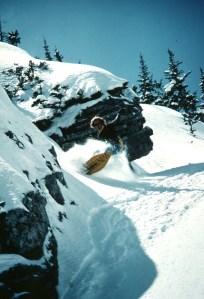
Dimitrije Milovich rides his Winterstick snowboard. Photo by Alan K. Engen. Special Collections, J. Willard Marriott Library, The University of Utah.

With a newfound sport on the rise and an open market demanding snowboards, a young man by the name of Dimitrije Milovich found his way to Utah and set out to invent the first snowboard without a rope for the rider to hang onto. (TransWorld, Part 1) With the help of famous surfboard shaper Wayne Stoveken, Milovich invented the first snowboard that used plastic for the base and metal on the edges of the board to help grip the snow. (Winterstick Advertisement) Milovich started out testing his prototypes at Snowbird and at Alta Ski Area. (Although Alta was willing to let Milovich test his newly designed equipment there, the area subsequently closed to snowboarders in 1984. It has yet to reopen to anyone but skiers, despite being on public land.) By 1971, Milovich had a couple of patents for his state of the art “snow surfboards” and had opened a shop to sell his aptly named “Winterstick Swallowtails” in none other than Salt Lake City, Utah. (TransWorld, Part 1)

Although the sport of snowboarding continued to grow, not only in Utah but also across the country, some skiers weren’t very happy to share the slopes with this newfound sport and the culture that followed. After a skier crashed at Stratton Mountain, a resort in Vermont, and sued the ski area, management was forced to create ski-at-your-own-risk laws and ban all non-traditional skiing sports. Snowboarding as well as telemark skiing were both considered too dangerous, and resorts started banning both all across the country. With few snowboarders willing to hike mountains to be able to ride, Milovich had to close the doors of his Winterstick stores in Utah in 1982.

But Milovich wasn’t done with owning a business. He and a man named Dwain Bush opened a windsurfing shop named Milosport. Later, it became a snowboard shop when the sport started to get back into the mainstream in the late 1980s. (Scheuerman, “Snowboarding”) Milosport is now the most popular snowboard shop in Utah, and has led the pack for snowboarding’s revolution in Utah since 1988.

After years of battling resorts for the return of snowboarding, in 1986 Beaver Mountain in Logan, Utah, was the first resort in Utah to open back up to snowboarders. (Halcomb, Part 1) After the sport of snowboarding stayed in the backcountry and off of the resort slopes for years, places like Brighton Resort, Powder Mountain, Sundance Resort, Snowbird, and many others started to see the return of snowboarding on their slopes. Although resorts all over Utah were welcoming back snowboarders, it wasn’t without stipulations. A rider certification card was required to use a snowboard at most resorts, to indicate that the rider could turn and stop without harming any skiers. (Scheuerman, “Re-search”)

Leading the pack in the fight to bring snowboarding back to resorts across the nation was a man named Dennis Nazari. Nazari was born in California and moved to Utah with his parents as a kid. Although Nazari spent most of his childhood in California, he was quick to pick up skiing and eventually snowboarding in Utah. After searching many ski shops in town, Nazari was able to locate and buy a snowboard at a local ski shop in Salt Lake City, which he rode primarily at Alta Ski Area, until they banned snowboards on Christmas Day of 1984. (Sheehan)

After Alta banned snowboarding, Nazari started the Southwest Surf Skiers Association, a program designed to get snowboards back on the slopes of resorts in Utah. (Halcomb, Part 1)

The SSSA was a program dedicated to educating people about the safety measures of snowboarding, and certifying that snowboarders could safely ride down the hill of a resort without injuring anyone else on hill. Nazari would drive up to Logan on the weekends to educate and certify riders. The rider would get an A, AA, or AAA, depending on how good they were at maneuvering their snowboard, with AAA being the best. (Halcomb, Dennis Nazari) After developing the idea of the rider certification card, Nazari brought snowboarding back to resorts all over Utah. (Sheehan)

Although snowboarding was becoming popular again in 1986, Milovich’s doors were still closed, which meant no one had anywhere to buy a snowboard. So in 1987, Dennis Nazari opened up a shop called Salty Peaks to cater strictly to snowboarding and the people interested in the sport. Not only did the shop sell the only snowboard gear available in Salt Lake City, but Nazari also started an official shop snowboarding team, dubbed the “Salty 8,” Utah’s first snowboarders to be sponsored for riding. All this was helping to make Salt Lake City and the rest of Utah a major hub for the culture and the sport itself. (Scheuerman, “Re-search”)

Utah is home to a very large ski and snowboarding community, so much that the license plates even claim the state has the “Greatest snow on earth.” Snowboarding’s culture and industry will continue to grow around the world as well as in Utah, while creating jobs at resorts, shops, local businesses, and elsewhere in Salt Lake City. With an industry booming and more people moving to Utah for the snow all the time, snowboarding will always have a home in Salt Lake City.

Stephen Konkler is a senior at The University of Utah, majoring in communication and minoring in design.

Sources

Erin Halcomb, “Dennis Nazari, an interview by Erin Halcomb,” March 28, 2012, Everette L Cooley Collection, Special Collections, J. Willard Marriott Library, The University of Utah.

Erin Halcomb, “Josh Scheuerman, an interview by Erin Halcomb, part 1,” November 8, 2011, Everette L Cooley Collection, Special Collections, J. Willard Marriott Library, The University of Utah.

Erin Halcomb, “Josh Scheuerman, an interview by Erin Halcomb, part 2,” December 6, 2011, Everette L Cooley Collection, Special Collections, J. Willard Marriott Library, The University of Utah.

Paul J. MacArthur, “Snowboarding, It’s Older Than You Think,” International Skiing Association, December 1, 2016, http://bit.ly/2oVZwMI.

Josh Scheuerman, “Snowboarding in Utah: An Adolescent Sport Grows Up,” Sports Guide, Winter 2009, 10-14. http://bit.ly/2pspLva

Josh Scheuerman, “Re-search and Destroy: A Brief History of Snowboarding’s Roots in Utah,” SLUG Magazine, March 2001, 6-7. http://www.slugmag.com/pdf/147-March-2001.pdf

Sheehan, Gavin. “Salty Peaks.” City Weekly, August 242009. http://bit.ly/2nM5v75

“Snowboard History Timeline, Part 1.” TransWorld Snowboarding, http://bit.ly/2mqe7T7

“Snowboard History Timeline, Part 2.” TransWorld Snowboardinghttp://bit.ly/2mHJeW0

Advertisement for Winterstick, Newsweek, March 1975.

A Look at the Mormon Church Influence in Building the Union Pacific Railroad

by SAMIRA GUIRGUIS

Union_Pacific_Railroad___Survey_p_1

Mormon surveyors worked in Utah’s Uintah Mountains during the construction of the transcontinental railroad. Courtesy of the Utah State Historical Society.

A civil war and the prospect of a quick fortune from the California Gold Rush left big companies like the Union Pacific and Central Pacific Railroads starving for a labor force. While it is common knowledge that Utah played a role in building the Transcontinental Railroad, an important factor often overlooked is that a big section of it was mostly done by Mormon workers. Power, influence, culture, geography and even a little luck all played a role in why the Mormons were perfect candidates for this job. (KUED)

In 1868, Union Pacific, desperate for workers and approaching Utah Territory, needed to recruit a lot of workers, including surveyors who knew the lay of the land against the intimidating Wasatch Mountain Range. Who better for this job than Mormon leader Brigham Young, who not only had access to a large number of workers, but also men with the discipline and sobriety of their faith? In fact, Mormons were so influential in the building of the railroad tracks that songs were even written about them.

In the Canyon of Echo, there’s a railroad begun,

And the Mormons are cutting and grading like fun;

They say they’ll stick to it until it’s complete,

For friends and relations they’re longing to meet.

Hurray! Hurrah! The railroad’s begun!

Three cheers for our contractor, his name’s Brigham Young!

Hurray! Hurrah! We’re light-hearted and gay,

Just the right kind of boys to build a railway. … (“Echo Canyon”)

The clean, sober, and polite Mormons stood out in stark contrast to the hard drinking, “wild west-type” of most other railroad company crews. Instead of whisky-induced boisterousness, gambling and “soiled doves,” the Mormon campsites operated under orderly and religious governance. (Miller, 102). Deseret News assistant editor Edward Lennox Sloan noted, “In but one camp of less than one hundred men, out of between two and three thousand working in the canyons, did I hear profanity.” The only evidence of any problem between other crews and Mormon crews was good natured “horse play” such as those cited in The Golden Spike, like hiding each other’s equipment, turning horses loose in the middle of the night and, in one example, dropping a rattlesnake into a nearby camp’s soup kettle. (Miller, 199)

Union_Pacific_Railroad__Construction_P__13

Union Pacific Railroad workers construct tunnel no. 2 at the head of Echo Canyon, Utah. Courtesy of the Utah State Historical Society.

Mormons proved to be excellent surveyors. They knew the lay of the land better than any outsider possibly could and grew up in a culture that highly valued the creation of records with meticulous detail. One only need look at the LDS genealogy to understand that. Consequently, Mormon surveyors drew detailed maps to help engineers determine the path of least resistance. (KUED) On one account, “Mormon workers became experts in the use of nitroglycerin ‘blasting oils’ and other explosives… Their sobriety would prove to be an advantage, indeed.” (Stewart, 93)

The Mormon Church used notices in the advertising section of the Deseret News to elicit help. For example, “MESSRS. Joseph A. Young, Brigham Young, Junr., and John W. Young, agents for President Brigham Young, left this city on the 8th inst., for the head of Echo Canon, to let contracts for grading on the Union Pacific Railroad…. Parties wishing contracts on that road can now start their men.… About 10,000 men will be wanted. (“Notice”) In fact, there weren’t enough men in the area, so Brigham Young sent letters to his friend and apostle Franklin D. Richards, encouraging him to send newly converted Mormons from Europe to Utah in order to keep a steady flow of workers. (Stevens, 17)

Union_Pacific_Railroad__Construction_P__3

Mormon laborers grade the Union Pacific line at the mouth of Weber Canyon, Utah. Courtesy of the Utah State Historical Society.

There’s also a mention that “fit men—immigrating from England to Zion could ride from Omaha to the end of the line free of charge if they agreed to work for the railroad.” (Stewart, 183) This fact is important because it kept the work in Utah hands; the wealth didn’t go to other places to be invested. Interestingly enough, Mormon crews worked for both the UP and CP lines east and west of each other. This competition between the two companies allowed the Mormons to increase their wages by starting bidding wars between the two companies. (Stewart, 198)

Despite working hard and being praised for their skill, there was a huge debt scandal and many Mormon workers weren’t paid for months, sometimes not at all. (Stewart, 177) One good thing did come from this experience: working with the Union Pacific gave Utahns the knowledge of how to make their own railroads rather than relying on big companies like the Union Pacific for future building. More importantly, it armed Utah with the economic power to grow. (Miller, 122) Having the manpower and new income, Brigham Young could now choose where the next railroad line would go and thus have a direct route pass through Salt Lake City. The railroad brought change to Utah, which was unsettling, but it also brought a bigger barter system, immigrants, and information. Brigham Young knew he couldn’t stop the railroad from coming. So, he prepared for its inevitability, making sure his people didn’t miss out on the economic opportunity and at the same time showing the world that the Mormons were a hardworking, selfless people (KUED).

Sources


“Notice,” Deseret News, June 17, 1868, 4.

Emrich, Duncan, ed. “Echo Canyon” in Songs of the Mormons and Songs of the West, from the Archive of Folk Song. Washington, D.C.: Library of Congress, 1952.

Miller, David E. The Golden Spike. Salt Lake City: Utah State Historical Society, University of Utah Press, 1973.

Stevens, Thomas M. “The Union Pacific Railroad and the Mormon Church, 1868-1871: An In-depth Study of the Financial Aspects of Brigham Young’s Grading Contract and Its Ultimate Settlement.” M.A. Thesis, Brigham Young University, 1972.

Stewart, John J. The Iron Trail to the Golden Spike. Salt Lake City: Deseret Book Co., 1969.

Utah’s First Female Editor: Louisa Green Richards and The Woman’s Exponent

by BAYLEE STEPHENSON

LuLu_Greene_Richards

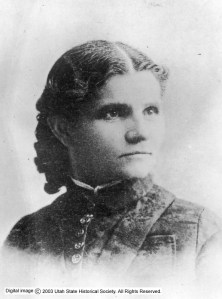
Louisa Greene Richards was the first female editor in Utah. She served as the first editor of the Woman’s Exponent. Digital Collections, Utah State Historical Society.

The Woman’s Exponent carved a path for women, equality and woman suffrage in Utah through the assistance of two incredible editors. Emmeline B. Wells is probably the most notable editor to have worked for the publication, but had it not been for her predecessor, Louisa Greene Richards, the newspaper would not have existed. Richards, known fondly as Lula or Lulu, was born in 1849 as the eighth of thirteen children to Evan Greene and Susan Kent in Kanesville, Iowa. (Bennion, 2) Greene and Kent were first cousins by their mothers, who were the sisters of the president of The Church of Jesus Christ of Latter-day Saints, Brigham Young. Richards relocated to Salt Lake City, Utah, with her family in 1852 when Brigham Young and the Mormon pioneers left Iowa. It was in Utah that she found her passion for writing. (Bennion, 2)

Richards had always enjoyed writing and had a knack for poetry. It is believed that her first poem was written when she was fourteen, with her first step into journalism happening at the age of twenty when she began editing the Smithfield Sunday School Gazette. That same year she made the decision to attend the University of Deseret, presently known as The University of Utah. (Bennion, 3) By late 1871 she had finished school and was in Salt Lake City inquiring about a teaching position. While there, she received a letter requesting that she return home due to a family illness. She didn’t have the funds for the journey and decided that she would stay up all night and write poetry in the hopes that she might be able to sell it to a publisher in exchange for the fare she needed to get to Smithfield. The next day she went to the Salt Lake Daily Herald to meet with the editor, Edward L. Sloan, to sell her poetry for the $7.50 she required. She was successful in her endeavor. (Romney, 262)

Richards made the journey back home to be with her family, which is where she received a letter from Sloan asking her if she would be interested in editing a paper for Mormon women that he would print on the Herald’s presses. (Bennion, 3) She had her reservations regarding the idea and wrote to Eliza R. Snow, the president of the Relief Society, the women’s organization within the church, to ask her if she could discuss the prospect of the newspaper with the president of the church, Brigham Young. Richards believed that if Young approved of the paper then she should pursue the opportunity of running the new publication. Young gave Richards a calling to serve a mission, which is a personal assignment to be done for the church for a designated time frame, as the editor of the paper. (Bennion, 3)

On April 9, 1872, Sloan sent a copy of the Daily Herald to every member of the Relief Society with an advertisement promoting the Woman’s Exponent and its first issue. It read, “…a proposed woman’s journal … will be found in the Herald this morning. A more extended notice of it is crowded out until to-morrow by a press of other matter.” The ad was in two spots on the third page, one announcing the new paper and another expanding on what the publication would be writing about and who its target audience would be. That ad elaborated on the Exponent’s mission to write to the women of the Relief Society and the goals it had set. The advertisement announced Richards would be the acting editor of the bi-monthly paper, which would release its first issue on May 1, 1872. Subscription costs were based on delivery frequency, ranging from $1.00 to $18.00.

Richards married shortly after she became the editor of the paper and during her time she had two daughters, both of whom died. She helped build and mold the publication into the successful female-centric paper remembered under the leadership of Emmeline Wells. Wells took over in 1877 when Richards stepped down to pursue being a wife and mother full time. (Bennion, 9) While her personal life changed, and grew during her tenure as editor, she never neglected the paper and prioritized its success. The paper focused on what mattered to women as well as what was going on within the news.

WomansExponent-Volume1-Number11-1872

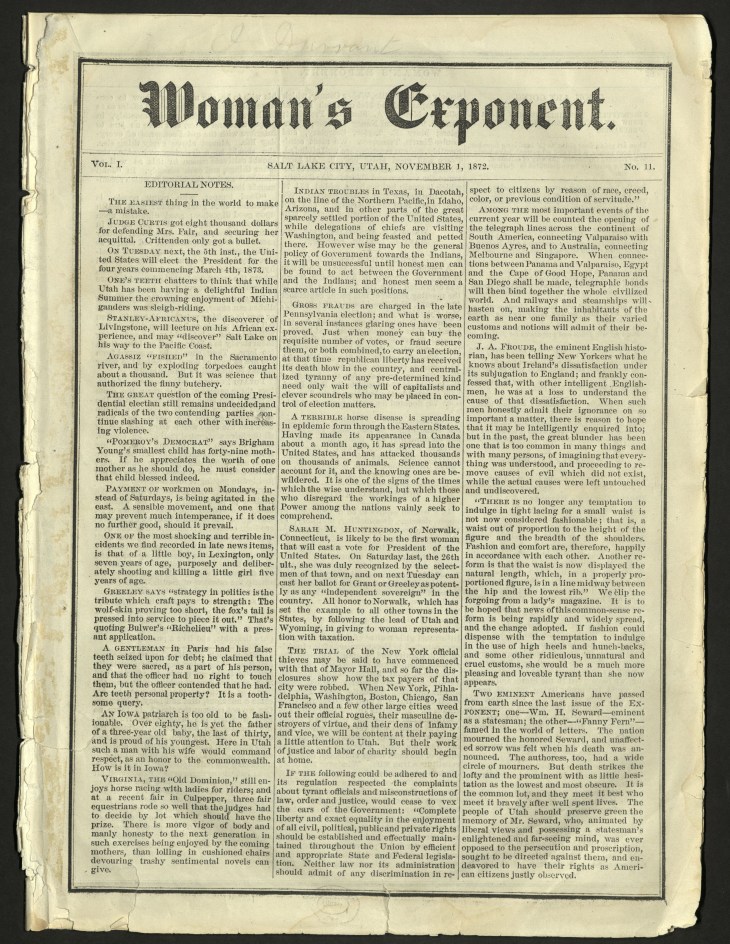
The November 1, 1872, issue of the Woman’s Exponent featured the news that a Connecticut woman might be the first female to cast a ballot for the president of the United States. Special Collections, J. Willard Marriott Library, The University of Utah.

Richards was unable to meet the release date of May 1, 1872, so the first issue of the paper published on June 1. It featured articles and information that Richards thought to be the most interesting and important to women at the time. The paper didn’t simply focus on matters of the home, or what could be considered the traditional normative role women typically took within society due to the religious influence. On page 4, an article titled “Our Position” delved into Richards’s intentions for the paper, which stated that the purpose was not to advocate for woman suffrage, “for it is enjoyed by women of this Territory.” Women in Utah had received the right to vote per a decision by the territorial legislature in 1870, years prior to the 19th amendment. This right was revoked by Congress in 1887, but was ultimately restored in 1895 upon it being written into the state constitution. (White)

The Exponent aimed to speak for many of the women within the state, knowing that there would be dissenting opinions. Richards knew that there was still much to be done for women’s rights, but she strived to reach the majority in the hope that the topics discussed and covered were those that were significant to the women of Salt Lake City. On page 5 of the first issue, an article titled “Woman’s Rights and Wrongs” examined the equality that women lacked in relation to their male counterparts. This article explained the hardships women faced in doing the same amount of work as a man and receiving only a portion of the pay, as well as addressing the issue that women have the right to do any job their desire regardless of gender should they be able to adequately perform. Whether Richards intended for the publication to speak on behalf of women, equality, and at times for woman suffrage, it did and it became a key player in advocating for women in Utah.

The first issue of the Exponent set the stage for what would come from Richards, and later her successor, Emmeline Wells. The front page of the publication began with an article titled “News and Views.” This article commanded the entire front page of the paper and disclosed the news and opinions of Utah, as well as what was happening nationwide. Topics discussed in this article included religion, politics, suffrage, and race. Richards didn’t shy away from discussing what she believed in and what she thought the women of Utah wanted to be reading. The bold approach she took in writing and editing the paper helped catalyze the publication into the success that it experienced during its 42-year lifespan. On page two of the first issue, there is an article written by Eliza R. Snow on “The Female Relief Society,” which became a regular column in the Exponent penned by Snow. It gave readers a summary of the happenings of the church at the time. Richards felt that providing women with insight into the church was important as most of her readers were members of the religion. She also felt that having this section written by the president of the relief society was important for the women consuming the material.

The articles seemed to mildly contradict in that the written purpose was not to advocate for equality, but the articles themselves did articulate the support and advancement of equal rights for women. Emmeline B. Wells, who was known for her work within the woman suffrage movement, became Richards’s successor when Richards chose to withdraw as editor. Under the new leadership of Wells, the publication began taking a stronger stance on equality and woman suffrage.

On August 1, 1872, the Exponent published an article titled, “Why Women Should Vote.” This article touched on the fact that while some women cared nothing for politics and would most likely not vote, women should still be able to participate in voting and the voting process. The article stated that it was an important part of our society and should not exclude half of the nation’s population, as women had well-informed opinions and deserved to have a voice within democracy and politics. This article was extremely well received because women in Utah already possessed the right to vote and it led to further articles regarding woman suffrage and equal rights.

For example, on October 1, 1872, there was an article titled “Lady Lawyers” that recognized the remarkable accomplishment of two women who were admitted and sworn into the bar to become attorneys-at-law in the state of Utah. And while it wasn’t their intention or desire to practice law, they understood the large impact this would have for women across the nation. The article acknowledged that just a few years prior to this event, women were often ridiculed for their pursuits. The article also addressed the right of a woman “to earn her living in any honorable career for which she has capacity.” Utah was a remarkably advanced state within the union at the time and encouraged women to pursue their aspirations and career goals.

The first few months of the Exponent under Richards’s leadership laid the foundation for this progressive paper. Just five years after she signed on to the project, she decided to remove herself as acting editor. On July 15, 1877, the final issue of the Woman’s Exponent crediting Richards was published. That issue continued to advocate for equal rights, provide updates on the LDS church, and share poetry. The issue also shows significance in that it sold ad space on the last page, which generated revenue and income for the publication. Throughout all the stories and articles published in this issue, there is no acknowledgement of Richards’s departure. In a following issue of the paper, dated August 1, 1877, Richards penned an article titled “Valedictory,” in which she bid the paper farewell and discussed her reasons for departing the Exponent. She made it clear in her message that she would not be losing contact with her readers, but would be communicating with them as a contributing writer for the Exponent. She noted that she was in good health, but her “head and eyes need recruiting.” She also wrote that she believed her time would be best spent dedicated to domestic duties. Richards was content to relinquish all claim to the Exponent, because she knew she would be leaving it in good hands. She ended her farewell by asking her “sisters old and young” to subscribe and write to the Exponent to make it “more interesting and successful in performing its mission.”

After retiring as the editor of the Woman’s Exponent, Richards turned to being a wife and mother full time, but she never stopped writing. Her poetry is what launched her into her career with the Exponent; her poetry is how she continued to express herself throughout her life. Richards published a few of her poems during her five-year run with the paper and afterward found herself publishing a book, Branches That Run Over the Wall. Richards spent her life dedicating her time to her family and her writing. Never forgetting who she was or what she believed in, and was never afraid to speak her mind in the effort of being an independent woman at a time when that wasn’t always fully embraced. Louisa Lula Greene Richards was the first female editor in Utah and became a respected public figure and advocate for women all over the state.

The Woman’s Exponent provided women with an outlet and a resource that wasn’t a common commodity at the time. The publication had a female editor, the first in the state and breached topics that were both helpful, informative, and at times controversial. Looking back at the many issues of the paper, it is obvious that these women were dealing with issues that are still prevalent today. We are still fighting for gender equality in many regards, we are still fighting to give women an independent voice and we are still fighting to break into male dominated industries. Utah was a unique place, where women held positions without it being perceived as a woman trying to take over a man’s role. These women were praised for their work and made strides in the fight for equality for women everywhere. The paper was so successful that it even spurred the conception of Exponent II, a quarterly publication launched to give feminist Mormon women a voice. (Sheldon) Women across Utah, especially within the Mormon community, have been deeply impacted by the Exponent and the work of Richards and Wells. Their efforts have resonated with women across generations for over 100 years and even led to the development of other publications. This progressive paper was created by women for women.

Baylee Stephenson graduated in May 2017 from The University of Utah with a degree in communication. She moved to New York City after graduating to pursue a career in product development and now resides in the city full-time.

Sources

Louisa L. Richards, Branches That Run Over the Wall: A Book of Mormon Poem and Other Writings. Salt Lake City, Utah: The Magazine Printing Company, 1904.

“Valedictory,” Woman’s Exponent, August 1, 1877, 36.

Woman’s Exponent, June 15, 1877, 25-32.

“Lady Lawyers,” Woman’s Exponent, October 1, 1872, 68.

“Why Women Should Vote,” Woman’s Exponent, August 1, 1872, 36.

“News and Views,” Woman’s Exponent, June 1, 1872, 1.

“Our Position,” Woman’s Exponent, June 1, 1872, 4.

Eliza R. Snow, “The Female Relief Society,” Woman’s Exponent, June 1, 1872, 2.

“Woman’s Rights and Wrongs,” Woman’s Exponent, June 1, 1872, 5.

“Woman’s Exponent,” Salt Lake Daily Herald, April 9, 1872, 3.

Bennion, Sherilyn Cox. “Lula Greene Richards: Utah’s First Woman Editor.” BYU Studies 21, no. 2 (1981): 1-14.

Romney, Thomas C. “Louisa Lula Greene Richards.” The Instructor (September 1950): 262-263.

Sheldon, Carrel Hilton. “Launching Exponent II.” Exponent II. http://bit.ly/2otlTLP

White, Jean Bickmore. “Women’s Suffrage in Utah,” Utah History to Go. http://bit.ly/2kWl4rr


Florabel Muir, First Woman Reporter for the Salt Lake Tribune and Pioneer for Women in Journalism

by MADISAN HINKHOUSE

Florabel Muir was a pioneer for women in journalism, from being the first female reporter for The Salt Lake Tribune after getting her start at a lesser known Salt Lake paper called the Salt Lake Herald, to being the first woman to witness and report on an execution. In this analysis of the life and career of Muir, I will explore these implications and other aspects of her career in the world of journalism.

1950_BookMuir, born in 1900, grew up in Rock Springs, Wyoming. She credited her upbringing for her ability to handle the “rough and tumble” side of journalism, meaning blood, fights and murder. Muir described Rock Springs as a mining town where rugged people had a better chance of survival, and most arguments were settled with fists. She was the youngest of eleven children. She wrote in her autobiography, Headline Happy, “Being a nonconformist from an early age, I developed a great strength of will to keep myself from being swamped by dos and don’ts from the rest of the family.” (Muir, 3)

The non-conformity began when Muir attended college at the University of Washington, where, following in the footsteps of her sisters, she studied to be a teacher. She went to work for the student newspaper to make extra money. This is where she was “bitten by the bug.” Muir writes about the time she spent as a teacher in rural Wyoming, but teaching was not what she wanted to do. (Muir, 3-4)

She made her way to Salt Lake City in search of a reporting job. Muir posed as an experienced reporter in an attempt to land a job. The language she learned while at the student publication helped her sound more experienced than she was. Even with this language and prior experience Muir worked odd jobs for nearly three months before getting a reporting job with the Salt Lake Herald. (Muir, 2-5)

Her career in professional news began in 1926 as a police reporter, according to an obituary published in Boxoffice in 1970. In her autobiography, Muir reflected on the hardships she faced being a woman in an industry dominated by males. She recalled when she got her start with the Herald: Women were not looked upon as proper instruments with which to get out the gutsier parts of the newspaper.” (Muir, 3) In this time, the 1920s and 1930s, editors allowed women to cover societal events and club pages. According to Muir, those beats bored the “bejesus” out of her. This boredom inspired her determination to cover murders, robberies and malfeasance with the boys. (Muir, 3; Boxoffice)

Although The Salt Lake Tribune was her first choice, it had never had a female reporter and the editor, Forest Lowry, had no intention of hiring one. Eventually Francis Matson, editor of the Salt Lake Herald, gave Muir a job covering the City and County Building. (Muir, 3-5)

In regard to landing the job, Muir wrote: “Matson was motivated primarily by a sly urge to dish out a cowering insult to a veteran Tribune reporter, Tom Higgs, with whom he had been feuding, by sending a girl to cover the beat against him.” (Muir, 4) This is only the beginning of the obstacles Muir faced in the journalism world solely based on her gender.

Muir worked hard to make a name for herself in Salt Lake City covering murders and scandals. She wrote in her autobiography about a time when she ruined the only good shoes she had by tramping through blood and gore to get information on a murder for a story. She wrote about sneaking around policemen to prevent being arrested for breaking and entering. “I do not intend to convey the impression here that walking around in blood is standard practice among newspaper reporters, but it does seem in retrospect that I have had more than my share of it,” Muir wrote in her memoir. (6)

She eventually landed a job with The Salt Lake Tribune as the newspaper’s first female general assignment reporter. While at the Tribune, Muir made it clear to her editor that she was not going to cover society or club news, which was the standard for women journalists. A history of the newspaper describes Muir’s career following her time with the Tribune as “violence studded.” She covered gang wars, murder and sensational trials. (Malmquist, 419-420)

Muir’s breakthrough for women reporters came when she was the first woman to cover the legal death of a man whose story she originally covered when he murdered his lover. During her time in Salt Lake City, Utah law stated only men could witness executions, leaving women out of a possible story during an already turbulent time for women in news, as discussed above. In order to cover the execution, Muir went to Utah’s attorney general and was ruled a reporter, not a woman, according to a 1944 article in Time. (Muir, 28-29)

Muir was successful in her push to cover the execution, but was provided a male back-up reporter, just in case she became ill while witnessing a man die. As it turned out, her backup is the one who fell ill watching a man die in front of a firing squad. (Malmquist, 419-420)

She writes a detailed and insightful chapter in Headline Happy about covering the execution. She remembered her editor telling her she had handled the story better than expected, considering she was not the reporter who became sick. She observed, “I graduated into the big time that day. I could handle a story like a man. That was very important to me.” (Muir, 32)

Through her career, Muir moved on to work for the New York Daily News, where she wrote a daily column, according to a 1932 story in Variety magazine. Muir wrote columns that were syndicated to Chicago and Los Angeles, giving her a wide readership and well-known name among journalists. (“Florabel Muir succeeds”) She spent time in her career covering Hollywood-esque beats while also heading out on multiple special assignments according to another article in Variety. (“Charterer as a Scenarist”)

In her autobiography, Muir relates a colorful story of a time when she was shot in the “derriere” while following an infamous New York gambler for a story. It happened in July 1949 when she followed Mickey Cohen to various night spots around Hollywood. She wrote that she was waiting for someone to kill him in hopes that she would be there when it happened. She succeeded, but not without scars. When the shooting began, a bullet hit an object and then Muir, but she got the “newsbreak” that several other reporters missed because they gave up and left before the shooting started. (Muir, 1-2)

Muir found herself in trouble later in her career, once for buying and reselling liquor licenses and once for spitting in the face of another reporter, according to Variety. The story, published October 14, 1953, detailed how the former got her fired from a beat at the L.A. Mirror, and that she didn’t resign, as other news outlets reported.

At the end of her career, Muir was widely respected by fellow writers and journalists. One Variety reporter observed in 1938, “Many of Miss Muir’s kidding phrases were fine bits of reporting and evidenced a showmanship slant of the principals.” From my research, I conclude that Muir enjoyed the peak of her career between 1926 and 1938.

A 1950 review of her autobiography published in Variety praised Muir and cited her “delicious sense of humor and double barreled talent for superb writing craftsmanship.” The book accounted the adventures of her exciting career in journalism.

Muir died of a heart attack at the age of 80. In the New York Times obituary she was quoted as saying, “I was having a talk with my croaker the other day. He says ‘Florabel, your ticker ain’t worth a pot in hell—you take it easy, so I guess I will.’”

While researching and reading her autobiography, I grew to admire Muir’s love of journalism of being a reporter. She claimed to be suffering from an occupational disease called “Headline Happy,” which she described as a “wonderful, stimulating form of looniness in the like of which is found only in the newspaper game.” She wrote that colleagues found her expeditions to get stories crazy. She claimed they were right: she was crazy about journalism. (Muir, 1)

Madisan Hinkhouse is an alumna of The University of Utah with a fiery passion for journalism and the First Amendment. She enjoys fly fishing, skiing and spending more time outdoors than indoors.

Sources

“Florabel Muir resigns,” Variety, February 16, 1932, 3.

“Charterer as a Scenarist,” Variety, June 21, 1932, 53.

“Florabel Muir, Take a Bow,” Variety, December 28, 1938, 45.

“The Press: Florabel,” Time, November 13, 1944, 70.

Florabel Muir, Headline Happy (New York, New York: Henry Holt and Company, Inc., 1950).

“‘Headline Happy’ Is Just That,” Variety, October 25, 1950, 61.

“Miscellany: Florabel Bounced By L.A. Mirror,” Variety, October 14, 1953, 2.

“Florabel Muir succeeds Hedda,” Variety, February 9, 1966, 4.

“Florabel Muir, 80, of The Daily News,” The New York Times, April 28, 1970, 41.

“Florabel Muir, 80, Dies following heart attack,” Boxoffice, May 4, 1970, 4.

Malmquist, O. N. The First 100 Years: A History of The Salt Lake Tribune, 1871-1971. Salt Lake City, Utah: Utah State Historical Society, 1971.


Reactions to Utah’s Public School Sex Education in the Early to Mid-1900s, from Medical Professionals and Students

by MARISSA SITTLER

Sex education has been a contentious topic since it was first introduced by the United States government in the early 1900s. However, Utah has been and continues to be stuck on the receiving end of flak from outsiders, as well as its own residents concerning its (lack of) sex education.

What might be defined as “sex education” now, was not the same during 1946-47, when LaMar Holmes conducted a study, The Status of Sex Education in the State of Utah, in which he sought to discover what Utah’s K-12 public schools were teaching its students. Holmes mailed a questionnaire to 435 public school principals listed in the Utah Public School Directory of 1946-47. One hundred seventy-four out of the 435 questionnaires were returned.

In Holmes’s study, he defined sex education as “activities directed toward bringing about the development of wholesome habits, conduct, attitudes, and ideals within the individual to the end that the family will be preserved and home life improved.” (Holmes, 10) The purpose of sex education, in his eyes, was not to teach of sexually transmitted infections or contraception, but rather to teach adolescents to respect the opposite sex, and to build “wholesome” relationships.

In Holmes’s study, there was not an official sex education curriculum for Utah’s public schools that was mentioned. Instead, offerings at schools varied. One example was a unit of instruction called “sex education” that was administered in tenth and eleventh grade physical education. Another school’s principal simply said that sex education was part of the health education program in his school. Perhaps the most comprehensive curriculum mentioned in the study was that of a home nursing class, which included a one-hour period for lecture and informal discussions about each of the following subjects:

“1. Anatomy and physiology of the female reproductive system. 2. Physiology and hygiene of menstruation. 3. Conception, growth and development of the fetus, and the birth of a baby. 4. Prenatal care of the mother including social and emotional adjustments. 5. Baby care including collection of layette and demonstration of a baby bath. 6. Brief discussion of the social diseases.” (Holmes, 19)

On the other end of the spectrum were schools where sex education was not integrated into the curriculum. Rather, instruction was given if “problems arose.” (Holmes, 18)

Three decades before Holmes’s study, Utah newspapers were discussing the need for a consistent curriculum and regular instruction of sex education. The Salt Lake Telegram reported on March 5, 1916, that Dr. M. J. Exner of New York said, “Sex education at high school is necessary” because the earlier the education, the better guidance in regards to the topic for high school-aged boys. Exner also commented on the sources of sex education in early years, and that “91.5 per cent said they received their early impressions from unwholesome sources, mostly from older boys; 70 percent said those impressions had aroused in them morbid curiosity, distorted the whole sex question, and led to unfortunate practices.”

On August 11, 1927, the Ogden Standard Examiner covered a meeting of the World Federation of Education. In an address to its health section, Dr. T. W. Galloway of New York, associate director of the department of education of the American Social Hygiene association, stressed “the need of greater sex education in home and school, particularly among junior high school students.” In addition, Galloway said the current state of sex education did not include enough information about biology, anatomy, hygiene, or venereal diseases.

p1086n038

The Utah State Capitol building, circa 1920. Used with permission. Special Collections, J. Willard Marriott Library, The University of Utah.

In a May 5, 1948, Daily Utah Chronicle article, another medical professional added her two cents to the sex education discussion. Dr. Bernice Moss, of the physical education department, believed that even those who had already been taught or trained on the topic of sex education could benefit from further instruction.

An article in the Salt Lake Telegram on May 23, 1938, noted that Dr. William Cary, a gynecologist and obstetrician, said “too many college courses are being taught by people who have had no personal experience” when it comes to sex education classes and that the teaching of such curriculum needs to be better.

A sex education conference in 1948 sponsored by the Adult Education committee, Board of Education of Iron County School District, and Parent-Teachers Association was held in a public school auditorium and was regarded as highly successful with good attendance. Miss Winifred Hazen, the consultant in family life education for the State Department of Public Instruction, was the conference leader. In a February 12, 1948, Iron County Record article, she stressed “the need for accurate knowledge of sex behavior, and fundamentals to proper training of every child, and also the responsibility of teacher and parent in giving proper information.”

It was not, however, only medical professionals who recognized the need for expanded teaching of sex education in Utah’s public schools. Students, also, voiced their opinions in favor of the matter. Several Utah newspapers chronicled stories on students’ reactions. As the Utah Daily Chronicle reported on March 2, 1939, “Sex education should no longer be a matter to be whispered about, a large majority of American college students believe.” Sixty-two percent favored making courses on the principles of sex mandatory, according to a nationwide study done by the Student Opinion Surveys of America.

The Salt Lake Telegram reported on April 8, 1948, that more students had been interested in a course on sex education than any other class offered in adult education curriculum of the Salt Lake City schools, according to Ralph V. Backman, head of the division.

On December 10, 1948, the Telegram reported that college students did indeed want more education about sex. According to surveys, about 99 out of 100 of people of all ages said they learned “practically nothing from courses in high school or from parents! Appalling!”

Despite considerable support for improvement upon sex education from medical professionals as well as students themselves in Utah’s public schools, currently the status of Utah’s public sex education is abstinence-only. Senator Frances Farley introduced the idea of teaching abstinence in 1988 into schools’ core curriculums in response to the AIDS crisis then. However, what Farley did not introduce was an abstinence-only stance, but the curriculum has since become that.

A February 16, 2017, Salt Lake Tribune article reported that Utah Democratic representative Brian King tried to introduce two bills to update Utah’s sex education curriculum. Both failed because people view sex education as the parents’ role. King’s bills intended to create a more comprehensive sex education for students, as the current curriculum for Utah’s public schools forbids the teaching of contraception, in addition to many other things.

The Trump administration has threatened to defund Planned Parenthood, an external source of sex education for what is not taught in schools. Speaker of the House Paul Ryan created a bill to eliminate health care for millions of Americans, which included Planned Parenthood centers. Neil Gorsuch recently became the Supreme Court Justice, and his history of interference with reproductive health and rights is concerning to Americans who need basic access to reproductive health care at centers such as Planned Parenthood.

Marissa Sittler is a sophomore at The University of Utah studying communication, with an emphasis on journalism.

Sources

Albert E. Wiggam, “College Students Seek More Sex Education,” Salt Lake Telegram, December 10, 1948, 8.

“Sex Education Conference Draws Good Attention,” Iron County Record, February 12, 1948, 10.

“Sex Education Popular,” Salt Lake Telegram, April 8, 1948, 8.

Jean Bruno, “Sociology forum urges early sex education,” Utah Daily Chronicle, May 5, 1948, 2.

“American Students Favor Sex Education,” Utah Daily Chronicle, March 2, 1939, 1.

Ruth Millett, “Doctor Suggests Improvements In Sex Education,” Salt Lake Telegram, May 23, 1938, 4.

“Sex Education Need Stressed,” Ogden-Standard Examiner, August 11, 1927, 3.

“Sex Education In High Schools Is Urged,” Salt Lake Telegram, March 5, 1916, 5.

The Tribune Editorial Board. “Sex ed is ed,” Salt Lake Tribune, February 16, 2017, 10.

Holmes, LaMar L. The Status of Sex Education in the Schools of Utah. Salt Lake City, Utah: University of Utah, 1948.


Creating and Building the Pride of Utah Marching Band, 1940s-1960s

by MACKENZIE McDERMOTT

On October 10, 1940, the Utah Chronicle reported the exciting news that the University of Utah band would present its new “costumes” to the student body “with some display of marching” at the upcoming Homecoming game. The article also noted that the new leader, Joseph C. Clive, promised “new and greater activity for the year.” But it wasn’t until 1948, according to Jay L. Slaughter, that the Pride of Utah Marching Band “reorganized.” That meant that the group, which had been established as a military band to perform military drills during halftime at football games, transformed into a 120-piece “marching unit using fast cadence [tempo, or speed of music] and fully uniformed.” (Slaughter, 8) The band stopped running military drills and started putting on shows that would be performed during halftime; they also started working on music to play at other school events. When the band was reorganized, the organization lobbied to expand the program. The band never competed in formal marching competitions, but was constantly being compared, in quality, to other bands across the nation.

The year that the band made the transition, it began to pick up speed with a guest conductor, Ronald D. Gregory. The Salt Lake Telegram reported on July 12, 1948, that he had been hired to lead the band. Gregory, a graduate of Ohio State University, conducted the band in a six-week course. One of his main goals, as reported by the Salt Lake Telegram on July 12, 1948, and the Utah Chronicle on July 14, was to prepare for a football game in Los Angeles that would be held on September 17. Gregory received $5,000 to purchase new instruments and uniforms for the band. The Utah Chronicle shared some of the ways the University of Utah marching band planned to impress the Southern California Trojans with “showy marching formations and such unusual designs as a moving covered wagon with rolling wheels.” Despite the band being bigger than it ever had been, with 120 people, the Sugar House Bulletin reported in August that the band was still looking for and auditioning people to join.

HomecomingUniversityofUtah

A band marches in a parade associated with The University of Utah’s homecoming celebration. Courtesy of Special Collections, J. Willard Marriott Library, The University of Utah.

In 1952, the marching band’s success was still being attributed to Gregory. The Daily Utah Chronicle reported that “much of the credit for a superior band should be given to Ronald Gregory.” According to the article, he was the first in the West to march the band group as fast as 180 beats per minute, and was one of the first to have a themed show for halftime. Marching Utes, members of the marching band in 1952, were also mentioned in the article for forming a block U on the field to create a “brilliant show.” At that time, all 120 members of the band would practice every day for an hour, along with extra rehearsals before games, for one and a half credit hours.

In Slaughter’s The Marching Band, he includes a survey that he based some of his findings on. One of the questions was designed to find out if band directors across the nation preferred men or women for the position of drum major, who are the student leaders of the band. The survey showed that most directors did indeed prefer men to women in this leadership position, although in 1958, the Salt Lake Times advertised for majorette tryouts at the U. The major and majorette auditions in 1958 were open to both men and women, putting the U ahead of many other bands across the nation that required men for the role. Auditions for the position were for university students, as well as high school seniors, who were eligible and willing to try for the position. Drum majors at this time would often twirl batons to infuse the audience with excitement.

After Gregory’s leadership, the Pride of Utah was able to gain high marks all across the nation under the direction of Forrest D. Stoll, who took over in the 1950s. By then, the Ute marching band was being ranked alongside some of the best marching bands in the country. According to a story published in the Chronicle on October 30, 1959, the band was comparable to those at institutions including UCLA and Michigan State University. The campus newspaper acknowledged Stoll’s “fine directorship” and commended his “capable assistant,” Loel Hepworth. “These two men work very hard to maintain the high standards of the Utah band,” noted the reporter. The consistently high standards held by Stoll and Hepworth pushed the band toward greatness. The Chronicle also mentioned the drum major, Lamar Williams, and the baton twirler, Karen Berger, who were strong examples of hard work for the band, as well as the entire university. The band at the time could not have been made possible without the hard work of each of these individuals.

The marching band at the University of Utah owes much of its success to a six-week guest conductor and all of the highly dedicated students who choose to give up their time to play a part in something greater than themselves. Today, the marching band has reached over 150 students under the direction of Dr. Brian Sproul. These students take two hours out of their day, Monday through Friday, and give extra time on days of football games. On game days, the band goes from tailgaters, an event where fans park cars and trailers and often indulge in barbeque before the game; to the Ute walk, where the fight song is played repeatedly as the team enters the stadium; to a performance on the field before the game (pregame); to the actual game and halftime. The University of Utah Pride of Utah Marching Band still performs in home games and across the nation for away games. But the group doesn’t just play at sporting events. The band can also be heard playing in ceremonies at the University of Utah, and welcoming incoming freshmen with the University’s fight song. The band continues to strive for excellence to live up to their name, Pride of Utah.

Mackenzie McDermott is a freshman at the University of Utah, majoring in journalism McDermott has participated in concert bands for seven years in Las Vegas, Nevada. Throughout her time at Cadwallader Middle School and Las Vegas Academy of the Arts, a performing arts high school, she played the flute. She marched for the Pride of Utah Marching Band, and played piccolo, in Fall 2016. She performed in a University of Utah concert ensemble, on flute, in Spring 2017.

Sources

Bob Foreman, “Ute marching band ranks high,” Utah Daily Chronicle, October 30, 1959.

“U. of U. to Conduct Majorette Tryouts,” Salt Lake Times, May 9, 1958.

“The Last March,” Utah Daily Chronicle, December 1, 1952.

“U. Names Band Leader For 6-Week Course,” Salt Lake Telegram, July 12, 1948.

“U band gets guest conductor, $5000,” Utah Chronicle, July 14, 1948.

“Positions Open In Largest Band In U of U History,” Sugar House Bulletin, August 6, 1948.

“Man of the hour! Gregory talk of Uteville after band revamping,” Utah Chronicle, October 7, 1948.

“University Band Elects Chiefs For New Season,” Utah Chronicle, October 10, 1940.

The University of Utah Marching Band: 1965 handbook. Salt Lake City, Utah, 1965.

Slaughter, Jay Leon. The Marching Band. Department of Music, University of Utah, 1950.


The Media’s Role in Citizens’ Perceptions of Topaz, the Japanese Internment Camp in Utah

by Elizabeth Fields

The media have always played a role in our history. More than simply relaying the news, media dictate which stories deserve our attention, whether or not we are aware of it. Sometimes subtle and sometimes not, the media mold our values and opinions through careful choice of language and selection of which stories to tell. In the case of the Japanese internment facility located in Delta, Utah, the media’s influence over the public proved to be no different. Through the alienation of Japanese-American citizens and normalization of internment facilities, Utah media placated its citizens and prevented them from being able to recognize Topaz as being inhumane and unjust.

WRA official

Internees began arriving at the Central Utah Relocation Center, known as Topaz, on September 11, 1942. This article from the August 27, 1942, issue of the Millard County Chronicle, was typical of the coverage.

Described as being “one of the most flagrant violations of civil liberties in American history,” the upheaval and relocation of many Japanese-American citizens during World War II was set in motion on February 19, 1942, when President Roosevelt signed Executive Order 9066. (history.com) This order authorized the creation of military zones along the West Coast and stipulated that individuals who were considered a threat to national security could be relocated to internment facilities located farther inland. The order soon was used to justify the removal of Japanese-Americans who were suspected of having an allegiance to Japan. Forced to put their jobs and education on hold and to give up their homes and most of their possessions, more than 120,000 citizens were sent to internment camps in states including Idaho, Wyoming, and Colorado, where they were closely monitored to ensure that they could not assist the enemy. The Central Utah Relocation Center, more commonly known as Topaz for the mountain to the west, officially opened on September 11, 1942. By the time it closed, it had housed more than 11,000 detainees. (topazmuseum.org)

American citizens who did not have ties to Japan had been primed by the media to distrust and dislike Japanese culture, both domestic and abroad, since the beginning of America’s involvement in WW II. In the months leading up to the opening of Topaz, Utah citizens were exposed to hateful, racist terminology degrading their perception of the Japanese. On January 6, 1942, the Salt Lake Telegram reported that American soldiers were “killing the cocky little invaders like flies,” quite literally dehumanizing the foreign enemy. On January 5, 1942, the Salt Lake Telegram relished the thought of American allies writing “in rivers of Japanese blood.” This violent rhetoric set the stage for internment camps to open without question or opposition from the American public. It is important to note that Utah media consistently referred to the Japanese enemy as “Japs” in nearly any article written about the progress of the war.

In September 1942, when Japanese-American citizens began arriving at Topaz, the media also referred to these camp residents as “Japs.” On August 27, the Millard County Chronicle published an article under the headline, “WRA Officials Arrive to Take Over Jap Camp.” In the same issue, a separate article advertised cheap labor provided by internees and provided details about “how the Japs can be got, the regulations, and other information.” In this particular story, the language is eerily reminiscent of historical articles advertising slave labor. Utah media did not even bother to differentiate between the Japanese enemy and the Japanese-American citizen. Instead, the media lumped the two populations together using the same racial slur. Immediately, citizens living outside of internment camps differentiated the Japanese-American citizens as being in a separate category from themselves and associated them with the enemy. In some cases, citizens may not have even made a distinction between citizens and the enemy because the two shared the same epithet.

To further Utah’s ignorance to the injustice at play, Utah media completely normalized the Topaz internment camp by publishing mundane, day-to-day happenings at the camp, none of which included any of the harsh realities of life at Topaz. One of the most insulting articles was published in the Salt Lake Telegram on December 30, 1942, with the headline, “You Wouldn’t Trade Places.” It suggested that those living outside internment camps were actually experiencing some kind of envy. The article observed: “There are all sorts of rumors—that the Japanese evacuees from California live there in style, that they are being fed far better than most Americans.” The article described the minimalistic lifestyle of internment camp, but then assured readers, “Certainly they are being treated decently … the food is wholesome…. Although not being pampered, they are being very fairly treated.” It even claimed that the Japanese-American citizens enjoyed the work they did at the camp, saying, “Work becomes desirable as a pastime.” In reality, life at Topaz was anything but fair. According to the Densho Encyclopedia,

“Many of the apartments were not finished when inmates arrived. The prisoners had to endure especially cold conditions until gypsum board was installed on the walls and ceilings… Ill health was common at Topaz… Several prisoners reported how this … traumatized them and prevented them from ever feeling fully secure in camp.”

On December 17, 1942, the Millard County Chronicle published an article detailing the plans for a Christmas party to be held at Topaz: “This will be a large scale operation, purposed by the WRA [War Relocation Authority] to promote good will, [and] to show the proper Christian spirit.” The brief article clearly applauded the righteousness of the WRA and completely dismissed the fact that internees could not be in their own home with their friends and extended family to celebrate. Many of the internees were not Christian and did not even observe Christmas as a holiday. This article reinforced the concept that they they were comfortable and happy, perhaps even lucky. This complete misconception of the reality of living in an internment camp prevented Utahns from recognizing the injustice of the situation.

The last and perhaps one of the most significant elements in keeping Utah citizens silent was the Espionage Act. This act prevented anyone from publishing material conveying “anti-patriotic” sentiments. More than an act of censorship, the Espionage Act reflected a deep-rooted fear that citizens of Japanese descent felt a stronger alliance to Japan than to America that would cause them to betray their country. On May 28, 1942, the Millard County Chronicle wrote,

“What shall we do with Japanese aliens to prevent possible espionage and sabotage?… Many of the Japanese, especially those of American birth, were loyal to the United States. But their fathers and mothers were aliens. It was to be expected that a considerable number of these would be tied to Japan by bonds of race and nationality.”

The Espionage Act only encouraged feelings of distrust toward the Japanese and furthered the media’s contempt for them. To write in opposition of Topaz would be to risk interrogation or even detainment. Simply put, it was unsafe to openly protest Topaz. Had it not been for the Espionage Act, perhaps Utah media would have exposed the truth about Topaz and the public would have had the ability to resist.

As Americans when we think of World War II, we think of bravery and sacrifice. We think of the grainy, black and white footage of victorious soldiers raising the flag at Iwo Jima. We think of Rosie in her red bandana, proudly pulling her denim sleeve across her flexed arm and proclaiming, “We Can Do It!” We think of the famous photograph of a young soldier home from war, in the streets of New York kissing a stranger out of pure elation. We do not think of an American Japanese family leaving their home in San Francisco to be locked away in an internment camp in Utah. We do not think of a young American Japanese student, forced to halt his education to be unjustifiably imprisoned. We do not think of thousands of people uprooted from their homes, careers, and aspirations to satiate the racism of a fearful country. We do not think of it, but we should. Through alienation, false justification, and writing within the boundaries of the Espionage Act, Utah media placated citizens and manipulated them to believe that Topaz and facilities like it were just and necessary.

Today still, our country faces prejudice every day that is perpetuated by our media. With the understanding of the injustice of Topaz, we are better able to critically analyze the sources we rely upon and protect those who our media would wrongfully have us fear.

Elizabeth Fields is studying strategic communication at The University of Utah.

Sources

“They Fought Like Demons,” Salt Lake Telegram, January 5, 1942, 8.

“The Japs Take a Beating,” Salt Lake Telegram, January 6, 1942, 6.

“The Story of 112,000 Japanese in America,” Millard County Chronicle, May 28, 1942, 8.

“WRA Officials Arrive to Take over Jap Camp,” Millard County Chronicle, August 27, 1942, 1.

“Utah County Wants Topaz Jap Laborers,” Millard County Chronicle, September 27, 1942, 8.

“To Hold Xmas Festivities at Topaz,” Millard County Chronicle, December 17, 1942, 1.

“You Wouldn’t Trade Places,” Salt Lake Telegram, December 30, 1942, 6.

“Japanese-American Relocation.” History.com, http://www.history.com/topics/world-war-ii/japanese-american-relocation.

“Topaz.” Densho Encyclopedia, http://encyclopedia.densho.org/Topaz.

“Topaz Camp.” Topaz Museum, http://www.topazmuseum.org/topaz-camp.


The Edmunds Act of 1882

by JENNA DAVIS

In the 1800s, polygamy practiced by Mormons in the Church of Jesus Christ of Latter-day Saints created complications between the Mormons and non-Mormons in the state of Utah. Polygamy is when a man has more than one wife at the same time. Non-Mormons urged Congress to pass an act making polygamy illegal. In 1882, Congress passed the Edmunds Act, also known as the Edmunds Anti-Polygamy Act, which barred members of the LDS Church from practicing polygamy and created punishments by law for those found guilty of it.

Group_portrait_of_three_wives_of_Brigham_Young__Zina_D__Huntington_Young__Emily_Partridge_Young__and_Eliza_R__Snow_Young

A portrait of three of Brigham Young’s wives. From left: Zina D. Huntington Young, Emily Partridge Young, and Eliza R. Snow Young. Special Collections, J. Willard Marriott Library, The University of Utah.

It is important to know the history of plural marriages in Utah in order to understand why the Edmunds Act was passed. According to the LDS Church’s website in an article titled “Plural Marriage and Families in Early Utah,” Joseph Smith, the founder of the church, claimed to have had a revelation from God that instituted plural marriage among the members in the early 1840s. It is believed that Smith received this revelation and made sense of it through the readings in the Book of Mormon, specifically in Jacob 2:30, where the scripture reads of God commanding followers to increase the number of children born into the gospel covenant and to “raise up seed unto me.” Mormons believed God ordained their practices, but non-Mormons didn’t agree with this and this created opposing opinions in the Utah Territory.

The question of whether Congress should interfere with the church’s practices and punish polygamy by law was debated in the newspapers. On January 1, 1882, the Deseret News quoted an article that was published in Century magazine that observed that the “Mormon problem was a local disturbance and nuisance and not a national difficulty.” Referencing the Edmunds Act that was about to be passed, the author argued that the punishments of conviction were unfair. He said it was unfair to bar all people who believed in polygamy or practiced it from serving as jurors in polygamy trials. The author claimed this was “a packed jury,” meaning it was an unfair selection and gave no chance to the person being prosecuted.

Brigham_Young_and_his_wives_

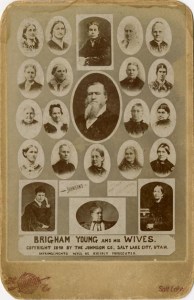
Brigham Young pictured with his wives. Special Collections, J. Willard Marriott Library, The University of Utah.

Although some viewed the passing of the act as unfair, most non-Mormons in the Utah Territory thought it was just. According to the Ogden Herald on January 4, 1882, the practice of polygamy in the Utah territory divided the Mormons and non-Mormons and created much tension. It was believed that if the practice was stopped, there could be greater peace and harmony in the territory.

The Salt Lake Herald reported another example of an opposing opinion on January 24, 1882, claiming that the act was denying rights and privileges that all citizens deserved and was singling out one religion in punishment. The Salt Lake Herald noted that “denying them privileges of citizenship seems to be a hobby with a good many anti-Mormons” and added, “we believe the suppression of polygamy will prove a sorry failure, should it pass.” But, regardless of the opposition, the Edmunds Act was soon passed.

The Salt Lake Herald reported on January 24, 1882, that the Edmunds Act consisted of three characteristics. The first was that it made it easier to find evidence to convict someone of practicing polygamy. Officials only had to demonstrate that there was more than one woman living with a man in the same house. The act also was explained in the Ogden Herald on January 26. The Deseret News reported on February 2 that the main purpose of the act was to “simply put Utah into political control of the minority.” The exact wording of the act is,

“Every person who has a husband or wife living, who in a Territory or other place over which the United States have exclusive jurisdiction hereafter marries another, whether married or single, and any man who hereafter simultaneously or on the same day marries more than one woman, in a Territory or other place over which the United States have exclusive jurisdiction, is guilty of polygamy, and shall be punished by a fine of not more than $500 and imprisonment for a term of not more than five years.”

The act was passed to create a punishment for those practicing polygamy with the goal of ending it completely. But, as one scholar points out, the provision that denied polygamists the right to vote had consequences for women. Mormon women who cohabited were disenfranchised after being granted the right to vote in 1870 by Utah’s territorial legislature. (Finkelman, 322)

After the act was passed the members of the church had to figure out how to deal with their existing relationships, possessions, and offspring and learn to live a monogamous lifestyle. It was a hard transition for them and some continued to practice for a while, which exacerbated the animosity in the state. The Salt Lake Herald reported on May 7, 1882, that polygamy was prevailing in spite of the laws of the US Congress and that “open violation of authority of this government has frequently occurred.” The article stated that non-Mormons viewed the Mormons as intolerant, wrangling, and that they ultimately had “weakened the authority of the United States.” Though persecution still raged against Mormons who were trying to deal with the transition, eventually the church strongly forbadd its members from continuing the practice of polygamy.

According to the church’s website in the article titled, “Plural Marriage and Families in Early Utah,” in 1890, eight years after the Edmunds Act was passed, Church President Wilford Woodruff issued a “Manifesto” declaring his intention to abide by the law forbidding plural marriage. He said he would use his influence to convince the members of the church to abide by the law as well. Then, in 1904, the LDS Church strictly prohibited any new plural marriages and since then, polygamy has been forbidden among the members of the LDS Church.

According to a transcript of a talk given in General Conference on the LDS Church’s website titled “Do Not Practice Polygamy,” former LDS President Gordon B Hinckley, who served from 1995-2008, said that if any members were caught practicing polygamy, they would be excommunicated from the church. Excommunication means that their records are taken away from the church, they are no longer recognized as a member, and are denied all privileges of membership.

Even though it took many years after the act was passed, the Edmunds Act was the final law against polygamy that had a lasting influence and greatly impacted the acceptance of Mormons throughout the world. The Huffington Post reported on February 18, 2016, that 51.41 percent of Salt Lake County residents identified as Mormon. Neighboring Utah County was 80 percent Mormon. By following the laws of the land, this immense number of Mormon people can live more peacefully and without opposition and resentment from the government and others in their community. To that end, the LDS Church disavows the “fundamentalist Mormons,” a sect not affiliated with the church that still practices polygamy because members believe it “brings exaltation in heaven.”

Jenna Davis graduated from The University of Utah in 2017 with a major in journalism and a minor in French.

Sources

“The Debate,” Salt Lake Herald, May 7, 1882, 2.

“Anti-Mormon Legislation,” Deseret News, February 2, 1882, 8.

“The Edmunds Bill,” Ogden Herald, January 26, 1882, 1.

“Local News,” Salt Lake Herald, January 24, 1882, 4.

“A Polygamy Bill,” Salt Lake Herald, January 24, 1882, 1.

“Another Crusade,” Ogden Herald, January 4, 1882, 2.

“Legal Aspects of the Mormon Problem,” Deseret News, January 1, 1882, 8.

Finkelman, Paul, ed. Religion and American Law: An Encyclopedia. London: Routledge, 2000.

Harrison, Mette Ivie. “Do Mormons Still Practice Polygamy,” Huffington Post, February 18, 2016. http://huff.to/1ULs8U9.

Hinckley, Gordon B. “Do Not Practice Polygamy,” transcript, The Church of Jesus Christ of Latter-day Saints, http://bit.ly/2lSphyz.

“Plural Marriage and Families in Early Utah,” The Church of Jesus Christ of Latter-day Saints, http://bit.ly/2mq7dtw.

“Sister Wives family appeal polygamy ruling to US Supreme Court.” Fox News, September 13, 2016.

Utah’s Role in Nuclear Testing During the Early 1950s

by ZACH CARLSON

The early 1950s were a tumultuous time for the United States of America. The Red Scare was well into effect, the Korean War was raging on, and Soviet Russia’s nuclear capabilities were looming on the horizon. These issues carried into 1951, marking the beginning of the new year with nuclear testing in what is now known as the Nevada Proving Grounds. The Proving Grounds are 65 miles northwest of Las Vegas. On January 27, 1951, the United States began dropping nuclear bombs to test the effect of them.

NTS_-_Warning_handbill

The U. S. Atomic Energy Commission distributed handbills such as this one before the first series of tests was conducted. The public is advised that there is “no danger” to individuals living outside the testing area. The Downwinders of Utah Archive, J. Willard Marriott Library, The University of Utah.

On January 4, 1951, the Iron County Record published an article stating, “We must pull out of Korea completely and stop useless sacrifice…. The A-bomb should be used if it will help our forces in Korea.” These lines tell us how local community members felt about the political situation then. Later in the article it is stated that “not a single letter expressed actual terror at the thought of another war and the possibility of A-bombs being used against us. War … is better than attempted appeasement of aggressors.” The local citizens would rather be exposed to the effects of nuclear radiation than roll over to the enemy. Little did they know, they got what they wished for.

In late January 1951, nearly a dozen nuclear bomb tests took place. The Salt Lake Telegram published an article on January 29, 1951, discussing how the 10th and 11th atomic blasts had affected locals. The bombs rattled casinos over 60 miles away in Las Vegas. The newspaper also reported on the wide number of complaints from citizens: “Citizens generally were not pleased. The police department got four calls per minute for a half hour.” Beyond this general grumble and discontent from Las Vegas and Utah residents, public fervor died down for a while.

A conference was held at the University of Utah in May 1951 on the subject of nuclear testing and specifically how Americans had been kept sheltered from just what nuclear bombs and energy could do when compared to other countries. An article published in the Salt Lake Telegram on May 19 discussed how the United States had recently declassified and made public a large amount of nuclear information. The author rightfully draws a connection between this now-public knowledge and citizens, especially Utahns and Nevadans, having such an up-close experience with nuclear bombs.

fig1

This image was published in a February 1955 information booklet produced by the AEC for people who lived near the Nevada test site.

Later in 1951, multiple nuclear tests were delayed because “light winds” could spell death and disease for local residents of Utah. The Salt Lake Telegram reported in November that “the postponement was the third in as many days.” This tells us just how common and deadly these light winds could be.

In April 1952, the United States began testing the effects of nuclear fallout on troops. The Salt Lake Telegram discussed how from 10 miles away the heat from the blast singed the hair off of people’s faces. The heat was described as a “blast furnace.” The soldiers had dug fox holes only 4 miles away from ground zero, subjecting themselves to extremely unhealthy doses of radiation.

For over a year, the continued nuclear testing didn’t receive much attention, as it just became a part of day-to-day life except for when it caused a much greater inconvenience. In May 1953 residents of Cedar City and southern Utah, specifically St. George, were asked to stay in their homes and not leave or drive anywhere. The problem lasted longer than one would expect; the radiation lingered in the air days after the nuclear test. The levels of radiation were deemed safe by the Atomic Energy Commission. The Iron County Record reported on May 21, 1953, that “the levels of radiation produced outside the test control area were in no way harmful to humans, animals or crops.”

Poisoning from radiation takes time to rear its ugly head in the form of cancer, birth defects, and other unfortunate symptoms. Janet Burton Seegmiller writes in The History of Iron County that:

Relatively few Iron County residents were aware of or concerned about nuclear testing when the first mushroom-shaped cloud rose into the western skies and drifted to the northeast in 1951, but the cloud figuratively remains over southern Utah and Nevada to this day. Residents live with every day what the cloud left behind that the eye could not see. There are no southwestern Utah neighborhoods or communities that have not been touched by the tragedy of cancer or birth defects or lingering bitterness over human and financial losses.

These people had been promised by their own government that they would be safe throughout the nuclear testing. They had been lied to. Seegmiller discusses that declassified documents show even back in the late 1940s it was painfully aware to scientists that this was hazardous to human and livestock.

The Atomic Energy Commission (AEC) proceeded to continue with the tests, anyway. Sheep began to have burns on their faces and miscarry fetuses that had deformities. Those that survived to birth would often die due to other deformities. Everyone still believed the government when it reassured the citizens that everything was fine. In 1984, the United States District Court ruled in Allen v. United States that “fallout caused human deaths and the federal government was negligent in failing to warn residents.” But the government won a reversal on appeal on the grounds of national security. On May 11, 1984, the New York Times reported that a federal district judge ruled that ”the Government was negligent in failing to warn residents who lived in the path of fallout plumes about the danger of radioactive contaminations.” The government again appealed the decision. In Utah, The Right Place, Thomas G. Alexander writes, “Although they knew or suspected the danger from the fallout, they did not tell the people… that they stood in risk of cancer or leukemia. Rather, AEC officials publicly lied about the danger.”

In 1990, the Radiation Exposure Compensation Act was passed. The government apologized to its very own citizens, now known as the Downwinders, and established a compensation program to help individuals who contracted certain cancers and other serious diseases. On March 2, 2015, the Department of Justice reported that it had awarded more than $2 billion in “compassionate compensation to eligible claimants” under the act.

Zach Carlson is a student at The University of Utah. He is pursuing a degree in communication with an emphasis in journalism. Zach is an avid consumer of movies, video games, and books, and loves dogs.

Sources

“Let’s Hear from the People,” Iron County Record, January 4, 1951, 2.

“Nevada Area Braces for More A-Blasts,” Salt Lake Telegram, January 29, 1951 3.

“The Big Question,” Salt Lake Telegram, May 19, 1951, 4.

“Storm Delays Atomic Tests,” Salt Lake Telegram, October 26, 1951, 7.

“Wrong-Way Wind Postpones Nevada A-Test” Salt Lake Telegram, November 17, 1951, 2.

“Mighty A-Bomb Slams Troops,” Salt Lake Telegram, April 22, 1952.

“Plan ‘Most Daring’ A-Bomb, Troop Maneuvers,” Salt Lake Telegram, May 26, 1952, 3.

“Atomic Winds – Fall-out,” Iron County Record, May 21, 1953, 2.

Alexander, Thomas G. Utah, The Right Place: The Official Centennial History. Salt Lake City, Utah: Gibbs Smith Publishers, 2003.

Peterson, Iver. “U.S. Ruled Negligent in A-Tests Followed by Nine Cancer Deaths.New York Times, May 11, 1984. http://lib.utah.edu/services/geospatial/downwinders/

Seegmiller, Janet Burton. A History of Iron County: Community Above Self. Salt Lake City: Utah State Historical Society, 1998.