Horse Racing at the Utah State Fair and Pari-Mutuel Betting

by HALIE BERRY

The Utah State Fair has been a cornerstone of Utah history even before Utah became a state in 1896. The original development of the fair was to promote “self-sufficiency” within agricultural production. The first fair, known as the “Deseret Fair,” was held in October 1856 under the supervision of the Deseret Agricultural and Manufacturing Society.

After its opening, the fair received little financial help from the Territorial Legislature and moved to various locations. Nevertheless, it was able to persevere as an annual event and in 1902 the Legislature purchased 65 acres for the purpose of assisting the local community. (Utah State Fair History)

In this pursuit, the fair had become a favored part of the horse racing industry in Utah. Horse races were featured on a new track and a covered grandstand welcomed spectators dressed in their best attire to enjoy the event. By 1909, horse racing in Utah developed similar rules and regulations to that of other organizations around the country and continued to gain increased popularity. Despite the success of the horse racing industry, there was rising opposition against it. Track owners were considered biased in the handling of wagering and during that time bookmakers were hired by the track. Utah had no state agency to oversee and/or regulate bookmaking of the horse races. (Westergren, 7)

By 1913, the belief of “dishonesty” within horse racing clouded the industry and the Salt Lake Herald and the Deseret News wrote lengthy editorials in 1909 and 1913 about the problems horse racing caused and why it should be banned. Westergren summarizes the reasons they offered, including: “The ‘fixing’ of races by dishonest horse owners and jockeys who ‘fleeced the public’ rather than providing, good, honest sport; the loss of spectators’ money in wagering at the track, depriving honest local merchants of sales and profits; the rise in crime that generally accompanied racing meets; and the moral impact of horse race gambling on individuals and families.” By February 17, 1913, Governor William Spry signed an anti-racing law initiated by Charles R. Mabey. The legislature passed the bill after a month-long “acrimonious debate.” (Westergren, 8)

In February 19, 1925, the Salt Lake Telegram reported that Representative Charles Redd had proposed a bill to the Legislature to legalize pari-mutuel betting and horse racing under a new state horse racing commission. Redd believed that horse racing was “the sport of kings” and should be re-established in the Utah industry. The bill proposed that the governor appoint a three-member committee to control the pari-mutuel betting system under new regulations by the commission. The bill gained traction among the legislature, but in March 1925, according to the Salt Lake Telegram, Sen. Herbert S. Auerbach considered the races “to be the most vicious forms of gambling and would bring into the state the worst riffraff of its kind.” This quote came after Auerbach admitted to not being “strait-laced” and dipping his hand in betting on a few races at the track.

State_Fair

A large crowd ventures to the Utah State Fairpark to watch horse racing in 1907. Shipler Commercial Photographers Collection, Mss C 275, Utah State Historical Society. Reprinted with permission.

Despite some pushback, the House Legislature passed the proposed bill on March 7, 1925, by a vote of 41 to 4 with ten members absent and by March 11, 1925, the Senate passed the bill by a vote of 12 to 5 with three absent. The law was signed by Governor George Dern and became effective on May 12, 1925. For the first time in twelve years, the horse racing industry was revived and the pari-mutuel betting system was now legal. Many who approved the bill believed horse racing was a “clean” and “respectable” sport and that the new law would encourage breeders to produce competitive offspring, bringing in a renewed source of revenue into the state. (Westergren, 8-9)

By April 1925, the fairgrounds needed improvements. Fred Dahnken and William P. Kyne, well-known men in the horse racing industry who conducted successful races in Phoenix and Reno, proposed a deal with the state fair board and were approved for a $60,000 track deal to develop horse racing over the next ten years at the Utah State Fairgrounds. According to the Salt Lake Telegram, this agreement included improvements to the existing grandstand, paddocks, jockey room, horse stalls, and fences.

Utah_State_Fair_Association___Trotters

Two racers wait outside the fairgrounds in 1908. Shipler Commercial Photographers Collection, Mss C 275, Utah State Historical Society. Reprinted with permission.

As opening day drew nearer, things were in full swing to prepare for the event. The Salt Lake Telegram reported on June 6, 1925, that a new chute would be added to the track, extending the length of the race to run up to a three-quarter-mile. Artisans put final touches on the barns, pari-mutuel booths were set up, and jockeys and exercise boys warmed up horses on the track. On June 8, the Salt Lake Telegram announced the program of the State Fair’s “Inaugural Day” and informed readers that July 2 would kick off the horse racing season with a $1,500 purse.

The Salt Lake Telegram reported on July 1:  “Several carloads of horses, in prime condition, arrived at the track today and yesterday and still more are due this evening which will swell the number of equine nobility to participate in the coming meeting to a full 400 head.” C. B. Irwin, owner of at least 21 thoroughbreds at the races, believed his top horse that he called the “route-goer,” Lizette, would be the one to beat. “He would run her from the car to the track, that’s how good he thinks Lizette is,” observed the newspaper. At last, July 2, one of the most anticipated days of the year, arrived and the Utah State Fair officially opened the races under the new Horse Racing Commission. A large number of people ventured to the track to take in and bet on some of the top thoroughbreds competing.

The new system controlled the odds of the race; no jockey, bookie or horse owner could “fix” the race ahead of time. The minimum wager was $2.00. Bettors could choose from three types of tickets to place on a horse: win, place, or show, similar to other races. According to Westergren, “This ticket system was universally used at all tracks where the pari-mutuel system was functioning. The rules placed no limit on the number of tickets a bettor could buy. He might put down money on every horse in the race if he chose. However, payoff came only if the participant held a ticket for a horse that finished in one of the first three positions.” Tickets purchased from a pari-mutuel betting machine were cashed in to verify receipt of the wager amount. Odds were based on the wagers at the track and the money collected from their bets, rather than fixed, random odds by a bookie. Therefore, bettors wagered against themselves. Once expenses were paid to the state and licensed track owner, the remainder of the pool was divided among those with winning tickets. (Westergren, 12, 10)

The Salt Lake Telegram reported on July 3, 1925, “Women dressed in their fine summer clothes added a touch of color to the scene. The pari-mutuel machines received a good play, a fact which testified by the clicking one constantly heard as wagers were made.” The day was considered an overall success, according to William P. Kyne, the general manager of the State Fair races. On July 3, 1925, the Salt Lake Telegram highlighted, “Running strongly to the front, Lizette never placed the issue to doubt and ran to victory with more than two lengths to spare,” living up to Irwin’s expectations. It was estimated that between 3,500 and 10,000 attended opening day, including Heber J. Grant, the president of The Church of Jesus Christ of Latter-day Saints, Governor George H. Dern, Salt Lake City Mayor C. Clarence Nelsen, and several other government officials. (Westergren, 14)

Overall, the races were financially successful as they hoped; from May 12, 1925, through the end of 1926, it was reported that racing brought in an additional $129,646 in total revenue. Business and community support was at an all-time high. But by February 1927, public concern with ethical issues of horse racing and betting affected support for the sport. Just two years after the passage of Representative Redd’s bill, pari-mutuel betting would again be banned by the Utah Legislature after accusations of corruption. (Westergren, 15)

Utah_State_Fair___P_26

Horses and buggies race to an exciting finish in 1904. Shipler Commercial Photographers Collection, Utah State Historical Society. Reprinted with permission.

In March 1992, the Davis County Clipper reported that Utah horse breeders had filed a petition to get pari-mutuel betting on the ballot, which would give counties the right to decide whether or not they would approve pari-mutuel wagering at horse races in their jurisdiction. According to the article, “The funds collected in the pari-mutuel wagering will be used to support the public, promote economic growth and reduce taxes.” Even though the bill made it on the ballot, late opposition from the LDS church prevented the bill from passing.

It’s been 90 years since pari-mutuel horse race betting has been legal. However, the positive impact it had on Utah’s economy shows the progressive role it can play today. It’s reported that the Utah State Fairgrounds is in a state of distress. Brian Grimmett of KUER reported on March 27, 2014, that an audit by the Utah State Auditor found the Utah State Fair Corporation is highly subsidized compared to similar state fairs around the country: “The legislature has given the fair more than $6.8 million since 2004. Meanwhile, attendance has decreased almost every year since hitting a peak in 2008.” Many of these concerns are due to the crumbling infrastructure. Legislative auditors are concerned if a plan to update and improve fair park facilities isn’t in place, the State Fair will be destitute in a few years, reported Judy Fahys of KUER.

The horse racing/breeding industry is an established sport in Utah. Allowing pari-mutuel betting or a similar system would be an incentive for members of the community to get involved, support the races and generate a year-round source of income to update and maintain current buildings at the state fairgrounds. Pamela Wood of the Baltimore Sun reported on March 18, 2016, that a new track deal allowed off-track betting at the Maryland State Fair all year. It was projected to generate upward of $500,000 per year in revenue for the Maryland Jockey Club, horsemen, and building upkeep and maintenance. Passing a similar bill here in Utah would allow the state fair to create new sources of revenue while continuing the tradition of the fairgrounds for future generations.

Halie Berry graduated in May 2017 from The University of Utah with a Bachelor of Science degree in mass communication with an emphasis in sports broadcasting.

Sources

“Huge Throng Thrilled as Lizette Wins Feature of Opening Day,” Salt Lake Telegram, July 3, 1925.

Track and Equipment is Ready for Opening Event,” Salt Lake Telegram, July 1, 1925.

Program Announced for the First Five Days’ Racing,” Salt Lake Telegram, June 8, 1925.

“Fair Grounds Race Track to Have ‘Chute Added,’” Salt Lake Telegram, June 6, 1925.

“Fair Grounds Track Deal is Made,” Salt Lake Telegram, April 15, 1925.

Senate Overrides Dern’s Veto of McCarty Election Measure; Utah Horse Racing Bill Passes,” Salt Lake Telegram, March 12, 1925.

“Solon Revives Horse Races in House Measure,” Salt Lake Telegram, February 19, 1925.

Horse Breeders Want Pari-Mutual Vote,” Davis County Clipper, March 31, 1992.

Our History.” Utah State Fair, http://utahstatefair.com/history

Fahys, Judy. “State Fair Park’s Future Remains Uncertain.” KUER, June 19, 2014, http://kuer.org/post/state-fair-parks-future-remains-uncertain#stream/0

Grimmett, Brian. “Utah State Fair Under-Attended and Over-Subsidized.” KUER, March 27, 2014, http://bit.ly/2pm6r2R.

Luhm, Steve. History of Horse Racing in Utah.” The Salt Lake Tribune, May 2, 2006http://bit.ly/2plUp9n.

Westergren, Brian N. “Utah’s Gamble with Pari-Mutuel Betting in the Early Twentieth Century.” Utah Historical Quarterly 57, no. 1 (Winter 1989): 4-23.

Wood, Pamela. “Community, state fair reach deal on off-track betting at the fairgrounds,” Baltimore Sun, March 18, 2016, http://bsun.md/21ALmMz.


Brigham Young University Athletics “blind-cited” by National Women’s Law Center on 25th anniversary of Title IX

by MICHAEL CHARLES WATERS

Title IX prohibits discrimination based on sex in any education program or activity that receives federal funding.

Twenty-five years after it was enacted, Brigham Young University found itself in trouble with the federal law. The law was signed in 1972 by President Richard Nixon to give equality to women in programs that provide education. The law states:

“No person in the United States shall, on the basis of sex, be excluded from participation in, be denied the benefits of, or be subjected to discrimination under any education program or activity receiving Federal financial assistance.” (United States Congress)

The Salt Lake Tribune reported on March 2, 1997, that BYU claimed its athletics program had given varsity status to sports in which female athletes had shown interest and ability to compete. BYU women’s athletic director Elaine Michaelis said BYU had what it needed for quality programs, but that there were some areas that needed improving. She also pointed to progress with upgrading women’s locker rooms, ensuring that practice facilities were equal, and adding a women’s soccer team to increase the number of women’s scholarships. But, in order to afford scholarships for women’s soccer, BYU had to shift money from the men’s sports. One of those sports was men’s wrestling.

The Deseret News reported on March 11, 1997, that BYU wrestling was on the bubble and was close to discontinuation. Head wrestling coach Mark Schultz was having a difficult time recruiting athletes to BYU, because scholarships were scarce due to BYU’s continued efforts to comply with Title IX. Funds were being taken from wrestling and reallocated to other areas, and Schultz was told his position would be adjusted to part-time status. Athletic director Rondo Fehlberg, who was an All-American wrestler at BYU in the early 1970s, had mentioned that his preference was to add sports instead of dropping them. But if it became necessary for gender-equity, he would drop wrestling. Per former U.S. Department of Justice policy advisor Jessica Gavora:

“…No men’s program is exempted, no matter how successful or established… Brigham Young University eliminated its top-10-ranked men’s gymnastics team and its top-25-ranked wrestling team.” (53)

BYU’s head track coach Willard Hirschi also had some troubles with Title IX. Hirschi said in an interview with the Deseret News on March 13, 1997, that the men’s team was only allowed 12 scholarships for 19 events, while the women’s team was awarded 18 scholarships. Part of the reason women had more track scholarships than men is that an imbalance is created by the large number of football players awarded scholarships. The total number of financial awards allocated to other men’s teams is then adjusted accordingly. This didn’t sit well with Hirschi.

TitleIXComplianceCommitteeCharter11-25-13_0

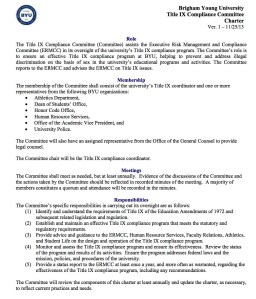
The first page of the charter prepared by the Title IX Compliance Committee at Brigham Young University.

The Deseret News, BYU’s own Daily Universe, and The Salt Lake Tribune reported on June 3 and June 4, 1997, that the National Women’s Law Center (NWLC) filed complaints against 25 schools, including BYU, stating that the institutions were not in compliance with Title IX. The complaint alleged that female varsity athletes were not receiving the same benefits by way of scholarships as the men were.

R. J. Snow, vice president for advancement at BYU, said in an interview with the Deseret News on June 3 that the institution was making considerable advancements when it came to women’s collegiate athletics. He also said that the motivation behind the complaints directed at BYU and other institutions, including Utah State University, was mainly for publicity and that the NWLC went to the media first before contacting the listed schools. In a statement to the Deseret News, NWLC co-President Marcia D. Greenberger said female athletes were putting forth a lot of effort, but were getting the short end of the stick when it came to getting scholarships.

The Daily Universe reported on June 4, 1997, that the complaint’s purpose was to have the schools in violation work with the Office of Education for Civil Rights. According to what Michaelis told the Universe, BYU had been doing just that for the past three years. The Universe also reported that the claims requested that women’s teams have equal locker space, the same quality of media guides and the same room and board opportunities as male athletes. After a random audit two years prior to the claims from the NWLC, BYU completed a new women’s locker room that provided more space. But Michaelis said the national scene was changing and BYU needed to look further at improving the women’s program. Otherwise, BYU would lose all federal funding.

The Salt Lake Tribune reported on June 4, 1997, that the BYU student body was made up of 52 percent women, but that women only made up 38 percent of the school’s varsity athletes. They also reported that the women’s varsity teams only received 30 percent of the school’s monetary awards in athletic-related student aid. This was an infraction of Title IX.

On June 7, 1997, The Salt Lake Tribune published another story stating that it was odd to celebrate the 25th anniversary of Title IX by filing complaints against just 25 schools. Indeed, as Fort Worth Star-Telegram journalist Andy Frielander reported, there were 305 Division I schools in the National Collegiate Athletics Association in 1997. The Tribune’s article reiterates the complaint that the 25 schools should offer the same number of scholarships between women and men as well as a standard that the percentage of woman in the student body should equal the percentage of female varsity athletes. The Tribune also quotes Title XIV as it pertains to athletic scholarships:

“To the extent that a recipient awards athletic scholarships or grants-in-aid, it must provide reasonable opportunities for such awards for members of each sex in proportion to the number of students of each sex participating in interscholastic or intercollegiate athletics.” (U.S. Department of Education)

The Tribune added that institutions of higher learning should strive for gender equity in both participation and scholarship awards.

On June 20, 1997, syndicated columnist Ellen Goodman wrote in the Deseret News that Title IX has not equalized opportunities for women in sports.

“In 1972, Title IX was passed in the name of fairness. Why pay the tax dollars so our sons could play but not our daughters? But the playing field is not yet truly level. There is barely a school in the country in which the proportion of women athletes matches the proportion of women students.”

Gordon Monson of The Salt Lake Tribune reported on December 9, 1997, that Michaelis said that Title IX has helped women gain many opportunities in sports. Female athletes were starting to get more of what the men got.

On December 11, 2011, the Daily Universe reported that the playing field for women in sports was leveling out. But there is still a problem for some men’s teams, because football is included in the scholarship count.

“There are 4.5 scholarships given to the men’s tennis program and 8 to the women’s, 9.9 to the men’s swim and dive team compared to the 14 women receive, and 12.6 for the men’s cross country/track and field team, whereas the women’s squad gets 18 at BYU. As a result, the fairness of Title IX continues to be debated among those affected by it.” (Ellett)

This shows that BYU was making progress toward total compliance with Title IX, regardless of lack of scholarships for male athletes not playing football.

On August 8, 2012, The Daily Universe reported that the decision to cut men’s gymnastics and the wrestling team further helped BYU be compliant with Title IX: “That decision has helped BYU to better meet the standards set for Title IX and allow the university to use its resources in the best ways possible.” Janie Penfield, BYU associate athletic director, also said in the article that schools are only checked occasionally to make sure they meet Title IX requirements. If schools show little to no progress, they will be penalized.

A committee charter from 2013 illustrates that BYU continues to push for full compliance with Title IX.

Michael Charles Waters is a junior at The University of Utah majoring in mass communication with an emphasis in journalism. He has worked for Salt Lake Community College, where he had his own sports talk show for school radio and television, and interned with the Utah Jazz in video production. He currently works at The University of Utah filming and creating highlight videos for the teams as well as supply play-by-play analysis and color commentary for some of the teams.

Sources

Joe Baird, “Bridging the Gap; Utah Schools Pleased With Progress on Gender Front; Local Schools Like Their Progress,” The Salt Lake Tribune, March 2, 1997, B1.

Jeff Call, “BYU coach wrestles hard times,” Deseret News, March 11, 1997, D7.

Doug Robinson, “BYU’s Hirschi believes Title IX is hurting track and field,” Deseret News, March 13, 1997, D3.

Jeff Call, “BYU, USU among 25 to be cited,” Deseret News, June 3, 1997, D4.

Dan Egan, “BYU and USU Both Caught Off Guard By Group’s Charge; TITLE IX: Catches BYU, USU Off Guard,” The Salt Lake Tribune, June 4 1997, B1.

Kathryn Sorenson, “BYU under fire for discrimination,” The Daily Universe, June 4, 1997.

“Pay to Play—Equally,” The Salt Lake Tribune, June 7, 1997, A10.

Gordon Monson, “Michaelis Loves ‘Purity of Sport’ (And Winning); Michaelis Leads Cougs To the Final 16,” The Salt Lake Tribune, December 9, 1997, D1.

“Brigham Young University Title IX Compliance Committee Charter,” Brigham Young University Compliance, http://bit.ly/2p9sDMU

Ellett, Carlie McKeon. “At 40, Title IX has leveled playing field at BYU.” The Daily Universe, December 11, 2011. http://bit.ly/2oAlmb6

Frielander, Andy. “UTA meets Title IX standards—University ranks high in recent gender study,” Fort Worth Star-Telegram, April 30, 1997, 1.

Gavora, Jessica. Tilting the Playing Field: Schools, Sports, Sex and Title IX. San Francisco, CA: Encounter Books, 2002.

Goodman, Ellen. “Title IX has yet to level the playing field for women.” Deseret News, June 20, 1997, A11.

Houghton, Jared. “Title IX: Helping or hindering college sports?” The Daily Universe, August 8, 2012. http://bit.ly/2otNvQX

United States Department of Labor. “Title IX, Education Amendments of 1972.” http://bit.ly/24uzmTF

Cornell University Law School. Legal Information Institute. 14 CFR 1253.430, Financial Assistance. http://bit.ly/2p9OCnb

Creation of the WAACs and their Arrival to Utah, 1943

by NICOLE COWDELL

In September 1939, German armies invaded Poland and the world was forever changed. The resulting war involved a dozen countries, took upwards of 60 million lives and altered the worldly perceptions for generations to come. However, this story is not strictly about the war. Instead, this story focuses on a unique group of individuals who answered the call when their country needed them. This story is about strength, courage and independence. This story is about breaking barriers and smashing stereotypes. This story is about the formation of the United States Women’s Auxiliary Army Corps. The WAAC was created by President Franklin D. Roosevelt in 1942. The first units started training in July and by 1943 units were sent out across the nation. In May 1943, one of those units arrived in Utah.

On May 18, 1943, the Transcript Bulletin reported that a WAAC unit comprised of 92 women arrived at the Dugway Proving Grounds in Tooele, Utah. One of the first units to be sent out, their arrival marks an important point in history. The article goes on to say that “although situated almost in the middle of the desert, the morale of the detachment is said to be unusually high.” The women there were replacing soldiers in positions such as “chemical work, laboratory aides, chauffeurs, truck drivers and other work connected with the operation of the post.”

Of particular note, was the fact that the unit was entirely self-sufficient. On that same day, the Transcript Bulletin also reported the unit was doing “their own cooking, laundry and the many details to maintain the camp.”

The Dugway Proving Grounds was a unique assignment for the women, as it was tasked with a very specific goal by the U.S. War Department. The grounds were set up in order to test and experiment with chemical warfare methods due to the growing usage of such weapons in the World War II battlefields. Needing a spacious, unpopulated area, the War Department looked to Western Utah as the ideal location. There, “tests with toxic agents, flame throwers and chemical spray systems were performed.” (Ison, 1)

FullSizeRender2

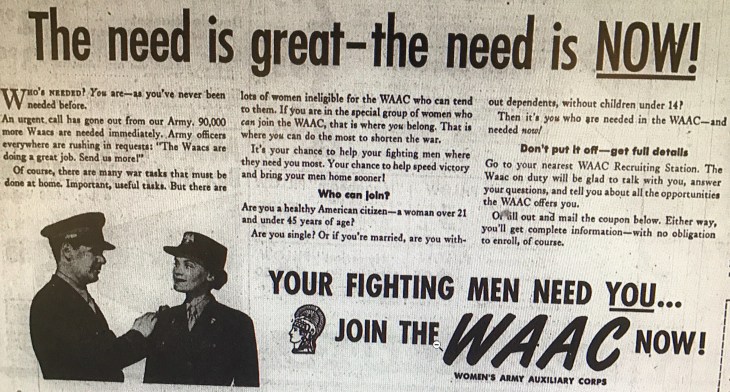
Advertisements, including this one published in the May 15, 1943, issue of The Salt Lake Tribune, urged women to support military men by joining the WAAC.

The WAACs’ arrival was seemingly perfectly timed, for earlier that same week the Governor of Utah, Herbert B. Maw, declared the week of May 10 to 15 as WAAC Week. According to the Salt Lake Tribune, the week was to be recognized statewide for “the first anniversary of the women’s auxiliary army corps…for the purpose of taking over many of the army’s noncombat jobs.” (May 10, 1943, p.16) In his address to the public, the Salt Lake Tribune reported that Governor Maw said the WAAC “has rendered important services to the army by performing more than 100 different types of work formerly done by soldiers needed on the fighting fronts.”

On May 12, 1943, the Salt Lake Tribune reported recruiting would “be the principal feature of the week.” Though the WAAC had already recruited over 60,000 members, the goal was set to quickly add another 110,000 recruits and send them off to training.

Since the primary focus would be recruitment, that week the Salt Lake Tribune featured a variety of ads for the Women’s Auxiliary Army Corps. One featured on page 10 on May 15, 1943, declared largely that the women in the WAAC were “the luckiest girls alive – and we know it! The need is great – the need is NOW!,” it said, sparking patriotism and desperately trying to appeal to the American women who could help fill the wartime void. It seemed great pride was placed upon the women as they bravely entered into unknown territory to dutifully help their country during wartime.

FullSizeRender3

Ads such as this one, published in the May 15, 1943, edition of The Salt Lake Tribune, emphasized duty and patriotism and encouraged women to seek more information about the program.

The women who enlisted also received much praise from their communities. In fact, updates of women who signed up were frequently printed in the papers. Since Tooele was home to one of the units serving at Dugway, it should come as no shock that they were particularly proud of their women. On March 23, 1943, the Transcript Bulletin announced that “Miss Eva C. Brough … left Tooele Saturday for Salt Lake headquarters prior to her departure for Fort Des Moines, Iowa.” The announcement made the front page and was printed above the announcement of two marines leaving for training soon. This is just one of many examples of communities rallying behind men and women supporting the nation’s war efforts.

The community, both local and farther away in Salt Lake City, welcomed the Dugway Proving Grounds unit and continued to encourage more enlistments. The WAAC even received praise from the nation’s president. Printed on page 12 of the Salt Lake Tribune on May 16, 1943, President Roosevelt said, “I congratulate the WAACs and express the gratitude of our nation for a task well commenced.”

The Women’s Auxiliary Army Corps became simply the Women’s Army Corps in July 1943 but the units’ story doesn’t end there. Women continued to dutifully, though separately, serve in the military until 1978 when the WAC was finally fully absorbed into the United States Army. Even then though, the battle for equality and recognition still continued. Though the creation, implementation and ultimate success of the Women’s Army Corps worked to break down gender stereotypes, women were still not seen as fully fit for combative military positions. Even once absorbed in the army, they were withheld from holding combat positons for years to come. Not until December 2015, close to 74 years after the creation of the WAAC, would women finally be allowed to occupy combat roles in all areas of the United States military.

On December 3, 2015, the New York Times published an article which stated “the Pentagon would open all combat jobs to women.” The newspaper also called this decision a “historic transformation,” a “groundbreaking decision” and “the latest in a long march of inclusive steps by the military.” As the fight continues around the nation, and the globe, for women’s equality the WAC and its legacy are a heart-filled reminder of all those who came before us and the accomplishments they strived to achieve.

Nicole Cowdell is a senior at the University of Utah. She is majoring in communication with an emphasis in journalism.

Sources

“Maw Signals Start of WAAC Week: Governor Cites Opportunities Waiting Recruits,” The Salt Lake Tribune, May 10, 1943, 16.

“Conference Opens Drive to Hike WAAC Total,” The Salt Lake Tribune, May 12, 1943, 14.

Advertisement for WAAC Enlistment, The Salt Lake Tribune, May 16, 1943, 10.

“The WAAC…Its First Birthday Just Passed…On They March,” The Salt Lake Tribune, May 16, 1943, 11.

“WAACS Gain Praise of U.S. President,” The Salt Lake Tribune, May 16, 1943, 12.

“92 WAACS Arrive at Dugway: Morale High as Ladies Adjust to Desert Life,” The Transcript Bulletin, May 18, 1943, 1.

“All Combat Roles Now Open to Women, Defense Secretary Says,” The New York Times, December 3, 2015, 1.

Ison, Yvette. “Chemical Weapons Testing Created Controversy at Dugway.” The History Blazer (July 1995): 41-42.

Williams, Vera. WACs: Women’s Army Corps. Osceola, Wisconsin: Motorbooks International, 1997.

Utah Jazz defeated by the Chicago Bulls in Game 6 of the 1998 NBA Finals

by TYSON SHAW

On June 13, 1997, the Chicago Bulls in the Chicago United Center hosted the Utah Jazz for Game 6 of the 1997 NBA finals. The Jazz held the lead over the Bulls for most of the game until the end of the fourth quarter, when Chicago tied the game at 86-86. In the last seconds of the game the Jazz fell apart and Chicago’s Steve Kerr broke the tie with a quick jumper. The last possession for the Jazz would also end with a steal and a bucket for the Bulls. The Chicago Bulls became the 1997 NBA champions, defeating the Utah Jazz 90-86. It was the first time the Jazz had made it to the NBA finals, but it was the fifth NBA championship in seven years won by the Bulls. With this win, Michael Jordan and the Chicago Bulls had lifted their team to dynasty status in the history of the NBA. (Taylor, 30)

The 1998 NBA season featured the Utah Jazz’s best season. The team led the Western Conference Division with a season record of 62-20. The Jazz once again found themselves in the NBA playoffs. They were able to push past tough teams such as the Houston Rockets and the San Antonio Spurs. They ended up sweeping the Los Angeles Lakers 4-0 to win the Western Conference title. (Basketball-Reference.com) The 1998 NBA finals would once again pit the Utah Jazz against the Chicago Bulls for the NBA championship. The Jazz ended up winning the first game in the series. In Game 3, with a loss to Chicago of 96-54, the Utah Jazz had set the record for the least amount of points scored in a finals game. By Game 5 of the Finals, the city of Chicago was planning for another Bulls championship ending at the United Center. But Utah surprised Chicago with a win in Game 5, with the help of 39 points by Karl Malone, to send the series back to Utah for Game 6 of the NBA Finals. (Lewis, 270-274)

An article from the Salt Lake Tribune published June 14, 1998, shows that the Chicago Bulls weren’t happy to have to travel to Utah for Game 6. Before Game 5, Dennis Rodman pledged, “We’re not going back to Utah.” Even Scottie Pippen chimed in after the loss of Game 5, stating, “I know no one wanted to make this trip.” The Chicago Bulls understood that it would be tough to face Jazz fans and players at the Delta Center in Salt Lake City.

One individual who still had hope for the Jazz was a writer for the Deseret News, Doug Robinson. His article, published June 14, 1998, was titled, “8 reasons the Bulls can still be had.” Robinson discussed the injuries the Bulls had encountered, such as the back problems that power forward Dennis Rodman was experiencing. The Bulls were struggling with their game and that included not having players they could pull from the bench. Robinson pointed out that Michael Jordan seemed “a little dreamy and distracted,” and noted that Jordan wasn’t playing up to his legendary status, only shooting 43 percent in the Finals.

Robinson changed his tune the following day, when he wrote about the Bulls’ victory over the Jazz in Game 6. Robinson had to admit that it wasn’t the Chicago Bulls that had beat the Jazz. Rather, “Michael Jordan beat the Jazz.” The Jazz stayed ahead of the Bulls throughout most of the game. Robinson listed the plays Jordan made in the last 41 seconds, including “a rebound, a layup, a steal, a jump shot, a trophy, a hug.” Though the Jazz had the last possession of the game, Jazz guard John Stockton wasn’t able to capitalize on a last-second three-pointer that ended the game with the Bulls defeating the Jazz 87-86. It was another NBA championship for the Chicago Bulls, their sixth world championship and a defining moment in Jordan’s career. Deseret News reporter Robinson truthfully admitted about Jordan, “Was there ever any doubt it would come to this? … He’ll find a way to beat you.”

It was safe to say that after Game 6, Utah Jazz fans were feeling disappointed. The Deseret News reported on June 15, 1998: “Thousands of somber, frowning fans departed” the arena following the loss. But many Jazz fans didn’t want to accept the fact that the season had ended with another loss at the finals to the Bulls. Dick Rosetta, writing for The Salt Lake Tribune, explained that there should have been a Game 7—even though Jordan would still have taken the championship in the end. Rosetta pointed out that bad calls by the officials resulted in the Jazz losing the game. The problem was that Howard Eisley, the guard for the Jazz, had hit a three-pointer as the clock buzzed, but referee Dick Bavetta called the shot as a “no basket.” Bulls Guard Ron Harper hit a buzzer-beater for two points that was counted by the officials. League officials didn’t use instant replay, but TV replays showed that Eisley’s three-pointer was in before the buzzer while Harper’s bucket later in the game did not beat the buzzer. If instant replay for officials had been used in the league then, the Jazz would have been ahead by five more points and most likely would have won Game 6.

As Rosetta observed, Game 7 might have ended with another last-minute shot by Jordan. However, the Jazz would have had home court advantage in Game 7. John Tauer, Corey Guenther, and Christopher Rozek discuss home court advantage in their article published in Journal of Applied Sport Psychology. It addresses the benefit of familiarity basketball players have when shooting baskets at home and the psychological advantage of cheering fans when it comes to winning a game. Yet even with this advantage the Utah Jazz still lost Game 6. If the Jazz would have made it to Game 7, as Rosetta claimed the team deserved, the Jazz would have had the best chance of winning. As the scholars observe in their article, “In the ultimate game of professional basketball series, we observed home teams performing exceptionally well in Game 7s.” (157) But that was immaterial. The loss of Game 6 sealed the end of season. No one felt that loss harder than the Jazz players and staff.

Utah_Jazz___P_271

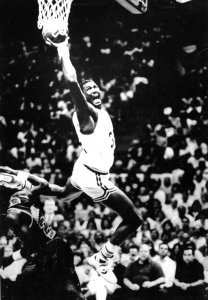
Forward Karl Malone enjoyed an 18-season career with the Utah Jazz. Used by permission, Utah State Historical Society.

A Deseret News article published on June 16 focused on the disappointment of the players on losing Game 6 and what the future held for the Utah Jazz. Jazz Coach Jerry Sloan pointed out that the defeat hit much harder than the loss of Game 6 in 1997. Regarding contracts and deals, no player knew what the next season would be like. The NBA even faced problems such as a lockout if the owners didn’t make the correct deals on time. Emotions were different for Jazz star Karl Malone. The thought of basketball was not something he wanted to discuss. His focus was on getting healthy and the wrestling match between him and Dennis Rodman that was scheduled for July 1998.

Utah TV viewers were ready to put the finals behind them. Scott D. Pierce reported in the Deseret News that Game 6 was “the most-watched NBA game in history.” Many tuned in to see what might have been Michael Jordan’s last game. NBA fans also would not want to miss the power duo of Karl Malone and John Stockton. Pierce pointed out that it was a time for relief: “No more Jazz Fever.” Utah viewership could forget about basketball for a while. There was always next season to worry about.

Game 6 of the 1998 NBA Finals will go down as one of the greatest games played in sports. Jazz fans should be proud that the great final match between Utah and Chicago all happened on their home court in the Delta Center. Some fans may always feel—as was written by Kurt Kragthorpe in The Salt Lake Tribune—that if Jordan had stayed in baseball, the Jazz might have been the 1998 NBA champions without having a Game 6 in the Delta Center. To fans of basketball, Jordan’s performance on June 14, 1998, in the Delta Center will always be remembered as one of his greatest performances. To Jazz fans, the 1998 Utah Jazz will always be remembered as a legendary team, despite not winning the NBA Championship.

Tyson Shaw is a junior at The University of Utah. He is majoring in film and media arts and minoring in media studies.

Sources

Scott D Pierce, “Finals are finished-some relief in order for Utah TV viewers,” Deseret News, June 18, 1998.

David Locke, “Always a gambler, Jordan deals Jazz the Finals blow,” Deseret News, June 16, 1998.

Loren Jorgensen, “Jazz feel letdown in the locker room,” Deseret News, June 16, 1998.

Zack Van Eyck, “Crunch time leaves fans feeling crunched,” Deseret News, June 15, 1998.

Doug Robinson, “M.J’s Moment: a Finals finale” Deseret News, June 15, 1998.

Kurt Kragthorpe, “Another Jazz Shot Comes up Just Short; But there’s hardly any disgrace in losing to MJ,” Salt Lake Tribune, June 15, 1998.

Dick Rosetta, “Hit Playback Button to Watch Rerun—MJ Shoots, Bulls Win; Rosetta: We’ve Seen This Stuff All Before,” Salt Lake Tribune, June 15, 1998.

Steve Luhm, “Jazz Back Home; They’er Not Alone; Bulls Would Like to Cut Visit Short,” Salt Lake Tribune, June 14, 1998.

Doug Robinson, “8 reasons the Bulls can still be had,” Deseret News, June 14, 1998.

Phil Taylor, “To the Top. (Cover Story),” Sports Illustrated (June 1997): 30.

Tauer, John M., Corey L. Guenther, and Christopher Rozek. “Is There A Home Choke In Decisive Playoff Basketball Games.” Journal of Applied Sport Psychology 21.2 (2009): 148-162.

Lewis, Michael. To The Brink: Stockton Malone and the Utah Jazz’s Climb to the Edge of Glory. New York, New York: Simon & Schuster, 1998.

“1997-98 Utah Jazz Roster and Stats,” Basketball-Reference.com.


University of Utah Among the Founders of the Western Athletic Conference (WAC)

by ALEX PAGOAGA

The Western Athletic Conference (WAC) was originally formed in 1962 after three years of discussions among several university officials of what would be the founding schools: Arizona, Arizona State, Brigham Young (BYU), New Mexico, Utah, and Wyoming. With this new cluster of teams all located in the Mountain Time Zone, the conference was set to establish itself on the national stage. Over the years, the WAC lost schools (Arizona and Arizona State) and gained schools (Colorado State, Texas-El Paso, San Diego State, Hawaii, and Fresno). The WAC was a success for thirty-four years despite having its ups and downs in athletic performance. In the late 1990s, the WAC tried to maintain pace with other conferences’ TV deals and revenue streams throughout the country and ended up losing almost everything.

The falling out of the original WAC started in 1994 after the announcement that the Southwest Conference would be disbanded. An article published in The Salt Lake Tribune on April 20, 1994, stated that the expansion had to happen for the WAC to improve. Otherwise, it would continue in the shadows of the true national power house conferences. The newly disbanded conference provided the perfect opportunity for expansion. But nobody was ready for the size of the expansion that was about to take place. In an attempt to catch up in the television ratings race that was happening throughout the country, the WAC attempted a TV market power grab. The WAC extended invitations to three schools from the newly disbanded conference (Rice, Texas Christian, and Southern Methodist) along with two schools from the Big West (San Jose State and Nevada Las Vegas) and one school from the Missouri Valley Conference (Tulsa). These new teams brought in the Bay Area, Houston, Dallas, and Las Vegas TV markets.

Rice University basketball coach Willis Wilson stated to the Deseret News on April 23, 1994, that being in the WAC would provide a level playing field for his team for the first time because of all the sanctions that the old Southwest Conference had a tendency to accrue from the NCAA. These feelings of excitement to be included into the new WAC was a common theme among the incoming schools after being abandoned by or unhappy in their old conferences. However, the feelings did not extend to the longstanding members.

As pointed out by the Chicago Tribune, the new WAC had 16 teams compared to 12 in the next largest collegiate conference. These 16 teams covered four time zones, 4,000 miles, and nine states. This caused a strain on all of the existing members of the WAC to try to accommodate the sheer time and energy it took to travel to all of the new schools in the conference. With the increased stress of the expanded league school officials started to doubt if this was the best choice. In a May 27, 1998, article published in The Salt Lake Tribune, President Bernie Machen said, “I asked myself: ‘How do we fit into this organization? Is this the best place for the University of Utah to be for the future?’”

WAC

The Western Athletic Conference, formed in 1962, was successful for more than three decades.

With the expansion of the WAC, it was no longer possible to play everyone in a season. To fix this the conference came up with a revolutionary idea to have quadrants that would swap divisions every other year. This caused several long-standing rivalries to be split up. As described by Jeff Call in BYU Magazine, the loss of familiar teams on the schedule was a vocalized cause for unrenewed season tickets. Losing rivalries and tickets caused more tension between the older teams that were no longer playing in rivalry games every year, and the new teams that were geographically far away from the older schools. After two years of awkward quadrants, a revamp of the divisions/conference was a necessity.

According to Patrick Kinahan of The Salt Lake Tribune, athletic directors of the conference voted during the last week of April 1998 to disband the use of quadrants and split the conference into two separate divisions. Their vote passed 13-3 and was scheduled to be passed on to the presidents of each school, who would then vote among themselves the following month. However, the dissatisfaction of the older schools was simply too much. BYU athletic director Rondo Fehlberg told Joe Baird of The Salt Lake Tribune, “The problem was, nobody could come up with a way to say, ‘Here’s how it’s going to get better.’ All we could see were the costs going up and the revenues staying flat.” (“BYU, Utah”)

Spearheaded by the two Utah schools, the presidents of Air Force, BYU, Colorado State, Utah, and Wyoming met at the Denver International Airport two weeks before the scheduled vote of divisions to find a new solution. The answer? Create a new conference again. Eight schools in total decided to split from the WAC. They notified the NCAA of their intention to form what would eventually be known as the Mountain West Conference (MWC) taking effect on June 30, 1999. (Edward) The eight defecting schools were: Air Force, Brigham Young, Colorado State, Nevada Las Vegas, New Mexico, San Diego State, Utah, and Wyoming.

After the abrupt rupture of the WAC many doubted how long the conference could survive. In the aftermath, Darren Wilcox of the Daily Universe said, “The only question remaining is how long the WAC can survive with leftovers. Sure, throw them in the microwave oven, stir them up a bit and they may look appetizing. They may even smell delicious. But they are leftovers just the same.” The leftover teams did lack an athletic prowess that was taken to the new conference. Due to this defect in arguably the most important trait of an athletic conference, many, including Joe Baird of The Salt Lake Tribune, theorized that the new WAC would require expansion and possibly include Utah State on the short list. (“WAC Defection”) Despite local support, Utah State University was not included in the first expansion after the split, citing market size as the cause for dismissal.

After being in the shadows on the national stage, the WAC attempted to expand the league to an unheard-of 16-team league. The loss of rivalry games paired with more difficult logistics to accommodate the size of the league ultimately resulted in concerned and unhappy members. Taking the lead, both BYU and Utah sought to rid themselves of these concerns and decided to create a league of their own, thus removing the league that they had helped create from the state of Utah.

Today, 19 years after their split from the WAC into the MWC, both BYU and Utah find themselves yet again in different conferences. BYU left for an independent football bid and landed in the West Coast Conference for all other sports. Utah accepted an invitation to the Pacific Athletic Conference. The WAC found its way back into Utah by way of an eight-year stint with Utah State from 2005 to 2013. Currently, Utah Valley University is among its full members. The WAC has acted as a steppingstone for three universities in Utah, and while all three have gone on to bigger and better opportunities, the conference still stands as a symbol of opportunity for student athletes across the western United States.

Alex Pagoaga is a senior at The University of Utah, majoring in journalism.

Sources

John McFarland, “SMU, TCU, Rice Ecstatic to be in Expanded WAC,” Deseret News, April 23, 1994.

Dick Rosetta, “Expansion Gamble Will Make WAC Bigger,” The Salt Lake Tribune, April 20, 1994, C1.

Darren Wilcox, “WAC leftovers won’t survive alone,” The Daily Universe, May 27, 1998.

James Edward, “Utes Seceding From WAC,” The Daily Utah Chronicle, May 27, 1998, 9.

Joe Baird, “WAC Defection Might Open a Spot for Utah State,” The Salt Lake Tribune, May 27, 1998, C6.

Joe Baird, “BYU, Utah Make a ‘Bold Move’ – Abandon the WAC,” The Salt Lake Tribune, May 27, 1998, C1.

Patrick Kinahan, “WAC Collapses Under Its Own Weight,” The Salt Lake Tribune, May 27, 1998, A1.

Stephen Nidetz, “8 Schools Defect From WAC to Form League Of Their Own,” The Chicago Tribune, May 27, 1998.

“Another Wacky Move?” The Salt Lake Tribune, May 28, 1998, A10.

Call, Jeff. “The Great Divide: BYU and Seven Others Leave WAC.” Brigham Young Magazine, Fall 1998. http://bit.ly/2qfSYZE

The 1965-66 Runnin’ Utes

by STEPHEN LINDSEY

If Disney’s 2006 major motion picture Glory Road had had the time to tell the whole story, there would’ve been a team in red getting a pretty fair amount of screen time. The NCAA’s 1966 storybook championship game between little-known, mostly Black Texas Western and widely celebrated and all-white Kentucky was preceded by an equally enthralling Final Four, featuring head coach Jack Gardner and his University of Utah varsity squad.

Before the NBA’s 1980’s Bird versus Magic, Celtics versus Lakers golden age, college basketball was king, and in 1965-66, the University of Utah found itself very near the throne. Behind the strong showing of a 23-8 season and a Western Athletic Conference title, the Utes managed to make it all the way to the NCAA semifinal game, losing to Texas Western in a thriller, bookending a season that, though it ended in disappointment, was indeed, as the Daily Herald said in March 1966, “a campaign that won’t soon be forgotten.”

Jack Gardner and Jerry Chambers

To truly understand the magic of that season, one must understand the preceding few years in Utah basketball, and more importantly, that of the coach, James “Jack” Gardner. Recruited to become the Utes’ new coach in 1953, in 18 seasons at the university Gardner would compile a 339-154 overall record good for second all-time in Utes’ coaching history. After varying degrees of success for seven seasons, Gardner helped the Utes climb to the apex of college basketball’s proverbial mountain, getting them to the famed “Final Four” in 1961, behind the strength of All-American and future No. 1 overall NBA draft pick Billy “the Hill” McGill. Though that tournament too would end in another fourth-place finish for the pride of Salt Lake City, the Utes had discovered a key element of success, one that would help them years down the road: recruiting and signing to scholarship Black players, a habit not widely practiced in those days. (Sports-Reference)

Basketball was a burgeoning sport in the 1960s. Riding the waves of the somewhat recently created National Basketball Association (NBA) and the success of college programs like Kentucky and UCLA, the game was especially noteworthy for the number of Black athletes found in its ranks, as compared to other sports. McGill’s recruitment and subsequent acceptance of scholarship to the university, though not the first such incident of a Black man coming to play on “the Hill,” signaled the dawning of a new era for the Utes. Gardner, along with several other coaching counterparts, including Don Haskins, against whom he would coach in the 1966 semifinal, didn’t necessarily pioneer the signing of Black players, but they were some of its larger and more well-known champions. For the University of Utah’s part, Gardner was absolutely instrumental. “Bud” Jack, an employee in the athletic department during Gardner’s tenure and a future athletic director at the school, reminisced on his early days at the University of Utah in an interview with Everett Cooley. He reported that there was some level of worry concerning what was deemed “the black issue.” “We were very concerned,” he said then. “[But] I think Jack Gardner had all this planned very well. And we had very little problem. That’s where you have to give Jack Gardner credit.”

Gardner’s reputation as a man willing to be fair and sign anyone with talent was evident to everyone. In an interview granted to the Los Angeles Times in 1995, retired Black coach and Washington, D.C., resident Bill Butler said he was impressed by the Utes coach, whom he met in 1968 at a practice for an all-Black all-star game he had organized and invited Gardner to attend. After watching the practice, Gardner was noticeably impressed with the quality of play on the court, and went to work offering scholarships to a few of those present. “Those kids had D averages,” Butler was quoted as saying in the Times article. “They couldn’t have gone to Utah right away, so Jack Gardner arranged for them to attend junior colleges before they went on to play at Utah.” With a whole demographic of players available to him that many other coaches had never considered, Gardner and the Utes went to work on winning.

The seasons immediately following 1961 proved more difficult than to be expected, and the Utes were a middling team. The arrival of Jerry Chambers to the University of Utah in 1964, however, proved a steppingstone to the grand achievements that awaited in 1966. Chambers, a 6-foot-4 athletic guard, terrorized defenses during his time at the “U.” No season of his would prove more special than 1965-66.

“Smooth-shooting and lanky,” as he was described by the June 16, 1966, edition of the Daily Herald, the college transfer from Trinidad, Colorado, was voted Western Athletic Conference (WAC) player of the year after averaging around 28.8 points a game. According to the February 4, 1966, edition of the Daily Herald, “the guy, percentage wise, is the finest shooter in Ute history.”

The Start of Something Special

Utah’s schedule that season was fantastic, even by today’s standards: the Utes would play most games in their home gym, the Einar Nielsen Fieldhouse, seemingly avoiding road trips to better their record. The few road trips they did make, however, would find them playing in some of the more prestigious gyms in the world, against some of the more prestigious teams. Not including the NCAA tournament, the Utes would play away games against Arizona, Arizona State in conference, as well as against Cincinnati, North Carolina, North Carolina State, and Miami (Florida) on their lone East Coast road trip. Though the Utes would only manage one victory in that four-game stretch, against NC State, their play dazzled local newspapers. Of their sole victory, the New Years’ day 1966 edition of the Ogden Standard Examiner would report, “The fast-breaking Utes, amazingly quick for their size and their height, dominated State as few teams ever do.” Chambers would manage 30 points, key to postseason recognition and accolades, as national press got to see the Utes star.

RunninUtesImage

The cover of the 1965-66 Runnin’ Utes men’s basketball team guide. Pictured are George Fisher (top) and guard Jerry Chambers. Courtesy of Special Collections, J. Willard Marriott Library, The University of Utah.

As the regular season wound down and the Utes were crowned WAC champions over the likes of nemesis Brigham Young University, the “Redskins,” as they were frequently called in those days, had astounded even the local pundits. A March 21, 1966, edition of the Provo Daily Herald reported, “In gaining the title, the surprising Utes [had] lifted themselves from last place to first place in a year.” Their status as WAC champions would afford them an automatic berth in the NCAA tournament, where they would face off with the “underrated” Pacific University Tigers.

The Utes, though, had been dealt a blow in the conference clincher. Starting forward George Fisher, one of the team’s best players, was lost to a broken femur against New Mexico. There was doubt surrounding the Utes, who, despite having already been guaranteed the conference title, had lost to BYU in their regular season finale. The lone bright spot, according to the March 9, 1966, Daily Herald, was Chambers, who had torched the Cougars for 48 points. Luckily for the Utes, his hot play would continue, and he rang up 40 points against the Pacific University Tigers, spurring his team to a nine-point, 83-74 victory in round 1 of the tournament. Chambers’ good play continued, and after a 70-64 win over Oregon State University, the Utes were headed to the Final Four. Battling injuries (Lyndon Mackay, another Ute starter, hurt his knee in the OSU game), a lack of national respect, and constant fatigue due to lack of reserves, the Utes had made it to the big time. “This is a hungry basketball team and they’ve suddenly developed a lot of pride in themselves,” Gardner told local papers. “They think they can get the job done.” (Smilanich)

The Final Four

“The rag-tag Redskins,” observed the March 15, 1966, edition of the Standard Examiner, would “find themselves in the familiar role of underdog against tough and talented Texas Western, and that’s just the way the Utes like it.”

The Utes and Miners, though separated by what many considered a talent gap, shared a unique history, one begun by their coaches. In the fall of 1965, and less than six months away from a fateful matchup in the NCAA semifinals, Gardner and Texas Western head coach Don Haskins shared a weekend of basketball discussion and philosophy when the Miners football team traveled to Salt Lake to face the Utes. Haskins made the trip, and during his three-day stay with Gardner, picked his brain. “Jack was very nice to me. He couldn’t have been nicer,” Haskins told Deseret News sports editor Lee Benson in 1993. “I’d always been so impressed with him growing up. Back then, we weren’t in the same league. Utah was in the WAC and we were independent. Anyway, I came up to meet him and learn something about the fast break. He took me to dinner the night before the football game and we talked for hours. The next morning I went to (basketball) practice. Jack took me in his office, he showed me all kinds of break films, he showed me his drills.” As Benson so cheekily wrote in his 1993 article about the story: “Basketball historians know where this is going.”

Fate had now guided the two teams back together, and armed with a heavy scouting report on the Utes and their tactics, Texas Western managed to squeak out a victory over the underdog Utes. Chambers opened the game with a 24-point first half, and the Utes were in it as they headed to the locker. The second half would prove more difficult, though. Chambers cooled down, the officiating tightened, and the Utes just couldn’t stay with the bigger, stronger Miners. The team lost 85-78. A total of 47 fouls were called, none of them more critical, according to Gardner, than the technical foul called on him by official Lenny Wirtz late in the first half, something he would lament in his post-game press conference. “The little guy, Lenny Wirtz, has rabbit ears and big ones,” Gardner told the Daily Press after the game. “The technical foul he called … I didn’t get off the bench … I didn’t swear. I don’t swear. He has big ears to call a tech on me for saying you missed that one.” Said Haskins, “I can’t believe they would call the game that tight.”

Nonetheless, the Utes had lost. The team would get a chance at consolation glory facing off with Duke in the third-place game, but still couldn’t manage a victory. Chambers was yet again fantastic, scoring 32 points, but it wasn’t enough, as the Utes lost 79-77. Still, the senior collegian had established what was then the all-time tournament scoring mark, posting 143 points in four games, good enough for a 35.8 average and the Tournament’s Most Outstanding Player award. (“Utes Return”) In addition, the Daily Herald reported on March 29, 1966, that Chambers had been recognized by Texas Western as the best player they had faced all season, even after the Miners’ win over Kentucky.

Filled with accolades and boasting a tremendous individual repertoire, Chambers would go on to the NBA. The Utes, meanwhile, had performed admirably. Said the March 21, 1966, Daily Herald, “The Utes returned home with the satisfaction of a job well done since no one expected the running Redskins to get as far as they did.” Unfortunately, they would never again, at least during Gardner’s tenure, make it to the top of the mountain.

The Squad’s Legacy

Gardner would remain at the University for five more seasons before retiring, none of them as successful as that of 1965-66. Though his 1967-68 squad would attain an AP ranking of 5 during the season, even it couldn’t match the success of the previous team. (Sports-Reference) Chambers’s 1965-66 campaign was dubbed by local press as the best shooting exhibit in Utes history to that point. The March 10, 1966, Daily Herald reported that Chambers had broken at least five standing WAC records, including leading the league in scoring, rebounding, and field goal percentage. Though not officially listed by the Associated Press, he was also considered by many outlets an All-American, and invited to several All-Star games before being drafted No. 7 overall by the Lakers in the 1966 NBA Draft. The Utes had surprised many, but not themselves.

For Haskins’s part, he would name Gardner one of the best he’d ever coached against. “I still put Jack Gardner in the top five coaches all-time,” he would tell Benson in 1993 (Gardner was scheduled to be inducted into the WAC’s Hall of Fame days later). “He deserves everything they’re giving him.” Gardner remains the only coach to ever lead a WAC school to a final four. (Benson) He died in 2000 at the age of 90.

Strangely enough, the 1966 Utes were largely forgotten, until just recently. Fifty-one years after their historic run, they were honored at the halftime of Utah’s March 4,  2017, game against Stanford (the Utes won 67-59). Honorees included assistant coaches, among them Jerry Pimm and Morris Buckwalter, and players such as Chambers, Mackay, Fisher, and others. (Facer)

Nearly half a century later, the 1965-66 Runnin’ Utes legacy still stands, enduring through the ages. A few of the members of that famed squad have died, yet those who remain continue to impress all, especially those employed in continuing the fine tradition of Utah basketball. “Pretty neat,” Utah Head Coach Larry Krystkowiak said of the honored squad in his post-game remarks. “We got a good dose of all those parts of some Utah basketball tradition.” (Facer)

Stephen Lindsey is a junior at The University of Utah. He is majoring in journalism.

Sources 

Steve Smilanich, “Jerry Chambers Named WAC Athlete of the Year,” The Provo Daily Herald, June 16, 1966, 11.

“Chambers Gains Another Honor,” The Provo Daily Herald, March 29, 1966, 9.

“Utes Return from NCAA Test,” The Provo Daily Herald, March 21, 1966, 6.

Tommy Seward, “Texas Western Conquers Utah, 85-78, Despite 38 by Chambers,” Daily Press (Newport News, Virginia), March 19, 1966, 15.

Steve Smilanich, “Utes, Miners vie in semis,” The Ogden Standard-Examiner, March 15, 1966, 9.

“Utes Advance in Western Cage Tourney,” The Ogden Standard-Examiner, March 12, 1966, 4.

“Chambers Breaks 5 WAC Records,” The Provo Daily Herald, March 10, 1966, 8.

“Redskins’ Hope Lies with Gangly Center,” The Ogden Standard-Examiner, March 9, 1966, 13.

“Utes, Cougars Poise for Big Cage Tilt,” The Provo Daily Herald, February 4, 1966, 6.

“Running Utes Upset North Carolina State,” The Ogden Standard-Examiner, January 1, 1966, 4.

Sports-Reference. “1965-66 Utah Roster and Stats,” http://bit.ly/2oA1TYn.

Benson, Lee. “Haskins Learned Well from Gardner.” Deseret News, March 14, 1993, http://bit.ly/2ooVih9.

Fulwood III, Sam. “Blacks Find Support in Sports but Not as Scholars.” Los Angeles Times, July 25, 1995, http://lat.ms/2opabQD.

Jack, James R. (Bud). Interview by Everett L. Cooley, August 13, 1984. Everett L. Cooley Oral History Project. J. Willard Marriott Library Manuscripts Division. The University of Utah. https://collections.lib.utah.edu/details?id=822251

Facer, Dirk. “Utah notes: 1966 Final Four team honored at halftime,” Deseret News, March 4, 2017, http://bit.ly/2o79cCQ.

Woman Suffrage and Local Coverage of the 19th Amendment in Utah

by ISSA PENUELAS

There was a time when a woman was frowned upon if she had an opinion on politics and enjoyed the occasional cigar. It seems as though an educated opinion on anything remotely important was a threat to the notion that women were supposed to be satisfied in the domestic sphere. Women have always been placed on a different spectrum than men. The passage of the 19th Amendment in 1920 was a culmination of a decades-long political struggle for women and required three-fourths of individual states to ratify it. According to The Guardian, Carrie Chapman Catt, a leader in the woman suffrage movement, estimated that the struggle required about 480 campaigns for legislatures to submit suffrage amendments to voters, 277 campaigns to get state party conventions to include woman suffrage planks, and 19 campaigns with 19 successive congresses. (Adams)

By 1919, thirteen out of sixteen western states had already granted women the right to vote when Congress passed the 19th Amendment. So, why did the West allow woman suffrage prior to the federal amendment? More specifically, why were the western states more progressive and groundbreaking toward the establishment of women’s rights? According to Holly J. McCammon and Karen E. Campbell, the explanation for this is grounded in sociological theories of western social movement success. The authors argue that the combination of gendered and political opportunities worked together with the strategies that suffragists used to convince lawmakers and governors to extend suffrage to women. (55)

Surprisingly enough, Utah granted women suffrage half a century earlier than the nation, but suffrage was revoked and later reinstated. It was allowed first in 1870 by the territorial legislature, but revoked by Congress in 1887 as part of the national attempt to end polygamy in Utah. Both Mormons and non-Mormons wanted to give women the right to vote. Brigham Young, leader of the Church of Jesus Christ of Latter-day Saints, at the time knew that the nation viewed Mormon women as victimized and oppressed because of the practice of polygamy. However, if Utah gave them the right to vote, then society’s perspective on Utah’s treatment of women could change. (Laursen, 3)

Nonetheless, the U.S. has come a long way since 1920, when the 19th Amendment to the United States Constitution granted women the right to vote. This was an incredibly historic moment in U.S. history because it represented the culmination of the 72-year-long woman suffrage movement.

Women_Suffrage_Leaders_P_02

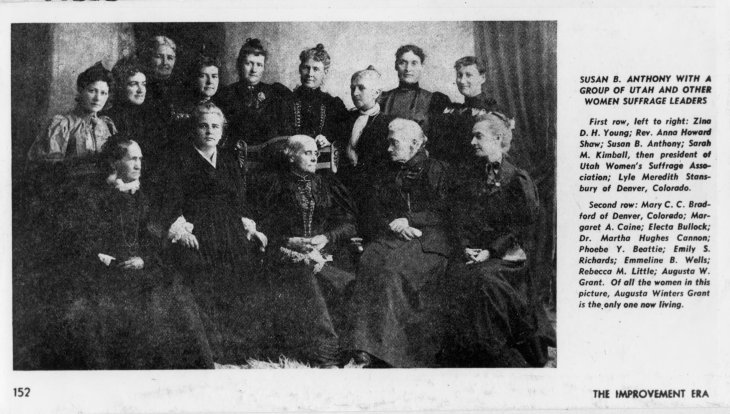
A group of woman suffrage leaders met in Salt Lake City in May 1895 to discuss issues concerning women’s rights. Image courtesy of the Utah State Historical Society.

It’s important to recognize why local coverage of the 19th Amendment is so significant. Why is the amount of news coverage of the movement in Utah specifically relevant? Like almost everything in history, the combination of thorough research and analysis of historical moments tells a story. In this particular case, the following discussion will highlight the local coverage of the suffrage movement and develop a hypothesis of gender roles and woman suffrage. Was the culmination of local coverage an indicator of where Utah stood on women’s rights? Or could there have been more significant coverage of the 19th Amendment by the local papers? My research will explore the role that journalism plays as a voice of advocacy in the modern day.

On August 17, 1919, Abby Scott Baker, the political chairman of the National Women’s Party, arrived in Salt Lake City, where she was set to have a conference with the governors. Her plans were to ask again for the cooperation of the voting women of the West to help the suffrage movement one last time. A story about it was published in The Salt Lake Tribune the following day. This demonstrates which meetings local papers were recognizing as newsworthy.

The Salt Lake Herald also did an exceptional job of covering senators who were advocating for woman suffrage. Uarda McCarty reported on August 17, 1919, that Miss Margaret Shuler was especially enthusiastic to meet Utah Senator Reed Smoot, a Mormon who supported women’s right to vote. Smoot, who came to be known as “one of the godfathers of the federal amendment,” did everything he could to ensure that there was political equality in the country. McCarty wrote that Shuler, along with three other members of the national suffrage association, were in Salt Lake to meet with governors attending a special session. The women hoped to secure their support for the amendment. McCarty highlighted in an August 19 article which governors had followed suit and pledged to call special sessions of their legislatures. The Herald article also reported that Louise M. Garnett and Margaret Z. Cherdron were making arrangements for an active local campaign for woman suffrage. Not only do these articles illustrate the local coverage that was happening at time, but they also show the local support that women voters were fiercely fighting for.

Susan_B__Anthony__national_suffrage_leader

Susan B. Anthony, a national suffrage leader, played a pivotal role in the woman suffrage movement. Image courtesy of the Utah State Historical Society.

The Salt Lake Tribune continued the coverage of woman suffrage by publishing an article on August 20, 1919, on the National Woman Suffrage Association. It also covered the special meeting held by Margaret Shuler at the Utah Hotel in downtown Salt Lake City. “Our campaign has been to get to the point where we could work in co-operation with the men, not against them,” she is quoted as saying. The Salt Lake Tribune emphasized how Shuler’s goal in the national association was to carry out the completion of the ratification in time for women to vote in the presidential election the following year.

Also on August 20, the Salt Lake Herald reported that women in Salt Lake were urging the visiting governors to recognize the importance of calling special sessions now that Congress had taken the initiative to further woman suffrage in their battle for political liberty. For the most part, many local papers such as the Salt Lake Herald and Salt Lake Tribune did an explicit job of showing what sort of coverage was being addressed in regard to woman suffrage.

The Salt Lake Herald published another article on suffrage on August 27, 1919. It stated that Utah women had been participating in state elections and would soon have further privileges once the amendment was ratified. This piece reiterated what the previous research has already demonstrated: unlike other states, Utah had favored equal gender suffrage before the amendment’s ratification.

Not long after, The Salt Lake Tribune released a complete text of Governor Simon Bamberger’s message on September 30, 1919, to Utah’s legislature on womqn suffrage. “Utah has gone on record so unmistakably and so frequently in this matter that I feel further comment at this time would be superfluous,” he was quoted as saying. This comment by the governor indicates that Utah was already pushing for suffrage before it was extended to other states.

However, it wasn’t until October 3, 1919, that Utah’s legislature held its first special session. The Davis County Clipper published a brief report on the ratification of Susan B. Anthony’s Amendment to the federal constitution granting women the right to vote. Although the paper gave the illusion that there would be more information about the ratification of the amendment by the House, there was only one paragraph that really demonstrated the local coverage of the topic.

Through my research, I was able to conclude that woman suffrage was not as controversial in Utah as it was in other states where suffrage had never been accepted. The consistency I found between my primary sources and local coverage is that Utah was intentionally progressive in woman suffrage as part of a campaign to prove that women were treated well. Furthermore, national groups took this progressiveness and tried to get support from Utahns on the national suffrage movement. Although there was a substantial amount of coverage by local papers, it was not to the degree that I thought I would find. Perhaps the impact was not as significant because Utah had already given women the right to vote in the state for more than twenty years. The article by McCammon and Campbell pushed me to ponder what led to suffrage success in the West and how gendered opportunities played a prominent role in women’s rights. Furthermore, Rebecca Mead explores in her book, How the Vote Was Won, the successes of woman suffrage and analyzes what women did after the women’s rights movement. The author concludes that equal suffrage in the West was both the cause and effect of progressivism and responsible for the reform legislation passed during this period. (288)

The ongoing battle of women in politics continues to be an issue in many states today. These articles emphasize the importance of using research to interpret historical patterns in U.S. history. For a state that stood by woman suffrage early on, the actual representation of women in Utah’s legislature is surprisingly scarce. According to Christopher Booker, Utah has one of the lowest percentages of women in the state legislature. Although the representation of women in politics today might not show it, these sources demonstrate that Utah was intentionally progressive in woman suffrage and illustrate that, as a state, Utah supported women’s equality.

Issa Penuelas is a junior at The University of Utah. She is double majoring in mass communication and sociology.

Sources

Uarda McCarty, “Woman Lauds Smoot’s Aid to Suffrage,” Salt Lake Herald, August 17, 1919, 17.

“Action Is Urged by Suffragist,” The Salt Lake Tribune, August 18, 1919, 4.

Uarda McCarty, “Suffrage Session in Conference Week, Plan,” The Salt Lake Tribune, August 19, 1919, 3.

“Progress of Women’s Suffrage,” Salt Lake Herald, August 20, 1919, 4.

“Women’s League Aims to Educate,” The Salt Lake Tribune, August 20, 1919, 12.

“The Special Session,” Salt Lake Herald, August 27, 1919, 4.

“Here is Complete Text of Governor’s Message to Utah Legislature,” The Salt Lake Tribune, September 30, 1919, 7.

“Special Session of Utah Legislature,” Davis County Clipper, October 3, 1919, 3.

Adams, Richard, “The 19th Amendment That Gave Women the Right to Vote, 90 Years On,” The Guardian, http://bit.ly/2ps4qB1.

Booker, Christian and Connie Kargo, “Why Does Utah Have so Few Female Legislators?” PBS NewsHour, http://to.pbs.org/2d12f5A.

“19th Amendment,” History, http://bit.ly/1o2cCzb.

Laursen, Amber A. “Woman, Wife, Mother-Saint, Scholar, Patriot: LaVon W. Laursen Papers, A Case Study of Utah Women in Politics” (master’s thesis: Utah State University, 2015).

McCammon, Holly J. and Karen E. Campbell. “Winning the Vote in the West: The Political Successes of the Women’s Suffrage Movements, 1866-1919.” Gender & Society 15, no. 1 (February 2001): 55-84.

Mead, Rebecca. How the Vote Was Won: Woman Suffrage in the Western United States, 1868-1914. New York City: New York University Press, 2004.


Utah Mountain Meadows Massacre and the Execution of John D. Lee

by SPENCER WILLIAM URE

john d. lee

The Salt Lake Tribune covered the execution of John D. Lee. This article was published on the front page of the March 24, 1877, issue.

Between September 7 and 11, 1857, there was a series of attacks on the Baker-Fancher emigrant wagon train at Mountain Meadows in southern Utah. Will Bagley wrote in Blood of the Prophets, “Alexander Fancher’s Party was said to consist of eleven families with twenty-nine children and sixty-five total members, traveling with eleven well-stocked wagons and large herds of cattle and horses.” (63) But why the Baker-Fancher party? It has been speculated that the attacks occurred because of the supplies individuals were carrying for their journey from Arkansas to California, and because the wagon train was passing through the Utah Territory during a time of civil unrest. Bagley quotes John D. Lee as saying, “As this lot of people had men amongst them that were supposed to have helped kill the Prophets in the Carthage jail, the killing of all of them would be keeping our oaths and avenging the blood of the prophets.” (381) Today, said Steven Lund, these series of attacks have come to be known as the Mountain Meadows Massacre.

According to both Bagley and Lund, Major John D. Lee of the Nauvoo Legion, Utah’s territorial militia, “led a ragtag band of 60 or 70 Latter-day Saints, better known as Mormons, and a few Indian freebooters” in the assault on the wagon train. (Bagley, “Wild West”) The only emigrants who were spared were 17 small children. (Lund)

Bagley writes in Blood of the Prophets, “The murder at Mountain Meadows raise larger questions about the human condition, particularly how decent men can, while acting on their and best firmest beliefs commit a great evil.” (xiii)

The significance of the Mountain Meadows Massacre comes from the scattered facts and myths that have been raised by this event. George Barclay stated in The Life and Confession of John D. Lee, the Mormon, that there is much speculation regarding what was truly the reasoning behind these attacks and what was covered up by the Church of Jesus Christ of Latter-day Saints. (43)

On August 5, 1857, one month before the massacre, Brigham Young wrote that martial law was declared in the Utah territory. (Proclamation) During this time, there were multiple escalations in the state that likely contributed to the massacre at Mountain Meadows. Most notable was the start of the Utah War. Lund explained that the Utah War is known today as the confrontation that Utah Mormon settlers had with the United States government over disputes in the Utah Territory. Lund states, “In mid-1857, Latter-day Saint leaders heard rumors that the federal government might replace Brigham Young with a new governor of the Utah Territory, who would be backed by large numbers of federal troops.” These facts have shown that through the pressure from the federal government on the newly created Utah Territory, LDS leaders feared that members would again be driven from their home.

It has been said that this attack was an inside job and part of a larger conspiracy within the Mormon church. Barclay wrote in 1910 that the “extermination of these emigrants was duly presented to the priesthood, and was discussed at considerable length.” (Barclay, 40)

John D. Lee, who led the attack on the wagon train, was executed for his crimes two decades after the fact. In 1875 and 1876, he was tried twice and found guilty for his participation in the massacre. During his first trial, there were no witnesses to testify about his crimes. In order to create legal and due process, a second trial was held. Members of the LDS church were able to find additional witnesses who then testified against Lee. (Barclay, 40) A few months later, on March 23, 1877, Lee was executed, though “he denied any intent to do wrong.” (Barclay, 42)

The Mountain Meadows Massacre has many implications for Utah history. The most notable is that the LDS church has taken responsibility for the event. On September 11, 2007, the 150th anniversary of the event, The Salt Lake Tribune quoted a Mormon leader as saying, “What was done here long ago by members of our church represents a terrible and inexcusable departure from Christian teaching and conduct.” Henry B. Eyring offered an apology for the church’s role and said, “We cannot change what happened, but we can remember and honor those who were killed here.”

Spencer William Ure graduated in May 2017 with a Bachelor’s of Science degree in communication studies.

Sources

George Barclay, The Mountain Meadows Massacre with the Life, Confession and Execution of John D. Lee, the Mormon (Philadelphia, Pennsylvania: Barclay & Co, 1877).

T. R. H. Stenhouse, The Rocky Mountain Saints: A Full and Complete History of the Mormons, from the First Vision of Joseph Smith to the Last Courtship of Brigham Young (New York: D. Appleton and Company, 1873).

“Message of the President of the United States to the 36th Congress, 1st Session,” May 4, 1860, http://bit.ly/2mf1oC1.

Brigham Young, “Proclamation by the Governor,” August 5, 1857, http://bit.ly/2lUTrRu.

Bagley, Will. Blood of the Prophets: Brigham Young and the Massacre at Mountain Meadows. Norman, Oklahoma: University of Oklahoma Press, 2002.

Bagley, Will. “Wild West: The Legacy of Mountain Meadows,” Wild West, October 2007, http://www.historynet.com/mountain-meadows-massacre.

Lund, Steven E.The Utah War & Mountain Meadows Massacre,” presentation to the members of the Highland Utah Stake in Alpine, Utah, March 10, 2017.

Ravitz, Jessica. “LDS Church apologizes for Mountain Meadows Massacre,” The Salt Lake City Tribune, September 11, 2007, http://bit.ly/2pD7f61.

Salt Lake Comic Con

by GEORGE W. KOUNALIS

In August 2013, The Salt Lake Tribune reported that Salt Lake Comic Con was projected to break inaugural convention attendance records with a low-end estimate of 40,000 attendees. That September, 72,000 comic fans showed up to the premier convention, according to Salt Lake Comic Con’s own statistics. These numbers speak volumes to the fandom phenomena taking place across the United States as well as in Utah. According to Jeffrey A. Brown, author of Comic Book Fandom and Cultural Capital, “Cons often appeal to a much wider range of fandom than just the comic book enthusiast.” (Brown, 17) The Geek Phenomenon is one that is becoming mainstream in American culture, with Utah being cited as the “nerdiest state in the country,” according to a 2014 piece in Time. Dan Farr and Bryan Brandenburg, the two forces behind organizing Salt Lake Comic Con and its current directors, have created Utah’s biggest convention in the state’s history.

Photo1

The vendor floor of the Salt Lake Comic Con, September 2013. Photo by George W. Kounalis.

Salt Lake Comic Con’s inaugural event had many guests of honor, including actors Adam West, William Shatner, and Henry Winkler, and comic-book writer Stan Lee. The initial event also boasted many vendors and artists from a wide range of fandoms. To the uninitiated, fandoms are the driving force of a comic con. The term is used to describe the groups of people who are fans of certain TV shows or other geek groups. The diverse amount of vendors, artists, and guests attracted thousands of Utah’s “geekiest” to the Salt Palace Convention Center in Salt Lake City.

Photo2

A panoramic view of the Salt Lake Comic Con vendor floor, September 2014. Photo by George W. Kounalis.

The event lasted from September 5-7, 2013. According to the Deseret News, “Fans reported waiting in line for as much as four hours Saturday just to get into the front door to catch the last of the three-day convention.” Ticket sales on that Saturday topped 50,000, with the event being declared as sold out and the Salt Lake County fire marshal limiting the number of people allowed in the Salt Palace. This means, according to The Salt Lake Tribune, that Salt Lake Comic Con’s inaugural event was bigger than the popular Outdoor Retailer show. (McFall) On August 30, 2013, The Salt Lake Tribune quoted one of the convention’s cofounders, Bryan Brandenburg, as saying, “Not only will we increase local participation by 50 to 100 percent, but based on analytics, we are going to be another San Diego Comic-Con.”

Salt Lake Comic Con’s next event, FanXperience 2014, hosted 100,000 people, making it the new biggest convention in Utah. According to Salt Lake Comic Con’s own website, event attendance has continued to grow with each additional convention.

The Salt Lake Tribune, in a story published on September 3, 2014, cited Salt Lake Comic Con’s statistics to illustrate the event’s popularity: “Attendees at FanX came into Salt Lake City from all but two U.S. states.” This suggests that the impact of Salt Lake Comic Con is reaching beyond Salt Lake County. The reporter also noted: “While only 15 percent of the registered guests at last year’s Comic Con were from outside of Salt Lake County, Farr says that number is showing a steady uptick.” Comic Con has been growing since its inaugural convention and is beginning to show an impact on businesses in downtown Salt Lake City.

Photo3

A group of cosplayers have fun at the September 2014 Salt Lake Comic Con. Photo by George W. Kounalis.

Salt Lake Comic Con’s initial convention included many panels on a wide variety of topics, including “How to Get on a Reality TV Show,” and featured numerous film/TV workshops and a Cosplay Contest. “Cosplay” is a term that is the fusion of costume and play. In
“geekdom,” the term is used to describe costuming as a character from a piece of visual media. The convention’s ability to give people access to these sorts of events is one of the many reasons that Salt Lake Comic Con has grown exponentially over the years. Attendees also have opportunities to get autographs and photos (for a fee of $20 or more) and greet the stars who are present.

Photo4

From left: Tom Kenny, Jeff Zannini, Jess Harnell, Grey DeLisle, and Bill Farmer participate in the Twisted Toonz Panel at Salt Lake Comic Con FanX, 2016. Photo courtesy of Dan Adams.

Prior to Salt Lake Comic Con’s 2014 event, San Diego Comic-Con notified Salt Lake Comic Con that it was suing for trademark infringement and false designation of origin. The Deseret News reported on August 8, 2014, that Dan Farr and Bryan Brandenburg denied dropping the Salt Lake Comic Con name and said, “We feel very strong that we’re not doing anything that everyone else isn’t doing.” The Deseret News also reported that “Salt Lake Comic Con is among dozens of conventions across the country and the world that brand their events as comic cons. San Diego Comic-Con holds the trademark on ‘Comic-Con’ with a hyphen, but abandoned its 1995 bid for the rights to ‘Comic Con,’ with a space.” In May 2016, according to Salt Lake Comic Con’s website, both San Diego Comic-Con and Salt Lake Comic Con requested an extension for the lawsuit. Dan Farr and Dan Farr Productions are arguing that they obtained a trademark for Salt Lake Comic Con and that many other events use the term comic con in their name.

In February 2017, The Salt Lake Tribune reported that Emerald Expositions, the company that owns the Outdoor Retailer show, would no longer hold its massive, twice-yearly shows in Salt Lake City. In response, Bryan Brandenburg wrote an open letter on LinkedIn regarding the situation and how Salt Lake Comic Con can fill in the shoes of the Outdoor Retailer Expo. In his letter he cites how the state’s tax credits for filmmaking in Utah has created the perfect environment for Salt Lake Comic Con to grow. Brandenberg writes, “We believe we can build something that will have much more impact if we are able to line up the type of support that Outdoor Retailers had here. Salt Lake Comic Con is only three years old and we’ve already helped generated tens of millions of dollars in economic impact to the area.” Requesting the support from the state of Utah could fill in the shoes of the Outdoor Retailer Expo and allow Salt Lake Comic Con to become the number 3 comic convention in the United States behind San Diego Comic-Con and New York Comic Con.

Salt Lake Comic Con is currently the largest convention in the state of Utah and has set a new precedent for Geek culture in the state. Even though the con is only about 3.5 years old, the impact of it is being seen across the state. With the Outdoor Retailer Expo making the decision to leave in February 2017, Salt Lake Comic Con has been put in a position to fill in those shoes and has the potential to become bigger.

I interviewed Dan Farr at the most recent event on March 17, 2017, regarding the Outdoor Retailer Expo leaving Utah and he had the following to say, “We would like to be something like South by Southwest, which is a fan festival for music. If we can turn it [Salt Lake Comic Con] into something like that here, we can have hundreds of millions brought into the state.”  This convention matters because it is one of the biggest events in the state and will continue to be so. The impact of events such as Comic Con bring new people into geekdom and allow the community to be put on the map for other geek events. It also allows Utah to expand connections with the entertainment industry.

George W. Kounalis is a junior at The University of Utah. He is majoring in journalism with a minor in music technology.

Sources

George Kounalis, interview with Dan Farr, recorded March 17, 2017, http://bit.ly/2nwDYGy.

Salt Lake Comic Con, “San Diego Comic-Con International vs. Salt Lake Comic Con,” accessed March 14, 2017, http://bit.ly/2mSLQkG

Bryan Brandenburg, “Salt Lake Comic Con Can Fill the Void of Outdoor Retailers Exit,” LinkedIn, February 24, 2017.

Salt Lake Comic Con, accessed February 23, 2017, http://bit.ly/2m4Jv8L

Michael McFall, “Comic Con delivers fans, but does it deliver dollars?” The Salt Lake Tribune, September 3, 2014.

McKenzie Romero, “San Diego Comic-Con strikes back: Lawsuit filed against growing S.L. convention,” The Deseret News, August 8, 2014.

Nolan Feeney, “This is the nerdiest state in America,” Time, April 26, 2014.

Matthew Piper, “Salt Lake Comic Con organizers have San Diego in their sights,” The Salt Lake Tribune, September 11, 2013.

Program, Salt Lake Comic Con 2013, September 5-7, 2013.

Matthew Piper, “Salt Lake City is poised to challenge first-year comic con records,” The Salt Lake Tribune, August 30, 2013.

Alberty, Erin. “Outdoor Retailer is leaving Utah over public lands issues, a move Herbert calls ‘offensive.'” The Salt Lake Tribune, February 17, 2017, http://bit.ly/2m1xxJx.

Brown, Jeffrey. “Comic Book Fandom and Cultural Capital,” The Journal of Popular Culture 30, no. 4 (March 1997): 13-31.

Wright, Bradford. Comic Book Nation: The Transformation of Youth Culture in America. Baltimore, MD: John Hopkins University Press, 2003.

A Quest for Speed: Athol Graham and His Home-Built Racer

by JOSIAH JOHNSON

Every late summer, as winter and spring runoff evaporates from the salt beds of the Great Salt Lake Desert, a site is revealed. (Hogue, 38) A site with great history, both of peril and excitement. A place so flat you can see the curvature of the earth with the naked eye. (Hogue, 32) And a place where highest speeds are most attainable.

The vast and desolate Bonneville Salt Flats are located on the western edge of Utah’s Great Salt Lake Basin. According to the Bureau of Land Management, which oversees it, the area occupies 30,000 acres; that is 12 miles long, five miles wide and over 46 square miles in total. The Salt Flats are primarily made up of leftover minerals from what was once ancient Lake Bonneville. (Bonneville Salt Flats Brochure)

In his Utah History Encyclopedia entry, Kevin Hallaran credits Jedediah Smith as being “the first white man to cross the salt flats.” He did so in 1827 on the way back from an expedition to California. In 1833, fellow trapper Joseph Reddeford Walker explored and mapped the Great Salt Lake area, naming the salt flats after his employer, Benjamin Bonneville. Hallaran also notes that the early history of the Bonneville Salt Flats even includes the demise of the 1846 Donner-Reed Party who, after getting stuck in the mud on the Flats, later perished in the Sierra-Nevada mountains.

Perhaps a more well-known association, however, is that of its racing history. The Bonneville Salt Flats were first promoted as a racing venue by William Randolph Hearst with little success, until, in 1925, Ab Jenkins raced a train across the Flats in his Studebaker and won. (Hallaran) In a piece for Landscape Journal, Martin Hogue explains that as automobile racing grew in popularity (and speeds), Bonneville became a racing mecca for its various racing qualities. In the 1920s, cars started to be designed with the land speed record in mind, and between the years 1935 and 1970, the land speed record was broken at Bonneville no less than 18 times. (Hogue, 32-33)

On August 24, 1939, The New York Times reported that British racer John Cobb had set a new land speed record at 368.85 mph. Cobb would return to Bonneville multiple times, and in 1947 he raised the record to 394 mph. That record would stand for over a decade and, as can be seen through many Salt Lake Tribune articles, was on the minds of all participants leading up to the 1960 racing season.

One of those racers with his eye fixed on the land speed record was 35-year-old Salt Lake City “garageman” Athol Graham. According to a Salt Lake Tribune article published November 28, 1959, Graham had been planning his land speed record attempt for 12 years. His home-built racer was made from an old B29 belly tank and powered by a 12-cyllinder Allison aircraft engine capable of 3000 horsepower. After a horrible first attempt in 1958, Graham rebuilt the car completely. (Hawley, 25) In early 1959, it reached 280 mph before experiencing mechanical problems. For his attempts in November of the same year, Graham requested no spectators.

GrahamsCityofSaltLake

Athol Graham’s home-built racer, the “City of Salt Lake,” on the Bonneville Salt Flats of western Utah. Used by permission, Utah State Historical Society.

Athol Graham’s quest for speed and obsession over the record had roots that ran deep. As a boy, his interest in racing was piqued after watching British racers on the Flats, according to a Salt Lake Tribune article published August 1, 1960. “I’d get goose pimples reading about them and I always imagined myself out there driving one of those beautiful cars across the salt,” Graham once said. (Hawley, 24)

On November 30, 1959, Tom Korologos of the Salt Lake Tribune reported that Graham’s “City of Salt Lake” missed the speed mark despite averaging 307 mph over two runs. Mechanical trials were once again a factor. In a statement for the paper, Graham said, “I’ve still got confidence that I can break the record but it looks as though we’re finished for this year.”

Dates for the 1960 season were announced in the Salt Lake Tribune on January 16, 1960. Graham was originally scheduled for the second block of attempts from August first through the fourth, and, after his run a few months before, Graham was listed as the fastest driver behind Mikey Thompson. In July 1960, the Tribune reported that fellow Salt Laker Marv Jenkins had surrendered his time slot, meaning that Graham and his rear-wheel-racer would have the first shot at the record in 1960.

In his book, Speed Duel, author Samuel Hawley highlights the giant expectations for the summer of 1960. High-profile racers, namely Thompson and Donald Campbell, would be returning to the Flats, and newcomer Nathan Ostich would be racing a jet-propelled car for the first time. (23) Bill Dredge of The New York Times referred to Athol Graham as the “Cinderella boy of the salt beds” and said of him, “He has no other pretentions than an ability to ramble down the salt bed faster than anyone believed he could.”

Graham was the obvious underdog. His home-built racer cost $2,500 but would be competing against Campbell’s Bluebird, a car with a $3 million price tag and support of 69 British companies, according to Marion Dunn, a sports writer for The Salt Lake Tribune. (July 10, 1960)

Buzz in local newspapers was especially focused around Graham, and numerous Salt Lake Tribune articles were published leading up to his record attempt in 1960. In addition to owning Canyon Motors, a Salt Lake City garage, Graham was a devout Mormon who served a mission to New Zealand. He also enlisted in the United States Army motor pool where he used his mechanic skills in WW II. (Hawley, 24) After returning from the war, he married his wife, Zeldine, and began building his racer. (“Whodunnit”)

As the first day of August approached, salt ripples on the Flats became a concern. Dave Mead, another sports writer for The Salt Lake Tribune, reported on July 27, 1960, that the “flats are not good enough for racing” and that “heat has severely buckled the course.” Just a day before, Graham had unveiled his newly improved racer with new Firestone tires and wheels (the source of previous failure), a stiffened body and frame, a rebuilt tail section and locked differential. According to Mead, Graham had three truckloads of spare parts with him, just in case.

It was becoming uncertain if the course would be fit to use, but “Graham himself ended that doubt,” reported the Tribune on July 28, 1960. After crews did their best to scrape and repair the two miles of ripples leading up to the measured mile-long course, Graham walked the stretch and said he would race.

The night before what he referred to as Graham’s “four-day date with destiny on the Bonneville Salt Flats,” Marion Dunn interviewed the Salt Lake City racer at his motel room in Wendover. “I feel that we’ll get the record,” Graham said, “but I certainly wish that all the people would say a prayer or two for me.” (“Graham Slates Record Assault”)

Graham planned to make his first pass at 9 a.m. on Monday, August 1, 1960, and told Dunn he would pack up and head home if his two-run average set a new record. (“Graham Plans Fast Halt”) According to the Tribune’s report on August 2, weather was once again a factor as gusty winds of 22 mph postponed the morning start.

Before the attempt, Graham told race spectators not to be alarmed if his bright red City of Salt Lake went into an early skid. (“300 mph Crash”) If Graham succeeded in reaching the coveted speed mark of 400 mph, he would be the first American to hold the land speed record since Ray Keech achieved it 32 years before, according to The Salt Lake Tribune. (August 1, 1960)

In the book Speed Duel, Samuel Hawley wrote of a final interaction that Graham had with his wife before setting off down the course in pursuit of his speed dream. Hawley described it as a private moment where the couple kissed and Athol said, “See you at the other end.” (Hawley, 30) It was later reported by The Salt Lake Tribune that Zeldine planned to make a run of her own for a 300-mph mark if the car ran well. (“300 mph Crash”)

Graham climbed into the cockpit of his race car around 11 a.m., got the engine running and, with a little help from his young assistant, Otto Anzjon, was closed in by the canopy. Soon, Graham was off, cruising across the salt, picking up speed as he went. (Hawley, 30) He made it nearly to the halfway mark before the measured mile before disaster struck. (“300 mph Crash”) An excerpt from the August 2 edition of The Salt Lake Tribune described the scene saying that “within seconds, his handmade racer skidded and flipped end-over-end at 300 miles an hour.” The New York Times reported that the accident took place at 11:02 a.m.

Borge Anderson, a photographer for the Tribune, and Marion Dunn were among the first to arrive at the scene of the crash, 600 yards from where spectators stood. (“Eyewitness Tells of Crash”) In his eyewitness account for The Salt Lake Tribune that ran on August 2, Dunn described the series of events beginning with seeing objects flying off the car. The City of Salt Lake then slid sideways, went airborne, landed on its top, bounced, landed on its top once more and slid to a stop, pinning Graham inside. When he arrived at the scene, Dunn believed Graham to be dead already.

Graham was removed from the mangled car and flown to a Salt Lake City area hospital. Just one hour after the crash, around 12:20 p.m. on August 1, 1960, Athol Graham died of extensive head, neck and chest injuries, according to the front-page story printed in The Salt Lake Tribune the following day. The local racer was survived by his 29-year-old wife and their four children. (“300 mph Crash”)

According to The Salt Lake Tribune, Athol Graham was the first driver to be killed on the Bonneville Salt Flats in a land speed record attempt. There is speculation, of course, but officials did not believe that the winds or the course had anything to do with the crash. (“300 mph Crash”) In the same Tribune article, Joe Petrall, an official observer representing the U.S. Auto Club, was quoted as saying, “It looked as if Graham was accelerating very fast and the rear wheels were beginning to spin forward throwing the car sideways before it flipped end over end.” Many sources, including an article for Motorsports Magazine recounting the tragedy, claim there was no safety harness in the home-built race car.

Athol Graham’s fellow racers were disheartened by the event, and Mickey Thompson was himself one of the 25 men who helped remove Graham from the crashed vehicle. Dr. Nathan Ostich was quoted in The Salt Lake Tribune as saying he was “deeply shocked” by the fatal accident but would still race. (“Race Season to Continue”) In one of the many Salt Lake Tribune articles published on August 2, it was reported that W. R. Shadoff would take over Graham’s racing dates. (“New Record Try”)

Many tragic ironies came to light following Graham’s death. According to Hawley in Speed Duel, August 2, 1960, would have been Athol and Zeldine’s tenth wedding anniversary. Hawley also noted that, on his comparatively minuscule racing budget, Graham couldn’t afford the $150 to have a doctor on site at the record attempt that morning.

In his article for Motorsports Magazine fittingly titled “Ghosts in the machine,” Peter Holthusen briefly discussed the fate of Graham’s racer, the City of Salt Lake. The year after the fatal crash and death of Graham, Otto Anzjon convinced Zeldine to let him rebuild and race Graham’s car. The 17-year-old mechanic got the car up to 254 mph before a tire blowout led to a crash during another record attempt. On October 12, 1963, Zeldine’s second husband, Harry Muhlbach, ran the rebuilt racer once more, only to result in yet another crash. After countless mechanical problems, rebuilds and three crashes, sponsors STP and Firestone withdrew all support of the project.

Graham’s City of Salt Lake would be rebuilt one last time, this time by Athol’s only son, Butch. In July 2010, KSL News reported on the unveiling of the 27-year-long restoration project. The car was put on display at Orthopedic Specialty Hospital in Murray for the 50th anniversary of Athol Graham’s fateful day. More than 100 people came to see it, according to the article by Alex Cabrero. (“Man Restores Race Car”)

Though the crash and death of Athol Graham in 1960 stained the site with tragedy, the legacy and spectacle of the Bonneville Salt Flats carries on as a world-famous site for racing. Many “speed freaks” have forgotten, or perhaps never even heard of Salt Lake City “garageman” Athol Graham, but his story speaks to the real consequences of speed-related sports and activities.

Despite the dangers, racers from around the world continue to push themselves to the fastest speeds, and some do so on the salt in westernmost Utah. Speed Week is still an annual event at the Bonneville Salt Flats, attracting racers and racing fans alike. As much as the geography itself, legendary racers like Athol Graham, John Cobb, Mickey Thompson and others have done their part to make the Bonneville Salt Flats a premier, world-renowned racing destination. As a result, men and women are still inspired to embark on their own quests for speed.

Josiah Johnson, a student of strategic communication at The University of Utah, graduated with his Bachelor of Science in May 2017. His interest in automotive culture has been increasingly inspired by his younger brother, Jeremiah, to whom this article is dedicated. Josiah has a passion for art, design and creative communication, and he hopes to travel the world observing it.

Sources

Alex Cabrero, “Man Restores Race Car in Father’s Honor,” KSL News Online, July 31, 2010, http://bit.ly/2oSKU4r

“Driver Killed in Bid for 400 M.P.H. on Salt Flats,” The New York Times, August 2, 1960, 36.

“New Record Try Looms Today,” The Salt Lake Tribune, August 2, 1960, 17.

“Race Season to Continue,” The Salt Lake Tribune, August 2, 1960, 17.

Marion Dunn, “Whodunnit,” The Salt Lake Tribune, August 2, 1960, 15.

“300 MPH Crash Kills S.L. Racer,” The Salt Lake Tribune, August 2, 1960, 1, 5.

Marion Dunn, “Eyewitness Tells of Crash,” The Salt Lake Tribune, August 2, 1960, 1.

Marion Dunn, “Graham Slates Record Assault,” The Salt Lake Tribune, August 1, 1960, 24.

Marion Dunn, “Graham Sets First Dash Across Flats,” The Salt Lake Tribune, July 31, 1960, D5.

Marion Dunn, “Graham Plans Fast Halt When, If, Record Falls,” The Salt Lake Tribune, July 29, 1960, D5.

“Graham Seeks Land Mark Monday,” The Salt Lake Tribune, July 28, 1960, 26.

Dave Mead, “Salt Ripples May Halt Graham Run,” The Salt Lake Tribune, July 27, 1960, 19.

Marion Dunn, “Drivers Set for Speed Shots,” The Salt Lake Tribune, July 10, 1960, B9.

Bill Dredge, “1960 Goal for Salt Flat Races,” The New York Times, April 17, 1960, A14.

“Race Dates Set for Flats in ’60,” The Salt Lake Tribune, January 16, 1960, 19.

Tom Korologos, “Auto Speed Mark Eludes Salt Laker,” The Salt Lake Tribune, November 30, 1959, 35.

“Salt Laker Maps Assault on Auto Speed Record,” The Salt Lake Tribune, November 28, 1959, 21.

Associated Press, “Cobb’s Red Lion Roars to World Land Speed Record on Utah Flats,” The New York Times, August 24, 1939, 30.

U.S. Department of the Interior, Bureau of Land Management, Bonneville Salt Flats Brochure, https://on.doi.gov/2p11Hix

Hawley, Samuel. Speed Duel: The Inside Story of the Land Speed Record in the Sixties. Buffalo, New York: Firefly Books, 2010.

Hogue, Martin. “A Site Constructed: The Bonneville Salt Flats and the Land Speed Record, 1935-1970.” Landscape Journal 24, no. 1 (March 2005): 32-49.

Holthusen, Peter. “Ghosts in the machine,” Motorsports Magazine, April 2002: 68-72.

Hallaran, Kevin B. “Bonneville Salt Flats,” Utah History to Go, http://bit.ly/2lEMktJ