Doug Fabrizio, Host of KUER’s ‘RadioWest’

by HANNA TATRO

Doug Fabrizio was born in 1964 in Bountiful, Utah. He studied at the University of Utah and began working and reporting for the KUER broadcasting station in 1987. KUER is a public radio station and is a member of National Public Radio (NPR). Its mission is simple: the station is “committed to building a community of world citizens through story and art, discussion and debate, sound and creativity.” (“About KUER”) The station is broadcast from the University of Utah and listeners around Utah tune in.

Fabrizio began working at the station when he was a junior in high school. By 1993, he had assumed the position of news director of KUER. (Sheehan) Then, in 2001, Fabrizio began hosting a radio segment, RadioWest. The show is “a radio conversation where people tell stories that explore the way the world works. (“About RadioWest“) In an interview with CityWeekly, Fabrizio expressed his views of the shows’ particular content, “Art and culture are an important part of the program. I actually don’t believe in segregating news – keeping the hard stuff from the softer stories (in fact I hate describing arts coverage or features as ‘soft’) or the local ones from the national ones. No matter where it comes from, most of us don’t see music or literature or great film as any less important to our lives than knowing about the critical events and issues of the day.” (Sheehan) Fabrizio has had the chance to interview many influential people throughout the years, from Madeleine Albright, the first woman in the United States to become secretary of state, to the Dalai Lama.

Doug Fabrizio, host of RadioWest, has worked at KUER since 19xx.

Doug Fabrizio became host and executive producer of KUER’s RadioWest in 2001. Photo courtesy of KUER.

Fabrizio’s work has been recognized by many organizations, including the Public Radio News Directors Association, Society of Professional Journalists, the Utah Broadcasters Association, and the Academy of Television Arts & Sciences.

RadioWest has steadily progressed throughout the years and Fabrizio’s style has evolved using storytelling mixed with honest interview question and answers. Fabrizio has profiled a number of topics, Utahns, and intellectuals, including the documentary, Ab Jenkins and the Boys of Bonneville, Everett Ruess, University of Utah President Chase Peterson, Congressman Ron Paul, David Foster Wallace, Nobel Peace Laureate Mohamed ElBaradei, and Robert Redford. These profiles incorporate Fabrizio’s storytelling approach.

“The Boys of Bonneville” segment aired on August 24, 2011. The segment featured the story of Ab Jenkins, who sped across the Bonneville Salt Flats and set record speeds. Fabrizio interviewed the director and others about the new documentary. Fabrizio introduced the piece with a simple introduction, setting the scene of the Salt Flats, a landmark not as well known by Utah residents as one would think. Fabrizio had four separate guests on the program; he kept the atmosphere relaxed.

Fabrizio focused on Everett Ruess, a young man who disappeared in the Utah desert, for a segment that aired on July 13, 2011. The tone was more serious as Fabrizio interviewed David Roberts, a writer who had thought he had found the body of Ruess. Fabrizio carried the piece by asking the tough questions first, and using basic interview skills. The piece doesn’t provide answers for where Ruess lies, but Fabrizio explores Ruess’s story and invites Roberts to discuss his chronicle of Ruess’ adventures.

University of Utah President Chase Peterson sat down with Fabrizio on May 7, 2012, to discuss his new book, The Guardian Poplar. The segment was carried by Fabrizio’s tone. He had respect for Peterson, which was evidenced by his very candid introduction. Fabrizio listed Peterson’s accomplishments and then let him do the talking. Peterson was humble and quiet and shared stories that appeared in his book. Fabrizio’s technique gave Peterson the stage and allowed the story to speak for itself. Peterson had been diagnosed with cancer and believed he only had a few years to live. But, he outlived his death sentence and Fabrizio’s presence put him at ease to share his struggles and joys.

Musician La Monte Young, who was born in Idaho and worked on a family farm on Utah Lake, has influenced some of the great artists. In a show that aired November 29, 2013, Fabrizio interviewed Professor Jeremy Grimshaw from Brigham Young University, who wrote a biography about the musical protégé. Fabrizio was knowledgeable about the guest and artist, but he asked open-ended questions that led to further discussion and allowed Grimshaw to discuss the complex character and Young’s musical compositions. Fabrizio’s technique allowed for a more in-depth approach that yielded untouched information.

Congressmen Ron Paul spoke at Utah Valley University in October 2012 and conducted a question and answer afterward with the students. Fabrizio’s segment took listeners inside the discussion and allowed people to share in the conversation. Fabrizio began with his simple introduction approach and allowed the congressmen to greet the viewers. Then Fabrizio facilitated the Q and A session.

David Foster Wallace was an acclaimed writer who committed suicide. D.T. Max, a New Yorker staff writer, wrote a biography of Wallace and joined Fabrizio’s show by phone to tell the story. The piece began with an introduction of Wallace and Max, which gave the audience an immediate feel for both parties.

Mohamed ElBaradei, a Nobel Peace Laureate, came to Utah in September 2012 to talk about his international atomic energy plans. He also joined Fabrizio for a RadioWest interview. The piece had a serious tone in keeping with a newsworthy international discussion.

Biographer Michael Feeney Callan chronicled the life of Robert Redford in his book, Robert Redford: The Biography. Callan spent fifteen years speaking to Redford and discovering his ways before finishing his book. Fabrizio introduced the September 2011 program with a story of Redford’s search for art and wanderings and then allowed Callan to discuss his book and findings about the infamous founder of Sundance Film Festival.

The early 1900s began the trend of the national radio craze throughout America. It all started with young teens from Utah, much like Fabrizio. In 1909 these kids began the first Radio Club in Salt Lake City. They transmitted and broadcast segments over the airwaves. (Larson and Avery) Fabrizio has continued to carry on the young Utah tradition and has transformed his broadcast to feature several storytelling techniques. He uses the airwaves to tell the stories, which carry communication to Utah and the rest of the nation.

Fabrizio’s broadcasts since 2009 can be found online. Archiving is an ongoing project.

Hanna Tatro graduated from The University of Utah in May 2014 with a Bachelor of Science degree in journalism.

Sources

Biographical sketch, Doug FabrizioRadioWest.

Doug Fabrizio, “Boys of Bonneville.” RadioWest.

Doug Fabrizio, “Finding Everett Ruess,” RadioWest.

Doug Fabrizio, “The Guardian Poplar,” RadioWest.

Doug Fabrizio, “The Music and Mysticism of La Monte Young,” RadioWest.

Doug Fabrizio, “Congressman Ron Paul,” RadioWest.

Doug Fabrizio, “The Life of David Foster Wallace,” RadioWest.

Doug Fabrizio, “Nobel Peace Laureate Mohamed Elbaradei,” RadioWest.

Doug Fabrizio, “Robert Redford: The Biography,” RadioWest.

Tim Larson and Robert K. Avery, “Utah Broadcasting History,” in Utah History Encyclopedia (Salt Lake City: University of Utah, 2009).

About KUER,” KUER.org.

Gavin Sheehan, “Doug Fabrizio,” City Weekly, July 10, 2009.

Printed Voices of the Salt Lake City LGBT Community in the Early 1990s

by BRIAN ROBLES

A newspaper’s success is heavily dependent on the character and strength of the people behind the scenes. This is especially true of the alternative press, including newspapers targeted for the Lesbian, Gay, Bisexual, and Transgender (LGBT) community. Without a large group of readers and subscribers, it would make printing and distributing a heavy cost not easily paid. Luckily, there are people who are willing to champion this cause. In recent years, Salt Lake City has become one of the most LGBT-friendly cities in the U.S., which contrasts with the city’s conservative image. (Breen) This is in part due to the LGBT community that pioneered for a voice.

Tracy Baim, an award-winning journalist in the gay community, wrote in her book, Gay Press, Gay Power: The Growth of LGBT Community Newspapers in America, that:

There is a reason a gay press was needed. When the media of the previous two centuries were not wholly ignoring everything about homosexuals and the growing gay-rights movement, they were doing far worse: moralizing, demonizing, criminalizing, medicalizing, “repairing,” proselytizing, polarizing, ostracizing and often just pitying those poor, sad, pathetic “avowed” homosexuals. (Baim, 15)

Gay media were able to supply the LGBT community with something that it desperately needed: gay news that was relevant to the community. Because the mainstream media tended to show the gay lifestyle in a negative light, it was important for readers to have somewhere to turn for reinforcement that it was OK to be gay. The gay press was able to provide role models and inspirational authors who were able to help readers find a positive self-image. A study on the effects of media on gay identity states that without these role models there “was a sense of being excluded from traditional society.” (Gomillion and Giuliano, 347) Without the gay press, the LGBT community of Salt Lake City would have found themselves as outsiders with no room for their alternative lifestyle.

The purpose of this project is to illustrate the crucial role that the writers, editors, and publishers of certain Salt Lake City publications played in creating a voice for the LGBT community in the early 1990s. Their staunch support and willingness to represent this minority demographic enabled the LGBT community to have its issues gain public awareness. Highlighted are the attempts by these editors and publishers to draw the lay public into action.

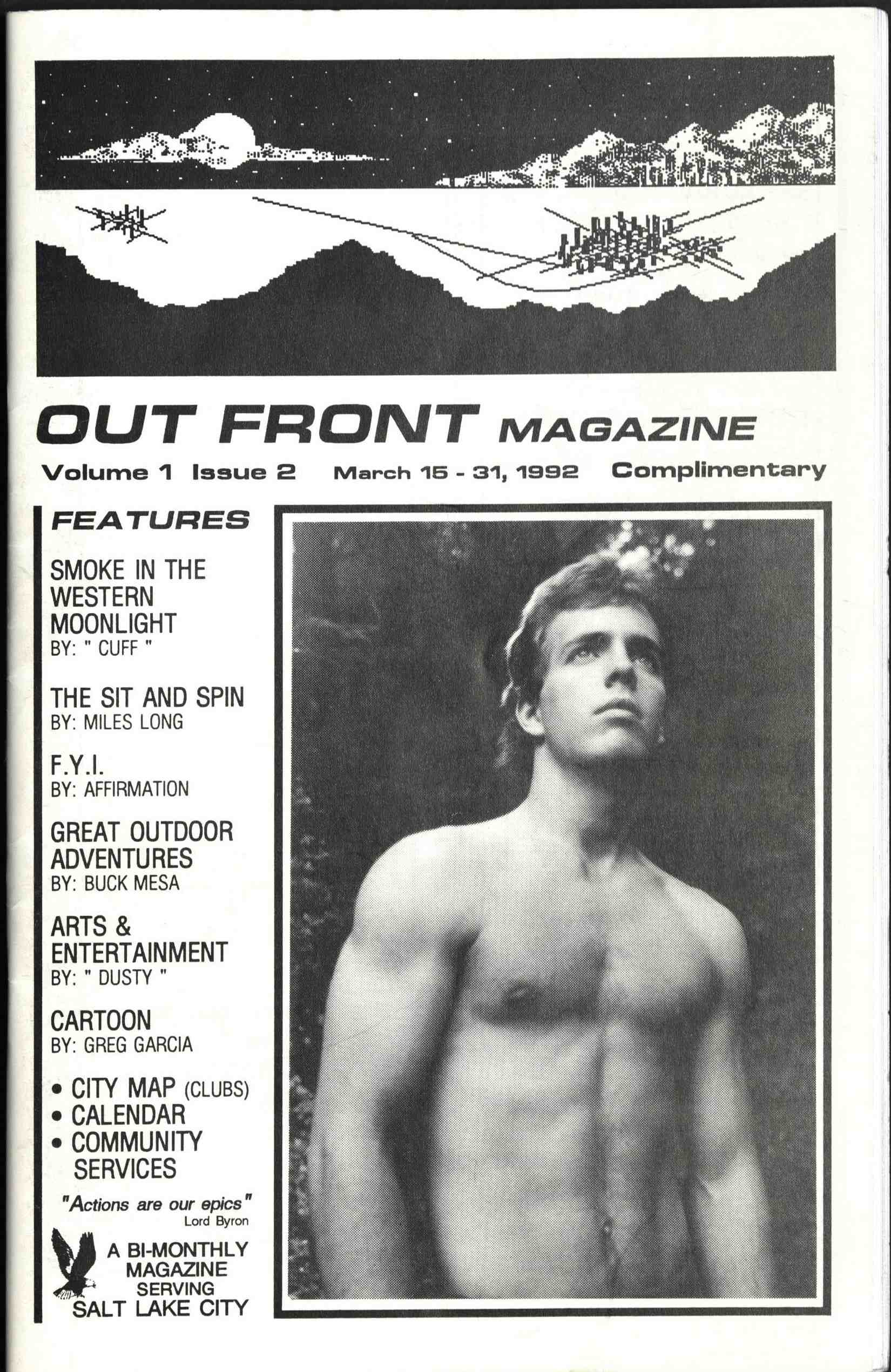
Excerpts from three publications that were published through the early 1990s in Salt Lake City will be presented and interpreted in this article. These publications were: The Bridge, Outfront Review, and The Pillar of the Gay Community. The editors and publishers of these papers reflected on specific LGBT issues at the beginning of each publication, which helped set the tone of that particular publication. Their blurbs, pieces, and publications provided a place for these community contributors to try to bring the LGBT voice of out complacency and to bring the community together as a collective chorus that would assure that their voices would be heard.

The Bridge

Starting in 1990, a monthly publication called The Bridge, and its copublishers Becky Moorman and Alice Hart, brought the call to action and urgency to the Salt Lake City LGBT community. The forceful tone found throughout the publications present LGBT issues that demand to be heard. The Publishers’ Notes varied from introductions of the month’s publication to celebrations of queer culture to short shout-outs to close friends. These Publishers’ Notes are how we see just how deeply invested Moorman and Hart were in their community. According to the note in the second issue of The Bridge, published in November 1990:

Besides being a service to the gay and lesbian communities of Utah, The Bridge is Utah’s watchdog to the arts (and art censors): literary and visual. And if you don’t believe they need guarding; you don’t get out much. America’s art, music, and culture are going to the congressional dogs, and the constitution right along with it.

From the beginning, Moorman and Hart showed a penchant for the political. This was a publication that had publishers who were not willing to let their community be voiceless any longer.

caption

Cover of The Bridge. This publication, and others discussed in this article, are available at the Special Collections Department, J. Willard Marriott Library, University of Utah.

The Bridge was a call to action for the LGBT community. The publishers were not merely interested in presenting alternative news; they wanted to shape their history and society. The editors and publishers of The Bridge believed that involvement was the way to bring change. But that is not to say that Moorman and Hart were solely interested in what affected the LGBT community. In the sixth issue, published in March 1991, Moorman and Hart wrote to their readers regarding pending legislation — The Hate Crimes Statistics Act and Anti-Abortion laws. The Hate Crimes Statistics Act, which was ultimately adopted in 1992, required the state to collect and publish the hate crimes committed in the state. Pro-life versus pro-choice was also a hot topic at the time with the Planned Parenthood v. Casey case discussing abortion. In this sixth issue, the editors were not afraid to show where they stood nor were they afraid to push their readers to action:

“Be sure to voice your support for the Hate Crimes Statistic Bill and to mention how disgusted you are with the new anti-abortion law. Remember to boycott Utah. Cancel your conferences. Encourage everyone you know out of state not to travel here, spend money or do business with Utah companies until the unconstitutional ban on choice is lifted. Gut and burn any cars you see with anti-choice bumper stickers. Or if you’re a republican pro-lifer, bomb an abortion clinic for Jesus. There’s no one in them right now; which makes it less fun, but infinitely safer.”

This use of language — asking the readers to participate in boycotts and the like — was to encourage readers to come out and start taking an active role in their community. While this call for boycotting and law breaking was strong, the idea itself proves to be a radical one and may have perhaps alienated some of the readers of these notes. The other issue with boycotting Salt Lake City as a whole is that it would hurt the LGBT community just as much as the general population. A powerfully emotional, and perhaps too zealous, call to action can prove to be more detrimental than helpful in this case.

As mentioned, not all of the Publishers’ Notes were written in this authoritative call to action, but it was the urge for readers to become one of their community, to shirk their fear of retaliation due to the way they chose to love, that made The Bridge such an important publication. The February 1992 issue featured one of the more powerful calls to raise the voice of the LGBT community:

Love & Hate — this is the month for it! Hate Radio! Hate Crimes! Hate legislation! Homosexuals are the fashionable to-hates. The last sanctioned discrimination. Legislators, churches hide behind silence and exclusion — tacitly financing violence. Stop the straight war on gay love. No one can afford to be a fence-sitter. Violence is everyone’s problem. We can only stop it by saying STOP in as loud a voice as we can. Ask everyone. TELL everyone. They don’t have a right to NOT have an opinion. Don’t be complacent. Don’t let anyone be complacent. They may not like you for it now. Equality is contagious. If you keep on person from being silent – other’s will speak up. Others will listen. Silence is death. There may be blood on your hands for every time you heard gays talked about, joked about, whatever and didn’t say STOP!

Here Moorman and Hart explain that it’s not only a right, but also an obligation to raise one’s voice and to participate. They take a stand against those who don’t walk their talk. Discrimination of any kind is kept in power by the silence of the people who may oppose it in their hearts but never lend their voices to the cause. As a member of a community, one has certain responsibilities. If readers chose to read this particular publication and be a part of the community, it was their responsibility to become an active member to help further the progress of the LGBT movement in Salt Lake City.

Image courtesy of J. Willard Marriott Library, University of Utah.

Image courtesy of the Special Collections Department, J. Willard Marriott Library, University of Utah.

Outfront Review

The second publication of focus is the bi-monthly publication Outfront Review, originally Out Front Magazine, whose editor provided a more unified vision to their readers. Throughout the years, Editor Randy Richardson used a voice that seemed more suggestive than authoritative in the call to arms for the LGBT community of Salt Lake. While reviewing the Editor’s Notes in these publications, it’s found that Richardson spoke more with an appeal to pathos in contrast to Moorman and Hart’s lean to logos.

Like The Bridge, Outfront Review called for the LGBT public to participate in politics in order to gain awareness and make political strides. Outfront Review presented this same line of thinking in November 1992 when Richardson wrote:

“When you VOTE, remember all those who have gone before us and died needlessly because we had no rights. Remember all of those who never had a chance because AIDS was a Gay disease. Do it in remembrance of all those who have fought hard all of these years to get us to where we are today … think of all of our children … what future will they have, what legacy shall we leave them?

“PLEASE VOTE. We know you are out there, and that you do really care!”

This piece shows that appeal to emotion in the mention of children and the dead but its plea is similar to that of The Bridge in that the editor still seeks participation from the community.

The second issue, published in November 1992 discussed the role of the community in politics. The Editor’s Note addressed the need for the community to come together rather than remain segregated into gays, lesbians, bisexuals, or transgender individuals ­— an issue that continues even today. Editor Richardson wrote: “Perhaps we need to look at forming a united gay and lesbian alliance … so that we can discuss things together, in an open forum … and then vote to obtain a majority opinion, speaking with one voice, representative of … and in … the best interest of our desires, goals and objectives as a community.”

The Pillar

Image courtesy of J. Willard Marriott Library, University of Utah.

Image courtesy of the Special Collections Department, J. Willard Marriott Library, University of Utah.

This brings us to The Pillar of the Gay Community (The Pillar for short), which began publishing in 1993 with a specific demographic in mind — gay men. As The Pillar grew in popularity, it became apparent that the niche it filled could be inclusive to all of the LGBT community. The paper started to expand its role in the LGBT community, which can be seen in the paper’s changing tagline. For example, it started as a publication for “For Utah Mehn,” [sic] then billed itself as being for the “Lesbian and Gay Community” before broadening its focus to the “the Gay, Lesbian, Bisexual and Transgendered Community” of Salt Lake. The Pillar was the longest lived of the three publications presented in this article and continued publication until 2007. Its longevity may be due to its mix of LGBT news, entertainment, and flat out in-your-face attitude. Here, in the paper’s debut issue published April 1993, the writers set the record straight on what they will contribute to their community — and what the community could expect in future issues:

Why another paper in an over-developed market such as Salt Lake City you might ask? Great Question! We at The Pillar feel that there is a “hole” that is not being filled in the Gay Media and we hop to plug it! With the demise of The Bridge, and the Outfront, a group of us desired to compliment The Womyn’s Community Newsletter by mirroring them in our Mehn’s community. We are not out to offend anyone but get use to seeing Faggot, Dyke, and Queer in print and some outrageous Gay consciousness raising at times. We are firm proponents of the Gay Human Rights and we make no apologies for being homosexually proactive.

As mentioned in the note above, The Bridge and Outfront Review had both closed their doors, leaving a gap for this publication to fill.

The Pillar seemed to combine the best aspects of both The Bridge and Outfront Review. In the premier issue, readers were introduced to what they could expect from The Pillar — an unapologetic, authoritative use of language, which is reminiscent of the pieces published in The Bridge. But then The Pillar also adopted that same desire for unity that The Bridge sought, as seen in the “From The Editor” piece by Kim Russo in the December 1995 issue:

Too many times and on too many occasions when we have had a conflict or could not come to an agreement as an organization, we tended to “eat our own.” Instead of resolving differences or understanding that we can disagree and still function as a group or organization, anger took its turn and we “ate our own.” Torie Osborne coined that phrase and I resolved never to forget it. She said that in gay and lesbian communities around the nation, when conflict occurred, members would turn against each other and tear the other one down. How right Torie is. Therefore, resolve to be fair and not too critical. You know of all communities that should stick together because they have personally experienced their own kind of pain, it is us. Indeed may we stand together through it all.

This piece echoes Richardson’s note from Outfront Review, showing us that there was, and is, still the need for the community to band together.

Conclusion

The Editor’s Notes and Publisher’s Notes are often missed or skipped over for the traditional news and entertainment articles. This is a problem as these notes and additions to periodicals reveal so much emotion in them and provide insight to why the LGBT publications existed in the first place. The stories found between the covers of the publications discussed here held many of the same qualities found throughout great journalistic articles, but these notes presented something similar to a dialogue, which helped make these documents relevant even after nearly two decades. It was like reading a letter from a dear friend. They provided summaries of what had happened, and hopes of what may come, and always pushed readers to be better in their community and their lives.

The efforts by the influential people of the time helped make the LGBT community as strong as it is today. There’s still work to be done and maybe today’s publications, like QSaltLake, will be what The Bridge, Outfront Review, and The Pillar were for the LGBT community in the early 1990s. There’s still a need for gay press to spur the people into action, to inform them of what rights they have (or don’t), and to unite the factions within the LGBT community.

Brian Robles is a senior at The University of Utah. He is majoring in mass communication.

Sources

Kim Russo, “From The Editor,” The Pillar of the Gay Community, December 1995, 6.

Kim Russo, “From The Editor,” The Pillar of the Gay Community, May 1994, 2.

“Premier Issue,” The Pillar of the Gay Community, April 1993, 1.

Randy Richardson, “Editor’s Note,” Outfront Review, November 15-30, 1992, 2.

Randy Richardson, “Editor’s Note,” Outfront Review, November 1-15, 1992, 3.

Randy Richardson, “Editor’s Note,” Outfront Review, July 15-31, 1992, 3.

Alice Hart and Becky Moorman, “Publishers’ Note,” The Bridge, February, 1992, 5.

Alice Hart and Becky Moorman, “Publishers’ Note,” The Bridge, March, 1991, 4.

Alice Hart and Becky Moorman, “Publishers’ Note,” The Bridge, November, 1990, 3.

Baim, Tracy and John D’Emilio. Gay Press, Gay Power: The Growth of LGBT Community Newspapers in America. CreateSpace Independent Publishing Platform, 2012.

Breen, Matthew. “Gayest Cities in America,” The Advocate, January 9, 2012.

Gomillion, Sarah C. and Traci A. Giuliano. “The Influence of Media Role Models on Gay, Lesbian, and Bisexual Identity.” Journal of Homosexuality 58, no. 3 (2011): 330-54.


University of Utah Professor Helped Shape Early Internet

by ABBY M. REYES

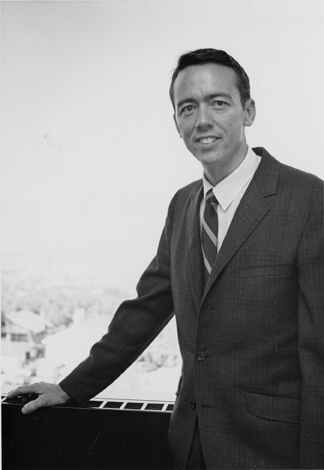
David Cannon Evans may not be the first, second, or even third household name one thinks of when considering celebrated communication innovations. As it turns out, Evans was a key player in helping pioneer what came to be known as the Internet. His work is deeply rooted in Salt Lake City’s very own backyard: the University of Utah.

Evans was born February 24, 1924, in Salt Lake City to David W. and Beatrice C. Evans. (Jensen, 1996) His father was the leader of an advertising firm and his family was described to have had generations of involvement in the newspaper business. (Jensen, Evans, Box 104, Folder 35) Evans married Beverley “Joy” Frewin in 1947 and together they had seven children: Anne, Peter, Gayle, Katherine, David F., Douglas, and Susan. (Jensen, Markoff) Shortly after his marriage, Evans graduated from the University of Utah in 1949 with a Bachelor of Science degree in physics. (Jensen, 1996) He later received his doctorate in the same field from the university in 1953. (Jensen, 1996) That year, Evans was hired as a senior physicist and engineering director for Bendix Corporation, where he would spend the next several years. (Evans, Box 1, Folder 2) In just a few years, Evans would engage in government work and academic research that would mark him as a significant contributor to Utah communication history.

As a military defense response to the 1957 Sputnik satellite launched by the Soviet Union, President Dwight D. Eisenhower appointed a task force of the U.S. Department of Defense named Advanced Research Projects Agency (ARPA), sometimes referred to as DARPA by adding “Defense” at the beginning. (Harvey, 2009) DARPA conducted scientific research in the field of computing and one of its branches, the Information Processing Techniques Office (IPTO), had been specifically responsible for federally funding these projects. (Harvey, 2009) By 1966, a federally funded ARPA network, nicknamed ARPANET, had been conceived to focus on the skill sets of four U.S. Universities. (Harvey, Hauben) Salt Lake Tribune journalist Tom Harvey wrote an extensive article in December 2009 reporting on the history of the Internet. He described ARPANET, the precursor to the Internet, as being “a network that would turn computers into communication devices, not just data crunchers.”

Harvey described this network in retrospect but the IPTO ostensibly noticed interesting productions also taking place from within ARPANET. Of particular interest would be the development of electronic communication spaces computer scientists had created — these could be described as the equivalent to early versions of email and chat rooms. However, this early form of electronic communication had been restricted to use on just one computer. (Evans, Box 5) This is why the concept of “time-sharing” was especially relevant. Time-sharing was the idea that electronic communication, such as email, could be extended for use on more than just one computer at a time and was a point of interest for Evans’ early research. (Harvey, Evans, Box 5)

David Evans. Special Collections Department, J. Willard Marriott Library, University of Utah.

David Evans had a talent for communicating his ideas to graduate students, colleagues, and industry leaders. Special Collections Department, J. Willard Marriott Library, University of Utah.

Evans joined the University of Utah as a faculty member in 1962, but he had taught previously at the University of California at Berkeley. (Markoff, Evans, Box 1, Folder 2) At Berkeley, Evans had engaged in early ARPA work but he needed support to effectively pursue his specific research interests. (Harvey, 2009) He was fortunate to have gained this support from Ivan Sutherland, a Harvard scholar and director of IPTO in 1964, who helped Evans gain federal funds to sustain ARPANET research. (Harvey, 2009) This was a notable feat, as it would establish a relationship and mark both men professionally as they eventually partnered to found Evans & Sutherland Computer Corporation, a private computer research business in Salt Lake City. (Harvey, 2009) Evans would go on to juggle his professional commitments as a faculty researcher and business leader throughout his career.

Evans returned to Utah to found and chair the university’s first Computer Science Department housed within the College of Electrical Engineering in 1966. (Harvey, Evans, Box 1, Folder 2) In December 1969, the department had connected to ARPANET as the fourth and final “node” of the original research network before it later expanded to other parts of the country. (Harvey, ARPANET) It was the only “node” uniquely situated outside of the state of California. The other three claimed their spots at University of California at Los Angeles, University of California at Santa Barbara, and Stanford Research Institute. (Harvey, ARPANET)

Each of the institutions housing the four “nodes” had a particular focus or distinguished branch of the ARPA research. The California schools were selected to study the following respectively: network measurement center (UCLA), network information center (SRI), and Culler-Fried interactive mathematics (UCSB). (Hauben, 2006) The University of Utah’s initial responsibility was to study computer graphics through the network, specifically a technique known as “hidden line removal” — a fitting match to Evans’ expertise and assumable passion for visuals and virtual memory. (Hauben, Markoff)

It appears that Evans was a highly organized scholar and that he established clear research goals for his work. He also had a talent for communicating his ideas with different groups of people. These specific and technical goals can be summarized and condensed into one phrase that Evans included in several of his abstracts, speeches, lectures, and manuscripts — he simply aimed for “improving communication” between machines and people. (Evans, Box 5, Folder 17) Evans presumably strived to allocate more creative control to humans when communicating with machines. He worked on displaying pictures on a computer screen, hence, potentially communicating unique messages depending on the creator and layout. In a 1966 speech to audience members of an educational symposium, Evans referred to John Von Neumann, a 1940s-era computer scholar, and pointed out that efforts for “extending the human intellect” were unsuccessful and should not necessarily be finite but rather a “working partnership” between computers and people could, and potentially should, be improved. (Evans, Box 5, Folder 17)

In addition to large audiences of professionals and academics, it can be said Evans also attracted a loyal group of students benefiting from his mentorship. The same year Utah joined the ARPA network in 1969, John E. Warnock, an engineering student, wrote a technical report on computer image research that was being conducted. In a section near the beginning of the report, before becoming heavily saturated with technical details, the young student dedicated a few sentences to warmly express gratitude for his mentors and supporters, including Dr. Evans. “The many hours [they] have spent with me in discussion have provided the intellectual stimulus required to carry on this research,” Warnock proclaimed. (Evans, Box 89, Folder 7)

Notably, a few of Evans’ graduate students went on to establish successful careers in computer science. They include: John E. Warnock, cofounder of Adobe Systems Corporations Inc. and incidentally the name for one of the two engineering buildings residing on the University of Utah campus; Edwin Catmull, cofounder of Pixar Animation Studios; Alan Ashton, cofounder of the WordPerfect Corporation; and Alan Kay, once a scientist at the Walt Disney Corporation. (Markoff, 1998)

Evans evidently impacted his students and colleagues in the world of academia but it is possible he influenced other industries outside of his field and area of expertise as well. He had captured the attention of business and communication industries outside of computer science and they wanted to speak with Evans about his work. On February 12, 1971, Evans composed a letter of advice to the operations research manager of the Minneapolis Star-Tribune in which he related certain aspects of his research in computer graphics as being useful for the automated production of a newspaper such as theirs. He explained how special computer-graphics equipment might make for a more efficient production process as well as give a person more creative control in the layout of the paper, including visuals such as advertisements. (Evans, Box 104, Folder 35) This letter, found in an unremarkable grey box within the Special Collections department of the University of Utah’s J. Willard Marriott library, could serve as evidence of Evans’ impact on communication history outside of his field. This begs the question as to whether any other industries experienced ripple effects of his ideas and knowledge, and, if so, what were they?

Is it possible that ARPANET researchers could have imagined that their rapidly growing work would stretch beyond their labs to help shape a fluid platform for today’s vast Internet uses? What started out as a secured U.S. Defense project continues to morph into a public resource and medium of discourse for living in the 21st century. Although not everyone is on the Internet and its uses vary, Evans’ early notions of creative manipulation of machines reveals itself in blogs, websites, research, news, and other online communication taking place at every moment of every day.

On October 3, 1998, Evans lost his life at the age of 74 to Alzheimer’s disease — a disease known for potentially consuming a person’s memory, whereas Evans spent his entire professional career studying that of computers. (Markoff, 1998) He was survived by his wife, Joy, and seven children at the time of his death. (Markoff, 1998)

Certainly, Evans could be remembered as a man ahead of his time. It is fair to say he was a visionary, an idealist with heightened intelligence and the acquired skills of an experienced communicator. Essentially, he was an important Utah figure in Internet history who had experimented with language and communication in the form of pictures and computers — a legacy that remains relevant today.

Abby M. Reyes is a senior at the University of Utah. She will complete her Bachelor of Science Honors degree in May 2015 having majored in communication studies and minored in health.

Sources

David C. Evans (1969). Graphical man/machine communications: November 1969 AD708483. University of Utah, National Technical Information Service.

David C. Evans papers, Ms 625, Box 1: Personal Correspondences (1969-1982); folder 2: March, 1973—April, 1974, Special Collections and Archives University of Utah, J. Willard Marriott Library, Salt Lake City, Utah.

David C. Evans papers, Ms 625, Box 5: University of Utah and Speeches; folder 1-5: University of Utah, Correspondence (1967-1987), Special Collections and Archives, University of Utah, J. Willard Marriott Library, Salt Lake City, Utah.

David C. Evans papers, Ms 625, Box 5: University of Utah and Speeches; folder 17-28: Speeches and Lectures (1966-1985), Special Collections and Archives, University of Utah, J. Willard Marriott Library, Salt Lake City, Utah.

David C. Evans papers, Ms 625, Box 89: United States Government; folder 2: Department of Defense, Advanced Research Projects Agency, Correspondence (1970-1977), Special Collections and Archives, University of Utah, J. Willard Marriott Library, Salt Lake City, Utah.

David C. Evans papers, Ms 625, Box 89: United States Government; folder 3: Department of Defense, Advanced Research Projects Agency, Proposal and Draft (1976), Special Collections and Archives, University of Utah, J. Willard Marriott Library, Salt Lake City, Utah.

David C. Evans papers, Ms 625, Box 89: United States Government; folder 7-8: Department of Defense, Advanced Research Projects Agency (1969), Special Collections and Archives, University of Utah, J. Willard Marriott Library, Salt Lake City, Utah.

David C. Evans papers, Ms 625, Box 104: Affiliated Companies and Customers; folder 35: Minneapolis Star-Tribune (1971), Special Collections and Archives, University of Utah, J. Willard Marriott Library, Salt Lake City, Utah.

The David C. Evans Papers, P0452, Box 1, Manuscripts Division, Special Collections, University of Utah J. Willard Marriott Library, Salt Lake City, Utah.

Harvey, Tom, “U. of U. helped give birth to Internet,” The Salt Lake Tribune, December 19, 2009.

Hauben, Michael and R. Hauben. “Behind the Net: The Untold History of the ARPANET and Computer Science,” Chapter 7, Netizens: On the History and Impact of Usenet and the Internet (2006).

Jensen, Mark. “Inventory of the David C. Evans papers, 1958-1987,” Northwest Digital Archive (NWDA) (1996).

Markoff, John. “David Evans, Pioneer in Computer Graphics, Dies at 74,” The New York Times, October 12, 1998.

The ARPANET Project,” ARPANET collection, J. Willard Marriott Library, University of Utah.


Lagoon, the Roller Coaster, and the Kilee King Investigation, 1989

by JOHANNA M. MELIK

In the late 1800s, Utah’s beloved amusement park, today known as Lagoon, was located in a different area along the shores of the Great Salt Lake, along with other “recreational resorts.” Not only was Lagoon’s location different back in the day, but its name was too. The resort was called “Lake Park,” and was open to the public on July 15, 1886. “It was one of the most attractive watering places in the West.” (127 Years) However, in 1893, the Great Salt Lake began to recede, leaving this once wonderful paradise surrounded by “a sticky, blue mud that was miserable to swimmers and guests.” (127 Years) This nasty inconvenience, among other reasons, basically forced Lake Park to switch locations and relocate to its current address in Farmington in 1896. The new home of this park was situated on the banks of a nine-acre lagoon, two and one-half miles inland from its original location, providing the park with its new name: Lagoon. (127 Years)

Department of Special Collections, J. Willard Marriott Library, University of Utah.

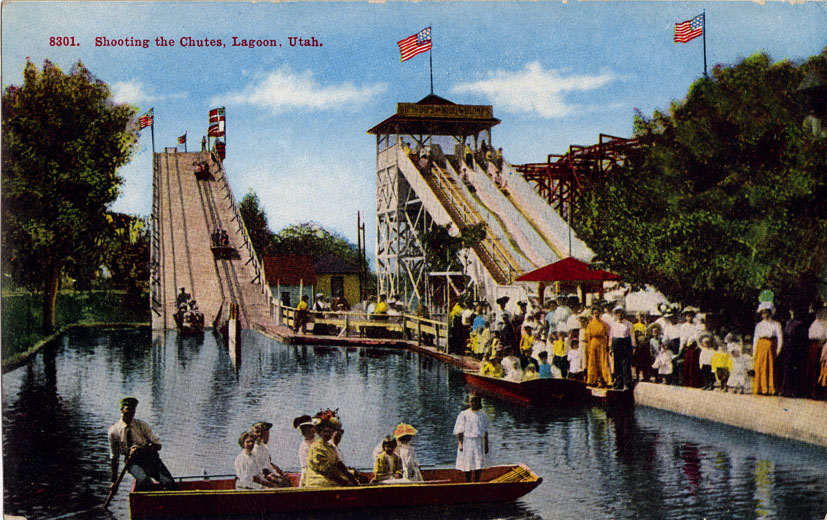
The thrill ride, Shoot-the-Chutes, was popular in 1896. Special Collections Department, J. Willard Marriott Library, University of Utah.

The same year of its relocation, Lagoon presented its first thrill ride, Shoot-the-Chutes, which is similar to today’s Log Flume ride. Later, in 1921, one of the most well known rides of this amusement park was finally introduced and “the roar of the Roller Coaster began.” (127 Years) “Almost 90 years old,” Arave writes, “the Lagoon Roller Coaster remains one of the most popular attractions at the park and is one of only a few wooden coasters between Denver and the West Coast.”

According to Lagoon’s press kit, a fire in 1953 destroyed the front of this coaster. It was rebuilt the following year, and sections of the Roller Coaster have been rebuilt each year since then. In that same press kit, Lagoon ensured the ride was, and would be, safe for the community. “The tracks are walked and thoroughly checked over each day before being put into use for the public.” (127 Years) As true as this may be, there have still been a few accidents, even fatal incidents, which occurred on this very ride. However, it seems that in all of those situations, Lagoon was not at fault. Arave writes that those deaths were caused by the “patron’s own negligence or recklessness.” In fact, the odds of being killed on one of these rides are about two chances in 43 million. (Arave) Rep. Blaze Wharton, D-Salt Lake, “compliments Lagoon’s safety record and doesn’t think, given information about the recent accident, that inspections could have prevented the deaths.” (Deseret News, June 25)

In the specific case of Kilee King, a 13-year-old girl of Bountiful who died on the infamous wooden Roller Coaster in 1989, investigation proved that no criminal negligence was involved. (Rosebrock, June 14) According to a June 29 story in the Deseret News, the Farmington police detective who investigated the incident found that the death of this teenage girl was a “fluke combination of her physique, actions and the laws of physics.” (Rosebrock, June 29) King was a slim, 5 feet 3 inches tall girl who only weighed 71 pounds. “In effect, it was a quirk of physics, combined with what the girl did and her height and weight,” said Detective Sgt. Jeff Jacobson after investigation of the incident. (Rosebrock, June 29)

Deseret News reporter Joel Campbell wrote on June 11 that Kilee King died at the park after falling from the front seat of the ride’s carts. “Witnesses said that the girl stood up from beneath a locked retraining bar, lost her balance and fell to a grassy area beneath the coaster.” According to that same article, the coaster had just gone over the curve of its second hill when she lost contact with the cart. The girl pushed herself up against the safety bar as the cart was at the peak of the hill, raised her arms above her head and lifted up off her seat as the cart took its ordinary “downward plunge.” The momentum from her forward and upward motion caused her to slip from under the bar, falling 35 feet to the ground. (Deseret News, July 29) The South Davis Fire Department officials said the girl was pronounced dead before any emergency medical personnel had arrived. (Deseret News, June 11)

The victim was the daughter of J. Wayne and Susan King. After the terrible incident, Susan filed a lawsuit against the amusement park, charging it with negligence. (Deseret News, July 29) According to Deseret News reports on July 29, 1989, Mrs. King stated that the design and operation of the park’s roller coaster was dangerous and that the lack of sufficient safety restraints is what had allowed her daughter to be thrown from the ride. Lagoon officials choose to not disclose much information about the lawsuits filed against the park, but according to Detective Jacobson’s findings, this was not the case. (Deseret News, July 29) According to Deseret News reporter Don Rosebrock, King had a season pass to Lagoon and had ridden the roller coaster multiple times prior to the deadly accident.

Department of Special Collections, J. Willard Marriott Library, University of Utah.

A postcard view of Lagoon. Special Collections Department, J. Willard Marriott Library, University of Utah.

Being a part of the LDS church, King’s passing was a topic of discussion during one of her church’s meetings. “We discussed the fact that her spirit had left her body, that she was still living…. We explained she will continue to live and they [young people whom she was friends with] should not be fearful and they would see her again,” stated Bishop Sherman Fuller, in an article written by Deseret News on June 12. “There was an air of peace.” Friends and neighbors remembered King as “vivacious, energetic and a natural leader.” She was thought of as someone whom everybody liked. (Deseret News, June 12) She was the type of person who did not care about what others had, “maybe they weren’t as popular or energetic. She tried to bring those people forward. She tried to involve them,” said Fuller in the article. (Deseret News, June 12) One of her “lifetime” friends, Katie Gardiner, was one of the people whom she “went out of her way to make feel accepted by a group of friends.” (Deseret News, June 12) Another one of King’s friends, Jeremy Christoffersen, said, “Next year in eighth grade I will think about her a lot and that she is gone. We spend a lot of time together. I used to go to Lagoon a lot with her. We went to a restaurant as a presidency. She was always laughing and smiling…. I still don’t understand what happened on the roller coaster.” (Deseret News, June 12)

The park itself remained opened after this accident, but the ride was shut down for inspection. (Rosebrock, June 14) However, “two studies, using research by doctors, scientists, astronauts and engineers, say amusement park rides are very safe.” (Deseret News, Jan. 21) J. Clark Robinson, a worker at Lagoon for 27 years who was president of the International Association of Amusement Parks and Attractions, said that the studies “have brought to light scientific proof that our rides are safe.” (Deseret News, Jan. 21)

People should not worry about accidents when visiting Lagoon, because cases such as Kilee King’s are very uncommon. Over the 127 years that Lagoon has been running and available to the public, there have been 16 deaths overall, including incidents not involving any of the rides themselves (such as heart attacks). Nearly half of those were caused by “the patron’s own negligence or recklessness.” (Arave) So it is, however, important to know how to keep yourself safe when riding these rides, in order to avoid a tragic accident. There are just some things that cannot be controlled by a safety restraint.

Johanna M. Melik is a junior at The University of Utah, majoring in mass communication.

Sources

Joel Campbell, “OFFICIALS PROBING DEATH OF GIRL, 13, WHO FELL FROM ROLLER COASTER,” Deseret News, June 11, 1989.

Joel Campbell, “KILEE WAS HAPPY AND CARING GIRL FRIENDS RECALL,” Deseret News, June 12, 1989.

Don Rosebrock and Joel Campbell, “BOUNTIFUL GIRL’S DEATH NOT THE 1st ON LAGOON’S WOODEN ROLLER COASTER,” Deseret News, June 13, 1989.

Don Rosebrock, “TEEN’S DEATH ON ROLLER COASTER AT LAGOON IS RULED ACCIDENTAL,” Deseret News, June 14, 1989.

Joel Campbell and Ray Eldard, “LEGISLATOR WANTS INSPECTIONS OF CARNIVAL, PARK RIDES,” Deseret News, June 25, 1989.

Don Rosebrock, “ROLLER COASTER DEATH CALLED A FLUKE A QUIRK OF PHYSICS, TEEN’S PHYSIQUE AND HER ACTIONS, DETECTIVE SAYS,” Deseret News, June 29, 1989.

“BOUNTIFUL MOTHER FILES LAWSUIT IN DEATH OF DAUGHTER AT LAGOON,” Deseret News, July 29, 1989.

Lynn Arave, “Lagoon questions data on injuries,” Deseret News, August 15, 2000.

Lee Davidson,“2 studies declare roller coaster safe,” Deseret News, January 21, 2003.

Arave, Lynn. “It’s About Fun: A History of Lagoon Amusement/Theme Park.” The Mystery Of Utah.

127 Years of Family Fun!” Lagoon Corp. Media Resources.


Forgeries, Bombs, and Joseph Smith: The Rise and Fall of Historical Documents Dealer Mark Hofmann

by JESSICA L. ONEIDA

October 15, 1985, began just as any other crisp, fall morning in Salt Lake City, Utah. Steven Christensen, a businessman who was described in the January 23, 1987, edition of the Deseret News as “an avid collector of Mormon documents,” made his way to work in the Judge Building located downtown. At the same time, Kathy Sheets, the wife of Christensen’s former business partner, J. Gary Sheets, began her day in the quiet suburb of Holladay, located 20 minutes south of the city. When two bombs, which killed both Christensen and Kathy Sheets, suddenly exploded within mere hours of each other, the entire valley was shocked. Newspaper headlines in the days following the bombings, such as, “Bombings shatter area’s composure: ‘It’s beginning to seem like Lebanon,’” found in the October 17, 1985, issue of the Deseret News, indicated that fear was a tangible issue within the community. This is a very telling piece of historical evidence that shows the seriousness of the event and its influence. This intensity and mystery maintained itself throughout the two-year-long journey that included the investigations, trial, and eventual conviction of Mark W. Hofmann for the murders of Steven Christensen and Kathy Sheets.

The book, Salamander: The Story of the Mormon Forgery Murders by Allen D. Roberts and Linda Sillitoe, describes the early years of Hofmann and his upbringing in Utah during the 1960s and 1970s. His family was active in the Church of Jesus Christ of Latter-day Saints (LDS) and he took an interest in some unique hobbies as a child, including performing magic tricks. Even though Hofmann was raised in the Mormon religion, he concluded that he did not believe the teachings of the church and secretly rejected the religion as a whole by the time he reached his teenage years. Since his family was still very active, Hofmann kept his newfound beliefs and feelings to himself and managed to convince his peers that he was still interested and involved. He kept up the act by serving a religious mission and marrying within the church. An amused Hofmann took pleasure in tricking his family and fellow church members about his involvement, which could stem back to his early years. Roberts and Sillitoe discuss his childhood and how he “loved tricking people and practiced his illusions diligently.”

After he married, he began to discover and collect historical books and documents, mostly regarding the history of the Mormon religion and the early development of the LDS Church. During the course of his collecting, he began to come across ancient Mormon documents among the pages of some of the books. One of the most controversial and most discussed letters that Hofmann brought to light was the Salamander Letter. This letter called into question the seriousness and validity of Joseph Smith’s discoveries and translations during the beginnings of the religion. Smith founded the LDS Church after discovering ancient writings near his home in western New York.

As Hofmann became more involved with his collecting, he connected with Christensen, who also enjoyed finding these rare documents having to do with Mormon history. The set of documents that sparked the bombings and the controversies was called the McLellin Collection, written by William E. McLellin.

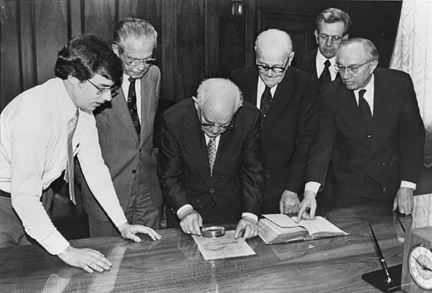
"Mark Hofmann watches as Mormon leaders inspect some of Hofmann's documents." Special Collections Dept., J. Willard Marriott Library, University of Utah.

“Mark Hofmann watches as Mormon leaders inspect some of Hofmann’s documents.” Special Collections Department, J. Willard Marriott Library, University of Utah.

McLellin was “an early church apostle who later left the church,” according to the Deseret News on October 27, 1985. The article reported that he left the church because he had issues with some of the beliefs and practices taking place and that he “came into frequent conflict with church leaders.” The desire for this collection stemmed from the actual content within the letters. The Deseret News reported the basis of this content as giving “some of the first accounts of President Smith’s involvement in plural marriage.” On October 27, 1985, the Deseret News wrote, “The collection has proven elusive over the years, prompting some to dispute its existence. Yet it’s believed by many scholars and historians to exist.” This brought about the initial controversial nature of the documents and called into question some of the other documents Hofmann collected and sold.

While many of the documents he produced were questioned for authenticity and accuracy, Hofmann was talented enough that he had many experts defending their quality. One such example, as reported by the Deseret News on October 17, 1985, was Leonard Arrington, who was a professor of Western history at Brigham Young University. He said “documents discovered previously by The Church of Jesus Christ of Latter-day Saints and he doesn’t believe they are forgeries.” Over the course of Hofmann’s activities, he sold many of his forgeries to collectors and the LDS Church alike. It was only a matter of time before the validity of his career was threatened.

Many motives were suggested as to why Hofmann orchestrated the bombings that led to the deaths of Christensen and Sheets. One of the most recurring ideas, however, was the motive of Hofmann covering up his shady dealings. The January 23, 1987, edition of the Deseret News reported, “Police and prosecutors believe that Christensen … may have discovered the fraud and threatened to expose Hofmann.” Hofmann must have felt the pressure and the article further suggested that, “Rather than risk a lucrative career in documents dealing, Hofmann killed Christensen and then planted another bomb at the home of J. Gary Sheets.”

"Mark Hofmann sits with his lawyers during the trial." Special Collections Dept., J. Willard Marriott Library, University of Utah.

“Mark Hofmann sits with his lawyers during the trial.” Special Collections Department, J. Willard Marriott Library, University of Utah.

The whole scheme came to a breaking point when a third bomb was prepared but malfunctioned and exploded in Hofmann’s car with him inside on October 16, 1985, the very day after the initial bombings. Officers found similarities between both bombings as reported by the Deseret News on October 17, 1985: “The bomb that injured Hofmann is almost identical in connection to devices that killed Steven F. Christensen and Kathy Webb Sheets.” The article continued, “Wednesday’s bomb apparently did not contain the shrapnel that sprayed in all directions in the first two blasts.”

The case took one year and three months to be compiled and executed. While it wasn’t until April 1986 that Hofmann’s role as a suspect was confirmed, he didn’t actually go to trial until January 1987. On January 23, 1987, the Deseret News reported the outcome of the trial. The judge overseeing the trial concluded that, “Due to the indiscriminate nature of the killings and the type of devices employed … I want you to serve the rest of your natural life in the Utah State Prison.” Hofmann pleaded guilty on “two counts of second-degree murder” and because of his confession, “prosecutors dismissed more than two dozen other complaints charging the documents dealer with theft by deception, communications fraud and bomb construction.” Hofmann is currently serving his life sentence in the prison located in Draper, Utah.

Jessica Oneida is in her fourth year at the University of Utah. She is majoring in Strategic Communication with minors in Business Administration and Design.

Sources

Jerry Spangler, “Booby-trapped bombs claim 2 in S.L. area,” Deseret News, October 15, 1985.

Brett DelPorto and Jerry Spangler, “Officers sifting evidence for clues to killer and motive in fatal bombings,” Deseret News, October 16, 1985.

Ellen Fagg and Jerry Spangler, “3rd bomb victim faces criminal charges,” Deseret News, October 17, 1985

Jerry Spangler, “Police focus on evidence, not theories,” Deseret News, October 18, 1985.

Brett DelPorto, Kathy Fahy, and Angelyn N. Hutchinson, “Hofmann retreats from statement; 2 bomb victims are eulogized,” Deseret News, October 19, 1985.

Marianne Funk, and Jerry Spangler, “Police sift documents to build Hofmann case,” Deseret News, October 23, 1985.

Jerry Spangler, “Hofmann wouldn’t get fair trail in Utah, attorney says,” Deseret News, October 25, 1985.

Linda Sillitoe and Jerry Spangler, “Still unseen McLellin Collection a mystery within murder mystery,” Deseret News, October 27, 1985.

Jerry Spangler and Jan Thompson, “Hofmann identified as the man who carried box into building,” Deseret News, April 14, 1986.

Jerry Spangler, and Jan Thompson, “Judge wants life in prison for Hofmann,” Deseret News, January 23, 1987.

Roberts, Allen D. and Linda Sillitoe, Salamander: The Story of the Mormon Forgery Murders. Salt Lake City, Utah: Signature Books, 1988.

Turley Jr., Richard E., Victims: The LDS Church and the Mark Hofmann Case. Chicago, Illinois: University of Illinois Press, 1992.

Salt Lake City and the Economy, One Year after the Stock Market Crash

by JOEY KINGSTON

Salt Lake City has a rich economic history that dates from the time it was settled in July 1847. That history is discussed in detail in the July 25, 1914, issue of The Salt Lake Tribune. When Latter-day Saints settlers arrived from the East, they quickly found that the Salt Lake Valley had a large reserve of copper just west of the Wasatch Front.

Salt Lake Tribune article published in November 1919 observed that mines quickly sprang up in the Salt Lake Valley and became an asset to Utah’s economy.

A view of Main Street, in downtown Salt Lake City, where most businesses were located. The image was made shortly before the onset of the Great Depression.

A view of Main Street, in downtown Salt Lake City, where most businesses were located. The image was made shortly before the onset of the Great Depression. Special Collections Department, J. Willard Marriott Library, University of Utah.

Today the economy of the Salt Lake Valley is still strong, but has changed drastically from the mining town it once was. Looking at downtown Salt Lake City today, one sees high-rise business buildings and large universities. Now one of the largest industries in the Salt Lake Valley is the banking industry, with the Chase tower and Wells Fargo tower located downtown. The economy is strong and the unemployment rate is low. But Salt Lake wasn’t always one of the economically strongest cities in America. There was a time, in fact, when it had one of the highest unemployment rates in the US, and poverty was at an all-time high. It all began in 1929, when the stock market crashed at the end of October.

Before the stock market crash, most people were either employed by the mining companies just west of Salt Lake or worked in factories in Salt Lake. But what was the city like a year after the market crash? We know that the effects of the stock market crash weren’t really felt in the first couple of months. Many commented on the stock volatility, but many were optimistic at first. Then after several months, the full effects of the crash were realized. We will take a look at what Salt Lake City economy was like a full year after the 1929 stock market crash on Wall Street.

One of the many mines that were located just west of Salt Lake City. They were the driving force of the economy in the 1920s, but saw difficult times in the '30s. Special Collections Department, J. Willard Marriott Library, University of Utah.

One of the many mines that were located just west of Salt Lake City. They were the driving force of the economy in the 1920s, but saw difficult times in the 1930s. Special Collections Department, J. Willard Marriott Library, University of Utah.

By the end of 1930, the stock market crash had reached all parts of the United States. Utah and the Salt Lake Valley had been hit especially hard. Their main source of employment had come to a halt; the coal industry and agricultural industry had decreased dramatically during that year. The Salt Lake Telegram reported on March 20, 1930, that the poor economy, plus several fatal mine explosions, caused the coal companies to lay off a large portion of their workers. Making matters worse, the agricultural industry In the Salt Lake Valley had decreased by almost half, causing even more local lay offs.

So how bad was it a year after the great depression hit? Some newspapers were optimistic regarding the stock market, claiming that stocks were on a rise and that jobs were being created every day. (Walzer) The reality was quite different, though. An article published in the Salt Lake Telegram exactly one year after the crash tells the story of a man who killed himself and his two sons by jumping off a building. This man had lost his wife the year before, and shortly afterward he lost his job as a tailor and never found a new job. Out of desperation, he committed suicide. While this was not representative of every situation in the Salt Lake Valley, it is a good reflection of the disparity many of the residence were in.

In addition, the coal industry was struggling and the banking industry slowed. (Thomas) In the first year alone, more than 25 banks failed. One particular failure that was a hard hit on the economy in Utah was the Ogden First National Bank. It was one of the largest banks in Utah at the time, reported the Salt Lake Telegram. (August 31, 1934)

The Walker Bank building, built in 1912 and located in the heart of downtown. The bank struggled during the 1930s due to the Great Depression. Special Collections Department, J. Willard Marriott Library.

The Walker Bank building, built in 1912 and located in the heart of downtown. The bank struggled during the 1930s due to the Great Depression. Special Collections Department, J. Willard Marriott Library, University of Utah.

At the year mark the Depression was in full effect in Salt Lake City and the whole valley. Unemployment was at an all-time high, reaching over 10 percent, according to Dean May. That statistic was one of the highest in the country, and was still rising. This was one of the lowest points in Salt Lake City’s history. Although unemployment was at an all-time high, there were several reports of local stimuli as well as government-assisted stimuli that were put in place. On October 30, 1930, the Davis County Clipper reported construction of a new office building. Its purpose was to offer office space at a cheaper rate than that of a similar building in Salt Lake City and thus stimulate small business in Salt Lake City and encourage the employment of more people. This is not the only case of artificial stimuli being implemented in the Salt Lake Valley. In December 1930, the Clipper reported that the federal government was getting involved. The proposed project was a new waterway system to be put in Salt Lake City to supply clean water to residents. This stimulus project was supposed to employ up to a thousand new government employees.

Alexander writes that by the one-year anniversary of the stock market crash, things were steadily worsening. The first year there was an additional 5.1 percent of unemployed. That doesn’t sound too bad, but the jump from the first year and the second year was 21.9 percent unemployment rate. The government knew it needed to get involved. Unfortunately, the federal government was spread thin at this point, so most of the burden fell on county government and private relief. At the time one of the largest groups in Salt Lake City was people of the LDS faith. Dean May wrote that in Salt Lake City at the time, about half the residents were members of the Church of Jesus Christ of Latter-day Saints. Most of the aid came from the church’s relief programs. Over 70 percent of the families receiving welfare from the LDS relief programs were not of that faith.

Salt Lake City was one of the hardest-hit cities in America. The stock market crash affected not just individual families but also whole communities. The first year was a hard year and it only got harder thereafter. Dozens of banks shut down, farms went out of business, and the mining industry suffered. The unemployment rate was growing and people were in the pit of despair. Welfare programs were just coming to the rescue, but help was hard to find. The year after the great Wall Street crash was a tough time for people in the Salt Lake Valley — and the worst was yet to come as the Great Depression took hold.

Joey Kingston is a junior at the University of Utah majoring in marketing with a minor in media communications. He expects to graduate in spring 2015.

Sources

“Cement firm sues Ogden state bank,” The Salt Lake Telegram, August 31, 1934, 5.

Edward Pickard, “Inland water way projects being pushed thorough to give jobs to unemployed,” Davis County Clipper, December 5, 1930, 3.

“New office building announced,” Davis County Clipper, October 31, 1930, 6.

Elmer Walzer, “Stock values climb fast as trading ends,” Salt Lake Telegram, October 30, 1930, 6.

“Man kills self after two attempts fail,” The Salt Lake Telegram, October 30, 1930, 5.

“Mine inspector blames lack of supervision in fatal mine explosion,” The Salt Lake Telegram, March 20, 1930, 8.

“Banker defends mining industry,” The Salt Lake Tribune, November 14, 1919, 2.

“Pioneer day celebration is big success,” The Salt Lake Tribune, July 25, 1914, 4.

Alexander, Thomas. Utah, The Right Place. Salt Lake City: University of Utah, 2003.

May, Dean. Utah: A People’s History. Salt Lake City: University of Utah, 1987.


Snow Canyon Project and the 1977 Drought

by CHELLE D. BRIDGE

The people who resided in the desert state known as Utah had an arid hit in the year of 1977. The Color Country Spectrum reported on February 27, 1977, that Gov. Scott Matteson had encouraged residents to prepare for the drought and urged the state to act as a team. Matheson asked Utah cities to help find a solution for the water shortage, particularly during the dry summer months.

Although the entire state experienced a water shortage that year, southern Utah — and the city of St. George — was particularly affected by the drought.

The city’s residents had saved water because of the shortage. The Water and Power Board enacted strict rules regarding water usage. Even so, the dryness still came.

St. George’s main water source was from natural springs and wells, but with the dry weather, the sunny city worried whether there would be enough water to last through summer. People feared that irrigation and agriculture would be hit the hardest. The Color Country Spectrum reported on February 24 that with the growth of the city and community it gave a great reason to also have the water usage shortened. The water development was worked on and was combined with the sewer project.

Fred Rendell, author of Making the Desert Bloom, wrote that “The Water and Power board were on a constant alert which made them ration the water.” (Rendell, 225) With the water disappearing, it had left residents with fear of water depletion. The almost waterless city had to find a solution to the shortage.

In fact, because of the dry weather, many residents had lost their jobs. But, the drought gave residents a new task. The Color Country Spectrum reported on March 4 that locals were asked to help in any way that they could. Ideas included limiting water usage, restricting the use of sprinklers, using water only for essential needs, and finding better sources of water. The residents would determine how much water they would have been able to use. This had made the residents look harder for water sources. The best idea was to go to local ponds, reservoirs, and lakes.

According to a story published in the Color Country Spectrum on February 24, ”The first place to drill for water was from a golf course in the sunny city. This would give hope to the residents and would save them about 88 million gallons of water a year.”

The paper reported on February 20  that “the main source was found by using pipes, from a natural spring.”

The project had begun by using aquifers. Rendell wrote in his book, “In the canyon water had been discovered. The Water, Power Company had put aquifers in the Navaho and Kayenta rock formations.” (Rendell, 445) This was an anticipated answer to come for the drought problems. Rendell also wrote that a University of Utah professor, Harry Goode, “was assured by the geology that the water could be found.” An employee with the U.S. Geological Survey also was optimistic that water would be located “beneath the floor of the canyon.”

Drilling ensued and five wells ultimately were constructed to feed “two giant underground storage tanks.” The Color Country Spectrum reported on March 4 that putting the tank in Snow Canyon Park created a water supply for residents of St. George.

Conclusion

Constant reminders to save and use water wisely were difficult for residents of St. George. However, the city pulled through, in part due to hard work and a team effort. This feeling of coming together helped to create an atmosphere of achievement and a sense that their city in southern Utah would remain.

Chelle Bridge is a senior at the University of Utah majoring in mass communication

 Sources

“Snow Canyon Arch … was source of life for Ivins,” St. George, Utah, Color Country Spectrum, February 20, 1977, 1.

“Drought program to aid West, Midwest,” Color Country Spectrum, February 23, 1977, 1.

“Washington copes with growing pains,” Color Country Spectrum, February 24, 1977, 1.

“Utah Faces Worst Drought,” Color Country Spectrum, February 27, 1977, 2.

“Southern Utah Prepares for water shortage,” Color Country Spectrum, February 27, 1977, 1.

“Weather Prompts Scare,” Color Country Spectrum, March 4, 1977, 1.

“Water Supply Deteriorates,” Color Country Spectrum, March 8, 1977, 3.

Bill Cooper,“Drought Affects Wildlife,” Color Country Spectrum, April 3, 1977, 2.

“Changing Water Rate System Encouraged,” Color Country Spectrum, April 10, 1977, 1.

About Snow Canyon State Park,” Utah State Parks and Recreation.

Rendell, Fred. “Drought Turns Eyes Toward Snow Canyon,” in Making the Desert Bloom, republished by the City of St. George.


Utah’s First Pro Sports Champ: The 1970-71 Utah Stars

by TALON CHAPPELL

On a cool night in Salt Lake City, Utah, Bill Howard, broadcaster for the Utah Stars, called what would be the last game of the 1970-71 ABA season. The Stars met up with the Kentucky Colonels in a win or go home matchup to determine the champion of the American Basketball Association. With 21 seconds remaining, Mike Butler made a driving layup to put the Stars ahead 129 to 118. The dull roar in downtown Salt Lake City turned into a frenzied cry of excitement as 13,000 fans arose from their seats in the Salt Palace arena. The noise grew louder with every passing second ticking off the clock. Kentucky’s Cincy Powell hit a 3-point shot with two seconds remaining to make the score 131-121 in favor of the Stars. It wasn’t much consolation as Stars center Zelmo Beaty raised his arms in triumph and excitement of the inbound play to come. Beaty received the ball and bedlam ensued as a mob of ecstatic Stars fans rushed the court to show appreciation for the team they had quickly come to love. In their first year in Salt Lake City, the Utah Stars had won the ABA championship. (“We’re No. 1”)

In the days following the historic ABA finals victory, the Stars received local media attention that rivaled most NBA franchises. When team owner Bill Daniels relocated the Stars from Los Angeles to Salt Lake City in June 1970, he claimed that the Utah Stars would become “the Green Bay Packers of professional basketball.” (Roblez) Some owners and media members were skeptical and believed the team would never be able to gain the fan support and media exposure needed in order to survive in the ever-shaky ABA. But Utah sports fans proved the critics wrong and became one of the most passionate and supportive fan bases in the entire league.

At a time when the ABA was fighting for fan support and television viewership with the more established NBA, Utah Stars fans exceeded expectations by continually filling the gem of Salt Lake City, the Salt Palace. An article in the May 28 edition of the Davis County Clipper recalled the ABA attendance record set during the Stars’ inaugural season in Salt Lake City. In the 42 regular season home games in the 1970-71 season, the Salt Palace welcomed in 262,342 fans, averaging just over 6,000 fans per game. In its first year, the franchise had broken the ABA attendance record set by the Carolina Cougars the previous season with 254,163 fans. Attendance grew as the regular season ended and the playoffs began. In the final seven playoff games played at the Salt Palace (three against the Indiana Pacers and four against the Kentucky Colonels), the Stars averaged 12,923 fans per game, 700 more people than the Salt Palace could seat.

Advertisement published in The Salt Lake Tribune.

Advertisement published in The Salt Lake Tribune. Image courtesy of the newspaper.

When the Stars were not playing at home, media outlets like the Salt Lake Tribune kept diehard fans (especially those in more rural areas of Utah) in the know during the 1971 playoff run. When the Stars defeated the Indiana Pacers in game seven of the Western Division Finals in Indianapolis, they returned home to the warmest welcome any team from Utah had ever seen. Salt Lake Tribune reporter Steve Rudman recalled the scene at the Salt Lake International Airport on April 29, 1971, as 3,000 raucous Stars fans welcomed home the newly crowned ABA Western Division Champions: “The arrival at the airport, with its attendant pomp and ceremony, was the culmination of a very hectic 24 hours, a time in which the Stars defeated Indiana, 108-101, partied half the night in celebration and then made the long trip back from Indianapolis after a couple of boring hours in Chicago. But it was all worth it for the Stars.” The celebration continued as more fans lined the streets of Salt Lake City to await the motorcade bringing the Stars back home to the Salt Palace.

A few days later, the Stars began their ABA championship series against the Kentucky Colonels of the Eastern division. On May 9, Rudman and the Salt Lake Tribune had to break the news to the Stars faithful that the team had dropped its second straight game to the Kentucky Colonels in Louisville after winning the first two games of the best-of-seven series in Salt Lake City. “The home court advantage may be some consolation,” he wrote, “but the Utah Stars really did want a split here. Instead they dropped both games and now it would appear Kentucky has the momentum going.”

Ten days after Stars fans were thrown into a pool of uncertainty after the game four loss to the Colonels, the Stars returned home for the final game of the best-of-seven series and defeated the Colonels 131-121 en route to the ABA Championship. While Stars fans jumped, yelled, hooted and hollered, local reporters were busy at work writing stories that had never been covered before in the state of Utah, the story of a professional sports championship.

In his article on May 21, 1971, Dan Pattison of the Deseret News proclaimed the win as the “Miracle on West Temple Street.” Pattison also gave Stars fans an inside look at the glory and pride felt by Stars players. Stars forward “Wondrous” Willie Wise said he wanted to wear his Utah Stars uniform “forever,” and center Zelmo “Big Z” Beaty proclaimed his appreciation to his teammates and the fans all over Utah. “I feel like I’m on top of the world,” he told Pattison. “It took eight years of playing for me to do something like this. I’ve played with some great guys before, but not like these guys. We just couldn’t let the fans down. It was a pleasure to play in Utah this season.”

Numerous sports reporters for the Salt Lake Tribune offered their congratulations to the team and had plenty to say about the historic win for the Stars and for the state of Utah. John Mooney, the renowned sports editor, wrote a short but sincere thank you to the Stars on the front page of the May 19, 1971, Salt Lake Tribune sports section. In the short letter, Mooney applauded the graciousness and humility of Stars coach Bill Sharman as well as team owner Bill Daniels and team president Vince Boryla, who would constantly thank media writers for their attention to the team and for their help in building a loyal fan base. “Every game when you walked by and said ‘Good luck,’ someone would say, ‘Whether we win or lose, thank you for everything you’ve done to help us this far,’” Mooney wrote. In the world of sports, where members of the media can often be blamed for added pressure on athletes or the demise of front office staff, the Stars showed true class by embracing their local sports writers as their partners in the business of success. Near the end of his letter, Mooney wrote, “The Stars won magnificently, but graciously. They had words of thanks for everyone, especially the fans who adopted a wandering ball club and took it to their hearts. The whole organization was major league, all the way.”

Also on the front page of the May 19, 1971, Salt Lake Tribune sports section was a stirring fan piece by reporter Dick Rosetta. All of Utah jumped on the Stars bandwagon, in the best sense of the word. Fans came from the red-rock cliffs of St. George and Kanab, from the arches and canyon lands of Moab and Price, from the farm country of Fillmore and Vernal and from the college towns of Ogden and Logan. People talked about the opportunity the Stars had to put Salt Lake City in a national spotlight. Stars fan Ron Henriksen told Rosetta over the noise inside the arena that night, “What difference does it make what time of year it is? Can you imagine what this has done for Utah over the nation? Man, anyone who could argue against basketball must be nuts.” That night fans didn’t even care about the crammed seating, lack of seating, uncomfortable heat or deafening noise, they were just glad to be there. Stars fan Dennis Dall proclaimed to Rosetta, “Ah, the sound doesn’t matter, the Stars do their own talking. They are the greatest thing that’s ever happened to this state.” That night, the Salt Palace was a portrait of pent-up people, ready to prove that Utah, yes, even Utah, could house a champion.

Over the next three seasons the strong Stars roster continued to dominate ABA competition, finishing all three years atop the Western Division standings. The Stars also made history by signing the first professional basketball player straight out of high school, a young and extremely talented Moses Malone, who went on to become an NBA champion, hall of famer and NBA top-50 all-time player. (Moses Malone Biography) But despite their talent, the Stars were unable to re-create the playoff magic that captivated Utahns in the Spring of 1971. The 1974-75 season was a disappointing one for the Stars and their fans, finishing with a record of 38-46, good enough for fourth in the Western Division standings. Monetary troubles began to plague new team owner James A. Collier in 1974, forcing him to sell the team to the Johnson brothers, Snellen and Lyle, before the 1975 season. The duo proved to be unfit to manage the small earnings of an ABA franchise and just like that, the Utah Stars disbanded after playing just 16 games in the 1975 ABA season. (Roblez)

Despite the disappointing end to the franchise, the Utah Stars were a catalyst for what is now a thriving sports culture in the state of Utah. Without the Stars, the notion of moving the NBA’s New Orleans Jazz to Salt Lake City would never have been considered. Other professional teams have come and gone: the Arena Football League’s Utah Blaze, the American Professional Soccer League’s Salt Lake Sting and even the WNBA’s Utah Starzz (a fitting homage to the state’s basketball heritage). None came close to having the same impact that the Utah Stars had on Salt Lake City.

Stars radio broadcaster Bill Howard once said, “The Stars boosters include the young, the elderly, the professional man, the blue collar worker, the household; all of whom dig the action and the emotion of professional basketball.” (“We’re No. 1”) Not only did this wide array of fans appreciate the Stars, but also the growing population of Utah’s sports reporters. The team was not only a professional opportunity for its players, but for those who covered them as well. The Stars gave news reporters in Salt Lake City the unique opportunity to cover a nationally recognized entity that Utah had had only a few times before. Anyone who wants to cover professional sports in a small market city need only look at the relationship between the Stars and their various news writers to truly understand the impact the team left on its followers.

Today, the most influential reminder of the Stars is former player Ron Boone, who remained a Salt Lake City resident even after his playing career with the Stars and the NBA’s Utah Jazz. Boone described the Stars 1971 ABA championship as “the greatest accomplishment” of his career and claims that Salt Lake City was where he spent his “best years” as a player. (Biga) Boone remains a fixture of the Utah Jazz broadcasting team, where he has been color commentating on television and radio since 1991. He is, perhaps, the greatest icon left from a team and an era that truly, in the mind of Utahns, has earned its heavenly place among the stars.

Talon Chappell is a senior at the University of Utah. He is majoring in mass communication with an emphasis in journalism.

Sources

“Stars Make It Big,” Davis County Clipper, May 28, 1971.

Dan Pattison, “Stars Gave Utah a Night to Remember,” Deseret News, May 19, 1971.

John Mooney, “Nice Guys Do Win Pennants And Stars Can Prove It,” The Salt Lake Tribune, May 19, 1971, 1.

Dick Rosetta, “Th’ Stars’ Fans Know No Calender,” The Salt Lake Tribune, May 19, 1971, 1.

Steve Rudman, “Colonels Clip Stars in Overtime, Even Series,” The Salt Lake Tribune, May 9, 1971, 1.

Steve Rudman, “Stars Return to Wild Cheers,” The Salt Lake Tribune, April 30, 1971, 1.

1970-71 Utah Stars Roster and Stats,” Basketball-Reference.com.

ESPN, “Moses Malone Biography,” espn.go.com.

KSL Sports, “We’re No. 1: Highlights of the 1970-71 Season,” YouTube.

Leo Bigas, “Ron Boone, Still an Iron man After All These Years,” Leo Adam Biga’s Blog.

Matt Roblez, “Remember the ABA: Utah Stars,” Remember the ABA.com.

The Wenner Family on Fremont Island

by ANDREW BUTTERFIELD

The Wenner family lived on Fremont Island from 1886-1891, the only family to ever call Fremont Island home. Uriah James and Kate Wenner are forever sealed into the history of Fremont Island, the Great Salt Lake and the state of Utah.

The Great Salt Lake is one of the largest lakes in the Western United States. The lake is surrounded by many islands, one of which is Fremont Island. Fremont is the third largest island in the Great Salt Lake. Discovered on September 9, 1843, by John C. Fremont and his four companions, Fremont described the island as “simply a rocky hill on which there is neither water nor trees of any kind although the Fremontia vermicularis, which was in great abundance, might easily be mistaken for timber at a distance.” Fremont was said to be so dissatisfied with the discovery that he named the island “Disappointment island.” (Miller, 219)

After Fremont and his companions had left the Rocky Mountain territory, the next group of explorers named the Mud Hen crew began investigating the Great Salt Lake. According to David E. Miller, the Mud Hen crew, the first known Mormon pioneers led by Albert Carrington, named Fremont Island “Castle Island,” a name that was commonly used by Mormon explorers during this time period. (Miller, 220)

A very important contributor to the history of Fremont Island is Howard Stansbury, who developed the first geographical outline of the Great Salt Lake. Stansbury had a meeting with Brigham Young, the pioneer of Mormonism and the migration to Utah, to develop the survey outline of the Great Salt Lake. Of the meeting, Stansbury declared, “ The impression was that a survey was to be made of their country in the same manner that other public lands are surveyed, for the purpose of dividing it into townships and sections.” (Madsen, 152) Stansbury knew of Fremont’s discovery and “in honor of him who first set foot upon its shore,” Stansbury revived the territory’s true name, Fremont Island. (Miller, 220-21) Using the created surveys, he determined that the island would excel as a territory for sheep herding.

A water spring on Fremont Island. Used by permission, Utah State Historical Society, all rights reserved.

A water spring on Fremont Island. Used by permission, Utah State Historical Society, all rights reserved.

Fremont Island first served as a cattle territory organized and controlled by Henry Miller and his family in the late 1850s. The Miller family had established a fresh water spring on the southeastern tip of the island, the only true source of fresh water. The Miller family decided the island would be best for the sheep because of the lack of natural predators, restrictions in sheep migration, naturally rural land area, and the privacy the sheep would enjoy to keep them protected. (Eckman, and Miller, 161-62)

The story of the Wenners begins with their arrival in Salt Lake City in 1880. Uriah James Wenner launched a small law office, which transformed the family into some of Salt Lake City’s most successful and recognizable citizens. Eli A. Smith, a judge, was relieved of his duties due to a violation of the Edmunds Act of 1882. Salt Lake City Governor Eli H. Murray proclaimed in the September 9, 1882, Deseret News, “Know ye, that by virtue of the anthority in me vested, I, Eli H. Murray, Governor of said Territory, do hereby appoint” Wenner to fill the vacancy. The article reported that Murray had announced several new positions, one of which was probate judge of Salt Lake County. Uriah James Wenner had been tapped to serve on the bench. Wenner, a non-Mormon, accepted the position.

Shortly after his appointment, the community became skeptical toward the Wenner family due to their lack of interest in the dominant religion. Many opposed his rise to the title of Probate Judge of the county. According to the September 20, 1884, Desert News, “Mr. U.J. Wenner, was in dense obscurity, being almost totally unknown in Utah, until a few months ago Governor Murray gave him a bogus appointment to the office of Probate Judge of Salt Lake County, a position which is elective and within the gift of the people.”

Uriah Wenner’s time as judge was short-lived. In 1886, he was diagnosed with tuberculosis and it was recommended the family move to a remote location to better his health. In the years leading up to his diagnosis, Wenner had become friends with the Miller family. Wenner had visited the Millers on Fremont Island several times. (Eckman, and Miller, 163-65)

The family's residence on Fremont Island. Used by permission, Utah State Historical Society, all rights reserved.

The family’s residence on Fremont Island. Used by permission, Utah State Historical Society, all rights reserved.

The story of the Wenners’ first purchase of Fremont Island is a hazy one, one that has not been confirmed. After two years witnessing the tranquility and privacy of the island, Uriah James Wenner had gone to the Union Pacific Railroad Company, which owned Fremont Island, and bought a portion of the territory under the Desert Land Act of 1877. (Eckman, and Miller, 164) Wenner acquired the most significant piece of land on the island, where the only fresh water supply was located. This was made in an attempt to move the Miller family off the island. With their sheep and livestock no longer having a sufficient water supply, they would not be able to survive. (Eckman and Miller, 164-65) Upon receiving the news that they were being evacuated, the Miller family, infuriated and betrayed, wrote to Union Pacific stationed in Omaha. By the time the Millers had received a reply from Union Pacific, they had already moved off the island. The letter stated that the Wenner family had no right to the land nor a record of purchasing property on Fremont Island. Jacob Miller, who had succeeded his father Henry, wanted to take the Wenners to court. However, due to his practicing polygamy, Miller decided against taking real action. Polygamy had been recently found unlawful and against the practice of the Mormon faith. The Wenner family officially purchased a vast majority of Fremont Island and in 1886 called Fremont home. (Eckman, and Miller, 171-73)

Life for the Wenner family had changed drastically. Kate Wenner, née Noble, who had always enjoyed a life of luxury, was now a housewife. According to the November 21, 1891, Dalles (OR) Daily Chronicle, she “cheerfully gave up her luxurious home in this city and went with him.” The original journey to Fremont Island took three days. “It seemed fun at first, but with calms, head winds, squalls, and seasickness,–for hours that treacherous body was like ‘a tempest in a teapot.’” (Noble, 225) By being able to rely on a boat shipment that came once or twice a month, the Wenner family rarely returned to the mainland. Kate Wenner addressed the matter in her personal account of life on Fremont by stating, “On that unsteady trip I made up my mind I would not take my family back to the mainland very soon, and perhaps I would wait until the lake dried up.” (Noble, 225)

Island living seemed to come naturally to the Wenner family. Kate Wenner wrote, “In the afternoon a swim in the lake, after supper a walk over the hill where a glorious sunset held us, and then the moon lit up our little world and hope built happy days ahead.” (Noble, 225) The three Wenner children seemed to be the greatest supporters of the move to the island. Like any family throughout history, Uriah and Kate Wenner set rules and restrictions. Living in semi-isolation, the Wenner adults did not have many worries about their children’s safety. In fact, there was “only one ‘do not’ on the children’s lives and that was not to go in the lake unless we were with them. If the briny water is swallowed it brings on a terrible strangulation!” (Noble, 226)

The Wenner family had been able to explore and rediscover life. The family was able to appreciate the natural beauties of both the island and of living in peace and solitude. These were the main highlights of their time spent on Fremont. Living in solitude forced the family to try new things. In “A True Story” of island life, Kate Wenner described an episode where she milked a cow: “His (Uriah Wenner) greatest surprise on the Island was my bucket of milk, and I am sure it was the cow’s greatest surprise too.” (Noble, 231) When the Wenner family was missing an ingredient or supply, they would simply say it was not needed, that it was an attempt at something new. That seemed to be the reality of island living, only the true necessities mattered, it was an eternal happiness for the Wenner family.

Unfortunately, the joyous times did not last. As the years went by, Uriah Wenner had begun losing his battle with tuberculosis. He stopped working, he needed the assistance of a walking cane, and when he was bedridden he was forced to call upon his wife for all his needs. Wenner died peacefully in 1891, lying in his bed on his beloved home, his island Fremont. According to Kate Wenner’s story, her husband’s final words to her were, “I love you, love the children.” (Noble, 232) With those words he rested for the final time. In a stunned fear, she used the island’s only distress signal with the mainland. Kate set off multiple fires on the highest hill, but it took several days until she was able to see a fire lit on the mainland shore. This signal meant that help was on its way.

Uriah Wenner's gravesite on Fremont Island. Used by permission, Utah State Historical Society, all rights reserved.

Uriah Wenner’s gravesite on Fremont Island. Used by permission, Utah State Historical Society, all rights reserved.

Several newspapers published accounts of Uriah’s death in 1891. According to the September 30, 1891, issue of the Ogden Standard Examiner, “The husband had expressed a desire to be buried on the island and his faithful wife determined to heed his request.” The Wenners had become a family loved by many. In another issue of the Standard Examiner, published on October 4, 1891, the paper wrote, “Many residents of this City and valley have been their guests and were charmed by the grace and refinement of the Islanders.”

After Uriah’s death, Kate and her children moved from the island. Shortly after their move, Kate died. Her second husband along with her family honored the request that she should be buried on Fremont Island, next to Uriah James Wenner. To this day Uriah and Kate Wenner have their graves on Fremont Island. Although currently owned by a different family, only the Wenner family called Fremont Island home. (Miller, 234-36)

Andrew Butterfield is a senior at The University of Utah. He is majoring in mass communication and minoring in sociology.

 Sources

Everett L. Cooley, “Great Salt Lake — Fremont Island p.13,” Utah State Historical Society, Mountain West Digital Library.

Everett L. Cooley, “Wenner, Uriah J. — Residence P.2,” Utah State Historical Society, Mountain West Digital Library.

Shipler Commercial Photographers, “Wenner, U. J. — Grave P.1,” Utah State Historical Society, Mountain West Digital Library.

Kate Y. Noble, “A Great Adventure on Great Salt Lake: A True Story,” Utah Historical Quarterly 33, no. 3 (July 1965): 218-236.

Faithful After Death,” The Dalles (Oregon) Daily Chronicle, November 21, 1891, 4.

J.H.K., “U.J. Wenner,” Ogden (Utah) Standard Examiner, October 4, 1891, 6.

A Heroic Woman,” Ogden Standard Examiner, September 30, 1891, 1.

The Alleged Reception,” Deseret News, July 23, 1884, 8.

Proclamation of the Governor,” Deseret News, September 9, 1882, 5.

Arave, Lynn. “Fremont Island is no disappointment,” Deseret News, April 16, 2009.

Eckman, Anne M. and David H. Miller. “Seymour Miller’s Account of an Early Sheep Operation on Fremont Island,” Utah Historical Quarterly 56, no. 2 (Spring 1988): 163-165.

Madsen, Brigham D. “Exploring the Great Salt Lake: The Stansbury Expedition of 1849-50,” Utah Historical Quarterly 56, no. 2 (Spring 1988): 148-159.

Iraqi Refugees Flee to Utah: The Human Consequences of the U.S. Invasion of Iraq

by BONNIE ADAMSSON-VORWALLER 

Introduction:

On March 19, 2003, U.S. troops invaded Iraq. The initial siege lasted only 41 days, but it marked the beginning of a protracted and acrimonious struggle that would come to be referred to by military analysts as a “quagmire,” (Warnick) and by some journalists around the world as “Viet Nam-like.” (Dalleck) The comparisons were unavoidable. Urged on by U.S. President George W. Bush, who insisted “God told me to end the tyranny in Iraq,” U.S. troops invaded a country that had not made a single military strike against the U.S. (MacAskill) The Iraqi people also had not requested any humanitarian intervention. As armed U.S. troops rushed into Iraq to “bring them Freedom” (Artyukov) in what Bush called a “preventive war,” (Klein) an internal crisis and then collapse resulted, forcing nearly 2 million Iraqis from their homes and, ultimately, from their country. This event in the Middle East was about to have significant consequences for the people of the State of Utah.

Findings:

Hundreds of thousands of Iraqi refugees flooded into neighboring Jordan in 2004. (Amos) Forty percent of Iraq’s middle class fled their homes and their businesses at the rate of nearly 3,000 Iraqi refugees per day seeking safety in Jordan and Syria through December 2006. (Lockhead) In Syria alone, some 50,000 Iraqi girls and women, many of them widows, were forced into prostitution just to survive. (Hassan)

Most Utahns remained unaware of the massive upheaval occurring on the other side of the world. The Deseret Morning News in Salt Lake City, Utah, first began to track the building pressure in the January 3, 2007, issue. In the editorial “Allow more Iraqis into U.S.,” the newspaper reported that, according to the New York Times, 8,100 Iraqi refugees had asked for asylum in western nations in 2006. According to the editorial, Senator Edward M. Kennedy of Massachusetts was preparing to take over the subcommittee for immigration, border security and refugees. The Deseret Morning News editor suggested that Kennedy focus first not on Mexico, but on the Middle East and particularly Iraq. The editorial pointed out that immigrants historically have brought diversity as well as economic benefits to the U.S.

The Deseret Morning News continued its coverage of the Iraqi refugee problem in the February 15, 2007, edition. Middle Eastern countries bordering Iraq, especially Syria and Jordan, were being overwhelmed by the hundreds of thousands of Iraqi war refugees flooding across their borders.

U.S. government and State Department officials announced on February 14 that up to 7,000 Iraqi war refugees would be allowed into the U.S. effective immediately. The U.S. decision was in response to the proposal of the Refugee Crisis in Iraq Act of 2007. In an effort to stabilize the region, the United States Senate would later pass the Refugee Crisis in Iraq Act of 2007 into law on June 19, 2007. The brief Deseret Morning News story, headlined “Iraqis in the U.S. cheer war-refugee clearance,” was picked up from the AP newswire and featured interviews with Iraqis in Nashville and Chicago. One paragraph, consisting of a single sentence, offered an almost prophetic glimpse: “In several cities with Iraqi communities, officials promised to welcome the newcomers.”

On April 17-18, 2007, an international conference on Iraqi displacement took place in Geneva, Switzerland. The conference approved a Strategic Framework for Humanitarian Action in Iraq. The Salt Lake Tribune had still not picked up the story when the Deseret Morning News ran its first feature-length article on the Iraqi refugee issue on May 15, 2007. The article, bylined by Elaine Jarvik, was headlined “Dozens of refugees Utah-bound in fall.” Jarvik wrote, “Several dozen of the estimated 2 million Iraqis who have fled to neighboring countries since the U.S. invasion will probably begin arriving in Utah some time next fall, according to local refugee resettlement workers.” Jarvik interviewed local refugee coordinators including Aden Batar, director of immigration and resettlement at Catholic Community Services, and Patrick Poulin, resettlement director of the International Rescue Committee. She also quoted Cassandra Champion of Lutheran Immigration and Refugee Services headquartered in Maryland, underscoring the local, national and international aspects of the developing story.

The Salt Lake Tribune ran its first article about the Iraqi refugee issue May 16, 2007.  In her article, “Iraq war refugees heading to Utah,” reporter Jennifer W. Sanchez wrote, “The UNHCR [United Nations High Commisioner for Refugees] also estimated that 40,000 to 50,000 Iraqis are fleeing their homes each month.” Of those, only a few dozen were expected to make their way to Utah. Sanchez interviewed Poulin and Batar. Poulin described the refugee relocation process as “very slow” and said the Iraqi refugee problem was “getting worse and worse.” He said many Middle Eastern countries that were dealing with the refugees couldn’t afford or handle the population influx. And Batar told Sanchez that his agency was going to work on informing the whole Salt Lake City community about respecting the new refugees. “We need to educate the community because we don’t need any backlash,” Batar said. “They need to start a new life here because of the Iraq war. It’s not safe for them to go back home.”

At that point, the “tipping point,” the debate began. A series of feature articles, opinion editorials and letters to the editor followed in both the Salt Lake Tribune and the Deseret Morning News. Many Utahns were in favor of this new group of “immigrants.” Some were cautious. A few were vehemently opposed.

As the specter of Iraqi refugees fleeing to Utah loomed, support for the war in Iraq began to wane. On November 2, 2007, the Salt Lake Tribune ran a news feature headlined: “Even in Republican Utah, support for Iraq War and Bush fading.” On November 9, the Tribune ran an article announcing: “Utah to open office to aid refugees.” Tribune writer Sheena McFarland reported, “A new Refugee Service Office will open in the Department of Workforce Services by the time the Legislature begins.” The Refugee Working Group, convened by Governor Jon Huntsman, Jr., and Salt Lake County Mayor Peter Corroon, announced that the new Refugee Service Office would open by January 2008. Huntsman said refugees would continue to come to the United States and to Utah “because we are a land of opportunity and hope, and that will always attract those fleeing oppression.”

Newly appointed Utah Refugee Service Office Director Gerald Brown wrote in Refugees 101, “The Utah Refugee Service Office was created as a result of the community’s demand for better support and services for refugees resettled in Utah.” Brown pointed out that refugees are survivors who deserve our help and support. “Giving refugees assistance in the beginning of their new lives in the U.S. ensures productive, contributing citizens for the future,” Brown wrote. “The best thing that a person can do for refugees is to befriend them.” Huntsman described the office as “a clearinghouse of information for the 20,000 refugees currently living in Utah and specifically for newly arrived refugees.”

Conclusions:

United States foreign policy resulted in nearly 2 million Iraqis being forced to flee from their homes. While at first the conflict in the Middle East did not directly affect most of the residents of Utah, over time more and more Iraqi refugees sought asylum in the United States and, in some cases, in Utah. The forward-thinking of former Huntsman and Corroon resulted in the establishment of a new Utah State government agency, the Utah Refugee Service Office, which aimed to help Iraqi war and other refugees arriving in Utah to adjust and thrive. As turmoil around the world increases, Utahns can expect that more and more refugees will find their way to Utah and seek assistance from the Utah Refugee Service Office.

Bonnie Adamsson-Vorwaller is a nontraditional student at The University of Utah. She is majoring in mass communication with an emphasis in documentary studies. Ms. Adamsson-Vorwaller has worked professionally with refugees since 1989. She worked with Christian refugees from Russia and Buddhist refugees from Cambodia and Viet Nam while living in Portland, Oregon. She worked with refugee survivors of domestic violence while living in Chicago, Illinois. And she worked with Muslim refugees from Afghanistan, Uzbekistan, Turkey and Iraq while living in Austin, Texas. As a young woman, she studied International Relations at BYU for five years. Adamsson-Vorwaller has been a resident of Utah off and on since 1966. She is a widow and a single mother of an “absolutely beautiful” teenage daughter. Adamsson-Vorwaller and her daughter actively and publicly protested the Iraq War while living in Austin.


Sources

Sheena McFarland, “Utah to open office to aid refugees,” Salt Lake Tribune, November 9, 2007.

Matthew D. LaPlante, “Even in Republican Utah, support for Iraq War and Bush fading,” Salt Lake Tribune, November 2, 2007.

“530 Iraqis admitted, but pledge may fall short,” Deseret Morning News, September 5, 2007.

Richard Warnick,“Strategic Reset,” OneUtah.org, June 25, 2007.

Nihal Hassan, “‘50,000 Iraqi refugees’ forced into prostitution: Women and girls, many alarmingly young, who fled the chaos at home are being further betrayed after reaching ‘safety’ in Syria,” The Independent, June 24, 2007.

Laura Hancock, “UVSC prof has mission in Mideast,” Deseret Morning News, June 2, 2007.

Robert Dallek, “Robert Dallek: Iraq and Vietnam: Inevitable comparisons,” Salt Lake Tribune, May 21, 2007.

“Welcoming Iraqis: Refugees deserve our compassion, help,” Salt Lake Tribune, May 17, 2007.

Jennifer W. Sanchez, “Iraq war refugees heading to Utah,” Salt Lake Tribune, May 16, 2007.

Elaine Jarvik, “Dozens of refugees Utah-bound in fall,” Deseret Morning News, May 15, 2007.

“Iraqis in the U.S. cheer war-refugee clearance,” Deseret Morning News, February 15, 2007.

Carolyn Lochhead, “Conflict in Iraq: Iraq refugee crisis exploding, 40% of middle class believed to have fled crumbling nation,” San Francisco Chronicle, January 16, 2007.

“Allow more Iraqis into U.S.,” Deseret Morning News, January 3, 2007.

Rick Klein, “Kennedy book blasts Bush, ‘preventive war,’” Boston Globe, April 5, 2006.

Ewen MacAskill, “George Bush: ‘God told me to end the tyranny in Iraq,’” The Guardian, October 7, 2005.

Deborah Amos, “Flood of Iraqi Refugees Strains Jordan,” National Public Radio broadcast, July 16, 2004.

Oleg Artyukov, “George W. Bush: We Bring Freedom to the Iraqi People,” Pravda, January 4, 2003.

Gerald Brown, “Refugees 101,” Utah Refugee Services Offices, Utah Department of Workforce Services, April 10, 2012.

Rhoda Margesson, Andorra Bruno, Jeremy M. Sharp, “Iraqi Refugees and Internally Displaced Persons: A Deepening Humanitarian Crisis?” Congressional Research Service Report for Congress, Report No. 7-5700, February 13, 2009.

Refugee Crisis in Iraq Act of 2007: House Bill S.1651-IS,” June 17, 2007.

“Refugee Resettlement in Utah: 2000-2009,” Utah Refugee Services Offices, January 2010.

Status of U.S. Refugee Resettlement Processing for Iraqi Nationals,” Middle East Regional Office, United States Department of State and the Broadcasting Board of Governors, Office of Inspector General, Unclassified Report, Report Number MERO-IQO-08-02, July 2008.

2008 Global Trends: Refugees, Asylum Seekers, Returnees, Internally Displaced and Stateless Persons,” United Nations High Commissioner of Refugees (UNHCR), Field Information and Coordination Support Section (FICSS), Division of Operational Services, Geneva, Switzerland, June 16, 2009.