Deseret Book Company, a Utah Staple

By Chandley Chynoweth

Deseret Book Company has been a part of the Utah community for 152 years. According to Deseret Management Corporation, Deseret Book is the market leader in books, media, art, decor, and lifestyle products serving members of the LDS Church. (“Deseret Book”) This company has become a staple in Utah for religious products and books.

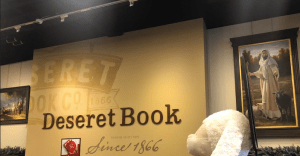
Deseret Book picture 1

Photo by Chandley Chynoweth.

Elder George Q. Cannon founded Deseret Book in 1866 under the name of George Q. Cannon and Sons Company as a religious bookstore. (“About Desert Book Company”) Cannon’s company was bought by the Desert News and then in October 1919 it was merged with Deseret Sunday School bookstore, creating the name of Deseret Book Company. (“Deseret Book”) One of the first advertisements for Deseret Book appeared in the Deseret News and promoted LDS religious books on November 2, 1865. The company has continued to grow and expand its locations and products throughout the years.

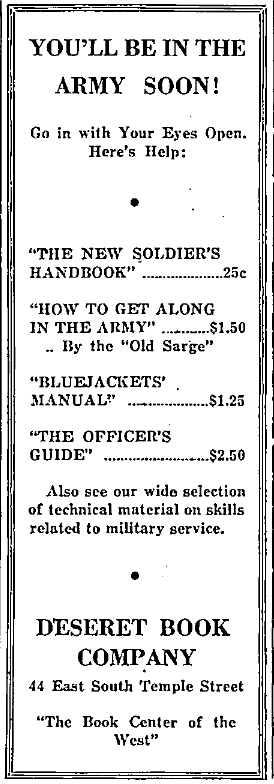
Deseret Book Company Utah Daily Chronicle-1Deseret Book was started in Salt Lake City and has become a local staple for Utahns. It has kept up with current trends in order to provide its customers with relevant products and books. The Utah Chronicle published an ad for the Deseret Book Company on March 10, 1943, that advertised books to help prepare soldiers for their service in World War II.  On March 24, 1943, the Utah Chronicle featured another ad for Deseret Book Company that was advertising “The new soldier’s handbook” and “How to get along in the army.”

Seagull Book and Covenant Communications are two companies that have been competing with Deseret Book in the religious retail book and publishing market. In December 2006, Deseret Book Company purchased Seagull Book and Covenant Communications, according to The Salt Lake Tribune. This deal had some Utahns worried that the cheaper prices of Seagull Book would be raised to match those of Deseret Book’s, but the Tribune reported on December 30 that Seagull book would remain an independent company and continue to offer discount prices.

Deseret Book is known as a good place to find gifts, religious or otherwise. On October 4, 1946, the Davis County Clipper ran an ad saying, “Desert Book is the Gift Center.” The ad also mentioned university students frequenting the store to buy their textbooks. Over the years Desert Book has morphed from a purely religious retail store to one that offers just about anything.

Deseret Book picture 2

Photo by Chandley Chynoweth.

The Deseret Book Company recently celebrated its 150th anniversary. An article written by Trent Toone for the Deseret News on December 15, 2016, discussed the company’s best accomplishments and current goals. In the article the publishing of Jesus the Christ by Elder James E. Talmage and A Marvelous Work and Wonder by Elder LeGrand Richards were big milestones to establishing the Deseret Book Company. Jeff Simpson, president of Desert Book, said in the article, “We are not just a bookstore — we are a lifestyle store. Books are still a big part of what we do, but over the last decade movies, music, and books make up less than half of our sales.”

Desert Book Company started with one little store in Salt Lake City and has expanded to 45 different stores on the West Coast. It continues to provide the citizens of Utah with a place to find both religious and non-religious products.

Chandley Chynoweth graduated in December 2018 with a degree in strategic communication.

Sources

Steven Oberbeck, “Seagull Books will retain its niche as discount retailer, Deseret says,” Salt Lake Tribune, December 30, 2006.

“LDSAudio.com Teams Up With Deseret Book to Offer MP3 Books and Music,” PR Newswire, September 15, 2004.

“Deseret Book Is Gift Center,” Davis County Clipper, October 4, 1946, 6.

Advertisement, Deseret Book Company, Utah Chronicle, March 24, 1943, 6.

Advertisement, Deseret Book Company, Utah Chronicle, March 10, 1943, 4.

Advertisement, Deseret Book Company, Deseret News, November 2, 1865, 8.

About Desert Book Company,” Deseret Book Company.

Deseret Book,” Deseret Management Corporation.

Trent Toone, “While celebrating 150 years, Deseret Book continues to innovate for the future,” Deseret News, December 15, 2016.


A Brief History of Kingsbury Hall​

By Davis Bulger

Atop 1395 Presidents Circle sits Kingsbury Hall, an elegant building that resembles a smaller version of the museums built during the world’s fair. Kingsbury Hall has welcomed individuals such as Eleanor Roosevelt, Keene Curtis, Carol Channing, Vincent Price, Harry Belafonte, and Maude Adams. It was also the starting place of many performing arts organizations in Utah, including Ballet West and the Utah Opera.

According to the Utah Chronicle on October 16, 1928, Kingsbury Hall was named after Joseph T. Kingsbury, former president of the University of Utah from 1897-1926. Edward O. Anderson and Lorenzo Snow Young designed the building. Anderson was also an architect for the LDS church and designed the temples in New Zealand, Switzerland, and London. The style is neo-classical with an Egyptian revival influence. The hall was designed so it would fit in color and style with the adjacent Park Building.

The Utah Chronicle reported on October 4, 1929, that the auditorium was designed to fix all of the problems that affected typical venues at the time, such as noise level and the capability to see the entire stage from every seat. Many steps were taken in creating this venue to not only make it spectacular to the eye, but also to make it the most functional auditorium Utah had ever seen.

Uofu_kingsbury

Kingsbury Hall on the campus of the University of Utah. Photo from Wikimedia Commons.

The Utah Chronicle stated on May 20, 1930, that the auditorium was equipped with 2,009 seats. An additional 200 people could be seated on the stage. Throughout the hall, patrons could see the splendid architecture and beautiful murals. The organ was to be installed soon after opening.

According to articles published in the Utah Chronicle in 1930, the stage was carefully worked out in accordance with modern ideals and was designed to be large enough to take care of almost any production. The velvet curtain adorning the stage cost $2,000. The lighting was to be the most elaborate in the city. The switchboard was described as “a masterpiece of electrical genius, capable of producing any desirable lighting effect.” The orchestra pit was to be equipped with a hydraulic lift at a future date.

The Utah Chronicle covered the “impressive” dedication ceremony on May 22, 1930. The play Bluebird was the first production to be staged in the new building. The play was the largest event ever put on at the nUniversity. Tickets were sold at prices from 50 cents to $1. The hall was originally built for extra classroom space, an assembly hall for students and the home of the Theater Program and Speech Arts Department but was later acclaimed as one of the largest concert venues in Utah.

The Deseret News on March 15, 1996, wrote about the renovation of Kingsbury Hall. After two long years and $15 million, the stage was set. Improvements included an enlarged stagehouse that was nearly four times the size of the original backstage area. Also, there were enough dressing rooms for 77 performers and two dressing rooms for stars were added.

Today, Kingsbury Hall is widely renowned as a concert venue, dance performance hall, play auditorium, and just about anything else you can think of. With the renovations over the years, Kingsbury Hall’s beauty and efficiency never cease to keep Utahns and visitors in sheer awe. Kingsbury Hall is one of eight buildings listed on the National Register of Historic Places.

Davis Bulger is a junior at the University of Utah. He was raised in Chicago and has lived in Utah for the past seven years. He is majoring in mass communication.

Sources

“Architects Are Now at Work on Kingsbury Hall,” Utah Chronicle, October 16, 1928, 1.

“Kingsbury Hall To Be Completed in Near Future,” Utah Chronicle, October 4, 1929, 1.

“Kingsbury Hall Dedicated May 15,” Utah Chronicle, April 18, 1930, 1.

“Kingsbury Hall $2,000 Curtain Will Be Hung Wednesday,” Utah Chronicle, May 6, 1930, 1.

“Kingsbury Hall Dedication Set for Thursday Noon,” Utah Chronicle, May 20, 1930, 1.

“Kingsbury Hall Is Dedicated,” Utah Chronicle, May 23, 1930, 1.

“Bluebird Scores on Opening Night in New Edifice,” Utah Chronicle, May 23, 1930, 1.

National Register of Historic Places Inventory—Nomination Form, University of Utah Circle, March 1977.

Ivan M. Lincoln, “Celebrating Kingsbury Hall,” Deseret News, March 15, 1996, 1.

Coon Chicken Inn: A Stain on Utah History

By Noelani Blueford

“Coon Chicken Inn: Nationally Famous, Coast to Coast.” That was the tagline used in advertisements for the restaurant chain, which could be found throughout the Pacific Northwest and originated in Salt Lake City, Utah. Opened by couple Adelaide Burt and Maxon Lester Graham in 1925, hungry patrons entered the restaurant through the red-lipped, white-toothed mouth of a 12-foot caricature of a winking black face wearing a porter’s cap. The chain even had a delivery fleet, wherein a car emblazoned with laughing minstrel faces would drive up to consumers homes, according to a January 2015 retrospective article by The Salt Lake Tribune. The restaurant saw great success.

Coon Chicken Inn 2

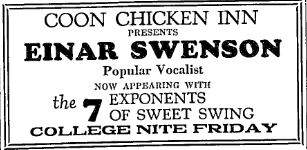
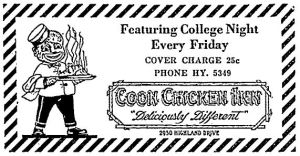
The restaurant advertised regularly in the Utah Chronicle.

A memoir written by a grandson of the original owners, which is available from the Jim Crow Museum of Memorabilia, describes Burt and Graham’s business practices as normal for the time. They had enjoyed fried chicken from a local business and decided to open a restaurant of their own serving the same food in Sugar House, which was then only a small suburb of the city. The famous logo was added to the storefront, eventually spreading to a large variety of other items nearly five years after the successful opening and growth of the business.

The “coon head” logo and memorabilia was a gimmick to attract customers, claims an article on the restaurant at BlackPast.org. The organization describes the logo as “[saturating] the restaurant’s interior…. Plates, forks, menus, and placemats featured the caricature, as did menu items such as the ‘Baby Coon Special’ and the ‘Coon Fried Steak.’” The logo additionally appeared on a variety of items such as “postcards, newspaper advertisements, matchboxes, children’s fans, and spare tire covers.” African-American communities and organizations near the Seattle location quickly took action against the restaurant. The NAACP and African American newspaper The Northwest Enterprise threatened to take legal action against Graham for libel and defamation of race, pushing for a change in advertising. There was no reactionary movement at the Salt Lake City location, but at the time the 681 Black citizens of Salt Lake City who might take issue with the business comprised only .5 percent of the populace, as recorded in the 1930 census.

Coon Chicken Inn 1

Ads like this appeared in the Utah Chronicle.

Utah’s Coon Chicken Inn closed in 1957, the last location of the chain to close by nearly a decade, according to The Salt Lake Tribune. The Seattle Civil Rights & Labor Department at the University of Washington argues that the presence of this restaurant more than a century after the height of the minstrel era underscores the lasting power of this caricature and the underlying stigmas about race and Black people that continue to exist in the Pacific Northwest.

In Utah, racial tensions were relatively unspoken but persisted in force. The installment of Black troops at Fort Douglas in 1896 and 1899 was met by strong protest from the media and local government, according to “Blacks and the Military In American History” by Jack D. Foner. In 1925, the same year that Coon Chicken Inn opened, a Black Utahn by the name of Robert Marshall was tortured and lynched to the cheers of a crowd in Price. A thousand Utahns petitioned with partial success in 1939 to restrict black citizens to a designated neighborhood away from the city center, and blacks were refused full access to local amusement park Lagoon until the late 1940s, reports Utah History To Go.

Advertisements for Coon Chicken Inn featuring minstrel art were posted in many issues of the Utah Chronicle in the early 20th century; today they provide a rare and important look into an obscured facet of the area’s culture. In its discussion of Coon Chicken Inn’s novelties and other minstrel products, “African American visual representation: from repression to resistance” by Paul Von Blum perhaps sums up the issue best: “All of these [advertising caricatures] were designed for a white population that rarely encountered contrary images of African American dignity. They were fully part of a racist visual culture, viewing such imagery as nothing more than humorous depictions of obvious racial truths. These racist pictures and objects confirmed what most white audiences already believed. Any suggestion that these posters, postcards, toys, figures, film clips, and other objects, had repressive political consequences would likely have led to puzzled or even incredulous responses.”

Noelani Blueford graduated in May 2019 with a Bachelor of Science degree in Journalism.

Sources

Advertisement, Coon Chicken Inn, Utah Chronicle, January 18, 1940, 4.

Advertisement, Coon Chicken Inn, Utah Chronicle, January 25, 1940, 4.

Coleman, Ronald G. “Blacks in Utah History: An Unknown Legacy,” Utah History To Go.

Foner, Jack D. Blacks and the Military in American History. New York: Praeger Publishers, 1974.

Gibson, Campbell and Kay Jung. “Historical Census Statistics On Population Totals By Race, 1790 to 1990, and By Hispanic Origin, 1970 to 1990, For Large Cities And Other Urban Places In The United States,” U.S. Census Bureau Population Division (February 2005): 106.

Macfarland, Sheena. “Whatever happened to … the chicken restaurant with the racially charged name?” The Salt Lake Tribune, January 13, 2015.

Roth, Catherine. “Coon Chicken Inn,” BlackPast.org.

Roth, Catherine. “The Coon Chicken Inn: North Seattle’s Beacon of Bigotry.” The Seattle Civil Rights & Labor History Project at the University of Washington.

Von Blum, Paul. “African American Visual Representation: From Repression to Resistance,” Journal of Pan African Studies 5 no. 8 (December 2012): 41.

The History of Coon Chicken Inn.” Jim Crow Museum of Racist Memorabilia at Ferris State University.

Why You Would Have Rushed a Sorority at The University of Utah in 1941

By Mallory K. Arnold

The_U_Spreads_The

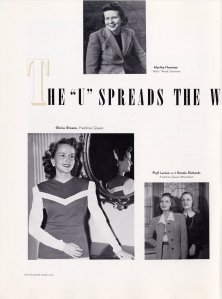
A portion of the article, “The U Spreads the Welcome Mat,” from the 1942 Utonian yearbook.

Greek organizations have always been a popular topic as well as a controversial one. With sororities and fraternities still going strong in 2018, what might it have been like to try to join such organizations during wartime, specifically for women?

The Utah Chronicle published an article in January 1941 where impartial statistics were given about each house at the University of Utah. According to said article, there were nine sororities and seven fraternities present during the time. It let the women and men trying to rush a house know the year all sororities/fraternities were founded nationally, when they were founded at the U, the address of the house, and who their current executive board was.

Right before Spring Recruitment began in 1941, the Utah Chronicle published an article about university men offering their opinions on each sorority. Although some comments given in the article were nice, others were not. Richard Blackhurst, who was part of a fraternity, said, “The Tri Deltas are plenty cute but their mental capacity has not developed to the highest degree.” Another man named Dave Boyer, who was unaffiliated, said, “Chi Omegas had the most beautiful group of girls on campus.” It seemed as if these men were trying to persuade women to join certain houses based upon their outsider opinion.

Going to college and joining Greek life can be a difficult process. Luckily for the women looking to join Greek life that year, the Sorority Council decided to publish its first-ever University of Utah Rushee Handbook. According to an article titled “Sorority Council to Publish Rushee Handbook,” it gave advice to freshmen with tips to rushees, a rushee’s lexicon, and do’s & don’ts. Rules and regulations, as well as how much dues were, also were listed in the handbook that presented a brief history of each house. The editor of the new book was Martha Havenor. In an October 1941 article by the Utah Chronicle, Havenor was listed as part of the sorority known as Tri-Delta, which made her the perfect person to write the handbook on rushing a sorority.

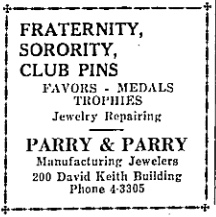
Sorority pin ad 1.23.41.3

Utah Chronicle, January 23, 1941, page 3.

Another reason rushing a sorority became enticing was because the Utah Chronicle always had advertisements about pins, dances, and other things going on in Greek life. This made readers more curious as well. In 1947 Marian Dawson wrote an article titled “Why I Like Sorority Life” in which she spoke about her decision to pledge a sorority. She said the benefits one gained from belonging to a sorority depended entirely on what that individual contributed. Dawson explained that if one desired companionship of the highest type, she would find happiness in a sorority.

After all of this information on rushing, the 1940s decision to join a sorority would vary from person to person. In conclusion, deciding to rush a sorority in the 1940s seems a lot like it does now.

Mallory Arnold is a junior at the University of Utah majoring in communication with a minor in parks, recreation, and tourism.

Sources

Advertisement for Parry & Parry, Utah Chronicle, January 23, 1941, 3.

“Statistics Give Impartial View of Campus Greek Groups,” Utah Chronicle, January 23, 1941, 5.

“University Men Reveal Opinions Concerning Qualities of Female Greek Organizations,” Utah Chronicle, January 16, 1941, 5.

“Fraternity Row Makes Final Plans for Formal Greek Rush Season,” Utah Chronicle, January 23, 1941, 5.

“Introducing Martha Havenor,” Utah Chronicle, October 2, 1941, 4.

Dawson, Marian. “Why I Like Sorority Life,” The Iowa Homemaker 27, no. 3 (1947).


The Clawsons’ Shop and Their Community

By Porter L. Anderson

Screen Shot 2018-11-26 at 2.30.10 PMThe Clara M. Clawson Shop was a clothing store for women located at 57 S. Main Street in Salt Lake City. Mrs. Clawson’s advertisements are found all throughout magazines and newspapers during the late 1930s, the 1940s and into the 1950s. The store was the passion project of Clara and was managed by her husband Seldon Clawson after it began to be recognized as a high-end clothing shop in Salt Lake City.

The Clawsons took out a number of advertisements during this time throughout different publications in the Utah Valley, including The Salt Lake Tribune and Utah Chronicle. The advertisements really gave a sense of the individuals who ran the shop and their connection to the community.

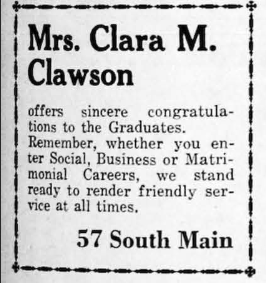
Screen Shot 2018-11-26 at 2.27.57 PMIn a congratulatory ad published in the May 28, 1942, issue of the Utah Chronicle, the text states that “Mrs. Clara M. Clawson offers sincere congratulations to the graduates.” The couple tried to demonstrate they were there to help the graduates who needed them rather than trying to sell them anything. The ad gains more strength because everything around it is listing products that should be purchased, such as suit coats and new materials for schoolwork. This friendly congratulatory message is different from the surrounding ads and draws the reader of the newspaper into wondering who these people are and why their ads look so different.

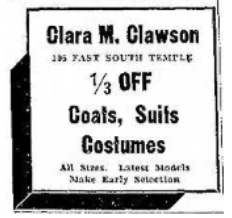
Screen Shot 2018-11-26 at 2.30.01 PMThe Clawsons clearly made a consistent effort to make themselves known in the community as a friendly place. Published advertisements show that the couple was dedicated to the store that featured high-end clothing with a friendly, welcoming feel. Many of the ads are tailored to reach out to specific people during certain times. For example, an advertisement published in The Salt Lake Tribune around Mother’s Day in 1950 states that patrons should bring their mother into the store to pick out what she wants for her holiday gift. This is another subtle ad that invites a specific group into the store to meet those friendly individuals who are trying to curry favor with the community.

scan0030The Clawsons took out a number of advertisements around the 1930s to 1950s, each working to build their image as a “Mom and Pop” store dedicated to their community and creating a friendly presence. Many of the advertisements were written in a way to make their readers feel like they were welcome there, which could be a reason why the Clara Clawson Shop was open for more than 65 years even during times of war and economic downturn.

The Clawsons were very committed to helping their community, whether that was through Clara’s work as the treasurer of the Service Star Legion, a group for mothers in wartime, or Seldon’s work for the building of the Latter-day Saints church. The couple owned a business that they worked to build but they also loved their community. This was evident in their one-of-a-kind personal advertisements. The Clawsons are the type of people who cared and helped others, which was a huge benefit to their community, especially during WWII.

Porter L. Anderson is a senior at the University of Utah studying communication with an emphasis in journalism. He is very passionate about web content creation including writing articles for different online outlets as well as web design. Anderson hopes that he will be able to use the experience and education he has gained at the University to find a way to use online resources to help others.

Sources

Selden Irwin Clawson and Clara Isabella Morris Clawson,” FamilySearch, The Church of Jesus Christ of Latter-day Saints.

Advertisement, Salt Lake Tribune, May 14, 1950, 3.

Advertisement, Salt Lake Tribune, February 26, 1945, 8.

Advertisement, Utah Chronicle, May 28, 1942, 3.


Spirit of the Beehive: Coon Chicken Inn an Unfortunate Utah Original

By Devon Alexander Brown

Coon_Chicken_Inn_P_2

Coon Chicken Inn logo. Image courtesy of Special Collections, J. Willard Marriott Library, The University of Utah.

When Brigham Young and a vanguard company of Latter-day Saints entered the Salt Lake Valley in 1847 they knew they’d finally found their home in the Rockies. (Griffiths) And as their community in the desert quietly blossomed they declared it Deseret, a term for honeybee lifted from the Book of Mormon, and adopted the beehive as their state emblem. This simple emblem not only referenced their Christian roots, but it also symbolized a unified commitment to industriousness that has remained a hallmark of Utah’s culture. (Malouf)

In modern times that industrious spirit has led to a boom in the beehive state’s tech and creative sectors, but in 1925 it drove Maxon Lester Graham and his wife Adelaide Burt to create a fast-food restaurant legacy built on a foundation of racist imagery with a name to match: Coon Chicken Inn.

Utah, like much of America, has a complicated history with race. Much of the population is affiliated with the Church of Jesus Christ of Latter-day Saints, which has always allowed Blacks into its ranks although they’ve held a lower status. A demonstration of this fact is that three Black members of the church were present in the vanguard company of 1847, but they were used as servants The most controversial aspect of this attitude is that Black members — as well as suspected Black members according to a racial “one drop” policy — were denied priesthood privileges essential to the faith until the 1970s. (Reeve) Yet these complications reach far beyond faith. An attitude of separation trickled into Utah’s secular psyche as well, with Blacks receiving second-class treatment inside and outside of the church. While the creation of Coon Chicken Inn is perhaps the most blatant example of this attitude, it is not an isolated example.

To grasp the severity of the logo’s use, one must understand the racist history behind the “coon” caricature. The term came into prominence during 19th-century minstrel shows through a character named Zip Coon. As a part of his act, Zip Coon would act uppity with a braggart’s swagger while employing malapropisms in a nod to his lack of education. This would elicit laughter and intrigue while also reinforcing White supremacy and animosity toward Blacks. The slur itself became popular in the late 1800s after Black entertainer Ernest Hogan released a song called, “All Coons Look Alike to Me.” Subsequent derogatory imitation “coon songs” were released shortly after and remained popular until the 1920s. Eventually the “coon” caricature became a nostalgic device for certain northerners and southerners to rekindle revisionist memories of life in the American South. (Strausbaugh)

coon ad

Advertisement for Coon Chicken Inn. Utah Chronicle, February 1, 1940, p. 4.

The first Coon Chicken Inn opened in 1925 after the Grahams bought and renovated a small building in the Sugar House neighborhood of Salt Lake City. Their take on southern fried chicken was a hit and by 1930 they opened two additional sites (in Washington and Oregon). To stir up additional business they incorporated the smiling blackface logo as they believed it would entice young families. The logo, an abrasive caricature with exaggerated lips, would reflect the owners’ racial disconnection, especially in Seattle and Portland where more Blacks were present.

Black residents did not accept the imagery, however, and Joseph Staton, a Black resident of Seattle, was arrested, booked, and fined $3 for cutting the caricature out of a Coon Chicken Inn spare tire cover. (The Seattle Times) Also, Clarence R. Anderson, a Black attorney, launched a two-year lawsuit against the inn with the NAACP, although Graham dodged the lawsuit by painting the Black porter’s face blue. (Northwest Enterprise) Nonetheless, the logo would later appear on paper products, plates, and menus that are now considered collectible. Eventually, 12-foot constructions of the logo would beckon patrons at the restaurants’ front doors.

Coon_Chicken_Inn_P_4

Coon Chicken Inn locations. Image courtesy of Special Collections, J. Willard Marriott Library, The University of Utah.

Protests by angry Black citizens of Seattle and Portland would ultimately yield few changes to the franchise, but the locations finally closed in 1949. (Seattle Post Intelligencer) However, in December 1949, Graham opened G.I. Joe’s New Country Store in the same Seattle location and continued using the coon logo in advertisements that reached Salt Lake City. (Lake City Citizen) The Salt Lake City location remained open until 1957.

Undoubtedly, Coon Chicken Inn is an ugly reminder of the past, but an unnamed grandson of the Grahams has since written an essay about the restaurant’s legacy for the Jim Crow Museum of Racist Memorabilia. (McFarland) “I preface this essay by saying that I do not condone the ‘Jim Crow’ attitudes of the past. I and ALL of my siblings believe in full equality for all races, creeds, and skin colors. My grandparents were entrepreneurs engaging in what were normal business practices,” he penned in the essay. “They left behind artifacts, popularly called ‘Black Memorabilia,’ that serve as reminders that this particular part of history must never, and will never, be repeated.” (The History of Coon Chicken Inn)

Utahns of Salt Lake City must ensure this sentiment rings true.

Devon Alexander Brown is a senior at The University of Utah and is majoring in journalism. He is pursuing a career in writing and photojournalism and is primarily interested in art and culture. Devon is also interested in documentary films and the tiny house movement.

Sources

Sadie McIver, “Files Protest Against ‘Coon Chicken’ Advertisement,” Northwest Enterprise, July 16, 1931, 8.

Candace Black, “Chicken Inn Dodges Suit with Blue Paint,“ Northwest Enterprise, March 17, 1932, 6.

“Big Crowd — Little Profit,” Seattle Post Intelligencer, March 8, 1937.

“C. of C. Helps to End Dispute,“ The Seattle Times, March 18, 1937.

Advertisement for Coon Chicken Inn, Utah Chronicle, February 1, 1940, 4.

“Joe’s Country Store,” Lake City Citizen, December 8, 1949.

The History of Coon Chicken Inn.” Jim Crow Museum of Racist Memorabilia, Ferris State University.

Strausbaugh, John. Black Like You: Blackface, Whiteface, Insult & Imitation in American Popular Culture. New York: Penguin, 2006.

Reeve, W. Paul. Religion of a Different Color: Race and the Mormon Struggle for Whiteness. New York: Oxford University Press, 2015.

McFarland, Sheena. “Whatever happened to … the chicken restaurant with the racially charged name?” The Salt Lake Tribune, January 13, 2015.

Malouf, Mary Brown. “Behind the Beehive,” Salt Lake Magazine, May 2, 2016.

Griffiths, Casey Paul, et al. “The myth about Brigham Young’s ‘this is the place’ quote,” LDS Living, July 25, 2017.

Auerbach’s: The Department Store That Advertised Customer Service and Quality Products

By Diana Rubio

In May 1943, The Utah Chronicle featured ads from Auerbach’s Department Store, a family-owned business that gained name recognition in the Western United States. (Auerbach, end page)

In 1864, Jewish brothers Frederick H. Auerbach and Samuel H. Auerbach gave rise to what would become a 113-year legacy of quality products and services. (Rudd, 234) Auerbach’s was initially named “The People’s Store: Auerbach & Brothers” and began welcoming customers in downtown Salt Lake City after the Auerbach brothers came to an agreement with former LDS leader Brigham Young. (Williams)

The difference in culture the Auerbach’s introduced to the business landscape in Utah connected non-Mormons and Mormons. When the store first opened on Main Street, the south end, where Auerbach’s was located, became a hub for non-Mormon shoppers, whereas the north end was known for catering to Mormon shoppers. (Stone, Introduction)

p0790n7_12_08

Interior of Auerbach’s department store in Salt Lake City. Image courtesy of Special Collections, J. Willard Marriott Library, University of Utah.

Auerbach’s began as a small shop, but as time progressed the business gained popularity due to its merchandise and customer service that touched its customers. (Auerbach, end page) These two characteristics were not only experienced in the store, but also promoted in advertisements. It is due to Auerbach’s advertising efforts and positioning that the family business distinguished itself from other retailers. (Auerbach’s, Folder 5, 7)

“You can count on the fingers of one hand the stores in Utah that have had a continuous life of eighty years,” said Herbert S. Auerbach, one of the successors of the company. (Auerbach, end page)

When the company observed its eightieth anniversary, the celebration was a testament to the company’s integrity, customers service, and its progress, despite the changes in the political atmosphere. (Auerbach, end page) Auerbach’s advertisements positioned the store as a retailer that carried high-quality goods and provided retail prices for consumers with various budgets. (Auerbach’s, Folder 5)

p0790n7_12_04

Auerbach’s store display in Salt Lake City. Image courtesy of Special Collections, J. Willard Marriott Library, University of Utah.

The first advertisement spanned two inches and appeared in the issues of the Daily Telegraph and described the merchandise as “Staple and fancy.” The advertisements promoted the following merchandise: dry goods, shoes, groceries, notions, clothing, and home accessories. An example of how merchandise was initially promoted advertised blankets imported from California as “the finest quality … offered at little over original cost.” (Auerbach’s, Folder 5)

In an ad published by Goodwin’s Weekly, the ad expressed that Auerbach’s had gained confidence and courage from experiencing success over the years. Such accomplishments had encouraged the company to import 100,000 handkerchiefs for the holidays that were packaged with care. In addition to providing details about “the world’s greatest production of handkerchiefs,” the ad was a cordial invitation for customers to experience these handkerchiefs for themselves. At the bottom, the ad read, “We invite you to make yourself at home among these new handkerchiefs of ours.” (Auerbach’s, Folder 7)

While Auerbach’s advertisements focused on the quality of products, other advertisements highlighted customer service, such as an ad that featured a sketch of the Auerbach store in Salt Lake City. The ad promised to deliver products within five days. If not, customers could return the items in store. Another ad with the sketch of a woman wearing a hat guaranteed a free purchase once customers had made fifty-seven purchases. Exceptions to this offer included: groceries, meats, phonographs, candy, and patterns. (Auerbach’s, Folder 5)

The Auerbach’s company recognized it had built a reputable name over the years and believed the store had become an inspiration to Utah history. (Auerbach’s, Folder 7) Although Auerbach’s reached its end in 1977, it was a Salt Lake City landmark for over 100 years. (Williams) The company’s focus on service and merchandise are marketing tactics still used today by marketers who position companies to increase revenue and eventually build strong brands.

Diana Rubio is a senior at the University of Utah. She is majoring in communication with a focus in strategic communication.

Sources

Auerbach, Herbert S. Auerbach Co.: 80 years of service, 1864-1944. Salt Lake City, UT, 1944.

Advertisement, Auerbach’s Man’s Shop Advertisement, The Utah Chronicle, May 20, 1943, 6.

Rudd, Hynda. “Auerbach’s: One of the West’s Oldest Department Stores.” Western States Jewish History 11, no.3: 234-38.

Stone, Eileen Hallet. Auerbach’s: The Store that Performed What It Promises. Charleston, SC: The History Press, 2018.

Various advertisements, Herbert S. Auerbach papers, Box 10, Folder 5, Special Collections and Archives, University of Utah, J. Willard Marriott Library, Salt Lake City, Utah.

Various Advertisements, Herbert S. Auerbach papers, Box 16, Folder 7, Special Collections and Archives, University of Utah, J. Willard Marriott Library, Salt Lake City, Utah.

Williams, Carter. “Auerbach’s to ZCMI: 4 historic Utah businesses that no longer exist,” ksl.com, November 16, 2017,


The Story of the Utah State Capitol

by MATTHEW A. SMITH

The Utah State Capitol building could be considered the crown of the Salt Lake Valley. Nestled high atop the northernmost hills of Salt Lake City, this beautiful statehouse can be seen from miles around in most directions. Despite its current location overlooking the capital city in which it resides, Salt Lake City was not the original choice for the Utah State Capitol.

In 1851, legislators for the then-territory of Utah decided the small working-class town of Fillmore, named after the sitting President Millard Fillmore, would be the ideal place to construct a government building. Construction began in 1855 for what was to be called the Utah Territorial Statehouse. (Fillmore City)

Funding for the project came in part from the Church of Jesus Christ of Latter-day Saints, which had recently arrived from the Midwest to start colonizing the new territory. Other construction funding came from the federal government, with a personal touch from President Millard Fillmore himself, who had become sympathetic to the young territory’s quest for statehood. (Fillmore City)

Fillmore’s goal of achieving capital city status never was fully realized. In 1856, after only part of the statehouse was completed and just one legislative meeting, territory lawmakers determined the bigger town of Salt Lake City would be the better option for a permanent location. (Fillmore City)

However, the capitol building as it is seen today took some time before it became a reality n Salt Lake City. Many local buildings in the area were used for the purposes of conducting territory business while officials pondered a final government home. (Fillmore City) In 1896 Utah was finally granted statehood by the federal government and that accelerated plans to come up with a capitol building. In 1900, the “Capitol Commission” was started as a special group dedicated to creating plans, searching locations and securing financing for the project. (“May Construct State Capitol”)

A few places in Salt Lake City were top candidates for the new construction, including the grounds of Fort Douglas, downtown Salt Lake City near the city/county building that had served as the temporary state building for some time, or the northernmost hills of Salt Lake City known as Arsenal Hill. (“Surveying Site of New Capitol”) Arsenal Hill was a more popular choice among decision-makers due to its central location and elevation. The site was not without its obvious challenges, though. The state legislature as well as the Capitol Commission had strong doubts regarding the placement on Arsenal Hill. Not only was there a large, natural grade, but there was also a large presence of residential neighborhoods and private property. Lawmakers knew it would be expensive to secure the land for the project to move forward. (“Surveying Site of New Capitol”)

Despite these concerns, Arsenal Hill was chosen. Thanks to a $1 million bond provided by the state legislature and receipt of an inheritance tax in the amount of $800,000 that was charged to the estate of Union Pacific Railroad President E. H. Harriman, the finances were secured for construction of the Utah State Capitol. (About the Capitol)

Once the finances were secure, Utah architect Richard Karl August Kletting won the bid out of 10 other national and local candidates to design the capitol building. (“Plans Selected by Commission”)

Kletting wanted to start right away because the governor of the new state of Utah, William Spry, who also served as the chair of the Capitol Commission, promised the citizens of Utah the project’s foundation would be poured by the time the following session of Congress commenced. (“Construction of State Capitol”)

Throughout the construction process, the Capitol Commission and Kletting worked together to ensure satisfactory completion. There was a clear understanding between the two that the capitol building be “functional, distinguished and lasting.” (Centennial Exhibit)

The materials involved in the construction were specifically chosen with Kletting’s eye on perfection and architectural significance, the sort that made him a name in the industry up to that point in his career. A priority that both Kletting and the commission agreed upon was the need for this building to be as fireproof as possible. (Centennial Exhibit) As most structures in that day were created with stone and wood, the destruction a fire would have on a building of such scale was certainly apparent. So, Kletting used reinforced concrete for the frame instead of wood, the standard framing option then. He also ensured the further protection by installing a vacuum system for fire suppression and stone walkways. (Centennial Exhibit)

capitol

The Tribune announced on March 14, 1912, that the esteemed architect Richard K. A. Kletting had been selected to design the capitol.

Aside from pragmatic construction methods, the pride Kletting had in Utah’s own natural resources gave way to the use of Utah granite, copper, Sanpete limestone and Utah onyx on the construction site. (“Marble Dial in Stone”) This was crucial in Kletting’s attempt to make this capitol building unique and representative of the local environment. These resources adorn the entire building, from the rotunda to the basement, and granite and limestone make up a large part of the capitol footprint. (About the Capitol)

Unfortunately, the state legislature was not able to hold its meeting, as promised earlier by Gov. William Spry, on the capitol grounds. Construction delays prevented the ability to open the capitol on time, thus an alternate location was designated for the session. (“Construction of State Capitol”)

The Utah State Capitol was finally completed enough in 1915 for many state workers as well as state legislators to move in. Improvements were still being completed to the satisfaction of the Capitol Commission and Kletting, but most of the working quarters were complete enough to house many people.

Then on October 9, 1916, as reported by the Salt Lake Tribune, the Utah State Capitol was dedicated before a crowd of nearly 40,000 people. Citizens, out-of-state guests, dignitaries and reporters attended the dedication on the steps of the capitol.

Gov. Spry addressed the crowd and said, in part, “I want to tell you how glad we feel that such numbers have turned out to accept from us this home that we now turn over to you.” (Centennial Exhibit)

Matthew A. Smith is a junior at The University of Utah. He is majoring in mass communication with an emphasis in journalism and religious studies.

Primary Sources

“Fillmore City,” http://www.fillmorecity.org/historyoffillmore.html

“About the Capitol,” https://utahstatecapitol.utah.gov/explore/about-the-capitol

“Centennial Exhibit,” https://drive.google.com/file/d/0B4l_fw7iWWaLSTdvNi1xSWNqZk0/

“Capitol Commission and City Are Agreed,” Salt Lake Herald, October 13, 1912.

“Construction of State Capitol,” Wasatch Wave, August 2, 1912.

“Plans Selected by Commission for Utah’s New State Capitol and Photograph of Richard K. A. Kletting, the Winning Architect,” Salt Lake Tribune, March 14, 1912.

“Surveying Site of New Capitol,” Salt Lake Tribune, August 12, 1911.

“May Construct State Capitol,” Salt Lake Herald, June 11, 1909.

“Marble Dial in Stone,” Deseret Evening News, January 16, 1900.


Lucin Cutoff Tragedy: Greek Contribution and Sacrifice in the Mountain West

by JONO MARTINEZ

Greek immigrants were among the last Europeans to make their way into the United States during the late 1800s. Toward the turn of the twentieth century, thousands of young Greeks fled to Utah to live what they would consider their first years of exile. Facing continued Turkish control in their own country, many of these people, young men and boys mostly, sought to live a life elsewhere with hopes of returning to a more promising Greece. (Papanikolas, 45)

Finding solace in the American West, Greek immigrants quickly took to labor on railroads and mines as a means to survive. These men endured long, isolated seasons of strenuous labor with payment as low as $20 for a single month. Although California and Nevada would provide bountiful labor for immigrants, the railroads of Utah would be of special interest to them and would also tragically cost some of their lives. Among the places where extensive Greek contributions took place are the Carbon County mines, Murray-Midvale smelters, Bingham Canyon mines, Magna mill, Garfield smelter, and north of Ogden for railroad-gang work on the Oregon Short Line (later Union Pacific). (Papanikolas, 46-48)

On February 19, 1904, 24 men—16 of whom were Greek immigrant railroad workers—died in a train collision near the Lucin Cutoff crossing the Great Salt Lake. The Lucin Cutoff is a 102-mile railroad line in Utah that runs from Ogden to its namesake in Lucin. (“With Dead”) News reports at the time provided varying numbers of victims and gave inconsistent details regarding the details of the crash. By most accounts, the air brake system failed on the eastbound train, which contained a boxcar of black powder, and the locomotive collided with a dynamite-laden westbound train attempting to clear the mainline. (“Air Brakes”) The magnitude of the explosion was such that the adjacent small town of Jackson was destroyed and 1,000 feet of track were blown up, leaving an excavation 30 feet deep. One engine was blown over in the flat and almost buried in the salt earth; one of the drive wheels was found nearly a half-mile away. (“Dynamite Wrecks”)

p0121n01_03_01

An unidentified group watches a woman shaking hands with a railroad worker. Greek Archives photograph collection, 1900-1967, Special Collections, J. Willard Marriott Library, The University of Utah.

The disaster would quickly gain the attention of local newspapers, with Ogden’s own Standard dedicating at least one piece a day of coverage for the weeks following the event. Accounts in the paper were graphic, with descriptions of decapitated bodies and scattered limbs. (“Dynamite Explosion”) Even the hailed New York Times would mention the half-mile radius of damage in its February 20 issue. The article listed by name the three American victims, but the immigrant workers were lumped into a single group with little to no recognition. While the tragedy was indeed covered in the news, the loss of the eight Utahns would ultimately overshadow the loss of Greek immigrant life. As The Salt Lake Tribune would make sure to mention on February 20, 1904, “A majority of those killed were Greek laborers, although many of the victims were English-speaking people.” The emphasis on “American” life over immigrant casualties in news accounts of the 1904 wreck ultimately reflected views that foreign laborers were expendable. (“Memorial Honors”)

Misfortune for the victims’ families only grew in the days following the accident. The designated coroner charged various undertakers, including Larkin & Sons, with handling the 24 bodies. Larkin opted to remove the bodies under his care to his own establishment in order to better prepare them for burial. This raised a protest from the assembled multitude of Greeks, many of whom had cousins and other relatives under the coverings inside the improvised morgue. They declared the bodies should not be moved. Richey, the other undertaker, later burned the blankets in which their bodies had been wrapped for transportation to the city. The Greek community had their own blankets that they wished to use instead, which were traditionally used for bedding. These were often hand-woven of superior material by them in Greece and brought to America with them. (“Dead are Brought”)

It was clear that there would be a long process in both identifying and treating the bodies, yet unique issues arose with regard to the extant language barrier between immigrants and local authorities who hoped to discover the cause of the accident. Two Americanized Greeks, John McCart and Arthur Mitchell, were sworn in as interpreters. Even so, they were unable to communicate much information to the authorities due to the conditions survivors were in. According to a story published in The Salt Lake Tribune on February, 26, 1904, “very little information concerning the accident could be elicited from the wounded Greeks.”

Other obstacles in the investigation came in the form of English-speaking witnesses who refused to give their full testimony. For example, Sam Courtney, the conductor of the water train, was questioned to no avail. Courtney’s hips and back were badly injured in the accident; yet, when he was asked who, in his opinion, was responsible for the makeup of the train and for the accident, he refused to make any statement. Ultimately, no blame would be placed on a single party and all persons interviewed would be absolved. (“Verdict of Jury”)

George N. Tsolomite, vice-consular agent for the Kingdom of Greece, arrived two weeks after the accident in Ogden. He then decided to contest each of the probate proceedings, which had just begun in Weber and Box Elder counties for the appointment of administrators in the estates of the Greeks who were killed in the recent railroad disaster at Jackson. (“Verdict of the Jury”) For many people at the time and now, it was evident that immigrants were misused as employees, especially those who could not speak English. Tsolomite’s involvement was to lessen aggravations felt by the families. Yet it was disasters like the one at Jackson and countless others that eventually energized immigrants to force employers to improve working conditions through labor unions. (“Memorial Honors”)

On October 22, 2000, nearly a century after the Lucin Cutoff tragedy, members of Utah’s ever-growing Greek community gathered in Ogden to witness the installation of a granite monument in memory of the deceased workers. (“Memorial Honors”) The tragedy and suggestion for the memorial were brought to the attention of the Utah Hellenic Cultural Association by Stella Kapetan of Chicago, who discovered the episode while researching her family history. (“Memorial”) This commemoration was seen by many as long overdue, considering that the majority of the men were buried without a headstone. For many, those Greek railroad workers who lost their lives are an example of the undervalued efforts and sacrifices undergone by immigrants in the United States of America. The memorial now serves as a reminder to both Greeks and non-Greeks of an otherwise downplayed moment in Utah history. Furthermore, their contribution as immigrants to help build the American West now receives the credit it has deserved.

Jono Martinez graduated in May 2017 with a Bachelor of Arts degree in journalism.

Sources

“Action of Greek Counsul,” Standard, March 1, 1904.

“Verdict of the Jury Judge Pritchard in Cut-off Disaster,” Standard, March 1, 1904.

“Coroner’s Inquest Continued to Thursday,” Standard, February 26, 1904.

“Inquest in Jackson Explosion,” The Salt Lake Tribune, February 26, 1904.

“Verdict of Jury in Cut-off Disaster,” Standard, February 26, 1904.

“Air Brakes Failed,” The Salt Lake Tribune, February 24, 1904.

“Dynamite Explosion Brings Havoc and Death,” Standard, February 23, 1904.

“Dead are Brought to Ogden Sunday,” Standard, February 22, 1904.

“With Dead of the Jackson Explosion,” The Salt Lake Tribune, February 22, 1904.

“Dynamite Wrecks Town,” The New York Times, February 20, 1904

“Memorial Honors Forgotten Victims of 1904 Railroad Tragedy,” The Salt Lake Tribune, October 23, 2000.

“Memorial,” Deseret News, May 29, 2000.

Papanikolas, Helen Zeeze. Toil and Rage in a New Land: The Greek Immigrants in Utah. Salt Lake City, Utah: Utah State Historical Society, 1970.


Nuclear Testing: Southern Utah’s Battle for Air

by ARYAN FARAHANI

During the years of World War II and throughout the years of the Cold War, we saw many horrific acts of violence that changed many components of our society. Within these acts of violence, the rise of destructive weapons, known as nuclear weapons, were more prominently showcased throughout the world.

Not only were these nuclear weapons used for “safety,” but they were also manufactured to showcase a nation’s superiority. In 1945, toward the end of WW II, the United States was the first nation to use nuclear weapons, on the Japanese cities of Hiroshima and Nagasaki. After these horrendous events, and as the quest for world dominance continued, many more nations began developing nuclear weapons. With that in mind, the competition to create the world’s best nuclear weapon was in the works. And with the United States taking on the role of global hegemon, it was clear that in order to create the perfect weapon, many tests had to be conducted throughout the US.

Nevada, with its desert-like geography and immense amounts of open space, was an ideal site for one of the nuclear testing centers operated by the United States Department of Energy. Nye County, in south-central Nevada, also was close to two cities in southern Utah: St. George and Cedar City. With the initial test-taking place in January 1951, many Southern Utahns were unaware of what exactly the nuclear tests would entail. But in the coming years, the disastrous effects of the “purple cloud” became more evident. (“Atom Explosions”) As Seegmiller writes, “Relatively few Iron County residents were aware of or concerned about nuclear testing when the first mushroom-shaped cloud rose into the western skies … but the cloud figuratively remains over southern Utah and Nevada to this day.”

The Salt Lake Telegram reported on January 27, 1951, that “residents of Southern Utah, miles to the cast of here, said they saw the sky light up and heard the distant rumbling.” This initial blast was the beginning of many tests. And although that was the case, many were not aware of the harmful toxins that nuclear tests would release on the residents, as well as on the surrounding residents of Southern Utah.

Through the initial steps of the first nuclear test, further progress needed to be achieved. Therefore, another nuclear test was conducted in April 1952. The Salt Lake Telegram reported on April 14, 1952, that “indications pointed to the testing of another atomic device rather than a full-blown atomic bomb,” which would essentially “be developed into future atomic weapons.” Many of the repercussions were still not evident to the residents, but it became clear that more nuclear tests were to be conducted in the near future.

Moreover, another nuclear test was conducted in March 1953. The Iron County Record reported on March 5, 1953, that “ranchers, miners, migrants, private fliers, and others concerned are warned that the atomic energy commission’s Nevada proving grounds will be used for nuclear experiments.” Although this was the case, many were still not warned of the harms, but instead had to find out about them the hard way.

In consideration of the above tests that were conducted throughout the years of 1951-1953, some individuals who were educated on the matter of nuclear weapons concluded that they were obliged to talk about it. It wasn’t until 1953 when some of the nuclear tests’ tragedies began to become evident. More specifically, and as reported in the May 7, 1953, issue of the Irony County Record, University of Utah research student Ralph L. Hafen noted that he was “morally obligated to warn people of the irreparable damage that may have occurred or may in the future occur” from the nuclear tests. Hafen stated in the Irony County Record that the plutonium and radiation that the tests released could affect many components of southern Utah residents’ lives, which can be summarized to include cancer, blindness, mutations, death, and climate change.

Capture

The Iron County Record reported on March 3, 1955, that ranchers were convinced atomic testing had killed their sheep.

Many individuals in southern Utah began noticing that some changes in their everyday lives could be related to the nuclear tests that had been conducted in the border state of Nevada. And although they noticed, it was clear that the tests would continue to be conducted. That being said, the March 31955, issue of the Iron County Record reported that “the third atomic blast [of 1955] was seen from Cedar [City],” which shows its severity, because Cedar City is more distant to the Nevada border. The article also stated that that southern Utah farmers were “convinced that the atomic fallout from the experiments at Yucca Flats in Nevada two years ago was the direct cause of heavy loss to sheep herds grazing in adjacent areas.” Therefore, they filed a lawsuit against the Atomic Energy Commission for its actions and incompetent behavior. Also in 1955, many citizens, including southern Utah residents, were briefly told about the harms that the nuclear tests could have on their lives. The Iron County Record reported on February 3, 1955, that “the Atomic Energy Commission, Department of Defense, has announced that it will not be responsible for patrons who might wander into the area, without proper authority.” It was also reported in the same issue that it was dangerous to be around the tests, identifying that “caution has also been advised for individuals in the general area.”

Film_transparency_of_atomic_explosions_at_the_Nevada_Test_Site_Nye_County_Nevada_circa_1950s

The view of an atomic explosion at the Nevada Test Site, located 65 miles northwest of Las Vegas in Nye County, Nevada. Lloyd Franklin Manis Collection, Special Collections, University of Nevada-Las Vegas. Used with permission.

The book Fallout: An American Nuclear Tragedy by Philip Fradkin discusses the government’s historical role with nuclear testing. Fradkin highlights how the Atomic Energy Commission was at fault through “the mistakes and subsequent cover-ups” that they used with these nuclear tests. (2) It is clear that the government officials involved with these tests were aware of their harms, but did not feel a need to tell residents the details. Instead, these officials withheld information, and gave them a brief warning four years after the first nuclear test took place.

Southern Utah residents were deeply affected by these events and by the actions of the Atomic Energy Commission. In the book Justice Downward: America’s Atomic Testing Program in the 1950s, a former University of Utah professor, Howard Ball, discusses the careless behavior of the government. Ball examines the events of the blasts, and quotes Frank Butrico, a Public Health Service radiation safety monitor who worked in St. George during the 1953 series of tests. Butrico testified in a 1982 wrongful death suit filed by 24 cancer victims and their relatives. He said, “The radioactive cloud hung over St. George for over two hours, fallout radiation levels peaked at a little less than 6 rads, well over even AEC standards.” (Ball, 43)

In addition to that, southern Utah residents were not truthfully told about this information. Instead, they were told, “Radiation levels were a little above normal but not in the range of being harmful.” (Ball, 43-44) Not only was valuable information withheld from residents, but they also were exposed to dangerous levels of radiation that indefinitely caused many issues to their health and surrounding environment. With a matter as severe as this, it is saddening to learn about the truths after they had initially taken place. Although there isn’t a reliable statistic proving the amount of illnesses and cancer-related deaths the exposure of the radiation levels caused, Seegmiller reports that “as of September 1994, 1,003 claims had been approved, 829 claims had been denied, and 125 were pending.” These figures illustrate just how severe the effects were on southern Utah residents.

All in all, it is clear that the nuclear tests that were conducted in Nevada are an incredibly important part of Utah’s history as a whole. Although this research focuses on the years of 1951-1955, these nuclear tests ultimately changed many people’s lives, and to this day in 2017, the effects that these nuclear tests had on southern Utah residents are extremely palpable. It is important to take into account these events, because although these nuclear tests caused many tragedies, they are an essential part of our history, and are important components in learning more about how nuclear activity had an effect on Utahns.

That being said, today, the government has set up funds to compensate families for the illnesses and deaths these blasts may have caused. Although it does not make up for the damages the nuclear tests have done, it does show some initiative and responsibility on the government’s part. Looking through the United States Department of Justice webpage, the Radiation Exposure Compensation Act “established an administrative program for claims relating to atmospheric nuclear testing and claims relating to uranium industry employment.” (RECA) And if these nuclear tests are proven to be the cause of any harm, then families would receive compensation to make up for the indescribable damage.

Aryan Farahni graduated in May 2017 from The University of Utah. He attained a Bachelor of Science degree in political science, with minors in media studies and international studies. 

Sources

“Atom Explosion Set off in Nevada,” Salt Lake Telegram, January 27, 1951, 1.

“Spews Purple Cloud,” Salt Lake Telegram, October 30, 1951, 1.

“Scientists Arrive at Vegas for Second A-Blast,” Salt Lake Telegram, April 14, 1952, 2.

“Atomic Proving Ground Set for Nuclear Test,” Iron County Record, March 5, 1953, 3.

Ralph L. Hafen, “Effects of Atom Blasts on Southern Utah Discussed by U. of U. Student, Iron County Record, May 7, 1953, 9.

“Citizens Are Warned of Dangers at Nevada Test Site,” Iron County Record, February 2, 1955, 2.

“Local Sheep Raisers File Suit with Govt. for Loss,” Iron County Record, March 3, 1955, 1.

“Third Atomic Blast Seen From Cedar,” Iron County Record, March 3, 1955, 8.

Ball, Howard. Justice Downwind: America’s Atomic Testing Program in the 1950s. New York, New York: Oxford University Press, 1988.

Fradkin, Philip L. Fallout: An American Nuclear Tragedy. Tucson: University of Arizona Press, 1989.

The United States Department of Justice. “Radiation Exposure Compensation Act.” https://www.justice.gov/civil/common/reca

Seegmiller, Janet Burton. “Nuclear Testing and the Downwinders.” Utah History to Go, http://bit.ly/1nSvCYD