Postwar Planning at the University of Utah

By David Miller

Image_1_Fort_Douglas

Fort Douglas (aerial), 1920-1940. Fort Douglas Military Museum, Salt Lake City.

World War II ushered in a time of radical change for the United States. Men and women went to war by the thousands and those who stayed home were forced to pick up the slack. The end of the war in 1945 was a relief for millions around the world, but the change was sudden and drastic and many had a hard time adapting. Universities across the country had to work especially hard to adapt to a post-war world. On June 9, 1944, the Progressive Opinion reported that “our own school system faces one of the greatest crisis in its history and, likewise, some of the greatest changes.” Elinore H. Partridge explains in the article “A. Ray Olpin and the Postwar Emergency at the University of Utah” that these changes were based mostly around two events that were tied to the end of World War II. GIs were coming home and looking for an education and all the teachers had either gone to war or switched to a more financially sustainable job in the war industry. (p. 197) Though the changes were swift, the University of Utah was not caught off guard. Plans had already been made and policies set into motion.

By the early 1940s, the University of Utah had adapted greatly to a nation committed to the war effort. Salt Lake City newspapers reported on the university’s wartime transformation. The Salt Lake Telegram reported on December 31, 1943, that “already more than 1,000 young men in khaki are pursuing studies designed to prepare them as efficient cogs in a war machine.” Yet, even as women and men left for the war, those who remained behind began to plan for the future after the conflict.

Article

Utah Chronicle, May 4, 1944.

On February 15, 1944, The Salt Lake Telegram reported that “a postwar planning council for Salt Lake City to ‘Integrate effort and coordinate a multiplicity of plans’ was approved.” The Utah Chronicle reported on September 21, 1944, that Brigham Young University would hold a conference on postwar planning for the “representatives of Utah’s institutions of higher learning.”

The University of Utah hosted similar discussions on postwar planning which were announced in the Utah Chronicle. For example, the paper reported on April 20, 1944, that “the school of business is doing its post-war planning by charting new courses for returning soldiers and by discussing their plans with downtown businessmen and government officials.” The University of Utah even helped to draft resolutions to send to their state representatives, the Utah Chronicle reported on May 5, 1944. According to the same article, “The resolutions had been discussed by the State College of Washington” and were then amended after being discussed at a public meeting at the University of Utah. Steps like these demonstrate how the University of Utah was committed to finding the most efficient way to navigate these trying times.

When the war finally did end in 1945, the impact on Utah was almost immediate. In January 1946, the University of Utah employed around 225 full-time faculty members and had around 3,000 students. In months enrollment rose to 5,300 and by the next year, it was up to 10,000. (Partridge, p. 197)
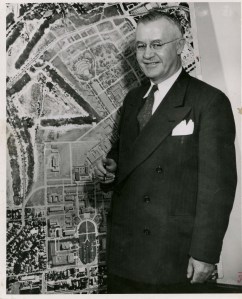
Image_2_Olpin

A. Ray Olpin, University of Utah president from 1940-1960. Special Collections, J. Willard Marriott Library, The University of Utah.

The problem wasn’t just with the number of new students either. According to a May 1944 article in the Progressive Opinion, a newspaper published in Salt Lake City, “American schools have lost 200,000 competent well-prepared teachers since Pearl Harbor.” With too many new students and not enough teachers, a downgrade in the quality of higher education in Utah looked inevitable. But Utah met these problems head-on.

The University of Utah went to great lengths to accommodate new students, especially veterans, under the leadership of president A Ray Olpin. A lot of the time these vets had families and current student housing was too expensive. According to Partridge, “Olpin and his staff worked throughout the spring of 1946 to acquire family-dwelling units. By summer, after countless telegrams between Olpin and United States Senators Abe Murdock and Elbert D. Thomas, 301 family units were moved in to place to form an instant community.” (p. 197)

World War II brought about changes at institutions around the world and the University of Utah was no exception. The University planned for and then reacted to the end of the war with the power of intellect. This chapter in the school’s history demonstrates the value institutions of higher education can have to their communities. They are places where ideas are born and plans are executed.

David Miller is a student at the University of Utah. He is planning on graduating in 2020 with a double major in communication and psychology.

Sources

“War Science Eclipses Art at Utah Campus,” Salt Lake Telegram, December 31, 1943, 9.

“City Board Appoints Postwar Planning Council to Coordinate Multiplicity of Movements,” Salt Lake Telegram, February 15, 1944, 7.

“Postwar Planning,” Utah Chronicle, April 20, 1944, 4.

“Resolutions Go To Congress,” Utah Chronicle, May 4, 1944, 1.

Baukhage, “U.S. School System Faces Greatest Crisis in History,” Progressive Opinion, June 9, 1944, 3.

“16 U Teachers To Attend BYU Meeting,” Utah Chronicle, September 21, 1944, 1.

Partridge, Elinore. “A. Ray Olpin and the Postwar Emergency at the University of Utah,” Western Historical Quarterly 48, no. 1 (Winter 1980): 195-206.


Elaine Cannon: The Feminist LDS Leader Who Got Her Start at The Utah Chronicle

By Alaikia Miller

with camera

Elaine Cannon at the KSL television studio, where she hosted a weekly program for teenagers as reported in the October 7, 1949, issue of The Bulletin.

Elaine Cannon, born Elaine Anderson, graduated from the University of Utah in 1943 with a degree in sociology. During her time at the university, Anderson contributed light commentary pieces to The Utah Chronicle. She went on to write for The Deseret News, authored over 50 books, and became the eighth president of the Young Women organization in The Church of Jesus Christ of Latter-day Saints, a position she held from 1978-1984. Cannon, who died in 2003, is remembered for her dedication to her family, to the church and to young women and youth around the globe. (“Elaine Cannon Dies”)

Interested in writing early in life, Anderson started a school paper while attending junior high. She also launched a weekly paper following high school graduation. (Woodger, p. 183) The Salt Lake Telegram reported on March 6, 1939, that the Red and Black, the paper Anderson helped start for West High School, would be the first “home-printed paper” at that school.

During her time at the University of Utah, Anderson wrote for The Utah Chronicle, the school’s independent student paper. Her contributions to the Chronicle were light commentaries on current events, both general and campus specific. In an October 1940 issue of The Utah Chronicle, Anderson is listed as the assistant women’s page editoran achievement that isn’t mentioned in the various publications about Anderson’s life and work.

Picture1

One of Elaine Cannon’s earliest articles in The Utah Chronicle, which appeared in the October 10, 1940, issue.

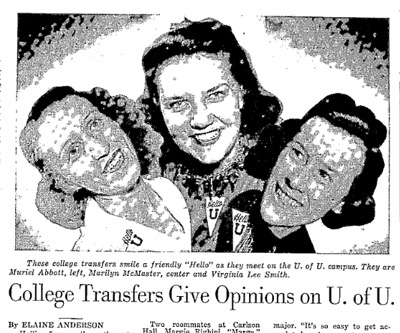
The fifth page of The Utah Chronicle was dedicated to articles written by and for women attending the University of Utah. The “Women’s Page” was established in September 1935, first appearing in the September 26 issue. In one of Anderson’s earliest articles published in The Utah Chronicle, “College Transfers Give Opinions on U. of U.,” she shared the opinions of University of Utah students who transferred from other institutions. Anderson noted that young women who joined the university appreciated the number of tall men and the dancing styles on campus. Throughout her student writing career, Anderson would offer comments on campus fraternities and advice for freshman women. She also contributed a recurring column called “Campus Ramblings.”

group cannon

Elaine Cannon with her husband, James Cannon, during his 1964 campaign for governor, as published in the June 25 issue of the Vernal Express.

Anderson also wrote for The Salt Lake Telegram while attending the university and would eventually become society editor for the Deseret News, where she wrote under her married name, Cannon. (Woodger, pp. 183-84) Throughout her career, she wrote numerous articles for various publications, including Seventeen. (Woodger, p. 178) Anderson, who wed in March 1943, also briefly hosted a local weekly television program for teenagers, which was announced in the October 7, 1949, issue of The Bulletin, a small publication for residents of the Sugar House neighborhood. Cannon also contributed articles and served as society editor.

At the time of her appointment as Young Women president, the women’s liberation movement was in full swing. Cannon’s appointment was very near groundbreaking, as she became the first president who was employed outside of the home. She balanced the duties of being a full-time mother of six, her work as a writer and her duties to the church. Cannon spoke often about the balance of her duties and how she was always looking for ways her career could help serve the church. (Woodger, p. 175)

While she herself worked outside of the home, her focus as Young Women president was still on advocating for a woman’s duty to her family, as this was a priority of church leadership at the time. She noted that while having a family and a career was an option for her, all women are different. What was fine for her life might not work for someone else. (Woodger, p. 176)

adversity

The cover of Elaine Cannon’s book, which was published in 1987 by Deseret Book Company.

When ratification of the Equal Rights Amendment (ERA) began in 1971, the LDS church struggled to form a conclusive opinion. Leadership seemed adamant that the bill was vague and unnecessary. Cannon agreed with the opinions of church leaders. However, the bill still inspired her to make efforts toward providing security and empowerment to women in the church. In response to the discussion over the ERA, Cannon helped create a separate magazine for youth in the church, restructured the Young Women General Board, implemented a Sunday class specifically for young women and established the first LDS women’s meeting. (Woodger, pp. 181-83)

Cannon wasn’t just dedicated to serving young women, but all youth. In 1955, Seventeen magazine provided Cannon an award for her support of teen activities and she served as a delegate at the 1959 White House Conference on Youth. (“Elaine Cannon Dies”)

Elaine Anderson Cannon’s writing career began early and carried on throughout her entire life. However, her work as a writer and leader within the LDS church barely scratches the surface. Cannon had a brimming life, marked by her dedication to her faith and her community.

Alaikia Marielle Miller is a senior at the University of Utah and is set to graduate in May 2019 with a B.S. in communications and journalism. Alaikia is currently a senior staff writer for The Daily Utah Chronicle and can be found across all platforms under @mariellerrrr.

Sources

“West High Will Celebrate First ‘Home-Printed’ Paper,” Salt Lake Telegram, March 6, 1939, 10.

“The Utah Chronicle: List of staff members,” Utah Chronicle, October 24, 1940, 4.

“Women’s Page,” Utah Chronicle, September 26, 1935, 5.

Elaine Anderson, “College Transfers Give Opinions on U. of U.,” Utah Chronicle, October 10, 1940, 5.

Elaine Anderson, “Freshman Women Express Views on Fraternities to Reveal Many Startling Conceptions,” Utah Chronicle, November 14, 1940, 5.

Elaine Anderson, “Scribe Ponders Resolutions; Submits Advise to Frosh,” Utah Chronicle, January 9, 1941, 5.

Elaine Anderson, “Campus Ramblings,” Utah Chronicle, January 16, 1941, 5.

“Television for Teen-Agers” The Bulletin, October 7, 1949, 3.

Elaine Cannon dies at age 81,” Church News, May 22, 2003.

Woodger, Mary Jane. “Elaine Anderson Cannon, Young Women General President: Innovations, Inspiration, and Implementations,” Journal of Mormon History 40, no. 4 (Fall 2014): 171-207.

Image Sources

“Group at Dine A Ville Motel,” Vernal Express, June 25, 1964.

Cannon, Elaine. Adversity. Salt Lake City, Utah: Deseret Book Company, 1987.

Elaine Anderson, “College Transfers Give Opinions on U. of U.,” Utah Chronicle, October 10, 1940, 5.

“Television for Teen-Agers,” Bulletin, October 7, 1949, 3.

WAVES and SPARS: Women go to War in 1943

By Matt McPherson

At the height of the second World War, university students across the nation were forced to withdraw from school and join military forces. First the men, but with a high demand, women also became part of the war’s history. Women not only entered the workforce, but they broke gender barriers by joining military forces. In 1943 President Franklin D. Roosevelt established the WAVES (Women Accepted for Volunteer Emergency Service) and the SPARS (United States Coast Guard Women’s Reserve). Historian Roger D. Launius discussed women’s impact on the war saying, “Not only did women enter the workforce in a big way, but many of the other traditional sexual boundaries were eroded by the war.”

Screen Shot 2018-11-26 at 11.36.37 AMAs reported by the Salt Lake Telegram on Tuesday, January 11, 1943, Lieutenant Tova L. Petersen, a recruitment officer for the WAVES and SPARS, arrived in Salt Lake City to interview applicants. Just one month later the first Utah women would enlist in the military.
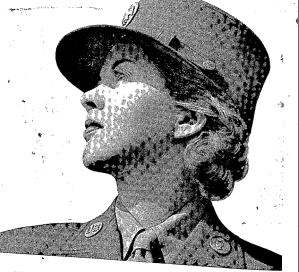
The Utah Chronicle reported on February 25, 1943, that twelve women from the University of Utah were assigned and enlisted to make up Utah’s first contingent of the WAVES and SPARS by the Navy Recruiting Station in Salt Lake City. In order to enlist, women had to be between the ages of 20 and 36, some schooling was required, and they could not be married to a man in the same military branch. The women had to complete four months of training of which nine participants were WAVES and three were SPARS. Following their training, they were assigned to active duty around the United States, or sent to schools for “technical training by Navy experts.” Utah continued to enlist women to reach a quota; to do so, the naval officer from San Francisco remained in Salt Lake City to approve applications.

A brochure titled Facts About the WAVES and SPARS addressed the importance of women joining the armed forces. The author wrote, “Never in history has there been such an urgent need for American women to serve their country. This is total war — a war in which every woman as well as every man must play a part.” The brochure gave complete instructions on how and where to apply, what living situations would be like, and the basic requirements to enlist as WAVES or SPARS.

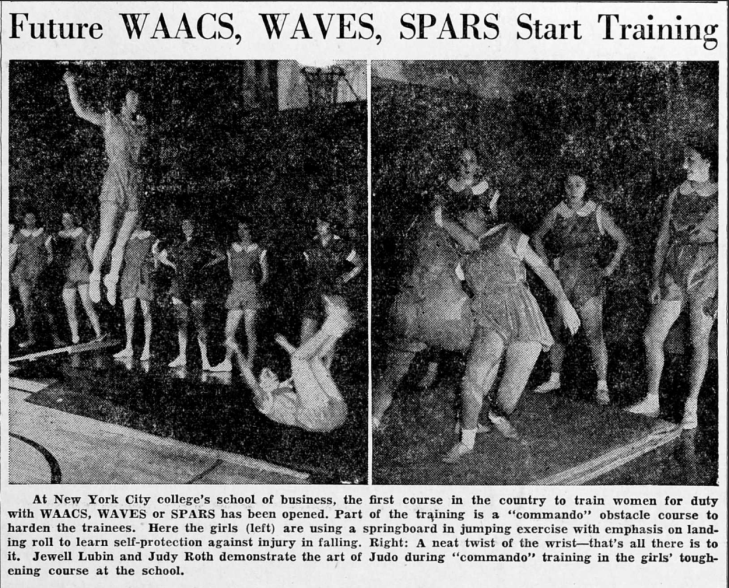
On March 19, 1943, the Sugar House Bulletin shared an image with a brief description of women in training, titled, “Future WAACS, WAVES, SPARS Start Training.” The trainees are shown doing jumping exercises on a springboard.

Screen Shot 2018-11-26 at 11.35.30 AM

On March 8, 1943, The Utah Chronicle published a letter from Florence Henrichsen, a WAVES member and former University of Utah student. Henrichsen wrote from Massachusetts to her sister and told her of her daily life. There was no more staying up late and no more everyday clothing, which she referred to as “civies” — only uniforms were allowed now. Henrichsen did not express any resentment for her decision and seemed quite happy. She wrote of her meals and the training she partook in. She ended the letter to her sister with a little encouragement: “Come and be a WAVE with me – you would love it.”

Reporting for KSL in August 2014, Peter Rosen shared the story of Utah’s own Kathryn Klaveano who served in the Navy WAVES. Klaveano wanted to be a part of the action. She is quoted as saying, “I told them I will go AWOL before I would be a secretary.” And she was more than that. Klaveano was a flight orderly on domestic military flights “from Newfoundland to Miami and to Hawaii.” Another Utah woman, Ora Mae Hyatt, actually served outside of the U.S. and made her way to Okinawa. Unconcerned with her surroundings, Hyatt said, “We were young. We didn’t dwell on the danger we were in.” (Rosen)

World War II brought an urgency upon the United States and called for young men and woman to help fight. President Roosevelt’s establishment of WAVES and SPARS gave women the opportunity to join the war effort. In February 1943 the first twelve Utah women were given the chance to help shape America’s future military and they did just that.

Matt McPherson graduated from The University of Utah in December 2018 with a Bachelor of Science in Communication.

Sources

“Future WAACS, WAVES, SPARS Start Training,” Sugar House Bulletin, March 19, 1943, 3.

“From Former U Coed—Now WAVE,” Utah Chronicle, March 8, 1943, 3.

“First WAVE, SPAR Unit Accepted,” Utah Chronicle, February 25, 1943, 3.

“Women Wanted in WAVES, SPARS,” Salt Lake Telegram, January 11, 1943, 18.

Advertisement/image of U.S. Army announcement, Utah Chronicle, January 14, 1943, 2.

Facts About the WAVES and SPARS,” n.p., 1943.

Rosen, Peter. “Utah Woman at War: Stories of Service in WWII,” KSL, August 28, 2014.

Launius, Roger, D. “World War II in Utah,” Utah History to Go.


Images provided by J. Willard Marriott Library, University of Utah

Salt Lake City Dance and Music: Rainbow Randevu

By Kendra A. Madsen

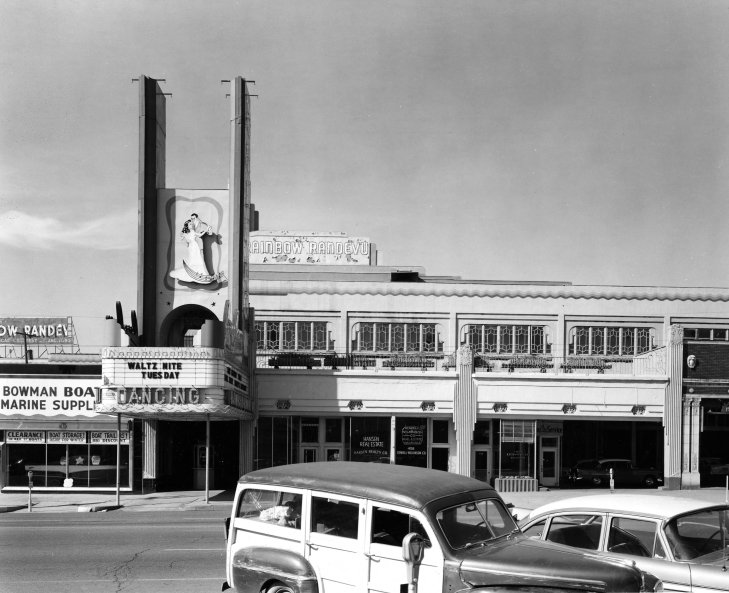
The Rainbow Randevu was one of the larger music revenues in northern Utah. The dance club previously located at 460 S. Main Street was a popular spot for larger band performers to visit from the 1930s to the 1960s. (Stewart, p. 221) Like many of the popular spots in historic Salt Lake City, the Rainbow Randevu played a large role in the music culture in northern Utah. The ballroom also gave generations of young people a fun place to gather, especially during times of hardship, such as World War II.

Rainbow Randevu ad_1937-09-10_Salt-Lake-Telegram

The September 10, 1937, ad that appeared in The Salt Lake Telegram.

The Rainbow Randevu, previously known as the Rainbow Ballroom, opened for dining and dancing the week of September 10, 1937, according to an advertisement in The Salt Lake Telegram published the same date. The Rainbow Randevu was a popular spot for University of Utah students who were looking to escape their school responsibilities for the weekend. Wilkins and Williams wrote in 1944 that students who were either leaving to fight in the war or had returned from the war would meet at the dance club to enjoy each other’s company.

The Salt Lake Telegram wrote in July 1943 that Louis Armstrong performed at the Rainbow Randevu with other swing performers. Jerry Jones, the manager of the Rainbow Randevu, would often perform with his own orchestra at the Rainbow, and over the years many big-name artists would come to perform at the club. (Raff)

Fire-razes-rainbow-randevu_1948-05-22_Salt-Lake-TelegramIn May 1948, The Salt Lake Telegram wrote that a large fire consumed the Rainbow Randevu, completely destroying the building other than the four outer walls. Officials suspected the cause of the fire to be a cigarette. Days before the fire, the Rainbow Randevu had held an inspection and received approval of its wiring, heating and other equipment in the building. Raff wrote that the fire began with three explosions at 3:45 a.m. Saturday, only two hours after the Friday night performance by the Ink Spots band that was attended by 1,132 dancers had ended. While the firefighters were battling to save the Rainbow, they realized there was no hope for the venue and worked to save the surrounding businesses on the block. Witnesses claimed the flames reached 200 feet in the air at the height of the fire, which left the building as “a mass of twisted steel and charred wood.” (Raff)
In October 1948, manager Jerry Jones chose a new site for the Rainbow Randevu. The Salt Lake Telegram reported that the Coconut Grove would be remodeled to become the new Rainbow site. The renovations included adding 250 booths, a new bandstand, two fountains, a TV room, and a new entrance. Jones said the building would have drapery installed in order to close off certain sections of the ballroom making renovations during the day possible while the venue was open in the evenings.

The music culture in Salt Lake City was fostered by the music venues such as the Rainbow Randevu. (Stewart, p. 221) This was a popular hub for University students and Salt Lakers alike to dance and listen to artists. The venue allowed artists from all over to meet at this cross-road town of the West and try out their music on the attendees of the club. Such cultural spots were the go-to place for many young people at the time and show the importance of having venues where the arts can be celebrated.

Kendra A. Madsen is a communication major at the University of Utah and will be graduating in May 2019.

Sources

 Advertisement, Rainbow Randevu, Salt Lake Telegram, September 10, 1937, 12.

“Rainbow Randevu Adds New Musician,” Salt Lake Telegram, March 26, 1938, 7.

“Louis Armstrong to Appear at Randevu,” Salt Lake Telegram, July 14, 1943, 15.

Pat Wilkins and Norma Williams, “Full Weekend Keeps Utes Busy . . . Playing,” Utah Chronicle, October 26, 1944, 3.

Colin Raff, “Fire Razes Rainbow Randevu,” Salt Lake Telegram, May 22, 1948, 1.

“New Site Set for ‘Randevu,’” Salt Lake Telegram, October 5, 1948, 24.

Stewart, Polly. “Urban Pioneers: The Folk-Music Revival in Utah, 1959-1966,” Utah Historical Quarterly 74, no. 3 (2006): 220-230.

They Paved the Rainbow

By Carley Longhurst

In Joni Mitchell’s hit song “Big Yellow Taxi,” she sings the iconic lyrics, “they paved paradise and put up a parking lot.” These two lines became the story of a building with one of the richest histories in Salt Lake City, Utah.

Rainbow Randevu OutsideBuilt in 1922, the Covey-Ballard Motor Company stood between 400 and 500 South on Main Street in downtown Salt Lake City until 1931, when it was transformed into the Coconut Grove. According to Lagoon history, the ballroom was advertised as the largest in the United States. Sometime during the 1940s, the Coconut Grove was changed to the Rainbow Ballroom. Jerry Jones assumed ownership in 1946 and renamed it Rainbow Randevu. Its popularity continued as the community continued to fill the hall. In 1958 Lagoon bought and named it Danceland. A few years later, the company settled on its final name, The Terrace. Lagoon History shares that a final New Year’s Eve party was thrown in 1981 before The Terrace permanently closed. In August 1987 a fire demolished the building and “they paved paradise and put up a parking lot.” (Braden)

Every city has certain places that give them their own identity. Between 1931 and 1981, Salt Lake City had a hotspot that almost every young adult would flock to. Many knew this venue as the Coconut Grove, others as the Rainbow Ballroom, Rainbow Randevu, Danceland, The Terrace, or even The Terrace Ballroom. In the late 1950s Budge and Jeannene Hyde referred to it as the Rainbow, saying in an interview that they congregated there every Saturday night with groups of friends. With World War II recently concluded and political unrest sweeping the world, it was a refuge from reality.

The venue had a life where the musical notes of Nat (King) Cole and Led Zeppelin, among so many other incredible musicians, seeped into its walls and no one wanted to miss the chance to be there. (“Danceland Sets Cole”) The Rainbow felt the vibrations of twirling and dancing to Andy Kirk and his Clouds of Joy not long after the Salt Lake Telegram announced in February 1941 that they were coming all the way from New York. Advertisements were scattered through the Utah Chronicle to inform students what big names were coming, just like the one in March 1941 telling how Carl Ravazza was to play at the Randevu.

Rainbow Randevu FireIn May 1948, The Salt Lake Telegram reported the fire that turned Rainbow Randevu “to a mass of twisted steel and charred wood” in the middle of the night. (Raff) Firemen searched, but only found a cigarette as the reason only four walls of the Rainbow were left standing. Covered by insurance, a seemingly positive Jerry Jones wanted to rebuild “as soon as possible.” The Rainbow would reopen to renewed popularity.
After staving off The Terrace lease from Little America Corp, The Deseret News reported in December 1981 of the final three events before the hall closed indefinitely. A concert by The David LaFlemme Band took place, along with the regular Tuesday night dance and a last New Year’s Eve party. Lots of work was needed to meet city fire and public safety codes, and a Little America spokesman announced the hall would remain unused until a use was decided (An Era Ends).

Terrace Ballroom InsideAlready partially torn down, The Terrace couldn’t disappear without a bang. In August 1987, The Deseret News wrote how it took 30 minutes for a fire to demolish a building that was so beloved by a community forever.
Joni Mitchell never performed at The Terrace, but the hall has an undeniable connection to her song “Big Yellow Taxi.” The building with such a rich history that saw so much and could give a look into the lives of several generations is now a parking lot. The Rainbow Randevu left an unforgettable stamp on those who were able to experience its magic and it’s seen within articles written in newspapers.

Carley Longhurst is a senior at The University of Utah, majoring in communication with an emphasis in journalism. She will be graduating in the spring of 2019.

Sources

“Randevu Bills Kirk Group,” Salt Lake Telegram, February 28, 1941, 20.

Advertisement for Jerry Jones Rainbow, Utah Chronicle, March 6, 1941, 5.

Collin Raff, “Fire Razes Rainbow Randevu,” Salt Lake Telegram, May 22, 1948, 1.

“Danceland Sets Cole,” Deseret News, February 12, 1959, 13.

An Era Ends as S.L.’s Premier Dance Hall Closes,” Deseret News, December 26, 1981, 6A.

Pierce, Scott D. and Twila Van Leer, “Flames Become Last Dancers at the Terrace,” Deseret News, August 6, 1987, 35.

Interview with Budge and Jeannene Hyde, December 1, 2018, author’s collection.

Smart, Christopher. “Whatever Happened to … The Terrace Ballroom?” The Salt Lake Tribune, March 12, 2015.

Braden [no last name], “The Terrace,” Lagoon History Project.

Williams, Carter. “Looking Back at Utah Music and Dance Venues That No Longer Exist,” KSL.com, September 15, 2016.

McCormick, John S. The Gathering Place: An Illustrated History of Salt Lake City. Salt Lake City, UT: Signature Books, 2000.


Wanted: Airline Stewardesses for United Airlines

By Stella Lee

United Airlines was looking for young women with an interest in flying the nation’s airways as a stewardess, according to an advertisement published in The Utah Chronicle on January 10, 1946. There were some qualifications that applicants needed to meet. The women had to be between 21 and 26 years of age, stand between 5’2” and 5’6”, weigh no more than 125 pounds, be unmarried and in good health, have good vision, be a United States citizen, and have completed two years of college or be a registered nurse. The title of stewardess, or flight attendant, is a job aimed at airplane passengers’ comfort and safety. In the middle of the 1900s, people preferred the description flight attendant rather than stewardess because the latter had a negative connotation and meant “flying waitresses.” (Bean-Mellinger)

UAL

Photo by Shipler Studio. Special Collections, J. Willard Marriott Library, The University of Utah.

The first flight attendant had appeared when passenger air travel began in the early 1920s. At the beginning, they were generally the sons of businessmen who had financed the airlines. However, as airplanes became public transportation, airlines needed official employees as flight attendants for passenger safety and service. Ellen Church, who was the first female stewardess hired in 1930 by United Airlines, opened the door for women stewardesses even though the atmosphere in 1930 was not favorable for women flight attendants because the ability of women was always in question. (Latson)

However, working as a stewardess—despite the pay, prestige, and adventure—was actually not as great as it seemed because the women were strictly controlled. (Harris) For example, they were not allowed to marry and most airlines had strict criteria for their height, weight and appearance. Victoria Vantoch, author of The Jet Sex: Airline Stewardesses and the Making of an American Icon, writes that applicants had to meet draconian airline beauty requirements, which embodied America’s mainstream ideal of beauty.

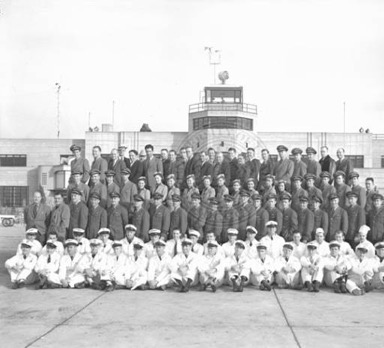
airline

Group photo of airline employees at the Salt Lake City Airport. Special Collections, J. Willard Marriott Library, The University of Utah.

This naturally led to beauty-based gender inequality, sexism and increased gender bias. Some stewardesses were not hired, even when their ability was outstanding, due to appearance. Airlines also discriminated against Black women. Ruth Carol Taylor, a journalist and registered nurse, broke the color barrier in 1957 after filing suit against Trans World Airline. (Van Houten)

Fifteen years later, two White Eastern Airlines flight attendants took the company to court on charges of discriminatory weight and grooming regulations. The organization Stewardesses for Women’s Rights was subsequently founded to address gender discrimination and advocated for reform until 1976.

Due to these efforts, problems with gender-based inequality were moderated and regulations were put in place. Nowadays, gender bias for flight attendants is mostly resolved, but society still requires our attention.

Stella Lee graduated in December 2018 with a Bachelor of Science in Strategic Communication from the University of Utah.

 Sources

Advertisement for United Airlines stewardesses, Utah Chronicle, January 10, 1946, 3.

Latson, Jennifer. “Hired for Their Looks, Promoted for Their Heroism: The First Flight Attendants,” Time, May 15, 2015.

Harris, Tom. “How Airline Crews Work,” HowStuffWorks.com.

Bean-Mellinger, Barbara. “What Is the Difference Between a Stewardess and a Flight Attendant?” Chron.com, June 29, 2018.

Van Houten, Matt. “Taylor, Ruth Carol,” BlackPast.org.

“Women in the Skies: The birth of the Stewardess”,Ms.blog, September 16, 2014. 1-2

Vantoch, Victoria. The Jet Sex: Airline Stewardesses and the Making of an American Icon. Philadelphia: University of Pennsylvania Press, 2013.


A Brief History of The Rainbow Randevu and Its Cultural Impact in Salt Lake City

By Cristian Garcia

Salt Lake City has always been the hub for live entertainment and nightlife for the state of Utah and surrounding states. With the state’s flagship university, young population, and abundance of downtown venues, it’s no wonder that entertainment acts gravitate to Salt Lake City. According to The Salt Lake Tribune‘s 2015 article “Whatever happened to … The Terrace Ballroom?,” the venue has been known by many names: Coconut Grove, Rainbow Ballroom, Rainbow Randevu, Danceland, and finally the Terrace Ballroom. The downtown venue located on 500 South and Main Street represented an entertainment icon for generations. The building, a quarter of a million dollar project originally built by the Covey-Ballard Motor Company in 1922, was later transformed in 1931 into the “largest ballroom in the country” spanning across half a city block. Known by its original name Coconut Grove, the venue was the prominent dance and entertainment hall during the years of the Great Depression.

rainbow randevu

Ads such as this one appeared frequently in the Utah Chronicle.

The concert venue was known for hosting a large number of top-tier performers. In 1941, Jimmie Lunceford, the famed saxophone player and bandleader, blessed Salt Lake City with his performance at the great hall. The venue was known as Rainbow Randevu at the time of his performance. According to a Salt Lake Tribune article from 1941, “Jimmie Lunceford and his orchestra will make an appearance for three nights only at Jerry Jones’ Rainbow Randevu Thursday Friday and Saturday. Collectively and individually this organization is a versatile and dynamic musical group.”

The hall has seen significant changes throughout its time in Salt Lake City, from a multitude of name changes, to renovations, and even damaging fires. Billboard reported on November 20, 1948, “Jerry Jones, owner of Rainbow Randevu, Salt Lake City dancery, which was destroyed by a $175,000 fire May 22, this week took a 10-year lease, involving more than $250,000, on Coconut Grove Ballroom in the same city. Jones intends to spend $100,000 in remodeling the room.”

The venue hosted a number of famed acts throughout its time, but it was no stranger to local artists as well. The News-Examiner, the prominent news source of Montpelier, Idaho, reported on October 24, 1957, that “Wayne Hoff, a former Montpelier resident, is appearing with the famed Jones Boys’ quartet at the Rainbow Randevu in Salt Lake City Friday and Saturday. Hoff produced, wrote and directed both radio and television shows before going to Los Angeles in 1952 to sing with bands there prior to joining the Jones Boys, recognized as one of the nation’s top vocal groups. He is the son of Mr. and Mrs. Herman Hoff.”

Screen Shot 2018-11-29 at 6.29.06 PMThe venue, known as The Terrace at this time, helped lead Salt Lake City into the modern mindset of equality. Before that time, many businesses and hotels still supported segregation. (Salt Lake City Television) Pushing boundaries by allowing admittance by all helped hoist the hall into fond memories from a diverse culture. According to historian Ronald G. Coleman, “By the late 1940s, Robert Freed had succeeded in fully opening Lagoon to Blacks; and when his company acquired the Rainbow Gardens (Terrace), the same policy was adopted.”

The venue failed to remain in its golden era forever. After its closing in the 1980s, the abandoned building sat unoccupied for some time before the decision to demolish it came from the city. According to a 1987 Deseret News article, “Even in the death throes, Salt Lake’s Terrace Ballroom put on a good show on­­ Wednesday afternoon. The memory-rich building on Main Street between Fourth and Fifth South was already half demolished. And at 5:30 p.m., fire added another element to its demise. The fire sent clouds of smoke through the downtown area and caused firefighters considerable concern as it danced inside the rubble. Although fire officials are happy to have one less fire hazard to worry about, the passing of the Terrace is not without a bit of melancholy.”

It is important to see the history of one’s community and the impact it may have had on the culture in that community. Although The Terrace isn’t around today, it was a historical icon and showcased the abundance of nightlife in Salt Lake City. The venue remains in Salt Lake City as a parking lot, but its rich history is retained through headlines in the newspapers and memories of attendees.

Cristian Garcia graduated from the University of Utah with a BS in Communication in Fall 2018.

Sources

“Local Items,” News-Examiner, October 24, 1957, 12.

“Salt Lake Dancery to Jones on Lease,” Billboard, November 20, 1948, 41.

Advertisement for Rainbow Randevu, Utah Chronicle, October 29, 1942, 5.

Advertisement for Rainbow Randevu, Utah Chronicle, November 5, 1942, 3.

“Lunceford Band Will Play at Local Club,” Salt Lake Tribune, May 14, 1941, 8.

Pierce, Scott D. and Twila Van Leer. “Flames Become Last Dancers at the Terrace,” Deseret News, August 6, 1987, B1.

“Covey-Ballard Motor Company Erecting $250,000 Building on Fifth South,” Deseret News, June 24, 1922, 3.

Ronald G. Coleman, “Blacks in Utah History,” Utah History to Go.

Braden [no last name,] “The Terrace,” Lagoon History Project.

Christopher, Smart. “Whatever Happened to … The Terrace Ballroom?” Salt Lake Tribune, March 12, 2015.

Salt Lake City Television, “Salt Lake City History Minute – Segregation,” YouTube, February 16, 2016.


The Legend of Ike Armstrong — University of Utah Football Pioneer

By Chris Frkovich

A 1940 issue of the Utah Chronicle featured a photo on its sports page of the University of Utah’s twin tailbacks, Guy and Huck Adelt, with the headline “Tacklers’ Nightmare.” The caption noted that “picking between the two has given Ike several headaches.” Who was Ike?

U Archives A-Fa IKE Armstrong 1938

Ike Armstrong in a photo from 1938. Armstrong was the head coach of the football team and the athletic director for the University of Utah from 1925-1949. Special Collections, J. Willard Marriott Library, The University of Utah.

Isaac “Ike” J. Armstrong was born June 8, 1895. He played four years of high school football and basketball for Seymour High School in Seymour, Iowa, before declaring for Drake University in Des Moines. Armstrong played fullback for the football team in the early 1920s. (Kellner) According to the Salt Lake Telegram, “Realizing Armstrong’s ability as a leader,” Drake’s head football coach, Ossie Solem, chose Armstrong to assist him during his senior year and the season after he graduated.

When Thomas Fitzpatrick resigned as the head football coach at the University of Utah in October 1924, President George Thomas put together a search committee for the next gridiron leader. (“I. J. Armstrong”) In a recommendation letter for Armstrong, Solem wrote, “I am glad to tell you that he is one of the cleanest, most exemplary young men that I have ever known. If you can get him, all I can say is that you are indeed getting all that you are looking for.” The search didn’t last long as the 29-year-old Armstrong was appointed the next head coach of the Utah football team.

U Archives B Rice Stadium Fd 1 #005

An interior view of Ute Stadium, probably in the early 1960s; The Einar Nielsen Fieldhouse is in the background. Special Collections, J. Willard Marriott Library, The University of Utah.

At the time of his hiring, Armstrong also agreed to terms to serve as the university’s athletic director (AD). While Armstrong is still the all-time winningest coach and longest tenured coach in the school’s storied history, his work as AD may be more meaningful. A 1950 article in the Daily Utah Chronicle reported, “As the athletic director at the university Ike has made Utah one of the centers of the western sports world.” Under Armstrong’s direction as AD, Ute Stadium (1927-71) was built. In January 1927, the Salt Lake Telegram reported the structure initially “cost about $125,000, and will have a seating capacity of 30,000.” Of course, now (and several upgrades later) it is known as Rice-Eccles Stadium. The Einar Nielsen Fieldhouse (1939) was also built during Armstrong’s time as AD. Once the home of the Runnin’ Utes basketball team, this building can be seen at football games above the North end zone with the letters U-T-A-H on its roof. (Wharton)

In his 25 years, Ike Armstrong helped mold the winning brand that is Utah athletics. The structure that is Rice-Eccles Stadium was built under his direction. One might call it “The House that Ike Built.” Armstrong also built a legacy on a 141-win foundation, best in school history. (Kellner) That is remarkable because his final season of coaching was 1949. To quote the iconic baseball movie The Sandlot, “Heroes get remembered, but legends never die.”

Chris Frkovich is a sophomore at the University of Utah. He is majoring in communication with an emphasis in broadcast/journalism. He is currently working as a graduate assistant in video production for the Athletic Department.

Sources

“Stadium Bids To Be Opened,” Salt Lake Telegram, January 28, 1927.

“Iowa Athlete Chosen Coach Of Crimson,” Salt Lake Telegram, February 16, 1925, 1

“I. J. Armstrong, Assistant Coach At Drake University, Named By Utah Officials To Succeed Tommy Fitzpatrick,” Denver Post, February 17, 1925.

“Utah’s Ike Armstrong Holds Chance at Top Athletic Job,” Daily Utah Chronicle, March 30, 1950.

“‘Double Trouble,’ These Tricky Adelt Brothers,” Utah Chronicle, October 17, 1940.

Wharton, Tom. “Whatever happened to … Einar Nielsen Fieldhouse,” Salt Lake Tribune, July 4, 2016.

Kellner, Holly. “Rockne of the Rockies — Utah’s Ike Armstrong left lasting impression on RMAC Football,” Rocky Mountain Athletic Conference, June 8, 2016.

OSS war documentary “The War Department Report” leaves mark at the University of Utah.

By Ellie Cook

students see war filmIn the February 3, 1944, issue of The Utah Chronicle, students were invited to attend a campus screening of the Academy Award-nominated documentary The War Department Report. The film was originally released to a small number of military personnel on December 7, 1943, by the U.S. Office of Strategic Services (OSS). It was directed by Oliver L. Lundquist; David Zablodowsky was credited as the writer, Carl Marzani as producer, Richard Lyford as editor. It was narrated by Walter Huston. (IMBD)

Director Lundquist was described by the Central Intelligence Agency as “a talented architect and industrial designer” who worked for the Office of Strategic Services, the CIA’s predecessor during World War II. Lundquist also created the logo for the United Nations as well as the one for Q-tips.

EPSON scanner imageThe documentary’s project began after a report was made by Major General George V. Strong on “The Strength of the Axis Forces.” The documentary included obtained footage taken of allies by the Germans, Italians, and Japanese. One segment of the film included “startling shots of the Pearl Harbor raid, taken from [Jap] planes.” (“New War Film”)

The American Film Institute notes that the film “marked the first time in history that the high command of the American armed forces made an official report to the country on the strength of the enemy.”

Originally the film was intended to remain “a restricted government film” and was “destined chiefly to be displayed before war plant workers.” (“Cary Grant”) However, it was later publicly released, which eventually earned the film an Academy Award nomination for Best Documentary Feature.

war department reportThe War Department Report is still viewed today, primarily used in military training. The OSS is highly praised for the film’s exposure of the war. Katz writes, “Through their pioneering experiments in the visual display of information … in service of the War Crimes trials … they left a small but indelible mark on history.” The film is kept today in the Academy Film Archives.
Leroy E. Cowles, the University of Utah’s president at the time, described the film as containing some of the “finest combat scenes ever photographed by army or navy cameramen.” In a Utah Chronicle story published in 1944, he highly encouraged professors who had classes at the same time of the on-campus screening to make arrangements in order to allow students to attend the viewing, which was held at Kingsbury Hall on February 3. The viewing included a display of “captured enemy pictures” as well as the film’s screening. (“Impromptu”)

Today, free screenings of recent films remain available to University of Utah students. However, the 1944 viewing of War Department Report stands out among many because students were able to see in real time the reality of the war via footage from the enemy’s perspective. The film is still highly acclaimed today and remains an important asset for military training purposes.

Ellie Cook is a third-year student at the University of Utah studying communication (journalism) and psychology. She has written for Trend Privé Magazine and U NewsWriting.

Sources

Major General George V. Strong, “The Strength of the Axis, delivered before the House of Representatives on 20 October 1943 and before the Senate on 21 October 1943.”

War Department Report. Oliver L. Lundquist, director. United States: U.S. Office of Strategic Services, 1943.

“Cary Grant, McCarey Team on Comedy Plans … ‘War Department Report’ Gives Pessimistic Outlook,” Los Angeles Times, December 21, 1943, 8.

“Impromptu War Film Showing at U,” Salt Lake Tribune, February 2, 1944, 8.

“New War Film Shown In S.F.,” San Francisco Examiner, February 2, 1944, 7.

“Students see War Pictures,” Utah Chronicle, February 3, 1944, 1.

Documentary (Feature Subject),”  The 16th Academy Awards.

Katz, Barry. “The Arts of War: ‘Visual Presentation’ and National Intelligence,” Design Issues 12, no. 2 (Summer 1996): 3–21.

The OSS Architect Who Designed the UN Logo,” Central Intelligence Agency, June 23, 2017.

War Department Report, IMDB.

War Department Report, American Film Institute Catalog of Feature Films.

World War II and Its Effect on Utah Universities

By Joe Coles

The_Military_on_campus_University_of_Utah_14_World_War_II

Soldiers train on the field north of the Field House (old Cummings Field) during World War II. The Life Sciences Building and Presidents Circle are in the background. Special Collections, J. Willard Marriott Library, The University of Utah.

World War II, the last major world war, changed the lives of millions of people around the globe during and after the conflict. Those affected included students at universities. Supplies were rationed, students were drafted, and sports were canceled due to not having enough athletes to field the teams.

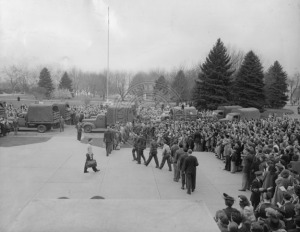
One way that these changes were evident were in morale shows, organized by the United States military. These shows were designed to make people feel good. In April 1942, The Utah Chronicle reported that the University of Utah was holding such shows. These “morale shows” originally started out as shows to boost the spirits of Army members, but the shows were so successful that Fort Douglas, adjacent to the University of Utah, put on the show for civilians and students. The shows included dancing, fencing, plays, and music.

A shortage of people, because students and workers were drafted into the war, manifested itself in both the workforce and in college athletics. In April 1942, The Utah Chronicle reported that the demand for workers was very high because the workforce had to replace those who had been drafted. Reported The Chronicle: “From the month of March to the month of April the demand for workers has almost doubled itself,” according to a report from Herald Carlston, the executive secretary of the placement bureau.

The_Military_on_campus_University_of_Utah_13_World_War_II

A crowd has gathered on Presidents Circle at the University of Utah during World War II, probably witnessing the departure of soldiers. Special Collections, J. Willard Marriott Library, The University of Utah.

The shortage was also felt in college athletics. In May 1942, The Utah Chronicle reported that freshmen, who normally didn’t play in varsity sports, were being considered for varsity teams due to players being drafted for World War II. The Chronicle reported: “Freshmen athletes offer a solution to the problem of team members whose playing lives are measured not by their four years of college, but by their respective draft boards. Several of the major college loops in the East have adopted this policy, but no definite action appears likely in the Big Seven conference.”

Rationing and a shortage of supplies were another consequence of the war. Everything from sugar to slide rules was being rationed, and due to a lack of money, wage scales were implemented and the United States government encouraged people to buy bonds. Even student activities were being cut because of money shortfalls. In May 1942, The Utah Chronicle reported that the university was “pleading” to sororities, fraternities, ASUU, and faculty members to buy war bonds and stamps. In another article published that month, The Utah Chronicle reported that the University of Utah Board of Regents was being rationed sugar at their monthly dinner. Other limited items include “drawing instruments and more expensive slide rules, because of increased demand in war industries.”  In a May 1942 opinion piece, The Utah Chronicle observed that the United States government had established price ceilings, scaled wages and rationed food, and the Chronicle reported changes in its student activities due to the war. “One or more of the university’s four publications probably will be forced to cease publication” and other activities, such as “debate, dramatics, music,” were forced to cut back.

Local universities in Utah also got an influx of dislocated Japanese-American students.  An article in Utah Historical Quarterly discusses the Japanese American Student Relocation Program and the role that universities in Utah had on it. Nisei college students were welcomed by the University of Utah and Brigham Young University after President Franklin Roosevelt issued Executive Order 9066, which essentially evicted Japanese people from the West Coast. The University of Utah and BYU welcomed the Japanese college students who were forced to leave their schools.

In summary, World War II had a huge effect on college life, especially in Utah. Food and supplies were rationed, college life was dominated by freshmen because upperclassmen were serving in the war, sports were canceled, and dislocated Japanese-American students were welcomed into local universities. The war changed college life in America in a way that may never be changed again.

Joe Coles is a senior at the University of Utah. He will graduate in spring 2019 with a Bachelor of Science degree in journalism.

Sources

“Morale Shows Gain Favor of Audiences,” Utah Chronicle, April 30, 1942, 1.

“Work Swamps Office of Job Dispenser,” Utah Chronicle, April 30, 1942, 2.

“Campus Prepares for Drive On Victory Bonds,” Utah Chronicle, May 7, 1942, 2.

“Freshmen Offer Solution To Athletic Problem,” Utah Chronicle, May 7, 1942, 6.

“Cooking Group Limits Sugar For U Regents,” Utah Chronicle, May 7, 1942, 2.

Harold Heath, “Greater Bureaucracy In Government Endangers Democracy,” Utah Chronicle, May 7, 1942, 4.

Hays Gorey, “War Status to Cause Extensive Change In Student Activities,” Utah Chronicle, May 14, 1942, 2.

“College Life During World War II Based on Country’s Military Needs,” The Harvard Crimson, December 7, 1956.

Welker, R. Todd. “Utah Schools and the Japanese American Student Relocation,” Utah Historical Quarterly 70, No. 1 (Winter 2002): 4-20.