Women Workers in World War II

By Riley Spear

women working2

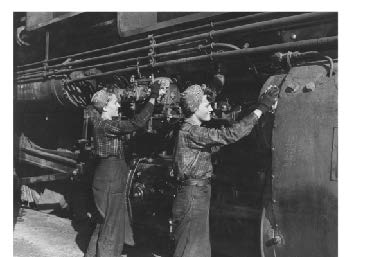
Women in World War II performed men’s jobs. Used by permission, Utah State Historical
Society.

Women played a large role in helping the United States throughout World War II. With men being called from every home to come serve on the battlefields, it allowed women to enter the labor force and have opportunities in the military. The New York Times, on November 23, 1942, said, “Women want a real role to play in the planning of tomorrow.” Not only did they give their time in the home, but abroad as well.

Prior to the women’s commitment to serve in the workforce and military, The Utah Chronicle on November 25, 1942, stated there would be university classes offered to teach women certain techniques in case they were ever needed for combat. These classes included rigorous training such as wrestling, crawling through barrels, and other conditioning activities. This class excited and prepared women for their future job opportunities. Many superiors were thrilled at the chance to teach this class because it was a step toward changing the gender stereotype. Pathfinder magazine reported training classes continued to be held across the states for women in their late teens, to early forties. The training preparation classes were receiving positive feedback, and genuinely helping women in their future job roles they would pursue to help the war cause.
women working3

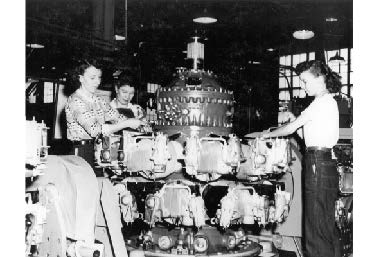
Women worked in the military air force in World War II. Used by permission, Utah State Historical
Society.

The attack on Pearl Harbor was a moment in history where all citizens had to come together as a team in order to survive the war, and women were prepared to give their aid. The Utah Chronicle, on December 3, 1942, reported that the war was asking for University of Utah women with scientific training such as engineering, physics, chemistry, mathematics and accounting. The need for help was dire, and it was urgent women were made aware of their need. The War Manpower Commission posted an advertisement that read, “Longing won’t bring him back sooner…GET A WAR JOB,” in order to encourage women to help. Posters such as these motivated women to serve their country and also help their men. Women responded, coming to serve in the country as industrial workers, and abroad filling the gaping hole in the U.S. labor force.

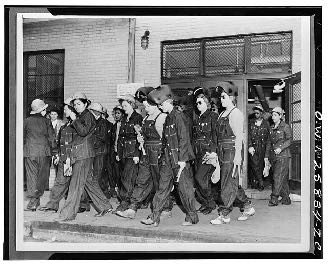
In San Diego, CLICK Magazine reported on February 1, 1944, “Women were becoming letter carriers, bus drivers, high altitude window washers, milk deliverers, and office workers.” An assortment of positions were left vacant and women were fulfilling them without hesitation. The American Magazine wrote an issue in January 1943 on a young women named Dorothy Vogley. When the war called for women employees she seized an opportunity at Timken Rolling Bearing Co. as a testing machine operator. “At first,” noted the article, “the strange hours put her at odds end with the world, but now she believes working in the war industry has made her a new, more self-reliant person.” (p. 11) The war was able to offer women a chance to prove their worth, and spread awareness that women were capable. In some cases, such as Vogley’s, it was also a realization and an inspiration to other women.
working women

Women working alongside each other in hard hats and overalls. Library of Congress Prints and Photographs Division.

Women’s involvement in the war was a huge turning for the United States, and in gender stereotypes. “The war may have demonstrated to employers that women could function well in jobs that had previously been male domains,” wrote Claudia D. Golding in her research article “The Role of World War II in the Rise of Women’s Employment.” After the war, and when men returned, many women were forced out of their jobs. However, within five years the percentage of women in the labor force increased dramatically. Golding’s data prove that during wartime 24.7 percent of the labor force participation rates were made up of women, and by 1950, five years after the war had ended, it increased to 26 percent. This demonstrates the determination and perseverance women continued to strive for during and following the war.

The Utah Chronicle on December 3, 1942, reported, “Women are needed, and the time is past stereotypes.” It is hard to see light in horrible sequences of events such as war. However, women took it by the reigns and demonstrated their worth, and value. The U.S. would have suffered greatly without the hard work women gave in all fields of occupations. The recognition deserved for their performance is endless. “This is a women’s war as well as a man’s,” said Oveta Culp Hobby, director of the Women’s Army Auxiliary Corps, in the 1942 New York Times story.

Riley Spear is a senior at the University of Utah. She is studying journalism and will graduate in spring 2019.

Sources

Advertisement for women workers, Office for the War Manpower Commission, 1944.

San Diego: A Woman’s Town,” Click, February 1, 1944.

Girl on the Midnight Shift,” American, January 1943.

Amazons of Aberdeen,” Pathfinder, July 1942.

“7,000,000 Women Workers Seen in War Plants before Peace Comes,” New York Times, November 23, 1942, 1.

“Coed Commandos Out to Win War and Men,” Utah Chronicle, November 24, 1942, 4.

“Dean of Women Lists Coed Opportunities,” Utah Chronicle, December 3, 1942, 3.

Golden, Claudia. “The Role of World War II in the Rise of Women’s Employment,” American Economic Review 81, no. 4 (September 1991): 741-56.
The History of Cadet Nurses and Their Struggle for Veterans Rights

By Catherine Simmons

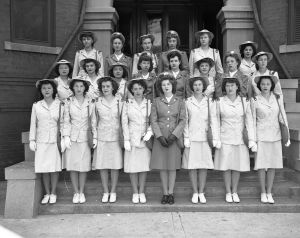
In the years leading up to WWll, jobs were in short supply. However, once America entered the war, that all changed. Because so many men signed up, employees of every kind were desperately needed. Nurses were perhaps needed most.

cadet1

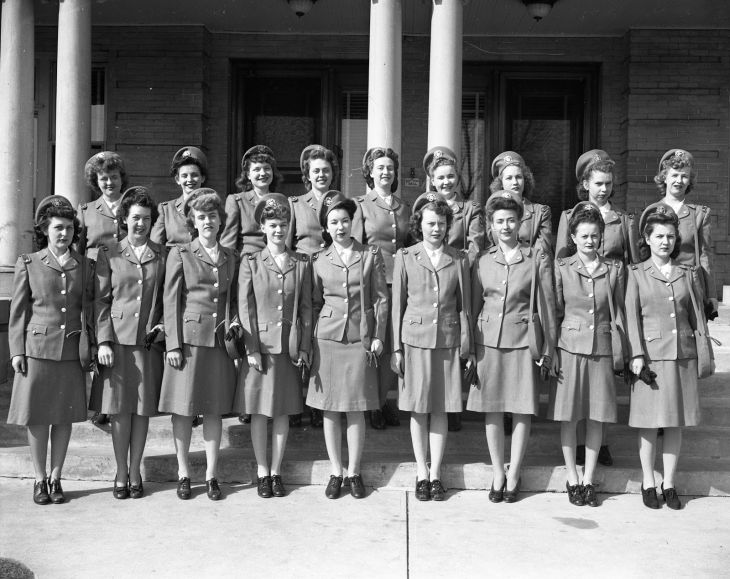
University of Utah–Cadet Nurses War Vets. Salt Lake Tribune Negative Collection, Utah State History.

In 1943, Frances Bolton introduced a bill to create a governmental program to recruit and train nurses. (“Short History”) It passed just a few months later. This led to a countrywide mass recruitment, particularly in universities. The University of Utah formed a club for all Cadet Nurses and even practiced drill with other ASTP, or Army Specialized Training Program, students. They often got in uniform and stood in formations and even ran practice exercises. (Cutler) There were numerous advertisements calling women to join the U.S. Cadet Nurse Corps, similar to the advertisements calling men to join the service. At one point, 80 percent of nurses in the United States were part of the U.S. Cadet Nurse Corps. (“Short History”)

cadet2

St. Marks Hospital Cadet Nurses. Salt Lake Tribune Negative Collection, Utah State History.

Their 30-month training was rigorous and demanding. There was a lot of school work as well as training, not to mention the strict curfews. (Bergman) But they all said they felt an obligation to help the young men and their country.

One nurse, Eunice E. Smolak, was assigned to Bushnell General Hospital where she treated wounded servicemen and prisoners of war. She wrote about how difficult it was, emotionally and physically, to care for those wounded soldiers, and that she would never forget those experiences. (“We Remember”) Each nurse was greatly affected by what she saw and heard in those hospitals. It was not an easy job. It was physically, emotionally and psychologically demanding. However, despite the hardship each cadet nurse faced, they were not considered veterans.

Numerous pleas have been submitted asking to change the status of cadet nurses to eligible veterans. A wave of activism has swept across the country. Former cadet nurses are sending letters and calling all their cadet friends and acquaintances, letting everyone know what they are trying to achieve. Letters were sent out begging for signatures on their petition. Cadet nurses and their families have sent letters to the editor in newspapers all over the country, including the Columbia (MO) Daily Tribune, asking for recognition of their efforts and sacrifice. The U.S. Cadet Nurse Corps is, in fact, the only uniformed force that has not received veterans status. That means they do not qualify for any of those benefits and services. (Karins)

On February 6, 2017, H.R. 1168, the United States Cadet Nurse Corps Equity Act, was introduced to Congress. It states that any member of the United States Nurse Corps who served between July 1, 1943, and December 31, 1948, is qualified to full veteran status, including all benefits, although those benefits won’t be back-paid. (Lowey) Seventeen representatives cosponsored the bill. However, despite all the effort put in by so many, nothing has come of it. Almost two years later and it has still not passed in the House of Representatives.

Thousands of women sacrificed so much of their time and energy, just doing their duty to their country and their fellow Americans and the least we can do is give them what they are owed. If we wait much longer, there will be no nurses left to recognize.

Catherine Simmons is a Utah resident who has a degree in communication from the University of Utah. She is married with a beautiful puppy.  She loves history and reading and dreams of becoming an author. 

Sources

Robert Cutler, “Campus in Crisis,” Utah Chronicle, November 4, 1943.

Belcher, David. “Cadet Corps Seeks Congressional Recognition: World War II Nurses Petition Congress for Veterans’ Benefits, Honors,” American Journal of Nursing 103, no. 3 (2005): 130-31.

Doona, Mary Ellen. “Cadet Nurse Corps,” Massachusetts Report on Nursing 11, no. 1 (March 2013): 6.

Karins, Jessica. “U.S. Cadet Nurse Corps members seek veteran status,” Columbia Daily Tribune, August 20, 2018.

Bergman, Julia. “All but forgotten: Cadet nurses reflect on service during WWII,” The Day, November 3, 2018.

Rep. Nita Lowey, H.R. 1168, United States Cadet Nurse Corps Equity Act.

Alissa Sauer, “Overdue Recognitions for WWII Cadet Nurse Corps,” Veteran Aid, April 3, 2018

Short History of Military Nursing: U.S. Cadet Nurse Corps,” Ebling Library, University of Wisconsin-Madison, August 18, 2017.

“We Remember: Eunice E. Smolak,” USCadetNurse.org.

Barefoot Boy with Cheek Helping Young Utahns Laugh in 1945

By Katherine Rogers

Being a young person in the mid-1940s could be stressful, with World War II creating strife for every nation. In the United States every able-bodied man was being drafted into the military. Everyone else was making sacrifices for the sake of the war effort. Early 1945 was an especially uncertain time. While the end of the war seemed imminent, no one was sure how much longer it would be going on. All throughout January of that year the Utah Chronicle wrote about the rumors of a 4-F draft (that is, drafting men who originally were not considered due to minor disabilities). Meanwhile, men were coming back from the battlefields with injuries and stories of the horrors of war. This kind of tension meant that the students were looking for relief. Enter: Max Shulman.

Shulman was a journalism student at the University of Minnesota. He wrote for the Minnesota Daily (the school’s newspaper) and Ski-U-Mah (the on-campus humor journal). He soon became known on campus for his goofy sense of humor. So, it was no surprise when in 1942 he was approached by an editor to write a book poking fun at college life. Shulman agreed and a few months later produced Barefoot Boy with Cheek. (Brady, p. 32)

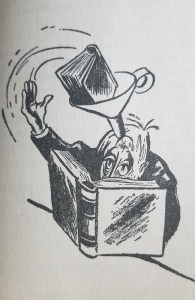
Rogers_PublicationImage1

Illustration by Will Crawford.

Barefoot Boy focuses on the adventures of Asa Hearthrug, a small-town farm boy, as he begins his college career at the “fictional” University of Minnesota. Shulman uses his famous silly sense of humor to make fun of parts of college life like fraternities (Hearthrug joins Alpha Cholera) and the troubles of dating in college (Hearthrug must choose between two girls). It touches on the prices of books, especially the ones the professors wrote themselves, and student journalists trying too hard to sound clever.

Even though Barefoot Boy soon became a national bestseller, it took a few years for it to reach Utah. Once it did, Shulman’s writing quickly captured the attention of the college crowd. The Utah Chronicle wrote in January 1945 all about the craze over the book sweeping the campus of the University of Utah. It was so popular on campus that one Utah Chronicle columnist, known in her column only as Pomerance, tried her hand at her own shortened version, which she called “Bare Faced Girl with Teeth” or “Foo to You U of U.” This parody, featured in the January 11, 1945, issue of the Chronicle, follows similar themes with the heroine dealing with Greek life (for example the fraternity Un Kappa Kega Brew) and having to choose between two boys.

Rogers_PublicationImage2

Illustration by Will Crawford.

The book was in high demand in the state. In October 1945, the Bear River Valley Leader wrote about the joy of the local libraries finally getting their hands on a single copy of Barefoot Boy, as did The Hillfielder in March of the same year. One group of young writers in Provo, after starting the American League of Young Penman, decided to show their love for Shulman’s writing in an interesting way. “Max Shulman, author of ‘Barefoot Boy with Cheek,’ ‘The Fatherly Merchants,’ etc., is the honorary president of the club,” the Provo Sunday Herald reported in the September 9, 1945, issue.

The absurdist humor that riddles the pages of the Barefoot Boy with Cheek appears to be just what the youth of Utah needed. It shows that a little book, no matter how silly its contents may be, can prove to be the perfect mood lightener in dark, uncertain times.

Katherine Rogers is a junior at the University of Utah, studying communication and journalism. She is also an intern at CATALYST Magazine.

Sources

Max Shulman, Barefoot Boy with Cheek (New York: American Book-Stratford Press, Inc., 1945).

“Pom Authors Sequel to ‘Barefoot Boy,’” Utah Chronicle, January 11, 1945, 2.

“Ouija Boards, ‘Barefoot Boy With Cheek’ Prove Distracting to U Students,” Utah Chronicle, January 11, 1945, 3.

“U Waits Decision On 4-F Draft,” Utah Chronicle, January 11, 1945, 4.

“Library Purchases Request Numbers,” The Hillfielder (Ogden Air Technical Services Command newspaper), March 28, 1945, 2.

“League of Young Writers Started By Provo Group,” Provo Sunday Herald, September 9, 1945, 2.

“New Books at Library,” Bear River Valley Leader, October 18, 1945, 3.

Brady, Tim. “Max Shulman. Dig it?” Minnesota Alumni Magazine, Spring 2016.

The Story of Alta Ski Resort

By Lorenzo Pighini

Skiing serves as one of Utah’s main forms of recreation, and locals believe the state possesses “The Greatest Snow on Earth.”  However, mass public skiing wasn’t always readily available to Utahns. In the fall of 1938, the development of Alta, what is now known as one of the most elite ski resorts in the world, began. Within a decade, Alta had become a nationwide attraction. The story of how Alta came to be is quite remarkable, and certainly imperative to the growth of one of Utah’s most coveted historical pastimes.

Before skiing in Utah reached mass popularity, it was used as a means of travel throughout Utah’s rugged mountain terrain. According to A. Joseph Arave, the first Utah skiers included trappers, miners, and others who relied on skis as a means of transportation. Gradually, it became a recreational activity for those looking to tour the mountains and by the late 1920s, these tours, as well as ski-jumping meets, began to attract thousands of Utah residents. Due to the growing interest and demand in skiing, several small ski areas were developed using simple tow rope and T-bar systems. All the while, The Alta Winter Sports Association was building Utah’s first ski lift and what would eventually become one of Utah’s finest ski resorts.

AKE_0102

Ski Archives Photograph Collection, Special Collections, J. Willard Marriott Library, The University of Utah.

The New York Times reports that after Alta was destroyed by fire and avalanches in the early 1900s, the lone resident of the town was the self-declared mayor George Watson. Watson agreed to give 1,800 acres of land to the United States Forest Service. With the help of Watson and the Forest Service, the Association was able to obtain land to construct the resort. The Association raised $10,000 in order to construct the lift, and was able to obtain a permit to construct the chairlift in the fall of 1938. An aerial mining tramway was then purchased from a pair of mining men, and the Association converted the machinery into a lift. It was named The Collins lift and it scaled the mountain a total of 2,740 linear feet.

p0371n1_01_09

Alta Photograph Collection, Special Collections, J. Willard Marriott Library, The University of Utah.

After the success of constructing Utah’s first operational lift, Alta’s popularity skyrocketed. New lifts were constructed in the early 1940s, and while many ski resorts nationwide shut down throughout the duration of World War II, Alta remained open and offered recreational relief to soldiers based in Utah. The Utah Chronicle reported on February 6, 1941, that University of Utah students were able to take tri-weekly bus trips sponsored by the student ski club to the resort. As Alta began to expand year after year, so did the number of visitors. According to Anthony Will Bowman, between 1964 and 1965, over 230,000 visitors went to Alta between the months of December and April.

As ski resorts have become Utah’s largest tourist attraction, as well as one of the state’s most profitable industries, Alta Ski Resort still possesses some individuality among other local resorts such as Park City and Canyons Resort. Alta is one of only six resorts in the National Ski Area Association where snowboarding isn’t allowed. Alta has also stuck to fundamental values of skiing, focusing its efforts on providing a quality skiing experience on unmatched terrain, rather than selling out for profit or joining a massive corporate conglomerate. This refusal to adapt has allowed Alta to preserve its integrity and remain the most historical ski resort in Utah.

Lorenzo Pighini is a Chicago native majoring in communication and minoring in business at the University of Utah. He moved to Utah to pursue an education and to experience world-class snowboarding.

Sources

Arave, A. Joseph. “Skiing in Utah,” Utah History Encyclopedia, Utah Education Network.

Bowman, Anthony Will. “From Silver to Skis: A History of Alta, Utah, and Little Cottonwood Canyon, 1847-1966″ (Master’s thesis, Utah State University, 1967).

“Ski Manager Plans Bus Trips to Alta,” Utah Chronicle, February 6, 1941, 2.

Jake [no last name]. “SkiUtah License Plate.” Ski Utah, November 20, 2007.

DeLeo, William. “Alta, Utah Historical Timeline.”

Diliberto, Gioia. “Earning It; A Ski Area Without the Extremes,” New York Times, March 22, 1998.

Photo Gallery. Alta Historical Society.


Edwin Evans and His Influence on Art Education in Utah

By Hannah W. Peterson

Edwin_Evans (1)Edwin Evans was an influential artist from Utah, a professor at the University of Utah, and the holder of various positions of prestige including president of both the Utah Art Institute and the Society of Utah Artists.
Born in Lehi, Utah, on February 2, 1860, his first art venture began in the fall of 1888 when he took off to Paris for a two-year course in drawing and painting at L’Academie Julien where he developed his skills. His talent was obvious, and according to William C. Seifrit, “Evans had quickly caught the spirit of art prevailing in Paris during the 1890s.” (“Letters from Paris,” p. 190)

After his training, Evans went on to create various pieces of historical artwork when he painted interior panels in the Mormon Temple in Salt Lake City from 1918-1919, did art research work in France from 1920-1922, exhibited at the World’s Fair in 1893, and had several of his pieces featured in local exhibits, which won a number of awards. Evans received considerable praise for his work, and according to the Utah Chronicle on April 17, 1941, he was, at the time, “One of Utah’s most outstanding educators and artists.”

Untitled_3

Edwin Evans watercolor painting depicting fields. Special Collections, J. Willard Marriott Library, The University of Utah.

Perhaps though, Evans’s most notable achievements came forth with his extensive involvement in art education in public schools and at the University of Utah, where he was head of the art department for 23 years. In 1897, Evans and fellow Utah artist J. T. Harwood displayed their passion for creative art curriculum in schools by addressing a letter to the Board of Education in Salt Lake City. Published by the Deseret Evening News on February 5, 1897, the letter read, “The aim of teaching drawing in the public schools should be to train correctly the perception, cultivate the creative faculties, aid in the expression of ideas, discipline the hand, and lead the pupil to think and work independently.”

Untitled

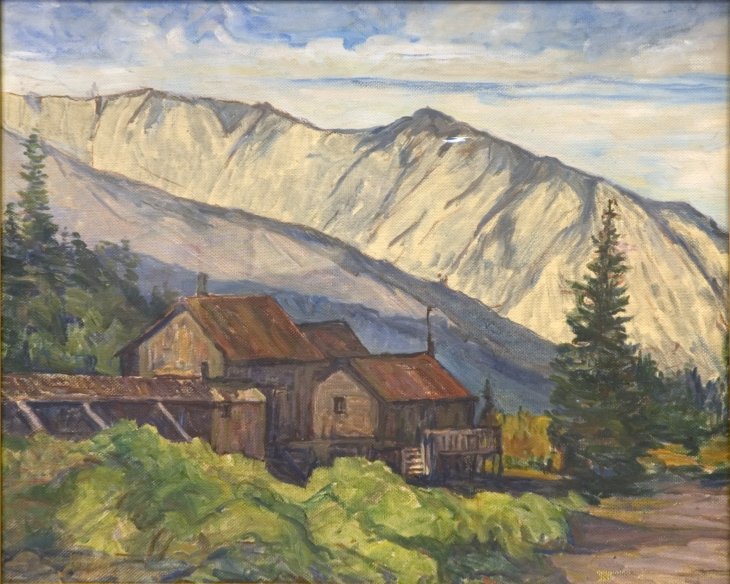
Oil painting depicting mining buildings and mountains in the background. Special Collections, J. Willard Marriott Library, The University of Utah.

Evans’s influence continued on when The Salt Lake Tribune reported on May 25, 1902, that he and other art professors at the University of Utah had arranged a textbook on art and drawing, in response to their dissatisfaction with current art textbooks. In an interview with Evans in 1938, conducted by Mabel Frazer for the Works Progress Administration, Evans reflected on his influence on art curriculum in the school system saying, “I feel that I did a valuable service to the public schools of the state when in the late nineties I spent a lot of time covering over three years, in an effort to have the pernicious system of drawing then in use in the state abolished.”

Along with teaching art classes while at the University of Utah, Professor Evans gave several lectures that enlightened and inspired his students. On April 1, 1912, The Utah Chronicle reported on a lecture he gave on art in which he said, “In painting, as in all things, individuality scores most toward the acquiring of success.” Evans had made a lasting impression on his students and local art. In the same 1938 interview done by Mabel Frazer with Evans, she reflected on his influence on her life, saying, “I don’t believe any other man in Utah has sent so wide an influence through his students. When I first studied with him he put color above form. Later he became interested in sculpture, and form and structure became vital elements in his expression. But he has remained true to his own ideals through his whole evolution. Never borrowing the mannerisms of individuals or schools. He is a decorator and colorist par excellence.”

Untitled_5

Watercolor painting depicting mountains with orchards in the foreground. Special Collections, J. Willard Marriott Library, The University of Utah.

His artwork was also honored and displayed at the university various times. Toward the end of his career, The Utah Chronicle reported on April 24, 1941, that Professor Edwin Evans would be presenting an art exhibit featuring 141 of his paintings. The exhibit was the culmination of years of hard work and lasting influence on the art community in Utah, which would tragically be one of his last artistic appearances before his death on March 4, 1946. According to the Lehi Sun on March 7, 1946, Evans had planned on bringing two additional paintings to an exhibit he had recently established at Lehi High School’s library just two weeks before his death.

Edwin Evans inspired his students with an expressive and creative method of teaching, setting an example of academic excellence that would be appreciated for generations to come. Adequate funding for the arts in the school system has been an issue in the U.S. for many decades, including the present day. Passionate professors like Evans will always be vital for the survival of art classes in schools, and for the fostering of an intellectually stimulating learning environment. His legacy lives on through this very idea.

Hannah Whitney Peterson is a senior at the University of Utah where she is majoring in communication and minoring in environmental and sustainability studies.

Sources

“Drawing In the Schools,” Deseret Evening News, February 5, 1897, 8.

“Art In Public Schools,” Salt Lake Tribune, May 25, 1902, 7.

“Prof. Evans Lectures on Art,” Utah Chronicle, April 1, 1912, 4.

Mabel Pearl Frazer, interview with Edwin Evans, MSS B 289, The Works Progress Administration (Utah Section) Biographical Sketches, ca. 1930-1941, University of Utah, J Willard Marriot Library.

“Exhibit Features 141 Paintings,” Utah Chronicle, April 17, 1941, 1.

“Artist Holds Exhibit In Union Building,” Utah Chronicle, April 24, 1941, 3.

“Lehi Artist Dies At California Home,” Lehi Sun, March 7, 1946, 1.

Seifrit, William C. “Letters from Paris,” Utah Historical Quarterly 54, no 2 (Spring 1986): 179-202.

The Coon Chicken Inn and Utah’s Hidden History of Racism

By Chris Oregon

The Coon Chicken Inn was a fried chicken restaurant chain located in the Pacific Northwest and owned by Maxon Lester Graham and his wife Adelaide. The first Coon Chicken Inn was established in 1925 in Salt Lake City, Utah. Coon Chicken Inn was famously known for its racist “coon” caricature logo that was used to promote the authenticity of the southern-style food. At the entrance of the restaurant was a 12-foot “coon head.” Customers entered through the mouth, which had exaggerated large lips and teeth. This same entrance was then used for the other two locations that opened later. Despite protests against the racial slurs and racist caricatures the stores remained open until the late 1950s. Even though the restaurant was racist, the only complaint from the city was when it heard rumors that operators were serving alcohol. On March 11, 1927, The Salt Lake Telegram wrote about the trial that Graham went to for “conducting a disorderly house,” because officers had claimed that they found liquor on three of the restaurant’s tables. (“Graham Enters Not Guilty Plea”)


Coon_Chicken_Inn_P_7

Special Collections, J. Willard Marriott Library, The University of Utah.

Catherine Roth writes that the large “coon head” used for the entrance of the building was a gimmick to attract customers. (“The Coon Chicken Inn”) Graham also used the logo on postcards, newspaper advertisements, children’s fans, delivery cars, and matchboxes as promotion.

After gaining a lot of success, Graham later opened two more locations in Portland, Oregon, and Seattle, Washington. Each location had the “coon head” entrance that was used with the first location to attract customers. The restaurant not only provided food for its customers but entertainment as well. The Utah Chronicle mentioned that the restaurant offered dancing and talented local musicians to entertain customers. (“What We’ll Do”) The Coon Chicken Inn was popular among University of Utah students; the Interfraternity Council planned a stag party for students and the restaurant was chosen to host its festivities. (“Greek Council”) Popular among University of Utah students, several fraternities chose to hold events such as banquets at the restaurant because it had a dance floor and live music for everyone to enjoy. (“The Town Chatter”) Variety magazine also mentioned in its April 7, 1937, issue that the Coon Chicken Inn was a great spot for out-of-state bands to work with local musicians, which helped attract customers.

Coon_Chicken_Inn_P_2

Special Collections, J. Willard Marriott Library, The University of Utah.

Despite being racist, the restaurant was very successful, opening a total of three locations in three different cities. After opening in Seattle in 1930, Graham was met with protests. That same year the Seattle branch of the National Association for the Advancement for Colored People (NAACP) and the African-American newspaper, the Northwest Enterprise, protested the opening of the restaurant and even threatened Graham “with a lawsuit for libel and defamation of race.” In response, Graham agreed to change his advertising styles by “removing the word ‘Coon’ from the restaurant’s delivery and also by repainting the ‘Coon head’ entrance to the restaurant.” Instead of the “coon head” being black he decided to paint the skin color blue to avoid further issues. Graham also canceled his order of 1,000 car tire covers to please the protesters and not get in legal trouble. In the end, Graham removed the “Coon head” from public view and decided to close the restaurant doors for good. (Roth, “The Coon Chicken Inn”)

Today, the original Coon Chicken Inn building is gone. Despite the restaurant being shut down, Coon Chicken Inn remains relevant today due to the collectibles being sold online as black memorabilia. In 2017, Cook’s Garage, a Texas restaurant, caused outrage when customers noticed a Coon Chicken Inn neon sign on its walls. After receiving so much backlash, the owner said the sign wasn’t there to offend anyone, but to display Americana history. (Robinson) Even though the restaurant has been closed since the 1950s, it is still making headlines to this day. It’s still a relevant topic due to its racism. The Coon Chicken Inn will forever be a part of Utah history.

Chris Oregon is a senior at the University of Utah. He is majoring in mass communication with an emphasis in journalism and minoring in Spanish.

Sources

Graham Enters Not Guilty Plea,” Salt Lake Telegram, March 11, 1927, 2.

The Town Chatter,” Utah Chronicle, December 21, 1932, 2.

What We’ll Do,” Utah Chronicle, January 25, 1934, 2.

Greek Council Chooses Rulers,” Utah Chronicle, May 21, 1936, 1.

“Salt Lake City Sets Bands for Summer,” Variety, April 7, 1937, 50.

Advertisement, Coon Chicken Inn, Utah Chronicle, September 28, 1944, 4.

Roth, Catherine. “Coon Chicken Inn (Seattle),” HistoryLink.org, October 16, 2009.

Roth, Catherine. “The Coon Chicken Inn: North Seattle’s Beacon of Bigotry,” Seattle Civil Rights & Labor History Project, University of Washington, 2009.

Robinson, Elliott. “The Coon Chicken Inn Lives,” CreativeTension.org, 2017.

The Role of Cigarettes in 1940s University of Utah Campus Culture

By Emerson Oligschlaeger

In January 1943, Utah Chronicle columnist Bette Pomerance penned an op-ed titled “Scribe Finds Weed Vices Common at the U.” Pomerance neither condemns nor defends the prominence of cigarette smoking on campus; her point is limited to chronicling students’ commitment to the vice. When contextualized against local and national historical resources, Pomerance’s column allows us to understand tobacco’s cultural role in the university community of the 1940s.

The article mentions “restricted areas” — campus venues where smoking is banned — and students’ “flagrant violations of the ‘no fagging’ rule.” Pomerance cheekily notes students’ unflagging devotion to tobacco, writing that offenders chastised for smoking in restricted areas “swear… to never do it again — and get caught.”

University_of_Utah_College_Inn_Shot_1

The College Inn in 1937. Used with permission of the Utah State Historical Society.

Pomerance also records a few epicenters of campus tobacco culture, including the university game room and the College Inn, an off-campus restaurant that once stood on 200 S. and University Street. “One could hardly write an article on smoking without mentioning the College Inn,” she writes, calling it “the best place to obtain a non-average report card, tubercular lungs and stomach ulcers.”

In the Summer 1997 issue of Continuum, the University of Utah’s official magazine, alumnus Rod Decker recalls visiting the College Inn as a 10-year-old to find it full of college students smoking cigarettes and “fleeing supervised wholesomeness.” The non-smokers tended to eat in the Union cafeteria where smoking was prohibited, Decker writes, while tobacco users congregated at the campus-adjacent eatery.

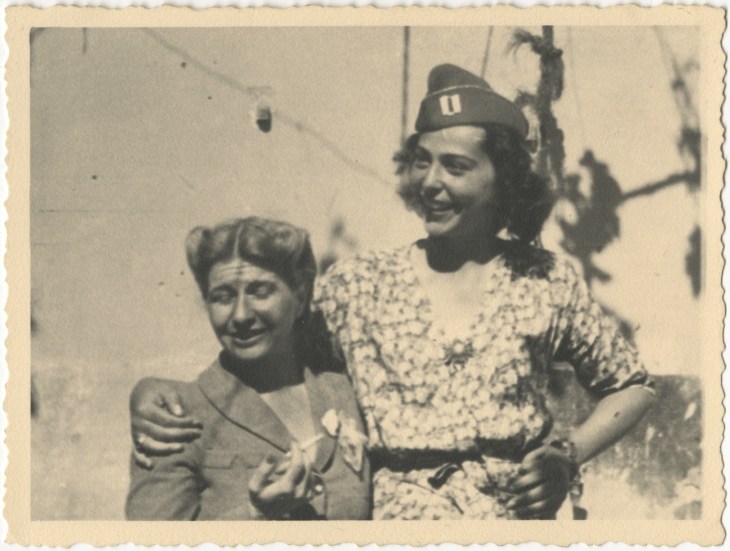
women

Ellis Gangl Leonard poses in her husband Leo Leonard’s military cap while an unidentified woman smokes a cigarette. Both soldiers and women contributed to the prevalence of tobacco on campus in the 1940s. Used with permission of Special Collections, J. Willard Marriott Library, The University of Utah.

Decker and Pomerance’s recollections reflect national trends in tobacco usage. The early 1940s saw one of America’s sharpest spikes in per capita tobacco consumption, and more women took up smoking during the ’40s than any other decade. (Centers for Disease Control and Prevention, 2014) Pomerance’s column notes the prevalence of smoking among university co-eds, writing of “the entire male population and half the female with a weed in his or her face.”

The presence of servicemen also contributed to the clouds of smoke on campus. Tobacco played a significant role in military culture. A July 1943 article from the Davis County Clipper titled “Smokes and the Soldier” detailed the ways that cigarettes “play a prominent part in many phases of the life of a soldier.” A January 1943 issue of the Vernal Express includes a write-up on care packages assembled by the local Red Cross chapter, which necessarily featured cigarettes. As rationalized by The New York Times during World War I, “tobacco may not be a necessary of life, in the ordinary sense of that term, but it certainly lightens the inevitable hardships of war as nothing else can do.” (Brandt, p. 52).

A letter to the editor published in a February 1943 edition of the Chronicle directly addresses the issue of servicemen smoking on campus. In response to complaints about soldiers smoking in buildings and areas where it is prohibited, the writer acknowledges that servicemen should follow the rules, but takes issue with critics’ tone.

“This note, then, is directed not to the validity or invalidity of the ‘no-smoking’ rule, but to one who, in times of war and stress, when the very life of our country hangs in the balance concerns himself with trivial things like smoking in school buildings. Let me say that we service men are concerned with affairs far more momentous,” he writes.

Another letter to the editors of the Chronicle chastised students for failing to properly dispose of their cigarettes, creating fire hazards and cluttering campus. “Just a little effort on the part of each of you can make our campus something to be remembered by the numerous visitors who come here,” wrote Marian R. Jones in 1949.

A 1941 Utah Chronicle article by Frank Allen, “Scribe Gets Hot Under Collar Over Paper’s Cigarette Ad Problem,” addresses an ongoing debate over the absence of tobacco advertising in the student paper. According to Allen, the Chronicle printed a number of letters to the editor alternately praising and decrying the paper’s decision not to advertise cigarettes. Throughout the 1940s – and indeed, to this day – the Chronicle remains an important venue for discussion of student smoking practices.

Tobacco use, on college campuses and elsewhere, has steadily decreased since the 1960s. (Centers for Disease Control and Prevention, 2014) In 2018, the University of Utah declared itself a smoke-free campus, sparking another wave of Chronicle op-eds. The first sentence of Pomerance’s 1943 column  —  “each year about this time someone starts a debate about the use of nicotine on our campus” — still rings true. While university nicotine culture has changed dramatically, some things never do.

Emerson Oligschlaeger graduated from the University of Utah in 2018 with a degree in mass communication. Emerson currently works for KSL NewsRadio and plans to pursue a career in community journalism.

 Sources

Frank Allen, “Scribe Gets Hot Under Collar over Paper’s Cigarette Ad Problem,” The Utah Chronicle, February 6, 1941, 4.

Bette Pomerance, “Pomerance Says: Scribe Finds Weed Vices Common at U,” The Utah Chronicle, January 21, 1943, 2.

“Local Red Cross to Make 275 Comfort Kits,” Vernal Express, January 28, 1943, 1.

 S/Sgt. OES., “Upholds Soldiers,” The Utah Chronicle, February 11, 1943, 2.

“Smokes and the Soldier,” Davis County Clipper, July 23, 1943, 6.

Marian R. Jones, “Battered Campus, Untidy Lawns Cause Greater Tuition Costs,” The Utah Chronicle, October 12, 1949, 2.

Brandt, Allan. The Cigarette Century: The Rise, Fall, and Deadly Persistence of the Product that Defined America. New York, NY: Basic Books, 2007.

Rod Decker, “Campus Hangouts Throughout the Years: A Cautionary Tale” Continuum,(Summer 1997): 24.

National Center for Chronic Disease Prevention and Health Promotion (US) Office on Smoking and Health. “The Health Consequences of Smoking—50 Years of Progress: A Report of the Surgeon General.” Atlanta (GA): Centers for Disease Control and Prevention (US), 2014, Chapter 13, Patterns of Tobacco Use Among U.S. Youth, Young Adults, and Adults.

U of U Students’ proposal of the trip to the Utah-Colorado football game in Boulder

By Ashley Ji Won Oh

This article is about the Utah homecoming football game against Colorado in Boulder. During World War II, the football team at the University of Utah participated in flight courses as part of a national program to teach 20,000 college men to reinforce and strengthen the nation’s air defense. This is because football was a nice distraction from the tough wartime abroad. Student groups held seminars about the effects of anti-Semitism on Utah’s campus. Even though the atmosphere was heavy and tragic, Utah football was a great way to forget for that moment. (War years)

U Archives D Athletics- Football 1940-1949 Fd 1 #005

A University of Utah team practice sometime between 1940 and 1949. Special Collections, J. Willard Marriott Library, The University of Utah.

The A. S. U. U. council proposed a chartered train trip to Boulder, where the Utah homecoming football game against Colorado would be held. The proposal indicated that from this trip, students would be able to build a strong friendship and boost school spirit. The deans council emphasized that responsibility and feasibility of trust were the most important to consider for approving the proposal. (Whitney)

After weeks of delay, the Boulder trip proposal was finally approved by the deans council. The train was scheduled to depart the Union Pacific depot at 6 p.m. Friday, November 1, 1940, for the Utah-Colorado football game in Boulder on Saturday, November 2. The transportation fee for men was $12, and for women, $16. The reason why women had a higher rate is that they were required to ride in sleeper cars. The University of Colorado had a dance on Saturday evening, following the game day. Many university students attended those events. (“‘U’ Students Will Take Grid Jaunt”)

Campus royalty honored their name on Thursday due to Mary Margaret Malmsten and Robert Johnston, elected queen and king of the annual homecoming events. Marie Folsom and Ruth Hunter were elected aides to Queen Malmsten and King Johnston. After Jack Buckle, the homecoming committee president, started the events, the first official presentation of the royalty would proceed on Friday both at the gathering and the rally. Johnston, a junior, was known as a “glamor boy.” He also was the wounded quarterback of the university football team. (“Football Player”)

254-UTON-1941_Page_253

The Utah-Colorado football game was featured in the 1941 Utonian, the University of Utah yearbook. Special Collections, J. Willard Marriott Library, The University of Utah.

The university students who planned to participate in the trip to Boulder had to be respectable and certify that they would show up at the football game at Boulder. The Chronicle‘s features editor, Richard B. Pyke, was critical of the strict regulations for the trip to Boulder. “At any other university,” he wrote, “the problem of arranging for a student train would be a commonplace procedure, with student officers taking charge.” Not so at the University of Utah, Pyke noted, where senior administration reserved the right to sanction the trip and establish rules governing deportment. (Pyke)

The University of Utah football team won the Utah-Colorado football game 21-13 in Boulder. Members of the alumni club there celebrated the U’s victory by having buffalo steaks at a post-game dinner. According to a November 7, 1940, story in the Utah Chronicle, club members could “hold their heads up” after defeating the University of Colorado. (“Redskin Alumni Feast”)

This article about the trip to Boulder for the University of Utah football game against Colorado is an effective way not only to study and research in-depth about university’s football history but also to compare the university’s football culture in the past and now.

Ashley Ji Won Oh graduated in December 2018 with a Bachelor of Arts degree in Communication.

Sources

John Whitney, “The Boulder Trip,” Utah Chronicle, October 17, 1940, 4.

Football Player[,] L.A. Transfer Capture Crowns,” Utah Chronicle, October 24, 1940, 1.

Redskin Alumni Feast on Buffalo Steaks after Colorado Hunt,” Utah Chronicle, November 7, 1940, 3.

“‘U’ Students Will Take Grid Jaunt – Special Train to Carry Injun Envoy,” Utah Chronicle, October 24, 1940, 1.

Richard B. Pyke, “We’ve Grown Up,” Utah Chronicle, October 31, 1940, 4.

Hinckley, Shane. University of Utah Football Vault. Salt Lake City: University of Utah. 2010.

Kerr, Walter A. Intercollegiate Athletics University of Utah 1892-1945. Salt Lake City: University of Utah, 1975.


Expressing the Importance of Buying War Bonds and Stamps


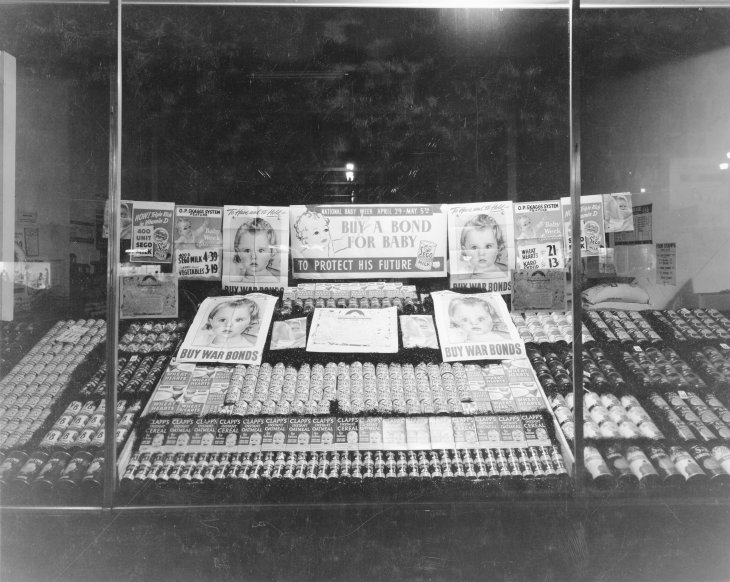
World_War_II_Bond_Drive_P_7-1

American Home Foods, window display, April 23, 1945; Shipler Commercial Photographers. Special Collections, J. Willard Marriott Library, The University of Utah.

By Eric U. Norris

During World War II, the war effort couldn’t be stressed more to the public than through the importance of buying stamps and bonds. The Utah Chronicle reported on April 8, 1943, that the University of Utah was starting a bond drive on April 19 with the goal of reaching $75,000 to buy a P-51 Mustang fighter plane by June 1. If the drive reached its goal the fighter plane would have the university’s name painted on its nose when it flew into its first battle. The Utah Chronicle made it a point to get young people involved and well informed in the war effort and contained multiple articles that detailed the development of the drive and how much money was raised.

The Utah Chronicle article “Easter Morn to Bring out Newest Fashions in War Time Clothing” mirrored many of the wartime efforts by magazines to encourage the purchase of war bonds. The majority of the article listed the newest spring clothing the campus coeds would be wearing on Easter Sunday. However, the author, Gladys Barker, tagged on at the end of the article, “It’s not wise to say that old bear ‘Vanity’ will not overcome that desire to save money for war bonds and stamps.” Its addition seems to contradict the theme of spending money on clothing yet it blatantly displays the obsession in raising money for the war effort.

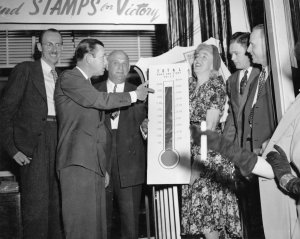
World_War_II_Bond_Drive_P_3-1

Donor Everett L. Cooley holds a chart indicating money raised for the War Fund Drive, May 1942. From left: Arthur Gaeth Dommenter; J. Fielding Smith; E. J. Dreyfons; Mrs. Wm. Gibbs McAdoo. Special Collections, J. Willard Marriott Library, The University of Utah.

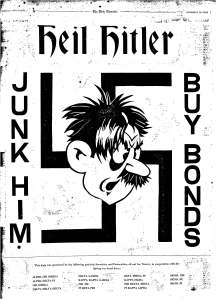
World War II brought out this involvement from the public to support itself. Basically, those who weren’t drafted were encouraged to buy stocks and stamps to fund those who were involved in the war — some of whom were University of Utah students. The overt patriotism that came up after the United States entered the war really shows in some of these articles and advertisements. One ad filled the entire page of an April issue of the Utah Chronicle. It depicted a caricature of Adolf Hitler with a swastika in the background. On the left side it read “JUNK HIM” and on the right side it read “BUY BONDS.” World War II was presented and is often remembered as a very black and white, good versus evil type war. The Nazis and the Axis Powers were considered evil and the US and its allies were good, so it was very easy to assimilate a communal aspect to the American public, and on a smaller scale, to the students at the University of Utah, especially when the majority of information people received about international affairs were from printed publications.

hitler ad

Utah Chronicle, April 29, 1943.

The drive worked as a great marketing ploy to get students to help out. By contributing to the drive, students were aiding the US in its quest for victory, and their school’s name would be on that fighter plane attempting to achieve it. The Utah Chronicle went as far as writing an article on April 29 that Nazi forces would infiltrate the campus on Friday, April 30, in an attempt to dissuade anyone from purchasing any securities in the form of war bonds and stamps. This article, “Nazi Forces to Blitz Utes on Friday,” read as a letter from Colonel Reinhart Von Schlubbe, but it wasn’t true. However, it sparked a reaction by students and resulted in a total of $1,000 in stamps and bonds that were bought that day despite the alleged raid, according to The Utah Chronicle’s May 6 article “Nazis Leave After High Stamp Sale,” which, of course, included a reminder about the bond drive and when and where to purchase bonds and stamps.

Despite the effort put into the advertising and emphasis in the articles for war bonds and stamps, the drive itself didn’t do well. The Utah Chronicle also reported on May 6 how the University of Utah only gathered $8,000 in five weeks for the drive, while the “high school down the street” managed to raise $45,000 in eight days. To add on, it brought the patriotism of the university into question and challenged the students to answer by buying more bonds and stamps. While the cause for the drive was to raise money to aid the military, the reward for reaching the goal made it look like it was a popularity contest. It felt that the U was trying to be the school that could say, “We raised the most money! We rallied for the cause! And now our name is immortalized in this war on the nose of a P-51 Mustang Fighter Plane!”

Eric U. Norris is a senior at the University of Utah. He’s majoring in communication with an emphasis on journalism. He is also a senior staff writer for SLUG Magazine.

Sources

Martin Tubbs, “U Sponsors Plane in Stamp Drive,” Utah Chronicle, April 8, 1943, 1.

Gladys Barker, “Easter Morn to Bring out Newest Fashions in War Time Clothing,” Utah Chronicle, April 22, 1943, 3.

Nazi Forces to Blitz Utes Friday,” Utah Chronicle, April 29, 1943, 1.

Advertisement, “Heil Hitler: Junk Him; Buy Bonds,” Utah Chronicle, April 29, 1943, 3.

Nazis Leave After High Stamp Sale,” Utah Chronicle, May 6, 1943, 1.

Bond Drive Shows Little Enthusiasm,” Utah Chronicle, May 6, 1943, 2.


Preparing for War: How the University of Utah Handled the Effects of World War II

By Lindsay Montague

The year was 1940 and World War II was into its second year. The United States had not declared war yet but on September 16 the US instituted the Service Act of 1940, which required all men between the ages of 21 and 45 to register for the draft. This age requirement was lowered to 18 in 1942. Many young American men were impacted by the draft, including students in college or planning to go to college. The University of Utah saw the impact of this Act and also prepared to do its part in the war effort.

U Archives President Cowles

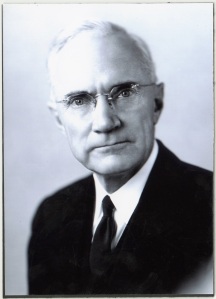
University of Utah President LeRoy E. Cowles. Special Collections, J. Willard Marriott Library, The University of Utah.

According to the book, University of Utah and World War II by LeRoy E. Cowles, president of the university from 1941 to 1946, there was a decrease in student enrollment for the 1941 fall semester. (p. 27) This was in contrast to the pattern of an increase in enrollment for the previous ten years. “There would certainly have been an increase in 1941 instead of a decrease, had it not been for the impending war,” Cowles wrote. (p. 27)

This was just the beginning, and the effects of the war grew. A few months into the semester came the attack on Pearl Harbor on December 7, 1941, and then the US officially entered World War II. Three days later, The Utah Chronicle published a letter to students from President Cowles. “We are at war!” he wrote. “I know you will do your duty. University students are noted for their patriotism and their idealism. They have always been among the first to respond and among the most valiant when our country has needed them.”

U Archives B Fieldhouse Interior Fd 1 #002

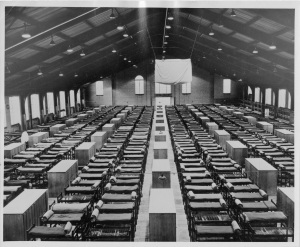
University Field House. Special Collections, J. Willard Marriott Library, The University of Utah.

What follows for the university is exactly that. The Utah Chronicle was constantly reporting on the university’s efforts during the war. On February 26, 1942, the Chronicle reported that “President Cowles has appointed a committee in charge of initiating, supervising, and coordinating the efforts of the institution.” With cooperation from the Committee on Civilian Defense and Military Affairs, Cowles appointed sub-committees to oversee the projects of four phases of the campus defense program. The committee also released a pamphlet known as the “University Defense Communique” for students and faculty members. The projects reported on included: 1. Air Raid Precautions 2. Information Service 3. Cooperative Recreation Program 4. Civilian Morale Service. Not only did the war mean more programs for the university, but it also meant physical changes for the campus. In 1943 the University Fieldhouse was converted to Army Barracks which hosted 1,000 military men. (Cowles, p. 152)

Utahchronicleadimage (2)

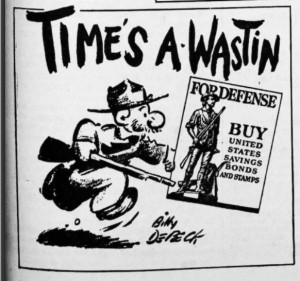
“Time’s A-Wastin”: cartoon promoting the purchase of savings bonds. Published in The Utah Chronicle on February 12, 1942.

As previously stated, The Utah Chronicle was a great source to inform students about campus and war events. It was also a source for advertisements, and the publication of letters and accounts by students who were drafted, experienced a war event, or who participated in local civilian defense efforts. In one article titled “University Student Gets Taste of War,” published on February 19, 1942, student Ralph Chalker told his story about returning from Hawaii when war was declared. According to the article, “Fear of a Japanese attack was the first reaction of passengers,” considering that their ship was within 100 miles of the torpedoed Matson freighter. They returned safely and half a day early as the ship had increased its speed. Advertisements geared toward students would notify them about events on campus that boosted war morale or those of which the proceeds went toward the war. Both an article in The Utah Chronicle and an advertisement published on February 19 urged students to support the “War Relief Dance.” People were urged to “Be Patriotic!” as all the proceeds would go to support local war relief societies.

Many of the changes made to the University of Utah are still relevant today. According to an overview of the university during the years of the Great Depression and World War II, the war brought forth developments to student programs, the establishment of a summer quarter, courses in meteorology and photography, expansion of engineering and medical programs, and an increase to the participation of women in works on and off campus. When the war ended on September 2, 1945, faculty and students celebrated and the student population doubled.

In the last chapter of President Cowles’s book, University of Utah and World War II, he writes:

The University is facing forward, not backward. She has passed through tragic depressions, and two great and destructive wars. She has grown and expanded in spite of limited rations. She is just beginning her maturity as a real Alma Mater. For decades and for centuries to come, she will grow in power and prestige, and will radiate intelligence, and make better living a reality. (p. 227)

Lindsay Montague is a student at The University of Utah. She is majoring in mass communication.

Sources

LeRoy E. Cowles, “To Students of the University of Utah,” Utah Chronicle, December 10, 1941, 4.

Billy DeBeck, “Times a Wastin’,” Utah Chronicle, February 12, 1942, 3.

University Student Gets Taste of War,” Utah Chronicle, February 19, 1942, 3.

“‘U’ Dance to Swell War Fund,” Utah Chronicle, February 19, 1942, 3.

Advertisement, ASUU War Relief Dance, Utah Chronicle, February 19, 1942, 2.

Morale Unit Appoints Sub Groups,” Utah Chronicle, February 26, 1942, 1.

LeRoy E. Cowles. University of Utah and World War II. Salt Lake City, Utah: Deseret News Press, 1948.

The Great Depression and World War II” and “Rapid Expansion, 1946-1964,” The University of Utah Sesquicentennial, 1850-2000.