
Introduction
Robert Frost, born in San Francisco, is best known as a New England poet — writing about quintessential rural American themes based on direct observations, according to his obituary in the January 30, 1963, edition of the New York Times. Success did not come quickly to the now-celebrated poet. The piece tells of the 20 years of writing and various jobs he busied himself with in the time before “A Boy’s Will” was published in England, 1913. Following Ezra Pound’s support of that publication, the path to recognition cleared and Frost began to teach again, lecture for audiences across the nation, and ultimately was awarded the Pulitzer Prize four times. (New York Times, 1963)
Findings
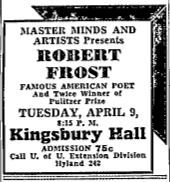
An advertisement that appeared in the April 5, 1940, issue of the Salt Lake Telegram.
It was during one of his lecture tours when Robert Frost found himself in Utah for a series of talks along the Wasatch Front. The Salt Lake Telegram reported in April 1940 that Frost first spoke in Logan the day before his April 9, 1940, University of Utah appearance and would be traveling to speak at the Provo Tabernacle the day after.
A Boy’s Will, North of Boston, Mountain Interval, New Hampshire, and West Running Brook were a few of his most popular works at the time, as reported in a March 28, 1940, issue of the Daily Utah Chronicle.
The Daily Utah Chronicle also noted this lecture marked the ninth and final event of the 1939-40 Master Minds and Artists series in its April 11, 1940, issue. Kingsbury Hall was scheduled to host the audience of students and members of the public alike that Tuesday, where Frost would regale them with “A Poet’s Outlook on Life,” described the April 9, 1940, copy of the Salt Lake Telegram. This article also revealed that the university extension division sponsored the program. (Salt Lake Telegram, 1940, pg 24)
On April 3, 1940, the Daily Utah Chronicle wrote that Mr. Frost was considered “one of the country’s most eminent contributors to the world of literature.” Being able to hear the poet tell his own story, from rural life, to personal stylistic choices, to his musings on academia surely would have been a treat.
 Indeed it was, for his “shrewd wit and good natured fellowship” garnered many laughs and claps from the full crowd. (Salt Lake Telegram, 1940, pg 20) Frost was quoted saying “he never bothered be radical when young for fear it would make him conservative when old,” in the April 11, 1940, issue of the Daily Utah Chronicle. This quote, the article reports, brought about a fit of laughter from the audience. In addition to slightly slandering philosophers and commenting on colleges, the April 11, 1940, Daily Utah Chronicle column ended by saying Frost read a selection of his short poems — The Road Not Taken among them.
Conclusion
In April 1940, Robert Frost spoke at the University of Utah. While his lecture brought laughs to those listening, it also left a legacy. Knowing that such an influential writer visited Salt Lake City is an amazing bit of history that seems to not have been researched and written about much since it happened. However, it shows that the U was influential enough to be able to coordinate such a visit.
Bringing speakers with diverse backgrounds to campus is a trend that has continued to today. Hearing people with upbringings that maybe aren’t so different from our own creates a richer perspective, even more so for university students about to bring their own knowledge into the world. Robert Frost, like other artists with such caliber, can speak to the human experience while enlivening their own works and enriching our lives.
Morgan Parent graduated from the University of Utah in 2019 with a Bachelor of Science degree in communication. She’ll be relocating to the Pacific Northwest in 2020 to pursue her next great adventure.
Primary Sources
“Master Minds Schedule Eminent Poet,” Daily Utah Chronicle, March 28, 1940, 3.
“Eminent Poet To Lecture Here Tuesday,” Daily Utah Chronicle, April 3, 1940, 1.
Advertisement for Lecture, Salt Lake Telegram, April 5, 1940, 24.
“U. Audience Waits Robert Frost Talk,” Salt Lake Telegram, April 9, 1940, 5.
“Robert Frost Talk Pleases Master Minds Series Audience at Kingsbury Hall,” Salt Lake Telegram, April 10, 1940, 20.
“Noted Verse-Writer Wins Applause With Poems, Tales,” Daily Utah Chronicle, April 11, 1940, 1.
Secondary Source
“Robert Frost Dies at 88; Kennedy Leads in Tribute,” New York Times, January 30, 1963.
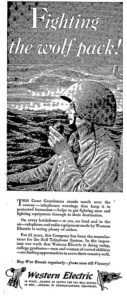
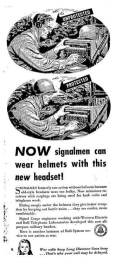
 Dr. Dilworth Walker, dean of the U’s school of business, announced the opening of a campaign to raise $2,500 for the war chest in a Utah Chronicle article published October 28, 1943, urged all university students, faculty and employees to contribute to the Salt Lake County War Chest.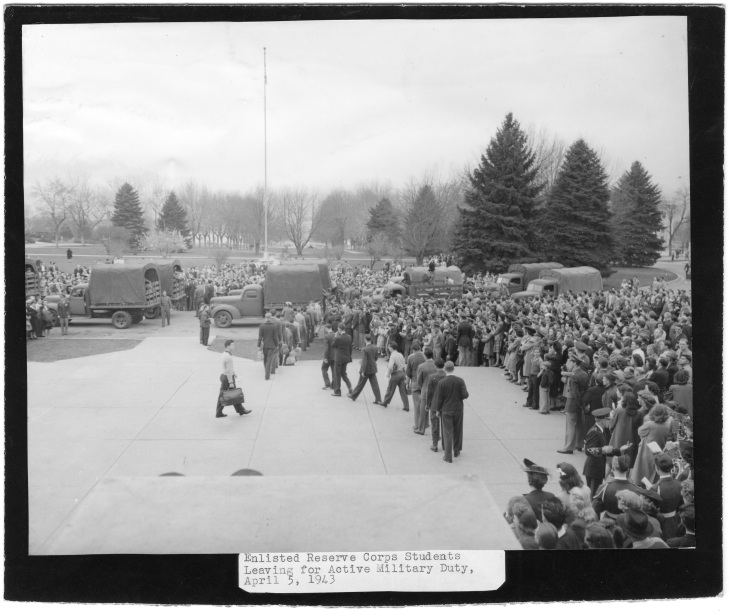
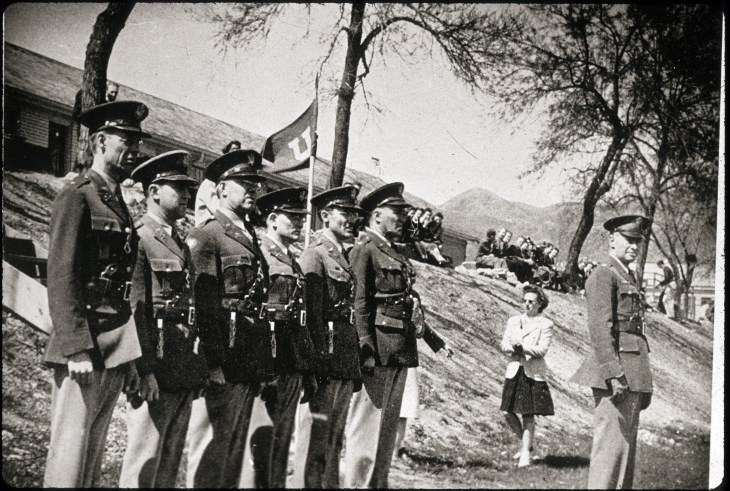

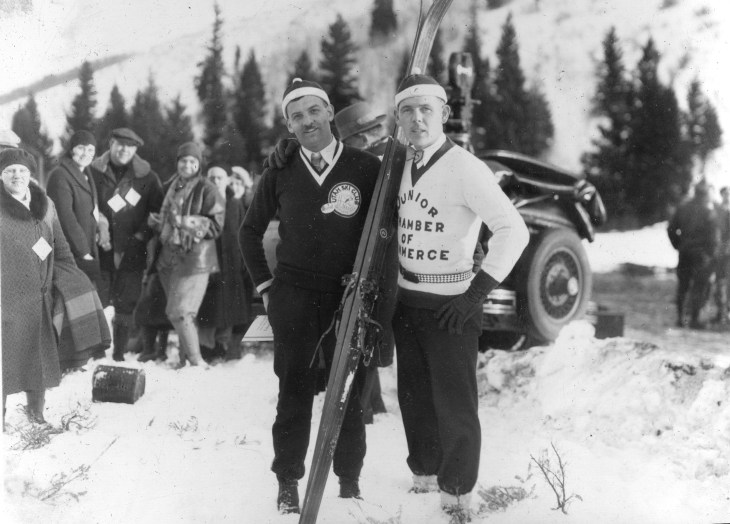
 If you were to open up an issue of the Utah Chronicle during the early to mid-1940s, you might find an advertisement in large, looping scroll advertising the next big jazz band in town. There were two “hoppin’ places” in this time, The Empire Room and The Rainbow Randevu, which later become known as the Terrace Ballroom. So, what happened to these iconic spots that, for decades, played such a large part in the music and nightlife culture of Utah?
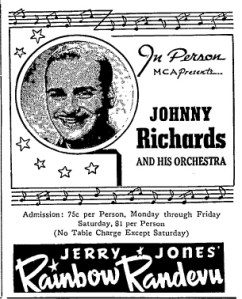 Joining the Empire Room at Hotel Utah, sandwiched between 400 and 500 South on historic Main Street, was the Coconut Grove. The Grove was advertised as the largest ballroom dance in the country. At the start of World War II, the name would be changed, yet again, to the Rainbow Ballroom and eventually became Jerry Jones’s Rainbow Randevu — or The Rainbow colloquially. It wasn’t until the 1960s that it was ultimately given the name Terrace Ballroom.
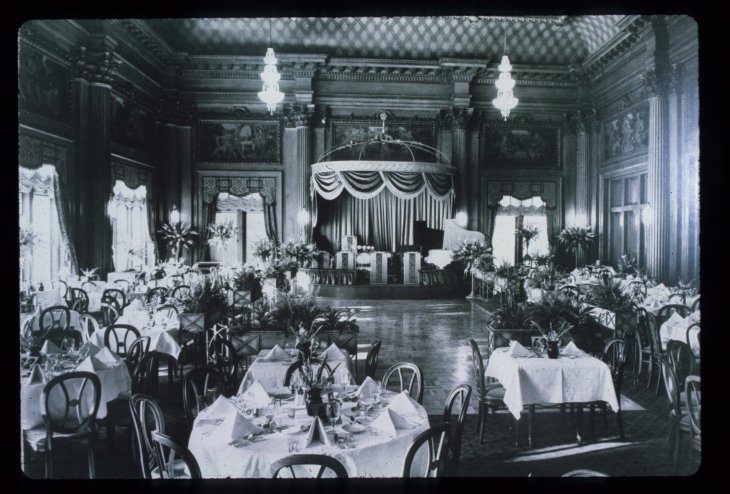 After 76 years of hosting visiting celebrities, politicians, parties and enjoying “minor celebrity status” in Utah, the LDS Church announced the closure of Hotel Utah in 1987 and it was converted into what we now know today as the Joseph Smith Memorial Building — an exceedingly elegant office building and visitors center. (Davidson) Coincidentally, this same year the Terrace Ballroom fell accident to a building fire during its demolition. The Provo, Utah, Daily Herald at the time called the demolition “an inelegant and unfair epitaph” for the beloved political and musical site that was enjoyed for over five decades. (“History Comes Tumbling Down”)
 An article in the Salt Lake Tribune describes the venue in its “heyday” saying, “Jerry Jones and his orchestra played big band sounds and hosted regular dance nights. For many in the 1940s and ’50s, it was the place to be on a Friday or Saturday night.” (Smart) This venue continued to shape Utah’s counterculture. In another interview with the Tribune, Steve Williams, jazz host for decades at KUER, said of the scene in the 1960s, “I had no idea how many hippies were in Utah. It blew my mind.” (Smart)




 In contrast to the secrecy that the club holds today, on March 28, 1940, The Utah Chronicle’s front page read, “Skull and Bones Honors 11 Prominent Juniors.” In this article two University of Utah students, Joe Dyer and Glen Craig, were selected for Owl and Key membership. The Utonian, the University of Utah’s yearbook, even has a page dedicated to the Skull and Bones Bonesmen with a list of names and their yearbook photos for the 1934 Junior Bonesmen.
 This king of hazing was depicted in the insightful illustration by Roger Hammond that was published on September 26, 1940, in The Utah Chronicle. It provided the opportunity for those looking back at the university’ss history in order to gain a better understanding of something that would now be considered hazing and perhaps unethical. Yet, this hazing was once a staple tradition in many American colleges. Hammond’s illustration consists of a young man, wearing a dink, looking down as he is being heckled by his sponsor upperclassmen. Often times sponsors were older students who were there to orient the incoming students. Some of the phrases that appear to fly out of the sponsor’s mouth include: rules and typical things one even nowadays tells a freshman, such pointing out the locations of buildings on campus. A statement that stands out as oppressive is “Wear your green cap all year!”
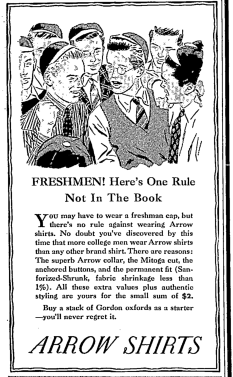 Messages like these were seen all across the nation; these hazing acts were nothing out of the ordinary. The rules became something that freshmen had to know by heart if they wanted to avoid the repercussions. They became like a rule book to follow. Knowledge of these rules was so common that companies used them to their advantage, as seen by this advertisement for Arrow shirts that was published in the Chronicle on September 26, 1940.

 Utah Communication History Encyclopedia