The Civilian Conservation Corps and the Building of Zion National Park

by AMY D. WILDE

Photo courtesy of the Special Collections Department, J. Willard Marriott Library, The University of Utah.

Zion National Park is one of the United States’ natural hidden treasures and would not be the utopia that it is today without the efforts put forth by the Civilian Conservation Corps. Also known as the CCC, this program was created to help sustain jobs and to give opportunity to the young unemployed men of the United States as well as to improve public lands during the Great Depression of the 1930s.

Signed as a national park in 1919, Zion is one of Utah’s best-kept secrets and the first national park of the state. Mukuntuweap Canyon, which was the original name for Zion Canyon, was the  “cool habitat that became the home for the first people of Utah … around 11,000 B.C.,” writes David Oswald in his book, A Journey Through Mukuntuweap: The History of Zion National Park. Located in the southeast corner of the state, Zion is a spectacular Park that can only be accessed by one double-lane state road, which is closed to public traffic in the summer months. Instead, visitors ride park-run busses that help keep the park almost emission free, clean and pristine. One thing that is more than likely forgotten by the visitors who come to the park is the history and how it came to be. Zion not only has a rich history of Native American culture but also an opulent history that involves the growth sustainability of the United States as a country.

President Franklin Delano Roosevelt established the CCC on March 31, 1933. The organization was created to fight against soil erosion and declining timber resources by utilizing unemployed young men from large urban areas across the country. It is said that “the speed with which the plan moved through proposal, authorization, implementation and operation was a miracle of cooperation among all branches and agencies of the federal government. It was a mobilization of men, material and transportation on a scale never before known in time of peace.” (CCC Legacy) After establishment the program boomed, and held great public support with hundreds of thousands of young workingmen enrolling every day.

Zion Canyon, Zion Lodge, circa 1930. Photo courtesy of the Special Collections Department, J. Willard Marriott Library, The University of Utah.

The Zion Camp was established in June 1933 and began to flourish not too long after. A newspaper ad from the Garfield County News on September 9, 1941, ran with a title, “Openings Announced in Zion CCC Camp.” An excerpt reads, “During this period of National Emergency there is a great demand for trained workers and the Civilian Conservation Corps performing its share of training young men for better jobs.” It gave insight into the demand for workers and the scarcity of position openings at the camps during their peak years. During the nine years that the CCC spent creating Zion, members “built and improved many of the Zion Canyon’s trails, created many of the parking areas, fought fires, eradicated invasive plants, helped build campgrounds, built park buildings, and reduced flooding of the Virgin River.” (NPS)

The booming year for the CCC camps was 1935 and by the end of the year, there were over 2,650 camps operating in all states. In total, $322,682 was spent expanding the Zion National Park through the CCC, according to Wayne K. Hinton in his 2011 Utah Historical Quarterly article. California had more than 150 camps, each housing over 6,000 people. CCC enrollees were performing more than 100 kinds of jobs and skills. Some of the specific accomplishments of the Corps included 3,470 fire towers erected; 97,000 miles of fire roads built; 4,235,000 man-days devoted to fighting fires; and more than three billion trees planted. (CCC Legacy)

For payment, the men were given somewhere to sleep, food to eat and clothing to wear, and made about $30 a month. Most of them kept $5 and the remaining $25 was sent home to their families. (Oswald) Topics regarding the “hearty Army meals and menus,” the clean hospitality that was given to the workers, as well as the hefty budget that was dedicated to running the camps can be seen in an article from the Kane County Standard on February 15, 1935. The reporter writes, “When the American boy of today goes into the woods he takes his appetite with him no less than his older brother took and appetite to war in other days.” Men gained an average of “9 ¾ pounds” after working in the camps for only three months, according to an article form the Iron County Record published on March 8, 1934. This information was noteworthy news because of the Great Depression in which the rest of the country was rationing food and supplies. Working for the CCC was not only beneficial to the country, but also for the workingmen who got the opportunity to enroll.

The men spent all week completing backbreaking jobs around the park, including building the 1.1-mile tunnel through a solid mountain. But they still had the energy to spend time taking hikes throughout the park on the weekends. One example of this is from the diary of Belden Lewis, a CCC enrollee who worked in the park from 1934-1935.

“I went on a long hike. First to West Rim, then on the way back Widdison and I went to Angels Landing and signed our name in the autograph book. The hike was at least 25 miles long round trip and we were tired.”

These places that Belden mentions are some of the most popular hikes in the Park and today are very frequently traveled trails, which were created by the CCC. “The main roads and trails of the canyon were built, including the trail to The Narrows by the men of the CCC.” (Larson) The men worked extremely hard on creating the beautiful park that we see today, but also had the amazing opportunities to explore the park themselves.

The CCC did wonders for Zion and almost the entire park holds the history of this hard time for the United States. When the Civilian Conservation Corps’ work in Zion was ended in 1942, many of the men were able to transition from structured CCC life to the structured life of a military man as they fought in World War II. The CCC was essential in the creation of Zion and without their work it is hard to say what would have became of the canyon, if anything.

Today, more than 2.5 million curious patrons visit Zion National Park annually, and many hope to catch a glimpse of the sun rising on the Towers of the Virgin. In the summer months, busy sightseers crowd the paths like sidewalks in New York City during rush hour, and walk upon trails created by the CCC. Zion National Park holds nothing less than the jaw-dropping landscapes and awe-inspiring cliff faces one would assume. There is nothing like it in the world and without experiencing this veiled sandstone treasure with your own eyes, you cannot say that you have seen the earth’s natural true beauty.

Amy D. Wilde is a senior at The University of Utah. She is majoring in mass communication and minoring in international studies.

Sources

“Openings Announced in Zion CCC,” Garfield County News, September 9, 1941, 1.

“Supt. Patraw Praises CCC,” Kane County Standard on February 15, 1935, 1.

“Men of CCC Camp in Good Condition,” Iron County Record, March 8, 1934. 1.

“CCC Camp Now Located at Zion Nat’l. Park,” Iron County Record, August 2, 1934. 1.

Wayne K. Hinton, “Getting Along. The Significance of Cooperation in the Development of Zion National Park,” Utah Historical Quarterly (2000): 313.

Karl A Larson, “Zion National Park—Park with Some Reminiscences Fifty Years Later,” Utah Historical Quarterly (1969): 408I.

David Oswald, A Journey Through Mukuntuweap: The History Of Zion National Park (Scotts Valley: CreateSpace, 2009).

J.L. Crawford, Zion National Park: Towers of Stone (Albion Publishing Group, 1988).

Zion National Park Museum, “The Diary of Belden Lewis,” 1934-1935.

National Park Service, “Civilian Conservation Corps,” http://1.usa.gov/HjZiGs

“CCC Brief History,” Civilian Conservation Corps Legacy, http://bit.ly/Hiaym9
The World War II Japanese Relocation Center in Delta, Utah

by WES A. HANCOCK

In the early morning of December 7, 1941, a large Japanese naval fleet attacked the U.S. Navy that was docked in the pier at Pearl Harbor. Most of the crew aboard these ships was still asleep when the attack began. The attack would last two hours, but in those two hours nearly 20 ships and 200 aircraft were destroyed, more than 2,000 men were killed, and nearly 1,000 more wounded. The following day President Franklin D. Roosevelt asked Congress to declare war. Congress approved the declaration of war against Japan, with only one vote against. The United States was now a part of the Second World War, with enemies on two fronts; the U.S. would have to fight two wars, one in Europe and the other in the Pacific. (History.com)

Within only a few months of the attack on Pearl Harbor, the American government and its citizens would succumb to the fear that Japanese-Americans were working for the enemy. On February 19, 1942, President Roosevelt would issue Executive Order 9066. This order would become one of the darkest stains in American history. This order allowed for the creation of what were called relocation camps. In reality they were not much different from the concentration camps found in Germany that were holding Jews. The U.S. camps were not for captured POWs; they were to hold Japanese-Americans, most of whom were citizens of the United States, and many of them were “Nisei,” the Japanese word meaning second generation, or Japanese who had been born in the United States. (HistoryMatters.gmu.edu)

The United States would build ten of these relocation camps, but for the  purpose of this paper I will focus mainly on the camp located in Delta, Utah, by Topaz Mountain, which is how the camp received its nickname, the Topaz Internment Camp. This relocation center would be in operation from September 11, 1941, to October 31, 1945.

During my initial research I was surprised to learn that a newspaper was printed at Topaz during the years of the internment camp. The paper was called the Topaz Times. The paper was started in an internment camp in California, the Tanforan internment camp, but when the Japanese-Americans who were living there were transferred to the Topaz internment camp in 1942, the paper changed its name to the Topaz Times. (Utah Digital Newspaper)

I could not imagine life as an interned prisoner, and that is exactly what the Japanese-Americans who lived at these internment camps were. They were not guests at a social club for a visit, they had been taken from their homes in America, relocated across the country and forced to live in these camps. But when you read the first issue of Topaz Times, those who wrote the articles in the paper try to paint a very different picture.

The first thing you see on the front page of the first issue in large letters along the banner is, “Welcome to Topaz.” The project director of the camp, Charles F. Erast, wrote a column on the front page called “Greetings,” in which he wrote, “You will be shown every respect as befits the dignity and importance which belongs to every human being.” Many of the articles in this issue followed the same pattern, trying to convince the Japanese-Americans that they were in the best and most humane internment camp, and that it was in their best interest to be there. (Topaz Times, September 17, 1942, 1)

Comments were made that the Japanese-American who resided at Camp Topaz would enjoy luxuries such running water and toilets that flushed. The writers of the paper even went as far as changing the language and terms that the Japanese-Americans had become accustomed to at other internment camps. The “Mess Hall” became the “Dining Hall,” “Internal Police” would be known as the “Safety Council,” and the “Evacuees” were to be known as “Residents.” All these changes were attempts at creating the illusion that the American government/people had done nothing wrong by imprisoning Japanese-Americans solely on the connection that they were descendants from Japan, and could be a potential enemy inside the borders of the United States. (Topaz Times, September 17, 1942, 2)

Though the United States believed that interning Japanese-Americans was the right thing to do during a time of war, the United States was exactly that, at war, and not just a war on one front but two. The United States needed men to fight on these two fronts, and they needed them badly enough that the idea of those who were in the relocation centers that could prove their loyalty to the United States would be allowed to enter military service and leave the camps.

It would seem that many Japanese-Americans who were at Topaz elected this option, for not only if they entered the service, those with family would be allowed to leave and live in homes outside of the relocation centers. An article in the Topaz Times called “Restrictions on Evacuees in Utah Counties Relaxed,” informs those who are considered fit for military service that they will be allowed to leave the camp with their family, and that when their husband leaves for the military the family will not be expected to return to the internment center. Simply put, they had earned their freedom; it might only cost them the life of their husband as he fought on the frontlines, for a freedom that had been taken away from them. (Topaz Times, April 19, 1944, 5)

I found it interesting that the United States had excluded an entire group of people from living among the general population, unless individuals proved their loyalty and served in the military. But the rest who could not serve or would not take the test to prove their loyalty would still be used in other facets. One article noted that the Japanese-Americans who were living in the relocation centers would be allowed to vote during an upcoming election. Here we have a country that was afraid that the enemy had people living within the United States borders, but would allow them to vote and influence who would be elected to office. The United States treated these people as an enemy by locking them up, taking away the basic right to live freely, but yet they were expected to vote in an election for the same government that had just taken their basic right of freedom away. (Topaz Times, April 12, 1944, 4)

As the war neared an end in the Pacific Front, opinion toward those interned in the camps would change as well. An article titled “The Nisei will Rise Again” gives light to those who elected to serve in the military. Even though they had been discriminated against they answered the call to rise and fight a war against what was called “a common enemy,” despite the fact that they were descendants of Japanese immigrants. It was said in this article that these men had proved beyond any doubt that they were faithful to the cause of democracy. (Topaz Times, April 6, 1944, 2)

At this same time in the nation, the war was coming to a close, though it was not known how the war was going to end. A published article discussed that the American people needed to start readying for the return and release of the Japanese-Americans who had been interned in the relocation centers. The article gave the sense that the American people now missed their American-Japanese neighbors, and that it was now time to make them feel welcome at home upon their return. (Topaz Times, April 12, 1944, 5)

I don’t know how I would react upon my release from a prison sentence, especially one that was imposed against me just because of my race or ethnicity. I don’t know how I would feel about the country that had just imprisoned me or if I would have any loyalty left toward such a nation. I wonder how many Japanese-Americans left the States, or even returned to Japan due to their treatment at these relocation centers. We have to remember the treatment of those that were forced to relocate to these camps, mainly so that we never make this same mistake in our history again.

Wes Hancock served in the United States Navy during Operation Iraqi Freedom and Operation Enduring Freedom. Upon discharge from active duty, he began his studies at The University of Utah, majoring in mass communication/new media with a minor in art and entertainment.


Sources

“Restrictions on Evacuees in Utah Counties Relaxed,” Topaz Times, April 19, 1944, 5.

Donald Culross Peattie, “Persecutors of Nisei Denounced by AAF Captain In TIME Magazine,” Topaz Times, April 19, 1944, 4.

“Nisei May Still Register for November 7 Elections,” Topaz Times, April 12, 1944, 4.

“Nisei Feels Like a Child ‘Kicked Out’ from Home,” Topaz Times, April 12, 1944, 5.

“The Nisei Will Rise Again,” Topaz Times, April 8, 1944, 2.

Charles F. Ernst, “Greetings,” Topaz Times, September 17, 1942, 1.

“Pearl Harbor,” History.com, http://bit.ly/h7rEKt

Franklin D. Roosevelt, “Executive Order No. 9066,” HistoryMatters, http://bit.ly/ft7KZ8

“Teaching with Documents: Documents and Photographs related to Japanese Relocation During World War II,” National Archives, http://1.usa.gov/695LHZ

“Topaz Times Archive,” Denso Digital Archive, http://bit.ly/yIjX9i

“About World War II Japanese-American Internment Camp Documents, 1942-1946,” Ancestry.com, http://ancstry.me/zfFSxh

“Topaz Times,” Utah Digital Newspaper, http://bit.ly/GZcdy3

Deseret News Marathon History

by CARA HASEBI

In 1847, the Mormon pioneers who had been traveling across the country trudged their way into the great Salt Lake Valley for the first time. Their first vision of the valley involved pulling handcarts down Big Mountain, up Little Mountain, down the other side of Little Mountain, through Emigration Canyon, until finally on the last turn they could see the vast desert valley that would be their home. More than 100 years later, folks from all over the country desire to trek through those same mountains over the same blessed ground in memory of the pioneer courage. Or, they simply love to run.

The first Deseret News Marathon was inaugurated in 1970. The course has become known as being “too difficult,” and Haraldsen notes it was the first such organized race west of the Continental Divide. It was originally named the Pioneer marathon, though the Deseret News was the marathon’s largest sponsor from its beginning. The name was eventually changed to reflect the sponsor but it is still held on Pioneer Day (July 24th) every year.

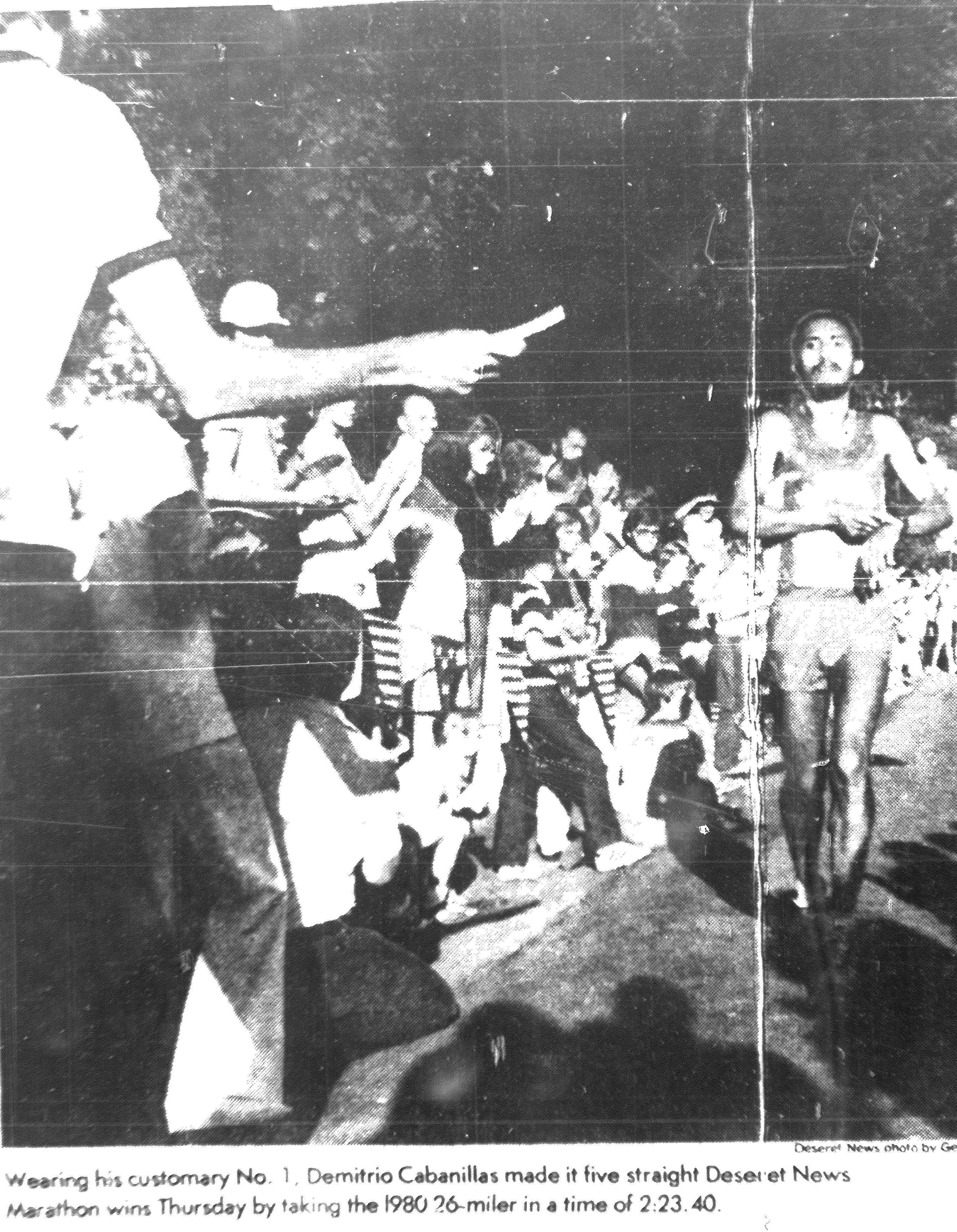
Demitrio Cabanillas won five straight Deseret News Marathons. In 1980, he competed against the largest field in the marathon's history and crossed the tape first with a time of 2:23:40. Published in the Deseret News, July 24, 1970.

According to a Deseret News article published July 24, 1970, the marathon started out small, with only 73 entrants, all of whom were men. The race gained in popularity and by 1980, more than 1,500 runners entered the race, according to a post-race article in the Deseret News. The popularity of running in Utah and specifically the Deseret News Marathon may be attributed to a national and religious fitness movement.

In 1980, the same year as the record number of Deseret News Marathon race participants, President Jimmy Carter spoke at the first ever Conference on Physical Fitness. Of the 15 priority areas created for national health, Physical Fitness was named as one of them. President Carter was a runner himself; he mentioned at the conference that he often jogged around the White House grounds with his wife. He also mentioned at the conference that the number of Americans who exercised had doubled between 1970 and 1980.

The number of race participants in the Deseret News marathon in that time had increased by a factor of 20. In a November 6, 1978, New York Times article, a spokesperson for the American Medical Association is quoted as saying, “there is unquestionably a greater awareness of the body and preventative medicine than 10 years ago.”

Utah was not absent during the rising national interest in fitness. The leaders of the Mormon Church, headquartered in Salt Lake City, found importance in physical fitness as well. Physical health is a key component in the Church of Jesus Christ of Latter-day Saints (Mormons). An article by an LDS member and marathoner appeared in the official church magazine, the Ensign, in February 1981, detailing directions on how to begin jogging and work up to marathoning. Church members were not the only ones who contributed to the fitness dialog. In February 1979, a church official wrote an article in the Ensign. He  noted that every member should practice sound principles of nutrition, physical fitness, and weight control. The article specifically mentioned running marathons as a way to have better physical health. Additionally, Thomas S. Monson, an apostle of the church, spoke officially for the LDS church in a semi-annual conference in April 1982. “The Church of Jesus Christ of Latter-day Saints affirms the continued support of Scouting and will seek to provide leadership which will help boys keep close to their families and close to the Church as they develop the qualities of citizenship and character and fitness which Scouting represents.” (Monson) He mentioned in the same article that scouting is a great way to stay physically fit, and running is an option for boys seeking to pass scouting requirements.

Despite support at the national and local level, participation in the Deseret News Marathon declined gradually until in 2003 organizers made the decision to no longer hold the marathon. Haraldsen writes that the directors announced in March 2003 they would no longer continue holding the marathon each year. With the decline of runners registering for the race there wasn’t enough reason to continue it. There are two primary reasons the race does not attract runners. The course is difficult with its many rolling hills, and the race is not considered “fast.” Also, on July 24th Salt Lake City can hit extremely high temperatures. Doug Robinson of the Deseret News explains it this way: “From its inception, the Deseret News Marathon has been largely the domain of grass-roots runners…. World-class marathoners, able to run only two or three marathons a year anyway, tend to look for fast marathon courses and fast times to promote their careers, and they’re unlikely to get either on a mountainous course at altitude in the heat of July.” Despite the decrease in the number of participants, the Deseret News Marathon received a message from the running community in Utah that it wants the Deseret News Marathon to continue. (Haraldsen, July 2003) Race directors listened to veteran runners’ pleas and decided to carry on with the race.

The growth of the Deseret News Marathon along with national and church health promotion is not purely coincidental. The rise and fall of national and religious physical fitness trends are displayed historically through organized marathon races. Although there are more options when it comes to marathons and the Deseret News course is more difficult to navigate, the Deseret News marathon is now in its 42nd year running — literally.

Cara Hasebi is an avid marathoner, having run the Deseret News Marathon several times.  She will be a senior at The University of Utah in Fall 2012, majoring in Mass Communication with a minor in Nutrition.


Tom Brown, “Price Runner Wins ‘News’ 47 Marathon,” Deseret News, July 24, 1970, B5.

Pamela G. Hollie,“Spas Thrive on Diet, Fitness Craze; Profits Mount For Owners,” New York Times, November 6, 1978, 82.

Marvin K. Gardner, “Staying Prepared,” Ensign (February 1979): 24

Jimmy Carter: National Conference on Physical Fitness and Sports for All Remarks at the Opening Session of the Conference,” February 1, 1980, accessible at The American Presidency Project, ed. Gerhard Peters and John T. Woolley.

Lee Benson, “Cabanillas makes it 5 in a Row,” Deseret News, July, 24, 1980, D1.

Scott S. Zimmerman, “Running Away from it All,” Ensign (February 1981).

Thomas S. Monson, “Run, Boy, Run!,” Ensign (October  1982).

Doug Robinson, “DNews Marathon: A Tale of Endurance,” Deseret News, July, 23 1994.

Tom Haraldsen, “July 24 marathon tradition coming to an end,” Deseret News, March 25, 2003.

Tom Haraldsen, “Marathon may get new life,” Deseret News, July 16, 2003.


Pretty in Print: Newspaper Accounts of Ted Bundy’s First Year in Utah

by APRIL ANTHONY CRITCHFIELD

The night of October 18, 1974, started out like any other: a young woman from Midvale, Utah, was meeting up with some friends for pizza. Her night, however, would end up far different than what she expected. No one but she and her attacker would ultimately know what happened, and her lifeless body, stashed in nearby Summit Park, would not be found for days to come.

“Girl Missing From Midvale” was the first of many articles that started a media frenzy concerning stories of several young women and their unexplained disappearances. The headline from The Herald, October 21, 1974, was simple. The article described the missing young woman’s clothes, hair color and when she was last seen. Hope was still in the air that she might be found alive.

Days later, more articles started to flood the local Utah newspapers, including The Herald, in Provo, the Ogden Standard-Examiner, and The Salt Lake Tribune. The newspapers had one thing in common: they wanted to find out what was happening to these young women, and who was responsible. Headlines ranged from “Police Press Search for Girl, 17,” which appeared in The Salt Lake Tribune on October 22, 1974, to “Hunt Goes On, Slayer of Girls Eludes Identification, Arrest,” which was published in the Tribune on December 8, 1974.

Panic was spreading across the state as The Salt Lake Tribune reported on October 28, 1974, that the first missing young woman had been found dead. “She had been shot in the back of the head. A stocking was knotted around her neck,” noted the article. Police didn’t know how someone could have done something so heinous, so inhumane.

A few weeks later, on November 12, 1974, the Ogden Standard-Examiner printed a story about a young woman — who remained anonymous in the newspapers — who had survived an attempted kidnapping at Fashion Place Mall, in Murray, Utah. The article also notified the public of yet another young woman who was now missing from Bountiful. The anonymous victim’s vivid account of what happened to her that fateful night at the mall would ultimately be the key to linking one man, Ted Bundy, to these heinous crimes.

"Sketch composite of Bundy." The Salt Lake Tribune, November 14, 1974.

Although Bundy was finally arrested for kidnapping numerous women, and later murdering them, initially the Salt Lake City police were having a hard time linking Bundy to the reported crimes. “We are attempting to determine if there is similarity in all the acts or if they have been committed independently,” said Salt Lake County Sherriff’s Captain Pete Hayward in the Standard-Examiner. There were no witnesses, Bundy had no accomplices, and except for the anonymous young woman who managed to escape, his victims never got away. The woman’s description of Bundy’s car, his clothes and a sketch composite she provided were the only real pieces of information authorities had to go on.

The woman’s sketch of “Abductor Sought” finally appeared in The Salt Lake Tribune on November 14, 1974. It was the first paper in Utah to publish a sketch of the attacker. Police Captain Hayward said, “We’re back to beating the bushes,” as a result of having to release a 21-year-old suspect for lack of evidence.

From October to December 1974, the newspapers printed continuous information about at least three missing women — some of whom were never found, some of whom were later found dead — and the lack of leads in the cases. It wasn’t until one year later, in October 1975, when the Ogden Standard-Examiner published a headline, “Utah Student Seized in Attempted Murder, Kidnaping [sic],” that Ted Bundy’s name would be associated with the crimes. Once the public found out the suspect’s name, and that he was a University of Utah law student, the associative descriptive identity seemed to be inserted into every headline reporting on this unfolding story.

Also, that same month, the anonymous woman was finally publicly identified as Carol DaRonch. When The Salt Lake Tribune published a headline, “U. Law Student Charged in Kidnaping [sic],” the public finally had a name to attach to DaRonch’s assailant: Ted Bundy. DaRonch’s account paid off, and Bundy was arrested, not for the previous missing women, or their murders, but for the attempted kidnapping of DaRonch.

The Standard-Examiner article reported that Bundy had been charged with the murders of two 17-year-old young women, and the disappearance of a third in Northern Utah. The Chief Deputy for Criminal Prosecution, William R. Hyde, claimed at one point the Salt Lake City Sherriff’s office was dealing with a different serial killer at the time, and some thought that Bundy could also be “The Zodiac Killer.” Hyde refused to comment on too many details and also “clamped a news blackout on local investigators.” Gerald Kinghorn, a Salt Lake County deputy attorney, said Hyde was “fearful of creating too much pre-trial publicity.”

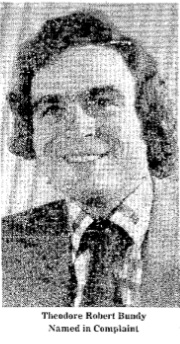
The Salt Lake Tribune published on October 3, 1975, “U. Law Student Charged In Kidnaping [sic].” The story began, “A University of Utah law student was charged Thursday,” which stimulated ideas that Bundy was smart and well educated. The article provided additional background information and reported that Bundy was a second-year law student who “had served as a campaign assistant for the Republican chief executive.” In addition, Bundy “was assistant director of the Seattle Crime Prevention Commission in 1973, and received publicity when he reportedly captured a purse snatcher.” The article included the first photograph of Bundy, dressed in a suit and tie, and clean-shaven.

Serial killers have long been associated with being smart, sly, cunning, and persuasive. Ted Bundy had more than just a bachelor’s degree in psychology (The Salt Lake Tribune, October 3, 1975); he had the newspapers rallying behind him supporting that thesis. By reporting his status in education and his community efforts, the media inadvertently drew attention away from the fact that he was the lead suspect in an attempted kidnapping and aggravated murder charge.

"U. Law Student Charged in Kidnaping," The Salt Lake Tribune, October 3, 1975.

Bundy released his own statement to the newspapers, which appeared in The Salt Lake Tribune on October 5, 1975, under the headline “Friends ‘stand by’ him, Kidnap suspect claims.” Bundy states, “My friends have been a source of great support … this is something that makes you feel that you’ve accomplished something in life.” By allowing Bundy to reach out to his supporters, it was as if the newspapers were allowing him to tell his side of the story. The Ogden Standard-Examiner also reported news from Bundy’s parents. The October 12, 1975, article headlined, “Utah Suspect Once Checked in 6 Deaths,” described their disbelief that their son could do something so terrible. His mother recalled, “Our daughter (19) was going out that night and Ted said, ‘Mom, I hope you know where she’s going and who she’s with.’” Including the recollections of Bundy’s parents helped support the notion that he was too clean-cut of a guy to do this type of crime. He was definitely prettier in print. The article also included his studies at the University of Washington and his “decision to study in Utah and become a Mormon.”

By November 27, 1975, one year after the first crime, the police were still trying to link Bundy to the previous crimes. At that time, he was only arrested for attempted kidnapping. The Ogden Standard-Examiner reported: “Law Student Bound Over in Kidnaping[sic]; 2nd Charge Erased.” According to the judge, “There is no reason to believe that another crime occurred.” Still, Bundy was only accused of kidnapping, and the attempted murder charge had been dropped. The judge went on to reprimand reporters for causing speculation and trying to link Bundy to the previous murders. Later in the article, once again, Bundy’s accomplishments are listed: “The suspect is a second year law student at the University of Utah and a former campaign aide to Washington Gov. Daniel Evans.”

The media created a sensation following a man who many believed could not have committed such a crime. By November 1975, Bundy was not known as a serial killer, nor had he been officially linked to the murders of several young women in Washington, Colorado, and Utah. Bundy was not convicted of kidnapping DaRonch until March 1976. At the time, he was also on trial for the murder of a Colorado woman, Caryn Campbell. In June 1976, Bundy was sentenced to one to fifteen years in prison for aggravated kidnapping and one year later, he escaped. He was found a few days later and returned to prison. In December 1977, he escaped again and fled to Florida. Bundy was finally found and arrested in Florida while driving a stolen vehicle.

In 1989, Bundy received the death sentence. According to Ann Rule, “Two days before his death, Bundy admitted to killing a score of other women and girls in Washington, Colorado, Utah, Oregon, and Florida.” (Rule, cited by Saltzman, 1995) Bundy was executed by electric chair at dawn on January 24, 1989, at Raiford Prison in Starke, Florida.

April Anthony Critchfield is a senior at the University of Utah. She graduated in August 2012 with a Bachelor of Science degree in speech communication.

Sources

Bundy Tests Utahn On Kidnap Details,” The Salt Lake Tribune, November 17, 1977.

“Utah Woman Positive: Bundy Was Kidnaper,” The Herald, November 17, 1977.

“Bundy’s Attorney Requests Disclosure of Evidence,” The Salt Lake Tribune, December 23, 1975.

“Defense Asks ID Pictures,” The Herald, December 23, 1975.

Peter Gillins, “Law Student Bound Over Kidnaping; 2nd Charge Erased,” Standard-Examiner,” November, 27, 1975.

Ken Connaughton, “Ruling Wednesday – Bundy Receives Closed Hearing,” The Herald, November 25, 1975.

“Blood Sample Ordered In Law Student Case,” The Herald, October 16, 1975.

“Suspect Thanks Seattle Friends,” The Herald, October 13, 1975.

“Utah Suspect Once Checked in 6 Deaths,” Standard-Examiner, October 12, 1975.

“Parents Defend Son in S.L. Jail,” The Salt Lake Tribune, October 10, 1975.

“Bundy Arrest Sequence,” The Herald, October 6, 1975.

“Kidnap, Slay Try Suspect Stayes [sic] in Jail Without Bail,” The Herald, October 5, 1975.

Clark Lobb, “Friends ‘Stand By’ Him, Kidnap Suspect Claims,” The Salt Lake Tribune, October 5, 1975.

Peter Gillins, “Utah Student Seized in Attempted Murder, Kidnaping,” Standard-Examiner, October 3, 1975.

Clark Lobb & Tom McCarthey, “U. Law Student Charged in Kidnaping,” The Salt Lake Tribune, October 3, 1975.

“Girl Slayings,” The Herald, December 25, 1974.

Clark Lobb, “Hunt Goes On, Slayer of Girls Eludes Identification, Arrest,” The Salt Lake Tribune, December 8, 1974.

“Police Chase Leads In Kidnap-Murders,” The Salt Lake Tribune, December 5, 1974.

“For Slayer of Midvale Girl Secret Witness Posts Reward,” The Salt Lake Tribune, November 19, 1974.

“Police Artists’ conception of a suspect,” The Herald, November 17, 1974.

“Missing Girl Abductor Sought,” The Salt Lake Tribune, November 14, 1974.

“Police Try to Link Kidnapings,” Standard-Examiner, November 12, 1974.

“Intermountain Area Obituaries – Melissa Smith,” The Salt Lake Tribune, October 29, 1974.

“Chief’s Daughter Found Dead,” The Salt Lake Tribune, October 28, 1974.

“Police Press Search for Girl, 17,” The Salt Lake Tribune, October 22, 1974.

“Girl Missing From Midvale,” The Herald, October 21, 1974.

Associated Press, “Ted Bundy Timeline,” Deseret News, February 13, 1999.

Rachelle H. Saltzman, “‘This Buzz Is For You’: Popular Responses To the Ted Bundy Execution,” Journal Of Folklore Research 32, no. 2 (1995): 101-119.

Flood Watch 1983: Newspaper Coverage of the Flooding of Thistle and Salt Lake City

by JAMES STARBUCK

During the spring of 1983, Utah was awakening from one of the wettest winters on record. The previous year saw record precipitation and, in the latter part of 1982, summer rains continued through the fall. Rainfall eventually turned to winter snows and, in the process, saturated the ground beyond its capacity. What was left in the spring was an unusually large snowpack that was waiting to release its moisture down the mountain streams. In normal years the snowpack melts slowly due to air temperatures that gradually warm through late June. This particular season, however, saw a very rapid warm up that created an equally rapid snowmelt and high run-off that overwhelmed local streams, buried a town underwater, and turned streets into rivers.

Throughout this record water year, each new storm was adding to a narrative that would become the prominent news story from mid-April through mid-June 1983. This narrative was conveyed through the two local newspapers, The Salt Lake Tribune and the Deseret News, and each story seemed to be a precursor to the subsequent stories that followed.

What would follow was a flood that had a lasting impact on Utah’s capital city and northern Utah, in general. This flooding was the result of heavy precipitation that accumulated during the 1981-82 water year, which began in October 1981, and culminated in September 1982. According to Linda Sillitoe in her article, “Floods,” it was a “water year that had broken all records; then September 1982 climaxed with ten times more moisture than normal.” Within this last month of the water year, saturated ground turned to mudslides that closed Big and Little Cottonwood canyons and flooded creeks to the point that the state’s Governor, Scott Matheson, declared a state of emergency, although federal aid was denied. (Sillitoe) September’s floods paled in comparison to what the following spring had to offer.

By spring, March again saw record rain and snowfall on top of soil that had reached its limits of absorbing water, and this record moisture continued on through April 1983. The soil limitations became evident on April 15, when a mountainside in Spanish Fork Canyon began to move and forced authorities to close the canyon. This mudslide was threatening U.S. Highway 6 and two railroad tracks and could potentially disrupt transportation and interstate commerce. The Salt Lake Tribune reported on Saturday, April 16, 1983, that during the previous afternoon, “the highway was measured at rising about a foot an hour. It is now about 15 feet higher than the original roadbed.”

In contrast to the reporting in The Salt Lake Tribune, the Deseret News took the opportunity to report on the impact the slide would have on the last run of the Rio Grande Zephyr, “the nation’s last privately owned, inter-city passenger railroad,” that was scheduled to run on April 24. (Fackrell) Inclusion of this bit of information brought a somewhat personal, or humanistic, approach to the paper’s reporting.

As the slide began to dam off the Spanish Fork River, rising waters were threatening the nearby town of Thistle. On April 17, 1983, the Deseret News stated that crews were giving up on “trying to keep the road or the railway open through Spanish Fork Canyon and will now concentrate on keeping residents of Thistle and nearby areas from being flooded.” The Tribune reported that within Thistle, 72 families were evacuated “as water backed up behind millions of tons of heaving, sliding mud.” (Clark)

By Tuesday, April 19, 1983, this rising water was now being called Lake Thistle. The township of Thistle was doomed. Already, the 22 homes that occupied the area were inundated by the lake, now as deep as 50 feet, and The Salt Lake Tribune reported that the town “is up to its rooftops in gray water. Thistle may be no more.” The Deseret News again added a human touch by reporting that “some of the residents are staying with friends and relatives and others in trailers set up in the Canyon Ward church house.” (Ward, Martz)

Federal aid finally came to the residents of Thistle on April 30, 1983, as President Ronald Reagan approved Utah’s request for disaster status for the Spanish Fork slide.  The Salt Lake Tribune reported on May 1 that the “emergency declaration could provide family financial relief grants and temporary housing assistance.”

In areas surrounding Thistle, similar slides were beginning to form, such as in nearby Payson Canyon. The Salt Lake Tribune quoted Utah County Sheriff’s Lt. Gary Clayton as saying that the slide was “a loaded gun up there just waiting to go off.” (Raine) This was a common sentiment felt across all of northern Utah as other streams and rivers were beginning to feel the strains of the spring runoff.  On May 1, 1983, an article in The Salt Lake Tribune prophesied on the floods that would threaten Salt Lake City. The article noted that the National Weather Service expected heavy rains that would cause “flash flooding and standing water in intersections and underpasses throughout the Wasatch Front.” The article also noted that the snowpack, which was only beginning to melt, contained 33 percent more water than the previous year and would strain the streams already swollen with run-off and steady rain. (Clark)

It would be nearly a full month after the Spanish Fork slide that the areas located in Salt Lake County felt the brunt of the melting snowpack. Spring storms were still falling on northern Utah throughout May, and by mid-month it was evident that disaster would soon strike Salt Lake City. On May 17, the result of these storms was beginning to show as “the rain and snow filled Red Butte and Emigration Creeks to overflowing and in some areas the bubbling water flowed into curbs and gutters.” (Sorenson) It was the same story in the surrounding suburbs of Salt Lake City, and the nearby towns located in Davis and Utah counties, as the groundwater began to push above ground. Eventually, the rains were reduced to isolated storms, but in their wake the makings of a “worst-case scenario” was brewing.

Sandbagging efforts created manmade rivers in Salt Lake City over Memorial Day weekend in 1983. Courtesy of Special Collections, J. Willard Marriott Library, The University of Utah.

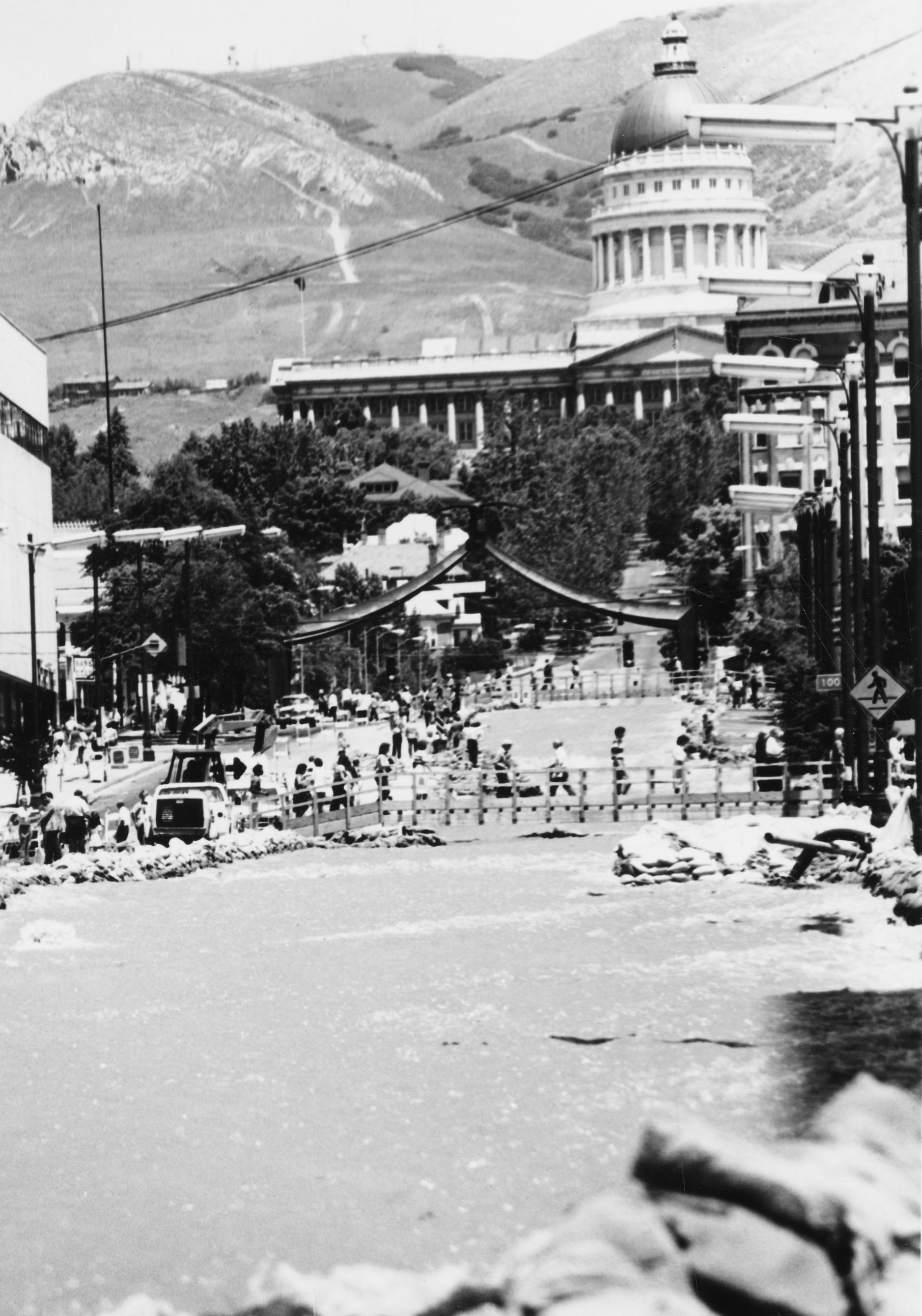
By the end of May, the rains had given way to higher temperatures that soared into the 80s. (Sillitoe) As The Salt Lake Tribune put it, “The sins of Winter have been visited upon the Spring.” On May 26, crews began setting up dikes and stacking sandbags along the east-to-west thoroughfare of 1300 South to convert it into a river that would run from State Street westward to the Jordan River. Things then went from bad to worse during the Memorial Day weekend as temperatures rose into the 90s. (Sillitoe)

Water began flowing down the makeshift river on Friday, May 27, between dikes that were seven feet high. The waterway was also extended six blocks eastward to accommodate the overfilled reservoir in Liberty Park. The Deseret News noted that “traffic was snarled … as crews blocked major roads and turned them into rivers.” (Davidson) Around the Salt Lake Valley, the melting snowpack was overfilling the numerous creeks and streams and prompted Salt Lake’s mayor, Ted Wilson, to declare a state of emergency for the city. City and state officials also began pleading with the public to supply volunteers to help with the sandbagging efforts in and around Salt Lake.

The next day, May 28, in a downtown park known as Memory Grove, water surged over a pond and sent City Creek rushing down both Main Street and State Street. (Ure) It was this event that made the flooding front-page news in the Sunday paper as the water flow from the creek “set a record of 234 cubic feet per second; the old record was 156 feet per second.” ( Ling, Dowell, Pressley) Previously, the coverage of the flooding had been placed in the local sections of both papers, but this changed once the capital city was affected. That night, road crews and volunteers began the construction of a second river to divert City Creek southward down State Street.

To save the local businesses from water damage, volunteers worked on through the morning of Memorial Day rerouting the creek from Temple Square to 400 South in downtown Salt Lake City, turning the city into a modern Venice. Whether it was in the spirit of the holiday, or the fact that disaster had been averted, once the water began to flow an impromptu “street festival” broke out among the 4,000 or so volunteers who helped build the waterway. (Ward, Davidson)

City Creek flows down State Street as pedestrians cross makeshift bridges. Courtesy of Special Collections, J. Willard Marriott Library, The University of Utah.

This festive sentimentality was also evident as the Deseret News attempted to add a little tongue-and-cheek humor to the situation. In its Sunday edition, the paper laid out instructions on “how to turn a street into a canal,” and listed the four necessary ingredients: “thousands of tons of dirt, a multitude of volunteers, a few thousandths of an inch of plastic, and, of course, water.” (Warchol) Already, these rivers in the middle of the city were becoming something of a novelty.

In the few weeks to follow, wood bridges were constructed to allow for pedestrians and vehicles to cross the river and linked downtown with Interstate 15. Restaurants also capitalized on the novelty as office workers navigated around the waterways during their lunch hours. (Sillitoe) At times, an occasional fisherman could also be seen casting his lure into the brown waters from one of the bridges.

Eventually, the streets dried up and the numbers were tallied. On June 9, 1983, The Salt Lake Tribune relayed the figures calculated by the Utah Department of Transportation, which put the damage to roadways at around $63 million. The Great Salt Lake had also risen over 4.4 feet and was continuing to rise. This was five feet above what was called the “compromise level.” (Fehr)  In a controversial move, Gov. Norm Bangerter ordered giant pumps that were installed in 1987 to lift the water out of the lake and into the desert to evaporate, to the cost of $65 million. (Fidel)

Both The Salt Lake Tribune and the Deseret News built upon this story as it evolved with each storm throughout the spring of 1983. Although television news covered the events, it was the newspapers that really captured the narrative with each article. Television was better able to show the devastation through aerial views, but only once the events took place. The newspapers were able to begin their coverage much earlier. Not only did they report on the events as they happened, they also helped to predict what was to become.  Within each weather forecast throughout the spring, the papers gave predictions for air temperatures as well as the effects that the ongoing precipitation would have on future flooding.

The newspapers also helped the public to be informed on flood areas around the state. Although the events in Thistle and Salt Lake City were the prominent news stories, there were several other areas that were affected by the flooding as well. By the end of May, updates were regularly printed that gave accounts of flooding in specific areas. The narrative that came out of each article, fully told the story of how “the desert did more than bloom like a rose. It became waterlogged.” (Fehr)

James Starbuck is a junior at The University of Utah.  He is majoring in mass communication with an emphasis in new media and is minoring in arts and technology.

Sources

Jerrie S. Fackrell, “Crews give on canyon roads, tracks,” Deseret News, April 16,  1983, B1.

Ann Shields, “Shifting Mud Clogging Spanish Fork Canyon,” The Salt Lake Tribune, April 16, 1983, B1.

Doug Clark, “Mountain Collapse Stops River, Destroys Town,” The Salt Lake Tribune, April 18, 1983, B1.

George Raine, “Wall of Debris Holding Water Back,” The Salt Lake Tribune, April 18, 1983, A1.

John Ward and Maxine Martz, “Slide turns mountain town into a lake,” Deseret News, April 18, 1983, A1.

Douglas L. Parker, “Reagan Approves Disaster Status for Slide,” The Salt Lake Tribune, May 1, 1983, B1

Doug Clark, “Crews Monitor Streams Rains Threaten Floods,” The Salt Lake Tribune, May 1, 1983, B2.

George A. Sorenson, “Storm Provides Flood Control Crews With Preview of Coming Disasters,” The Salt Lake Tribune, May 17, 1983, B1.

Lee Davidson, “Crews Turn Streets Into Rivers,” Deseret News, May 27, 1983, B1.

“Warm Days Heat Up Utah Flood Battle,” The Salt Lake Tribune, May 27, 1983, B1.

Glen Warchol, “How to turn a street into a canal,” Deseret News, May 29, 1983, A6.

Jon Ure, “Flooding Erupts From Memory Grove,” The Salt Lake Tribune, May 29, 1983, A1.

Ben Ling, Thomas R. Dowell, and Roderick Pressley, “Sandbaggers Turn State Street Into Aqueduct,” The Salt Lake Tribune, May 30, 1983, A1.

John Ward and Lee Davidson, “Storms threaten to aggravate flood nightmare,” Deseret News, May 30, 1983, A1.

Will Fehr, ed., Spirit of Survival: Utah Floods 1983, Indianapolis, IN: News & Feature Press, 1983.

Steve Fidel, “Chiefs from ’83 remember Salt Lake Floods and their impacts on conditions now,” Deseret News, April 20, 2011, http://bit.ly/higJCe

Linda Sillitoe, “Floods,” Utah History to Go, http://1.usa.gov/9GmOKI

Helen Foster Snow – A Utah Pioneer

by LAUNA GARDNER

Born in Cedar City, Utah, on September 21, 1907, Helen Foster Snow was a journalist who traveled to China in the 1930s to report on the emerging revolution in China. Snow produced an abundance of writings from China during this time, which was full of severe turmoil. She recorded everything she could on the Communist Movement in China, her perspective of Chinese experiences during World War II, and the ultimate victory of the Revolution. Snow’s writings also showed her exemplary ability as a journalist of politics and war. (Long)

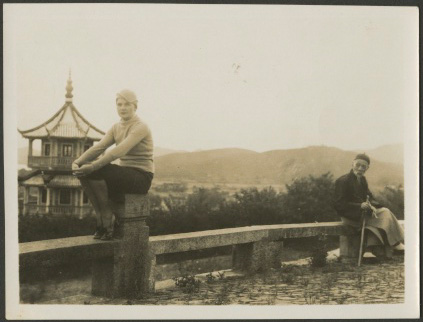
Helen Foster Snow was 23 years old in 1931 when she set sail from a Seattle port for the Far East aboard an American Mail Line vessel called the President Lincoln. Originally, Snow travelled to Shanghai to start a new position as secretary to the managing director of the China Finance Company in the American Consulate. According to Snow, traveling to China was a dream come true: “I have read about the Orient and dreamed about the Orient for three years and now I am really sailing for the Orient; it’s too good to be true.” (“Miss Helen Foster”)

Personal Photo, Helen Foster Snow Collection, L. Tom Perry Special Collections Library, Harold B. Lee Library, Brigham Young University, Provo, Utah.

During Snow’s stay in China, she married, and later divorced, Edgar Snow of Missouri in 1932. The Snows both taught journalism at Yenching University in Beiping, the former name of Beijing. There, Helen Snow met a number of patriotic students in her classes, many of whom were associated with the Communist underground. Helen Snow, known to her friends as “Peg,” urged communication among her students as to what was happening in China, which prompted her excitement on current events during that time. Such events also made Snow sympathize with the people in China during such perilous times. In addition, Snow and her husband supported the December 1935 Chinese student movement, which helped spur resistance to the danger of the Japanese conquest in China. (Long)

As a journalist, Snow wrote multiple articles for newspapers back in America, all sent by mail in a journal-like fashion. For The Salt Lake Tribune in the early 1930s, Snow recounted the fear she and her colleagues felt during such tense times in her article “Tenseness Prevailing in Shanghai Recounted by Former Salt Lake Girl.” According to Snow, Shanghai was dangerous—a place where people had to be alert and prepared for any situation with war on the horizon:

“Every minute we are expecting the Japanese fleet to steam into the peaceful Whangpoo River. Several transports of marines come in now and then, but you could hear a pin drop as far as actual war is concerned. However, when a pin drops there probably won’t be much left of China but 400,000,000 lost souls looking for a concession. If you only knew how tragic and strange it is to be here now!”

Snow also wrote about how the undeclared war between the Nipponese and the Chinese affected business in the area. In her article for The Seattle Star titled “Shanghai Busy City Until War Stifles Its Commerce” published on March 23, 1932, Snow described how the market once boomed in the new place she called home. Low silver values helped pave the way for the development of local industries, and high gold exchange triggered foreign capital to hurry over to Shanghai at a time where it could be invested at an excellent rate of 5-to-1. However, once Japanese troops made it to Shanghai, a deadly message came alive in the form of machine guns and rifles. As Snow described it: “While we in Shanghai were congratulating ourselves smugly upon an unprecedented activity in industry and while the rest of the world twiddled its thumbs in enforced idleness, down swooped calamity.”

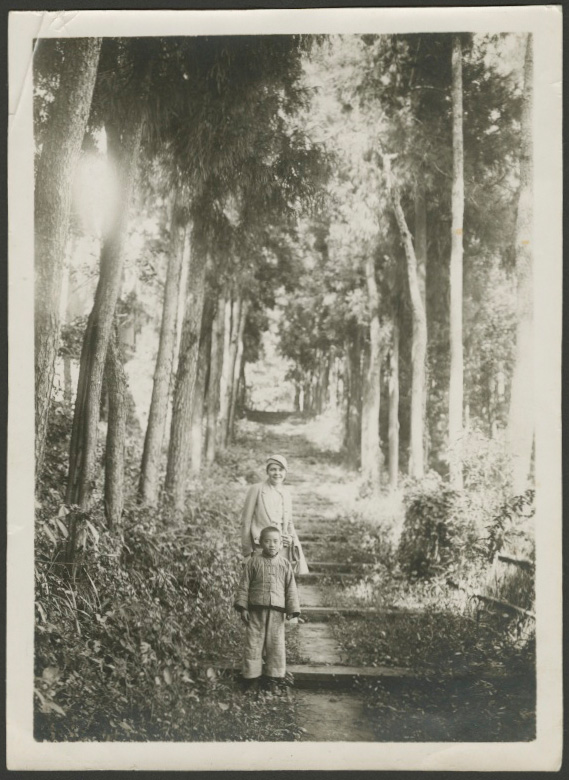
Personal Photo, Helen Foster Snow Collection, L. Tom Perry Special Collections Library, Harold B. Lee Library, Brigham Young University, Provo, Utah.

Among Snow’s writings were her private journal-like entries, most of which were printed onto paper by typewriter (Snow had stated that she was “practically illiterate with a pen”). One entry, in which she refers to her memoirs as “mem-wars,” discusses her day-to-day experiences in China. Interestingly, after only a few weeks stationed in China, Snow became accustomed to the war going on in her neighborhood of “gunfire raging within a few blocks” and described the fear she felt and how she got around the violence—she didn’t let the violence stand in the way of her having a good time. Describing one of her days of fun during her stay in China, Snow wrote: “Sunday, I got up at my customary twelve o’clock meridian for ‘tiffin,’ watched a cricket game for two hours, then went home to dress for a tea dance at five o’clock at the French Club. Then I had dinner and went to the ‘Canidrome’ that’s a famous dancing place where they have greyhound racing.” (Personal Writing)

Snow also had the honor of putting together an American Independence Day in China. According to an article in The China Press from July 3, 1932, Snow was in charge of many festivities, some of which included a flag raising ceremony and a baseball game.

Personal Photo, Helen Foster Snow Collection, L. Tom Perry Special Collections Library, Harold B. Lee Library, Brigham Young University, Provo, Utah.

Although war surrounded her, Snow found a certain beauty about China, and she felt as if she were living in a fantasy. One of her writings, which she labeled “Americasian Eurasian,” notes that she was “thrilled” to be in China. According to Snow: “I occasionally stopped short in my busy days at first just to remember that I was actually in China. I couldn’t quite believe I was in China, it seemed like a dream, not to be taken seriously somehow, like being in costume at a masquerade party.”

In another entry titled “The Inimitable Chinese,” Snow beautifully describes how she saw China’s people: “Alice in Wonderland could not be more amused and astonished than I in this Land behind the looking glass. What wonderful strange people are these inimitable children of China!”

In 1937, Snow set out to visit Yan’an, located in northwest China. Here, Snow visited a Communist stronghold. She used the information she garnered to write her book, Inside Red China, later published in 1939. The book was largely compiled of Snow’s writings that describe up-close and personal accounts of destruction and sympathy. With her husband, Snow also helped establish the Chinese Industrial Cooperatives (industrial worker’s cooperatives) Gung Ho (work together). (Snow)

By December 1940, Snow was ready to come home. She returned to America where she spent the remainder of her life in Connecticut. Snow died on January 11, 1997. In 2011, The Salt Lake Tribune reported that five performing arts students from Southern Utah University had the opportunity to go to China to perform their play on Snow, The Dream of Helen. A statue of Snow also stands at Cedar City’s Heritage Center.

Helen Foster Snow continues to be a significant figure in American and Chinese history because she was a native of Utah who made a copious number of contributions to China during the 1930s. She was respected as a friend of China and as a savior by students and colleagues during her time spent overseas. Snow’s journalistic ability and reports on the war also gave people in America a personal account of global affairs; as a woman in the 1930s, such recognitions are major. For many people, Snow will always be one of the most influential cultural pioneers in Utah’s history.

Launa Gardner is a senior at the University of Utah. She is majoring in mass communication and will graduate in August 2012.


Sources

Helen Foster Snow. Inside Red China. New York: Doubleday, Doran & Company, Inc., 1939.

“Shanghai Busy City Until War Stifles Its Commerce,” Seattle Star, March 23, 1932.

“Americans To Celebrate Glorious Fourth Here Tomorrow In Grand Style,” China Press, July 3, 1932.

“Americasian Eurasian,” Helen Foster Snow Collection, Tom Perry Special Collections, Harold B. Lee Library, Brigham Young University, Provo, Utah.

“Miss Helen Foster,” Helen Foster Snow Collection, Tom Perry Special Collections, Harold B. Lee Library, Brigham Young University, Provo, Utah.

Personal Writing, Helen Foster Snow Collection, Tom Perry Special Collections, Harold B. Lee Library, Brigham Young University, Provo, Utah.

“Tenseness Prevailing in Shanghai Recounted By Former Salt Lake Girl,” Helen Foster Snow Collection, Tom Perry Special Collections, Harold B. Lee Library, Brigham Young University, Provo, Utah.

“The Inimitable Chinese.” Helen Foster Snow Collection, Tom Perry Special Collections, Harold B. Lee Library, Brigham Young University, Provo, Utah.
Kelly Ann Long. Helen Foster Snow: An American Woman In Revolutionary China. Boulder: University Press of Colorado, 2006.

“Remembering a 1930s-era Cultural Pioneer,” The Salt Lake Tribune, July 24, 2011, D2.

Denver and Rio Grande Depot Brought Economic Prosperity to Utah

by KELSIE HAYMOND

In May 1869, the final spike was driven into the ties at Promontory Point, Utah, to complete the nation’s first transcontinental railroad. (Richards, 137) By 1906, railroad tracks crisscrossed the state. Trains were coming and going through many of Utah’s towns, hauling freight, mail, and passengers. As the capital, Salt Lake City had heavy train traffic, but the small, dilapidated depots were inadequate to handle the demand.

The grand exterior of the Denver and Rio Grande Depot. 3rd South became one of the busiest streets in the city because of the trolley traffic and the numerous businesses and restaurants that lined the paved lane. Digital Image © 2008 Utah State Historical Society. All Rights Reserved.

The Denver and Rio Grande railroad (D&RG) proposed to build a modern depot in downtown Salt Lake. On the 100th birthday (August 20, 2010) of the completion of the D&RG depot, Brandon Johnson, from the National Endowment for the Humanities in Washington, D.C., explained in his keynote address that the depot had initially been opposed by local neighborhoods. Because there would soon be a new Union Pacific Depot several blocks away, they feared the increased congestion and noise. In the end, however, the City Council sided with vocal business leaders and the area was greatly benefited economically by the addition of the D&RG depot. (Arave, 2010) The magnificent Rio Grande Depot, as it is now known, stands as a tribute to a past age in which trains were the arteries of industry and travel across America.

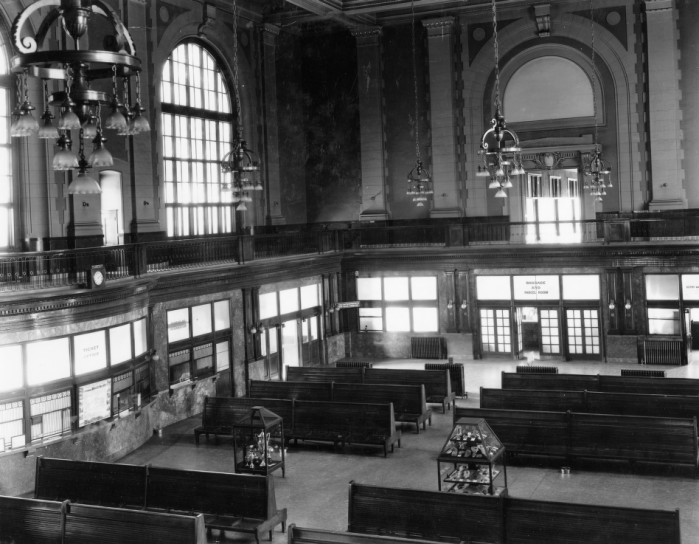
The interior of the depot while it was still under construction. Digital Image © 2008 Utah State Historical Society. All Rights Reserved.

The December 15, 1906, Deseret Evening News headlined with the long awaited announcement that George J. Gould, the “Young Colossus of the Railway World” and executive of D&RG, had plans to build a brand new train depot in the heart of Salt Lake City. The article exclaimed that Salt Lake was to be the “great mountain division point in George Gould’s ‘Atlantic to Pacific’ system.” While some residents had been skeptical of the necessity of a second depot, businessmen understood the implications of having two train depots to compete for business. The article articulated the benefits of two depots by explaining that, “It is all indicative of how the kings of finance and industry view the future of Salt Lake.” Clearly if men of great financial means were willing to pour money into large business projects, they had faith in the economic future of the city.

On page two of the same newspaper, another article detailed some early plans for the size and style of the building. The author described plans for the new passenger depot as “modern” and “up to date” and since Gould “builds for the future,” it would be one of the finest structures west of the Missouri River. This same article in the Deseret Evening News on December 15, 1906, announced the chosen site for the new depot as 3rd South, between 4th and 5th West. An update on the construction of the new depot was given in a January 3, 1909, article in The Salt Lake Tribune that encouraged Salt Lake residents not to worry about financial issues slowing its completion. The author explained that the D&RG executive E. H. Harriman was “watching Salt Lake grow, and while he is watching he is working for that end with all the might of his great financial standing.” Again, the people of Salt Lake had high hopes that their city and state had been targeted by financial titans as a place worth investing in.

A common theme among the articles regarding the depot was that Salt Lake was soon to be a burgeoning city.  “Salt Lake City will become the commercial metropolis of the west,” claimed an article on page 23 of the August 20, 1910, edition of the Deseret Evening News.

Utah industries eagerly awaited the increased routes in and out of the city. An article published in the Salt Lake Herald-Republican on August 14, 1910, described the new depot as a “Golden hopper to feed the city through extensive channels of trade and varied industries which stretch octopus-like east and west.” The D&RG depot would connect Salt Lake with new trade markets along the 20,000 miles of rail lines stretching from San Francisco in the West to Pittsburgh in the East, according to an article on page 22 of the August 20, 1910, Deseret Evening News.

That article included many ads for the newly built-up business district surrounding the depot. Acorn Printing Co., the Salt Lake Stamp Co., and the Bicycle Supply Co. were among a few that listed the great deals they would have in honor of the opening of the new depot, which was officially August 20, 1910.  The May 15, 1910, edition of The Salt Lake Herald-Republican described how 3rd South was turning into one of the busiest streets in the city. In fact, a brand new hotel, the “Mardorf Hotel,” would soon be under construction to accommodate the swell of visitors the D&RG depot was expected to bring.

The modern interior with chandeliers, elegant woodwork, and green opalescent arched windows. Digital Image © 2008 Utah State Historical Society. All Rights Reserved.

With only days left until the first trains would pull into the depot, an August 14, 1910, article in The Salt Lake Tribune listed some facts about the new building. As promised back in 1906, Gould never did anything halfway and the estimated cost of the construction was over $750,000 (more than $18 million in today’s dollars). Other businesses had also been building up their infrastructure to take advantage of expanded opportunities. The Utah Light & Railway Co. had built a new streetcar line to the depot to facilitate travelers coming and going, announced The Salt Lake Herald-Republican in July 1910.

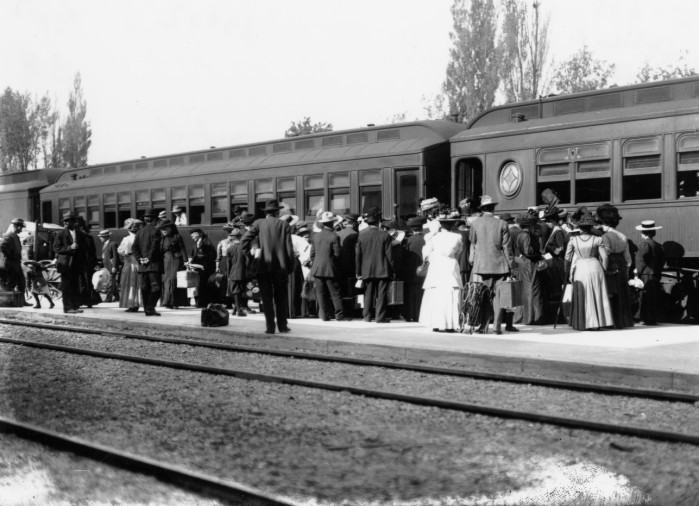
On the morning of August 20, 1910, the first passenger train rolled into the Denver and Rio Grande Depot in Salt Lake City. The structure was a magnificent edifice built by the famed Chicago architect Henry J. Schlacks, according to the August 14, 1910, edition of The Salt Lake Tribune. The article also detailed the beauty of the exterior of the building as consisting of white Colorado Yule Marble at the base that was contrasted wonderfully by red New Jersey rain-washed brick that made up the walls. Goodwin’s Weekly described the interior of the building as corresponding “in beauty to the exterior,” in its article published on the long awaited opening day. The spacious building’s main hall was illuminated by “three immense arched windows on each side through green opalescent glass,” which gracefully complemented the brownish-red and gray color scheme. The Tribune’s August 14 article also gave a long list of the depot’s amenities, including: baggage/parcel rooms, a men’s smoking room, a women’s retiring room, a restaurant, and telegraph and telephone offices. Covered platforms lined the tracks behind to the depot to protect travelers from the elements of snow, rain, and sun. It was the most modern and completely equipped union passenger depot of its size in the country. Travelers to the city would now be greeted with a grand sight that lent credence to the city’s ever burgeoning economy.

Passengers line up to board the first train on the opening day of the Denver and Rio Grande Depot. Digital Image © 2008 Utah State Historical Society. All Rights Reserved.

George J. Gould’s foresight to build a magnificent and costly depot in the heart of downtown Salt Lake City helped to mold the economic destiny of a state and its people. The architecturally elegant Denver and Rio Grande Depot brought not only pride to city residents, but also brought prosperity to Utah in numerous ways. New shops, restaurants, and hotels benefitted from the increased number of travelers to the city. The expanded rail lines opened new trade markets for Utah’s entrepreneurs.

To this day, over 100 years since the official opening of the depot, residents of Utah look upon the Rio Grande Depot as a monument to the perseverance and ingenuity of a generation past. While the Depot no longer acts as a hub to an artery of trade, industry, and travel, it stands as a tribute to the capitalist nature of America that took Salt Lake from a desert valley in 1847 to a thriving, prosperous city that played host to the world for the 2002 Olympic Winter Games. And though long past its prime in terms of age, the Denver and Rio Grande Depot has not been retired into the abyss of vacancy; it now houses the Utah State Historical Society, which helps to preserve our past so that we can have a more prosperous future.

Kelsie Haymond graduated in May 2012 in Mass Communication from the University of Utah.

Sources

“Gould Now Spans American Continent,” Deseret Evening News, August 20, 1910, 23.

“The New Denver & Rio Grande-Western Pacific Union Depot Opens its doors Today,” Deseret Evening News, August 20, 1910, 22.

“Mining and Financial,” Goodwin’s Weekly, August 20, 1910, 3-4.

“A New Epoch For Salt Lake,” The Salt Lake Herald-Republican, August 14, 1910, Section Three, 1.

“Epoch in Utah’s History Is the Opening of Western Pacific and New Gould Terminal in Salt Lake,” The Salt Lake Tribune, August 14, 1910, 3.

“Gould Limited to be a Fine Train,” The Salt Lake Herald-Republican, July 20, 1910, 5.

“Third South To Be A Busy Street,” The Salt Lake Herald-Republican, May 15, 1910, Section Two, 1.

“Prosperity on Denver & Rio Grande,” The Salt Lake Tribune, January 3, 1909, 77.

“Superb Terminal Station For the Gould Railroads,” Deseret Evening News, Art Section, December 15, 1906, 2.

“Dawn of the Era of Salt Lake City’s Greatness,” Deseret Evening News, Art Section, December, 15, 1906, 1.

Lynn Arave, “Salt Lake City’s Rio Grande Depot Finally Dedicated on 100th Birthday,” Deseret News, September 10, 2010. http://bit.ly/ap5SIU

Bradley W. Richards, “Charles R. Savage, the other Promontory photographer,” Utah Historical Quarterly 60, no. 2 (Spring 1992): 137-157. http://bit.ly/IP2N3C

One Cane, 40 Years of Hard Work, 100 Years of Celebration

by CAMERON DeWITT

Several days after the Latter-day Saints (LDS) pioneers entered the Salt Lake Valley in July 1847, Brigham Young stood over a dry spot of ground. He drove his walking cane into the dirt and exclaimed, “Here we will build the temple of our God.” (Gates & Widtsoe, 1924)

Construction on the temple began on February 14, 1853, with President Young turning the first shovelful of dirt during the groundbreaking ceremonies. The construction of the temple took a total of forty years to complete, during which time three other temples — St. George, Manti, and Logan —were all constructed in Utah.

Two months after the groundbreaking, in April 1853, the cornerstones were laid. Workers hauled large blocks of granite across the valley to the temple site at 50 W. North Temple St. At the site, the stones would be hewn, shaped and put into place. It would sometimes take up to eight painstaking days for workers to haul one large stone block of granite from the quarry at Little Cottonwood canyon to the temple block. (Gates & Widtsoe, 1924) The giant stones were used to create the temple walls that were 9 feet thick at the base and 6 feet thick at the top. Each granite block weighed between 2,500 and 5,600 pounds and was hauled by oxen. As the 40 years of construction evolved so did the workers’ ingenuity. They abandoned the use of oxen and instead used the railroad; trains traveled from the Little Cottonwood quarry some 20 miles southeast of the temple site.

Work on the temple moved steadily ahead until a U.S. Army led by Col. Albert Sydney Johnston was sent in 1857 to occupy the Utah Territory. The LDS workers buried the foundation to hide the construction. The LDS pioneers had lost two temples due to destruction prior to the Salt Lake Temple and they weren’t about to lose another one. Johnston’s Army settled in Camp Floyd neat present-day Fairfield, and work on the temple resumed. However, upon uncovering the foundation, defects were discovered and the completed portions were removed and redone to ensure the highest quality and stability of the temple. President Young determined that this temple would “stand through the millennium.” (Journal of Discourses, vol. 15, 139) President Young was determined to complete the temple’s construction and knew that with his own faith and the faith of the LDS members it would be a monument of biblical proportions.

The temple cost an estimated $4 million in 1893 dollars, according to historian Leonard Arrington. (Campbell) Measured by today’s standards, the temple would be costly to duplicate. Local Utah contractor Ted Jacobsen, president of Jacobsen Construction, estimates that the temple would cost anywhere from $85 million to $95 million to build today. In addition, the cost wouldn’t include landscaping or Temple Square’s distinctive wall. By comparison the Delta Center, now EnergySolutions Arena cost $66 million. (Campbell)

However, President Young did not live to see the temple completed. It would be President Wilford Woodruff who would lead the dedication of the temple on April 6, 40 years after its groundbreaking. The dedication would run from April 6 to April 24.

April 6, 1943, marked the 50th anniversary of the Salt Lake Temple. A picture of the temple and three men filled 40 percent of the front page of The Salt Lake Tribune. The image was used to depict the landmark and included 69 words describing the men who made up the presiding bishopric of the LDS church. (“LDS Leaders”) The Park (City) Record discussed a jubilee program where the first ward held a dedication ceremony on April 11 and performed songs from the original dedication. (“Jubilee Program”) On the day of the ceremony a dedication was held by a local church where the following hymns were sung: “Come, Come Ye Saints”; “O My Father”; “Now Let Us Rejoice”; and “Praise to The Man.” The Salt Lake Tribune described the performances by the radio group the KSL Players and the Tabernacle Choir. (“Tribute To S.L. Temple”)

News for the 100-year anniversary began early. The Deseret News published an article in 1991 detailing the massive plan for the temple’s cleaning in preparation for the centennial mark. Scaffolds were placed to clean towers. Preparations were made to gather granite from the original quarry site in Little Cottonwood Canyon to replace existing granite that was showing weather damage. And wood window seals were to be cleaned and painted. All of this work started three years prior to the centennial, demonstrating the pioneers’ faith, grit, and ingenuity. The last time the temple was pressure washed was in 1962. (“S.L. Temple To Get Cleaning”)

The LDS church planned a plethora of events to help boost the 100-year celebration event. Activities included: a major exhibit at the Museum of Church History and Art; a satellite broadcast of the feature-length film, The Mountain of the Lord, between sessions of general conference; and the Days of ’47 Parade, which featured a special focus on the temple. (“Special Events”)

The temple’s centennial was centered on an exhibit at the LDS Museum of Church History and Art in downtown Salt Lake City titled, “The Mountain of the Lord’s House.” The exhibit featured a unique collection of documentary photographs, original architectural drawings and art work, and temple artifacts. Eyewitness accounts from personal letters and diaries from those who participated in the construction were used to personalize the experience. To help streamline the event for patrons, the exhibit was organized into 10 sections: initial planning and design stages; groundbreaking and cornerstone laying ceremonies; biographical information on the architects, builders and craftsmen; details on building materials, techniques, and challenges; particulars on why the temple took 40 years to complete; temple symbolism and religious significance; the means by which the $4-million building was financed; design and construction of the temple’s exquisite interior; and the long awaited dedication ceremonies. (“Exhibit Highlights”)

President Spencer H. Osborn researched the original dedication by President Woodruff and saw that he, his counselors, and the First Presidency set aside two days of dedication sessions to include children who were under age 8. (Older children were admitted to general sessions.) In recognition of that event, President Osborn sought approval from the First Presidency and in consultation with the Primary general presidency he invited children in the stakes of the temple district to come for a special tour. “About 45,000 primary children came during three months in the summer,” he said. “About 1,000 children came each Saturday of May, June and July [1993]; some weeks there were 2,000.” (“Special Events”)

Today the Salt Lake LDS Temple is still a recognizable icon for Utahns and LDS members alike. The attention to detail and the members’ dedication to their beliefs are stamped on the temples’ interior and exterior of Utah’s most visited tourist site. The temple is a symbol of the pioneer faith, grit, and ingenuity.

Cameron DeWitt graduated with a degree in organization communication from The University of Utah. He is working on a masters in public health at Westminster College in Salt Lake City.

Sources

The Journal of Discourses, 26 vols. (1854-1886).

“LDS Leaders Mark Temple’s Dedication 50 Years Ago,” The Salt Lake Tribune, April 3, 1943, 1.

“Jubilee Program,” The Park (City) Record, April 8, 1943, 8.

Tribute To S.L. Temple: Drama Tells Story Of Building,” The Salt Lake Tribune, April 16, 1943.

S.L. Temple To Get Cleaning For Its 100th Anniversary,” Deseret News, June 28, 1991.

Exhibit highlights temple’s 100th anniversary,” Moscow-Pullman Daily News, February 12, 1993.

Special Events To Mark Temple’s Anniversary,” Deseret News, February 7, 1993.

“Salt Lake Mormon Temple Turns 100 Years April 6,” The Prescott (Ariz.) Courier, February 26, 1993.

“LDS Leaders Mark Temple’s Dedication 50 Years Ago,” The Salt Lake Tribune, April 3, 1943, 1.

Joel Campbell, “Temple Marks First Century,” Deseret News, April 6, 1993, 1.

Susan Young Gates and Leah D. Widtsoe, Life Story of Brigham Young: Mormon Leader, Founder of Salt Lake City, and Builder of an Empire in the Uncharted Wastes of Western America (New York: Ayer Co. Publishing, 1924).

The Salt Lake Bees, 1915

by CAMERON STEVENS

The Salt Lake Bees, a Pacific Coast League (PCL) baseball team, came into existence in 1915. In 1915, the Sacramento Sacts franchise had relocated to San Francisco due to poor ticket sales. The franchise stayed in San Francisco only one season before moving to Salt Lake City in search of better revenue opportunities. According to Snelling, once in Salt Lake City, the franchise had unprecedented financial gains and a highly successful, rollercoaster 1915 season.

The PCL has functioned as a minor league, or farm system, for developing Major League talent since its inception in 1903. Several minor leagues existed in the United States at the time, but the PCL offered higher quality baseball, salaries, and amenities than any other farm system at the time.  The PCL produced such excellent baseball that it was widely considered a third major league, according to Utah Historical Quarterly, in addition to the American League and National League, which would eventually join to form Major League Baseball.

In 1912, the Sacramento Sacts were failing at the gates, and in 1913 the team finished the regular season with a losing record and relocated to San Francisco in search of greener pastures. The official Web site of Minor League Baseball reports that after only one season as the San Francisco Mission Wolves, the franchise again moved in search of greater revenue, this time to Salt Lake City. As the only PCL franchise outside of California, the Bees became a baseball outpost. This both heightened the presence of the league throughout the western United States and raised operating costs for the league due to the increased amount of travel to meet home and away games. Despite these initial risks, Snelling notes that new franchise owner Bill “Hardpan” Lane deemed the move prudent and believed a success was inevitable.

The Bees season began on the road with a March 8 loss to the Chicago White Sox, followed the next day with a 5-3 victory over the same club.  The San Jose crowd (the White Sox were on an extended road tour to keep costs down, and thus played “home” games in California) was one of the largest recorded for a minor league game at the time, and the game was tied in the top of the sixth 3-3. On March 9, 1915, The Deseret News reported that Hannah, a little known utility infielder, came to the plate with the bases loaded and hit a low line drive that scored one run and provided a lead that would never be relinquished. It should be noted that because of the scarcity of full rosters and use of abbreviated box scores, players are often recorded only as last names.

On March 31, 1915, the Salt Lake Bees took the home field for the first time against the Vernon Tigers, a PCL team based near Los Angeles. Until this point, Salt Lake fans only knew of the Bees from sports page box scores and open practices.

Bonneville Park in Ogden, Utah, was filled beyond capacity with 10,000 newly minted Bees fans. As if preordained, the Bees pounded the perennial PCL powerhouse 9-3, as observed by The Deseret News on April 2, 1915. This game was the beginning of one of the most exhilarating seasons in minor league history, and an unquestionable financial success, explains Snelling.

A month and a half into the season, the Bees were playing above-average baseball. Because of the cost of traveling to the West Coast, the Bees went on extended road trips and played throughout California. The Bees played a game against the San Francisco Seals that would set the tone for the rest of the season. Despite also being a newly transplanted team, the Seals were locked in an early inning struggle with the Bees in which the Seals capitalized on their few scoring opportunities and Salt Lake repeatedly left men on base. The Seals pitcher, recorded simply as Meloan in the April 28, 1915 issue of The Deseret News, decided the game. The left-handed Meloan set a standard of dominating southpaws that Snelling’s statistics show haunted the Bees until season’s end.

At the season’s halfway point, the Bees were ten games above .500, but several crushing defeats turned the tide and threatened the season-ending standings of the PCL’s most remote franchise.

On June 22, Salt Lake lost in the last second to the Oakland Oaks 7 to 11.  Surprisingly, only the final score was reported in The Deseret News, on June 23, 1915. The full box score wasn’t even printed.

The following day, the Bees used four pitchers against the Oaks in a rematch (although common in modern era baseball, using more than two pitchers was a rarity in professional baseball in the early 1900s). Despite their best efforts and managerial creativeness, The Deseret News, June 23, 1915, reports that the Oaks shelled the Bees for 11 runs. The Bees managed three two-run spurts but nothing else over nine innings.

The ability to seemingly score at will became a hallmark of the 1915 Bees, but this ability only presented itself in patches with maddeningly irregular results. The Bees had shown that they could blow out any team in the PCL, yet had a terrible habit of losing crucial games. Snelling writes that despite these shortcomings, the Bees stood five games over .500 at the beginning of July.

As the season wore on, the Bees affirmed themselves as a PCL championship contender and every game became increasingly important. On July 10, 1915, the Bees played a critical doubleheader against the Vernon Tigers. Despite defeating the Tigers by three runs the day before, Salt Lake lost both games 4-6. When the season series had ended, Salt Lake had won only two of the seven games the two teams played in 1915, as explained in The Deseret News, on July 10, 1915.

On July 24, 1915 the Bees played against the Portland Beavers, a middling PCL team. Despite the dominance the Bees had shown throughout the season over the Beavers, Snelling observes that the game was important for the Bees record and season-ending standings.

The Bees’ right-handed pitcher Williams allowed only nine hits in a complete game. Despite Williams’ performance, The Deseret News reported on July 26, 1915, that his own fielders, namely Lou Barbour, undid his efforts.

Barbour was the Bees’ regular third baseman, a great hitter but an inconsistent fielder.  Three of the Bees’ six errors came from third base alone, one of which ricocheted off Barbour’s glove, and two balls he actually kicked away from himself while trying to field the ball.  These mistakes, combined with eight men left on base, show the comically bad side of a great baseball team.

The Los Angeles Seraphs came to Salt Lake for a July 29 meeting to place the finishing touches on the season. Salt Lake was one game out of first place, and had to win in order to maintain a chance at the PCL championship. Snelling’s game score card shows that the Bees entered the ninth inning two runs in the lead, and promptly fell apart at the seams. The Seraphs scored three times, twice on Salt Lake errors. After a close play at first base allowed the winning run to stay on base, the Bees’ fate was sealed. At game’s end, both teams had generated thirteen hits, according to The Deseret News August 1, 1915.

The  Bees finished the 1915 season with a record of 108-89 in second place in the PCL, as noted by Snelling.

On November 1, 1915, The Deseret News reported that the Bees paid out a 5 percent dividend to investors in Bees owner Bill Lane’s long shot and the franchise was officially valued at over $50,000. The franchise values provided by Snelling show that a newly transplanted team, in a remote location such as Salt Lake, would never be expected to experience this kind of success.

The Bees concluded their initial season under owner Bill “Hardpan” Lane and manager Cliff Blankenship, holding second place in the Pacific Coast League, one of the most dominant leagues in minor league baseball.

Cameron Stevens is a public relations student at the University of Utah.  He enjoys long walks on the beach, imported beers, and Café Rio fire grilled steak burritos, black beans, hot sauce.  Hold the guac, por favor.  Oh, and a large Fresca.

Sources

John Sillito, “‘Our Tone’: Tony Lazzeri’s Baseball Career in Salt Lake City, 1922-1925.” Utah Historical Quarterly 72 no. 4 (Fall 2004): 343-357.

The Deseret News, March 9, 1915.

The Deseret News, April 2, 1915.

The Deseret News, April 28, 1915.

The Deseret News, June 23, 1915.

The Deseret News, July 10, 1915.

The Deseret News, July 24, 1915.

The Deseret News, July 26, 1915.

The Deseret News, August 1, 1915.

The Deseret News, November 1, 1915.

Dennis Snelling. The Pacific Coast League: A Statistical History, 1903-1957. Jefferson, N.C.: McFarland & Co., 1995.

1942: Developing the Topaz Community As Noted in The Topaz Times

by JESSICA BOUDAH

On September 11, 1942, the Central Utah Relocation Center – later known as Topaz for most of the Second World War – opened. The U.S. War Relocation Authority (WRA) imprisoned roughly 9,000 Japanese-American residents from the San Francisco Bay Area. Topaz, one of ten WRA incarceration camps, housed virtually all Japanese-Americans from the Bay Area by the end of the year. (Bankson)

Japanese-Americans from the San Francisco area, who had been held at Tanforan Race Track while Topaz was under construction, were transported to Delta, Utah, by train. (Beckwith) Upon the internees’ arrival at Topaz, many barracks and schools were not complete at the camp. (Beckwith) Beckwith also mentioned in her article that once situated, some internees “finished building their own barracks and other structures at the site.”

The Topaz Times, which was published at the Central Utah Relocation Center, was first published at Tanforan Assembly Center and then continued in Topaz until the camp closed in October 1945. The first issue printed in Topaz was printed on September 17, 1942. The Times was designed to inform its public on local events, community involvement, employment, education and religion.

In issue No. 1, The Topaz Times stated, “You will find various agencies of the United States Government have been mindful both of your needs and those opportunities which you desire in the fields of religion, employment, education, health and recreation.” The same article also states that the authorities of the center expected its internees to put in their best efforts in the “common objective” of developing the Topaz community to the “greatest degree possible.”

Most issues of The Topaz Times ranged from four to six pages in length. The first ten issues of the Times were called pre-issues. These pre-issues were published from September 26 to October 24, 1942. Within the first month of the camp’s opening, there was a great deal of internal action and organization necessary. As illustrated in eight of the first ten issues of The Topaz Times, there was a large amount of change in the society’s organization. In pre-issues No. 1 through 7, the main topics discussed were residential housing, education facilities and employment for internees.

With approximately 8,500 Japanese-American internees, it was deemed necessary to have immediate action on the internal organization. (Ostlund) Framework for a community council, as stated in the WRA Manual, was debated in a community meeting that was called in late September. According to an article in the pre-issue  published September 26, 1942, blocks 3, 5, 6, and 14 were to elect councilmen the following Monday. The article reported, “The vision of establishing Topaz into a model city came another step nearer to its realization as the machinery for self-government was being rapidly set up this weekend through the cooperation of the residents and the project administration.”

Association between the new community and its need for organization was an important theme in the first three pre-issues of the paper. Pre-issue No. 1 also stated that the Community Council would consist of one representative from each residential block, and later stated the members of the community council would possess some jurisdiction in the Topaz community:

“The Community Council will be authorized to ‘establish such regular and special committees and commissions as may be necessary to carry out its duties and functions or to cooperate with the Project Director in promoting the general welfare of the residents,’ according to a statement approved by Project Director Charles Ernst.” (The Topaz Times, September 26, 1942, 1)

According to an article by Clarence Ostlund, some earlier issues that faced the Community Council were: enacting a charter or constitution under which community-business could be legally transacted, labor problems, welfare and health problems, housing problems and fuel, education and recreation, work clothing problems, medical problems due to “lack of doctors,” medical supplies, equipment and hospital facilities. (Ostlund, Section I)

The issue of The Topaz Times published October 3, discussed the first eight members inducted into the Community Council in early October 1942. The new members of the Topaz Community Council were: Vernon Ichisaka (Block #3), Albert Kosakura (Block #5), Ernest Iivena (Block #6), Kay Nishida (Block #7), Dr. Carl Hirota (Block #12), Sam Yagyu (Block #13), Shinji Yamemoto (Block #14), and Paul Fuiii (Block #15). The same issue also described how the new officers repeated the following oath:

I solemnly pledge, as a member of the Community Council of Topaz, State of Utah, to uphold the Constitution of the United States and the related laws thereof. I further pledge my ideals, devotions and energy to the common welfare of all residents of this community: and to insure that my efforts will not be contrary to the basic principles of human rights.

Outlined in the October issue of the Times were the basic roles of the Topaz Community Council, which included: members were obligated to act in a legislative capacity, act in a liaison capacity, and to act in an advisory capacity.

In its first eight pre-issues, The Topaz Times also covered education – an important issue for the United States Government and the Japanese-American internees. Author Charles Wollenberg writes in the book, Schools Behind Barbed Wire, that “during WWII the United States government undertook an unusual educational enterprise – teaching students who were imprisoned behind barbed wire … an understanding of the American ideals, institutions and practices.” (210) The WRA soon found itself capable and “responsible for the education of more than 25,000 Japanese-American children,” not just at Topaz, but at other relocation centers as well. (75)

Pre-issue No. 6, published on October 10, 1942, is the first issue where we see education reach the front page of the paper. The paper reported that Robert E. Gibson, the Assistant Director of Education, would be visiting the city to assist with the “evolution of the educational curriculum” at Topaz. The issue suggested that Gibson believed that the “prevailing educational system in the average American community need[ed] reconstruction and that the WRA projects [had] the opportunity to set an example for America” in the Topaz community.

In the next issue, published on October 14, the headline read, “Housing For Schools Discussed Before First Public Hearing.” Educational systems were underway. When internees first started moving into the Topaz community, school buildings were not yet completed. The issue of the Times stated that at the public hearing, the need for an elementary and high school was deemed necessary. The same issue also discussed idyllic segmentation of the camp, and which block would be designated to which school building. The issue reports a motion by a Community Council member, Marii Kyoroku of the housing committee, who displayed a series of graphs that showed a breakdown of building space for the high school and elementary school. As written in pre-issue No. 7, “all of Block 32 be allocated to the high school” with 28 schoolrooms … and “half of Block S and half of Block 41 to the elementary school.”

The Topaz Times is extremely important to our present-day understanding and knowledge of the Relocation Center at Topaz. Now, we as researchers have the ability to understand what life was like at Topaz in 1942 through the articles and topics discussed in The Topaz Times. The development of community involvement became more prevalent within the Topaz society, as seen in the progression of the first eight issues of The Topaz Times. By 1943 camp life at Topaz “settled down” as residents got in the habit of gardening, attending classes at schools or recreation halls and working, according to an article from the Topaz Museum Web site. The Topaz Times helped develop the community life within the camp. By promoting community involvement with elections for the Community Council, and developing space for both an elementary school and a high school, The Topaz Times reassured the internees that Topaz was a “model city” and it would be developed into the greatest city possible – as stated in the first issue of The Topaz Times: Jewel of the Desert.

Jessica Boudah is a senior at the University of Utah, planning to graduate at the end of fall semester 2010. She is a mass communication major in the strategic communication sequence. Jess is originally from Burlington, Vermont, a small, idyllic town, also home to the University of Vermont. Currently, Jess works for the Salt Lake City School District as a tutor at Highland High School. She plans to acquire her master’s degree in education after receiving her bachelor’s degree in communication from The University of Utah.

Sources

Bankson, Russell A. “Guide to the Records of the United States War Relocation Authority Central Utah Project 1941-1945.” University of Washington Library.

Jane Beckwith. “Topaz Relocation Center.” Utah History Encyclopedia.

Clarence Ostlund, ed. “War Relocation Authority Central Utah Project Topaz, Utah.” Online Archive of California. The Bancroft Library, University of California, Berkeley.

“Greetings,” The Topaz Times, September 17, 1942, 1.

“Blocks 3, 5, 6, 14 to Elect Councilmen Next Monday,” The Topaz Times, September 26, 1942, 1.

“The City,” The Topaz Times, September 26, 1942, 1.

“More on Elections,” The Topaz Times, September 26, 1942, 3.

“Induction of 7 Councilmen Slated for 7:30 Tonight,” The Topaz Times, September 30, 1942,1.

“More on Community Council,” The Topaz Times, September 30, 1942, 5.

“Eight Representatives Take Council Oath Wednesday,” The Topaz Times, October 3, 1942, 1.

“More on Induction,” The Topaz Times, October 3, 1942, 2.

“Education,” The Topaz Times, October 10, 1942, 1.

“Housing for Schools Discussed Before First Public Hearing,” The Topaz Times, October 14, 1942, 1.

“Education,” The Topaz Times, October 14, 1942, 2.

Charles Wollenberg. “Schools Behind Barbed Wire.” California Historical Quarterly 55 (1976): 210-217.