The Salt Lake City Chamber of Commerce, 1880-1890s

by EMMA FULLERTON

While Salt Lake City was developing, businessmen had a difficult time getting Eastern investors interested in the state. A group of these men wanted to build a reputation for Utah and help it become an attractive investment. The Church of Jesus Christ of Latter-day Saints was interested in an independent economic system. As the settlement began to grow, non-Mormons began to settle in the valley and start their own companies. There was competition between the Mormons and non-Mormon business owners, or “gentiles,” as they were called, which resulted in a boycott against them.

During this time, mining and smelting were becoming popular and attracting other non-Mormon companies to develop in Utah. Groups started to form because of the success. One of these clubs, The Board of Trade, started as early as 1879 with Thomas R. Jones as president and William S. McCornik as treasurer. They worked to change the public image and show that there were healthy benefits of living in Utah. The LDS church started to feel the political pressure from their boycott of non-Mormon businesses.

Salt Lake City’s population continued to increase as the mining industry was evolving. In 1882, the president of the LDS church, John Taylor, had no choice but to abandon the boycott. (Woodward and Campbell) Mormon and non-Mormon businessmen “voiced concern that the city’s negative public image was hindering eastern investment in Utah’s resources.” (Hafen, 361)  McCornick, Patrick Lanahan, owner of The Salt Lake Tribune, and Mormon apostle Heber J. Grant joined together to form the Salt Lake City Chamber of Commerce in an effort to bring the community together for “business promotion purposes.” (Woodward and Campell, 18) With their motto, “No politics or religion in the Chamber,” they hoped to “revive trade, establish home industries, and attract capital and population to the territory. (Woodward and Campbell, 18)

Salt Lake Tribune reporter and historian O.N Malmquist wrote, “I think the Salt Lake Chamber of Commerce was the first formal organization in Salt Lake in the territory of Utah, in which Mormons and gentiles got together and actively collaborated in common causes. And in that sense it was certainly one of the major instruments of the evolution from the ‘irrepressible conflict’ to the situation we have today.” (Woodward and Campbell, 19)

In the early years of the Chamber of Commerce, the chamber set aside $4,000 of its $10,000 budget in an effort to change the public image of Utah through advertising and marketing. One of the first efforts was The Exposition Palace Car. On June 6, 1888, a rail car left Salt Lake City with the words on both sides, “Utah Exposition Palace Car; The Resources of Salt Lake City, the Gem City of the Rocky Mountains; Free exhibit sent under the auspices of the Salt Lake Chamber of Commerce.” (Woodard and Campbell, 19) It traveled 9,000 miles around the United States. A 96-page booklet written by the secretary, M.J. Forhan, called, “Salt Lake City; A sketch of Utah’s Wonderful Resources,” was distributed at stops around the country. This helped attract people and contributed to the economic development of the state. Shortly after the campaign, H.L.A Culmer wrote The Journal of Commerce, which spoke of the three-month trek to the East with the car. The end results of the campaign were fourteen tons of printed matter at a cost of $3,339.25 ($78,719.69 in 2009 dollars), which brought in thousands of new residents and got the Chamber recognition. (Inflation Calculator)

The Chamber was passionate about increasing the Utah population. It hired the Western Investment Company of Chicago to distribute 30,000 promotional pamphlets to over 200 cities in the East. (Woodward and Campbell) Also, as stated in the Journal of Commerce, the chamber placed ads in “100 of the country’s leading daily publications.”

Today, the Salt Lake Chamber represents 4,600 businesses statewide and “one in every three jobs in the Utah economy,” as stated on the Web site.  Also, it is Utah’s “largest business association and Utah’s Business Leader.” The Chamber recently celebrated its 100-year anniversary and released a history book called Common Ground, 100 years of the Salt Lake Chamber, by Don Woodard and Joel Campbell. The Chamber’s mission statement, as quoted on its site, is, “As Utah’s Business Leader, we stand as the voice of business, we support our member success, and we champion community prosperity.” The organization works with businesses such as American Express, Wells Fargo, Zion’s National Bank, Delta Air Lines, Questar  and many other firms.

Woodard and Campbell write, “Almost without exception, every major event and accomplishment in Salt Lake for the last 100 years has felt the influence of the Chamber. Whether it was the development of freeway routes, location of hospitals, distribution of welfare, building of the airport, securing the Utah Jazz, promotion of winter sports, or creating a business-friendly environment, it has been the Salt Lake Chamber leading the charge.” (Woodward and Campbell, 11)

Emma Fullerton is a communication major with an emphasis in public relations at the University of Utah.

Sources

Thomas K. Hafen, “City of Saints, City of Sinners: The Development of Salt Lake City As A Tourist Attraction 1869-1900,” The Western Historical Quarterly (Autumn 1997).

“Secretary’s Report,” Salt Lake Journal of Commerce (January 1891): 6.

The Inflation Calculator.

H.C.A. Culmer, “On the Utah Exposition Car,” Salt Lake Journal of Commerce (August 1888).

Don Woodward and Joel Campbell. Common Ground, 100 years of the Salt Lake Chamber. Alabama: Community Communications, 2003.

Amelia Earhart’s Layover in Utah

Amelia Earhart (1897 — missing July 2, 1937 — declared legally dead January 5, 1939)

by CRYSTAL MIETCHEN

Amelia Mary Earhart is known for her aviation expertise, being a bestselling author writing several best sellers, and many other acclaimed talents. Amelia Earhart’s passion for flying led her to write of her own experiences and to share with those interested in her exploits what she had witnessed and conquered. 

Amelia Earhart, born in Atchison, Kansas, was not your typical little girl with ribbons and bows; she enjoyed being outside and playing rough. Earhart was only a child when she saw her first airplane at the Iowa State Fair. She wasn’t very interested in what she saw, so she turned away from the opportunity to go on an airplane ride offered to her and decided to go back to other activities taking place at the fair.

Despite what Earhart thought about airplanes as a young girl, she grew up to become one of the most well-known female pilots of all time. She was the first female passenger to travel the Atlantic; she eventually started flying her own airplane solo. Earhart said, The woman who can create her own job is the woman who will win fame and fortune.” (Roesler) Earhart decided she wanted to travel the world and was excited to accomplish such a goal. (Roesler)

In her travels, Earhart paid an unexpected visit to Utah. She was on her way from Glendale, California, to the East Coast when she had to land in an open farmer’s field near Eureka, Utah. It was September 30, 1928, and the plane was experiencing problems that led her to make a force landing of the plane. Due to the unexpected occurrence, the plane landed in the soft ground, breaking the propeller. With the knowledge that her plane would most likely take a couple of days to repair, and while waiting to receive a new propeller from New York City, she visited Salt Lake City.

Earhart had a tremendous amount of influence on Utah residents with the little time she spent in Utah. Reporter Annie Feidt, of the Alaska Public Radio network, recounted the story of Earhart’s unexpected layover and her brief stay with Feidt’s great-great-grandfather and her mother, Mon Hillsdale. Resident Jim Maxwell was the first to arrive at the scene and after the plane was on the ground he witnessed Earhart jump out of the plane and ask, “Where am I?” Because her sources were unpolished maps and she was simply following the railroad line, she was not exactly sure of her location. Earhart stayed with the family for a total of three days and left a wonderful impression on every member of the family. Feidt recalled that Earhart sent a two-page letter to Hillsdale to thank her for her hospitality in Eureka.  She wrote: “I shall always think myself fortunate in tumbling into Tintic [Mining District, Eureka], and you don’t know how deep an impression was made.” (Feidt) The story of Feidt’s family history with Amelia Earhart is amazing to listen to and will always have an impact on the family, people of Eureka, and Utah. (Feidt)

The Salt Lake Tribune reported on October 1, 1928, that Earhart said, “The little motor in my plane was not working very well, due to the high altitude, and I just simply had to come down quickly.” During her layover she toured the area, gave speeches, visited schools such as West High School, and visited Bingham Canyon Mine. The famous female pilot was very social with Utah residents and may have even astonished some of the Utah conservatives. The Tribune reprinted an interview she gave to the Deseret News in which she discussed the Relief Society, the official women’s organization of The Church of Jesus Christ of Latter-day Saints. Earhart said she was glad to hear about women organizing themselves and “trying out their wings.” (1928)

The times were changing with society witnessing what women were capable of. It may have been changing slowly but with influences like Amelia Earhart, it was sure to change and for the better. Earhart was so empowering in a time where most women were not able to have their own opinion, yet she in her time gave her opinion without doubt. Earhart was not the typical stereotype of what was expected of females, especially in Utah in the 1920s. The female pilot wore a leather aviator’s cap, flight pants, and an overcoat. It was unheard of and very unlikely for a female in the 1920s to wear anything other than a skirt or dress; she was a female ahead of her time and was respected greatly. The independence she held and the ability to believe in her without letting anyone sway her in a wrong or different direction is what initially proved her legacy. Earhart eventually had a repaired plane and was able to carry on with the trip that was initially planned. (Clark)

Earhart is significant and has made an amazing impact in culture, society, and history. She was a leader in her time and continues to lead and has encouraged individuals from the past, present and this encouragement will continue into the future. There has been an elementary school and street in Utah named after the female pilot.  Amelia Earhart Elementary is located in Provo, Utah, and uses the motto-“Flying with Pride,” and Amelia Earhart Drive is located in Salt Lake City. There is proof of ambition and courage when something has been named after a certain individual; it is even more unique to have a school and street named after an individual and in the same state.

After flying across the Atlantic Ocean in 1928, Earhart decided she was going take flight around the world. The voyage that will never be forgotten started with her departure from Los Angeles, California, on May 21, 1937. On July 2, the following transmission was sent from the Electra at maximum strength: “KAHQQ calling Itasca, We must be on you but cannot see you … gas is running low ….” (Earhart) The pilot went missing on July 2, 1937; it has since been determined that her plane went down between 35 and 100 miles off the Coast of Howland Island. The legendary pilot went missing without a trace and the disappearance remains one of the most known unsolved mysteries of all time. (Earhart, 1937)

Amelia Earhart will not only be remembered internationally, but the residents of Utah will always remember her unexpected visit to Utah. Earhart was the first and most famous female aviator of her time and remains to hold that title today. The recognition she continually receives is respected and honored by all, including both men and women. The influence she has provided women is not only guidance, but gives meaning to why people have rights and reasons to believe they can achieve anything.

Crystal Mietchen is a junior at The University of Utah. She is majoring in communication with an emphasis in strategic communication. She will be graduating from the University in December 2010 and is excited to start a career in public relations and continue writing.

Sources

Cody Clark, “Aviation pioneer, film subject made little-remembered Utah visit,” Daily Herald, October 21, 2009.

Amelia Earhart. 20 Hrs., 40 Min,: Our Flight in the Friendship. New York: Harcourt Trade Publishers, 1928.

Amelia Earhart. The Fun of It: Random Records of My Own Flying and of Women in Aviation. New York: Harcourt Brace, 1932.

Amelia Earhart. Last Flight by Amelia Earhart. New York: Harcourt, Brace and Company, 1937.

Annie Feidt. “Remembering Amelia Earhart’s Stop In Utah Town.” National Public Radio, November 5, 2009.

Rodger L. Hardy, “Forgotten Earhart link to Utah found,” The Deseret News, October 22, 2009.

The Last Flight.” Ellen’s Place.

D. Cochrane and P. Ramirez, “Amelia Earhart.” Smithsonian National Air and Space Museum.

Mark Roesler. The Official Web site of Amelia Earhart.

Christopher Smart, “Amelia Earhart had unexpected layover in Utah,” The Salt Lake Tribune, October 19, 2009.

Ron McBride, University of Utah Football Coach

by KEVIN HUSSEY

Vickie McBride said about her husband: “Ron had only two girlfriends in his life, and he married them both.” (Jacobsen-Wells) Ron McBride got married at an early age to Joann Hefte. They eventually divorced; she said it was because he still was too into football and interested in hanging out with his friends. He later would marry Vickie, who is still his wife today.

Football was always a huge part of McBride’s life. He was captain of the San Jose State football team, and went on to play semi-professional ball with the San Jose Apaches. McBride would make his way up through the ranks, from coaching a high school team in San Jose to being one of the most renowned coaches of all time.

His greatest days were coaching the University of Utah Utes. “Since he became head coach in 1990, McBride has won 83 games, second most in school history.” (UtahUtes.com) That is an astounding number for a college coach. McBride always had a way of putting things simply, as he does here, “They kept getting better as it went on, and the other team kept getting worse.” (McBride)

He had great success with these Ute football players, and that came from his intense coaching style. He stressed to his players that they must take pride in their work and work for what they wanted to achieve. Coach Mac, as they called him, took pride in the rivalry games that occurred once a year. Coach Kyle Whittingham said, “Coach Mac got that thing turned around to where it was a true rivalry again.” (Kragthorpe) The rivalry became as intense as it had ever been before because of Coach Mac and his Utah Utes. “He’s responsible the resurgence of this program.” (Alden) He was commenting in the newspapers and letting people know that this was the year that the Utes would pull off the victory.  This of course caused uproar and chaos within Salt Lake City and Provo and created many years of epic rivalry games. “Utah had managed only two victories over BYU in the twenty years prior to Mac’s attack.” (Jacobsen-Wells)

In 1993, Coach McBride surprisingly led the Utes to an upset over the favored BYU Cougars, 34-31. “The state was stunned.” (Jacobsen-Wells) What made McBride such a star at the University of Utah was the fact that he started out three and one against the dreaded Cougars from down south. That is what mattered most to these die-hard Ute fans.

In 2002 Ron McBride was in the end of his career as Utah coach and he knew it. “There’s dark, and then there’s dark. And then there’s Ron McBride’s mood.” (Miller and Rosetta) This completely described Ron McBride’s career and how he felt toward his Utes. He would even take them to Price every August just to keep them away from distractions. Unless perfection was met, McBride was an unhappy fellow. “In just eight years, Coach Mac became the second-winningest coach in Utah’s 104-year football history and the only coach ever to take Utah to more than one bowl game.” (Jacobsen-Wells) Coach McBride was also very superstitious, especially when it came to rivalry games. Coach McBride talked after a game: “After the BYU game, I knew something was going to happen. There was an article in the Sunday paper that was pretty harsh.” (Dienhart)

McBride knew that his tenure at Utah was going to come to a screeching halt unless he won some sort of championship or kicked BYU’s butt; he did neither. Although he did not win a championship at Utah, he still led a potent football team that grew to the powerhouse it is today. Ron McBride was part of the roots of this football team, and he brought them to greatness. Dick Tomey, coach of the Arizona Wildcats, said about Coach McBride: “McBride is willing to sacrifice anything — time, effort, even his own blood — to earn a victory.” (Miller and Rosetta) He had won a few rivalry games during his tenure at Utah, but it surely wasn’t enough without a championship. Even though McBride had been at the University of Utah for thirteen years, he was still going to be shown the door because he hadn’t won a championship, and he lost to BYU a few too many times. Coach McBride said, “The people in Salt Lake were good to me, and the University treated me well. (Dienhart) He loved this city and how the rivalry made this community and his team come together. He said he deserved more respect at the end of his career because of all that he had done for this team, but in the end, “That’s just the way it is.” (McBride)

Some people didn’t feel like McBride fulfilled his potential. “He may be a decent recruiter, and able to motivate and inspire his players, but in the final analysis, he doesn’t have the resolve or gumption to push the players to the very limit of their endurance. He’d rather be their buddy.” (Neeleman) It is very hard for a coach to have full respect from his players if the player sees the coach as a friend. The coach is supposed to strike some fear in the players because he is considered their boss. If McBride were able to terrorize his players a little bit like Rick Majerus did, as well as mix in being a personable coach, then he would have had the chance to be one of the greatest coaches of all time to go along with his already stellar resume.

Some important stats to his resume: “McBride posted an overall record of 88-63 (.582).” (Wikipedia) He also took his Utes to six bowl games, previously three bowl games in the past 97 years. He beat powerhouse teams such as USC, Arizona, and Fresno State in three out of the six bowl games. “His best season came in 1994 when the Utes won a then-record 10 games and attained the highest post-season ranking, at the time, in school history climbing to No. 8 in the USA Today/ESPN poll and No. 10 in the AP poll.” (Wikipedia) Coach McBride started to look like a genius to Salt Lake City folk, and became a local town hero for turning the Utes into a national contender.

McBride had many nicknames in Utah: “Mac became known as ‘Captain Voodoo,’ the man who, with the sweep of his magical cape, had been known to ward off evil spirits and win games.” (Jacobsen-Wells) This was implying how superstitious that Coach McBride was. He believed in good-luck charms, and who can argue that they didn’t work, just look at his win/loss record? “Mac’s belief: It can’t hurt to have help.” (Jacobsen-Wells) He is absolutely right, why not have karma on your side? That is one of the reasons why the Utes would stay in the same hotel the night before home games, and McBride would stay in the same room every time, and if his team won the previous time then he would wear the same clothes as the previous time.

So why is Ron McBride such a great part of our Utah history? He was the base of our greatness for all Ute football fans. He brought pride back to our community and made people proud to say they were a Ute. People were able to talk trash again to the Cougar community, and flash their red in gloating greatness. He struck confidence into many players, that would go onto have successful careers in the NFL, as well as the workplace. He jump-started a program that continues to grow in talent every year. Ron McBride will always have a place in Utes fans hearts, and will be remembered for a long time.

Kevin Hussey is a senior at The University of Utah majoring in communication with a minor in business. He has played for the Utah baseball team from 2008-2010.  Kevin plans on working in the sports communication business, dealing with advertising.

Sources

Phil Miller and Dick Rosetta. BYU vs. Utah — The Unholy War. Salt Lake City: Gibbs Smith Publisher, 1997.

Tom Dienhart, “…To Get Canned?” July 12, 2004.

“Utah Football,” UtahUtes.com.

J. Neeleman. “Ron McBride’s Fatal Flaw and where the Utah Program May Have Gone Wrong in the Early 1980s.”

Kurt Kragthorpe, “BYU Vs. Utah: Mac’s Legacy Played out in LaVell’s House,” The Salt Lake Tribune, November 28, 2009.

Ron McBride. “Ron McBride Quotes.” ThinkExist.com.

“Ron McBride.” Wikipedia. <http://en.wikipedia.org/wiki/Ron_McBride&gt;.

“Ron McBride.” Daylife. <DayLife.com>.

Doug Alden, “Former Coach Returns to Face Utes,” USA Today, September 26, 2008.

JoAnn Jacobsen-Wells. Mac Attack: The Story of University of Utah Football Coach Ron McBride. Springville, Utah: Slickrock Books, 1998.

The History of LGBT Publications in Salt Lake City (1975-2010)

Queering readers in the “reddest of the red states”

by NICK CRITCHLOW

When writing about queer history in the United States, the LGBT (Lesbian, Gay, Bisexual and Transgender) community has been a very underground community due to societal disapproval and ignorance. Utah is well known for being a conservative Republican state with a predominantly LDS population, so one wonders how a community that is so marginalized can survive in a conservative state such as Utah. As with all underprivileged groups, we learn that the way they find camaraderie and strength within a hostile environment is through newsletters, magazines, and newspapers geared toward advocating for their community. We also find that with this particular community, there has come not only a unique culture that is distinct from the contemporary heteronormative status quo that we all grew up with, but there has also developed this mass communication and media system that has built and sustained a community in a harsh environment. What I will be studying in this project is the history of queer print publications in Salt Lake City, including GayzetteOpen Door, Salt Lick, and Triangle Magazine. I will be studying not only how these newspapers were set up, but also the role they played in building the LGBT community in northern Utah.

Before discussing the history of these publications in Utah, it is important to first give a background as to how the LGBT revolution in America began. The LGBT rights movement, as we know it in the United States, was basically kicked off after the Stonewall Riots in 1969 in Greenwich Village, New York.

Stonewall is considered a legendary event among LGBT activists as being the catalyst as to how gay people and gay rights came out of the shadows and into people’s homes and everyday conversations. Martin Duberman in his book, Stonewall, documented how this small event at a bar in New York City revolutionized the gay community in the United States forever.  The Stonewall Inn was a gay bar in New York City during the 1960s.  However, gay bars were illegal at the time and the bar, along with other bars where homosexuals were known to socialize, was raided by the police quite frequently. (Duberman, 183) As a result, many of the patrons were put into paddy wagons for either dancing with a same-sex partner or wearing three or more clothing items that are intended for people of the opposite sex. (Duberman, 192–193)

However, on June 28, 1969, patrons finally got tired of police coming into the bar to arrest them, so the clientele, mostly drag queens and lesbians, revolted and fought back against the police. It was a riot that lasted three nights; however, mainstream magazine publications such as Newsweek and TIME did not cover the riots until October. (Cusac, 1)

According to Arthur Lipkin in his book, Understanding Homosexuality, Changing Schools, the late 1960s in the US were such a time of political unease and protest that it allowed the gay community to finally be given a voice. “1968 was a watershed year for protest and disruption in the United States, in that environment, gay liberation was a cause waiting to explode.” (Lipkin, 90)

Within six months after the riot in New York, two gay activist organizations were formed, the Gay Activists Alliance and the Gay Liberation Front, and three newspapers were established to promote rights for gays and lesbians. According to the Encyclopedia of Gay, Lesbian, Bisexual and Transgender History, within a few years, gay-rights organizations were founded across the U.S. and the world. On June 28, 1970, the first Gay Pride marches took place in Los Angeles, Chicago, and New York to commemorate the anniversary of the riots. Similar marches were organized in other cities. Today, Gay Pride events are held annually throughout the world, mostly in the month of June in observance of the Stonewall riots.

There were, however, gay organizations prior to 1969. Organizations such as the Mattachine Society [1] and the Daughters of Bilitis [2] have been around since the 1950s. These groups were described as part of the homophile movement, which was a movement within the gay community that emphasized assimilation and presenting all gay identified people as “normal” citizens. They also were very underground and rarely engaged in activism. This was a strategy that was known as “the politics of respectability” within the gay community. (Gallo, 1–5, 11)

Now in the midst of all this consciousness-raising around the gay and lesbian community during the late 1960s and early 1970s, how does revolution like this work in a conservative state like Utah? We find that even within the heavily religious environment of Utah, gays and lesbians found a way to stay connected with one another, and support each other.  (I should clarify that I will be using gay and lesbian and LGBT interchangeably in this research, because bisexuals and transgender people were generally not included in the same category of gay and lesbian politics until around the 1980s and 1990s.)

The first LGBT newspaper of its kind that appeared in Utah was called the Gayzette and was founded by Babs DeLay and edited by DeLay and Gene Petten in 1975. The newspaper later evolved into the Salt Lick and then the Open Door, Triangle Magazine and into today’s incarnation, QSalt Lake. The publication contained local and national news centered on the needs of the gay and lesbian community, as well as some local advertisements and gay events.

The Gayzette was set up in a basic newsletter style with community announcements and some articles. There were no photos or advertisements, just stories and events in the community. The first issue was published on May 27, 1975, just one year after the Gay Student Union at the University of Utah was formed. It was Utah’s first gay organization and it is still in existence at the university to this day. It has since been renamed the Queer Student Union.

The printing for the newspaper was donated and done by the Feminist Women’s Health Center, a woman-controlled center that in their words was “dedicated to reclaiming our bodies from the medical profession.” (Gayzette, issue 1) The main article for the first issue of the newspaper focused on the formation of a Gay Community Service Center. The center was a small nonprofit dedicated to the gay community.  Proposed services for the center included a “Gayline,” which was a 24 – hour answering service manned by trained volunteers to aid in crisis intervention, alcohol and drug-related problems, emergency food and housing needs, employment, medical services, legal aid, and general referrals. There was also news of the elections of the committee members for the center. Most of the names of the people on the committee were men, which was reflective of the time period because during the 1970s, the gay rights movement was generally a male-based movement. Most lesbian-identified women were involved in the feminist movement at the time, rather than the gay rights movement.

According to Lee Walzer in her book, Gay Rights on Trial: A Handbook, lesbians had created their own political circles within feminism because they faced sexism within the broader gay rights movement. “Lesbian feminists were victims of sexism within the gay liberation movement, where women’s issues were deemed of lesser importance then the sexual liberation sought by gay men and the women themselves were often relegated to secondary, support roles.” (Walzer, 14) This is not to say that lesbians did not make great contributions to the gay rights movement, it was just not always a safe space for them to voice their concerns.

The main focus of the Gayzette was about educating the public about the myths of homosexuality and empowering gay individuals. “The gay person will be aided in defining his/her sexual orientation toward a positive self-concept that will confront the negative ideas transferred by society, family and the church.” (Gayzette, May 27,1975) The committee organized electronic media and a speaker’s bureau for organizations and groups who requested it. (The electronic media outlets they were using were not specified in the newspaper.)

What surprised me the most about reading the first issues of the newspaper was the strong emphasis on family. The first issue described dates for potlucks, social gatherings, movie nights, “keggers” and other activities. Being that many of the readers whom the newspaper was targeting were shunned from their biological families, friends, etc., a reader gets the feel for the sense of community that the people who were in charge of this newspaper were trying to forge. The newspaper almost gave a lonely and confused reader the impression that there was a loving family out there for them to utilize.

The second issue, which was published June 28, was a more developed newspaper with letters to the editor, a classified section, a list of events going on through the center, and stories of political legislation concerning the gay community in the United States. Two stories discussed the military ban on homosexuals; another was written just after California legalized all sexual acts between consensual adults. It was not until 2003 that sodomy laws were officially taken off the books in Utah with the US Supreme Court decision of Lawrence v. Texas, which decriminalized consensual sex between adult same-sex partners.

The latter incarnation, the Salt Lick, was formatted in a way where it resembled a genuine mainstream newspaper, with advertisements, articles and editorials, local and national news, as well as local community events. One interesting story that was actually printed in The Salt Lake Tribune in 1976 was a story of two women who applied for a marriage license. Technically, the two women were allowed to be granted a marriage license because according to the article, “Utah statute does not specifically prohibit marriage between members of the same sex.” This is interesting, because in 2004, voters in Utah passed an amendment to the state constitution that not only bans marriages between same-sex couples, but also any legal recognition or protections.

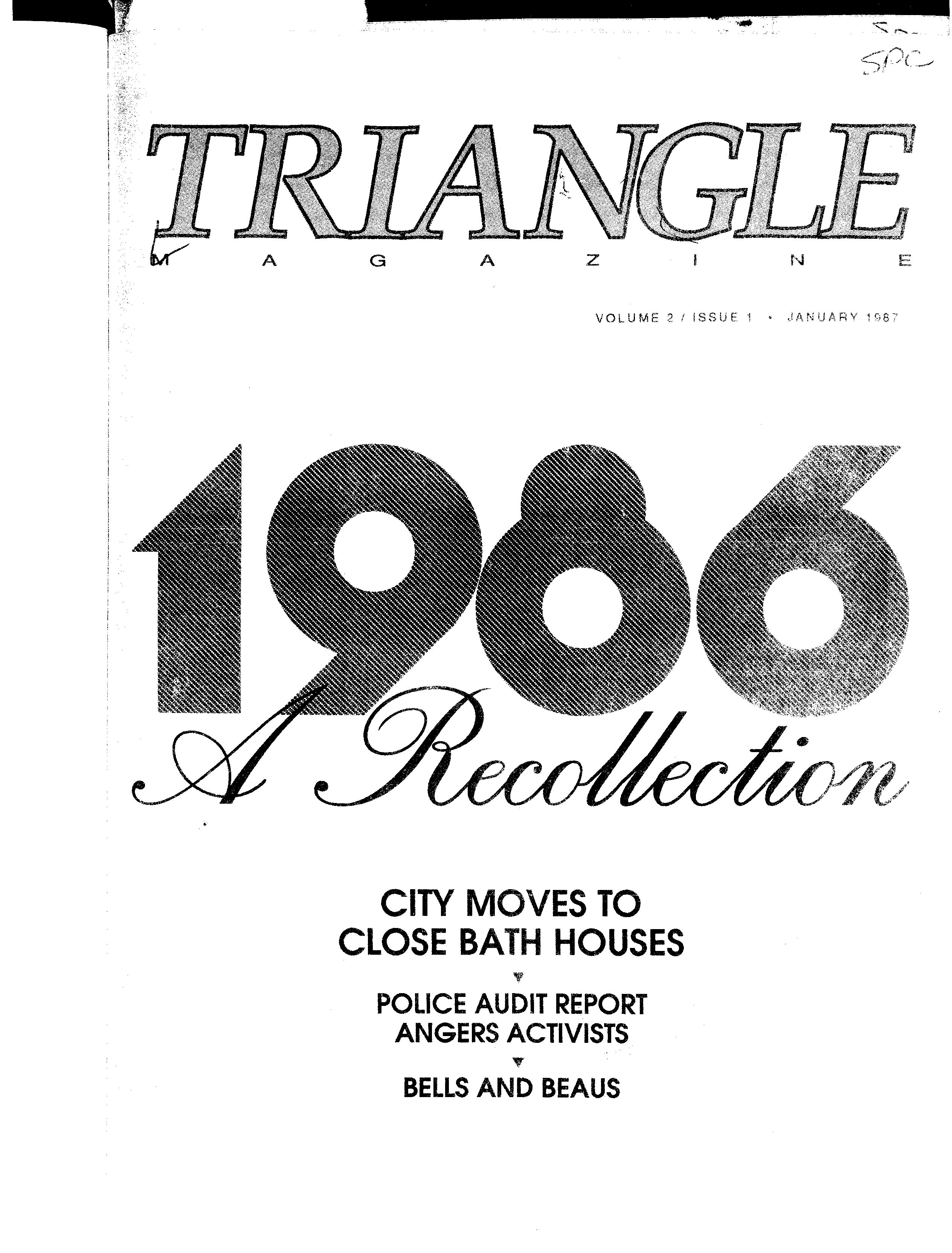
Another incarnation that appeared during the 1980s was  Triangle Magazine. It was set up in much the same way as the Salt Lick and the Gayzette, in that it contained both local and national news surrounding the gay and lesbian community. However, the tone of the newspaper was different than the newspapers during the 1970s; it had more serious coverage concerning AIDS. There were many advertisements about AIDS and condom use and articles on the gay community’s battles with the government concerning AIDS patients. Being that AIDS was discovered in the early 1980s and was prevalent in the gay community, especially among gay and bisexual men, it was an issue that really brought the community together in solidarity. “The impact of AIDS on the gay and lesbian community was profound,” writes Tina Fetner in How the Religious Right Shaped Lesbian and Gay Activism. “People from lesbian and gay communities formed organizations to educate the public on how to prevent the spread of AIDS, to distribute condoms for free, and to distribute bleach kits for intravenous drug users so that they could clean shared needles between partners. This quickly turned into an AIDS movement with multiple programs and organizations.”  (Fetner, 55)  Articles from the newspapers focused on ways to bring AIDS education to Utah and formation of organizations such as the Salt Lake AIDS Foundation, since renamed the Utah AIDS Foundation, which is still operating.

What I have gathered in this research is that despite Utah’s reputation of being a strong “red” state with conservative values, the LGBT community in Salt Lake City has thrived and been strong since the beginnings of the Gay Liberation Movement during the late 1960s. Due to the activism of these brave men and women, they have created a community and culture that is rich in a history that needs to be accounted for. Today, Salt Lake City has been documented as one of the 51 “gay-friendliest” cities in the United States, according to Gregory A. Kompes, author of 50 Fabulous Gay-friendly Places to Live. There are political and community-based organizations such as the Utah Pride Center, Equality Utah,  and the Utah AIDS Foundation. There is also an LGBT Resource Center at the University of Utah along with the Queer Student Union, as well as many bars, clubs, and social groups in the Salt Lake City area. The Utah Pride Festival which is hosted by the Utah Pride Center is the second-largest festival in Utah and it celebrates both the history and culture of the LGBT community.

Nick Critchlow graduated in August 2010 with undergraduate degrees in both mass communication and gender studies from The University of Utah. A strong radical queer feminist, he looks forward to using his education in helping create positive social change in the world.

Sources

Gayzette, May 27, 1975.

Triangle Magazine, January 1987.

Martin Duberman. Stonewall. New York: Dutton, 1993.

Marcia Gallo. Different Daughters: A History of the Daughters of Bilitis and the Rise of the Lesbian Rights Movement. New York: Carroll & Graf Publishers, 2006.

Anne-Marie Cusac. “The Promise of Stonewall – Stonewall Riot, New York, New York, 1969.”

Arthur Lipkin. Understanding Homosexuality, Changing Schools. Boulder, Colo.: Westview Press, 1999.

Tina Fetner. How the Religious Right Shaped Lesbian and Gay Activism. Minneapolis: University of Minnesota Press, 2008.

Lee Walzer. Gay Rights on Trial: A Handbook. Santa Barbara, Calif.: ABC-CLIO, 2002.

Marc Stein, ed. Encyclopedia of Gay, Lesbian, Bisexual and Transgender History. New York: Charles Scribner’s Sons/Thomson/Gale, 2004.


[1] The Mattachine Society was one of the earliest homophile organizations in the United States and was founded in 1950.  Membership primarily comprised white, middle-to-upper-class men and was formed to protect and improve the rights of homosexuals.

[2] The Daughters of Bilitis is the first lesbian rights organization in the United States. It was formed in San Francisco, California, in 1955. The group was conceived as a social alternative to lesbian bars, which were considered illegal and thus subject to raids and police harassment. It lasted for fourteen years and became a tool of education for lesbians, gay men, researchers, and mental health professionals.

The Circleville Massacre: A Tragic Event in Utah History

by THEADORA DAVIDSON

In history classes, as we go through school, we are told that history repeats itself. It’s for this reason that we take careful account of the past. It’s why media have covered many of our historical events, such as the sinking of the Titanic, World War II, and the assassination of John F. Kennedy. The media cover events like these so that they may become public knowledge, because if history repeats itself, as we’ve been warned, we would at least know what’s to come.

Occasionally, however, there are events throughout history that have escaped the media’s attention. That may be because an event happened in a remote location and the media just never heard of it, or the event may have been horrible, and the people involved made an effort to disguise what had happened. One such event is the Circleville Massacre. On April 22, 1866, the settlers of Circleville, Utah, slaughtered sixteen men, women, and children while the three youngest children were left alive and later adopted by the townspeople. (Gottfredson)

The Black Hawk War was being fought all around Circleville and its neighboring towns. When the settlers of Circleville heard of Indian uprisings not far from their home, they received instructions to be cautious of the nearby encampment of Paiute Indians. Bishop William Allred of the Church of Jesus Christ of Latter-day Saints sent a message to the Indian encampment asking them to come to town and read the notice they had received. A handful of Indians went into town and it was decided that the encampment would give up their weapons, and live peacefully with the settlers for the duration of the war. When the militia went to escort the remaining Indians to town, one man tried to escape and was shot and killed.

This act spurred the militia to arrest the entire encampment and hold them as prisoners in town. The men were held in the town’s meetinghouse, and the women and children were placed in an empty cellar. The townspeople, needing advice on how to proceed, sent a message to Colonel W.H. Dame. A passage from the message reads, “As we did not like to take the responsibility of deciding the course to be taken with the Indians.” (Winkler 16-17) Colonel Dame received the letter, and General Snow, who was with him at the time, left strict instructions for the townspeople of Circleville “to see that those prisoners were treated kindly and such only retained in custody as were found hostile or affording aid to the enemy. (Winkler 17) Sadly, Circleville’s militia did not receive the message soon enough. The Indians had attempted to escape, causing the settlers to act in haste and kill the imprisoned Indians one by one.

Martha C. Knack, in the book, Boundaries Between: The Southern Paiutes, 1775-1995, writes that the Indian men were gunned down, while the women and children had their throats cut. (Knack 85) The few newspaper articles that were written on, or around, the time of this massacre give very little information on what truly happened. The given date of the incident also ranges from April 21 to April 23, 1866. There is a dispute over how many Indians were killed. While the Winkler article says that it is unknown for sure how many Indians were killed, the Gottfredson article says that sixteen men and women were killed while three children were allowed to live.

Because a lot of information is missing from the actual event, historians have had to piece together what happened through accounts given by family members of those children who lived, and from the few references found in journals and letters of those involved. The newspapers of the time didn’t publish all that had happened at Circleville. Many articles glossed over the incident even 100 years later. In the April 23, 1960, issue of The Deseret News, there was an article with the headline, “Paiute County Colonies Abandoned.” According to the article, “The Circleville settlers retaliated for this raid by wiping out an encampment of Paiutes near the town.”

An article in the Richfield Reaper gives a slightly better description. “A few days before the ‘minute men’ arrived, there were a number of Indians camped nearby who pretended to be friends of the settlers, but who were spies. They had killed one man [and] wounded another who had managed to escape. The people were so enraged at this that they made short work of the 9 renegades who committed the treacherous act.” (“The Relief of Circleville”)

The only accounts we have with information of this event comes from the letters written by the militia leaders, and the accounts given by those few children who survived because they were thought to be too young to remember what occurred. Newspaper articles at the time generally glossed over the event as if it wasn’t a tragic event. Although the townspeople of Circleville tried to cover up the incident initially, what had happened was leaked and became known by the surrounding areas and the press. Even though the incident was mentioned in the press, it did not get much attention. An example of this is in the May 10, 1866, edition of The Deseret News: “In a skirmish with the savages, near Circleville, in that region, several of them got killed, but no whites.”

“The next consideration,” a guard recalled, “was how to dispose of the squaws and papooses. Considering the exposed position we occupied and what had already been done it was considered necessary to dispatch everyone that could tell that tale. Three [of four] small children were saved and adopted by good families.” (Winkler 18) This quote recalls how the settlers felt about what they had done. When the church leaders had heard of this crime, they were disgusted; however, there was never any mention of charges being pressed against any of the settlers involved.

Theadora Davidson is a junior at The University of Utah. She is majoring in mass communication.

Sources

“A Brief Resume of the History of Circleville,” Piute County News, June 20, 1947.

Phillip B. Gottfredson, “The Circleville Utah Massacre.” Blackhawk Productions.

Martha C. Knack. Boundaries Between: The Southern Paiutes, 1775-1995. Lincoln: University of Nebraska Press, 2001.

LaVan Martineau. The Southern Paiutes: Legends, Lore, Language, and Lineage. Las Vegas: KC Publications, 1992.

“More About the Indians,” The Deseret News, May 10, 1866.

John Alton Peterson. Utah’s Black Hawk War. Salt Lake City: The University of Utah Press, 1998.

“Paiute County Colonies Abandoned in Fear of Marauders,” The Deseret News, April 23, 1960.

“The Relief of Circleville,” Richfield Reaper, July 10, 1909.

“The Sevier Region,” The Deseret News, June 9, 1891.

Albert Winkler. “The Circleville Massacre: a Brutal Incident in Utah’s Black Hawk War.” Utah Historical Quarterly (1987): 4-21.

Fortunato Anselmo

by LAURA NIELSON NEWBOLD

From 1890 to the 1920s, Utah became home to thousands of Italian immigrants. This second wave of Italian immigrants exerted by far the most influence on the development of Utah, and the development of Italian culture in Utah. Unlike the first wave of Italian immigrants, in the late 19th century, this second wave included immigrants from all parts of Italy, most notably Calabria and Sicily and the northern regions of Trentino and Piedmont. As a result of this increase of Italian Americans, a Little Italy soon developed and spread across the western part of Salt Lake City near the Rio Grande railroad station. Due to the influence of a devout Catholic following, a parish began holding meetings at St. Patrick church in downtown Salt Lake City. (Notarianni) It was this enviroment in which Fortunato Anselmo, one of Utah’s most famous Italian Americans, raised his family and thrived.

"Italian fighter Primo Carnera (left), visits Italian Vice Consul Fortunato Anselmo at 164 S. 900 East, Salt Lake City, May 1930."

Born October 1, 1883, in Grimaldi, Italy, Fortunato Anselmo immigrated to Pueblo, Colorado, in the early 1900s. There he met and married Anna Pagano, and the couple had three daughters, Gilda, Annette, and Emma. In 1911, Anselmo and his family moved to Salt Lake City and started F. Anselmo & Co., an imported wholesale Italian food store. With the store’s success, he opened another in Carbon County, where many Italian immigrants had settled to work on the nearby railroads and mines. With so much interaction with fellow Italian immigrants, Anselmo started La Gazzetta Italiana in 1912, to give a voice to the concerns and interests of his fellow immigrants. He quickly established himself as a representative of Italian Utahns, particularly those in the Salt Lake Valley. (Notarianni)

In 1915, he was appointed vice consul of Italy of Salt Lake City and the official adviser to Utah and Wyoming Italians. As such, he presided over all the official documents that required the approval of the Italian government, such as requests for visas, passports, and other papers and documents. He also served as a representative of the Bank of Naples, a prestigious institution and one of Italy’s oldest banks. This position allowed him to help local Italians send money orders to friends and relatives in Italy as well as provide the proper paperwork for traveling immigrants. (Notarianni)

Beyond these responsibilities, Anselmo also participated in many of the local political and social issues of the community. One endeavor he is well known for was his lobbying of the Utah State Legislature to have Columbus Day proclaimed a legal state holiday. While his efforts ultimately failed, Columbus Day did eventually become a holiday in 1919. (Notarianni; Chiariglione)

In addition to being a businessman and diplomat, Anselmo was well known for his magnanimity. Despite not being a member of the Church of Jesus Christ of Latter -day Saints, his generosity was spread to some of the most prominent Mormons at the time. In 1943, J. Reuben Clark Jr., a member of the Church’s First Presidency and namesake of Brigham Young University’s Law School, wrote Anselmo a letter thanking him for the cheese he sent him. Clark wrote, “As I am sure you like cheese (you can hardly like it better than I do), and as you know as well as I how hard good cheese is to get just now, I feel very certain that you will understand me when I say I am most thankful to  you for your thoughtfulness in sending to me that large portion of Gorgonzola cheese.” (Clark)

Similarly, the entire First Presidency of the Church wrote Anselmo in 1946 to thank him for the olive oil he gave them. They noted, “We are all beneficiaries of you gracious kindness in the matter of a supply of pure Italian olive oil. It has been so long since we were able to secure any of this oil that it is a real luxury. Please accpet our thanks for this splendid gift and accept also our sincere wishes for your welfare.” (Smith, Clark, and McKay)

One of his sadder diplomatic duties took him to the site of a mining accident. In 1924, Castle Gate suffered a mine explosion in which 172 men were killed, twenty-two of them Italian immigrants. As one of the most well known Italian Utahns at the time, Anselmo traveled to Castle Gate to offer his services and condolences to the devastated town. (“Castle Gate Relief Fund”)

At other points in his career, Anselmo rubbed shoulders with celebrities and dignitaries from around the world. In 1922, Anselmo and his wife entertained Vittorio Rolandi-Ricci, the Italian ambassador to the United States. Governor Mabey, the Utah governor at the time, was so impressed with Anselmo’s hosting abilities that he wrote him a letter saying, “I would indeed be remiss in my duty if I did not convey to you my cordial appreciation for the splendid reception accorded your esteemed countryman, Ambassador Ricci. In every respect the ceremonies and entertainment were commendable, and the committee in charge is to be heartily congratulated.” In 1930, the Anselmo family was treated to a visit by Italian heavyweight boxing champion Primo Carnera, who is depicted in the photograph. Probably the most distinguished guest Anselmo had the opportunity to greet was Cardinal Eugenio Pacelli, who would eventually become Pope Pius XII. (Notarianni; Mabey)

Anselmo’s favor with the Italian government and their diplomats actually began early on in his career as vice consul. On Feburary 3, 1920, after only five years of being vice consul, he was made a Knight of the Crown of Italy and Officer of the Order of the Crown of Italy. These awards, much like being knighted in England, are only given to those believed to have offered great service to the Italian government. Most who are awarded with such an honor are military men or important political figures. The fact that Anselmo was awarded with both honors speaks volumes of about how valued he was as a diplomat. (Notarianni; “Italian Consul Honored By King”)

Despite these honors, Benito Mussolini forced Anselmo to resign from his position as vice consul in 1923 after Anselmo completed the naturalization process and became a United States citizen. However, he was ordered to maintain the position until a successor could be appointed.  Nobody else was ever appointed, and in 1941, the US government ordered the office to close entirely. (Notarianni; Monson)

In addition to forcing him out of his position as vice consul, becoming a naturalized citizen incited distrust in terms of Anselmo’s allegiance to America. Some even went as far as to claim he was un-American and began a movement to denaturalize Anselmo. These rumors and defamations caused many to speak out on behalf of Anselmo and his family. One notable writer, Secretary Gus P. Backman of the Salt Lake City Chamber of Commerce, wrote a letter to Burton W. Musser. Backman writes:

I have been personally acquainted with Mr. Anselmo for fifteen to eighteen years …. During the entire time I have know Mr. Anselmo, he has always conducted himself in a most outstanding manner, has also been rated by me, as well as by the people of the community in general, as a forthright, honorable business man. His business ethics have always been above reproach and any question as to his Americanism and loyalty to American ideals has never to my knowledge been raised …. This letter is written due to the fact that I understand some one has started a movement to denaturalize Mr. Anselmo which, in my opinion, would be outrageous …. (Backman)

Fortunately for Anselmo, the movement to denaturalize him failed. In 1950, the office of vice consul was reopened, and the position was returned to Anselmo. He served in that position until he died on July 15, 1965. (Notarianni) Zopito Valentino, an Italian American author, has since eulogized Anselmo with the following:

For how long have the Italians of Utah known Anselmo? For how long have they looked to him for help, protection and advice? Who ever saw his door closed? Who ever found his heart indifferent? He is always ready to extend the glad hand, to help and protect, to offer his counsel and to give liberally. A more generous heart does not exist and a better soul is not to be found. (Valentino)

Today, visitors can learn about Anselmo Fortunato and his family by visiting his home, located at 164 S. 900 East in Salt Lake City. His house has been preserved as a historical monument by the Utah State Historical Society. Visitors may also visit the Utah State Historical Society for more information about Anselmo and other notable Utahns.

Laura Nielson Newbold is a communication major at The University of Utah. She will be graduated this year with a Bachelor of Arts in speech communication and plans to attend the University of Utah S.J. Quinney Law School in the fall. Her husband, Sean Newbold, translated all of the Italian documents into English.

Sources

Fortunato Anselmo Papers, Folders 1-15, Box 1, 1917-1963, Utah State Historical Society.

Governor Charles R. Mabey to Fortunato Anselmo, May 19, 1922, Fortunato Anselmo Papers, Mss B 103, Utah State Historical Society.

Secretary Gus P. Backman to Burton W. Musser, March 19, 1943, Fortunato Anselmo Papers, Mss B 103, Utah State Historical Society.

Secretary of State E. E. Monson to Fortunato Anselmo, July 12, 1941, Fortunato Anselmo Papers, Mss B 103, Utah State Historical Society.

Salt Lake Tribune article, “Italian Consul Honored By King,” February 3, 1920, Fortunato Anselmo Papers, Mss B 103, Utah State Historical Society.

J. Reuben Clark Jr. to Fortunato Anselmo, March 30, 1943, Fortunato Anselmo Papers, Mss B 103, Utah State Historical Society.

George Albert Smith, J. Reuben Clark, and David O. McKay to Fortunato Anselmo, November 29,1946, Fortunato Anselmo Papers, Mss B 103, Utah State Historical Society.

Prop H. Chiariglione to Fortunato Anselmo, January 6, 1917, Fortunato Anselmo Papers, Mss B 103, Utah State Historical Society.

Philip F. Notarianni, “Italianità in Utah: The Immigrant Experience,” in Helen Z. Papanikolas, ed., The Peoples of Utah. Salt Lake City: Utah Historical Society, 1976.

Zopito Valentino, Italian Activities of the Intermountain Region (1965-1975)

Castle Gate Relief Fund Committee.” Division of Archives and Records Service, Department of Administration Services.

Ordini Cavallereschi del Regno d’Italia, Corpo della Nobiltà Italiana.

Statutes of the Order of Merit of Savoy

The Completion of the Transcontinental Railroad in Promontory, Utah

by KEITH THOMAS

The transcontinental railroad was completed May 10, 1869, in Promontory, Utah, when the Union Pacific Railroad of the East met the Central Pacific Railroad of the West. Many people said that building a single railroad that spanned the United States was impossible, but it was essential to expedite travel, communication, and business. It also helped to cement California’s allegiance to the United States during the Civil War, and win the fight for land with the Native Americans; it was easily one of the greatest of the United States’ achievements during the nineteenth century. (Utley, 45)

In 1850, the U.S. House of Representatives’ Committee on Roads and Canals stated the basic motives for building a railroad to the Pacific Ocean, saying that it would “cement the commercial, social, and political relations of the East and the West,” and would be a “highway over which will pass the commerce of Europe and Asia.” (Utley, 1) At the time, trade from China and Japan to the East Coast of the United States was only possible by ship, but building a railroad to the Pacific meant great trade and business opportunities. The railroad would also help win land from the Native Americans, through quick and easy transport of military supplies, soldiers, and citizens to occupy the West. The new possibilities for more efficient transport of mail and journalists would make communications faster. And the railroad would strengthen political bonds with California, ensuring that the new state would not secede from the Union as the Civil War began. (Utley, 1)

In 1862, Congress passed The Railroad Act of 1862. Under the act, the Union Pacific Railroad was authorized to build a railroad westward until it met with the Central Pacific, which was authorized to build eastward from California. (Kraus, 49) The construction of the railroad was not actually begun until 1865, after the Civil War ended, making more resources available to the project, and the Railroad Act of 1864 was signed, making the government the main endorser of the railroad. (Kraus, 100-107)

On May 10, 1869, the two railroad companies finally came together in Promontory, Utah. Leland Stanford, president of Central Pacific Railroad, and Dr. Thomas Durant, vice-president of the Union Pacific Railroad, pounded in the last two stakes to complete the railroad. (New York Times, May 12, 1869) Telegraph stations all across the country were waiting for the signal that the railroad was complete, and with the single word “done,” the country was informed that the task was completed. (Utley, 45)

A silver sledgehammer and golden spikes were used to complete the project, and on the final spike there was a silver plate with the inscription, “The last tie laid on the completion of the Pacific Railroad, May 10, 1869.” (Derby, 352) After a ceremony and celebration, the golden spikes were taken out and replaced with regular spikes, driven by a standard hammer. (Deseret News, May 18, 1869) At the time, this was considered to be one of the greatest industrial feats ever achieved.

The completion of the railroad meant progress in a lot of areas. According to E.H. Derby, an early traveler of the transcontinental railroad, riding the railroad was a pleasant and comfortable experience for passengers, and a great way to travel across the country in a quick and efficient manner. (Derby, 15; Pine 13-19) Political bonds with California were strengthened as well, leaving trade with Asia to be the only expectation that fell short, which ironically, was the main reason for building the railroad in the first place. The completion of the Suez Canal, however, made the railroad unnecessary for trade. (Utley, 57)

Now, the site where the two railroads met in 1869 is the Golden Spike National Historic Site, and although the section of track at Promontory, Utah, is no longer in commercial use, visitors can see reenactments of the trains coming together on a daily basis, through the use of replicas of the Union Pacific’s No. 119 and the Central Pacific’s Jupiter locomotives.

Keith Thomas is a communication major at The University of Utah. He is planning to graduate with his bachelor’s degree after he completes fall semester 2010, after which he is planning to join the Navy and sail the open seas.

Sources

E.H. Derby. The Overland Route to the Pacific. Boston: Lee & Shepard, 1869.

George W. Pine. Beyond the West. New York: T.J. Griffiths, 1870.

Union Pacific Railroad and Connections 1870. Map.

Robert G. Athearn. Union Pacific Country. Chicago: Rand McNally, 1971.

Andrew J. Russell. East and West Shaking Hands at Laying of Last Rail. 1869. Photograph. National Park Service.

“The Pacific Railroad,” The New York Times, May 12, 1869.

“The Proceedings at Promontory Summit,” The Deseret News, May 19, 1869.

Union Pacific Railroad 1867. Map. N.F. Mraz.

Union Pacific Railroad Collection. Promontory, Utah. 1969. Photograph.

George Kraus. High Road to Promontory. California: American West Publishing, 1969.

Robert M. Utley. Golden Spike. Washington, D.C.: US Government Printing Office, 1969.

The Band Between the Seas

by AMELIA WHITWORTH

In 1869, a momentous event occurred in Utah history, the completion of the transcontinental railroad at Promontory, Utah. What the union of these two lines would mean for the state was uncertain, but certainly inspired a lot of excitement, conflict, and hope. The primary means through which Utah residents learned about the construction of the line, and the implications of its completion, was through the LDS church-run Deseret News. The manner in which The Deseret News as well as local authorities presented the construction of the railroad was of paramount importance in terms of the lasting effect that the construction itself would have. The conflict between the Central Pacific and Union Pacific railroad companies, details about the construction and its dangers, as well as the threat of outside influences were newsworthy issues that were regularly reported in The Deseret News. Through the use of these editorials and articles, the LDS church was able to establish an economic policy that solidified their culture and secured their settlements in Utah.

The construction and completion of the railroad offered many things to the areas that it passed through. Among these were increased exposure, increased opportunities for commerce, boosts in tourism, and definitely the opportunity for expanded communication within the United States. In addition to the changes that the completion of the railroad would bring, the actual construction itself brought a lot of shifts and presented many issues, too. The Mormons in Utah, especially the Salt Lake Valley, were a relatively cloistered group, whose isolation from outsiders was critical for maintaining their kingdom of heaven on earth. (Arrington, 144) Church leaders were fully aware of the threat to their culture that a massive influx of outsiders would bring. As a means of combatting what they feared would dilute their culture of local industry, and inter-church commerce, The Deseret News published a series of editorials preparing the public for what the coming railroad could bring. Church leaders knew that the railroad would either make or break their settlement, and they aimed for the former. “The railroad will not be an unmixed benefit to us unless we prepare for it. It will not put an abundance of money in circulation unless we lay the foundation of branches of business that will bring it to us.” (“Changes It Will Produce” )

Prior to the emergence of the railroad, Utah’s economy relied heavily on agriculture. (Bolino, 409) As Utah is situated in the middle of a desert, the water needed to support this economy came at a high cost. Church leader Brigham Young knew that with the incoming railroad, crops that were grown here at a fairly high cost could now be imported at half the price, eliminating agriculture as a viable primary source of income for Utah’s economy. The next obvious option was mining. (Bolino, 410)

In regards to mining, church policy was based on the idea that the building of their utopian society, or heaven on earth, required a regimented, balanced development of area resources by a unified people for the support of a permanent society. (Arrington, 146) The threat that large-scale mining posed to the valley and the state in terms of economy and culture was substantial. The Mormons had come here with the idea that this was their promised land and would be their home for years to come, a dream that would not be realized if it became a ghost town after all of the mining was exhausted. To maintain economic control, and to ensure that the development that had happened here was not in vain, Brigham Young enforced policies that prevented too much of the mined material from being exported. A substantial amount of rock and ore extracted from the valley had to be put toward building up local industry and the city itself. If the city could become strong and well established, it was sure to survive. (Bolino, 410)

Construction of the railroad instilled fear in local residents, fear of the dangers of the construction, and of the people who would come with it. In a June 1868 letter to an associate abroad, Salt Lake City local George Q. Reynolds wrote:

It is not the men actually working on the line that I should fear so much, though no doubt they would cause some trouble, and raise a muss occasionally, but it would the bummers, gamblers, saloon and hurdy-gurdy keepers, border ruffians, and desperadoes generally, who prey upon laborers, whom I should fear the most. (Quoted in Arrington, 149)

Reynolds’ fear was not unfounded, as upwards of 25,000 Chinese workers were employed by the Union Pacific railroad company, and around 10,000 Irish by the Central Pacific Railroad Company. The presence of outside workers did in fact lead to the opening of several of Utah’s earliest whiskey stops and dance halls. (Bolino, 410) From a numbers perspective, it is not difficult to imagine what a scene the construction site would have been. Descriptions of the work as viewed from afar likened the scene to that of a great army, as there were tents, people, and a cloud of dust as far as the eye could see. (“By Telegraph”)

The construction of a hand-made track between the seas spanning all sorts of terrain is a veritable engineering feat by any standard, even today. This notion was the primary focus of most other accounts of the railroad construction as published in local papers. (“End of Track U.P.R.R.”; “Work on the Railroad”; “The Pacific Railroad Bill”) What was happening all around these people, from the masses of workers, to the triggering of explosive charges was not commonplace anywhere. They were living in the midst of something great, and they knew it.

“Never before has this continent disclosed anything bearing comparison with it,” observed one account. (“The Proceedings at Promontory Summit”) One man recalled dining at a friend’s house and being shown a 400-pound boulder that had been fully buried in the ground just 20 paces from his kitchen window, after it had been thrown half a mile by an explosion. With good humor, he elaborated on the dangerous nature of the work,“Fun is fun, but standing a straddle of four or five kegs of powder and working it into the rocks with a crowbar is a particular kind of sport that the most of men wouldn’t relish.” (“Correspondence: Promontory”)

The dangerous nature of the work was aggravated by the serious competition between the Central, and Union Pacific, railroad companies. The companies were working from opposite directions, and where they were to meet was yet to be determined. The companies owning the railroads profited off of the use of their rails, and as such more rail meant more money. (“Work on the railroad”) Each company pushed its workers to superhuman speeds, sometimes laying a mile of track in only one hour, in hopes of owning  more of the track. (“Correspondence: Promontory”) The competition was so fierce that the two companies actually began sabotaging each other’s work, endangering many workers. Toward the end of construction, they were building in very close proximity to each other, and would sometimes set off charges without warning the other company, or they would go as far as actually removing track that had been lain by their competitor. (“Correspondence: Promontory”)

The completion of the railroad put months of planning to the test, in terms of how strong of a society the Mormon Church had built in Utah. The School Of Prophets was formed in response to all of the issues promoted by the railroad, both pre- and post-construction. The school (essentially an upright citizens brigade) worked closely with Brigham Young in developing economic policies that would keep the settlement growing. (Arrington, 146)

Young stressed the importance of importing raw materials for the production of consumer goods, rather than exporting raw materials to be processed outside the settlements. Adherence to these policies guaranteed that an individual and their family would be taken care of by the church, as was the nature of their community, and straying from them could mean excommunication. (Arrington, 147) Young forbid church members from trading with, or purchasing goods from non-Mormons. Young said, “We are going to draw the reins so tight as to not let a Latter-day saint trade with an outsider.” (Quoted in Arrington, 147) Policies like this were fairly effective in maintaining their society in which what is good for the whole was good for the individual.

On May 10, 1869, the line was completed. The proceedings at Promontory were a highly publicized event, with more than twenty newspapers represented. (Bowman, 97) While coverage of the proceedings was great, much of it was speculation, as it is believed that fewer than twenty people were actually able to see the spike driven or hear the addresses spoken. (Bowman, 97-98) However, much of the ceremony was actually seen by the reporter from The Deseret News, whose description of the events was nothing short of beautiful. “The meridian hour has come and on the expansive and lofty plateau, at the summit of the Promontory, a scene is disclosed in the conception of which every exultant element of humanity is revivified.” (The Proceedings at Promontory Summit”) Whatever reservations about the railroad the church may have had, they presented its completion with only the most optimistic of coverage.

In terms of facing the potential threat that the construction and completion of the transcontinental railroad posed, no tool was more useful to the Church of Jesus Christ of  Latter-day Saints than their newspaper, The Deseret News. Through their use of the paper, the Church was able to inform members of general news about the construction, and the way in which they should deal with issues that were bound to arise with the population change that the construction would bring. Through their editorials and articles, church leaders were able to have their people benefit from the construction, yet remain somewhat insulated from outside influence. These early Mormon economic policies changed the way that Utah’s economy developed, the effects of which are still visible today, in how many local industries remain throughout the state.

Sources

Editor, “End of Track, U.P.R.R.” Daily Deseret News, April 23, 1869.

“The Proceedings at Promontory Summit,” Daily Deseret News, May 16, 1869.

Editor, “Work on the Railroad,” Deseret News, November 17, 1868.

Saxey, “Correspondence: Promontory, near Cedar City,” Deseret Evening News, March 25, 1869.

“The Pacific Railroad Bill.” Deseret News, April 28, 1869, 6.

By Telegraph,” Deseret Evening News, May 12, 1869.

Editor, “The Railroad — Changes It Will Produce,” Deseret News, August 10, 1868.

Secondary

Leonard J. Arrington. “The Transcontinental Railroad and Mormon Economic Policy.” The Pacific Historical Review 20, no. 2 (1951): 143-57.

J.N. Bowman. “Driving The Last Spike: At Promontory, 1869.” California Historical Society Quarterly 36, no. 22 (1957): 97-106.

Martin Mitchell. “Gentile Impressions of Salt Lake City, Utah, 1849-1870.” Geographical Review 87, no. 3 (1997): 334-52.

August C. Bolino. “Mormon Philosophy and Practical Railroad Building.” The Business History Review 32, no. 4 (1958): 407-22.

A Day That Will Live in Utah Infamy: Local Media Coverage of Salt Lake City’s Destructive Tornado

by JAMES G. LOWE

August 11, 1999, was a significantly unique day in Utah history. It is on very rare occasions that events occur that have never before transpired in a state’s history. It is rarer still, that professionals of journalism are required to report on events that they never thought possible. On that fateful day, both of these rarities occurred in Salt Lake City. Shortly before 1 p.m., swollen, purple storm clouds billowed over the city’s skyscrapers, foretelling of the event to come. Soon after, the first tornado to ever be seen in downtown Salt Lake struck, creating a journalistic environment never before seen in Utah.

The twister, an F-2 on the Fujita Scale of tornado severity, initially touched down just southwest of central downtown. Over a period of ten minutes, it blew through the city’s business district, heading north towards the state capitol. Significant damage occurred, resulting in gas leaks, power outages, interrupted phone service, and roofs being blown off of multiple business buildings and homes. (Janofsky) Extensive damage was done to the Delta Center now Energy Solutions Arena, the home of the Utah Jazz. Five hundred trees were destroyed, and another 300 trees were extensively damaged. Significant losses were felt in the residential district known as the Avenues, with over 300 houses being damaged, and thirty homes being deemed uninhabitable by the responding emergency officials. (Brough)

The most poignant loss came in the form of human casualties. One man, Allen Crandy of Las Vegas, was killed and more than 100 people were injured — with fifteen to twenty serious injuries reported. Crandy’s death marked the first ever recorded tornado-caused fatality in state history. An annual trade show known as “Outdoor Retailers” was occurring the day of the disaster, coincidentally taking place directly in the path of the tornado. The sole loss of life and multiple accounts of injury occurred at the convention. (“Tornado Hits”)

Immediately following the tornado, the atmosphere in Salt Lake City was distinctive. The city had felt a kind of devastation that it had no previous experience with and thus had no understanding of how to accurately cope. According to an article published the following day by The New York Times, Utah had experienced 32 tornados in 25 years leading up to this incident. Comparatively, in the same time period, Oklahoma had experienced 1,326. Despite this unfamiliarity, Salt Lake City’s responses to the disaster were tremendously effective. Both in providing immediate aid to the afflicted, as well as journalistically, Salt Lake responded professionally and practiced excellent damage control. (Wharton)

As it relates specifically to the journalistic efforts of the city, three major trends can be seen in the coverage of the catastrophe. News coverage, particularly print media, employed breaking news stories, personal accounts from members of the community, and editorials to accurately capture the history of the event, and to help the healing process of the public. Drawing on the works of both The Salt Lake Tribune and The Deseret News, and utilizing a weeklong time frame following the incident, this pattern can be visualized. 

In the seven days following the destruction caused by the tornado, both of Salt Lake’s local newspapers ran numerous articles responding the disaster. In the immediate aftermath, from approximately August 11 to August 12, both publications ran articles of the breaking news variety.  Summaries of the damage that had been done, as well as strong focuses on the human casualties, covered the front pages of both publications.

“The twister hit hard and fast, tearing apart buildings, shutting down power and scattering debris for miles,” The Deseret News reported in an article printed the following day. In the same story, the paper displayed the scope of the incident by quoting President Clinton. “The burden of recovery will be heavy, but it is a burden that the people of Salt Lake City need not carry alone. As they begin the difficult process of mourning, healing and rebuilding, our nation stands steadfastly behind them,” he said. (Bryson, et al.) The article ran with an accompanying photo of the tornado, providing the reader with not only with a vivid description of the damage caused, but also with a culprit.

The Salt Lake Tribune echoed that style in its immediate coverage. They noted that the state estimated the tornado caused $150 million in damage, and spoke in specific detail of its destruction. One article reported, “Insurers in Utah so far have received 700 claims totaling $7 million for tornado damage under individual homeowner and automobile policies.” (Mitchell)

As the days following the tornado passed, the media evolution continued.  There was a remarkable softening of content, as the focus observably shifted from reports on the extent of the destruction to profiles of individuals who were affected by its consequences. The Avenues, the residential area that absorbed the most significant damaged, received strong coverage by The Deseret News. In an article published two days after the tornado, the experiences of multiple individuals were discussed at length, specifically of the family of Grace Wilson. “They heard a ferocious wind, then looked out a window of their 16th Avenue home and saw lightning,” noted reporter Donna Kemp. “A nearby power line exploded, so (the family) cowered near the couch. They watched in horror as a tree crashed through their living room. And then the ceiling turned to sky.” Despite recounting the damage incurred to the Wilson’s home, the article had a quality of hope and comfort. It stated that once the family was safe in the basement, they turned to their faith to provide comfort, huddling together and praying until the storm passed. (Kemp)

The same story also profiled LaWanna Chilelli, also an Avenues resident: “‘Oh, my God,’” Chilelli cried when she walked in her front door at 4 p.m. Wednesday. A whirling funnel cloud had ripped off the little house’s roof.” Again, after recounting the horror felt by the individual, the focus was brought back to a tone of hope. “I was going to take a vacation day  — I’m glad I didn’t. I’m glad I wasn’t home. It’s a mess. But it’s just stuff. It’s just stuff, and I’ve got to remember that,” the article quoted Chilelli as saying.

The next day, August 13, The Deseret News ran a second Avenues article, enhancing their previous writing. The headline, “Humor, hope resonate in Avenues. Firewood jokes and unbroken china help the residents cope,” elucidated their goal and the direction of their evolving incident coverage.  Turning away from shock and awe tactics, the story was solely concerned with providing a face for the tragedy. “We’re going to rebuild bigger and better … with all sorts of goodies,” the article quoted an Avenues resident as saying. “I feel really lucky that (we’re) OK and that our cat came back.” (Kemp and Toomer-Cook)

The Salt Lake Tribune responded accordingly. In an article published on August 16, the Tribune looked to accomplish the same goal as The Deseret News, but utilized the American Red Cross as their vehicle of expression. More than 200 Red Cross volunteers had served some 20,000 meals and answered 300 of some 400 inquiries from family members trying to locate loved ones, the article said, drawing on the statistics as a symbol of compassion. “‘We have had more offers for help than we can handle,’ said Bob Dingman, a mental health counselor in the Red Cross.” The piece also focused on the rebuilding of the community environment, providing information regarding uprooted tree transplantation and readers with information on how to best help. (Ure)

The final installment of news coverage crafted for this scenario came in the form of columns, letters to the editor, and editorials. Both publications utilized this form of journalism to publish content that was not only personal, but personal in voice as well. The Salt Lake Tribune took this format especially to heart. An associate editor of the paper wrote a column on August 15 recounting the actions of the Tribune’s journalists: “What we provided was an all-encompassing, in-depth view of who, what, when, where, how and why,” he wrote. “We told stories about people directly involved, furnished information from the so-called experts, showed the damage through photographs …. I am proud of what was produced in The Tribune …. We tried our hardest to cover every angle. I believe we succeeded.” (McCarthey)

The Tribune continued this model as they published multiple articles submitted by readers, recounting in the first person their views on the incident. Also printed on August 15 was a piece submitted by Laurie J. Wilson, the department of communications chairwoman at BYU. “Some would call it an ‘ill wind’; I would label it fortunate,” she wrote. “It blew in compassion … service … gratitude. Here’s to the community that has been Salt Lake for the past few days. May it not take natural disaster to create it ever again.” (Wilson)

The devastating tornado that hit Salt Lake City on August 11, 1999, brought an atmosphere to the city that had never been seen before. With it came a journalistic responsibility that had never been experienced, yet was handled professionally and thoroughly. As can be seen through the writings of The Salt Lake Tribune and The Deseret News, this incident was covered in the form of breaking news, human interest pieces, and letters to the editor/editorials.

James Lowe is a senior in the College of Humanities at The University of Utah. He is a journalist for the Daily Utah Chronicle, and works as an intern for Simmons Media Group. He enjoys being active outdoors and spending time with his loved ones.

Sources

Amy Joi Bryson, Jennifer Dobner, and Lucinda Dillon, “Twister’s terrible toll 1 killed, 81 injured, 300 homes damaged,” The Deseret News, August 12, 1999.

Michael Janofsky, “Tornado Damages Downtown Salt Lake City; 1 Is Killed and Many Are Hurt,” The New York Times, August 12, 1999.

Donna M. Kemp, “Avenues residents pick up the pieces,” The Deseret News, August 12, 1999.

Tom McCarthey, “Letter From The Editor,” The Salt Lake Tribune, August 15, 1999.

Lesley Mitchell, “Tornado Claims Total $7M,” The Salt Lake Tribune, August 20, 1999.

Jennifer Toomer-Cook and Donna Kemp, “Humor, hope resonate in Avenues. Firewook Jokes and unbroken china help the residents cope,” The Deseret News, August 13, 1999.

Jon Ure, “Red Cross Workers Relieved Victims Are Few,” The Salt Lake Tribune, August 16, 1999.

Tom Wharton, The Salt Lake Tribune, August 9, 2009.

Laurie J. Wilson, “Twister Blew In Compassion and Service,” The Salt Lake Tribune, August 15, 1999.

Clayton Brough, et al. “Utah’s Tornadoes and Waterspouts, 1847-Present.” National Weather Service Salt Lake City.

Tornado Hits Salt Lake City.” University of Nebraska-Lincoln High Plains Climate Center.

Emmeline Wells: Suffragette

by JENNA LEVETAN

Emmeline Wells was known in Utah for her leading role in politics and women’s suffrage. She converted to the Latter-day Saints religion in 1842 shortly after her mother did. She then followed the church migration from Illinois and ended up in Utah. (Madson, 1) She first started actively supporting women’s rights when the Utah Territorial Legislature gave women the right to vote in 1870. She even tried to become Salt Lake City’s treasurer; however, women were not yet allowed to be in office. (The West)

Wells was not only a vigorous activist, but she was also a journalist. She began by contributing her writings to Woman’s Exponent. The Exponent was an LDS newspaper that was distributed semi-monthly and it supported polygamous marriages and woman’s suffrage. The paper’s professional slogan was, “The Rights of the Women of Zion, and the Rights of the Women of All Nations.” Women would use this newspaper as a medium for discussion to motivate women to become active in the fight for woman’s suffrage.

On March 1, 1881, Wells showed her support to women by writing, “History tells us very little about women, judging from its pages one would suppose their lives were insignificant and yet their opinions worthless … yet the future will deal more generally with womankind and the historians of the present age will find it very embarrassing to ignore women in the records of the nineteenth century.” (Wells, 148)

After writing for the Exponent for many years, she became Louisa Greene’s successor as the editor of the Woman’s Exponent in 1877.  When it was announced that she would assume the editorial duties she told the daughter of Brigham Young, Susa Young Gates, “Believe me I am ever ready to add in all my power in literary work for the advancement and culture of our people.” (Madson, 34)

On January 12, 1887, when the Edmunds-Tucker Act was passed, Wells wrote in her diary that she wished the House of Representatives never had let it pass. She wrote, “It is contrary to all justice and rights.” (Wells, January 12, 1887) The following day, she wrote in her diary about attending a meeting that the town was holding to talk about the new law. She wrote that there was no excitement surrounding the law and that it was not only unfair to women, but also to men. (Wells, January 13, 1887)

Wells used the paper to influence women to speak up about how they deserved the same rights as men. The Edmunds-Tucker Act repealed the right of plural marriages and women’s right to vote in Utah. The bill was enacted because George F. Edmunds and John R. Tucker thought the vote of women would make the political power of the church stronger. (White) When Wells found out about the bill she believed that it was a great step to take in the opposite direction from their former position. (Wells, January 16, 1887)

On January 15, 1887, three days after the bill was passed, one editorial was printed in the Exponent saying, “This outrageous bill derives from two leading men in Congress of the United States and it greatly discredits that they should thus degrade the talents given to them and subverts the aims and intentions of all law making and good government.” (Unknown, 124) The author goes on to say that not only was the bill anti-Mormon, but also anti-American. The unidentified writer also said the repeal makes Mormons “one and all, little better than slaves.” Women suffragists tried to get President Cleveland to revoke the Edmunds-Tucker Act; however, nothing happened quickly. In the same editorial the writer described Edmunds as “proud, rich, cold as an icicle, aristocratic, and arrogant.” She also labeled Tucker as an illiberal, bigoted man.

As time went on Wells continued to tell women to show their independence and fearlessness until suffragettes could convince President Cleveland to veto the “ant-Mormon” bill. (Wells, 139) The Exponent talked about how it was unfair that the right was taken away without due process. Women hoped that Cleveland would see that even if people denounced polygamy that did not mean it was OK to take away human rights. (Wells, 139)

Emmeline Wells paved the way for independent women all over the state and the women of today are still taking initiative. Not long after the 19th amendment was ratified a Utah woman, Jeannette A. Hyde, formed the Women’s Legislative Committee of Utah. It was later renamed the Women’s State Legislative Council of Utah (WSLC) and is still politically active after 90 years. (Stone)

Jenna Levetan is a junior at The University of Utah. She is majoring in mass communication with an emphasis in journalism.

Sources

Emmeline Wells Diaries, January 12-16, 1887. Special Collections, J. Willard Marriot Library, The University of Utah.

Carol Madson. An Advocate for Women: The  Public Life of Emmeline B. Wells, 1870-1920. Provo: Brigham Young University, 2006.

Unknown, “Comments,” The Woman’s Exponent, January 15, 1887, 124.

Emmeline Wells, “Comments,” The Woman’s Exponent, February 1, 1887, 132.

Emmeline Wells, “Self- Made Woman,” The Woman’s Exponent, March 1, 1881, 148.

Eileen, Stone, “Living History: Utah woman’s group still political after 90 years,” The Salt Lake Tribune, March 12, 2010.

The West, Episode 5 (1868-1874). The Woman’s Exponent.” Public Broadcasting Service.

Jean Bickmore White, “Women’s Suffrage in Utah.” Utah History To Go.