The Ogden, Utah, Hi-Fi Murders: April 22, 1974

by KRISTINE CHILD

A heinous crime was committed in the quiet community of Odgen, Utah, on the night of April 22,1974. Little did those at the Hi-Fi store in town know what was going to happen.

Dale Selby Pierre and William Andrews, who were United States Air Force airmen, entered the shop where two employees, Stanley Walker and Michelle Ansley, “a pretty 19-year old who had been hired as a store clerk only a week before,” were working. (Spangler) Pierre and Andrews took them down to the basement, tied them up, and then they started to rob the store. When Cortney Naisbitt came into the store to talk with Stanley Walker, the robbers took him down to the basement also. (DelPorto) Later, Orren Walker came looking for his son, Stanley; Carol Naisbitt went to the store, too. Both were taken to the basement.

Outside, Keith Roberts, another airman, waited for Pierre and Andrews to rob the store. After forcing the hostages to drink liquid Drano, Pierre raped Michelle Ansley. (DelPorto, Lund) Then, deciding that it was taking too long for the hostages to die, Pierre shot each of them in the back of the head. Orren Walker survived, only to be tortured and have a pen kicked into his ear. (Wade) The men then loaded up their van with the stolen equipment and left.

Gary Kinder described the scene in his book, Victim: The Other Side of Murder:

When Stan had not shown up for dinner, Mr. Walker had driven to the shop to see if he had had trouble with the utility jeep they had just bought. Mrs. Walker began to worry when two hours had passed and neither had returned home. A little after ten she and the younger boy had gone to the shop. The boy, a strapping sixteen-year-old, had rung the buzzer in back. When he heard his father yelling for them to call the police and an ambulance, he had reared back and kicked in the locked door. (Kinder, 52)

Stanley Walker and Michelle Ansley were dead when they were found.  Carol Naisbitt made it as far as the ambulance ride, but was pronounced dead on arrival at St. Benedict’s Hospital in Ogden, Utah. Cortney Naisbitt was not expected to survive, but he pulled through with serious and permanent brain damage, and was hospitalized for 266 days. (Delporto) Orren Walker survived as well, but had extensive burns around the mouth and face, along with major ear damage from the torture.

Within hours of the crime an Air Force officer who supervised Pierre, Andrews, and Roberts, called in a tip to the Ogden City Police Department. When two teenage boys found wallets and other personal belongings of the victims in a Dumpster near Hill Air Force Base, a crowd of airmen gathered and after some theatrics and keen detective work, the three men were taken in as suspects.

All three were tried together for first-degree murder and robbery. (Lund)  The Deseret News reported on August 28, 1987: “Because of emotion and tension surrounding the case, it had been moved to Farmington from Ogden in a change of venue. Still within the same judicial district, Ogden Judge John F. Wahlquist heard the case.” (Wade) Walker was able to testify as the star witness. Naisbitt, on the other hand, suffered from amnesia due to his injuries and did not go to the trials, but his father, Dr. Bryon Naisbitt, did testify.

Because Roberts was waiting in the van and was not in the store at the time of the murders, he was only convicted of robbery and sent to prison. He was paroled in 1987.

Pierre and Andrews, on the other hand, were found guilty on both accounts of robbery and murder in the first degree. A journalist covering the trial reported on November 11, 1974: “The decision came from an 11-man, one woman jury after a day-long sentencing hearing in Second District Court.” (Lund)

At the time of the original sentencing the death penalty choices were by hanging or by a firing squad. Gilbert Athay and John Caine, the attorneys for Pierre and Andrews, appealed the verdicts with help from the NAACP and Amnesty International. The NAACP became involved because all three defendants were African American. During the process of selecting jurors, the candidates were intensely questioned in regards to their views on black people and their opinion on blood atonement.

A reporter present during the trial reported, “The undercurrent of emotion erupted one afternoon when juror James Weaver received a napkin at a Bountiful restaurant on which were written the words, ‘Hang the niggers.’ Court bailiff Tom Lenox, an ex-military intelligence officer and a Davis County deputy, reported to [Judge] Wahlquist that only two or three of the other jurors had seen the note, which Weaver had turned immediately over to the bailiff.” The defense pushed for a mistrial at that point, but Wahlquist gave a stern reprimand to the still unknown writer of the note. (Wade)

Amnesty International held a candlelight vigil on the night Pierre was put to death. In the article, “Amnesty plans vigil to protest Aug. 28 execuation of Selby,” the reporter stated, “State coordinator Michael Spurgin said the human rights group opposes the death penalty because it does not deter violent crime and is biased by race and economic class.” (Amnesty) Pam Wade reported, “News reports that day said Selby and Andrews  sat silent and emotionless as the verdicts were read but as Andrews left the courtroom, escorted by guards, he turned briefly, stared and clenched his fists at Orren Walker.” (Wade)

While in prison, Dale S. Pierre legally changed his name to Pierre Dale Selby. (Bernick) Selby was put to death by lethal injection, the first in Utah, on August 28, 1987. Gary DeLund, executive director of the department of corrections, was the man who gave the order to execute Selby. DeLund said, “It was remarkably different than the way his victims died. This execution was very calm, very peaceful. It (lethal injection) is probably the most humanitarian way to end a life.” (Spangler)

Andrews had the chance to appeal again after Selby was put to death. He believed he shouldn’t die, that he was a victim of circumstance, error, and youth. (Bernick) Earl Dorius, the assistant attorney general at the time, described Andrews as “… very slick, almost warmhearted, and sounds somewhat sorry for what he had done. But I’ll tell you, he is very methodical in his answers. It’s clear to me he’s been prepped to go just so far.” (Bernick 4A) William Andrews also was executed by lethal injection, on July 30, 1992.

Kristine Child is a senior at The University of Utah.  She is majoring in mass communication with an emphasis in strategic communication.

Sources

“Amnesty plans vigil to protest Aug. 28 execution of Selby,” The Deseret News, July 15, 1987, 10 A.

Bob Bernick Jr., “Selby’s final footsteps are echoing harbingers of fate awaiting Andrews,” The Deseret News, August 28, 1987, Metro, 4A.

Brett DelPorto, “Daughter’s death is avenged but bitter memories live on,” The Deseret News, August 28, 1987, Metro, 4A.

Brett DelPorto, “Hi Fi survivor aiming to leave ‘fame’ and victim status behind,” The Deseret News, August 28, 1987, Metro, 5A.

Jerry Spangler, “Selby Pays for 1974 Hi Fi Murders: Injections painlessly end life of killer by 1:12 a.m.,” The Deseret News, August 28, 1987, Metro.

Pam Wade, “Web of evidence tightened inexorably in the Hi Fi trial: Grisly event pieced painstakingly slowly,” The Deseret News, August 28, 1987, Metro, 4A.

Wanda Lund, “Hi Fi 2 guilty of murder,” The Deseret News, November 16, 1974, Metro, 3A.

Wanda Lund, “Jury Decrees Death for Hi Fi Slayers,” The Deseret News, November 11, 1974, Metro, B.

Gary Kinder. Victim: The Other Side of Murder. New York: Delacorte Press, 1982.

Deseret News Follows Developing Ski Industry, 1970-1973

by DAKOTA HAWKS

The Rocky Mountains have given Utah a resource for recreation and have become a selling point for tourists from all over the globe. Skiing has a long history in Utah and started gaining national and global recognition around the start of the 1970s. Resorts started to spring up in the mountainous areas in the northern and southern ends of the state, joining the veteran resorts such as Alta, Brighton, Park City, Snowbird, and Brian Head farther south. The Deseret News made an effort to attract both local and non-resident skiers to come get a piece of the action.

Prior to the Utah ski industry boom “ tourism expenditures increased over 30 percent in the Rocky Mountain Region in 1960-65,” which was a good indication that there was a bright future for a ski industry in Utah. (Rugh, 447) The impending revenue that was on the horizon forced Utah’s government to look into expanding ski resort accommodations and facilities in order to handle an expanding cliental.

Skiing presented a new industry for the local government to develop and visibility in local newspapers played a major role in the development. An article in The Western Historical Quarterly describes how state branding helped in “Utah’s transformation from a rural backwater to a world player in the tourism enterprise.” (Rugh, 446) The coverage of the booming ski industry in The Deseret News during the early 1970s displays boosterism tactics that attempted to help bring people up to the Rocky Mountains to experience the expanding facilities offered by the numerous resorts.

The Deseret News has delivered the news in Utah since 1850, following Utah through many changes and advancements. (Lythgoe) The growth of the ski industry in Utah and the revenue it brought in through tourism was a topic covered in the countless pages of grey paper. Looking at articles in The Deseret News during the beginning of the 1970s gives insight into how the paper attempted to bring people from outside the state and local skiers to Utah resorts as they expanded to new heights.

In 1970 the ski industry in Utah was reaching new revenue heights in the millions and the local economy was cashing in. The number of visits to ski resorts doubled between 1966 and 1971, from 442,000 to an estimated 862,000. (Wikstrom, 219) An article published in The Deseret News on March 24, 1970, noted that “new [ski] facilities are much needed” as the number of skier increased. This article voiced the need for the expansion of resorts and developments in new areas.

There was a long skiing heritage in Utah, dating back to the first resorts established in mining territories like Brighton and Park City in the late 1930s and early 1940s. Despite the skiing history the amount of non-local recognition was small and the mountains were utilized mostly by locals through the 1960s. The Deseret News reported on December 11, 1970, that actor Robert Redford had felt the power of the Rocky Mountains. The article describes a written feature including photos by Robert Redford about skiing in Utah and the treasures it offered, noting that the “vast Wasatch range have remained undiscovered by the majority of skiers.” The feature, “Robert Redford on Skiing in Utah,” displayed color pictures of the locations offered in Utah with descriptions of each area. This article gave Utah a well-known voice that advocated venturing to the ski resorts in the state.

The Deseret News on December 17, 1970, reported that the Intermountain Ski Instructor Association honored a local ski legend, Sverre Engen, for his work as a teacher of the sport and an early filmmaker of Utah skiing. He was an advocate of bringing people to Utah for the skiing locations and was praised in the article by stating that the “Wasatch wonderlands have never bad a better booster.” This article shows that movie stars and local skiing legends were both promotional selling points utilized by The Deseret News.

The Rock Hill Herald reported on March 12, 1971, about Snowbird’s new accessibility through a tram system that was the “ first tram in Utah and one of the largest in North America.” The article described the difficult accessibility of the mountain when it stated that it had been “popular with ski buffs affluent enough to use a helicopter as a chairlift.” The article also described the huge lodge projects that were being erected in Little Cottonwood Canyon stating, “Snowbird’s building program will accommodate 5000 people,” which showed the promise of further expansion in the ski industry.

An article published by The Deseret News on November 27, 1971, noted that “for visitors skiing is believing.” The article quoted then American Airlines president George Spater claiming that when “ a skier comes back from Utah and tells his friends about great skiing, they listen.” This was one of the first relationships between airlines and ski resorts. Spater continues saying that “ the proposed merger with Western Airlines would strengthen American’s ability to attract more people to Utah.” Gaining the support of airline companies in marketing and advertising gave Utah’s ski industry an new ally that could prove to be valuable in bringing people to the state in order to utilize the local ski resorts.

The Deseret News published an article on April 5, 1972, noting that skiing was perceived as the “least impressive recreation in Utah.”  The comparison against other neighboring states put Utah below neighboring states on the list of recreational tourism location. The message in the feature suggested that a new image and promotional efforts were necessary for expansion in Utah’s ski industry. The Deseret News reported on November 2, 1972, that “getting up the mountain is a snap” and recreation in Utah is a great ski location. The article noted resorts like Alta, Park City, and Park West along with the more southern region, and reported that “Robert Redford dug the area so much he put a ski resort there.” The Deseret News played a part in 1972 in attempting to change the state’s image in order to draw new skiers to Utah slopes.

An article published by The Deseret News on February 5, 1973, reported on the ski industry’s business growth. The article quotes Al Geibel, owner of the Rustler Lodge at Alta, who stated, “business is good—very, very good.” Geibel goes further and claims that “almost 100 percent of new business has been from out of state,” which helped pay for the new lodges that were under construction at the time. The article shows how different articles in The Deseret News were attempting to provide a positive image for the ski industry and Utah in general.

The increasing business occurring in the Utah ski industry was reported by The Deseret News on November 23, 1973, noting that “Utah’s ski industry showed a net profit of $18,000,000, in 1972.” This rise in profits and Utah Ski Association’s nationwide recognition showed that the industry was on the right track. The article also noted that non-resident skiing visitors “ increased 40 percent.” The article also hopes that resorts don’t “turn their collective backs on the all-important local skier.” This article shows the upswing in the ski industry and its contribution to Utah’s economy while keeping focused on local ski enthusiasts.

Looking at the move toward a successful ski industry, The Deseret News reported on September 15, 1973, that Utah’s ski industry “has been discovered” and will continue to prosper. The ski conditions of the Rocky Mountains were noted as “another factor in Utah’s ski success.” The article also shows how the airlines profited, stating that their revenue had grown “as much as 300 percent in skier traffic this past winter,” showing the symbiotic relationship between the industry. The feeling of the article is that Utah skiing had finally arrived and had a bright future.

My research on The Deseret News coverage on the ski industry was focused on the progression of the industry. Although the media aren’t always the driving factor behind industries, the ski industry was impacted by the newspaper’s coverage directed toward local and non-residential skiers. The Utah ski industry utilized the resources at hand and created an industry that continues to flourish. The Deseret News’ coverage of this development played a part in gaining support for the expansion of the industry on a local and non-residential level. The cooperation of the airlines and publicity drawn from Redford’s feature and local skiing legend Sverre Engen helped boost Utah’s ski industry to a new level.
Without the media coverage on the emerging ski scene, it may have never reached the high marks that we see it at today. The Deseret News has remained a staple of communication for Utah, because it has covered issues like “The Greatest Snow on Earth.”

Dakota Hawks will graduate from the University of Utah in August 2010 with a degree in mass communication. He is a snow fanatic.

Sources
Arnold Irvine, “Leisure Manufacturing Big In Utah,” The Deseret News, March 24, 1970, A17.

Hack Miller, “Ski Feature Boosts Utah,” The Deseret News, December 11, 1970, B9.

Hack Miller, “Skiers Honor Sverre,” The Deseret News, December 17,1970, D1.

Bill Hill, “Snowbird Rises on Wasatch Slopes,” The Rock Hill Ledger, March 12, 1971, 15.

Arnold Irvine, “Visitors: Skiing is Believing,” The Deseret News, November 27, 1971, 27.

Arnold Irvine, “Vacation in Utah? Poll Says ‘Unlikely,’” The Deseret News, April 5, 1972, 8b.

“Utah Has Desert Image,” The Deseret News, November 2, 1972, 6f.

Robert Buckhorn, “’Utah’s Really Arrived,’” The Deseret News, Febuary 5, 1973, 10B.

Rolf Koecher, “Utah’s ski snow a hot item these days,” The Deseret News, September 15, 1973, 1B.

Dave Kadleck, “Yes, Virginia, Utah’s skiing is on the move,” The Deseret News, November 23, 1973, 2C.

Susan Rugh, “Branding Utah: Industrial Tourism in the Postwar American West,” The Westerm Historical Quarterly (2006): 445-472.

Dennis Lythgoe, “Deseret News,” Utah History Encyclopedia.

Wikstrom Economic & Planning Associates, Inc., RRC Associates. “Utah’s Ski Industry.”

Summer of ’68: Janis Joplin, Jimi Hendrix & Beach Boys Concerts at Lagoon Amusement Park

by ANNA SULLIVAN

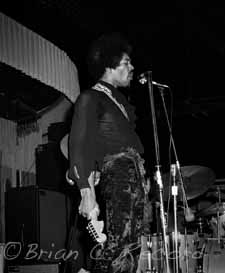
After Lagoon Amusement Park opened its Patio Gardens concert venue in 1954, the Gardens hosted many famous acts there until the venue changed to a roller rink in the late 1970s. Some of the acts that visited Patio Gardens included such luminaries as Johnny Cash, Ella Fitzgerald, The Doors, Ray Charles and the Monkees. In the summer of 1968, three of the most popular names of the time decided to make a stop at Lagoon: Janis Joplin with Big Brother & the Holding Company, Jimi Hendrix, and The Beach Boys.

"Jimi Hendrix Picking Peace, 1968." Photo by Brian C. Record. Collection of Brian C. Record.

Between 1886, when Lagoon opened as “Lake Park” and 1968, the park went through numerous changes, reflecting the change of the culture surrounding the park. When it first opened, Lake Park featured an “open-air dancing pavilion with delicately carved latticework and archways,” and true to its name, the park sat along the banks of the Great Salt Lake. (Lagoon Press Kit, 5) Some of the other activities available to guests there were swimming, boating, roller skating, dancing and bowling. After seven years of the success at Lake Park, the Great Salt Lake began to dry, receding and forcing the now murky lake to be closed to visitors.

As the park transitioned to its current location, it began to gravitate more toward rides as attractions, and finally in 1954, Patio Gardens was erected to become a premier concert venue for Utah and its residents. As the summer of 1968 approached and Big Brother & the Holding Company, Jimi Hendrix, and the Beach Boys prepared to make a tour stop in Farmington, Lagoon also opened its Opera House, where musicals would be performed for the next few years for the Utah summer theater. (Lagoon Press Kit, 6) The year 1968 was an important year for Lagoon, when it would contribute greatly to Utah’s history by bringing so many live performances to Farmington, primarily advertising in The Salt Lake Tribune.

Janis Joplin. Photo by Brian C. Record. Collection of Brian C. Record.

Janis Joplin, performing with Big Brother & the Holding Company, was the first of the three bands to come to Lagoon on July 20, 1968. In the days leading up to the concert, The Salt Lake Tribune ran daily advertisements for Lagoon, paying special attention to concerts that were coming to the music venues there, the Opera House and Patio Gardens. The first advertisement ran on July 18, 1968, in four panels, one of which loudly proclaimed “Big Brother & the Holding Co.,” and in smaller words below, “with Janis Joplin.” (Advertisement, B6). It is interesting to note that while Joplin’s name ran fairly small in all advertisements, in the single article devoted to the concert leading up to the show, Big Brother & the Holding Company was downplayed, while the focus was on Joplin.

The article states: “Two big-name rock groups will entertain Saturday at 7:30 and 10:30 p.m. in the Patio Gardens of Lagoon. Appearing will be Big Brother & the Holding Company with Janis Joplin and Blue Cheer. Miss Joplin, 25, of Port Arthur, Tex., has emerged as one of the new stars of the rock music world. She has been working with the group for a year and a half.” (The Salt Lake Tribune, A13) The article’s claim that Joplin was a “new star” at the time of the concert is also notable, as she had been performing with Big Brother & the Holding Company for almost two years at the time of the concert. She had performed with the band in such venues as the Hollywood Bowl in Los Angeles, the Avalon Room and perhaps most famously, the Monterey Pop Festival earlier in 1968. (Dalton, 131)

"Jimi Hendrix Guitar Backing, 1968." Photo by Brian C. Record. Collection of Brian C. Record.

The Salt Lake Tribune’s label of Joplin as a new artist speaks to Salt Lake City, and the Tribune more specifically as a conservative center then, just as it is now. While Joplin may have been more accepted in California, where many of her early concerts occurred, she was just starting to catch on in Utah. That Janis Joplin with Big Brother & the Holding Company played at Lagoon, rather than a larger venue like the Great Saltair, shows that the band may not have been as popular in this conservative community.

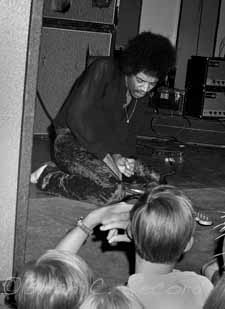
Jimi Hendrix & the Experience came to Patio Gardens at Lagoon on August 30, 1968, a little more than a month after Joplin graced the stage. Like Joplin, Jimi Hendrix had advertisements in The Salt Lake Tribune leading up to his performance, which billed the concert as the “Jimi Hendrix Experience Dance Concert.” (Advertisement, B7) These advertisements were published for the two days before the concert as well as the day of the concert. And like Joplin’s performance, Hendrix was granted a short blurb two days before his concert. Neither advance story featured a photograph accompanying the preview.

"Jimi Hendrix pulling out all the strings, 1968." Photo by Brian C. Record. Collection of Brian C. Record.

Hendrix’s preview, however, was a bit longer, delving deeper into his musical history:

While working in Greenwich Village, Hendrix came to the attention of Chase Chandler, one of the Animals. Chandler persuaded him to go to England, where the Jimi Hendrix Experience originated. Jimi Hendrix writes all his own material including songs three albums: ‘Are You Experienced?’ ‘Axis: Bold as Love,’ and ‘Electric Ladyland,’ a newly recorded record set. (The Salt Lake Tribune, B11)

Despite the fact that Janis Joplin was also a songwriter who penned her own songs, The Salt Lake Tribune did not find that to be pertinent information for her, but it was for Hendrix. The two also had the similarity that their fame had risen at the Monterey Pop Festival; but it seems that in Utah, Hendrix may have been more revered.

Unlike Hendrix and the Jimi Hendrix Experience and Janis Joplin with Big Brother & the Holding Company, the Beach Boys did not have a preview article leading up to the show. They had performed previously at the Patio Gardens, though; according to Lagoon, the band performed in 1963, 1964, 1965, and 1966. (The Beach Boys also performed in 1969 and 1970 following the 1968 concert.) What’s most surprising about the lack of recognition The Salt Lake Tribune gave the Beach Boys is that the band wrote a song about Salt Lake City in 1965, after visiting Lagoon and Salt Lake City.

Salt Lake City

Down in Utah
The guys and I dig a city called Salt Lake
It’s got the grooviest kids
That’s why we never get tired of Salt Lake
And the way the kids talk so cool
Is an out of sight thing
And the number one radio station
Makes the town really swing yeah
Salt Lake City we’ll be coming soon

There’s a park near the city, yeah
All the kids dig the Lagoon now
It’s full of all kinds of girls
And rides and we’ll be flyin’ there soon now
And girl for girl
They’ve got the cutest of the Western states
They got the sun in the summer
And winter time the skiing is great yeah
Salt Lake City we’ll be coming soon. (Wilson)

As evidenced by the Beach Boys lyrics, they clearly appreciated Salt Lake City, and Lagoon in particular. Though The Salt Lake Tribune did publish advertisements for their show, those were paid for by Lagoon; there was no write-up before their show previewing the Beach Boys for those who might go see them, nor a review following the concert.

There were no concert reviews in The Salt Lake Tribune following the Big Brother & the Holding Company with Janis Joplin concert at Patio Gardens either, nor was there a review for The Jimi Hendrix Experience. Despite the fact that other than advertisements in the newspaper, there was very little promotion for any of these bands, that did not impact their popularity negatively. All three artists went on to greater success, and save for the Beach Boys, neither Janis Joplin nor Jimi Hendrix returned to the Patio Gardens. Two years later, Joplin and Hendrix both died of drug overdoses, but their legacies lived on and Lagoon and Utah residents and visitors were a part of all of their careers. (Gent, 1)

The Patio Gardens was converted to a roller rink in 1978, and is now the Game Time Arcade. (Lagoon Press Kit, 6) Because no posters were made for the concerts, there is little evidence of them outside some photographs, and newspaper articles and advertisements. Customers who bought tickets to Lagoon on the days of the concerts were only given regular Lagoon tickets, not tickets with the bands’ names on them. Despite this lack of publicity, Patio Gardens was an important part of both Lagoon and Utah’s history.

Anna Sullivan will be a senior at The University of Utah in Fall 2010, majoring in journalism with a minor in creative writing.

Sources

“Death of Janis Joplin Attributed to Accidental Heroin Overdose,” The New York Times, October 6, 1970, 50.

“Jimi Hendrix to Perform,” The Salt Lake Tribune, August 28, 1968, B11.

“Holding Co., Blue Cheer Set Lagoon Performance,” The Salt Lake Tribune, July 19, 1968, A13.

Lagoon Advertisement: Jimi Hendrix & the Beach Boys, The Salt Lake Tribune, August 30, 1968, C6.

Lagoon Advertisement: Jimi Hendrix, The Salt Lake Tribune, August 29, 1968, B7.

Lagoon Advertisement: Big Brother & the Holding Company, The Salt Lake Tribune, July 18, 1968, B6.

Lagoon Advertisement: Big Brother & the Holding Company, The Salt Lake Tribune, July 19, 1968, A12.

Lagoon Advertisement: Big Brother & the Holding Company, The Salt Lake Tribune, July 20, 1968, A11.

Lagoon Advertisement: Beach Boys, The Salt Lake Tribune, September 5, 1968, A17.

Lagoon Advertisement: Beach Boys, The Salt Lake Tribune, September 6, 1968, D7.

Lagoon Advertisement: Beach Boys, The Salt Lake Tribune, September 7, 1968, A8.

“Open Verdict Given in Hendrix’s Death,” The New York Times, September 29, 1970, 59.

Brian C. Record. Jimi Hendrix Picking Peace, 1968. Collection of Brian C. Record.

Brian C. Record. Jimi Hendrix Tripping at Lagoon¸1968. Collection of Brian C. Record.

Brian C. Record. Jimi Hendrix Guitar Backing, 1968. Collection of Brian C. Record.

Brian C. Record.  Mitch Mitchel in Jimi Hendrix Experience, 1968. Collection of Brian C. Record.

Brian C. Record. Jimi Hendrix Pulling Out All The Strings. 1968. Collection of Brian C. Record.

Brian C. Record. Janis Joplin, Patio Gardens at Lagoon. 1968. Collection of Brian C. Record.

Brian Wilson and Mike Love. “Salt Lake City,” Summer Days (and Summer Nights!!) Capitol Records, 1965.

David Dalton. Janis. New York: Simon and Schuster, 1971.

Korral L.K. Broschinsky. Novelty Versus Nostalgia. Unpublished Master’s Thesis. University of Utah, June 9, 1997.

Images:

Record, Brian C. Jimi Hendrix Picking Peace, 1968. Collection of Brian C. Record.

Record, Brian C. Jimi Hendrix Tripping at Lagoon¸1968. Collection of Brian C. Record.

Record, Brian C. Jimi Hendrix Guitar Backing, 1968. Collection of Brian C. Record.

Record, Brian C.  Mitch Mitchel in Jimi Hendrix Experience, 1968. Collection of Brian C.

Record.

Record, Brian C. Jimi Hendrix Pulling Out All The Strings. 1968. Collection of Brian C. Record.

Record, Brian C. Janis Joplin, Patio Gardens at Lagoon. 1968. Collection of Brian C. Record.

Woman’s Suffrage in Utah: The Woman’s Exponent Reacts To the Edmunds-Tucker Act of 1887

by JAMIE A. WELCH JARO

After the United States Congress stripped Utah women of their right to vote in 1887 through the Edmunds-Tucker Act, one Utah publication, The Woman’s Exponent, its editors and readers alike, chose to fight back. Through editorial pieces, letters, columns and speeches, it is evident that the people of Utah were united against this outrageous law which denied them their basic freedoms as citizens of the United States.

Utah women were able to vote in political matters as early as the year 1870, granted by territorial legislature. They were the first women in the history of the United States to have this right. Sometime in the year 1847 during the final settlement of the Salt Lake Valley, both men and women voted by ballot. This, Hubert Howe Bancroft records, may have been “the first instance in the United States where woman suffrage was permitted.” (Bancroft, 272)

The Edmunds-Tucker Act was passed in 1887 as an attempt to defeat polygamy in Utah as well as the political power of its Mormon settlers. The law broke down the local political system already well rooted in the Utah Territory, replacing it with federal control. Along with losing their rights to plural marriage and their land, Utah women were outraged at losing their basic right to vote after having it for seventeen years. Women fought this action and were supported by men both within the Mormon Church and outside it.

The Exponent, a Salt Lake City women’s newspaper originally published by Mormon women Emmeline B. Wells and Louisa Greene, was an eight-page monthly publication that covered topics ranging from church activity reports and homemaking hints to politics, both local and national. The Exponent was a well circulated form of communication in its time for women in the Utah Territory. On January 15,1887, its editors proclaimed the paper was not merely the voice of its editor or its columnists, but that of every Latter-day Saint woman. On the same date it also charged these women with having the responsibility to “help send this voice abroad,” thereby spreading information, knowledge, and promoting sisterhood.

Emmeline Wells was born in New England in 1828 at Petersham, Massachusetts. In March 1842, Wells was baptized into the Church of Jesus Christ of Latter-day Saints following her mother, who became a member in 1841. Crocheron notes that “Mrs. Wells often says she was born a woman’s rights advocate, inheriting it from her mother, who was a staunch advocate for woman’s emancipation” and who promoted the education of women, even among circumstances where it was not highly valued. It was in November 1847 that Wells first stepped into the office of the Exponent to assist the current editor and in July 1877 she took over the entire role of editor. (Crocheron, 69)

Wells, quick to endorse political action from women, wrote in the Exponent on November 1, 1880, encouraging her fellow females to take part in a local election scheduled for the next day. Votes were cast for the delegate to congress from Utah and Wells reminded her readers that despite recent attempts to abolish the franchise for women, they were still permitted to vote and every able woman should not miss her chance to do so.

Women enjoyed exercising their political power and, when talk began of Congress challenging their ability to do so in 1880, voices rose through the Exponent. One letter to the editor, published November 11, 1880, from a woman named Jane C. Johnson, demanded her right to be heard. Johnson challenged an article from a previous issue that argued women were not taxpayers and thus should not be allowed to vote. Johnson disputed this, writing, “I think we are very heavy taxpayers. Does not every wife own property in connection with her husband? I think so. Does not her labor help to make that property? … Yes we do …. We ask for the justice and freedom that belong to American citizens, and wish to vote for men of integrity and those that will stand by the constitution of our country.”

Mormon Church leaders, including its president Brigham Young, supported woman suffrage. George Q. Cannon and Brigham Young, then officials in the Mormon Church, wrote in the Deseret Evening News on July 23, 1878, “Under the laws of Congress a woman born in the United States is a citizen just as much as a man…. If woman is entitled to the name and position of a citizen, should she not also be invested with the rights and privileges of a citizen, so far as she is capable of properly exercising them?”

Editorials from other national magazines were included in The Woman’s Exponent to show not only that local women were being supported in their efforts to keep the vote, but also those who doubted the power and impact of the women’s movement. Before the imposition of the Edmunds-Tucker Act was conceived, a publication out of Philadelphia noted the trials of women in Utah. The Exponent recorded on November 12, 1880, that the editor of Woman’s Words in Philadelphia wrote, “Another effort is being made in Utah to disfranchise the women of that Territory … a [mandate] having been issued by the Supreme Court bearing on the question. We do not believe it will succeed. Liberty takes no step backward, and when the elective franchise is once exercised, no other can take it away without a revolution.”

That same date marks another paper with a similar tone from Matilda Joslyn Gage of the National Citizen in New York. “Let this attempt to deprive the women of Utah of their political rights nerve the heart and brain of every woman to more strenuous effort for a sixteenth amendment which shall recognize the rights of all United States citizens to the ballot. When once this is gained, no isolated state or territory can strike such a blow at suffrage rights.”

On March 21, 1888, The Deseret Evening News reported an international council of women in Washington, D.C., was to be held by the National Woman Suffrage Association on March 25, 1888. Suffragists Elizabeth Cady Stanton and Susan B. Anthony along with delegates from states and territories of the United States and England joined in the advocacy for woman’s rights, establishing the position to attain suffrage. Wells received a report from this council and printed it in the Exponent April 15, 1888, saying Utah’s position was not forgotten and the delegate from Utah, Emily S. Richards, delivered a speech that left the audience with perhaps a better view of Mormonism and feminism in the Utah Territory.

Woman’s rights made a large leap forward when, as the Exponent reported on February 1, 1895, Utah’s constitutional convention was to gather and the Utah Woman Suffrage Association impressed upon those in the convention to remember the rights of women in the state’s new constitution. Editors wrote, “Our government is ‘of the people, for the people and by the people.’ Whatever the status of women may be, they are at least a part of the people … and by no form of principle of reasoning can they be deprived of such rights and privileges as inure to men under government, without at the same time destroying the natural rights which men hold for themselves to be inviolate.”

The report of the Committee on Elections and Suffrage that emerged from the constitutional convention resolved, as the Exponent reported on April 1, 1895, “That the rights of citizens of the state of Utah to vote and hold office shall not be denied, or abridged on account of sex. Both male and female citizens of this state shall equally enjoy all civil political and religious rights and privileges.” In its completed work, the state constitution would include the victory of woman suffrage.

Women celebrated in Utah on November 5, 1895, when the final constitution was accepted, which included equal rights for women. On November 15, 1895, the Exponent rejoiced in Utah being the 45th state and proudly declared Utah as revolutionary for being only the third in the nation to incorporate women’s right to vote.

Utah’s history of woman suffrage is a unique one. The woman of Utah who voted in 1895 — decades before others in the country — succeeded in 1895 largely due to their supportive force from the dominant Church of Jesus Christ of Latter-day Saints. The leading political figures of the state were Mormon and predominantly were for giving women voting privileges as they had originally been granted in 1870. However, without the vigilant efforts of Emmeline B. Wells and The Woman’s Exponent, it is possible Utah’s women may have been fighting even longer. As the early women settlers discovered, the power of the press is often stronger than the voice. Without the support network set up by Wells and other suffragists throughout the state, it is likely the issue of woman’s rights would have withered and faded until brought about by the 19th Amendment to the United States Constitution in 1920.

Jamie Welch Jaro graduated in May 2010 with a Bachelor of Arts degree in mass communication. She studied print, new media and photojournalism throughout her college career and looks forward to a lifetime of writing in whatever field she pursues.

Sources

Primary

“What To Do with Your Exponent,” The Woman’s Exponent, January 15, 1887, 1.

Emmeline B. Wells, “The Coming Election,” The Woman’s Exponent, November 1, 1880, 4.

Jane C. Johnson, “Women Are Taxpayers,” The Woman’s Exponent, November 1, 1880, 8.

George Q. Cannon and Brigham Young, “Woman In Politics,” Deseret Evening News, July 23, 1878, 2.

Lewis, “The Coming Election,” The Woman’s Exponent, November 1, 1880, 4.

Matilda Joslyn Gage, “The Coming Election,” The Woman’s Exponent, November 1, 1880, 4.

Emmeline B. Wells, “An International Council of Women,” Deseret Evening News, March 21, 1888, 151.

“N.W.S.A. Convention,” The Woman’s Exponent, April 15, 1888, 4.

“Woman Suffrage Column,” The Woman’s Exponent, February 1, 1895, 1.

“Woman Suffrage Column,” The Woman’s Exponent, April 1, 1895, 4.

“The New State,” The Woman’s Exponent, November 1-15, 1895, 4.

Secondary

Hubert Howe Bancroft. History of Utah, 1540-1887. San Francisco: The History Company, 1889.

Augusta Joyce Crocheron. Representative Women of Deseret. Salt Lake City, Utah: J.C. Graham, 1884.

The Completion and Dedication of The Cathedral of The Madeleine, 1909

Entry and photo by CARLY KUNZ

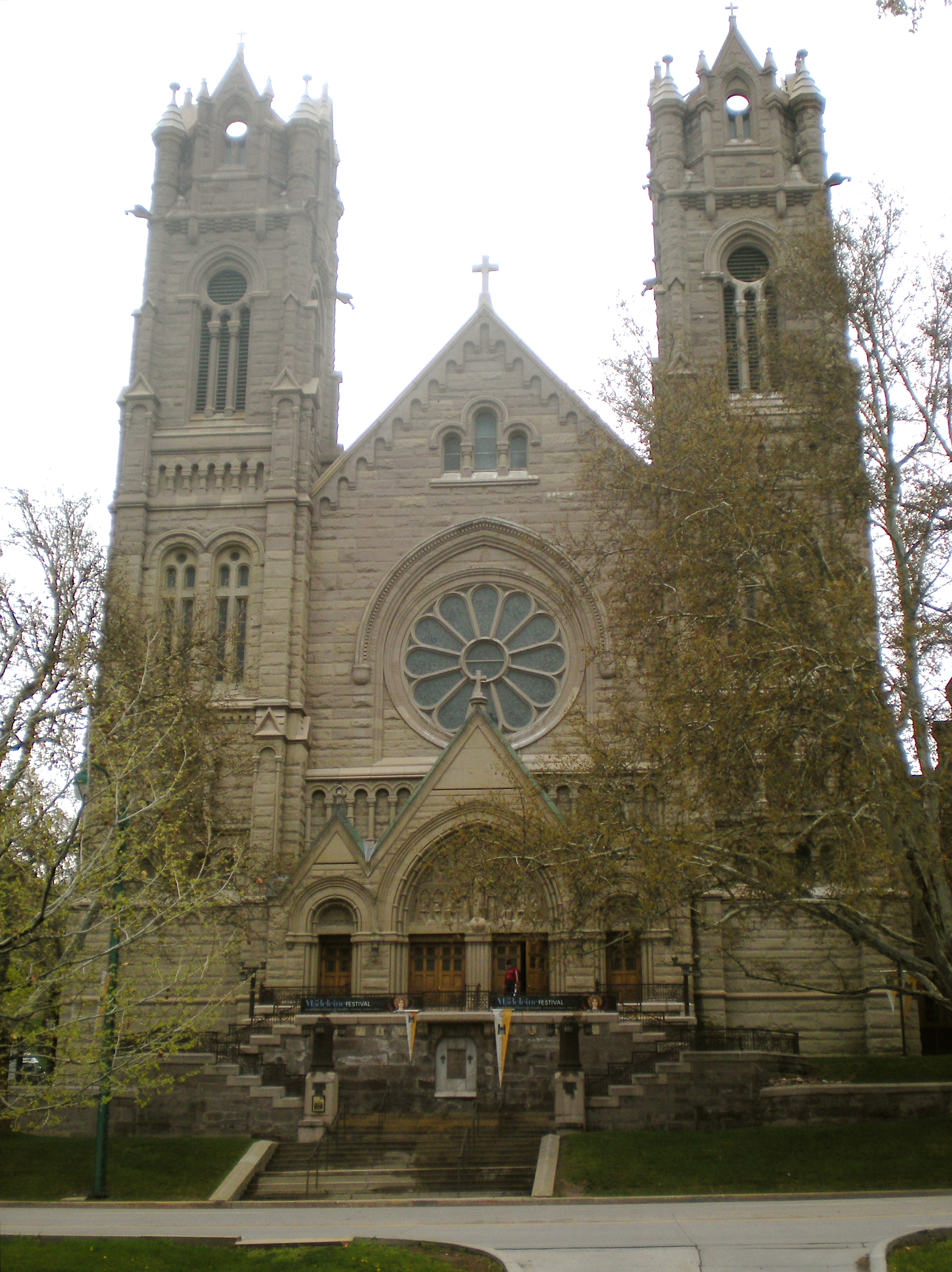
Photo by Carly Kunz, April 21, 2010.

The Cathedral of The Madeleine was dedicated on August 15, 1909. It took ten years for its completion and the completion was in part due to the devotion of Bishop Lawrence Scanlan. Bishop Scanlan came to Salt Lake City on August 14, 1873. He came with the aspiration to teach Catholicism in Salt Lake City and allow the religion to flourish. Upon his arrival, he created Catholic schools and hospitals. With the Catholic community beginning to thrive, Scanlan approached his next dream. He dreamed of creating a cathedral “that would look out across Salt Lake Valley from the heart of the city all the way to where the mountains push up against the sky.” (Mooney, 12)

On February 25, 1890, Bishop Scanlan purchased the land for the Cathedral for $35,000. That land is located on what we know today as B Street and South Temple. Mooney credits Bishop Scanlan with drawing the final plans for the Cathedral “over a period of eight years from the time of the purchase of the site.” (Mooney, 16)

The groundbreaking for the Cathedral occurred on Independence Day of 1899; however, it wouldn’t be finished until 1909. The overall construction ended up costing $344,000. The construction was delayed for the reason that Bishop Scanlan felt it was better to delay the process rather than accumulate further debts. (Mooney, 17)

Nonetheless, Bishop Scanlan was able to see through his dream. On August 14, 1909, The Intermountain Catholic reported:

Yes, Bishop Scanlan is a wonderful man, but don’t let him hear you say it. If you want to get into his good graces, just say: ‘Bishop, you have a wonderful, a good people.’ He will assure you then, with a warm handshake, that they are the best of the best, and that these institutions, which today are the glory of the diocese, are all due to their generosity. And the Cathedral itself, the crowning glory of the Bishop’s life, looks out proudly and boldly to the mountains of Utah, and it whispers: ‘I am the temple of the Living God, I stand guard at the gates of the West, and my pinnacles, as they soar up and point to Heaven, remind men that as they dig and delve for gold there is another digging to be done, a digging and delving on the great road to God.’

The completion and the dedication of the cathedral were not only substantial accomplishments for Bishop Scanlan, but for the Catholic community in the Salt Lake Valley as well. The Intermountain Catholic was a publication within the Salt Lake Valley that provided news and reports on Catholicism. With the dedication of the cathedral just a week away the anticipation in the community was high. The Intermountain Catholic on August 7, 1909, reported, “Right Reverend Bishop Scanlan accompanied by Very Reverend Dean Harris, went to Pocatello Thursday night to meet Cardinal Gibbons, who is going to the national park before he visits Salt Lake.” The newspaper also warned (in this same issue), “Those who have not yet rented seats or pews for the dedication should see or phone Reverend W.K. Ryan, who has the charge of the seating. The desirable seats are nearly all gone.” The article added: “Owing to the fact that there are 7,500 Catholic people in Salt Lake and that seats for only 1,200 can be provided it has been determined to make the admission solely by ticket for both the morning and evening service.”

The day before the dedication The Intermountain Catholic quoted the “History of the Catholic Church in Utah” by Very Reverend Dean Harris: “The Cathedral of Salt Lake is without exception, architecturally, the finest ecclesiastical structure west of the Missouri. Resting on an imperishable foundation of massive blocks of granite, the great building occupies a commanding site in one of the finest quarters of the city, and imparts to the surrounding neighborhood a tone of quiet solemnity and impressive dignity.” (Mooney, 22)

According to Mooney and Dwyer,

The dedication on August 15, 1909, proved to be one of the most brilliant assemblies of American Church dignitaries the Far West had even seen …. The actual ceremony of dedication was performed by the Right Reverend Denis O’Connell, Auxiliary Bishop of San Francisco, and preceded the Mass. In the sanctuary were present His Eminence James Cardinal Gibbons, Archbishop of Baltimore, undoubtedly the outstanding man in contemporary American Hierarchy; the Most Revered John J. Glennon, Archbishop of St. Louis (and later a Cardinal)…; the Most Revered J. Dappenwill, Archbishop of Vancouver; the Right Reverend Richard Scannel, Bishop of Omaha …; the Right Reverend J.J. Keane, Reverend A.J. Glorieux, Bishop of Boise … and the Right Reverend John J. Carroll, Bishop of Helena. (Mooney, 22)

The next publication of The Intermountain Catholic came out on August 21, 1909. This publication featured articles such as, “Cardinal Gibbons Delivers Address, A Great Orator.” A Great Orator” offered a quote from The Evening Telegram, in which Judge Goodwin said:

The exercises in the cathedral yesterday were most impressive. The authorities of the great church were present in full force — priests, bishops, archbishops and the cardinal: the music was filled with solemn splendor; the cathedral itself is both majestic and beautiful and those who heard the dedicatory sermon were charmed. The speaker has some of the rarest gifts of the orator. There was not a trace of the theatrical in his manner, but there was a sincerity and power in his arguments which showed clearly that what concerned him was not how he should speak, but what he was to say and here and there was a simple sentence which apparently unstudied, was as filled with stateliness and splendor as a great anthem. It was a great day for our Catholic friends.

Overall, the dedication was very well perceived. People were impressed with the stunning architecture of The Cathedral of the Madeleine. Utah Historical Quarterly observed in 1981 that with the exception of the “decoration of the interior,” the architecture and design of the cathedral has remained the same since its dedication in 1909. Not only has the architecture remained substantial, but its importance to the Catholic community in the Salt Lake Valley has also remained the same. Bishop Scanlan created a truly beautiful work of architecture, but more importantly a place of worship that will continue to bring the Catholic community of the Salt Lake Valley together.

Carly Kunz is a senior at The University of Utah. She is majoring in mass communication and will be graduating in August 2010.

Sources

“Bishop Scanlan And St. Mary’s Cathedral,” The Salt Lake Herald, July 20, 1907.

“Dedication Of The Cathedral,” The Intermountain Catholic, August 7, 1909.

“A Great Orator,” The Intermountain Catholic, August 21, 1909.

Rev. W.R. Harris, “The Catholic Church In Utah: Parishes And Missions,” The Intermountain Catholic, 1909.

Bernice M. Mooney. “The Cathedral of the Madeleine: The Building and Embellishment of a Historic Place.” Utah Historical Quarterly 49 (1981): 110-32.

Bernice Maher Mooney. The Story of the Cathedral of the Madeleine. Salt Lake City, Utah: Litho Grafics, 1981.

Sacerdos, “The Bishop of Salt Lake Communicated,” The Intermountain Catholic, August 14, 1909.

“St. Mary Magdalene’s Cathedral,” The Intermountain Catholic, August 14, 1909.

This Is the Place: The Building of the Salt Lake Temple

by DIANE HOLBROOK

Shortly after inhabiting the great Salt Lake Valley, a place was soon chosen where the Salt Lake City temple would be built. On February 14, 1853, there was not only a dedication and groundbreaking of this magnificent building, but a commencing of something being built of biblical proportions.

After members of the Latter-day Saints were persecuted and driven out of both Kirkland, Ohio, and Nauvoo, Illinois, they started their long and treacherous journey west. Temples were built in both of these locations because temples and work done in them are a very important part of the Mormon religion. The Saints knew they would end up in the West and they knew they would want another temple there as well.

They arrived July 28, 1847, in the Great Salt Lake Valley. Just four short days later, Brigham Young, then president of the church, declared where the temple was to be built. On February 19, 1853, the Deseret News reported about Young: “Only as he had learned by dreams and visions, and revelations, that there was a good place for the saints in the mountains, and that when he arrived on the spot where he then was, he declared that the place for a temple.” Mormons believe in revelations from God to guide them in the right direction. President Young was sure when he said that this is “the place.” Since most of the inhabitants of the Salt Lake Valley were members of the Church of Jesus Christ of Latter-day Saints, they were thrilled at the prospect of having yet another temple in their midst. Since their arrival in 1847, only six years had gone by until they commenced the building of the Salt Lake Temple.

The groundbreaking for the temple was held February 14, 1853. Prayers were said, hymns were sung, and the first shovel was dug in the ground. The spot where the temple was going to be built was dedicated as well. Many people showed up for this. As far as the eye could see there were Saints there to bear witness to the beginning of construction and to hear the voice of their Prophet.

In a book titled, The Salt Lake Temple: an Architectural Monograph, written by Charles Hamilton, it was said that the groundbreaking and the site of the temple was monumental because “President Young required the city be laid out from the temple plot.” (Hamilton, 33) Young wanted the temple to be the focal point of the valley. Because of this thought and plans for city plans, Salt Lake City is on a grid system, with the temple being at the center of everything. The temple plot is a total of ten acres. On this includes the temple, the tabernacle, the Salt Lake Assembly Hall, and two visitor centers. Hamilton also suggests that the Salt Lake Temple design was very influential of other temples. He says that “symbolically and ecclesiastically the [Salt Lake Temple was the] most important of the temples.” (Hamilton, 152) This temple certainly is the most widely known. Many tourists visit the temple and temple square daily. According to a Deseret News story by Aaron Falk, Temple Square receives about five million visitors per year, which actually makes it number 16 out of 25 for most visited sites in the United States.

Building this humongous temple was a feat to be had. It took 40 years to complete the development. It was a hard, seemingly impossible endeavor. Granite was brought in from Little Cottonwood Canyon, which was about 30 miles away, and tithing was used to pay for the temple, which wasn’t very easy for the people. On April 16, 1853, the Deseret News encouraged readers to “bring up to the Tithing House of the Lord your tithings and your consecrations; pay up what you owe ….” A lot of sweat, hard work, and sacrifices were made for this House of the Lord. It was very important to the members of the church that this temple be built and they were willing to do whatever it took for the completion of this great building. Talk of the building of this great temple was widespread. Harper’s Weekly even wrote a long story about the temple in its newspaper in the July 11, 1857, edition. There was a lot of information about the temple and even a picture of what it was to look like when completed. The temple was big news all over the country.

Upon completion in April 1893, the Deseret News published an article titled, “Word of Warning.” The article observed, “During … the temple dedication services, many hundreds of Latter-day Saints will visit this city for the first time, and many more who are not accustomed to the ways of the world as exhibited by those who are not of this faith.” The completion was a huge deal around the country. The temple’s completion was so newsworthy, the Deseret News felt it needed to warn people about the influx of tourists.

Twice a year the Church of Jesus Christ of Latter-day Saints holds a General Conference going over certain religious topics and spreading word of the church’s work. On April 8, 1893, the Deseret News wrote about the completion and dedication of the Salt Lake Temple. In the article, titled “House of the Lord,” it makes mention of a speech by then President of the Church, Wilford Woodruff. During that speech, President Woodruff acknowledged the completion of the temple and how great it was now that they had it in their presence. In a Deseret News article titled “The Interior,” the reporter described the temple saying, “It amazes by its massive solidity and charms with its exquisite beauty; by the ingenuity and completeness of its appointments it delights the most practical, and in its perfection of taste and harmony it dazzles the most artistic and refined.”

America was aware of the atrocities the Mormons had endured before reaching the Salt Lake in 1847. The Salt Lake Temple was the sixth temple to be erected. It is however, one of the more popular temples to people around the world, whether they are members of the Mormon Church or not. To this day, the temple is still well talked about. Mormons are very religious people who are willing and waiting to do what God asks of them. The building of the Salt Lake Temple was just one of those things.

Diane Holbrook is a junior at The University of Utah. She is majoring in mass communication.

Sources

“A Word of Warning,” Deseret News, April 8, 1893, 6.

Deseret News, February 19, 1853.

Deseret News, April 16, 1853.

Charles Hamilton. The Salt Lake Temple: an Architectural Monograph. Ph.D. dissertation, Ohio State University, 1979.

“New Temple to be built in Salt Lake City,” Harper’s Weekly, July 11, 1857.

Aaron Falk, “Temple Square Ranks 16th in Visitors,” Deseret News, March 11, 2009.

“The House of the Lord,” Deseret News, April 8, 1893, 19.

“The Interior,” Deseret News, April 8, 1893, 20.

The Mormon-Black Hawk War

by CHAD MANIS

The “Black Hawk War” that took place in Utah and started roughly around April 9, 1865, was the longest and most destructive war between pioneer immigrants and Native Americans in Utah history. It was a war between the Ute Native Americans and the Mormon settlers.

It all started when a handful of Ute Indians and Mormon settlers gathered in Manti, Utah, to settle a dispute over some cattle and livestock that were killed and eaten by some hungry Utes. The Mormons attempted to reason with the Indians, saying they had the right to take possession of their land because the Indians were heathens and non-Christians who didn’t believe in the Bible or Jesus, or the Messiah. (www.blackhawkproductions.com)

One thing led to another and a Mormon settler insulted a Ute Indian as well as a Ute named Black Hawk. But Black Hawk was not his name; his real Ute name was Nooch, a name sacred to the Ute Indians in honor of the Noochew people. Black Hawk was the name that Brigham Young gave him. That is when the Indians promised retaliation, and retaliation is exactly what happened. Over the next couple of days the Indians followed through with their promises and stole hundreds of the Mormon settlers’ cattle as well as killed five men, then escaped into the mountains. Black Hawk was given the title of War Chief after his stand up to the settlers. Historian Will Bagley wrote, “It was a matter of who would own the land and who would survive.  It was a battle over resources that led to a brutal bloody conflict between the Mormon settlers and the Ute.” (www.blackhawkproductions.com)

Militiamen mostly fought the war in the northern states, and few Indians were given credit for anything. Miss Doris Duke said, “If a white person would of grown up the way an Indian did, the white person would think the same way, there is no right or wrong, it was just the circumstances.” (Miss Doris Duke)

Over the next year Black Hawk continued with this stealing of cattle and challenging the Mormons. Black Hawk was not supported by everyone in his tribe, though. He had gained the support of only a handful of people, but he also had gained some support from other tribes in the area, such as the Paiute and Navajo. Their task was simple: it was to make life difficult for the Mormons through that area of land. Their goal was to steal as much cattle as they could, as well as taunt and hassle people who were traveling through the area. (Gottfredson)

In the small town of Circleville in the year of 1866 it was said that there occurred “the largest massacre of Indians in Utah’s history.”  (Winkler) The Circleville Massacre was a key event in the Black Hawk War and lives up to every bit of its title. On September 18, 1865, Major Warren S. Snow and a hundred men who were out hunting Indians stopped in the town of Circleville for the night. The next morning they took off, eventually to meet up with some Indians to fight in Wayne County. The Utes heard of this and started their move toward Circleville.  The townspeople saw the Utes all around the mountains just watching them, waiting to make a move. One day after the Utes came to the town and stole some more of their cattle, the townspeople took cover in the meetinghouse with only a few militiamen guarding the town. (Winkler)  After the first raid the people did not want to chance any more Indian attacks so they went to the neighboring tribe to their town where the Paiute Indians were and took sixteen men captive and some women and children, as a precautionary measure against any further raids. They were placed in the meetinghouse under arrest with guards and the women and children were placed in the cellar. That night when the guards were waiting for orders on what to do with the captives, the Paiute men freed themselves and sprung on their captors. In a panic all of the sixteen men were shot and killed in the struggle. Since they did not want the word to get out about the killings they brought up the women one at a time and shot them, and then shot the children one at a time. (Winkler)

Throughout the next couple of years the Mormons decided enough was enough and decided to stand their ground. Historian Robert Carter said, “When the Ute failed to assimilate into Mormon culture, the answer was to exterminate them.” (www.blackhawkproductions.com) The Mormons got hundreds of militiamen and chased the Utes through the wilderness and mountains but did not have much success since that was the Indians’ homeland. But that didn’t stop some of the men who were upset with what was happening to their land and their cattle from killing some innocent Utes, including women and children. Mormons decided to go another route and called upon federal troops to step in and help them out with the growing problem, but their support was not answered for a while. After much fighting and constant little battles, Black Hawk and the Mormons made peace with each other in 1867. A treaty was signed in 1868.

Before Black Hawk died in 1870, from a bullet wound a year earlier that made him sick, he traveled to the Mormon village to apologize for the pain and suffering that the war had caused. He asked for settlers’ forgiveness and asked them to do the same and stop all the bloodshed. (www.blackhawkproductions.com) But even after the treaty was signed, many Native Americans were still being killed, even after Black Hawk apologized to them.

White expansion brought a problem to the Indians. Mormons and Europeans brought in new diseases and their settlement in some areas hurt the natural eco-system, and scared away wildlife, which led to the starvation of many Indians.  All of the events were not uncommon in the western states at this time but the Black Hawk War was different because of the animosity between the United States government and the LDS Church. The war ended without any incident when federal troops were ordered to engage the Indians in 1872. (Lowry)

Chad Manis is a senior at The University of Utah. He is majoring in mass communication and plans to graduate in fall 2010. He grew up in Long Beach, California, but now lives in Salt Lake City with his wife, Casey.

Sources

Albert Winkler, “The  Circleville Massacre: A Brutal Incident in Utah’s Black Hawk War,” Utah Historical Quarterly 55 (1987).

Peter Gottfredson. Indian Depredations in Utah (1919), Legislative Assembly Of Utah Territory.

Kate B. Carter. Our Pioneer Heritage, vol 9. Salt Lake City: Daughters of Utah Pioneers, 1958.

The American Indian Oral History Project, Miss Doris Duke, MS 417. Legend Translated by Alvina Quam 1968, Manuscript Division, J. Willard Marriot Library, University of Utah, Salt Lake City, Utah.

The John Lowry, Sr., and John Lowry, Jr., Papers , MS 306. J. Willard Marriot Library, University of Utah, Salt Lake City, Utah.

Sketch Of The Life Of John Lowry 1799-1867, Manuscript Division, J. Willard Marriot Library, University of Utah, Salt Lake City, Utah.

Secondary Sources

Carlton Culmsee. Utah’s Black Hawk War. Logan: Utah State University Press, 1973.

Black Hawk Indian War: Utah’s Forgotten Tragedy.”

Utah’s Spiral Jetty: Art and Nature Collide

by MADELINE VANDEVER

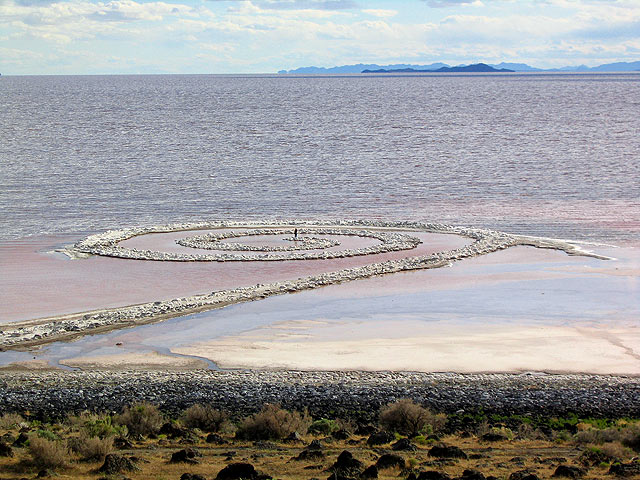
Photograph of the Spiral Jetty at Rozel Point by Soren Harward.

The Spiral Jetty is a man-made, sculpted work of art by artist Robert Smithson. It is located on the northeastern shore of the Great Salt Lake, near the Golden Spike National Historic Site. Smithson used black basalt rocks and earth from the area to create the Spiral Jetty in 1970. The Jetty is in the shape of a spiral coil that is 1,500 feet long and 15 feet wide, and it took six days to create. It reaches out counter-clockwise into the red waters of the area. The Spiral Jetty was acquired by Dia Art Foundation, based in New York, as a gift from Smithson’s estate in 1999. It has worked diligently to preserve the Spiral Jetty since the acquisition, according to the foundation’s Web site.

The Spiral Jetty is a highly regarded and well-respected work of art that tourists and art enthusiasts alike can enjoy and appreciate. In 1972, The New Yorker referred to it as Smithson’s “most ambitious [project] to date.” The Jetty is only visible when the water level of the Great Salt Lake is low enough, giving the Jetty an air of rarity and mystique among those who seek it. The Jetty was not visible for many years in the 1980s, resurfacing briefly in the 1990s only to disappear once again. Today, the Jetty is entirely visible.

Because the Spiral Jetty exists within a natural, outdoor setting, it has been the center of some controversy between environmentalists, art enthusiasts and oil drillers. An editorial published in The Free Lance-Star in 1981 referred to the Jetty as a “curling path of rock bulldozed into Utah’s Great Salt Lake,” addressing concerns over environmentally destructive works of art such as the Jetty. There has been some controversy regarding the Spiral Jetty and mining. The New York Times has published articles discussing how art enthusiasts believe the Jetty should be left alone, while mining and drilling proponents think that the land surrounding the Spiral Jetty should be fair game for Utah’s mining industry. In one article, John Harja, director of the Utah Governor‘s Public Lands Policy Coordination Office, said, “Like everywhere in the West, the lake is being discovered and people want to protect it and people want to use it.”

Photograph of the Spiral Jetty by Michael David Murphy.

The Jetty has also served as a great location for amateur, nature and art photographers due to its unique design and all-natural landscape. Of the included photographs, two were taken at Rozel Point, which is slightly northeast of the Jetty and a popular spot for photographers to capture the Jetty in its entirety. The aerial photograph was featured on a New Jersey public television (NJN) program titled, “State of the Arts” for their Forces of Nature segment, demonstrating that interest in the Jetty is not only at a local level, but a national one as well. Many pictures of the Jetty have been taken over the years, some while the Jetty was fully exposed, others while it was barely visible above the waters of the Great Salt Lake. According to the Dia Art Foundation’s Web site, no permits or special permissions are required to take photographs of the Jetty.

As for artist Robert Smithson, he did not live to see the Spiral Jetty gain momentum in the press, or attention from fans. He died on July 20, 1973, at age 35 in a plane crash in Texas. Following his death, The New York Times wrote, “When a culturally significant person dies, there may occur for the living a moment of illumination, not only of one career but of a whole nexus of events and meanings into which that career was woven.” Smithson and his Spiral Jetty have gained a number of fans posthumously, including a number of fellow modern artists.

Aerial view photograph of the Spiral Jetty courtesy of NJN Public Television.

The Spiral Jetty has been called one of Utah’s best kept secrets by some. Smithson revealed in an interview with Paul Cummings that he felt the Jetty possessed a “prehistoric motif,” making it a timeless work of art in the spirit of Earth’s histories. The visitor’s center at Golden Spike National Historic Site serves as an unofficial information center for the Spiral Jetty where fans and curious onlookers can go for directions and information. Writer Kirk Johnson from The New York Times discusses the controversy that exists between the state of Utah and the Dia Art Foundation over the land surrounding the Spiral Jetty. The Utah state government, which includes the aforementioned Governor’s Public Lands Policy Coordination Office, is interested in drilling oil near the site, while the Dia Art Foundation feels that oil rigs would harm the work’s aesthetic experience. As of today, the future of the Jetty is uncertain. The debate over drilling near the site is still ongoing, and the Jetty is not visible indefinitely. However, this unique piece of artwork has carved itself an important place in Utah’s artistic and geographic history.

Madeline Vandever is a mass communication major at The University of Utah. She plans to graduate in May 2011 and will then pursue a Master’s degree in elementary education.

Sources

Calvin Tomkins, “Onward and Upward with the Arts: Maybe A Quantum Leap,” The New Yorker, February 5, 1972, 42.

George Will, “Pistol-packing ‘artists’ may reflect mood of world,” The Free Lance-Star, August 1, 1981, 3.

Peter Schjeldahl, “Robert Smithson: He Made Fantasies as Real as Mountains,” The New York Times, August 12, 1973, 127.

“Robert Smithson, 35, A Sculptor, Is Dead,” The New York Times, July 24, 1973, 41.

Kirk Johnson, “Plans to Mix Oil Drilling and Art Clash in Utah,” The New York Times, March 27, 2008.

Secondary sources

Nancy Holt, ed. The Writings of Robert Smithson. New York: New York University Press, 1979.

Paul Cummings. “Interview with Robert Smithson For The Archives of American Art/Smithsonian Institution (1972).” Robert Smithson: The Collected Writings, ed. by Jack Flam. Berkeley: University of California Press, 1996.

Opium, the Drug of Destruction

by JED PIERCY

The year 1869 was a landmark year for Utah. With the completion of the transcontinental railroad, traffic to the West was now open and people made passage to Utah. This included many of the Chinese, who had been workers on the railroad and were paid minimal wages. Many of the Chinese moved where “economic opportunities were.” The railroad along with merchants offered many job opportunities in Utah. By 1890, the Chinese population grew to an estimated 806 people; often they were concentrated in small areas. (Dirlik, 269-275) This resulted in the creation of Chinatowns in Utah. According to Dirlik, Chinatowns offered “a place of security comfort and cultural familiarity.” (Dirlik, 271) Many men felt that they were in a strange country with unfamiliar customs.

With the growth of Chinatowns in Utah, so grew the Chinese influence, customs and traditions in the area. In fact, many white men and women adopted the habit of smoking opium after a long day of work as a way of relaxing their mind. Opium is a substance that is extracted from the sap of a poppy seed; it is a tar-like substance that is smoked and gives feelings of euphoria. On January 7, 1857, The Deseret News reported on the “Effects of Opium.” The article described it as a “wasting of youth, health, strength and those who begin its use at 20 can expect to die at 30 years of age.” One user described his experience with opium: “The pleasurable sensations and imaginative ideas arising at first soon pass away — they become fainter and fainter, and at last entirely give place to horrid dreams and appalling pictures of death.” This encyclopedia entry will focus on the rise and fall of opium dens in Utah and the role that they played in Utah’s history.

As Chinatowns continued to grow, so did the influence of opium. The drug was often stored and smoked in underground dens, thus making it harder for authorities to find them. Opium was becoming so popular that it eventually worked its way into white society. On February 7, 1883, The Deseret News reported on “Opium Traffic.” The reporter was amazed at how the use of opium was increasing among “civilized nations.” The claim was made that, “where alcoholism had been abandoned, opium in various forms has been adopted as a substitute in a large number of instances.” As the use of opium grew so did the amount of dens. Commercial Street was located in Salt Lake City, which often housed many opium dens in a concentrated area. “Chinese Dicks” and “Quong Wah Sing” were two of the dens, which happened to be next door to each other. One could often find twenty to thirty people housed there on a given evening.

On October 8, 1883, The Deseret News reported on opium dens in a story headlined, “A Visit to A Couple of Chinese Haunts.” The reporter described the den as he was walking in: “Light down a dark narrow stairway, the atmosphere of which was musty and unwholesome, an underground apartment was reached. The sides cased with rough boards, and around the room were large shelves covered with matting on which the opium smokers recline.” It became so accessible that opium cost 25 cents a pipe; anyone who was willing to pay regardless of age, race, or gender was welcome. Often these dens become dangerous places for young girls.

On May 5, 1883, The Deseret News reported on how the dens ruined young girls. Girls anywhere from 10 to 20 years old were often coaxed into a den by someone they knew. They were then taken upstairs to a dark murky room. In the company of other “ruined” girls they were told of the greatness of the drug. The young girls were usually expected to try it out of courtesy. Everyone looked on while the first few pipes were smoked. Once addicted, they stay “wasting away their young lives in a darkened room as helpless victims of the den keepers and their customers.” (“Openings for Christian Missionary Labors”) Most people thought of these dens as evil, wrong, and immoral, but according to Kirk, “The Tribune complained in 1878 that police were planning to raid dens in the city but could not because there was no law against them.” By 1890 a law had been passed prohibiting the sale of opium, fines would range for $10 to $99, finally giving law enforcement power. (Kirk, 233)

With the law finally on their side, officers could start cracking down on the dens. They were determined to find and shut down all access to opium. Many of the dens were found in Plum Alley, which ran north from 200 South to 100 South between Main Street and State Street. There was so much opium and so many arrests that police had trouble keeping track of inmates. One instance of this occurred on January 22, 1900. The Salt Lake Herald reported on one of the inmates named John Wah. Mr. Wah was a trustee to the jailer, and was turned out into the yard as a trustee. By the second day he felt the itch for opium so he “hot footed” it to Plum Alley where he got his fix. He returned to the jail on his own free will by suppertime. After his return he received a beating from the jailer. Mr. Wah promised to be good and follow the rules. The next day Mr. Wah was missing again, but this time he would not return and the jailer would not find him.

Often, if the person could not afford the fine he or she would have to do the same amount of days in jail as their fine. Raids on opium dens would continue until 1910 when they slowly started to fade away along with Utah’s Chinatowns. Looking back through Utah’s history we can see how opium dens played a large role in what was happening in white society, Chinese environments and with the youth. Opium came to Utah with the Chinese and was abused for more than forty years by all types of people disregarding gender, race or age. As laws were passed and efforts were made by law enforcement opium dens had their demise.

Jed Piercy is a student at The University of Utah. He is majoring in mass communication.

Sources

“Opium Dens, a Visit to a Couple of Chinese Haunts,” The Deseret News, October 8, 1883.

“Raided Opium Den,” The Deseret Evening News, October 2, 1901.

“Raided an Opium Den,” The Salt Lake Tribune, January 26, 1897.

“Effects of Opium,” The Deseret News, January 7, 1857.

“The Opium Traffic,” The Deseret News, Febuary 7, 1883.

“Wah Couldn’t Go On Without His Opium,” The Salt Lake Herald, January 22, 1900.

“Tried to Smuggle Opium,” The Deseret Evening News, October 9, 1900.

Openings for Christian Missionary Labors,” The Deseret News, May 23, 1883.

Secondary Sources:

Arif Dirlik. Chinese on the American Frontier: Lanham, Md.: Rowman & Littlefield, 2001.

Andrew Kirk. “Dens of Hell in the Cities of Zion.” Journalism History (Winter 2010).

Community Park to Derks to Franklin Covey to Spring Mobile: A 94-plus-year History of Salt Lake’s Diamond

by BRETT CURTIS

A little known fact is that professional baseball has been an important part of Salt Lake City culture for nearly a century. Since the birth of the Salt Lake City ball club, in March of 1915, the team has undergone many name changes and venue adaptations. The club was initially known as the Salt Lake Bees and retained the name for many years. Next, the team was known as the Trappers (the team’s name changed many times at this point and was called the Angels, the Gulls, and the Giants). This series of name changes began in 1950 and went on for forty years. I first knew the team as the Buzz in 1993, after which the name was changed to the Stingers for a short twoseason time period and it has come around full circle to be called the Salt Lake Bees anew.

The team name is not the only thing that has changed. In the history of the franchise, stadiums also have come and gone, and changed names multiple times. Demolition of the ballpark has happened by means natural or of man power; construction and stadium name changes have been a common reoccurrence in its lifespan. In this article, I will discuss the evolution of team and stadium names and construction of the current stadium. Independent of the team and stadium name changes this extraordinary part of Utah’s history has undergone, one fact has remained unspoiled. The park’s northwestern cornerstone has sat and will continue to sit at 1300 South and West Temple, and hundreds of thousands of fans will visit annually to enjoy an exhibition of America’s favorite pastime.

When first constructed in 1915, the stadium was given the name Community Park; it retained this title and facade for a little over two decades, until it burned to the ground on the night of September 24, 1946, as throngs of spectators gathered to observe the consuming inferno. All this happened just four evenings after the team finished the Pioneer League Playoffs. Construction of Derks Field began in early Februrary of 1947 and was completed just in time for the Bees home opener on the 23rd of May in that same year. (Deseret News, May 30, 1947)

Aerial view of Derks Field three years after its construction. Photo courtesy of the Utah State Historical Society.

The team was forced to commence its season with twenty-two consecutive away games because the project was in the final stages of completion. The park was named after John C. Derks, the “dean of baseball,” a longtime Salt Lake Tribune writer, a sports editor, and baseball advocate who died just two years prior to the field’s opening. The stadium commemorated Derks until its demolition in 1992.

During that year, fans arrived to discover a deteriorating edifice where 1,500 of 10,000 total seats were sectioned off and condemned to public use. The concrete was unsafe and unsound for spectators and the decision to close a portion of the park was made due to a lack of structural integrity on the third baseline section between home plate and into the left field bleachers. At this point, demolition of the existing park and a rebuilt stadium it its place was in the best interest of stakeholders, including Salt Lake City Mayor Deede Cordini, who came into office and jumped at the opportunity to go out with the old and in with the new in the form of a stadium that would attract a larger fan base and provide sports fans with peace of mind and needed safety. (Deseret News, April 19, 1992)

The task of building the new park was given to Adams & Smith, Inc. The project called for 952 tons of steel and took two years to complete — a lengthy period when considering the design’s simplicity. The park, named Franklin Covey Field, opened in 1994 with a spectator capacity of 15,500 people. Three years later, the park was renamed Franklin Quest Field due to the merger of Franklin Quest (day planners and time management company) and Covey (time management seminars). When it opened, one source observed: “Franklin Covey Field was one of the first of the new, double-decked AAA stadiums, and it’s a beauty.” (Jarvis)

Spring Mobile Ballpark as it looks today. Photo courtesy of City Weekly.

The name of the diamond changed again in April 2009 when it became known as Spring Mobile (this is the park’s name to present date). This ballpark has been and will continue to be of great importance to Utah’s rich recreational history. The franchise is second only to the Jazz in numbers of fan spectators over its lifetime. It is important in communication because the general public knows very little about the park’s history. This article was written as a tool to educate a mass number of those who have long appreciated The Bees without knowledge of the evolution of the team or stadium’s interesting history. The relevance of this brief history is to both Utah citizens and baseball fans round the globe.

Brett Curtis is a senior at The University of Utah. He is majoring in organizational communication and minoring in Brazilian studies. He is a Realtor at RAN Life Real Estate and is a native Utahn with a “fever pitch” for the game of baseball.

Sources

Eric Pastore , Wendy Pastore, and Fred Sagebaum. “Derks Field.” Baseball Reference.com.

“Smoking and Voting,” The Deseret News, March 2, 1964.

“At Cavalcade,” The Deseret News, July 3, 1965.

“Old Timers Tilt Set Saturday,” The Deseret News, July 30, 1967.

Lex Hemphill, “History of Neglect Has Plagued Derks,” The Deseret News, April 19, 1992.

Dee Chipman, “Derks Roof? One Problem …,” The Deseret News, March 5, 1963.

“Ready for Cubs, Bosox Derks Field Takes on Polish,” The Deseret News, April 4, 1965.

Hal Schindler, “Utah Grows Up With the New Century,” The Salt Lake Tribune, January 28, 1996.

Interview with Craig Wirth, University of Utah Adjunct Professor, April 7, 2010.

Interview with Dave Curtis, a Bees fan who attended games in the 1950s and 1960s, April 7, 2010.

Gary Jarvis. “Franklin Covey Field.” Minorleagueballparks.com.