Scofield Mine Disaster, May 1, 1900

by EMILY JOHNSON

On May 1, 1900, there was an explosion in the Winter Quarters Mine, Number 4 shaft. Winter Quarters mine is west of Scofield, which is located southeast of Provo. The Winter Quarters Mine was a coal mine.  According to A History of Carbon County: “The best possible explanation of the cause of the explosion was the coal dust had not been kept at a safe level. The state inspector’s report stated that one miner accidentally ignited a keg of black powder in the mine which ignited the coal dust.” (Watt, 148-149) Although the explosion involving the ignited coal dust happened in the Number 4 shaft, those who were in the Number 1 mine also were affected because the two mines were connected. Those who died in Number 1 were not killed immediately,  but rather were poisoned by the carbon monoxide and carbon dioxide. According to J.W. Dilley, author ofHistory of the Scofield Mine Disaster: “Dr. E.B. Isgreen lives in Scofield and has practiced for two years …. He said suffocation by gas may have caused the death of those examined. He noticed in treating some of the miners, who went into the mine later as rescuers, that there was a smell of poisonous odor. Some seemed to have struggled before death came, as the bodies showed great bodily violence.” (Dilley, 55) Because this was a small community comprised mostly of mining families, it had a huge impact on everyone. This also had a huge impact on Utah history in that this mine disaster had the most deaths compared to any other mine disaster in the state. It also was the worst in the country at that time. Many women not only lost husbands, but also sons. It was a devastating time for this community.

My great-grandfather, Emil Isgreen, was working as a doctor in Scofield at this time. He later wrote a journal of his memories from what happened and included many of his findings and personal experiences with the mine disaster. I will compare and contrast the things he wrote about the explosion and what was written in newspapers in the subsequent days.

Isgreen wrote of the devastating effect  that the explosion had on the mothers and wives of the miners. “I went to Edwards Boarding House just across from the railroad track in front of mine no. 1…. Tables and chairs were taken out and already more than 50 dead were lying in rows on the floor while all around them were wives, mothers [and] children crying furiously.” (Isgreen, 2) On May 2,1900, The Deseret News reported on the “Story of  terrible suffering of heart-broken wives, parents, brothers, sisters, and little children…. The lamentations of the bereaved were heard on all the streets and the moans of mothers and piteous cries of many orphans were heartrending in the extreme.”

Isgreen wrote about a young woman who had lost her husband in the mine. He told of walking by the railroad track and seeing a train coming.  “The young bride rushed out onto the middle of the track screaming ‘I want to die. Jimmie I am coming.’ I suddenly dropped my case [and] rushed out and grabbed her and pulled her off the track just in time for the train to cross. She was very angry at me saying ‘I want to die, I want to die.” (Isgreen, 3-4)

This was something that not only affected those who were right there in Scofield but also those who were throughout Utah and even all over the nation. On May 3, 1900, The Deseret News reported  that President Loubet of France had sent a message to President McKinley with his condolences regarding the mining disaster that happened in the Winter Quarters mine.

One thing that the residents of Salt Lake did to show their love and sympathy was to send flowers. On May 3, 1900, the Deseret Newsreported, “It was made known here this morning that a carload of flowers, presumably the gift of the people of Salt Lake, would arrive here tomorrow night. The simple announcement brought tears to many eyes, engulfed in their own sorrow. The stricken ones have scarcely thought of the sympathy that is felt for them all over Utah, and an act like this suddenly awakens in them the thought that their sorrow is shared by others.” Isgreen wrote about this experience in his journal: “An express car completely filled with flowers from Salt Lake, Ogden, Provo, Springville and Price was such an expression of sorrow and sympathy to the bereaved families.” (Isgreen, 6)

Four days after the disaster, The Deseret News reported on the front page the number of miners who had died from the tragedy. “Five brought out this morning and the other four all located, which makes a total of two hundred and fifty corpses.” (May 5, 1900)  In all of my research I have found that this number has been different in every article that I have read.  This number varies from 200 to 250 in contemporaneous newspaper accounts. On May 7, 1900, The Deseret News asked: “Will the number ever be learned? … Dr. Seymour B. Young counted two hundred and two — others who have been on the ground continuously insist upon the number of being dead near two hundred and fifty — News correspondents invariably make a higher count than does the company.” Even within the same newspaper the number is uncertain. Isgreen reported 202 men had died in the mine.

Most of what was being reported was news of the deaths and the sorrow of what was going on within the community. Articles published during the first week of the explosion talk about those who had died. Many articles name the men counted as dead and spoke of the widows and orphans left behind. Many of the people living in Scofield had just had their means of support taken from them. Support funds were set up for the widows and orphans. On May 15, 1900, the Salt Lake Mining Reviewreported, “Prompt aid and assistance on the part of the kind-hearted and generous people of the state robbed the situation of some of its terrors but it will take time to soothe and comfort the afflicted ones and to erase from their memory the horrible fate which overtook their loved ones.” TheDeseret News names many of the different organizations that were raising money for relief. Of those that were reported was a charity concert given at the Tabernacle, Richfield Commercial and Savings bank, Ladies of Provo, Evanston’s Odd Fellows, Arizona Lumber and Timber company and many more. (May 9, 1900) 

One thing that was not widely publicized in the newspapers was the cause of the explosion. However, a short article published in The Deseret News on May 4, 1900, reported that “State Mine Inspector Thomas Says There Was Neglect.” Gomer Thomas, the mine inspector, is quoted in the article as saying: “This accident was caused by neglect of the Pleasant Valley Coal Company. … There has been considerable carelessness. The dust in tunnel No. 4 and the various cross-entries and ‘rooms’ should have been sprinkled with water. Had that been done none could have arisen to be ignited.  … Consequently there should have been greater precaution taken ….” Isgreen wrote in his memoir what he felt was the cause of the deaths of the miners. He described how some had died of carbon dioxide poisoning and others had died of carbon monoxide poisoning. He wrote five lessons to be learned from this explosion. “1st — dry coal miners should be sprinkled. 2nd — moist air should be pumped in. 3rd — all men must be kept out of the mine when dynamite charges are set off. 4th — miner’s  headlights are to be safe. 5th — the purity of the air to be regularly tested.” (Isgreen, 10)     

In every instance of reporting from this explosion we can see that it was a devastating thing to happen to the community and the state. I found that for the most part the reporting from both my great-grandfather and fromThe Deseret News was the same. There were some small differences, but overall it was a true report of what was going on at that time. I was interested to see the personal way of writing; the newspaper listed names and told the stories of the people who had been killed. In today’s reporting we get the facts but many times leave our hearts out of reporting. I felt as I read the many articles that it had the potential to be a personal experience for everyone who was reading the articles. To me this has a great significance for communication history because it shows how history was reported and even more importantly how we have changed over the years.  To me this shows that our society has become detached and not as caring about the details. But also from their style of reporting, you can see that the problems were not necessarily addressed. And when the investigative reporting was addressed it was in a small article. This shows that it is good to have the stories in the articles but because the investigative reporting was not up to par at this time we might be missing some of the important details that could be beneficial to us in this day.

One struggle that I had with writing this paper was that many of the newspapers did not go back to 1900. Some newspapers went further back than 1900, but for some reason the year 1900 was missing from the archives. I felt that it made my research difficult in that I got almost all of my primary resource information from The Deseret News. This made it difficult to find variety in my research. One source that I was planning on relying on, The Salt Lake Tribune/ Salt Lake Telegram did not have the year 1900 for me to look up. I felt that the broad scope that I wanted to have became narrow and limited. 

Emily Johnson Keyes graduated in May 2010 with a bachelor of science in mass communication from The University of Utah.

Sources

Journal of Emil Isgreen, author’s collection.

“Death’s Awful Harvest At Winter Quarters,” The Deseret News, May 2, 1900, 1.

“Sympathy of France,” The Deseret News, May 3, 1900, 1.

“Terrible Mutilation,” The Deseret News, May 3, 1900, 1.

“State Mine Inspector Thomas Says There Was Neglect,” The Deseret News, May 4, 1900, 1.

“All the Miners’ Bodies Are Found,” The Deseret News, May 5, 1900, 1.

“Will The Number Ever Be Learned,” The Deseret News, May 7, 1900, 1.

“Efforts for the Fund,” The Deseret News, May 9, 1900, 1.

“The Mining Review,” Salt Lake Mining Review, May 15, 1900, 6.

Ronald G. Watt. A History of Carbon County. Salt Lake City: Utah State Historical Society, 1997.

J.W. Dilley, J.W. History of the Scofield Mine Disaster. Provo, Utah: Skelton, 1900.

Utah vs BYU: Year One

by SHANE ROBERTS

“… to the thousands of Utahns who loathe Cougars and to their counterparts who can’t stand the Utes, it wouldn’t matter. The BYU-Utah game will always be the most important line on the schedule, the most anticipated afternoon of the fall. As long as they meet in late November with their fate and their faith on the line. Utah’s Unholy War will continue to rage.” (Miller & Rosetta, 251)

The Holy War is what the name of the game is called. The annual Utah/BYU game has become a Thanksgiving-time tradition in the state of Utah. In fall 2009 the two teams met for the 91st time on the football field. In recent years the rivalry has reached unseen success. Utah has crashed the exclusive Bowl Championship Series twice since the 2004 season. Brigham Young University has had four consecutive 10-plus-win seasons, a mark never seen in BYU football history. And within the last decade, the media coverage of this event has reached new heights. In 2004, for example, the annual game was highlighted when the very popular ESPN program College Gameday visited the University of Utah campus during the week of the game. The local media as well virtually shut out any other stories just for this week, just for this game. The Salt Lake Tribune and the Deseret News have it on the front page all week, and the student papers run rampant with excitement.

There was a time, however, when football in this state was just a blip on the radar. The rivalry started in 1896, back when BYU was know as Brigham Young Academy (BYA). There was only a single clipping in The Salt Lake Tribune, and the Deseret News was basically a local and national newspaper with little else in it, including sports. The Daily Utah Chronicle was very big on Utah football, however, primarily because it appeared to be a popular on-campus source of entertainment.

The very first Utah/BYU game was played on April 6, 1896, on the University of Utah campus. The only piece I found in either of the two big local newspapers (the Tribune and the Deseret News) was a clipping in the Tribune under the headline, “Provo BYA vs U of U: Interesting Game of Football Promised for Tomorrow.” (“Provo BYA vs U of U,” 1896) This particular story talked not only about the game time (4:15 in the afternoon it stated), but it also reported that BYA would bring to Salt Lake about 200 people. Compare that to today’s typical 50,000 to 60,000 fans in attendance at the rivalry games. The short articles goes on to speak about the rosters of both squads.

Two days later, after the game had happened, the Tribune ran a follow-up on the game headlined,  “University 12: BYA 4.” It touched on the attendance, which was around 800 people, and also included a brief description of the game itself. But it appeared the main story was the fight that happened at the game. The Tribune reported, “During the progress of the game some Salt Lake roughs, who had stolen into the grounds, started a fight with some Provo boys and in a minute over forty were being handled pretty roughly on all sides. One of the professors called the police patrol and great excitement followed on its arrival and its chase around the square after the rowdies that were captured. When the fray was over six or seven boys had bruises and bleeding faces, but no damage was done and the game went on, the University boys winning 12 to 4.” (“University 12: BYA 4,” 1896) It seems that this rivalry started the way that many fans would expect, with sleeves rolled up.

Some of the best, most detailed coverage of the rivalry can be found in The Daily Utah Chronicle. A story by I.C. Haslett, “Twelve to Four,” discussed why the first game in the rivalry happened in the spring. “After the games during the holidays, our team disbanded, and football was laid on the shelf until next fall; but the Provo boys were so very anxious to have a game that we could do no less than accommodate them.” (Haslett, 353) This article does a much better play-by-play description about that game than I would have imagined. It would rival many current publications when it comes to game analysis. Haslett touches on the fight, “Such an affair is disgraceful and gives the University a bad name, but so long as we rely on egg shell promises of the men in charge at police headquarters, occurrences of this kind will be frequent.” (Haslett, 355)

Aftershocks were felt for weeks after the first game. In a letter to the editor in the April 21 issue of the Chronicle there was a letter from one of the members of the football team saying that the U students did not carry themselves well and that they should “take a lesson in ethics and gentility.” (The Daily Utah Chronicle, 371-373) He also went on to say, “The Provo team deserves to be commended and congratulated for their excellent conduct during the game.” In the same section, the writer of the initial column, I.C. Haslett, wrote in and clarified a miscommunication that the University team played BYU “as a matter of accommodation.” He also added that his statement in the previous article about the game and the fight was only his opinion and not an official explanation. And following his letter, another writer stated that the buildings on campus needed to be used appropriately because of the lack of space and that “football and other athletic sports are not in the curriculum and the buildings must be used for legitimate use.” (The Daily Utah Chronicle, 371-373)

It is not until October that there is any correspondence from the Chronicle regarding the next game. It comes up in an article titled, “The U of U Foot-ball Team.” The piece was basically a preseason article and it touched briefly on the next BYU game that was scheduled for November 14 and it “promises[d] to be a very close contest.” (“The U of U Football Team,” 1896)

The next piece came in the November 3 issue of the Chronicle, and it was essentially an advertisement for the game in the “Home Happenings” section of the paper. It went on to say, “Do not forget the great foot-ball game to be played on the University campus Nov. 14. Provo (BYA) vs U of U. It will be a close contest and well worth seeing” (“Home Happenings,” 52) If you compare that to modern newspapers, usually they have a stand-alone area for the big game information. This information was mixed in with other student-life information. A week later a sales pitch to the game comes up. “The expense of bringing the Provo men here and their expenses while here will amount to considerable, so all students are earnestly asked to attend. The admission will be twenty-five cents … and you will not be sorry for your little investment, as the game will surely be one of the very best in the State this season.” (The Daily Utah Chronicle, 69) This appears to be the first attempt to cash in on the rivalry by the University. Early on it appears the priority in sports is the same as it is today: money.

In the same issue there is a very interesting article headlined, “Girls, Attention!” This article really dives into the idea of school spirit. This appears to almost be a subliminal spirit contest between Utah and BYU. G.M. Cheril writes, “The Provo girls not only turned out, but made a lively display of their college colors, and cheered their heroes on towards victory.” (Cheril, 75) The writer added: “Girls, we can’t afford to let the Provo maids outdo us in any respect.” This very passionate cry to fellow students (women primarily) to rally the team, what one can say is like a very early call for something like The MUSS (The Mighty Utah Student Section).

The article about the second game appeared on November 17. The article was titled, “Victory! The Senior Eleven Wins in its First Contest. After a Hard Fought Battle the BYA is Defeated. Score, 6-0.” This article started out much more descriptive about the events prior to the game. It showed much more pageantry, which is very common in modern college football. It speaks about the crowds showing up to the game, the flags being waved, and the college yells being shouted. And it seems that the article calls upon the women to show up to the game. “We are here forcibly reminded that U of U, co-eds were few and far between.” (“Victory!” 86) And then it goes into a very lengthy summary of the game activities. There also was a very impressive recap on the game that spans multiple pages. And, of course, at the end of the article there is a financial summary: “The Athletic Association made about seventy-five dollars from the game.” (“Victory!” 89) Again, money is becoming more of a central figure in collegiate athletics.

The December 1 issue of the Chronicle previewed the third and final game of the calendar year between Utah and BYU. It reported the results of the previous games and it also did something I had yet to see: it offered a prediction. “Next Saturday’s game will decide, and we will say nothing until after that day, except to assert our confidence in Captain Kimball and his sturdy followers, and casually predict a score of not less than ten to nothing.” (“U of U vs BYA,” 122) The article also talks about transportation to Provo by train and that there is a special rate of $1.25, but only if 100 people traveled to Provo. And once again a rally cry: “Let all those who can go do so by all means and show the BYA people that we have a great reserve stock of enthusiasm and patriotism.” (“U of U vs BYA,” 122)

It turns out that the University did not provide enough people for the train and the Athletic Association had to pay the additional costs, according to the Chronicle on December 8. One interesting bit from this piece was about the lack of attendance from women once again, but with a different angle. “The blame for this, though, is not on the side of the girls … but from the fact that the boys did not offer themselves as escorts.” (The Daily Utah Chronicle, 130)  Later on in the issue it breaks down the final game in an article titled “At Last.” The University of Utah had lost its first game to BYA by a count of 8-6. “Three times have the University and BYA battled on the gridiron. Twice the Varsity teams have come smiling from the field, but on the third occasion, the Academy, after a terrible struggle, made good their past defeats by wildly giving vent to their joy with long, enthusiastic cheers and waving of white and blue banners.” (“At Last,” 134-136) A very detailed account of the game follows. And something unheard of happened after the game. BYA hosted a dance for the U. “The dance given Saturday evening in honor of the U of U eleven was a very enjoyable affair. Pretty and charming maidens were very plentiful, and the Provo boys played hosts very gallantly …. The University boys were furnished with a convenient dressing-room in the Academy building which they greatly appreciated.” (“At Last,” 134-136) And of course the last thing about the rivalry in this issue: “The Athletic Association lost about fifty dollars on the excursion to Provo. It is a deplorable fact.” (The Daily Utah Chronicle, 148)

The history of the Utah/BYU rivalry is an old and rich one, one that dates from the first game in April 1896. From that point to the point that it has reached today is remarkable. It started with only a couple mentions in the major papers (primarily The Salt Lake Tribune) to being front-page news in modern times. And that, coupled with the advent of television and the Internet, makes it a multimedia blitz now. But when you look at the articles within the Chronicle, sportswriting itself has not changed all that much. There is analysis of the game, play-by-play. There is news surrounding the game.  The Chronicle dealt not only with the fight but also travel, school spirit, as well as financial information around the games and the Athletic Association. Those are all things you see today when it comes to sports coverage. I would say the main difference with media of yesteryear and today would be just the amount of it when it comes to sports coverage, including the local rivalry. The media coverage of the rivalry today has really taken it to the next level, not just locally but nationally as well. Utah versus BYU is now a national rivalry. It has taken both programs to unseen heights. The rivalry itself has evolved. Starting in the early years with Utah dominating, to BYU taking control in the 1970s through the early 1990s, to once again Utah gaining control and it now becoming much more balanced with the last 10 games going five to Utah and five to BYU. The passion behind this rivalry is very rare. It has a state (Utah) versus church (BYU) aspect to it. The fans don’t like each other and the players don’t like each other. And as of today it is at an all-time high. “There are no great secrets to what constitutes a good rivalry. Both participants must win their share of contests, and competitive fires must burn brightly. Big upsets and unusual plays … add to the richness of rivalry mythology. Great team rivalries are built by skilled athletes and leading coaches who face off, season after season, in high-pressure games, creating vivid traditions that flourish with the passing years.” (Davies, ix)

Shane Roberts is a senior at The Univeristy of Utah. He is majoring in mass communication.

Sources

The Daily Utah Chronicle, December 8, 1896, 148.

The Daily Utah Chronicle, December 8, 1896, 130.

The Daily Utah Chronicle, November 11, 1896, 69.

The Daily Utah Chronicle, April 21, 1896, 371-373.

“At Last,” The Daily Utah Chronicle, December 8, 1896, 134-136.

G. Cheril, “Girls, Attention!” The Daily Utah Chronicle, November 11, 1896, 75.

I. Haslett, “Twelve to Four: To This Time the Provo Giants Go Down,” The Daily Utah Chronicle, April 8, 1896, 353-355.

“Home Happenings,” The Daily Utah Chronicle, November 3, 1896, 52.

“Provo BYA vs U of U,” The Salt Lake Tribune, April 5, 1896.

“The U of U Football Team,” The Daily Utah Chronicle, October 27, 1896, 37-38.

“U of U vs BYA,” The Daily Utah Chronicle, December 1, 1896, 122.

“University 12: BYA 4,” The Salt Lake Tribune, April 7, 1896.

“Victory!” The Daily Utah Chronicle, November 17, 1896,  86-89.

P. Miller and D. Rosetta. The Unholy War: BYU vs Utah. Layton, Utah: Gibbs Smith, 1997.

Richard Davies. Rivals!: The Ten Greatest Sports Rivalries in the 20th Century. Malden, Mass.: Blackwell Publishing, 2010.

Sir Arthur Conan Doyle’s Lecture in the Salt Lake Tabernacle on May 11, 1923

by VALERIE JOHNSON

Sir Arthur Conan Doyle, best known for creating Sherlock Holmes, became a fervent Spiritualist during the latter part of his life. He strove to prove the existence of spirits through psychic photography and exposed fraudulent psychics. According to an interview he gave to the Deseret Evening News on May 11, 1923, he became interested in spiritualism about 35 years before, or around 1888, when A Study in Scarlet, the first Sherlock Holmes novel, was published. After his son and his brother died in World War I, Conan Doyle turned his attention towards Spiritualism, the Daily Utah Chronicle reported on May 9, 1923. This was his second academic tour of the United States and his first time visiting Utah and members of The Church of Jesus Christ of Latter-day Saints, both of which had been featured prominently in A Study in Scarlet, the latter unflatteringly so. With some arrangements from the extension division of the University of Utah, Conan Doyle headed to Salt Lake City.

Sir Arthur Conan Doyle arrived in Salt Lake City on May 11, 1923, around 12:50 p.m. He was accompanied by his wife, Lady Jean Elizabeth Conan Doyle, his three children, Denis, 14, Malcolm, 12, and Miss Jean, 10, his business manager Wallace Erskine, and the children’s governess, Miss French. Conan Doyle was immediately impressed with the Salt Lake Valley that he was seeing for the first time. According to a May 11, 1923, Deseret Evening News article, he described the valley as “very lovely and so well cultivated and neatly done. It is quite inspiring.” The same article neglected to mention that not only did he have one more son who died in World War I, but he also had two other daughters, one of whom was traveling with him. The Salt Lake Tribune and The Salt Lake Telegram both mention that Conan Doyle was traveling with his three children, but the Deseret Evening News either forgot about his daughter, or chose to omit her altogether. It’s possible that they didn’t feel the need to mention her because she was a girl.

Sir Arthur Conan Doyle was scheduled to lecture in the Tabernacle at 8:15 in the evening. Tickets were priced from $0.50 to $2.00, and all 5,000 seats were sold out, according to the May 12, 1923, Salt Lake Telegram article. His topic, “Recent Psychic Evidence,” sparked great interest. A May 11 Salt Lake Tribune article attributed the unprecedented popularity of Conan Doyle’s lecture to the fact that he could answer the question of what might lie beyond the grave. The other reason was that he was the creator of the great detective Sherlock Holmes. The Salt Lake Tribune expected the crowd to consist of “pastors of many churches, attorneys, doctors, men of science, students of literature, bankers, merchants, mechanics, salesmen, railroad men, from executive down to the clerical force; women, from social leaders down to house servants – representatives of every type and station.” All came to see the exciting psychic photographs or to meet the author of the famous Sherlock Holmes stories.

The most popular feature of Conan Doyle’s visit were his photographs proving the existence of spirits. The Salt Lake Telegram published several stories on Conan Doyle’s work in Spiritualism in the weeks before his arrival. One of these pictures was described in detail in The Salt Lake Tribune on May 9, 1923. It described the scene of a crowd around a soldier’s tomb, with the presence of spirit faces amongst the living. It was to this photograph that women reacted so emotionally. On the same day, The Salt Lake Telegram described a photograph of a paraffin glove created by a spirit during a séance. Conan Doyle explained that only a spirit could have made the glove of wax because the thin layers were unbroken.

In order to show these photographs, a special screen was erected in the Tabernacle. On May 9, 1923, the Deseret Evening News asked for “an expert slide operator and a machine with an adjustable carrier since the slides which Sir Conan will use are of English manufacture and a little different in style from the American make.” According to an article in The Salt Lake Telegram on May 11, Russell E. Enger was put in charge of the visuals so that everyone could see the slides. Levi Edgar Young was chosen to introduce Conan Doyle’s lecture. He was also the toastmaster at a luncheon given at the Alta club, where Conan Doyle and his wife were guests of honor.

A May 13, 1923, article in The Salt Lake Telegram detailed the luncheon given by F. W. Reynolds, director of the extension division of the University of Utah. It was through his arrangements that Conan Doyle was able to lecture at the Tabernacle. During his stay, Conan Doyle was able to visit a pioneer museum and compared the items to those he had seen in South Africa after the Boer War.

The Deseret Evening News seemed hesitant to print anything about Conan Doyle’s psychic endeavors. The paper focused on what Conan Doyle had to say about Salt Lake City and on the literary achievements of his 12-year-old son, but had little to say about Conan Doyle’s photographs. On May 12, 1923, a summary of his lecture gave the overall impression that spiritualism was an optimistic religion that promoted tolerance. It hardly mentioned the photographs that were supposed to be the main feature. Like Sherlock Holmes, Conan Doyle kept his lecture free of “the uncanny” and explained the difference between the tricks used by swindlers and real psychic phenomena.

The Salt Lake Tribune took a different stance to covering Conan Doyle’s lecture. On May 12, 1923, it described the process for photographing spirits, how the spirits were able to become visible for brief periods, and what kind of life one should expect beyond the grave. It took as clear and calculated a tone as Conan Doyle was likely to have taken with his lecture. The Salt Lake Tribune took Conan Doyle’s methods seriously, but with a grain of salt and didn’t take his theories to be fact.

The Salt Lake Telegram was possibly the most “spellbound” of the papers to summarize Conan Doyle’s lecture on May 12, 1923. It was impressed by Conan Doyle’s conversations with his dead brother and mother, and explained how his view of Spiritualism depended on the Bible and Christianity. It is the only paper to put some doubt in his lecture: “It was when he grew argumentative that his logic at times appeared to be far from invulnerable.” It also brought up an argument against Conan Doyle’s claim that life is mostly unhappy, reminding readers about the joy of childhood.

Most of the credibility of Sir Arthur Conan Doyle’s claims comes from Sherlock Holmes. Even though Conan Doyle was trying to shift his readers’ attention from his popular Sherlock Holmes novels to his more serious, historical works, the great detective still comes back into play. The public believed that someone who could create as analytical and clever a character as Sherlock Holmes must himself be a man of science and understanding. In The Salt Lake Tribune May 11, 1923, article, Conan Doyle’s sincerity and integrity was placed next to the mention of Sherlock Holmes. On the same day, The Salt Lake Telegram ran a story on Conan Doyle with a sub-head of, “Man Known to World as Sherlock Holmes Will Exhibit Photos Showing Evidence of Ectoplasm.” The mystery of what lay beyond the grave was akin to one of Holmes’ cases, and would be solved just as easily. Were it not for Sherlock Holmes, Conan Doyle wouldn’t have nearly as much credibility, and the articles about his “spirit” photographs or the sighting of spirits around a soldier’s tomb would not have been run in The Salt Lake Tribune on May 7 and 9 respectively.

Valerie Johnson is a junior at the University of Utah. She is majoring in mass communication and minoring in creative writing. She has also been a Sherlock Holmes fanatic for six years and is an aspiring Sherlock Holmes expert.

Sources

Primary Sources:

“Sir Conan Doyle is Accompanied by Family,” Deseret Evening News, May 9, 1923, sec. 1, 5.

“Doyle Delighted With First Visit to Western U.S.,” Deseret Evening News, May 11, 1923, sec. 2, 1.

“Most of Mankind Deserves Reward Says Sir Conan,” Deseret Evening News, May 12, 1923, sec. 2, 8.

“A. Conan Doyle to Lecture on Psychic Proofs,” Daily Utah Chronicle, May 9, 1923, 1.

“Doyle Will Exhibit ‘Sprit’ Photographs,” The Salt Lake Tribune, May 7, 1923, 7.

“Doyle Will Arrive in City Friday Noon,” The Salt Lake Tribune, May 8, 1923, 11.

“Doyle Film Pictures Dead Around Tomb,” The Salt Lake Tribune, May 9, 1923, 7.

“Doyle Awakens Much Interest,” The Salt Lake Tribune, May 11, 1923, 11.

“Spirit Proofs are Advanced,” The Salt Lake Tribune, May 12, 1923, 18.

“Recent Psychic Evidence” (advert for Conan Doyle’s Lecture), The Salt Lake Telegram, May 7, 1923, 10.

“Conan Doyle Comes Friday,” The Salt Lake Telegram, May 9, 1923, 5.

“Sir Arthur Conan Doyle Salt Lake Visitor: Noted Author Will Tell of Spirit Research,” The Salt Lake Telegram, May 11, 1923, 2.

“5000 Attend Conan Doyle Spirit Lecture,” The Salt Lake Telegram, May 12, 1923, 3.

“Conan Doyle is Entertained at Luncheon Here,” The Salt Lake Telegram, May 13, 1923, 3.

Secondary Source:

Michael W. Homer, “‘Recent Psychic Evidence’: The Visit of Sir Arthur Conan Doyle to Utah in 1923,” The Journal of The Arthur Conan Doyle Society 6 (1995): 160-168.

The Woman’s Exponent and Its Impact on Women’s Suffrage

by JORDAN EVANS

The Woman’s Exponent was a monthly newspaper that was published from June 1872 until February 1914. A Brigham Young University archive notes the newspaper was geared specifically toward women of the LDS faith and helped to record the early history of Utah. According to the archive, although the LDS Church did not own The Woman’s Exponent, it did gain the backing and support of the Church. The Relief Society of the LDS Church operated the newspaper. The Woman’s Exponent had such a profound effect on Utah history because it not only was early documentation of what was going on Utah, but it also took a stance on many political issues, including women’s suffrage.

Emmeline Wells was one of the first women to stand up and support women’s suffrage in The Woman’s Exponent. In the first issue printed on June 1,1872, Wells was quoted saying, “Millions of intelligent women are deprived of the vote simply because nature qualified them to become mothers and not fathers of men. They may own property, pay taxes, assist in supporting the government, rend their heart-strings in giving for its aid the children of their affections, but they are denied all right to say who shall disburse those taxes, how that government shall be conducted, or who shall decide on a question of peace or war which may involve the lives of their sons, brothers, fathers and husbands.” This statement Emmeline Wells made in the first issue showed not only the outlook of the Utah women, but also the men in Utah as well.

According to an article printed by the Women of the West Museum, Brigham Young, the Prophet of the LDS Church at the time, supported The Woman’s Exponent and Emmeline Wells’ opinion on women’s suffrage. Young thought that if the women of Utah could vote it would help him gain more control over the territory. The Woman’s Exponent did not just give Emmeline Wells the ability to voice her opinion, but it also gave women all over Utah the option to stand up and get their opinions heard, which is another reason that The Woman’s Exponent played such a strong role in the women’s suffrage movement.

Other women also used The Woman’s Exponent as a tool to gain support for women. Louisa L. Greene, who was the first editor of the newspaper, wrote in the June 15, 1872, issue, “We have no rivalry with any, no war to wage, no contest to provoke; yet we will endeavor, at all times, to speak freely on every topic of current interest, and on every subject as it arises in which the women of Utah, and the great sisterhood the world over, are specially interested.” By publishing this quote in The Woman’s Exponent, Greene ensured that the paper would cover any issue it pleased and that just because women wrote it did not mean that they would hold back on their opinions. This ideal held true because the topic of the fight for women’s suffrage can be seen throughout many of the issues published. In the PBS documentary, The West: Episode 5, the women also used their voices to stand up and support polygamy as well.

The Woman’s Exponent continued to fight for women’s suffrage by including news about some of the biggest supporters of women’s suffrage. Susan B. Anthony was included on the front page in the July 15, 1872, issue of The Woman’s Exponent. Part of a letter she wrote to the men of the Republican Convention was published. She said, “In behalf of the women of this nation, one-half the entire people, I ask you to put a plank in your platform that shall assert the duty of the National Government to protect women citizens in the exercise of their right to vote, and thereby make it possible for women possessed of true self-respect to advocate the claims of the Republican Party to the suffrage of the people.” By including this piece about Anthony, it can be determined that The Woman’s Exponent believed that women’s suffrage news was worthy of a spot on the front page. This placement in the journal stressed that the Utah women during this time felt that they were respectful women who deserved equal treatment and rights. Articles such as the Anthony piece described above give validation to the opinions of Utah women during this time period. This piece is included in the journal because The Woman’s Exponent most likely wanted to show its support for equal rights for women.

Anthony also appeared in another publication of The Woman’s Exponent. In the July 1, 1873, issue an article was published about a recent court trial that was held to determine if she had voted illegally. The article reported, “As might have been anticipated, Judge Hunt, in the trial of Susan B. Anthony, for illegal voting at Rochester, New York, gave the decision that each State and not the United States, has the power and authority to judge for its own citizens in relation to sex and other qualifications. Miss Anthony is a shrewd woman, does not give up the chase and at the next general election, will probably be allowed to vote as she deserves to do nonetheless.” This article gave a clear view of where The Woman’s Exponent stood on women’s suffrage. By publishing the opinion that Anthony deserves to vote in the next election, the newspaper made it clear just how strong their support for women’s suffrage was.

Another early issue of The Woman’s Exponent announced news of the progress of women’s fight for equal rights and the freedom to vote. The announcement appeared in the August 1,1872, issue. The news speaks of recent progress in the state of Iowa. The piece stated, “In Iowa there is no provisions of the law which excludes women from holding any office in which they may be elected. In several counties women are holding elected offices. When the right of suffrage is granted to the women there, what a happy state Iowa will be!” This article emphasized The Woman’s Exponent and its fight for women’s suffrage. Specifically, the declaration that the women in Iowa will be happy when women’s suffrage is granted gives the opinion of the journal. The Woman’s Exponent would not have provided such excitement over this news had its staff not shared the opinion that women should have equal rights.

Many other articles also showed The Woman’s Exponent’s stance on women’s suffrage. In the April 1, 1873, issue an article was printed that discussed the women of Massachusetts and the outcome of a vote that had taken place to give women equal rights. The article stated, “The friends of woman suffrage in Massachusetts, are grieved at the action of the legislature of that State, in which, not-withstanding the Republican platform for the prohibition of equal political rights for women was voted down by a large majority. They declare themselves ‘defeated but not conquered’; and they eventually gain the victory.” The Woman’s Exponent printed articles about the fight for equal rights to show their support. The staff of the newspaper printed these articles to keep their readers informed and up to date on different matters of equal rights for women.

The August 15, 1872, issue of The Woman’s Exponent included a story on its front page that exemplified the stand women in New York were taking to express that they wanted equal rights. The brief article noted, “Five young ladies of New York announced through a leading newspaper the other day that they would ride in a public part of the city, on horseback, in the style men use: without side saddles. Whether the exploit was an illustration of moral courage, or a specimen of ‘fast’ life, the public can determine; but the act itself shows that the modesty which our great-grandfathers admired in our great-grandmothers is not so popular as it might be to the benefit of well-ordered society.” This particular piece can give us today an idea of how people in Utah (particularly women) felt about the fight for women to have equal rights. Women during this time were expected to act very differently from men, and those women who would not conform to this ideal of society were looked down upon. By printing this story, The Woman’s Exponent was making a broad opinion for the women who read this journal. Printing stories, such as the one above, showed that the newspaper supported change for not only Utah women but also all women in the United States.

The Woman’s Exponent didn’t just include information on the steps the United States was making to give woman equal rights. The paper also took the initiative to report on advancements the world made. In an article published on June 1, 1873, news from Switzerland was reported. The article stated, “Female Emancipation makes wonderful strides in the Republic of Switzerland. At the last term of Zurich University 110 lady students were entered; and this term 119 are already reported entered with the lists not closed. The assignment of professional chairs to women is only considered a matter of time. And the end is not yet.” This article was an example of how The Woman’s Exponent took a stand on and was interested in equality for women everywhere.

Lastly, The Woman’s Exponent gave support to women’s suffrage and equal rights because it gave women a voice in the marketplace of ideas. During this time period, women were oppressed and considered to be inferior to men. However, the women of Utah used The Woman’s Exponent as a tool to get their opinions heard. By giving women an outlet to voice their opinions, we can now look back and see what issues were important to the early settlers in Utah. We can see what the early women in Utah were facing and the goals they wished to accomplish. The Woman’s Exponent was vital to the history of women’s suffrage in Utah and we can see this because the journal gave women in Utah a voice.

In conclusion, The Woman’s Exponent is a great example of Utah history and of how women in Utah took a stand for women’s suffrage and equal rights. Through editors and writers such as Louise L. Greene and Emmeline Wells, the paper was able to create a strong and clear message on their stance for women’s suffrage. Both women wrote about equal rights for women and focused on the ways in which they could use their leadership at the journal to improve the lives for women everywhere. The Woman’s Exponent also printed news on the major women’s suffrage movement leaders. One in particular, Susan B. Anthony, was quoted in the journal and given more press on the efforts she was putting forth to bring equal and voting rights to women. The journal also included stories of young women around the country who were taking stands against society and the mannerisms in which one had to follow to be a lady. The story about the five young ladies who wanted to ride through the streets of New York like men is an example of this. Lastly, The Woman’s Exponent gave women a place to express their opinion and document the history of early Utah. By giving Utah women this freedom, we not only have a detailed early history of Utah but we also know where so many women stood on the issues of women’s suffrage and equal rights.

Jordan Evans is junior at the University of Utah. She will graduate in Fall 2010 with a degree in mass communication.

Sources

Emmeline Wells, “News And Views,” The Woman’s Exponent, June 1, 1872, 1.

Louisa Greene, “News And Views,” The Woman’s Exponent, June 15, 1872, 4.

Susan B. Anthony, “To The National Republican Convention- Gentlemen,” The Woman’s Exponent, July 15,1872, 17.

“News And Views,” The Woman’s Exponent, August 1, 1872, 33.

“News And Views,” The Woman’s Exponent, August 15, 1872, 41.

“News and Views,” The Woman’s Exponent, April 1, 1873, 161.

“News and Views,” The Woman’s Exponent, June 1, 1873, 1.

“News and Views,” The Woman’s Exponent, July 1, 1873, 17.

Emmeline Blanch Wells.” Women of the West Museum.

The Woman’s Exponent.” Mormon Publications: 20th Century. Brigham Young University.

The Woman’s Exponent.” New Perspectives on The West: Episode Five (1868-1874). Public Broadcasting Service, 2001.

The 1977 Execution of Gary Gilmore

by ALY ANDERSON

Gary Gilmore was the first person executed in the United States after the U.S. Supreme Court upheld a new series of death penalty statutes in 1976. He committed two murders in Utah, one on July 19, 1976, and another one the next night. He was found to be guilty and sentenced to the death penalty after the recent Gregg v. Georgia (1976) case overturned the prior Furman v. Georgia (1972) case that deemed the death penalty unconstitutional. Gilmore became an instant celebrity when he demanded that his death sentence be carried out.

Before he was sentenced to death, he tried to take his own life two times and great efforts were made to save him so he could be executed. When the day finally came for him to be executed, he was killed by a firing squad in Draper, Utah. Some of his famous last words before his death were, “Let’s do it.” Before Gilmore was executed he chose to donate his corneas for transplant purposes and shortly after his death two people received them. It was now January 17, 1977, he was finally gone, but his story would be told again in many mediums in pop culture in the future. He has shaped many genres of American culture with his unique character, controversial murders and trial, and most of all his execution and eye donation. (“Gary Gilmore”)

On January 31, 1977, TIME described the setting of Gilmore’s execution: “It was an old mahogany office chair with a black vinyl seat and back. There, in an old tannery known as the Slaughterhouse in the southwest corner of the Utah State Prison, sat Gary Mark Gilmore, 36, freshly shaven and wearing a black T shirt, crumpled white trousers and red, white, and blue sneakers. His neck, waist, wrists and feet were loosely bound to the chair. Twenty-six feet away hung a sailcloth partition with five slits. Hidden behind the curtain stood five riflemen armed with .30-.30 deer rifles, four loaded with steel-jacketed shells, the fifth with a blank.” As this describes, Gary Gilmore’s death itself became well known to society, and it was also the aftermath of his death that had an effect on pop culture.

One of the most influential and well known things that came from Gilmore’s execution was the current Nike slogan. Before Gilmore was executed, he was asked if he had any last words. He replied with, “Let’s do it.” This later inspired Dan Wieden of Wieden+Kennedy, one of the largest independently owned advertising agencies, to come up with the idea for the Nike slogan, “Just Do It.” Wieden, the agency’s cofounder, said he wanted to appeal to women who had just started walking and also to world-class athletes. For some reason, when he was brainstorming he thought of Gary Gilmore and his last few words. He remembered how at a hard time like Gilmore’s execution he still had it in him to push through, hence the origin of the “Just Do It” slogan. (Wieden)

On top of inspiring a well-known slogan, Gilmore’s execution also became part of TV pop culture. References were seen on Roseanne and Saturday Night Live following the execution. During the December 11, 1976, episode of NBC’s Saturday Night Live, host Candice Bergen and the cast sang a Christmas-themed melody titled, “Let’s Kill Gary Gilmore for Christmas.” Set to the tune of “Winter Wonderland,” a few lyrics went like this, “In the meadow we can build a snowman / One with Gary Gilmore packed inside / We’ll ask him, ‘Are you dead yet?’ He’ll say, ‘No, man’ / But we’ll wait out the frostbite till he dies.”

Then, during an episode of Roseanne titled, “The Wedding,” that aired on May 7, 1996, Roseanne’s daughter Darlene is asked if she is ready to get married. Darlene responds, “Well, in the words of Gary Gilmore, ‘Let’s do it!'” The references on these popular TV shows illustrate that Gary Gilmore’s story continued to be told — even twenty years later — and the phrase that both of the shows used were his famous last words of “Let’s do it.”

The same year that Gilmore was executed, 1977, a popular English punk band, The Adverts, debuted a song titled, “Gary Gilmore’s Eyes.” This song was about how Gilmore’s corneas had been donated when he was executed and what it was like to have just received them in the hospital. The lyrics go as follows: “I’m lying in a hospital / I’m pinned against the bed / A stethoscope upon my heart / A hand against my head / They’re peeling off the bandages / I’m wincing in the light / The nurse is looking anxious / And she’s quivering in fright, I’m looking through Gary Gilmore’s eyes.”

As impressive as it seems to have one popular band write a song about you, it is even more impressive to have two popular bands write songs about you. In addition to The Adverts’ song, The Police released an album that included a track titled, “Bring on the Night,” which is an ode to Gary Gilmore’s ultimate death wish. (“About this album”) These are a few of the lyrics: “The afternoon has gently passed me by / The evening spreads its sail against the sky / Waiting for tomorrow, just another day / God bid yesterday good-bye.” This demonstrates how Gilmore’s story and execution had an impressive effect on music and society in general.

Larry Schiller interviewed Gary Gilmore for an article in Playboy magazine on April 1977. Since this was during the time Gilmore was in the spotlight for his trial, this article made his story even more of a mainstream topic than it already was and one that would be read for leisure on top of being read in hard-news mediums. It is unusual that hard-news stories appear in leisure publications, too, but since this story was so interesting and intriguing, people who took a variety of media were reading about Gilmore’s story. This interview had many controversial questions and after reading it, one might feel more strongly about Gilmore being sentenced to death.

Along with the songs and TV references, there were also books that were written about Gilmore’s execution and his life. Two years after Gilmore’s death, The Executioner’s Song, written in 1979, depicted the events surrounding the execution. It is also notable for speaking about the debate about capital punishment, in which this book takes a central position. This book by Norman Mailer won the Pulitzer Prize for fiction in 1980 and in 1982 it was made in to a TV movie titled, The Executioner’s Song, that starred Tommy Lee Jones. Jones won an Emmy award for outstanding lead actor in a miniseries or a special in 1983 for this role. Then in 1995, Gary’s brother, Mikal Gilmore, wrote a memoir, Shot in the Heart, which detailed his relationship with Gary and their troubled family. The book traced the family’s genealogy starting with the original Mormon settlers and then continued to Gary’s execution and its aftermath.

Gary Gilmore was the first person to be executed since the re-installment of the death penalty in 1976. He became an instant celebrity for events surrounding his execution and death including his famous last words and the many effects he had on pop culture that would last for decades to come.

This event highlighted the death penalty, which is still a hot topic today. Back then it placed the death penalty on the main stage in Utah and whenever people might see the re-runs of Roseanne or Saturday Night Live with Gilmore references they will be brought back to that time and think about how Utah was the first place to execute Gilmore after the statutes were changed. Still today this could leave a bad taste in people’s mouths and they might think that Utah is a police state that is pro-gun and pro-death penalty even though that happened several decades ago and not all people who live in Utah share those beliefs.

Recently, a judge approved the request of an inmate to be sentenced to death by firing squad in Utah in April 2010. This will be Utah’s first execution since 1999 and only the third man to be killed by a firing squad in Utah since the U.S. Supreme court reinstated capital punishment in 1976 when Gilmore was executed.

Aly Anderson graduated in May 2010 from the University of Utah with a bachelor of science degree in mass communication.

Sources

“After Gilmore, Who’s next to Die,” TIME, January 31, 1977.

“Firing Squad Executes Killer,” The New York Times, January 27, 1996.

Dan Wieden on Just Do It.” YouTube.

Gary Gilmore.” Wikipedia.

The Adverts. “Gary Gilmore’s Eyes.” Anchor Records, 1977.

Mikal Gilmore. Shot in the Heart. New York: Doubleday, 1994

Norman Mailer. The Executioner’s Song. Boston: Little, Brown, 1979.

Michael O’Donoghue. “Candice Bergen/Frank Zappa.” Saturday Night Live. December 11, 1977.

Jeremy Peters, “The Birth of ‘Just Do It’ and Other Magic Words,” The New York Times, August 19, 2009.

Playboy Interview.” Interview by Larry Schiller. Playboy (April 1977): 181.

“The Wedding.” Roseanne. May 7, 1996.

Sting/The Police. “Bring on the Night.” A&M Records, 1986.

About this Album.” The Police, “Regatta De Blanc.”

The Scofield Mine Explosion

by JESSIE WARMOTH

On the morning of May 1, 1900, the most deadly explosion the United States had witnessed up until that point tore through the Winter Quarters Mine in Utah. The coal mine, owned by the Pleasant Valley Coal Company of Carbon County, was located just west of Scofield. Work at the mine provided the incomes for many of the families in the area. The explosion occurred when a significant amount of coal dust in the tunnels caught fire, resulting in the deaths of at least 200 men and young boys.

According to Floyd A. O’Neil, author of “Utah’s Twentieth Century History: Reprise and Nostrums,” published in the Utah Historical Quarterly in spring 2006, “It was one of the worst mining disasters in the history of the nation and the worst in Utah’s history.” (O’Neil, 6) Among the dead were 20 boys and 61 Finnish immigrants. O’Neil also noted that caskets holding the bodies of the deceased were gathered at the Scofield train station to be sent home to their families for burial. (O’Neil, 6)

Many of the deaths were not caused by the explosion itself, but by the carbon monoxide gas that was released in the blast. Some of the men trying to escape made their way through the Number Four mine, the quickest way out of the mines, but were suffocated before they could reach the opening. A similar incident took place seven years later, when a West Virginia coal mine exploded causing the deaths of 362 men and boys. According to an online article published by Boise State University, titled “Monongah Mining Disaster,” that explosion disrupted the ventilation system and also blocked several mine entrances, causing poisonous gas to accumulate and remain trapped within the tunnels.

According to an article published on the Utah History Encyclopedia Web site, families grieving the losses of their fathers, grandfathers, and sons each received $500 from the Pleasant Valley Coal Company as compensation, and were also supplied with the coffins and burial clothes for their dead. As an added contribution, the mining company forgave $8,000 of the debt incurred by the miners at the company store. (Powell)

The media coverage had a tremendous effect on the community’s response to the mine tragedy. The Deseret News, as well as other news sources, brought reports of the disaster into American homes and helped to create a strong sense of community in the area. Perhaps most important was the media’s ability to spread awareness. Newspapers at the time not only gave details about the incident, but also painted a vivid picture of the grief and destruction that the affected families faced.

The Deseret News, a Utah newspaper, tirelessly covered the events of the tragedy as they unfolded. Readers of the paper could find news about the funeral plans, fundraising efforts, and the struggling families of the dead miners. Reporters captured the suffering caused by the explosion by using both eloquent and stirring language to describe the scene.

In an article titled, “Agony of Bereaved,” published May 4, 1900, it was stated that, “Death’s winding sheet seems to envelop Scofield this morning. Every house, without exception, is a house of mourning and every household is preparing to receive its dead.” The article also added this description: “The awful scene of yesterday had passed away when the sun dawned this morning and the awful calm of despair had taken its place. The agonizing shrieks of the widows and the moans of the fatherless were no longer heard.”

The detail and imagery used in many of the newspaper articles, like the one mentioned, likely influenced the public to feel sympathy for the grieving widows and children. Donations and fundraisers continued for months after the disaster. An article published in the June 5, 1900, Deseret News stated, “Philanthropic ladies raise nearly one thousand dollars more,” referring to a ladies group that was still meeting to collect money for the mine victims’ families. Also influential in the public’s willingness to give were the petitions of the Utah governor of the time, Heber M. Wells, for support of the grieving community. According to an article in the Deseret News published May 8, 1900, Governor Wells quickly established a relief committee to aid the families of the deceased. He also made an eloquent appeal to Utahns, and later one to the whole American public, to be generous in their support for the poor Utah women and children.

Leaders in the Church of Jesus Christ of Latter-day Saints also encouraged support. An article, titled “Jordan Stake Conference,” published May 8, 1900, in the Deseret News recorded the speech of Apostle Brigham Young, in which he stated that those of the faith “should be liberal in their donations to the bereaved in order that the cries of the widows and orphans should not go unheeded.”

People everywhere wanted to know more about the disaster and to find out what was going to be done to help the community. In a May 8, 1900, article, “Agony of the Bereaved,” the Deseret News reported, “All along the line of travel the people are greatly agitated over the mine disaster; papers are in such demand that five times their price has been refused; they are read aloud to listening groups at the post offices.” The news of the tragedy was also far reaching. Within the days following the disaster, the news had reached the White House. According to the May 4, 1900, edition of the Deseret News, President McKinley sent a telegram to Governor Wells on May 3, expressing his sorrow over the tragedy.

News of the mine disaster also helped to make the public aware of the plight of the widows and orphans created by the explosion. Many of the families were left without a means of support. Perhaps even more problematic was the fact that a great many of the women had immigrated with their husbands and could not speak English. Thus they were left isolated in a foreign land without the support of relatives or close friends. According to a Deseret News article published May 8, 1900, a 21-year-old immigrant woman proclaimed upon watching the coffin of her husband being lowered into its grave, “What will become of me? I am alone. I have no relatives in America, nowhere to go. They cannot give them back to me and I only want to die.”

The Scofield Mine Disaster was one of the most damaging coal mining tragedies in the United States. On the surface, the incident was the cause of grief and major losses for the wives and children from Manti to Coalville. It cost families both their livelihoods and their only means of assimilation into a foreign society. However, the common grief caused by such a massive loss helped to create a stronger sense of community. Newspapers like the Deseret News vividly described the days that passed between the first news of the explosion, and the heart wrenching funeral services where the dead found their final resting places. Both Utahns and those living outside the state were touched by the stories of the women and children struggling to accept their losses. They were quick to offer their support and their sympathies. The newspaper offered a means for connectedness to exist among those affected and those interested in the story of the mine. The Deseret News provided a vantage point from which those affected could step back and see the bigger picture of what had happened. It also created a road map for outsiders to follow along and have an understanding of what was going on in the Scofield area in the aftermath of the explosion. Thus, the paper was critical in not only chronicling the event in history, but also in shaping the public view of what had taken place May 1, 1900.

Jessie Warmoth is a senior at the University of Utah. She is majoring in mass communication.

Sources

“Agony of Bereaved,” The Deseret News, May 4, 1900, 3.

“Arrival of the Dead – A Fortunate Misfortune,” The Deseret News, May 8, 1900, 8.

“Eleven Coalville Citizens Among the Victims – Escape,” The Deseret News, May 8, 1900, 7.

“God Help Her,” The Deseret News, May 8, 1900, 5.

“Jordan Stake Conference,” The Deseret News, May 8, 1900, 5.

“Last Rites at Ogden,” The Deseret News, May 8, 1900, 5.

“McKinley Extends His Sympathy,” The Deseret News, May 8, 1900, 5.

“Official Report on Mine Disaster,” The Deseret News, June 5, 1900, 7.

“Scofield Fund Increased,” The Deseret News, June 5, 1900, 5.

“Utah Now Appeals to the Nation,” The Deseret News, May 8, 1900, 6.

Yvette D. Ison. “The Scofield Mine Disaster in 1900 Was Utah’s Worst.” Utah’s History to Go. State of Utah, 1995.

Floyd A. O’Neil. “Utah’s Twentieth Century History: Reprise and Nostrum,” Utah Historical Quarterly (Spring 2006): 6.

Allan Kent Powell. “Scofield Mine Disaster.” Utah History Encyclopedia.

My Darling Clementine.” Monongah Mining Disaster. Boise State University.

Saltair: The Tragic Fire of 1925

by KIMBERLEE WARD

As soon as the Mormon pioneers settled the Salt Lake Valley in July 1847, they knew that the Great Salt Lake was something special. Three days after arriving in the valley, Brigham Young, the president of the Mormon church, and other church leaders traveled to the Great Salt Lake and enjoyed the buoyancy of the water. (McCormick & McCormick) From this time forward, residents and tourists have enjoyed the recreation found at the Great Salt Lake. Beach resorts began to emerge on its banks beginning in 1870. The one resort that was known as an American tourist destination was Saltair.

The owner of the new resort was the Saltair Beach Company and its largest stockholder was the Mormon Church. Church leaders wanted to build a resort that was family-oriented and intended that there be a wholesome atmosphere with the open supervision of church leaders. The Saltair Beach Company was established in 1891 and plans for the new resort started then. The beach resort of Saltair was built on the southeast side of the lake and was finished in 1893. The Mormon Church intended Saltair to be the “Coney Island of the West.” Saltair was advertised just as that before completion and for many years afterward. (McCormick & McCormick) A direct train route made the resort accessible to people all over the Salt Lake Valley. People visiting Saltair not only enjoyed the beach and the buoyancy of the Great Salt Lake, but also took pleasure in one of the first amusement parks west of New York.

After a record-breaking season in 1924, tragedy struck the beach resort Saltair. On April 22, 1925, as workmen readied Saltair for the upcoming season, a fire broke out in the Ali Baba Cave. The Salt Lake Tribune reported on April 23 that L.S. Peterson, an employee of the Saltair Beach Company, had smelled smoke and discovered “a wall of flame about four feet wide and running the length of the cave.” Peterson beat out the fire and was able to reduce the fire to embers before running for help. The Salt Lake Tribune quoted Peterson as saying, “I hadn’t been gone over two minutes and in that time [the fire] had started up again and spread before the wind.” The strong southerly winds helped expand the fire that eventually took over much of the beloved resort.

For several hours Saltair employees, workers, concessionaires, and volunteers from the Inland Crystal Salt Company struggled to save the pavilion. Firefighters from Salt Lake were called in and arrived at the resort in record time. (McCormick &McCormick) The Deseret News reported on April 22 that “fire station No. 3, located in Sugar House district responded to the call for the reason that it has the only pump that can be used for pumping salt water.” On April 23, the Salt Lake Telegram reported that two trucks of the Salt Lake County volunteer fire department from Murray had also arrived to fight the ongoing fire. The Telegram continued to say that “Claude Anderson, Superintendent at Garfield, arrived with six men and offered to dynamite the pier leading to the pavilion and hence stop the spread of the fire and was denied admittance.”

About 3:30 p.m., the winds shifted away from Saltair and it looked for a moment that the main pavilion could be saved. Just minutes later, the winds swerved back and the flames began to overtake the pavilion. The Salt Lake Tribune reported on April 23 that “tongues of the flame and smoke leaped fifty to one hundred feet [and] shot out and licked up the timbers and beams of the great structure as though they were cardboard.” The heat and smoke from the fire drove the firefighters away until the fire burned out of control. (McCormick & McCormick) The Telegram observed that “the smoke cleared slowly and left a gaunt-like pavilion, once the largest dance hall in the world, nothing but a network of wooden posts gnawed at by the tongues of fire.”

The fire continued into the evening and much of the famous beach resort was destroyed. On April 23 the Telegram noted the losses from the fire. The property lost included the Fun House, Dinty Moore’s, the Ali Baba Cave, the Hippodrome, the Old Scenic Railway, Dodgem, Ship Café, the dancing pavilion, a shooting gallery, the Automat, a photograph gallery, twelve hot dog stands, a bathing suit house, minor concessions, and stands and piers and houses. The Telegram estimated a total of $500,000 in damages with the total insurance coverage being $150,000.

Just one day after the tragic fire at Saltair, there was talk of rebuilding the beach resort. On April 23 The Salt Lake Tribune quoted part of the statement released by the president and manager of Saltair. It said that “[Saltair] was covered by all the insurance the company could obtain, but at this time that does not seem adequate to rebuild any such elaborate structure as has been destroyed. However, it is reasonably certain that a new Saltair will rise from the ashes of the old resort.” On the same day, the Deseret News reported that “Manager Stevens looks forward to 1925 being the banner season and expressed hope the resort would be restored in time to take care of hordes of tourists who will visit Salt Lake.”

After a visit to Saltair and an evaluation of the damages, the owners decided that the resort would open up for bathing at the end of May. On April 24 the Deseret News reported that “with every bathing house at Saltair beach intact … bathing in the lake will still be one of Salt Lake City’s finest attractions this summer.” Saltair’s President Ashby Snow issued orders for the wreckage to be cleared as soon as possible. At this time, plans regarding rebuilding of the pavilion and other structures were put on hold until after insurance adjustments had been made. However, the overall plan of the Saltair Beach Company was to rebuild the resort. The officers had decided to build on the same site and to reuse the same building plans for sentimental and historical purposes. (McCormick & McCormick)

On April 24, in both the Deseret News and the Davis County Clipper, there were articles regarding Ogden’s suggestion that the famous resort be moved closer to Ogden. The Deseret News reported that “Ogden’s Chamber of Commerce officers are suggesting to directors of the Saltair Beach Company a resort be built on the shores of the Salt Lake, somewhere in Davis County, instead of rebuilding Saltair.” The article continues to say that a letter was sent to Manager Stringham A. Stephens, pointing out the reasons why a move would be better for the Saltair Beach Company. The letter stated that “such a resort … would draw more people from Ogden, Logan, Brigham City and all northern Utah points, and would not be farther removed from Salt Lake than the present resort.”

The Davis County Clipper reported that the Ogden Chamber of Commerce had seriously considered the building of a resort on the lakeshore west of Ogden. The Chamber officers felt that if a resort were placed on the state highway, it would be “patronized by more tourists and would more adequately show the big things Utah has to display.” The Davis County Clipper reported in the letter sent to Manager Stephens that “if the new Saltair could be placed closer to Ogden such plans [for a new resort] would be abandoned and all would boost and support the new resort.” Ogden’s plan to move the beach resort Saltair closer to the highway never happened.

The Great Salt Lake has been an attraction to people from the beginning. People have traveled from near and far to experience swimming in the lake. They have enjoyed the many resorts that lined the shores of the Great Salt Lake, but none as much as the famed Saltair. The fire of 1925 was the beginning of Saltair’s decline. The community loved Saltair along with the many tourists who had visited the resort. For months and even years after the fire, there was talk of rebuilding the famous resort. No one wanted to see the end of Saltair. They wanted to hold onto what it once was.

Saltair did not open to the public when the owners and manager had anticipated. The resort reopened on July 1, two months after the fire. The summer of 1925 was the grand opening of Lagoon, which offered a larger scale amusement park to the community. (McCormick & McCormick) With the difficulties that the fire caused and the attraction of Lagoon, Saltair did not regain the patronage and splendor it once had. Toward the end of 1925, the new pavilion was built and the resort was expanded. However, Saltair never achieved the same success that it once had. A number of factors prevented Saltair’s overall success, including the advent of motion pictures and radio, automobiles and the Great Depression, which kept most people closer to home. In 1931, another fire overcame Saltair once again. The once famous amusement park and beach resort never regained the popularity and splendor that it once enjoyed during its first 30 years.

Kimberlee Ward is a senior at the University of Utah. She is majoring in mass communication and will graduate August 2010.

Sources

“Flames Leap in High Wind Over Buildings,” Deseret News, April 22, 1925, 1.

“New Building will be Upon Larger Scale,” Deseret News, April 23, 1925.

“Saltair to be Bathing Place This Summer,” Deseret News, April 24, 1925.

“Salt Lake’s Famous Place of Diversion Ravaged by Flames,” The Salt Lake Tribune, April 23, 1925, 1.

“Future of Saltair to Be Determined at Today’s Meeting of Directors,” The Salt Lake Tribune, April 24, 1925.

“No Decision on Saltair Made,” The Salt Lake Tribune, April 25, 1925.

“New Saltair on Old Site, Plan,” The Salt Lake Tribune, April 26, 1925.

“Great Dance Pavilion at Resort Afire,” The Salt Lake Telegram, April 22, 1925, 1.

“$500,000 Fire Wipes Out Main Portion of World-Famed Resort,” Salt Lake Telegram, April 24, 1925, 2.

“Ogden Suggest Davis as Center for Resort,” Davis County Clipper, April 24, 1925, 1.

Nancy McCormick and John McCormick. Saltair. Salt Lake City: University of Utah Press, 1985.

Topaz: Internment Through Young Eyes

by TIFFANY M.T. LIEU

Photos courtesy of J. Willard Marriott Library Special Collections

After the Japanese attacked Pearl Harbor on December 7, 1941, over 127,000 Japanese Americans were placed into government internment camps, due to a military exclusion order issued by President Franklin D. Roosevelt. Arrington wrote that the Executive Order 9066 was seen as a “military necessity” to remove all of the Japanese Americans, primarily from the coastal areas (California, Oregon, Washington and Alaska), to eliminate any danger during enemy attacks or raids along the coast. Arrington noted that Lieutenant General John L. DeWitt’s reasoning was that the bond between the Japanese (through culture, religion custom, race, etc.) were unparalleled; “A Jap is a Jap … it makes no difference whether he’s an American citizen or not; he is still Japanese.” (Arrington, 14) As a result, claims of communication between the coastal Japanese Americans and Japan grew largely in suspicion, though none of the claims were ever proven by reliable sources or evidence. (Arrington, 13)

The relocation of the Japanese Americans began as a voluntary process and nearly five thousand Japanese Americans obliged and moved without force. (Arrington, 15) However, as the speculation and fear grew larger that the Japanese Americans were a dangerous threat, the need for relocation spread among various states, including Utah, making the relocation mandatory on March 27, 1942. (Arrington, 16)

A total of 10 concentration camps were constructed after the relocation mandate was issued. The Central Utah Relocation Center was housed in Delta, Utah, also known as the “Jewel of the Desert.” The camp was located where Lake Bonneville once was in Millard County. The area was known as Sevier Desert on dated maps or as “Pahvant (abundance of water)” by the Paiute Indians; the camp’s name, Topaz, derived from the Topaz Mountains located near the center. (Arrington, 21) Arrington described Topaz as windy, which stirred up “a seldom interrupted whirl of dust. Another [detraction was] the non-absorbent soil, which, after a rain [storm], is a gummy muck, ideal as breeding ground for mosquitoes.” (Arrington, 22)

The Topaz Internment camp was constructed to comprise over 19,800 acres and “consisted of forty-two checker board blocks, of which thirty-four were living quarters or residential blocks.” (Arrington, 23) The blocks were built to accommodate 250 to 300 people and “had twelve single-story resident barracks buildings, a central mess or dining hall, recreation hall, a combination washroom-toilet/laundry building, outdoor clotheslines, and an office for the block manager,” wrote Arrington. (23) Among the many Japanese Americas transferred to Central Utah Relocation Center, and the nine other camps across the nation, many if not most of the internees were teenagers and children.

P1584 Willis Carl. BX 1, FLD #3. "Teens outside high school."

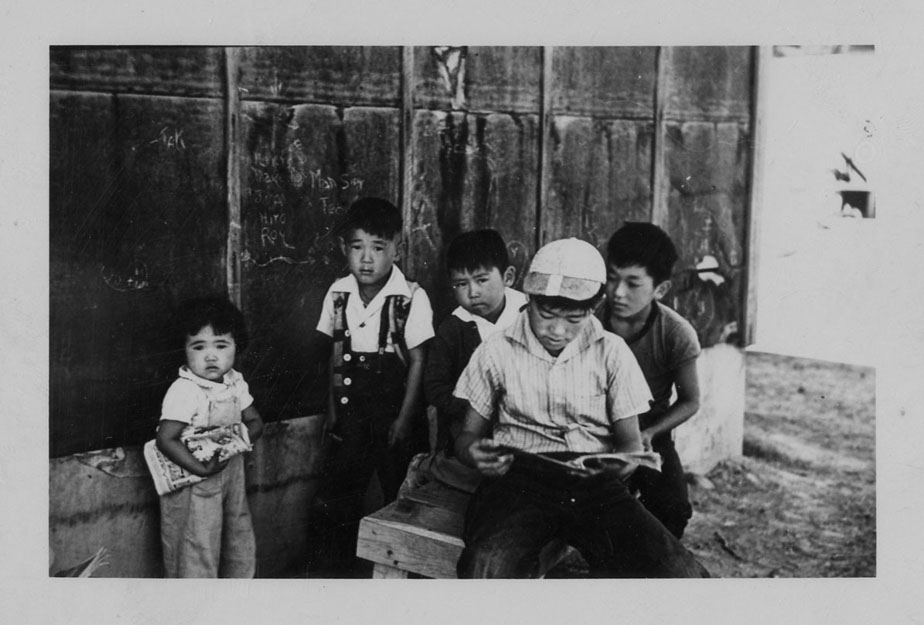
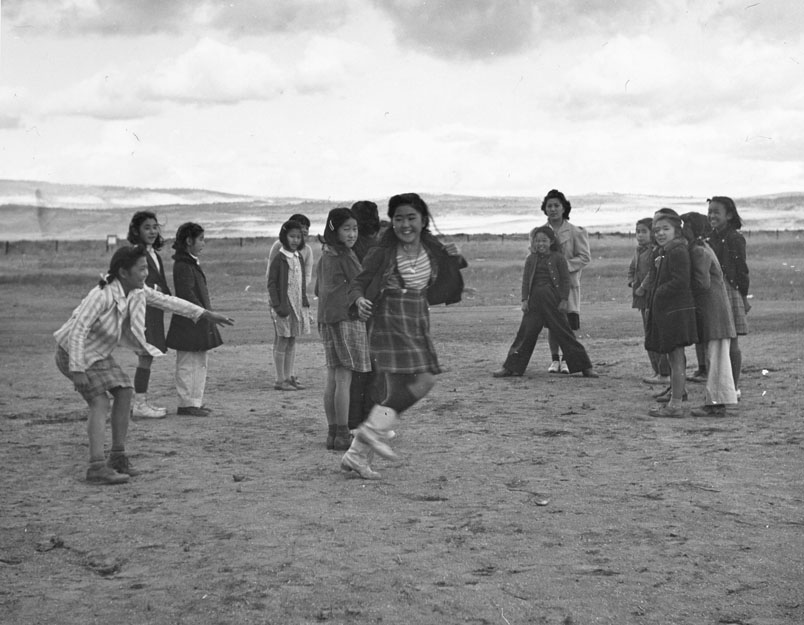
For many young people, the experience in the internment camps differed in perspective and experience than that of their parents or older Japanese Americans at the time. While camp life cast a cloud of uncertainty and worry for the future of older, parental figures, Japanese teens and children saw it differently. In fact, more often than not, many of them found ways to make the best of their situation. Many were able to meet and make new friends, attend school activities and be involved in sports. “Within the confines of the assembly centers, the Japanese Americans tried to create a community. They organized schools, camp newspapers, sports programs, and talent shows.” (Tunnell, Chilcoat, 11) Other than the fact that the teens were confined to the internment camps, their lives are very similar to the lives of many teenagers today.

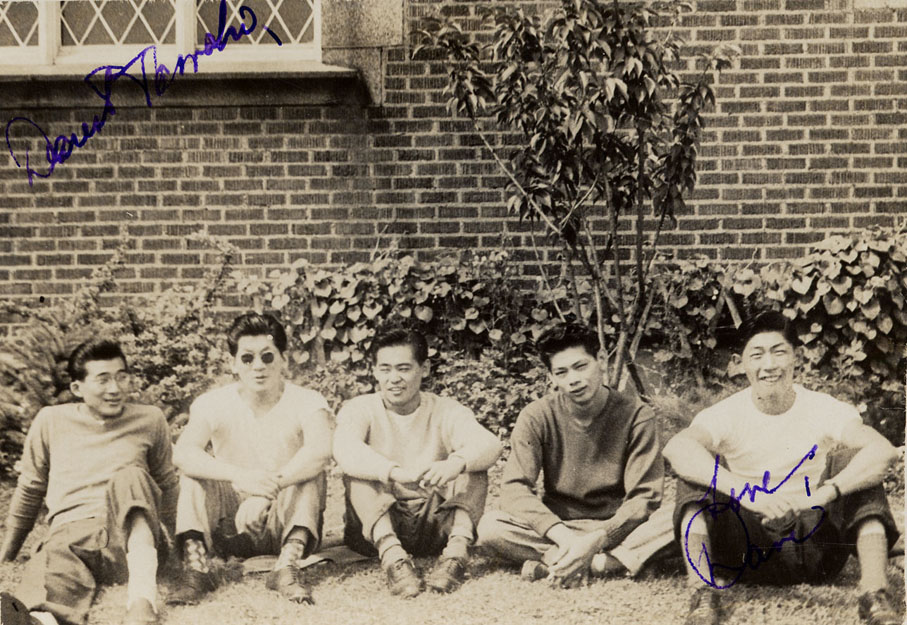
P1584 Willis Carl. BX 1, FLD #4. "Five young men." David Hisato is on the far right.

In the letters written between teenage lovers David Hisato and Tamaki Yamate, the two hardly spoke of any extreme sufferings or turmoil from being in Topaz or, in Hisato’s case, working at the Roy Labor Camp near Ogden.

Hisato sometimes spoke of the lack of work in his letters, where he only worked six to nine hours a day and earnings were tough and the harsh weather often made his hands dry. At the other extreme, he wrote about working continuously for over 13 hours a day. (Letter, September 9, 1944)

But a majority of the letters Hisato wrote to Yamate described the events of his day and his unconditional affection for her. “As for girls, no worry sweet because I got my heart on and it’s you only darling. You know I have your picture right above my bed so before I go to sleep I can look at it. Some of the boys see your picture and think I’m pretty lucky.” (Letter, September 12, 1944)

Yamate wrote similar letters to Hisato. She described the upcoming parties and dances at the high school in Topaz.

Yamate also continually expressed her love for Hisato. In one letter she writes, “The days I spend with you, are the happiest days I have spent in my whole life. I know I’ll never know that happiness with anyone else.” (Letter, March 26, 1945)

PO 800 George Murarami Topaz, FLD #6. "7 young men."

Hisato and Yamate also wrote to their friends throughout the nation and received many letters in return. A close mutual friend, “Minzo” Askiyoski, wrote them both and his letters were similar to the letters exchanged between Hisato and Yamate. There was minimal discussion of specifics of camp life, but he emphasized social and personal events.

In one letter he asks Hisato to send him some good basketball shoes if he saw any. They also exchanged holiday cards and gifts through the mail. (Hisato & Yamate Collection)

P1584 Willis Carl. BX 1, FLD #4. "5 young kids."

However, students in an English class at Tule Lake Internment Center felt that camp life was harmful to young minds. “Since I’ve been to camp, I no longer feel that I am a part of the world,” Yukio Kumata wrote. “I feel like a dangerous enemy spy being held in prison. I take no interest in world events concerning America as I did at home. For a loyal American to be placed in a stuffy camp, I feel I am no part of America. I am inclined to feel bitter and sarcastic about the whole fair. But as I recall my faithful Caucasian friends at home, I realize that America is and will be for the rest of my life, home for me.” (Kumata Papers)

PO 800 George Murarami Topaz, FLD #6. "Three Varsity football players."

Many teenagers found camp life dull and repetitive, but seldom complained about living conditions. Another English student from Tule Lake Internment, Heidi Morioka, described camp as being unbearably hot some days and with the lack of trees on site, there was no place to cool off under. (Morioka Papers) Nearly all the teens were happy that the camp gave them the opportunity to meet other Japanese teens/children their age.

P1584 Willis Carl. BX 1, FLD #2. "Young girls doing homework."

But beyond making the best of their situation, there was much fear and worry in the lives of these young people. Although life at camp was relatively easy, the future was uncertain and fearful to some young people as well. “We all wonder what the future will be like,” wrote Rosie Ishibashi. “It has been said, ‘let us look to the future, rather than to the present.’ Yes, we all wonder what the future will be.” (Ishibashi)

PO 144 Japanese Relocation, WRA. BX 1, FLD 3. #41. "5th grade girls playing 'too deep.'"

The Japanese relocation was a defining time in American history. For several years, many Japanese Americans lived in barracks behind fences, unable to go out on their own without being supervised. But as the youth internees have displayed, many Japanese Americans complied with the U.S. government and did their best to assimilate and adapt to camps to keep their lives as normal as possible. The Japanese Americans were faithful U.S. citizens and were punished for something they did not do or want.

PO 144 Japanese Relocation, WRA. BX 1, FLD 3. "5th grade boys."

The relocation of Japanese Americans will always be significant in U.S. history. The gender, race, ethnicity, religion and color of a person’s skin do not determine their amount of loyalty or disloyalty to their country. After the recent September 11th incident, many Muslim Americans were threatened and scrutinized for an attack made by a terrorist in a Muslim country. Some Americans feared the Muslim Americans, weighing in the same accusations the Japanese Americans were accused of (sharing information and helping Japan) because “that’s who they originally are.” It’s important that these stereotypes are broken and that we as a nation do not segregate individuals based on the way they look or where they come from.

Tiffany Lieu, born and raised in Utah, began her college career at the University of Utah in August 2006. She is experienced in both print and broadcast journalism and has worked for the Daily Utah Chronicle, KTVX ABC 4 News, News 8 Texas, Lessons Magazine and KUTV CBS 2 News. Lieu loves being able to share her love of writing and communicating by helping others tell their stories. Lieu studied mass communication, with a focus in journalism and graduated with a bachelors of science in May 2010.

Sources

David Hisato and Tamaki Yamate, Hisato and Yamate Papers – Letters, MS 680, Boxes 1-5, 8, Special Collections, J. Willard Marriott Library, The University of Utah.

Rosie Ishibashi, Japanese Relocation Papers, MS 144, Box 4, Special Collections, J. Willard Marriott Library, The University of Utah.

Yukio Kumata, Japanese Relocation Papers, MS 144, Box 4, Special Collections, J. Willard Marriott Library, The University of Utah.

Heidi Morioka, Japanese Relocation Papers, MS 144, Box 4, Special Collections, J. Willard Marriott Library, The University of Utah.

Leonard J. Arrington. The Price of Prejudice: The Japanese-American Relocation Center in Utah during World War II. Logan: Utah State University, 1962.

Michael O. Tunnell and George W. Chilcoat. The Children of Topaz: The Story of a Japanese-American Internment Camp. New York: Holiday House, 1996.

University of Utah 1944 NCAA Basketball Championship

by KIT CHIPMAN

This is the story of the 1944 University of Utah basketball team and the effect that it had on the state of Utah.

It was December 1943 and Vadal Peterson was the head coach of the University of Utah basketball team. He had assembled his team of “blitz kids” and was preparing for another season. There was only one problem; they did not have anyone to play. At the time, it was in the middle of World War II, and many colleges and universities were having a hard time fielding teams in any sport. The University of Utah’s own newspaper, The Utah Chronicle, reported on December 30, 1943, that “Utah [was] the only school left which [was] trying to run off an athletic schedule.” In the same article the Chronicle also reported that “Colorado U, Utah State, Wyoming, and Colorado State have all given up the ghost because of the manpower shortage.” This “manpower shortage” most likely had to do with many of the young men in the army. To make things worse, the conference that the Utes were in would not allow the basketball team to play more games. Later the conference allowed the team to play more games. Also the quality of the opponents was not what they were used to. In Continuum: The Magazine of The University of Utah, an article written by Chad Nielsen states that the Utes played teams such as “Colorado College, Bushnell Hospital, and the Wendover Bombing Quintet” (Nielsen, 9). Even though the Utes had trouble finding teams to play they were able to win 18 games and were invited to play in the National Invitational Tournament (NIT).

This is a post regular season tournament that teams have to be invited to participate in. There is also another post-regular season tournament, the NCAA tournament. Back then the NIT was the better of the two. Any college that won the NIT was considered the national champion. Kentucky was Utah’s first opponent. This was on the big stage: Madison Square Garden. Utah was the heavy underdog in this game, and lost 46 to 38. On March 21, 1944, The Ogden Standard Examiner reported that “the Kentucky – Utah game brought the Madison Square Garden crowd of 16,273 to its feet time and again as the teams swapped the lead 10 times.” It was not in Utah’s fate to win this game, even though it was close. The team did not know it yet but the Utes had greater things to accomplish.

The Utes thought their season was over and with all the turmoil were pleased with what they had accomplished. A few days after that loss coach Vadal Peterson received a telegram from the NCAA with surprising and good news. The NCAA was in need of another team because of a tragic event that had happened. Players on the University of Arkansas basketball team had been on the bad end of a car accident. On March 22, The Salt Lake Tribune reported that “Arkansas, cochampions of the Southwest conference, originally was chosen but was forced to drop out following an automobile accident … in which a coaching aide was killed and two players seriously injured.” It was said that the athletic director and two starters on the basketball team had been hit by another car while trying to change a flat tire. (Nielsen) Not wanting to play, Arkansas backed out of the tournament. The Utes had originally planned on playing only in the NCAA tournament but decided to play in the NIT when they got the invitation.

After Arkansas decided not to play The Salt Lake Tribune reported on March 22 that “Graduate Manager Keith Brown called Professor Walter A. Kerr, chairman of the University of Utah athletic council, about 1:30 a.m. about the invitation to the NCAA tournament and Professor Kerr was telephoning members of the athletic council most of the night to get a vote on the tourney. The council was unanimously in favor.” Later, the players were called to see if they wanted to play. Of course the whole team wanted to play. The Salt Lake Tribune quoted Brown as saying that “the boys felt like they could have won the game with Kentucky, and they figure that if they win out at the Kansas City meet and get another chance at Madison Square Garden they can really do themselves proud. That’s their goal.” This gave Utah a chance that no one had ever been given before. This was the first time that any university had participated in both the National Invitational Tournament and the NCAA Tournament in the same year.

Before the Utes could get back to the Garden they had to go through Kansas City. Two wins and they were going to be back where they had lost less than two weeks earlier. They were able to beat Missouri and then Iowa to advance to the NCAA title game back in New York City. Yet again the Utes were the heavy underdog in facing Dartmouth. On March 28, 1944, the day of the game, The Salt Lake Tribune reported that Utah was facing “a heavily favored Dartmouth quintet for the National Collegiate Athletic Association championship.” The Ogden Standard Examiner noted that the Utes were 8-point underdogs. Even though the media thought it wasn’t likely that the Utes would win, everyone back home in Utah was ready to support the team to victory.

The day of the game arrived and the Utes were ready to play. This was the most important game of their lives and everyone knew it. Madison Square Garden was over capacity with 17,990 people in attendance. Dartmouth and Utah played a thrilling game that saw the Utes win 42 to 40. On March 29, The Deseret News reported “Utah … upset mighty Dartmouth, 42 to 40, to win the NCAA title in an exciting extra period game before 17,990 at the Garden last night.” The Utes had beaten the odds. But this was not the end.

The next night in a charity event the University of Utah played St. John’s University. St. John’s was the winner of the NIT. This game was the unofficial, or mythical as they called it then, national championship. Another rousing crowd of 18,125 filled the Garden to see these two Cinderella teams battle for the title of National Champion. On March 31, The Ogden Standard Examiner reported that Utah “ruled today as mythical basketball champion of the nation by virtue of a 43-36 victory over St. Johnson’s last night.” Now with this title of National Champions there was a big party waiting for the team back in Utah.

People in Utah were very excited to greet these “blitz kids” as the team traveled back home. Many events were set up to celebrate this championship. On April 4, The Deseret News had a whole page honoring the team by saying, “all Utah and especially hosts in Salt Lake City pay homage today to a most amazing squad of young basketball stars, winner of the highest collegiate honor available in the hoop sport.” Right as the team got home there were fans waiting for them. The Utah Chronicle reported on April 4 “the blaring of the band, cheers of fans, the honking of automobiles, began the festivities which will honor the national basketball champions during the coming week.” There was a parade and a rally on the university campus that day as well. But while all of this was going on there was one player who had an effect on the team that will never be forgotten by those players.

A Japanese-American University of Utah basketball player, Wat Miska, was born and raised in Ogden, Utah. At this time in his life the U.S. was at war with Japan and many Japanese American people were being taken and put into internment camps. Because he was from Utah he and his family were not in the internment zone and were not forced to go to the camps. But it was not pleasant to be of Japanese descent at this time. Nielsen wrote, “Misaka was denied service at restaurants and avoided on the street, even after leading Weber Junior College to two Championships.” (Nielsen, 9) He even experienced terrible things during games. Nielsen said that “at road games, spectators threatened Misaka from the stands, shouting for the ‘dirty Jap’ to go home. Nielsen also stated “through it all, Misaka somehow still believed in America. And he poured his heart into playing basketball, like his teammates.” Wat has said that he didn’t think of himself as being different from his teammates.” (Nielsen, 9) Later he served in World War II in Japan and came back to play on the Utah basketball team and helped the team win the NIT. Nielsen noted that later in the summer of 1947 the New York Knicks drafted him to play basketball in the National Basketball League, which later became the NBA. Also Wat Misaka was the first non-white person to be drafted by any professional basketball team. In 1999 Wat Misaka was inducted in the Utah Sports Hall of Fame. (Nielsen, 10)

This story of the Utah “blitz kids” is a forgotten story that needs to be remembered and is important to Utah communication history because all that was in the news at the time was the war. This story was big. It was a way that people in this state could rally together during a hard time. It gave them comfort and an opportunity to think about something other than the war. Although the war was still bigger, this was news enough to help Utahns forget about the war for a few exciting weeks.

Kit Chipman is a sophomore at The University of Utah. He is a mass communication major.


Sources

“City Honors Victorious Hoop Team,” The Utah Chronicle, April 4, 1944.

Rulon Rasmussen, “Utes Face Lean Year With Few Games Scheduled,” The Utah Chronicle, December 30, 1943.

“‘U’ Wins In Overtime,” The Deseret News, March 29, 1944.

“Welcome Utah’s ‘Blitz Kids’ Basketball Champions of the U.S.A.,” The Deseret News, April 4, 1944.

“Utes To Play In NCAA Tourney,” The Salt Lake Tribune, March 22, 1944.

Glen Perkins, “Arnold Ferrin Stars as the Utes Lose in Famous Garden,” Ogden Standard Examiner, March 21, 1944.

Jack Coddy, “Indians and Utes in Cage Treat,” The Ogden Standard Examiner, March 21, 1944.

Joe James Custer, “Utah’s Cinderella Kids Take National NCAA Title in Overtime in New York Garden,” Ogden Standard Examiner, March 29, 1944.

Joe James Custer, “Indians Provide New Story Book Finish in Sports,” Ogden Standard Examiner, March 31, 1944.


Chad Nielsen, “That’s Just How It Was,” Continuum: The Magazine of the University of Utah (Spring 2010): 8-10.