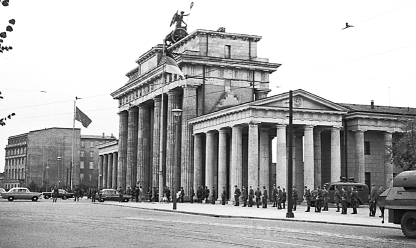
The Importance of Federal Funding for Education: Dean Jack H. Adamson Advocates for Students at the University of Utah in 1962

By Michelle Saucedo

Education is an important factor in how individuals pursue and achieve their academical goals. It is also significant as it contributes and creates a path for students to succeed. However, education at a higher level, specifically college, is not affordable by a majority of people in the United States. College education can be broad, offering degrees from arts, engineering, and language to many other areas. It is a community and space where students understand their academic purpose. Although education is accessible, it is only obtainable through tuition payments, which cover fees and courses. Having the desire to pursue an academic goal through attending classes, covering other expenses such as school fees, books and supplies is highly important as well. As these create and ensure that students obtain and have a successful educational experience.

adamson

Dean Jack H. Adamson, pictured in a January 1962 issue of The Daily Utah Chronicle, was a guest speaker during the Greek Lyceum fair.

To this day, however students struggle to finance their education careers. In fact, a majority of students enroll in a university or college through financial aid, scholarships, private loans and at times with personal life savings. Federal funding programs such as financial aid, offer scholarships, Pell grants, and loans to students who struggle to pay tuition rates from their first year of school to their graduation expected date. This funding is available for students after they complete and process an application that requires a background check in their yearly income, filling out family information and submitting official documents. Students who then qualify are able to afford and pay for tuition each year through the available funds that the program offers for each individual. Numerous universities all over the United States also provide scholarships for incoming and enrolled students. However, not all students with an ambition of pursuing a college degree can afford tuition or qualify for local, school or private scholarships.

In 1962, through the Greek Lyceum fair on campus at the University of Utah, the idea of increased role of the federal aid in colleges was presented by Dr. Jack Adamson. As the Dean of the College of Letters and Science, Dr. Adamson, discussed with students at the time about the significance of funding programs focused on science, engineering and technology. Particularly, after Sputnik in 1957. The Sputnik Satellite was created by the Soviet Union, and it demonstrated that the Soviet Union was highly in advantage through its technology programs and innovations, in contrast to the United States. Creating a concern on how the United States was focusing federal funding, specifically for education purposes. Through this discussion at the University of Utah, Adamson created awareness and students were able to understand how important it was having fund directed to science, engineering, and technology. If funding was not being granted to programs in colleges, how was the United States going to advance and make progress technologically in the world? In other words, Dean Adamson highlighted the necessity of universities to obtain federal funding to budget research, teaching, and federal aid for students.

The Daily Utah Chronicle reported in January 1962 that Dean Adamson, emphasized the importance of having “a balance between science and humanities and between teaching and research.” Through this lecture, Dean Adamson provided an understanding of the United States’ educational and technological developments, however this lecture presented the idea that the United States was becoming a less potential power in technology compared to the Soviet Union. As federal funding was not being focused towards technology and science in Universities. Students, then understood that federal funding was necessary to improve programs and allow other individuals to attend and enroll in university and pursue degrees in engineering, science, and technology.
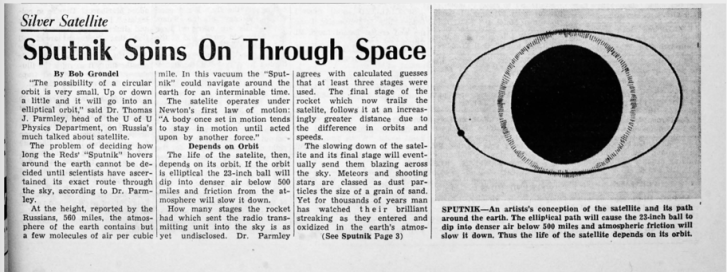
sputnik

Article published in an October 1957 issue of The Daily Utah Chronicle.

The conversation introduced the technological development of the Soviet Union, the Sputnik Satellite from 1957. This topic was mentioned all over the United States, as it was one of the examples and advancements that presented the concerns and lack of budget to education. Alvin Powell published an article in the Harvard Gazette, on October 11, 2007 regarding the Sputnik Satellite and its importance to the educational path of the United States. “The United States may be overdue for a science education overhaul,” wrote Alvin. (p. 1) The Sputnik satellite was a technological advancement that demonstrated the development and importance the Soviet Union had towards technology in comparison with the United States in 1957. In this case, it was then given that the United States had to enact and work on a type of reform to fund educational research regarding science and engineering if it wanted to continue as a world potential power. And in response to the problematic educational crisis, the United States enacted the National Defense Education Act in 1958, which according to Powell, “increased funding for education at all levels, including low-interest student loans to college students, with the focus on scientific and technical education.” (p. 1)

As the conversation towards education increased with the controversy of the Soviet Union being the superior power in technological advancements, it was then noted that the funding for educational research and tuition was lacking. The University of Utah, during the Greek Lyceum lecture of Dean Adamson, presented findings according to the budget in 1962. Charlotte Garff, editor of the Daily Utah Chronicle in 1962 from Adamson’s lecture, wrote that “79 percent of the total U.S. budget is allotted for defense.” in an article published in February 1962. This amount and data presented in the lecture introduced the real budgeting the United States had towards other federal government programs comparing to education. Garff also presented how Dean Adamson emphasized that if the United States wanted to survive as the best potential power through the war crisis, it required the best programs and research or “the group with the best trained intelligence will win the cold war.”

Although education has been considered important to achieve success, it became a highly important factor for the United States to work on developing a technological era back in 1957. This movement, aside of budgeting programs focused on science, technology and engineering, opened new doors to other degrees as it introduced the federal funding programs towards education. The Soviet Union challenged the moral values and resources the United States had focused on research, and it created a breakthrough for future research, universities and education as a whole. The United States acquired the initiative and funded more educational programs over the nation. Discussions such as Dean Adamson’s lecture at the University of Utah, advocated and informed students and colleges on how valuable it was to have federal aid towards programs and student tuition. Federal funding has been providing a path to education for students for all majors and interests. Which creates opportunities for students to enroll and attend school and invest their educational careers in developing the technological future of the nation.

Michelle Saucedo is a senior at The University of Utah. She is majoring in communication with an emphasis in journalism and minoring in Spanish.

Primary Sources

Bob Grondel, “Sputnik Spins on Through Space,” Daily Utah Chronicle, October 10, 1957, 1.

Adamson To Initiate Greek Lyceum Fare,” Daily Utah Chronicle, January 31, 1962, 1.  

Charlotte Garff, “Aid Here to Stay, Dean Claims,” Daily Utah Chronicle, February 2, 1962, 1.

Ernest Ford, “Adamson Urges Program To Better Use Students,” Daily Utah Chronicle, February 16, 1962, 1.

Lecture Series Begins Tuesday,Daily Utah Chronicle, June 27, 1963, 1.

Secondary Source

Powell, Alvin. “How Sputnik Changed U.S. Education.” The Harvard Gazette, October 11, 2007.
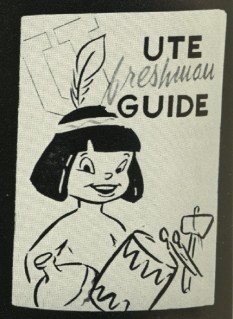
Debate Continues Over the Use of Ute Mascot

By Jacob Rueda

The term “Ute” has become synonymous with the University of Utah. Names such as “Utes,” “redskins,” and “redskin braves” have been associated with the university sports teams in some manner or another. Most of those names have been dropped except for “Ute,” a name that is almost always associated with football.

In reality, the actual Utes are barely recognized by students and fans of the university’s sports teams alike. The tribe itself struggles to find acknowledgement in a world that cares more about use than consequence.

The University of Utah was established in 1850. It started using the Ute identity beginning in the 1920s, according to Utes Nickname Project website. The school received permission to use the “Ute” identity from one of the three recognized Ute Tribes, the Northern Ute Nation.

The other two nations, the Southern Ute and the Ute Mountain Tribes, did not grant permission to the school to use their name.

The Ute tribe has inhabited the area for over ten thousand years. The university has made efforts throughout its history to bridge relations with the Ute Tribe, albeit somewhat clumsily at times.

The Daily Utah Chronicle reported in October 1951 that the U.S. Supreme Court awarded $17,000,000 (equal to $167,880,884.62 in 2019 money) in an effort to appease the Uintah-Ouray reservation and for “furthering educational standards of the people.” Eleven young people between the ages of 17 and 19 were selected and interviewed for acceptance into the university.

Utonian 1-1

“Hoyo” first appeared as the University of Utah mascot in 1947. Used with permission from Special Collections, J. Willard Marriott Library, The University of Utah.

At the time the university used a mascot called Hoyo, a cartoonish Native American child. The Chronicle absent-mindedly reported in that issue that the acceptance of native peoples at the university meant Hoyo “will at last have some country cousins on campus to urge him on to greater activity.”

Letters to the Editor in an April 1970 issue of the Chronicle acknowledged the “Ute” identity as a sign of strength, vitality, and “a source of pride.” While other students found the university’s mascots racist, others believed those who found them offensive were reading too much into things.

In April 1972, the issue was addressed again in the Chronicle. The concern over the use of native people’s image in college sports was growing nationwide. According to the article, tribes were suing universities for appropriating names and images alike.

There was some reconciliation later on, at least from the Chronicle itself. In 1987, the paper decided to distinguish when it referred to the Ute Tribe and when it referred to the school by using quotations marks when referencing the school. That practice has since been abandoned.

April 2014 saw the University of Utah signing a Memorandum of Understanding with the Ute Tribe. The memorandum is a five-year agreement where the university is allowed to use the name of the tribe on a conditional basis.

Utonian 2-1

The image of “Hoyo” was ubiquitous, especially in school announcements and calendars. Used with permission from Special Collections, J. Willard Marriott Library, The University of Utah.

Among the conditions, the university is to include in its campus programs a member of the tribe who was not a student. The purpose of that is to “enhance Native American perspectives,” writes author Larry Gerlach in the summer 2017 issue of the Utah Historical Quarterly.

Other conditions to use the name include a tribe-approved Native American advisor, a special advisor to Native American affairs, a full-time advisor on the reservation for high school students to attend college, and financial aid and scholarships for Native American students.

The debate over the name came up once more in the Chronicle on August 2016. This time, it was about doing away with the “Ute” nickname altogether. The article deemed the nickname “culturally insensitive” when referring to the school. Two sides, one for and one against, argued their points much like Letters to the Editor did 46 years earlier.

The Chronicle reported in September 2019 efforts by the Housing and Residential Office and Social Justice Advocates to educate dorm residents and advisors on moving away from using familiar symbols and replacing them. They also suggested using the phrase “Go Utah” instead of “Go Utes.” To date, none of these transitions have been implemented.

According to Gerlach in his article for the Quarterly, the National Collegiate Athletic Association declared that starting February 1, 2006, “institutions with hostile or abusive racial/ethnic/national origin mascots, nicknames or imagery” were prohibited from hosting championship games or displaying their mascots in jerseys and uniforms during championship tournaments.

Despite these regulations, the University of Utah was permitted to keep the classic drum and feather logo. Students at the school continue to debate its use.

Controversy surrounding the use of Native American symbols and names has plagued professional, high school and college teams alike. For example, the Washington Redskins continue to stir up controversy with their name and logo.

The situation with the Redskins is similar to that of the University of Utah with the drum and feather logo and the name “Utes.” Most fans support the team name and logo while others support changing the name and image of the teams altogether.

The situation got more complicated in Cedar High School in Cedar City, a small town in the southwestern corner of Utah. The mascot “Redman” had started to raise the ire of some members of the Paiute community.

In a Salt Lake Tribune article from January 2019, various members of the Paiute community expressed personal conflict when it came to supporting the mascot for Cedar High School. Opinions were split; some supported it while others didn’t. The support came at a price for some and questioned whether such support was warranted in the face of communal backlash.

Since that time, the school opted to change the mascot. Google docs published in the school’s website say a committee of “students, faculty, staff, and alumni” moved forward with changing the identity and mascot of the school. They are now known as “Reds” and the mascot is a wolf.

Unlike Cedar High School, the University of Utah does not have even a sizeable population of Native peoples. Therefore, it cannot and likely will not form any sort of committee with the kind of influence that impacted Cedar High School to evolve away from its former mascot.

Also, changing mascots for the university will not have the same significance as it did for Cedar High School. A school with a high non-native population that moves from using a Native American symbol cannot appreciate the significance of that like a school with a high Native American population.

Regardless, there is still a strong sense of pride for fans who identify as “Utes.” It has not waned in the slightest despite objections from individuals who feel the identity of “Utes” should not be commercialized or casually used.

Despite the clamor to respect Native Americans and protect the image of the Ute Tribe, statistics from the Office of Budget and Institutional Analysis at the university say Native Americans accounted for 0% of first time freshmen, undergraduate or graduate students in 2018.

To date, there has been no inquiry on the tribe’s views of the name or how their image is appropriated and used by the University of Utah today.

Since the Memorandum of Understanding between the school and the Ute Mountain Tribe in 2014, there have been no formal documented objections from either side over the agreement.

How the Utes intend to proceed with their relationship with the university after all that has transpired remains to be seen.

Jacob Rueda is a junior majoring in communication with an emphasis in journalism at the University of Utah.

Primary Sources

Connor Richards, “Debate: Should Utah Ditch The ‘Ute’ Nickname?” The Daily Utah Chronicle, August 29, 2016.

Indian Youths Enter U on Tribal Grant,” The Daily Utah Chronicle, October 9, 1951, 1.

Craig Glover, “Letters to the Editor: Seriously?,” The Daily Utah Chronicle, April 24, 1970, 1.

Indians See Red, Hide Skins to Ute,” The Daily Utah Chronicle, April 19, 1972, 2.

Memorandum of Understanding between the Ute Indian Tribe and the University of Utah,” April 2014.

Martin Raybould, “Letters: Bring ‘Ute’ Back into Football,” The Daily Utah Chronicle, November 13, 1984.

Natalie Colby, “Appropriation or Appreciation? Social Justice Advocates Host ‘Utah Fan Am I,’” The Daily Utah Chronicle, September 26, 2019.

New Policy Distinguishes ‘Utes,’” The Daily Utah Chronicle, October 1, 1987.

Erin Alberty, “Is a ‘Redmen’ mascot racist or does it honor Native Americans? The debate is dividing a southern Utah town,” The Salt Lake Tribune, January 13, 2019.

The Utes Nickname Project, Communication Institute, The University of Utah.

Secondary Source

Gerlach, Larry R. “Appropriation and Accommodation: The University of Utah and the Utes.” Utah Historical Quarterly 85, no.3 (Summer 2017): 204-223.

Neal A. Maxwell, Hays Gorey, and William B. Smart on Freedom of the Press in 1962

By Ann Reich

Freedom of the press has been under fire since it was included in the First Amendment. Even today, ethical questions arise around the country concerning the right to release information. In critical moments news organizations have to weigh the consequences before publishing sensitive material.

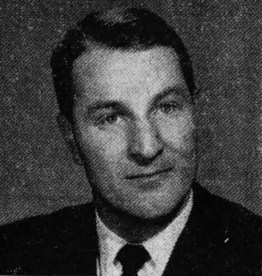
Neal A. Maxwell

Neal A. Maxwell, as pictured in The Daily Utah Chronicle on January 17, 1962.

The early 1960s were a time of tumult for the United States. The country was in the midst of an indefinite cold war and problems with Cuba were heating up. In April of 1961 the Bay of Pigs invasion during President Kennedy’s term was a failure, and the press released information about the defeat. (history.com) On January 17, 1962, The Daily Utah Chronicle in the article, “Press Freedom’s Future,” said, “Presently the threat by the communist nations to the United States has again caused people to challenge freedom of the press.” It was a crucial time in history for the press, and freedom of the press was a significant topic in the journalism community.

On January 17, 1962, The University of Utah held a Great Issues Forum. At this event Neal A. Maxwell, the assistant to President A. Ray Olpin, discussed an essay he wrote titled, “Is Freedom of the Press Compatible with National Security?” After Maxwell, Hays Gorey, Salt Lake Tribune editor, and William B. Smart, head of the Deseret News editorial page, spoke on the same topic. (The Daily Utah Chronicle, p. 1)

In his essay, Maxwell analyzed the government’s relationship with the press, and his thoughts on a free press. Many times throughout history, the U.S. government has made a pact with the press to suspend fighting until a war or dangerous time is over. Maxwell argued that the Cold War was different and this suspension agreement could not be made. There was no end in sight during the Cold War, and the people needed information. (Maxwell, p. 46)

Maxwell argued that national security, especially with the military, was better with a free press. If the people know about the strengths, weaknesses, and plans in the military, then the executive branch would be presented with more choices regarding taking action. (Maxwell, p. 50)

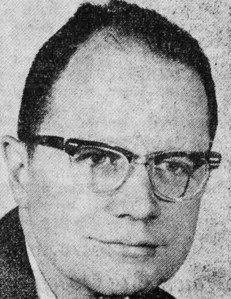
Hays Gorey

Hays Gorey, a University of Utah alumnus, was pictured in The Daily Utah Chronicle on January 17, 1962.

Hays Gorey responded to Maxwell’s article. Gorey’s view agreed with Maxwell’s and he said that if the U.S. had no free press then it “would not be America at all.” (Gorey, p. 54) However, the press could cause some short-term harm to national security, but it is never lasting. While reporting on the mistakes of the U.S. could make the country weak in the moment, it would strengthen the country in the long run. The government would learn from their mistakes and would be less likely to repeat history if it was all documented by the press. Gorey was overall concerned with the government lasting. Free press might hurt the current government, but it has a more positive long-term outcome.

William B. Smart also wrote a response. Much of what he said aligned with Maxwell and Gorey: the free press had done well to protect national security. At the time of this speech, the country was in the midst of fighting communism. Smart mentioned President Kennedy’s fear of becoming like the enemy the country was fighting. The free press keeps the U.S. a democracy and stays away from too many governmental censorship.

William B. Smart

William B. Smart, pictured in The Daily Utah Chronicle on January 17, 1962, was head of the Deseret News editorial page.

Another important topic discussed was the fear caused by the press. Gorey claimed that it is better to know all of the horrifying events happening, then to be left afraid in the unknown. Maxwell brought up fear as a reason the government may push against the free press. However, Smart disagreed. In his comments he mentioned that the American citizens were “far more tough-minded” than what Maxwell implied. (Smart, p. 58)

Even though many events in the 1960s were mentioned by these speakers, their comments have been relevant throughout history. The Washington Post stated, “governments around the world are becoming more sophisticated in their efforts to censor expression.” (Rezaian) An increase in press censorship is largely due to the internet’s role in spreading information. Although the government will always attempt censorship in the interest of national security, freedom of the press will always be necessary.

Ann Reich is a senior at the University of Utah. Her major is communication with an emphasis in journalism.

Primary Sources

Neal A. Maxwell, “Is Freedom of the Press Compatible With National Security?” in Great Issues Concerning Freedom, ed. Waldemer P. Read (Salt Lake City: University of Utah, 1962), 41-54.

Hays Gorey, “Comments” in Great Issues Concerning Freedom, ed. Waldemer P. Read (Salt Lake City: University of Utah, 1962), 54-57.

William B. Smart, “Comments” in Great Issues Concerning Freedom, ed. Waldemer P. Read (Salt Lake City: University of Utah, 1962), 57-60.

“Press Security To Theme Great Issues,” The Daily Utah Chronicle, January 16, 1962, 1.

Jackie Back, “Maxwell, Newsmen Set Examination Of Press,” The Daily Utah Chronicle, January 17, 1962, 1.

“Press Freedom’s Future,” The Daily Utah Chronicle, January 17, 1962, 2.

“Great Issues Airs Free Press In U.S.,” The Daily Utah Chronicle, January 18, 1962, 1.

“Vice President of U. Links Press Freedom, Security,” The Salt Lake Tribune, January 18, 1962, 24.

Secondary Sources

Editors, “Cuban Missile Crisis,” History.com.

Rezaian, Jason. “Dictators and the Internet: A Love Story,” The Washington Post, September 10, 2019.


The Pieces of a Bigger Story: How Early Women Penetrated the Male-Dominated Field of Engineering

IMG-4770

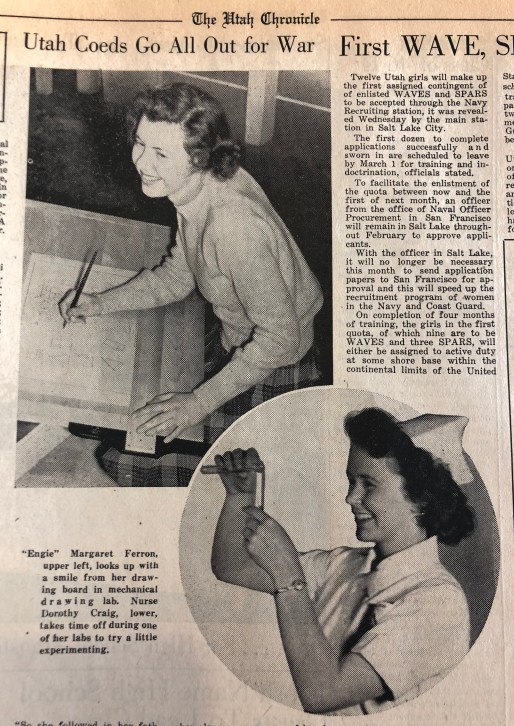
Margaret Ferron, upper left, and Dorothy Craig are examples of how World War II influenced women in certain fields of work. Ferron is seen here with her drawing board in the mechanical drawing lab while Craig is seen doing some “experimenting.” Used with permission, Special Collections, J. Willard Marriott Library, The University of Utah.

By Eliza Jane Pace

In 2019, according to the Office of Budget and Institutional Analysis at the University of Utah, there are a great number of people enrolled in engineering majors. However, there are large discrepancies in the numbers when comparing genders. At a pre-major level for instance, only 3,387 are women while men number 4,290, a whopping 903 person difference. That’s not the only area of difference. In every aspect of every engineering major, pre-major, to bachelors, to doctorate, men outnumber women. This difference is not unusual. The Daily Utah Chronicle has several articles as early as the 1930s talking about the novelty of women enrolled in engineering majors.

The professor and head of the electrical engineering department, Dr. L. D. Harris, was quoted in The Daily Utah Chronicle, November 17, 1961, stating, “We’ve had two women graduate in this field -— both in the 1930s.” In an earlier article it mentions the names of these two women listed as graduating from the engineering program, Dorothy Blades in 1924 and Mary Frances Plumb in 1934 in The Daily Utah Chronicle, November 27, 1935.

Even by 1961, 31 years later, only one or two women decided to take on the challenge of entering the engineering field as stated in The Daily Utah Chronicle, November 17. This article will explore the women who penetrated these fields and how their position as women in engineering fields was treated.

Each of these women have their own reasons for entering the field and their own opinions about women in engineering.

IMG-4786

Judy Brown was honored for her achievements in her field of civil engineering by the Associated Women Students. She was one of only two women enrolled in engineering fields. Used with permission, Special Collections, J. Willard Marriott Library, The University of Utah.

A senior in civil engineering, Judy Brown, was a transfer student from the University of Wyoming and used to being the only girl in her classes. She continued as the only woman registered in upper classes in any field of engineering at the University of Utah and was eventually honored by the AWS or Associated Women Students, reported The Daily Utah Chronicle on November 16, 1961, for her accomplishments in her field of study and her 3.92 grade point average.

Despite being told on her first day that the “Frosh English class was across the hall,” Brown laughed. “They finally decided that maybe I belonged.”

Margaret Ferron was highlighted in The Daily Utah Chronicle, February 25, 1943, and chose to enter engineering because it was a family affair.  She said that despite what others believed she was not in the field for attention or to find a man. “My father happens to be an engineer, and so are my two brothers; in fact, I just come from an engineering family, and I decided to carry on the tradition.”

Ferron added, “There’s a lot of prejudice against women engineers at the present time. But I think it will be all dispelled as the war makes it more and more necessary for women to be trained to take the place of men in the engineering field.”

According to The Daily Utah Chronicle, November 27, 1935, Opal Cummings age 16 was the only girl registered in any field of engineering at the University of Utah at that time. A graduate of local West High School, she believed that “women are just as well qualified as men in engineering.”

Each of these women have a story, and represent part of an even bigger story still being told. Women have certainly increased their presence in the workplace since the early to mid 1900s, but the trend of males dominating in engineering fields continue.

Some claim it’s because of the lifestyles women lead, with many choosing to have children or raise a family, lifestyles that are not as conducive to having such an intensive major and job. According to an article in the Salt Lake Tribune in June 2013, “Far fewer women study STEM fields at Utah colleges -— just 12% of engineering degrees … go to women.” However, even the language of the articles portrays a difference of societal expectations, as seen in The Daily Utah Chronicle, November 17, 1961, which focused on how the female students would still “find a husband.” It’s hard to tell how much of this large gap in numbers is because of sexism and oppression or if it’s simply the result of a different culture and expectations. But one thing is for sure, these early women who were willing to push beyond any barriers in engineering fields have paved the way for women to come.

Eliza Jane Pace is a sophomore at the University of Utah, majoring in communication with an emphasis in journalism and a minor in music. 

Primary Sources

Girl Engineer Dislikes Males,” The Daily Utah Chronicle, November 27, 1935.

Is Engineering for Males Only? Nope! Ute Coeds’re In,” The Daily Utah Chronicle, November 17, 1961.

AWS Honors Engie Coed,” The Daily Utah Chronicle, November 16, 1961.

Utah Coeds Go All Out for War,” The Daily Utah Chronicle, February 25, 1943.

University to Graduate 296 Students,” The Daily Utah Chronicle, May 18, 1944.

Walter Crosby Eells, “Earliest Collegiate Degrees Authorized for Women,” Educational Horizons 39 no. 4 (Summer 1961): 135-37.

Lindsay Whitehurst, “Why are Utah women far behind men in STEM education, jobs?” The Salt Lake Tribune, June 8, 2013.

Secondary Source

Office of Budget and Institutional Analysis, The University of Utah.


Blood Drive Saves Lives

By Aubrey R. Olsen

After the end of World War II and the Korean War, the world, and the United States, were on edge waiting for the next war to break out. It wasn’t long until the Vietnam War started and many were back to serving, getting deployed and fighting for our country. With this being the case, injuries were plentiful and blood was in a very high demand. In an effort to help with the massive blood shortage the United States was facing, coeds at the University of Utah held a week long blood drive in hopes of doing their part for the war here in Utah, while so many were fighting for the United States in Vietnam.

The Blood drive was organized and ran by cochairmen Deanne Simmons and ROTC sponsor Sally Anderson. They encouraged all students, faculty and staff to participate and do their part for our country by participating in the blood drive from 10 a.m. to 4 p.m. in the Union from November 13, 1961 to November 17, 1961. The goal was to donate and collect a total of 500 pints of blood in the span of that one school week, Monday through Friday.

Olsen2

Blood drive cochairs Deanne Simmons, left, and Sally Anderson. Image appeared in the November 13, 1961, issue of The Daily Utah Chronicle.

According to the November 13, 1961, issue of the Daily Utah Chronicle, “Coed ‘Vampires’ to Stage Bloodletting on U Campus,” coeds were encouraged to donate blood by being given incentives as motivation. Simmons and Anderson created a contest in which the club or organization on the University of Utah Campus that donated the most blood would be rewarded with prizes. There were four different categories that students could claim they were a part of as a way to win the prize. The categories were fraternal, service and religious, residence hall, and military.

An encouragement that was frequently used around campus and in the entire weeks issues of the Utah Chronicle was to do your part for our country while the brave young men are fighting and do what you can on the “home front.”

On top of having incentives and prizes as a reason for coeds to donate, it was announced in the November 14, 1961, issue of the Daily Utah Chronicle “Blood, Sweat and Tears Not Necessary – Just Blood,” that if coeds were to donate to the blood bank during the blood drive, they would be able to draw from the blood bank for free at any point in time in the future for free. This was a really big deal for people as the memory of World War II was still fresh on people’s minds and the fear and constant threat of there being another war on the United States “home turf” loomed in the back of people’s minds.

By the end of the first day of the week which was full of events and donations, University of Utah students, staff and faculty were able to donate a total of one hundred and seven pints of blood. According to the November 15, 1961, issue of the Daily Utah Chronicle in an article titled, “Blood Oozes from Donors as Utes Donate 107 Pints,” students were continuously encouraged by blood drive sponsors who were stressing the importance of building a large reserve of blood. These encouragements worked as donations continued to flood in over the course of the next 4 days.

It was stated in the November 17, 1961, issue of the Daily Utah Chronicle Article “U Blood Drive Ends With Counts in Red,” at the end of the week, the students, faculty and staff had donated a total of over 474 pints. Carolyn Wheeler, chief nurse claimed that even though the University didn’t meet their original goal of donating a total of 500 pints, the University of Utah and local blood banks are taking the week as a win and are “proud of the outcome and number of donations made.”

The events that took place in November of 1961 during the blood drive on the University of Utah’s campus are still vastly important to us today for many reasons. Blood donations always seem to be in short supply and blood banks and the American Red Cross Association are constantly in search of blood donations to help with people’s medical needs both locally, nationally and internationally.

Another thing we can learn from and relate to with the blood drive of 1961 is the current state of the United States and the fact that we’ve been involved in a constant war in Afghanistan since 2001. While many of us aren’t actively in the United States Military or plan on joining the United States Military, we could help with the war efforts by donating blood to those injured in the war.

Aubrey R. Olsen graduated from the University of Utah with a Bachelor of Science in Strategic Communication in December 2019 and is working in advertising.

Primary Sources

Blood, Sweat and Tears Not Necessary – Just Blood,” Daily Utah Chronicle, November 14, 1961.

Blood Oozes from Donors as Utes Donate 107 Pints,” Daily Utah Chronicle, November 15, 1961.

Coed ‘Vampires’ to Stage Bloodletting on U Campus,” Daily Utah Chronicle, November 13, 1961.

U Blood Drive Ends with Count in Red,” Daily Utah Chronicle, November 17, 1961.

Utes Donate 269 Pints; Blood Drive Ends Today,Daily Utah Chronicle, November 16, 1961.

How Football Gave and Took from the Borich Family  

By Hunter H. Miller

Joe Borich was not your typical athlete. Borich, a two-sport star at Murray High School, originally began his college career at the University of Utah as a member of the Utah Men’s Basketball team. His freshman year, Borich was the second-leading scorer behind the eventual number-one NBA Draft pick Billy McGill, according to the Deseret News on Dec. 3, 2000. That is when the football team came calling. “I was shooting hoops one day in the Einar Nelson Fieldhouse, and the football trainer came in and said coach [Ray] Nagel wanted my butt on the football field,” Borich told the Deseret News. That’s when Borich became a two-sport star for the Utes.

Borich would go on to have an impressive career for the University of Utah football team. Borich finished his career with seven receiving touchdowns, including five in the 1961 season, according to Ute Stats. In today’s game of football, five touchdown catches is hardly an impressive feat, in fact, in 2018 the leading receiver in the country, John Ursua, caught 16 touchdowns according to Sports-Reference, more than three times that of Joe Borich in 1961. However, in the era of football in the 1960s, passing had yet to be used frequently by football teams. Most receivers were lucky to finish their career with a single touchdown, making Borich’s five in 1961, the sixth-most by any player in the country that season according to Sports-Reference.

brain1

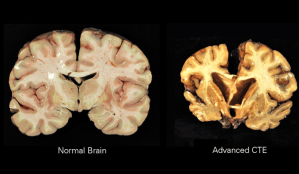
Human brain suffering from chronic traumatic encephalopathy compared to a normal, healthy brain. Used by permission, Boston University Research: CTE Center.

Borich would never go on to play professional football, although the chances were there for the Utah star. Instead, Borich would go on to join the Army Reserve, being stationed in California, before becoming a Police Officer for Salt Lake County, according to the Deseret News on Dec. 3, 2000.

While Borich never played football beyond the college level, the sport continued to be a staple in the Borich household. Borich’s son, Mike Borich, would go on to play for Snow College before working as an assistant coach for BYU and eventually the NFL’s Chicago Bears, according to ESPN on October 22, 2009. Football was life for much of the Borich family until it took the life of one of them.

According to Mike Borich’s obituary, the eldest of Joe Borich’s two sons died on Feb. 9, 2009, at his home in Midvale, Utah, at the age of 42. Much like Joe Borich would be one of the first receivers to find success in the game of college football, his son Mike’s death would prove to be a groundbreaking occurrence for the sport.

Eight months following the death of Mike Borich, ESPN reported that the Boston University School of Medicine had found signs of Chronic Traumatic Encephalopathy (CTE) in the brain of Mike Borich. It was the first time that CTE had been found in a player who did not play beyond the college football level. According to the Boston University CTE Research Center, “(CTE) is a progressive degenerative disease of the brain found in people with a history of repetitive brain trauma (often athletes), including symptomatic concussions as well as asymptomatic subconcussive hits to the head that do not cause symptoms. CTE has been known to affect boxers since the 1920s. In recent years, reports have been published of neuropathologically confirmed CTE found in other athletes, including football and hockey players (playing and retired), as well as in military veterans who have a history of repetitive brain trauma.”

brain2

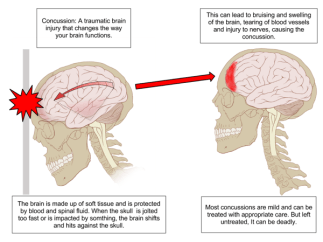
Concussions are serious brain injury suffered when the skull is jolted or impacted by a hard surface. The brain shifts, slamming against the skull, causing damage and swelling to the brain. Concussions can lead to chronic traumatic encephalopathy. Used by permission, Max Andrews.

Mike Borich’s death led to increased awareness of CTE and the effects that it can have on those who suffer from it. But while his death was just the start of CTE awareness in sports, it was the end of a struggle for the Borich family. According to the Denver Post, Joe Borich found relief in the CTE diagnosis in his son as it provided some answers for Mike’s peculiar behavior and subsequent drug addiction in the years leading to his death.

Joe Borich was an accomplished athlete and someone who gave a large portion of his young life to the game of football. But while football gave Borich so much in his life, it has also taken away a large part of it. He once was a groundbreaking athlete, finding success on the football field in ways that were decades ahead of his time. But it may be a groundbreaking occurrence in his life off of the field that has a more lasting impact on his life and the life of others who take part in the sport of football. As researchers and doctors continue to study CTE and look for ways to negate the effects that head trauma can have on a person, Borich recognized the significance of his son’s death and the positive impact it can have.

Recently CTE was discovered in 110 of 111 brains of former professional football players, according to  The New York Times, July 25, 2017, and it is believed that at least 9.6% of NFL players will suffer from CTE, according to a recent study (Binney and Bachynski). Joe Borich recognized that the death of his son could provide knowledge about the disease and increase awareness about the dangers of CTE. “If this study can help somehow progress the knowledge, it’s worth it,” he said (Denver Post).

Hunter Miller is a senior at the University of Utah majoring in communication. Hunter is also a reporter for ESPN 960 covering BYU Athletics.

Primary Sources

“Athletic Borich leads by example,” The Deseret News, December 3, 2000.

Joe Borich,” Ute Stats.

“Degenerative disease found in donated brain of former college player,” Denver Post, May 6, 2016.

“Player’s brain shows signs of CTE,” ESPN, October 22, 2009.

Frequently Asked Questions About CTE,” Boston University Research: CTE Center.

Mike Joe Borich,” Legacy.com, February 11, 2009.

“110 N.F.L. Brains,” The New York Times, July 25, 2017.

Zachary O. Binney and Kathleen E. Bachynski, “Estimating the prevalence at death of CTE neuropathology among professional football players,” Neurology 92, no. 1 (January 1, 2019).

Joe Borich,” SportsReference.com.

2018 College Football Year Summary,” SportsReference.com.


Dr. Ewart Swinyard and his Contribution to Pharmaceutical Progress in Universities

By Bryce Merrill

Ewart A. Swinyard was born January 3, 1909, in Logan, Utah. Later in life he was a student, professor and dean of the College of Pharmacy at the University of Utah. He taught the students about advances made in the field of pharmaceutical research and founded the U’s school of Alcoholism and Drugs. He was constantly looking at the future of pharmacology and felt the need to instill that urgency in students of the field as well. He died on July 10, 1997.

swinyard

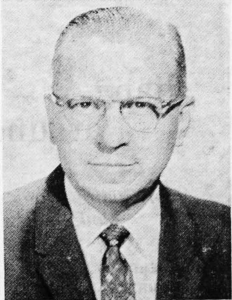
Dr. Ewart A. Swinyard in 1961. He delivered a lecture around this time about the future of pharmacology on campus. From The Daily Utah Chronicle, October 20, 1961.

Swinyard had a degree in zoology from Utah State University and later received a degree in pharmacology from the University of Utah, Idaho State University, and the University of Minnesota each. (The Deseret News) The Provo Sunday Herald reported that he was one of the first people to get a graduate degree from the University of Utah in 1947. The Vernal Express noted that he even received an honorary doctorate from Utah State University in 1983 in the university’s 90th commencement.

Swinyard was interested in all advances in the pharmaceutical field he stated in an address on the University of Utah Campus in 1961. He said he hoped that expenditures in drug research would increase which would indicate more progress was being made in the field. (The Daily Utah Chronicle) He also discussed methods used to discover new drugs. The methods he discussed were; accidents, specifically designed chemical structures, and screening of new drugs, as reported by the Chronicle before his talk on October 19, 1961.

In a speech Swinyard gave in 1977 titled “Research and Graduate Education in Pharmacy: Looking Back – Looking Forward” he expressed his concern with the state of the contributions of universities and colleges to progress in the field. He emphasized that “tomorrow … is being made today” to point out that if the university did not focus on educating students better and increasing its contribution to science it could be left behind in the future. (Ewart Anslie Swinyard Papers, Box 8, Folder 1)

swinyard2

Dr. Swinyard running an experiment on a mouse while researching a cure for epilepsy in 1967. From The Daily Utah Chronicle, May 9, 1967.

One of the focuses of Swinyard’s work was finding a cure for seizures and epilepsy. The Salt Lake Telegram, on August 13, 1949, reported he was part of a team doing research on epilepsy. Another article, again in The Daily Utah Chronicle on May 9, 1967, states that Dr. Swinyard had “been investigating convulsive disorders for 20 years.” His research involving mice was cited by Dr. David L. Hiner, the then dean of the School of Pharmacy, as getting “health sciences … closer to the solution of the control of epileptic seizures than ever before.”

Eighteen years later The Daily Utah Chronicle published an article about Swinyard’s continued research on curing epilepsy. At that time, he was the director of the Antiepileptic Drug Development Laboratory in the U’s College of Pharmacy. He said the “NIH (National Institute of Health) decided to start a program of their own” when it found out no pharmaceutical firm was actively working on an anti-epileptic drug.

Dr. Ewart A. Swinyard’s contributions as the dean and founder of the University of Utah’s College of Pharmacy helped shape the school’s future thanks to his forward-thinking attitude. (The Deseret News) Dr. Swinyard was an important part of the university’s past, present, and future due to his foresight and focus. His constant commitment to furthering not just the school’s place in its field but to developing life changing drugs to help others, Dr. Swinyard’s presence is felt by all those who have benefited from the School of Pharmacy, be they student or teacher.

Bryce Merrill is a senior at the University of Utah. He is majoring in strategic communication and minoring in sociology.

Primary Sources

900 Students Get Diplomas,” Provo Sunday Herald, June 15, 1947, 5.

DeVan Shumway, “Physician Sees Possibility Of Cure for Epilepsy,” Salt Lake Telegram, August 13, 1949, 10.

Elaine Krans, “Dr. Ewart Swinyard Set Lecture On ‘Drugs From Laboratory To Man,’” The Daily Utah Chronicle, October 19, 1961, 1.

Swinyard Cites Progress In Pharmacy Research,” The Daily Utah Chronicle, October 20, 1961, 1.

Epileptic Control,” The Daily Utah Chronicle, May 9, 1967, 5.

Researchers test mice for cure of seizures,” The Daily Utah Chronicle, September 30, 1985, 13.

USU Graduates Listed for 1983,” Vernal Express, May 25, 1983, 20.

Funeral set for Ewart A. Swinyard,” Deseret News, July 14, 1997.

Secondary Source

Swinyard, Ewart Anslie. The Ewart Anslie Swinyard Papers, 1945-1987. Box 8, Folder 1, Special Collections, J. Willard Marriott Library, The University of Utah.

Gregory Crampton: U of U Professor Who Conducted Archaeological Research on Glen Canyon

By Seungwon Na

Glen Canyon, located in southeastern Utah and northern Arizona, is now a popular tourist site where millions of people visit each year to enjoy the beautiful scenery and nature: Lake Powell and the tributaries of the Colorado River. However, while tourists relish their excursion to Glen Canyon, they are not fully aware of the efforts that were put by many scholars and researchers to maintain its historical values and beauty. In fact, there is a prominent researcher whose study on Glen Canyon must be recognized: Dr. C. Gregory Crampton.

C_Gregory_Crampton-1

Dr. C. Gregory Crampton was a prominent researcher who conducted research on Glen Canyon to record its history before the construction of the dam. He died in 1995. Used by permission, Utah State Historical Society.

Before Dr. Crampton joined the history faculty of University of Utah in 1945, he was already a renowned scholar for his study in Latin American countries. The Daily Utah Chronicle described the professor on November 7, 1961, as a member of “Phi Kappa Phi, scholastic honorary, and Phi Alpha Theta, national honorary society in history.” However, it was after moving to the University of Utah when he started to focus on his research in Glen Canyon. Since 1957, Dr. Crampton started to work for the National Park Service. According to a 1961 Daily Utah Chronicle article, as construction of Glen Canyon dam was expected to be completed by 1963, Dr. Crampton had to “salvage archeological, geological, and historical values in the area” before then. However, within the short amount of time, Dr. Crampton succeeded in unveiling Glen Canyon’s historical background and recording its original land formation.

The first task Dr. Crampton had was to identify the missing history of Glen Canyon before A.D 1300. Through careful excavations, he found out that the first dwellers in Glen Canyon were the Anasazi, so called ancient ones. (Ghosts of Glen Canyon, p. 1) Dr. Crampton asserted they settled in Glen Canyon around the 10th century A.D. and relied on farming and hunting for their livings. In his 1986 book Ghosts of Glen Canyon, there is a evidence of “prehistoric petroglyphs located near Hite in upper Glen Canyon.” (p.1) After staying temporarily in Glen Canyon, Dr. Crampton presumed Anasazis left the region due to a sustained drought or the appearance of hostile nomads. (Ghosts of Glen Canyon, p. 2)

Soon after analyzing the first prehistoric men to land in Glen Canyon, Dr. Crampton moved on to study people who visited Glen Canyon later. He discovered that in 1776, Spaniards Dominguez and Escalante arrived in Glen Canyon. Dr. Crampton claimed they were the first white men to land in Glen Canyon. On the Southern part of the Glen Canyon, Paiute Indians fought to preserve their territory against Navajo Indians. (Ghosts of Glen Canyon, p. 3) He also found out that during 1821-1848, Glen Canyon was used as a trade route between New Mexico and California.

Glen_Canyon_dam_and_bridge-1

Lake Powell, a reservoir on the Colorado River, was created after the construction of Glen Canyon dam in 1963. Used by permission, Special Collections, J. Willard Marriott Library, The University of Utah.

Nevertheless, this was not an end to the discovery of Glen Canyon’s history. His 1986 book Ghosts of Glen Canyon tells us that in May 24, 1869, John Wesley Powell, “an American explorer and civil war veteran,” (p.7) visited the place to complete the missing portion of the map. In September 1883, the Cass Hite’s findings of gold in the region attracted many prospectors and many Mormon explorers and fur trappers visited the place. (Ghosts of Glen Canyon, p. 9)

After finishing his research about Glen Canyon, Dr. Crampton published his book Standing up Country: The Canyon Lands of Utah and Arizona in 1964. The reaction from the public was sensational as he was a pioneer to fully investigate the history of Glen Canyon and publish it as a book. The professor was also proud that he “[preserved] the history of the flooded area for future use.” (“Dr. Crampton Reviews”) According to a 1965 Daily Utah Chronicle article, in 1964, the Western Heritage Awards Commitee acknowledged his achievements and awarded him the Outstanding Western Non-fiction Book of the Year.

Dr. Crampton continued his teaching at the University of Utah and visited numerous institutions in the United States to lecture about his findings in Glen Canyon. After tremendously contributing to Utah history, he died in 1995. His students and professional associates described him as a professor with “intellectual acuteness and integrity.” (Peterson, 4) Although Dr. Crampton is not alive, his effort and dedication to inform people about Glen Canyon will be forever remembered and appreciated.

Seungwon Na is a senior at the University of Utah. He is studying communication with an emphasis in journalism.

Primary Sources

 Dr. Crampton to Tell of Glen Canyon,” Daily Utah Chronicle, October 27, 1958, 3.

Dr. Crampton to Speak on Glen Canyon History,” Daily Utah Chronicle, November 7, 1961, 1.

Dr. Crampton Reviews Chapter of Utah History,” Daily Utah Chronicle, November 8, 1961, 1.

Ex History Honorary Chief to Address Ute Students,” Daily Utah Chronicle, January 10, 1962, 3.

Dr. Crampton to Lecture Tuesday,” Daily Utah Chronicle, July 18, 1963, 1.

Canyon Country is the Subject of Beautiful New Illustrated History,” Times Independent, November 5, 1964, 10.

U of U Prof Writes History of 4-Corner ‘Standing Up Country,’” Beaver County News, November 19, 1964, 1.

Professor’s Book Lauded,” Daily Utah Chronicle, May 18, 1965, 5.

Secondary Sources

Crampton, C. Gregory. Standing Up Country: The Canyon Lands of Utah and Arizona. New York: Knopf, 1964.

Crampton, C. Gregory. Ghosts of Glen Canyon: History Beneath Lake Powell. Salt Lake City, Utah: Bonneville Books, 1986.

Peterson, Charles S. “In Memoriam: C. Gregory Crampton, 1911-95,” Utah Historical Quarterly 63, no.4 (Fall 1995): 2-6.


A Journey Through the First Three Season’s of Ray Nagel’s Career

By Sammy Mora

CoachNagelImage2-1


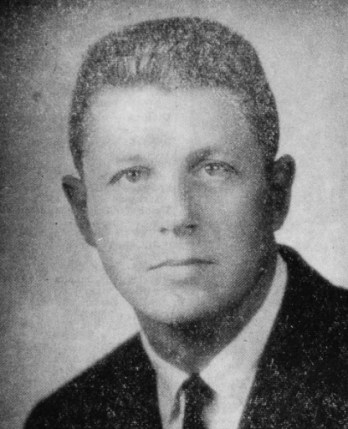
Ray Nagel was the University of Utah head football coach from 1958-1965. Photo courtesy of The Daily Utah Chronicle.

Ray Nagel was the head football coach of the University of Utah football team from 1958-1965. During his time at Utah, his record was 42-39-1. (Ray Nagel Coaching Record) He led his team to an appearance in the 1964 Liberty Bowl to take on West Virginia, which was iconic in its own right. The Liberty Bowl was one of the major postseason games that year, but also it was the first ever college football game played inside. That year’s game was played inside the Atlantic City Convention Center. (Miller) The Utes won the game against West Virginia 32-6.

That year was the best year Nagel had during his time at Utah, not only did he win the Liberty Bowl, his team was named the Western Athletic Conference (WAC) football champion that season. Nagel was also named the WAC Coach of the Year in 1964. (Blevin, p. 144)

Nagel was hired as the new head coach of the University of Utah football team in January 1958. Before he was hired by Utah, he was an assistant football coach at his alma mater, UCLA. (Pearson) The University President, A. Ray Olpin, told the Salt Lake Tribune when Nagel was named the head coach that “in Nagel the University is getting the most outstanding young coach in the nation. He has wonderful background as a player and coach and comes to us with the highest of recommendations from such men as Red Sanders, Bud Wilkinson and Tom Prothro.” Sanders, Wilkinson and Prothro were all coworkers while Nagel was at UCLA. According to the Daily Utah Chronicle, at the time he was hired, Nagel was the second youngest coach to spearhead the university football team. The only coach who was younger than Nagel at the time he was hired was the great Ike Armstrong. (West)

CoachNagelImage

University of Utah head football coach Ray Nagel stands next to a statue on the campus of the University of Utah where he was the head football coach from 1958-1965. Photo courtesy of The Daily Utah Chronicle.

While his first season at the helm of Utah football was not ideal, finishing the season 4-7, from that moment his record as the head coach went up. In his second season he finished 5-5, his third 7-3. His best season happened during his seventh year at Utah when he went 9-2 and earned a Liberty Bowl berth.

According to the Daily Utah Chronicle, even in his first year as the head coach the team wanted to make him proud and look good. According to Walt Deland, who was a trainer on the team, “I heard some players talking and Pete Haun said, ‘I’ve never seen any man that I would rather model my life after than Ray Nagel.’” Haun was one of many players whom Nagel coached during his time at Utah.

Not only was Nagel a powerhouse on the field, he was also involved in activities around the university. He spoke multiple times at the student union. A reporter for the Daily Utah Chronicle on April 9, 1958, said that Nagel’s speech focused on defensive topics and how he would implement a tough defense to try and make the U football team harder to play against making it so fans would come out and support the team.

Not only was he known for his speaking on campus, he also penned an article for the Daily Utah Chronicle that same season. That season the team finished with a 4-7 record and while it looked as if there were lots of lows Nagel talked about the positive saying, “Our last three games are a good indication of the team’s progress. We lost to Colorado, 7-0, despite the fact that we dominated the game in all but one important aspect­—the score. Then we defeated Utah State, 12- and Hawaii, 47-20.”

From the 1958 season on, Nagel’s squads proved to be resilient opponents, winning more games in Nagel’s second and third season than in his first season as the head coach.

During the 1961 season, Nagel was named the United Press International (UPI) coach of the week after his team upset Colorado 21-12, in a game the Utes were expected to lose. That season even after facing powerhouse teams like Oregon, Wisconsin, Arizona State and the previously mentioned Buffaloes, the team finished with 6 wins and 3 losses.

Without Nagel’s contribution to Utah football, the team might not have made the jump from the Skyline Conference to the WAC, and then from the WAC to the Mountain West and in 2011 joining the Pac-12. He was a key piece of Utah football history, as well as college football in general. He also helped other schools not only as a coach but  as an athletic director to help make the jump and make their football teams and athletic departments better.

Sammy Mora is a junior at the University of Utah. She is a communication major whose focus is journalism. She is a sports management minor. 

Primary Sources

Vince Pearson, “Newest Ute? Coach Nagel!” Daily Utah Chronicle, January 1, 1958, 1.

Dee Chipman, “New Ute Grid Mentor Has His Problems,” Desert News, January 31, 1958.

“University Coach Youthful, Qualified,” Salt Lake Times, February 7, 1958, 3.

“Nagel Speaks in Union,” Daily Utah Chronicle, April 9, 1958, 4.

Bob Beers, “Coach Ray Nagel Inspires Ute Players,” Daily Utah Chronicle, November 4, 1958, 4.

Ray Nagel, “Coach Nagel Sums up Concluded Grid Season,” Daily Utah Chronicle, December 12, 1958, 8.

John West, “Nagel is Second Youngest Coach in U Grid History,” Daily Utah Chronicle, October 22, 1959, 4.

“Ute Coach Selected UPI ‘Coach of Week’,” Daily Utah Chronicle, November 16, 1961, 4.

“Coach, Tackle Receive Honors,” Daily Utah Chronicle, December 7, 1964, 3.

Reece Stein, “New Grid Mentor in S.L. for Talks,” Daily Utah Chronicle, January 5, 1966 4.

Bruce Miller, “Utah Coaches are ‘Winners’,” Daily Utah Chronicle, November 3, 1967, 12.

Secondary Sources

Blevins, Dave. College Football Awards: All National and Conference Winners Through 2010. Jefferson, North Carolina: McFarland & Co., 2012.

Miller, D.A. “#8: 1964 Liberty Bowl—Utah vs. West Virginia,” The Greatest Utah Football Games Ever, blog.

Ray Nagel,” Sports Reference.


A World With Walls: The Creation of the Berlin Wall

By Ivana Martinez

Barriers have existed for centuries either to protect or to keep people out. They have served as historical landmarks, such as the Great Wall of China, Belfast Peace Walls, or in this instance the Berlin Wall. The Berlin Wall was erected on August 13, 1961, as a result of conflicting ideologies between the East and West sides of Germany. (Fishman, p. 364) It later came to symbolize the Iron Curtain during the Cold War.

Berlin_Wall_Three Men

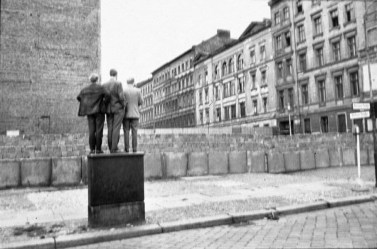
Three men stand on a post looking out at the Berlin Wall. Photograph by Henri Cartier-Bresson. Image is in the public domain.

In the aftermath of World War II two ideologies circulated Germany. Fishman wrote in History of Education Quarterly that the German Democratic Republic (GDR) was created in the Soviet Occupation Zone in October 1949. According to Fishman, the creation of the German Democratic Republic “was a response to the founding of the Federal Republic of Germany, i.e. West Germany, five months earlier.” (Fishman, p. 364) The escalating tensions between these two ideologies erupted in the creation of the Berlin Wall, which was an attempt to halt immigration fleeing to the West on behalf of the German Democratic Republic. On August 27, 1961, the New York Times described the Wall from a helicopter view as “an unhealthy vein on a man’s arm.”

In the early stages of building the wall it was reported to be 25 miles long and strung with barbed wire. Once completed, according to Barksdale, the wall spread 96 miles long through the countryside and only 27 miles within Berlin. The New York Times reported on August 27, 1961, that the wall was mostly “dirty red-grey color with white splotches where Masons dropped mortar on the pavement.” The New York Times also observed that same day that “the Brandenburg Gate, once the chief crossing point between East and West, is deserted now behind its barbed wire fences.”

Closing of Border by Steffen Rehm

Closing of the border between the East and West sides of Berlin photographed at the Brandenburg Gate. The author of the photograph is Steffen Rehm. Image is in the public domain.

The impact of the wall was felt in all sections of life: work, relationships, and travel. The Berlin Wall separated families and halted almost all immediate immigration to the West. Violent confrontations between civilians and the police quickly gathered the attention of the world. The crisis in Berlin reached the crevices of local communities. The confrontations were featured in front-pages articles in local newspapers in the Provo Daily Herald and the Daily Utah Chronicle.

Local coverage in Utah focused on the tensions between these two polarizing sides in Germany and the responses from prominent leaders. For example, the Provo Sunday Herald reported on October 1, 1961, that communist police had strung barbed wire around Stienstueeken an isolated village and that, “In Berlin, East German refugees yesterday sought liberty or death in a grim game of ‘hide-and-seek’ with Communist border guards under orders to shoot to prevent them from escaping to the West.”

A few days later, the Provo Daily Herald reported on October 5, 1961, that there were two separate incidents that involved police gun fire at the border of the wall that same day. Fleming wrote about the first incident “Communist police first-fired [sic] four machine pistol shots today at a West Berlin electric worker laying a cable along the border when he wandered about the one yard into East Berlin.” The second incident involved an exchange of 40 shots. Fleming reported that occurred when, “Communist police began throwing rocks at a West Berlin police loudspeaker truck near the border area.”

Much of these violent exchanges prompted political leaders to speak out on these incidents. Mayor Willy Brandt of West Berlin had warned the Communist “to stop the shooting.” (Goldsmith) After a visit to the United States Brandt had a meeting with President John Kennedy via telephone. The Daily Utah Chronicle on October 10, 1961, reported on Brandt’s statement, “Rarely has the U.S. government committed itself so irrevocably than to the freedom of West Berlin.”

The Allies kept a close eye on Berlin watching these violent exchanges. The Provo Daily Herald observed on October 9, 1961, “There appeared to be differences among the Western powers as to the wisdom of continuing to probe for a soft spot in the Russian demands which call for abandonment of the Allied position in Berlin.”

The Berlin Wall illustrated an escalation of tension in a polarizing time in history. The wall obstructed the free flow of immigration and caused many East Germans to “plot their escapes and occasionally die in the trying.” (Newsom) These tensions are still seen today. The barriers still exist, except it’s no longer in a foreign land. The United States border has caused a similar polarizing tension between nations and citizens. Many immigrants have died in the Rio Grande attempting to flee to the United States or died of dehydration in the desert. Although the Berlin Wall has since been torn down, we still live in a divided world filled with walls.

Ivana Martinez is a junior at The University of Utah. She is majoring in communication with an emphasis in journalism.

Primary Sources

Joseph E. Fleming, “Reds String Barbed Wire Around Isolated Village,” Provo Sunday Herald, October 1, 1961, 1.

Joseph E. Fleming, “Gunfire on Border Stirs Crisis in Berlin; Mayor Brandt Heads for U.S.,” Provo Daily Herald, October 5, 1961, 1.

Phil Newsom,“Story of Human Tragedy Seen in Berlin,” Provo Daily Herald, October 5, 1961, 12.

Steward Hensley, “U.S., Allies Study Move In Berlin,Provo Daily Herald, October 9, 1961, 1.

Joseph E. Fleming, “Brandt Warns Against Concessions; Mayor Says U.S. Firm on Berlin,” Provo Daily Herald, October 9, 1961, 1.

Michael Goldsmith, “W. Berlin Mayor Brandt Warns Soviets:‘Stop The Shooting,’” Daily Utah Chronicle, October 10, 1961, 1.

Joseph E. Fleming,“Allies Say Red Mobilization In East Germany Grave Threat,Provo Daily Herald, October 10, 1961, 1.

Secondary Sources

Barksdale, Nate. “How long was the Berlin Wall?” History.com, September 1, 2018.

“Berlin Wall Built,” History.com, August 13, 2019.

Fishman, Sterling. “The Berlin Wall,” History of Education Quarterly 22, no. 3 (1982): 363-70.

Berlin Wall,” Encyclopædia Britannica, November 29, 2019.

“The Wall Marks Blotch in Berlin: Red’s 25-Mile Slash Across City Viewed From the Air,” The New York Times, August 27, 1961, 8.